
How to Write Cold Emails That Get Replies in 2026
The core elements of a successful cold email in 2026 can be distilled into a precise, non-linear formula: hyper-targeted, intent-based outreach sent through fully authenticated infrastructure, featuring a subject line of four to seven words, an email body strictly under 80 words, and a multi-channel follow-up sequence 1234. The era of high-volume, automated "spray and pray" outreach is entirely defunct 1567. Today, success relies on referencing specific buying signals, prioritizing list quality over volume, and ensuring technical compliance with stringent inbox provider mandates 358.
For the freelance graphic designer pitching a creative director, the job seeker attempting to bypass an algorithmic Applicant Tracking System (ATS), or the small business owner scaling lead generation, these core elements represent an everyday reality. The same filters that guard Fortune 500 executives also guard local agency owners 2910. Reaching a decision-maker directly now requires treating an email address not as a free marketing broadcast channel, but as a heavily defended, highly regulated asset 36. The strategic implementation of these elements dictates whether an email generates a lucrative partnership or damages the sender's domain reputation beyond repair.
Is Cold Emailing Dead in 2026, or Just Evolving?
The narrative that cold email is a dying medium is contradicted by current return-on-investment data, which demonstrates that intent-based cold email can yield a 4,200% ROI, generating approximately $42 for every dollar spent 1. However, the baseline metrics for engagement have undergone a severe compression, revealing a growing chasm between sophisticated operators and legacy senders 101112. To calibrate the true state of the industry, it is necessary to cross-reference data published by sales platforms - which often highlight best-case scenarios to market their software - with independent surveys and operator self-reports from 2024 through 2026.
According to platform-wide benchmark reports analyzing billions of interactions across 2025 and 2026, the overall average reply rate for cold email has plummeted to a mere 3.43% 41315. This represents a significant decline from historical averages, which hovered around 8.5% in 2019 and 5.1% in 2024 1213. The typical conversion rate to a closed deal sits between 0.2% and 2%, meaning an operator may need to contact 500 to 1,000 prospects to secure a single transaction depending on their sales cycle 1316. However, independent data from operator communities, such as Hacker News self-reports and independent consulting surveys, suggests the floor is even lower for generic sends, with Software-as-a-Service (SaaS) founders and enterprise targeting teams reporting baseline reply rates between 0.1% and 2% 11. This independent data corrects the inherent bias of platform vendors, underscoring that the 3.43% average includes the highly optimized campaigns of top-tier users 11.
Conversely, independent surveys and top-quartile platform data reveal that the highest-performing campaigns consistently exceed 10% reply rates, with deeply personalized, signal-based campaigns achieving 15% to 25% response rates 51013.
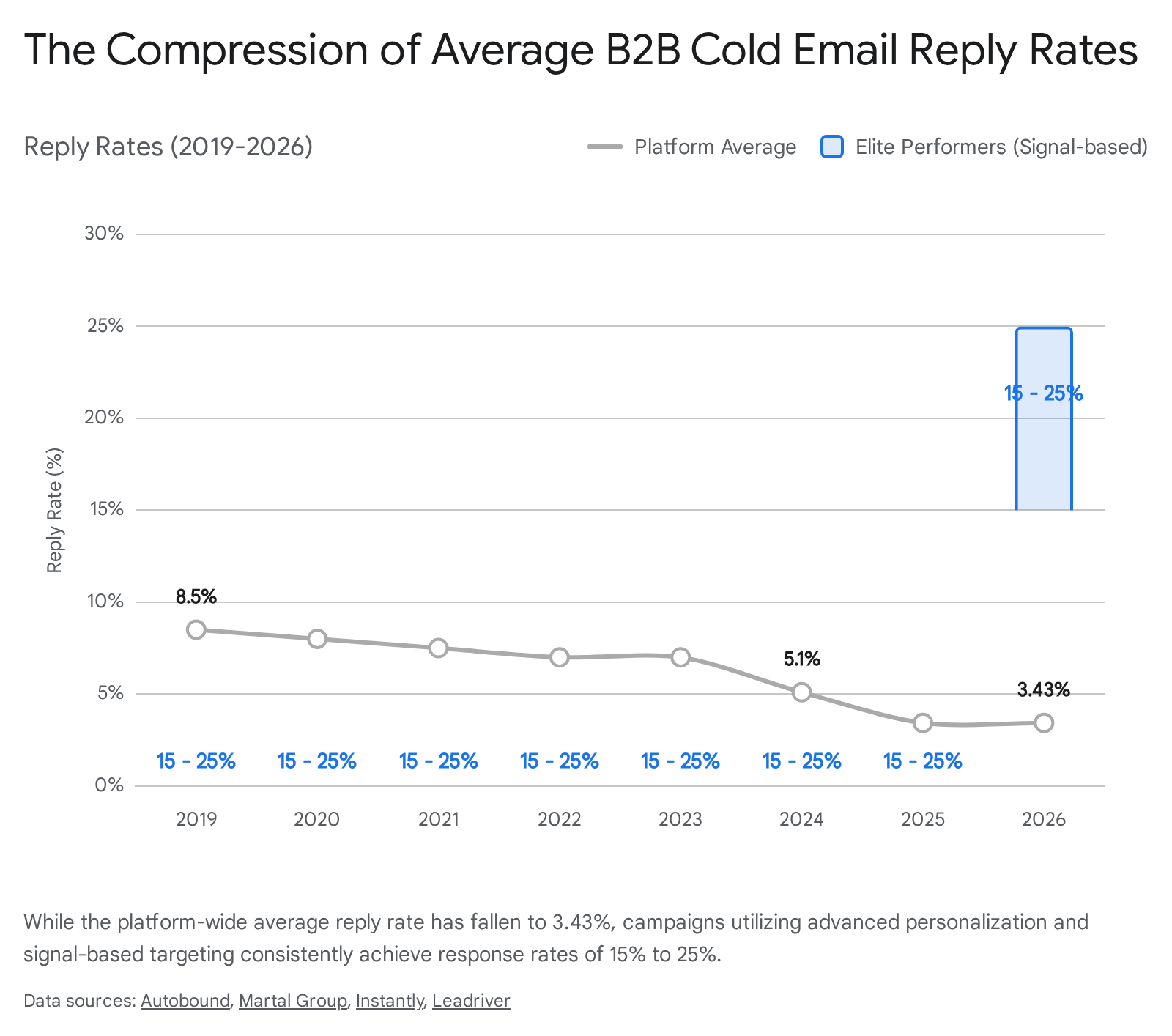
This discrepancy highlights a structural shift in the medium. The decline in average reply rates is not merely a product of recipient fatigue; it is a mathematical function of inbox saturation and aggressive algorithmic filtering 1113. Approximately 17% of all cold emails sent in 2026 vanish entirely, failing to reach the inbox due to bounces, authentication failures, or silent spam routing 1315. The old arithmetic playbook - sending more volume to yield more replies - actively triggers these filters, creating a paradox where increasing volume degrades overall pipeline health 511.
The utility of the open rate as a reliable performance metric has also fundamentally deteriorated. While average open rates are reported between 27.7% and 44.2%, these figures are heavily inflated by technologies such as Apple's Mail Privacy Protection (MPP), which automatically pre-loads tracking pixels for users 12131514. Consequently, modern outreach teams have abandoned the open rate as a primary key performance indicator. Leading operators now rely almost exclusively on the reply rate - specifically the "positive reply rate" - and the meeting-booked rate to evaluate campaign health 3151519. Tracking these downstream metrics ensures that teams are optimizing for actual human engagement rather than algorithmic anomalies.
The baseline compression is further clarified when examining industry-specific variances. Data aggregated from 2025 and 2026 reveals that while Legal Services achieves roughly a 10% average reply rate and Healthcare yields between 4% and 6%, the highly saturated Software-as-a-Service (SaaS) and Technology sectors languish at 1.8% to 3.5% 101113. For a B2B SaaS organization, a 3.5% reply rate indicates robust execution, whereas the same metric in executive recruitment would indicate severe underperformance 1020.
| B2B Cold Email Benchmarks by Industry (2025 - 2026) | Average Open Rate | Average Reply Rate | Inbox Saturation Level |
|---|---|---|---|
| Legal Services | 38% - 42% | ~10% | Low to Moderate |
| Healthcare / MedTech | 28% - 32% | 4% - 6% | Moderate |
| Manufacturing | 26% - 30% | 4% - 5% | Moderate |
| Cybersecurity | 25% - 29% | 3% - 5% | High |
| Financial Services | 30% - 35% | 3.4% | High |
| SaaS / Software | 47.1% (Heavily MPP inflated) | 1.8% - 3.5% | Very High |
| Consumer Goods | 19.3% | <2% | Moderate to High |
(Data consolidated from independent vendor analyses and benchmark reports 101113. Note: Open rates across all industries remain highly subject to Apple MPP inflation.)
How Do Google, Yahoo, and Microsoft's Sender Rules Impact Inbox Placement?
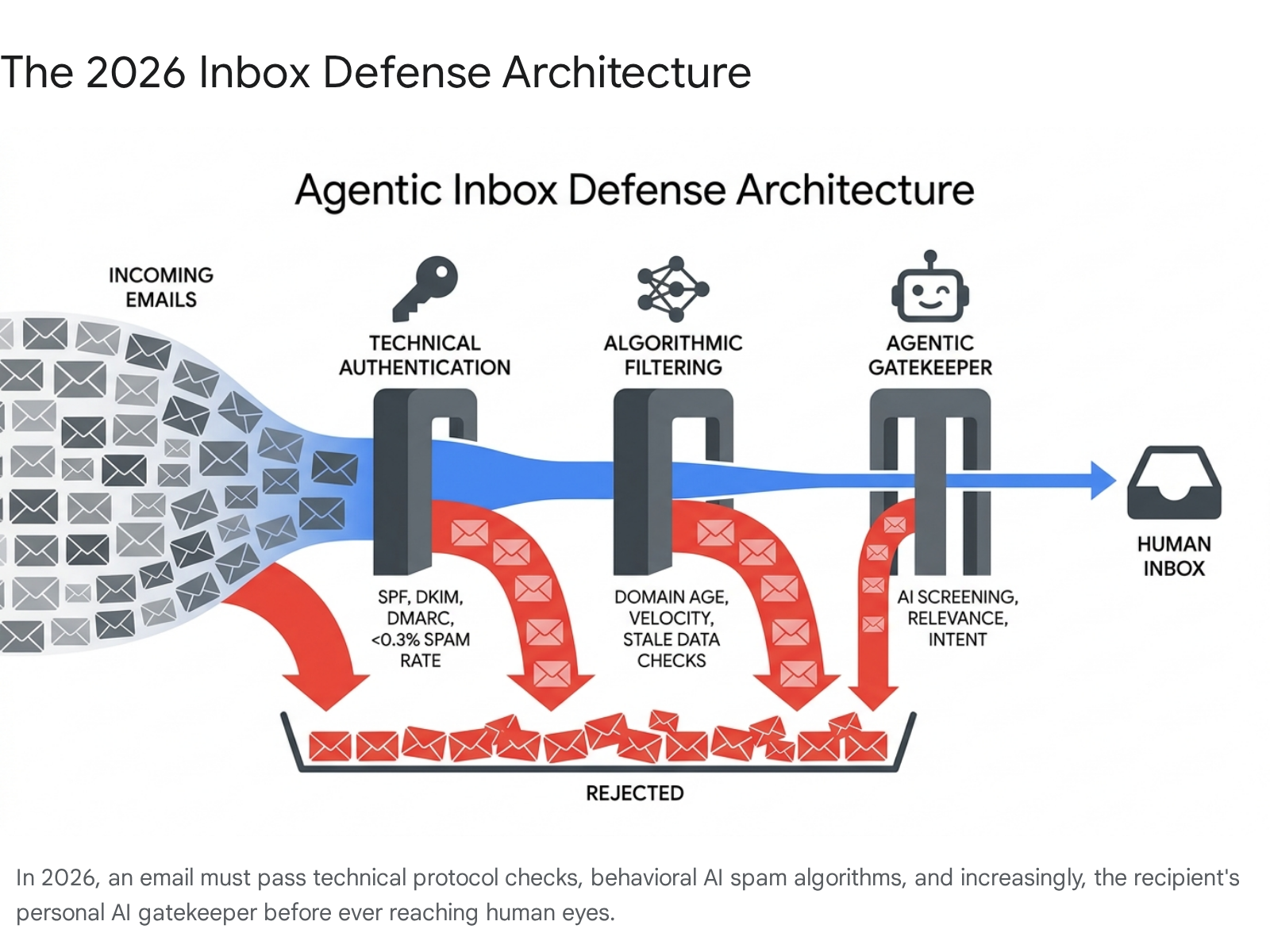
The most profound shift in the outreach landscape occurred not due to changing buyer psychology, but through technical mandates enforced by the world's largest inbox providers. In October 2023, Google and Yahoo jointly announced stringent, non-negotiable requirements for bulk senders - defined as any entity transmitting 5,000 or more messages per day to personal accounts - which officially took effect in February 2024 8161718. By May 2025, Microsoft followed suit with similar restrictions for its Outlook, Hotmail, and Live.com consumer domains, and by late 2025, temporary delays were escalated to permanent rejections across all major providers 16182419.
These rules fundamentally transitioned essential technical protocols from recommended best practices to absolute prerequisites for inbox placement. First, the trinity of email authentication - Sender Policy Framework (SPF), DomainKeys Identified Mail (DKIM), and Domain-based Message Authentication, Reporting, and Conformance (DMARC) - became mandatory 716171824. Previously, many self-hosted operators deployed SPF and DKIM but ignored DMARC due to the operational complexities of managing aggregate reports. In 2026, failing to align the SPF From-domain or the DKIM signing domain with the visible 'From' header results in silent routing to the spam folder or outright rejection by the receiving server 17. A common technical failure occurs when a business routes emails through a third-party Customer Relationship Management (CRM) platform that signs the DKIM with the CRM's domain rather than the sender's visible domain. This misalignment causes DMARC failure, triggering a permanent 5xx rejection code 817.
Second, the mandates established a hard mathematical ceiling on spam complaints. Senders must maintain a spam complaint rate below 0.3% at all times, with Google strongly recommending remaining under 0.1% to guarantee reliable inbox placement 13161718. This threshold is uniquely unforgiving for low-volume, highly targeted senders; a campaign transmitting 10,000 emails requires only 30 recipients to click the "Report Spam" button to trigger automated domain demotion 1618.
Third, promotional and bulk communications are now required to feature a functional, one-click unsubscribe mechanism in the message header. This requirement enforces RFC 8058 standards, demanding that the unsubscribe URL accept a single POST request and process it immediately without requiring the user to navigate a confirmation page, log into a portal, or solve a CAPTCHA 16171826. The culmination of these rules means that an organization's deliverability infrastructure is the binding constraint on their entire revenue pipeline. A sophisticated artificial intelligence agent capable of generating 5,000 highly qualified leads per week is rendered entirely useless if the underlying sending stack only successfully places 200 emails into primary inboxes 15.
How Are AI-Driven Spam Filters and "Agentic" Buyers Changing Outreach?
Beyond static technical rule enforcement, the nature of spam filtering has evolved through advanced machine learning and the rapid proliferation of artificial intelligence. Traditional spam filters operated on linear pattern recognition, flagging specific "spam words" (e.g., "Free," "Urgent," "Act Now"), excessive punctuation, or broken HTML structures 619. Modern inbox defenses in 2026 operate non-linearly, evaluating the holistic sender reputation, traffic velocity, domain age, and the real-time behavioral engagement of the recipient 192028.
Major providers actively penalize senders for utilizing "stale data." An operator repeatedly attempting to contact defunct, expired, or abandoned mailboxes incurs a severe domain reputation penalty, as AI models interpret high bounce rates as a definitive signature of unmanaged, automated spam operations 62930. Data that has not been verified within the last 30 days carries a significant risk of encountering "abandoned account traps" - inboxes deliberately monitored by Google and Microsoft to identify negligent bulk senders 630. This dynamic makes real-time intent searching, live ping validation, and strict list hygiene mandatory for survival 62930.
The recipient environment has also fundamentally altered, creating what industry analysts refer to as the "Agentic Buyer." Buyers in 2026 are increasingly employing their own AI agents to screen incoming communications, summarize lengthy text, and research vendors autonomously prior to any human interaction 6282122. Forrester data indicates that 61% of purchase influencers now utilize private generative AI engines to support their purchasing decisions 21. Similarly, Gartner reports that 67% of B2B buyers state they prefer a completely rep-free experience, relying on AI tools for self-guided validation 22.
Because an AI gatekeeper frequently intercepts the initial message, traditional persuasive copywriting loses its efficacy if the core proposition lacks specific, verifiable data 615. An email designed to bypass an agentic filter must function not as an emotive sales pitch, but as a high-value data transmission that points the buyer's AI toward trust-building, authoritative content, such as a technical whitepaper, a peer-reviewed case study, or a proprietary data set 62122.
What Are the Most Common Misconceptions About Subject Lines, Email Length, and AI Personalization?
The tactical execution of cold outreach is plagued by outdated advice. Practices that successfully gamed algorithms in 2019 are now the exact triggers that guarantee banishment to the spam folder in 2026. Understanding the psychological and technical mechanisms behind these failures is critical for modernizing outreach playbooks.
The Misconception of the "Trick" Subject Line
A pervasive myth suggests that subject lines should leverage clickbait, false urgency, or feigned familiarity to artificially inflate open rates. Tactics such as prepending "Re:" or "Fwd:" to simulate an ongoing thread, or sending vague notes like "Quick question...", are heavily penalized by both algorithms and human recipients 3192033. Major inbox providers, including Yahoo's Sender Hub and Google's Workspace algorithms, explicitly prohibit subject lines that open with fake prefixes unless the message is an actual reply 19. These systems actively scan message headers for legitimate In-Reply-To and References tracking data. A message sporting a "Re:" prefix without the corresponding cryptographic proof of a prior thread immediately signals manipulative intent, downgrading how filters score all future mail from that domain 19.
Empirical data proves that the highest-converting subject lines are brief, contextual, and devoid of hype 11933. The optimal length is strictly between 30 and 50 characters, translating to roughly four to seven words 13423. This brevity is dictated by the physical constraints of mobile device screens, which account for 68% of initial email triage and truncate subjects after 33 to 35 characters 3436. Effective subject lines utilize an "information gap" - a psychological principle where the brain perceives a void between what it knows and what it wants to know 37. However, this curiosity gap must be anchored in specific relevance - such as "[Company Name] + [Sender Company]" or referencing a verifiable recent achievement - proving to the recipient within three seconds that the sender possesses contextual awareness 13337. Furthermore, personalized subject lines that reference the recipient's company or a specific initiative increase response rates by approximately 30.5% 2338.
The Misconception of the "Comprehensive" Pitch
Senders frequently and mistakenly believe that a cold email must comprehensively explain their product's features, value propositions, and background history, leading to paragraphs of dense text. Statistical analysis of tens of millions of emails concludes unequivocally that brevity directly correlates with positive response 151423.
Emails containing between 50 and 125 words capture roughly 50% of all positive replies, with the elite tier of performers maintaining messages strictly under 80 words 1341023. Short emails averaging a half-paragraph in length, with sentences kept under 10 words, consistently out-convert longer messages 14. The structure must be intensely focused: a problem-centric opening that proves research, a single sentence demonstrating value or social proof, and a low-friction, binary Call-To-Action (CTA) such as "Are you open to learning more?" rather than demanding a specific 30-minute calendar slot 134. Furthermore, messages stripped of attachments, heavy graphic materials, and multiple hyperlinks perform substantially better in both deliverability and response metrics, as heavy payloads trigger spam heuristics 14.
The Misconception of "Basic" AI Personalization
While 73% of decision-makers assert that personalization matters, the definition of what constitutes "personalization" has escalated dramatically 1436. The basic insertion of a {{first_name}} and {{company_name}} token is now recognized by buyers as mass automation, yielding reply rates of less than 1% 13363924.
Generative AI has democratized personalization, making it trivial to produce unique opening lines at scale. However, senders who rely solely on raw AI outputs without human oversight suffer from four distinct failure modes that sophisticated buyers and journalists reject on sight: 1. Generic Openers: Starting an email with "I hope this finds you well" or "I saw your article and was impressed" acts as a binary spam signal, proving the AI lacked specific contextual data 31520. 2. Perfect Grammar Devoid of Personality: AI-generated text often appears suspiciously uniform, lacking the conversational rhythm, idiosyncratic word choices, or recognizable voice of a human colleague 15. 3. Bland Insights: Generating statements like "AI is transforming the marketing industry" provides zero value. True personalization requires citing specific, proprietary numbers or data points 15. 4. Promotional Masquerading: AI systems trained on commercial copywriting datasets often produce marketing-heavy prose that fails to sound like a genuine 1-to-1 professional communication 15.
True personalization in 2026 operates on a tiered system. "Tier 0" (name only) yields 1-3% replies. "Tier 1" (name, company, industry tag) yields minor uplifts but risks spam flags. "Tier 2" personalization - which involves deep research into a prospect's recent professional activity, company news, or specific pain points - can lift reply rates to between 10% and 15% 16153924. The time cost for a human to perform this deep research manually is roughly 8 to 10 minutes per lead, rendering it difficult to scale effectively 24. Consequently, top-performing organizations use AI not as an autonomous author, but as an aggregation and orchestration assistant, pulling enrichment data from dozens of sources (LinkedIn posts, 10-K filings, press releases) to structure the message, while a human finalizes the tone to ensure authenticity 2124142.
Cold Email vs. LinkedIn: Which Channel Actually Wins in 2026?
A persistent, often polarized debate exists between the efficacy of cold email versus direct outreach on professional networks like LinkedIn. The empirical data reveals that neither channel is universally superior; instead, they possess inverse strengths and weaknesses that must be strategically combined 725262746.
Cold email provides unmatched scalability, absolute control over the distribution infrastructure, and the lowest cost-per-conversation 7252627. Research indicates that cold email campaigns generate leads at roughly $18 to $50 per meeting, making it highly cost-efficient once the infrastructure is built 2547. However, email is plagued by the aforementioned deliverability fragility, where a single poor campaign can burn a domain, and severe inbox fatigue, with average professionals receiving over 120 emails daily 24252747.
Conversely, LinkedIn InMail and direct messaging yield significantly higher per-touch response rates - averaging between 10% and 25%, and occasionally higher for elite campaigns 102526274648. C-suite executives respond 23% more often on social and alternative channels than to email, as the platform bypasses corporate firewalls and traditional gatekeepers 1025. Furthermore, a prospect's LinkedIn profile acts as an immediate trust signal; the recipient can verify the sender's credibility, mutual connections, and professional history before reading the first word 2526. The severe limitation of LinkedIn is its strict volume caps. The platform actively tracks connection acceptance rates, restricting users to roughly 100 connection requests per week to prevent account bans 72526. Additionally, premium InMail credits are highly limited and expensive, making it cost-prohibitive as a primary high-volume channel 2527.
The most successful operators, freelancers, and job seekers in 2026 do not choose between the two. They execute a sequenced, multi-channel approach where the channels cover each other's vulnerabilities: LinkedIn earns the trust, while email scales the communication 2739252646. Data indicates that multi-channel outreach boosts overall engagement by up to 287% and conversions by 300% compared to single-channel campaigns 464849.
The Multi-Channel Job Seeker & Freelancer Playbook
For individuals such as job seekers trying to circumvent the ATS "resume black hole" or freelancers targeting local business owners, a precise cadence is critical 910. Traditional applications often fail because recruiters, overwhelmed by volume, spend seconds scanning profiles, and up to 70% of large companies use software to aggressively filter talent 10. Direct outreach to the hiring manager or department head requires a structured touchpoint model: 1. Day 0: View the target's LinkedIn profile and send a connection request devoid of a pitch to build initial familiarity 2546. 2. Day 2: Send the first cold email. It must be highly researched, referencing a specific keyword, roadmap theme, or recent post by the target, and keeping the request small (e.g., asking for a 5-minute virtual coffee or asking a specific question, not a direct plea for a job or contract) 91025. 3. Day 5: If no reply is received, send a second cold email reinforcing value (e.g., providing a 1-page ramp plan, a relevant code snippet, a portfolio link, or a brief case study demonstrating immediate competence) 1025. 4. Day 8: Follow up via LinkedIn Direct Message (if the initial connection was accepted) with a soft, casual tone referencing the email 25. 5. Day 12: A final "break-up" email designed to trigger a response by gracefully closing the communication loop and lowering the pressure 2546.
Follow-ups are statistically non-negotiable across all personas. While the first email generates 58% of all replies, the subsequent touches capture the remaining 42% 141550. A campaign that stops after a single email abandons nearly half of its potential yield, yet 48% of sales representatives never make a single follow-up attempt 4153850. However, sequences extending beyond four or five emails exhibit steep diminishing returns. Each additional email after step four adds less than 0.3% to the cumulative reply rate while exponentially increasing the risk of generating spam complaints and unsubscribes 143850.
How Do Global Privacy Laws (GDPR, CAN-SPAM, CASL) Dictate Outreach Limits?
Operating a cold email infrastructure without a firm grasp of international privacy law exposes the sender to catastrophic financial penalties 26295152. The regulatory landscape is highly fragmented, and the proliferation of artificial intelligence-generated outreach is accelerating enforcement actions 51. A common mistake is applying domestic legal frameworks to international prospects.
The United States: CAN-SPAM Act In the US, cold email remains legal without prior consent, as the federal CAN-SPAM Act operates on an "opt-out" framework rather than an opt-in model 26295153. Senders can legally initiate contact provided they meet strict transparency requirements: the email must not feature deceptive subject lines or spoofed headers, it must clearly identify the sender, include a valid physical mailing address (a P.O. Box is acceptable), and provide a functional opt-out mechanism that is honored within 10 business days 26295153. Ignorance of these transparency rules is costly; the Federal Trade Commission enforces penalties of up to $51,744 per individual non-compliant email - not per campaign 265152. A single automated blast of 5,000 deceptive emails carries a theoretical financial exposure exceeding $258 million 51.
The European Union: GDPR and the ePrivacy Directive Contrary to widespread belief and common internet myths, the General Data Protection Regulation (GDPR) does not explicitly ban B2B cold email. Under Article 6(1)(f) and Recital 47, the processing of personal data for direct marketing purposes is recognized as a "legitimate interest" 30525354. However, senders must document a Legitimate Interest Assessment (LIA) proving a clear business reason for contacting the individual, demonstrating that the communication is necessary, and ensuring it is highly relevant to the recipient's professional role 26305455. Emailing personal (non-work) addresses under this premise is strictly illegal 54.
The critical, often overlooked layer of European compliance is the ePrivacy Directive (Directive 2002/58/EC), which governs electronic communications specifically and supersedes general GDPR principles where they overlap 3055. Because the directive was implemented differently by each EU member state, outreach legality is highly fragmented across borders 3055. For example, Germany's strict UWG laws practically mandate prior consent (enforced as double opt-in) for nearly all commercial emails, rendering standard cold outreach highly perilous 305556. Conversely, France and the UK (under PECR) are more permissive for B2B outreach directed at corporate subscribers, provided the product relates to their professional capacity, the data source is disclosed, and an easy opt-out is present 26293055. Violations of these EU regulations carry maximum fines of €20 million or 4% of global annual revenue 2651525456. Furthermore, the EU AI Act, taking full effect in August 2026, introduces new transparency mandates requiring senders to explicitly disclose if an AI substantially generated the outreach content, adding a new layer of compliance for automated sequences 1152.
Canada: CASL Canada's Anti-Spam Legislation (CASL) is widely considered among the strictest in the world. It mandates a rigid "opt-in" model requiring either express consent or a highly specific form of implied consent prior to sending any commercial electronic message 26295152. Implied consent is generally limited to an existing business relationship within the past two years, or an email address conspicuously published in a business context without a "no solicitation" disclaimer 5152. Corporate penalties for CASL violations scale up to $10 million CAD, and enforcement is active and aggressive 295152.
What Is the Q216 Metric and How Does It Address Algorithmic Visibility?
When bridging the gap between benchmark data and tactical execution, organizations face the dual challenge of tracking internal sales metrics without incentivizing bad behavior, while simultaneously maintaining external algorithmic authority to survive AI-driven buyer filtering. This operational tension is encapsulated by the "Q216 Methodology" - a conceptual framework emerging from research into how modern sales and marketing units balance internal metrics with external strategy 57582860.
Internally, the Q216 approach questions which metrics a team should broadcast (e.g., meeting booked rates, positive reply rates, pipeline generated) versus which should remain private to management 57. Displaying raw email volume on a public sales leaderboard creates perverse incentives, encouraging representatives to prioritize quantity over quality, ultimately burning domain reputation and triggering spam filters. To manage this, the framework emphasizes rotating high-value contacts and capping the number of times a "champion" or reference can be contacted per quarter, ensuring that the highest-quality leads are not exhausted by volume-driven metrics 57.
Externally, the Q216 framework addresses the "CPQ Citation Threshold," recognizing that if an organization lacks structured algorithmic visibility, agentic buyer AIs will systematically exclude them from recommendations 5860. As buyers increasingly rely on AI to generate shortlists and conduct initial due diligence, traditional SEO and email blasts are insufficient. The CPQ threshold dictates that an AI system requires a high degree of signal confidence to cite a company without hedging 58.
To win in 2026, a sender must engineer consistency across all touchpoints, ensuring that their LinkedIn profile, company website data, Crunchbase profiles, and email outreach present a unified, machine-readable identity 5860. If the prospect's AI assistant cannot verify the sender's industry classification, expertise domains, or corporate entity consistency across platforms, the outreach is flagged as low-authority and discarded during the buyer's automated due diligence phase 658. Therefore, modern outreach is not just about writing a persuasive email; it is about establishing a digital entity architecture that an AI gatekeeper trusts.
What Are the Practical Takeaways and Actionable Outreach Frameworks for 2026?
For small business owners scaling operations, freelancers hunting for contracts, and enterprise sales teams managing pipelines, adapting to this environment requires a complete restructuring of the outbound motion. The comparative tables below translate these broad strategic shifts into explicit, actionable frameworks.
Strategic Paradigm Shift: Volume vs. Personalization
| The High-Volume Automated Approach (Outdated) | The Deeply Personalized Approach (2026 Standard) |
|---|---|
| Philosophy: "It's a numbers game." Send 10,000 emails expecting a 0.5% reply rate. Success is measured by output. | Philosophy: "It's a relevance game." Send 100 heavily researched emails targeting a 15-20% reply rate. Success is measured by outcomes 12. |
| Data Sourcing: Scraping static, unverified databases. Tolerating high bounce rates (>5%) that destroy domain health 650. | Data Sourcing: Signal-based prospecting using live intent (funding rounds, hiring signals, recent LinkedIn activity) 1641. |
Personalization: Basic macro tokens ({{first_name}}, {{company}}) resulting in robotic, easily filtered outputs 1324. |
Personalization: Tier 2/3 deep research. AI is used to orchestrate data and enrich profiles; humans are used to calibrate tone 15392442. |
| Infrastructure: Sending mass blasts from the primary corporate domain, risking core business communications 561. | Infrastructure: Using separate, warmed-up sending domains, strictly authenticated via SPF, DKIM, and DMARC 15061. |
| Volume Limits: Pushing 500+ emails per inbox daily, which mathematically guarantees triggering algorithmic spam filters 11. | Volume Limits: Capping volume at 30-50 emails per mailbox daily, horizontally distributing the load across multiple inboxes 114750. |
Tactical Execution: Writing for the 2026 Inbox
The mechanics of the email copy itself have shifted aggressively away from classic marketing tropes toward hyper-concise, value-driven, peer-to-peer communication.
| Outdated Outreach Tactics | 2026 Best Practices |
|---|---|
| Subject Line: "Re: Our meeting" or "Quick Question!" (Clickbait, deceptive, triggers spam penalties) 3193352. | Subject Line: 4-7 words (30-50 characters). References a specific trigger or mutual connection. No title case, no punctuation hype 1193437. |
| Opening Line: "I hope this email finds you well..." (Signals automated spam immediately to both AI and human readers) 31520. | Opening Line: Problem-centric and researched. "Saw your team is hiring engineers, which usually strains the existing CI/CD pipeline..." 433. |
| Body Copy: 200+ words detailing product features, company history, attachments, and multiple hyperlinks 11014. | Body Copy: 50-80 words maximum. Focuses entirely on the prospect's business context and pain points, not the sender's product 1423. |
| Call To Action (CTA): "Can we jump on a 30-minute call next Tuesday at 2 PM?" (High friction, demands too much time) 20. | Call To Action (CTA): Single, low-friction binary question. "Are you open to seeing how we solved this for [Competitor]?" or "Does this align with your Q3 goals?" 34. |
| Follow-Up Strategy: "Just bubbling this to the top of your inbox." (Adds zero value, creates annoyance) 3. | Follow-Up Strategy: Value-add touches over a 3-to-5-step sequence, utilizing a multi-channel (LinkedIn + Email) approach spaced 3-4 days apart 12561. |
Bottom Line
The cold email channel in 2026 is mathematically tougher, heavily regulated, and actively policed by both stringent technical mandates and advanced artificial intelligence. However, for those willing to abandon the lazy, volume-centric playbooks of the past, it remains one of the most cost-effective and direct mechanisms for revenue generation, client acquisition, and career advancement. Success today demands a paradigm shift: operators must treat deliverability as a rigorous engineering discipline, respect complex global privacy frameworks to avoid devastating financial penalties, and utilize AI not as a ghostwriter for generic copy, but as an intelligence engine to identify the microscopic buying signals that make an email impossible to ignore. Reach out only when you possess specific intent data, keep the message ruthlessly short and value-driven, and seamlessly sequence your efforts across multiple platforms to build trust before you ever ask for a prospect's time.