
B2B cold email outreach and deliverability in 2026
The Macroeconomic Context of Pipeline Generation
The fundamental mechanics of business-to-business (B2B) sales and outbound prospecting have undergone a rapid, structural transformation. In a macroeconomic environment characterized by heightened scrutiny over procurement, expanded buying committees, and extended deal cycles, pipeline generation has emerged as a critical vulnerability for corporate growth. Research analyzing revenue engagement benchmarks reveals that pipeline generation is consistently identified by 55% of revenue leaders as their primary impediment to growth, an issue compounded by the reality that median quota achievement for Account Executives (AEs) languishes at approximately 50% 123. By 2026, this operational pressure has only intensified. As organizations attempt to insulate themselves from market volatility, an increasing dependency on existing customer expansion has taken hold. Because the cost of acquiring net-new customer revenue is estimated to be two to three times higher than the cost of expanding existing accounts, the efficacy of traditional outbound channels - particularly cold email - has been subjected to intense executive scrutiny 12.
The narrative that "cold email is dead" frequently surfaces within sales technology discourse, but empirical data contradicts this assertion. Rather than dying, cold email has matured from a volume-based copywriting exercise into a highly technical, infrastructure-driven discipline. The barrier to entry has escalated. Decision-makers in reasonable B2B target markets routinely receive thirty to fifty cold emails per week, the vast majority of which fail to resonate due to generic messaging or fail to deliver altogether due to algorithmic filtering 45. Senders who rely on legacy tactics without proper technical foundations suffer from chronic deliverability failures. Conversely, organizations that adapt to advanced behavioral filtering, strict authentication protocols, and intent-based targeting continue to generate highly reliable pipeline yields 5.
Simultaneously, the behavioral dynamics of the modern B2B buyer are shifting the purpose of outbound engagement. According to recent market analysis, 67% of B2B buyers now explicitly state a preference for a "rep-free" experience, choosing to navigate critical buying tasks autonomously 45. Furthermore, 45% of buyers report utilizing artificial intelligence (AI) agents and conversational search tools during recent purchasing cycles to conduct independent research, aggregate options, and shape solution requirements without engaging early-stage sales development representatives 45. In this environment of autonomous discovery, the role of cold email is less about basic education and more about highly targeted, signal-based interception that provides immediate value clarity to an audience already saturated with AI-generated information.
Core Deliverability Benchmarks and Performance Dispersions
The evaluation of cold email efficacy has moved away from top-of-funnel vanity metrics toward downstream engagement signals and infrastructure health. Deliverability in 2026 represents a bifurcated landscape: organizations with optimized technical setups achieve high placement rates, while those neglecting domain infrastructure face insurmountable algorithmic penalties that silently suppress their outreach.
Global Inbox Placement and Provider Nuances
Following the enforcement of bulk sender guidelines by major inbox service providers (ISPs) like Google and Yahoo in early 2024, the baseline for deliverability has stabilized for compliant senders, but overall placement rates reflect a challenging ecosystem. In 2026, the cross-industry median inbox placement rate sits between 83.1% and 89%, depending on the measurement index 89. The global average inbox placement experienced a slight decline from 84.8% in 2023 to 83.5% in 2024 before flattening, a trend primarily dragged down by commercial senders who fail to authenticate domains or execute routine list hygiene 8. Effectively, between 11% and 17% of all legitimate commercial email never reaches the primary inbox 896.
Inbox placement rates vary significantly by provider, heavily influenced by each platform's proprietary algorithms and filtering stringency. Senders must benchmark their campaigns against the specific providers dominating their target market, rather than relying solely on global averages.
| Mailbox Provider | Estimated Inbox Placement Rate (2026) | Algorithmic Characteristics |
|---|---|---|
| Google Workspace (Gmail) | 87.2% | High reliance on behavioral engagement and domain reputation. Enforces a strict 0.3% maximum spam complaint threshold 11. |
| Yahoo / AOL | 86.0% - 87.3% | Rapidly penalizes inactive accounts and unauthenticated bulk senders. Closes inactive accounts after 12 months, creating hard bounce risks 1112. |
| Apple Mail (iCloud) | 82.0% | Benefiting from a "halo effect" as senders upgrade overall practices to comply with Google and Microsoft standards 12. |
| Microsoft 365 (Outlook) | 75.6% - 77.4% | Maintains the highest filtering stringency. Places heavy reliance on IP reputation, domain history, and strict text-to-link ratios 81112. |
The Unreliability of Open Rates
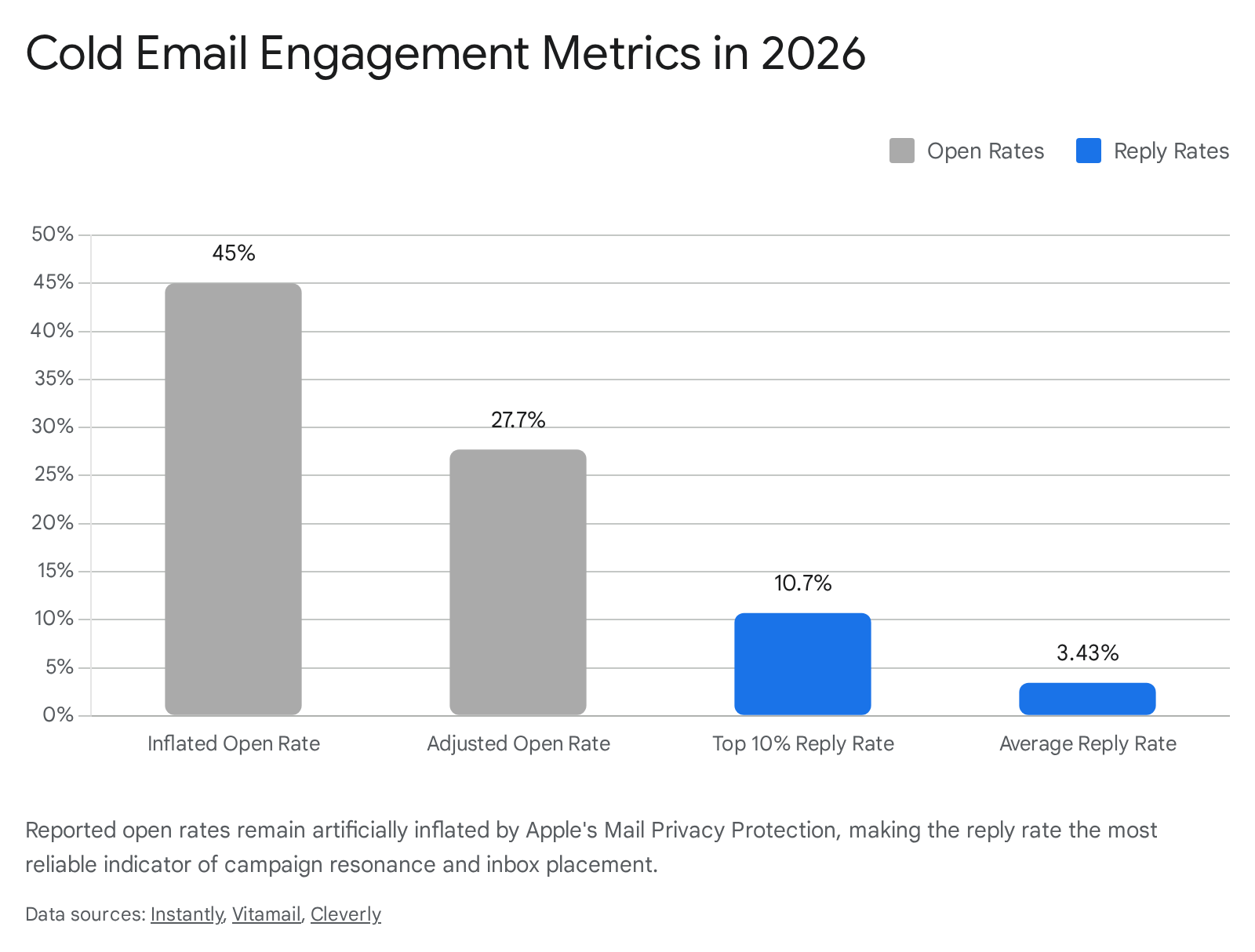
The utility of the open rate as a primary performance indicator has effectively collapsed, rendering historical comparisons misleading. The widespread adoption of Apple's Mail Privacy Protection (MPP), which pre-loads tracking pixels to obscure user activity, artificially inflates open rates across the industry. In 2026, Apple Mail accounts for approximately 49% of all tracked opens 13. Consequently, while the actual, non-inflated average cold email open rate is approximately 27.7%, many platforms report blended rates exceeding 40% to 45% due to MPP distortion 111314. Deliverability analysts strongly advise treating open rates merely as directional indicators of basic inbox placement rather than concrete measures of human engagement or campaign resonance.
Reply Rates and Downstream Conversion
With open rates compromised, reply rates have emerged as the definitive metric for cold email performance. Reply rates represent genuine two-way engagement and remain entirely immune to pixel distortion. Between 2019 and 2026, the average response rate experienced a historical decline, dropping from roughly 8.5% down to approximately 3.43% across all platform-wide senders 1415. However, this average encompasses massive volumes of poorly targeted, unauthenticated spam.
Top-tier senders achieve significantly higher yields. Elite performers - representing the top 10% of tracked campaigns - consistently generate reply rates of 10.7% or higher, which is two to three times the global average 15.
This disparity is driven almost entirely by infrastructure hygiene, micro-segmentation, and signal-based targeting rather than superficial copywriting alterations. Furthermore, sequence length and timing play a critical role in conversion. Approximately 58% of all replies are generated from the very first step in a campaign, while the remaining 42% are captured through persistent, spaced follow-ups. Analysis suggests optimal cadences rest between four to seven touches, with diminishing or negative returns manifesting if persistence turns into harassment 1315.
At the bottom of the funnel, the raw conversion rate from a cold send to a booked meeting or active deal ranges widely from 0.2% to 2%, with the industry median hovering around 0.7% 13. This equates to roughly one pipeline opportunity per 142 emails sent for an average campaign. However, elite campaigns utilizing multichannel cadences that combine email, LinkedIn social selling, and telephony can outperform email-only sequences by up to 287%, pushing meeting booking rates to between 5% and 8% per 100 emails sent 13.
Email Infrastructure and Technical Authentication Requirements
The most profound operational shift in B2B cold email over the past three years is the transition from copy-centric strategies to infrastructure-centric engineering. Deliverability is no longer a passive byproduct of writing a compelling message; it requires proactive architectural management. Senders who attempt to bypass technical configuration find their campaigns shadow-banned by algorithms long before a human prospect can interact with them.
Mandated Authentication Protocols and the Enforcement Gap
In February 2024, Google and Yahoo instituted strict regulatory requirements for bulk senders - defined generally as those transmitting more than 5,000 messages daily to personal accounts, though the algorithmic principles apply to B2B workspaces as well. These mandates, later echoed by Microsoft in updates extending into 2025 and 2026, fundamentally altered the compliance landscape by demanding complete domain authentication using three core protocols 14161718.
The first protocol, the Sender Policy Framework (SPF), validates the origin of an email by checking the sender's IP address against a published list of authorized IPs in the domain's DNS records 17. Second, DomainKeys Identified Mail (DKIM) applies a cryptographic signature to the email header, ensuring the content has not been altered or tampered with in transit 17. Finally, Domain-based Message Authentication, Reporting, and Conformance (DMARC) acts as the enforcement mechanism, dictating exactly how receiving servers should handle messages that fail either SPF or DKIM alignment checks 17. Furthermore, bulk senders must maintain a valid forward and reverse DNS (PTR records) and strictly support one-click unsubscribe functionality via the RFC 8058 List-Unsubscribe-Post header, which is actively monitored by postmaster tools 91619.
Despite these universal mandates, a significant enforcement gap persists across the corporate landscape. In 2026, while nearly 75% of Fortune 500 companies have published a DMARC record, approximately 40% leave their policy at p=none - a passive monitoring state that takes no preventative action against spoofing 9. Only about 35% enforce a strict p=reject policy. Among the broader Inc. 5000, strict policy adoption is even lower, hovering near 15.2% 8. For cold outreach operations, a fully aligned SPF, DKIM, and DMARC setup at a strict enforcement level is a non-negotiable prerequisite; senders lacking these protocols face immediate routing to the spam folder, rendering their campaigns statistically irrelevant 1520.
Shared Versus Dedicated IP Architecture
A critical architectural decision for any outbound team is the selection between shared and dedicated Internet Protocol (IP) addresses. The decision hinges entirely on sending volume and internal technical resourcing, and making the wrong choice frequently leads to burned domains.
| Infrastructure Type | Mechanism | Optimal Use Case | Primary Risk Factor |
|---|---|---|---|
| Shared IP Pool | Senders share an IP address managed by an ESP (e.g., Google Workspace, Microsoft 365). Reputation is a composite of all users in the pool. | Senders generating under 50,000 emails per month without dedicated IT operations 20. | Neighbor Risk: Egregious spamming by another user on the same IP can degrade the collective reputation, throttling deliverability for everyone 7. |
| Dedicated IP | The sender operates exclusively on a proprietary IP address. Reputation is entirely isolated and reflective solely of the sender's behavior. | High-volume senders (150,000+ emails per month) with strict list hygiene and consistent sending cadences 20. | Cold Starts & Inconsistency: Requires a rigorous 4-6 week warmup. Irregular sending patterns will instantly damage a dedicated IP's pristine reputation 207. |
Approximately 85% to 90% of cold email operators utilize shared IP infrastructure, largely because it absorbs administrative complexity and provides pre-warmed reputation baselines 207. It also drastically reduces infrastructure costs, saving operators between $300 and $3,600 annually compared to dedicated setups 20. However, dedicated infrastructure becomes essential for agencies or massive enterprise outbound teams that must isolate client risk and guarantee that their deliverability outcomes are uninfluenced by external actors in a shared pool 722.
Inbox Volume Limits and Domain Warmup Protocols
The brute-force tactic of sending hundreds of cold emails from a single corporate inbox has been entirely deprecated by modern spam filters. In 2026, algorithmic volume monitoring enforces severe, immediate limits. Industry consensus dictates a maximum safe ceiling of 30 to 50 cold emails per inbox, per day 2324. Pushing a single inbox beyond this threshold inevitably triggers automated volume anomaly alerts at major ISPs, resulting in temporary throttling, provider warnings (e.g., "Unusual activity detected"), or permanent domain blacklisting 24826.
To scale volume, organizations must decentralize their infrastructure by adding more inboxes across multiple secondary domains (e.g., utilizing getcompany.com or trycompany.com instead of the primary corporate root domain company.com) 62223. A standard scaling architecture limits concentration to 2 to 3 inboxes per domain, safely generating 75 to 150 emails per domain daily 8.
Furthermore, all newly registered domains must undergo a mandatory warm-up phase to establish sender reputation before transmitting commercial payloads. Warm-up involves gradually ramping up sending volume through automated networks that simulate human interaction - specifically opening, replying, and rescuing emails from spam folders 62627. The standard protocol in 2026 requires waiting 21 to 30 days before initiating active campaigns 8. During Week 1, the volume is strictly limited to 5 automated exchanges per day 6. By Week 3, the volume scales to 10-20 emails per day, allowing for the introduction of very low-volume live outreach 6. Rushing this process or spiking volume by more than 20% in a single day is recognized as the primary cause of campaign failure for new outbound operations, as sudden massive volume spikes trigger spam filters immediately, regardless of the underlying content quality 26.
Decentralization: Multi-ESP Pools and Infrastructure Diversification
As inbox providers tighten their internal routing rules and algorithmic scrutiny, reliance on a single Email Service Provider (ESP) has become a critical point of failure. Organizations managing large-scale outbound operations - particularly those exceeding 50,000 emails monthly - increasingly adopt decentralized, multi-ESP infrastructure pools to mitigate catastrophic deliverability collapses 2829.
Data derived from managing over 833,000 inboxes and 270 million cold emails sent through platforms in Q2 2026 reveals that relying solely on one provider restricts deliverability due to cross-platform suspicion and inherent algorithmic biases 28. When a single platform experiences technical degradation - such as the incident on January 24, 2026, when Gmail's spam checks and inbox labeling degraded for nearly five hours - senders concentrated entirely within that ecosystem experience total workflow paralysis 19.
An optimized, diversified sending stack typically allocates traffic to balance cost, deliverability, and domain risk. Approximately 50% of outbound volume is routed through Microsoft 365 or Outlook tenants, which capitalizes on official Microsoft IP pools that are highly trusted by enterprise Exchange recipients 2829. Another 30% is allocated to Private SMTP networks; these dedicated IPs serve as a highly scalable volume buffer for testing new angles and absorbing volume spikes without risking the core, high-value domains 2829. Finally, 20% of the volume is processed through Google Workspace.
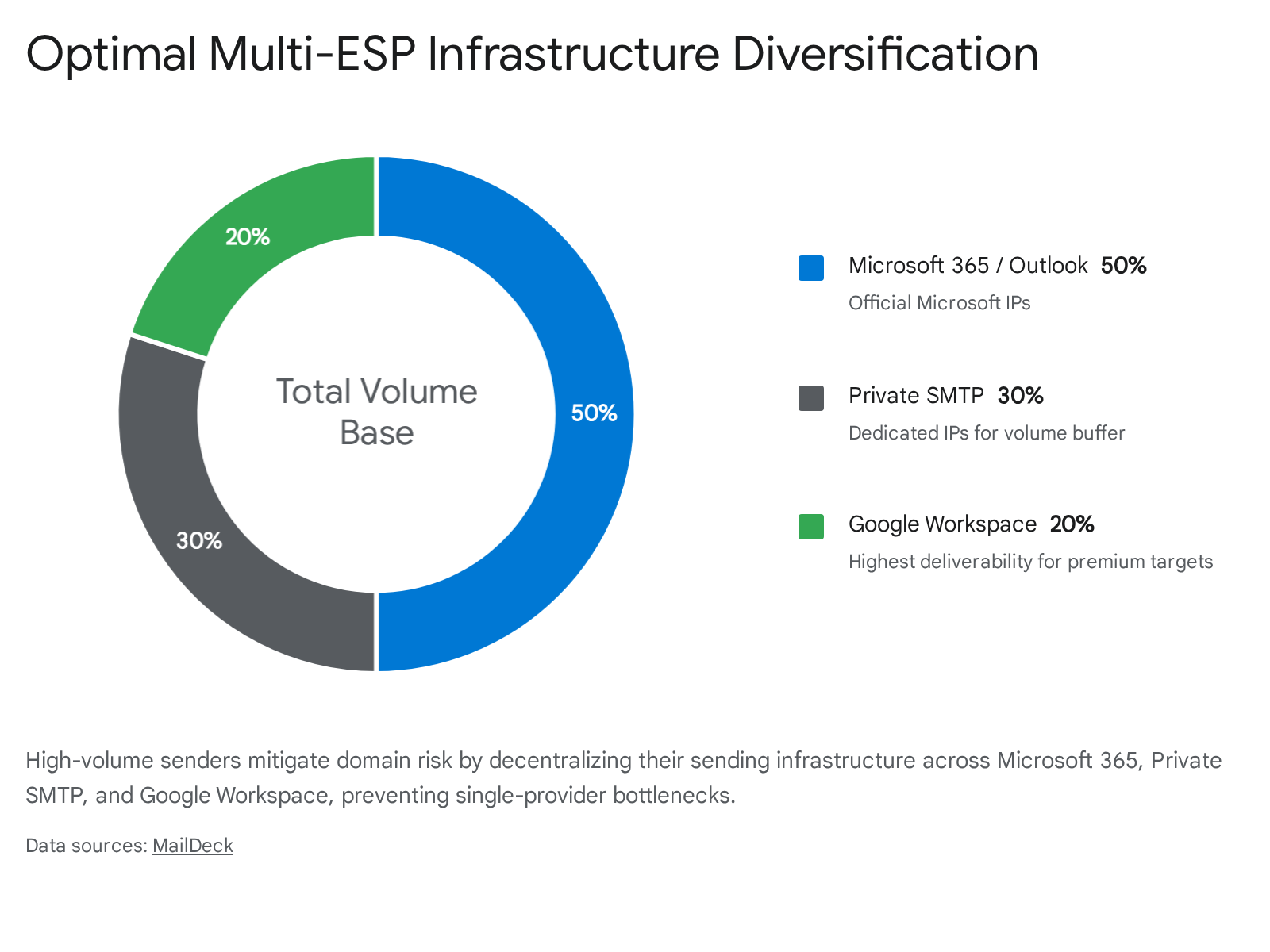
While Google maintains the highest overall deliverability rates, its behavioral filters are highly sensitive, making it best reserved for premium, high-intent targets 2829.
This diversification actively mitigates risk. If Microsoft updates its spam algorithms and temporarily throttles delivery, the Google and SMTP pipelines continue to operate uninterrupted 29. Additionally, modern sending platforms support "ESP matching" - an algorithmic routing feature that pairs a Gmail-sent email specifically to a Gmail recipient, and an Outlook email to an Outlook recipient. By leveraging the natural trust providers place in intra-platform communication, ESP matching has been shown to improve inbox placement by 10% to 16% 2930.
Algorithmic Defenses and Stylometric Spam Filtering
The sudden influx of generative AI has initiated a cybersecurity arms race between outbound marketing professionals and enterprise threat detection systems. Traditional spam filters relied almost exclusively on static rules, keyword blocklists (e.g., flagging capitalized words like "FREE" or "URGENT"), and rudimentary sender reputation scoring. In 2026, these static models are viewed as dangerously obsolete, highly vulnerable to spear-phishing and the grammatically perfect, highly polished text generated by large language models (LLMs) 313233.
Behavioral and Stylometric Analysis by Inbox Providers
To combat a landscape where an estimated 51% of all spam is now AI-generated, Google, Microsoft, and enterprise Secure Email Gateways (SEGs) have pivoted aggressively toward transformer-based behavioral and stylometric filtering 34. Systems such as Google's RETVec (Resilient & Efficient Text Vectorizer) process text as visual patterns rather than individual alphanumeric characters, immunizing the filter against common evasion tactics like character substitution and hidden text 35.
More significantly, modern filters deploy advanced Natural Language Processing (NLP) to conduct deep stylometric analysis. Because LLMs leave a distinct, measurable mathematical signature, modern spam filters analyze over 60 distinct linguistic features to differentiate between organic human writing and machine-generated mimicry 3234. Academic research published in early 2025 and 2026 demonstrates that machine learning models like XGBoost can detect AI-generated phishing and cold emails with 96% accuracy by evaluating highly specific syntactic markers 32.
Key metrics analyzed by these stylometric filters include: * Perplexity: A measure derived from information theory evaluating how "surprised" a language model is by the sequence of words. Lower perplexity indicates highly predictable, statistically average text typical of machine generation 36. * Burstiness: The variance in sentence length and structural complexity. Organic human writers naturally alternate between terse, fragmented observations and complex, multi-clause reflections, creating an uneven cadence. AI output typically exhibits low burstiness, remaining structurally uniform and rhythmically monotonous 36. * Syntactic Density: Filters identify the rhythmic repetition of transitional adverbs (e.g., "furthermore," "moreover"), high clause density, and unusual distributions of imperative verbs and first-person pronouns, all of which strongly correlate with LLM prompting artifacts 3236.
For legitimate B2B senders, this introduces a severe operational risk. Heavily templated, overly polished outbound emails generated purely by tools like ChatGPT run a high risk of triggering these stylometric filters, resulting in silent routing to the spam folder, even if the sender's infrastructure is perfectly authenticated 3435. The most effective countermeasure is intentional human editing that reintroduces natural variance, colloquialisms, and structural burstiness.
Dynamic Engagement and Real-Time ML Feedback Loops
Inbox placement is no longer a binary outcome determined at the gateway; it is a fluid spectrum of visibility managed continuously by AI. In 2026, algorithms monitor recipient engagement over time. If a target audience frequently ignores a sender, AI organizers like Gmail's Gemini-powered categorization features will automatically deprioritize future messages from that domain, clustering them into low-priority views or generating unhelpful, truncated summaries if the opening text lacks specific value 3537.
Furthermore, Microsoft 365 and Google Workspace aggregate behavioral data across their entire global networks. If a critical mass of users drags an email to the junk folder or clicks "Report Spam," real-time machine learning feedback loops update global blocklists within minutes, neutralizing campaigns instantly 34. To survive these dynamic filters, senders must keep their spam complaint rates strictly below the 0.1% threshold and bounce rates under 2% 14161924.
API-based cloud email security platforms like Abnormal Security and Darktrace bypass the traditional Mail Exchanger (MX) gateway entirely. Instead, they connect directly via API to read emails after delivery, using behavioral AI to retroactively pull messages from user inboxes if patterns suddenly correlate with emerging threats 31. This implies that an email's survival is never guaranteed, even post-delivery.
Deliverability Tooling and the "Cosmetic AI" Risk
As defense mechanisms become increasingly complex, go-to-market teams have integrated specialized tooling into their outbound execution to manage scale and protect sender reputation. The technology stack in 2026 separates standard outbound sequencing tools from dedicated, AI-driven infrastructure platforms.
Market leaders in cold email execution, such as Smartlead and Instantly, differentiate themselves by focusing heavily on deliverability protection. Smartlead operates on an infrastructure-heavy model that utilizes "variable volume sending," intentionally randomizing daily send counts to mimic human unpredictability and evade algorithmic pattern detection 3038. It features auto-throttling mechanisms that pull back send rates automatically if Gmail signals rate-limiting, preventing cascading domain damage 3038. Instantly focuses heavily on pool-level warmup and user accessibility, leveraging massive network engagement to lift the reputation of newer domains 3039. Both platforms have popularized flat-fee, unlimited-mailbox pricing models, which removes the financial penalty of per-seat licenses and enables teams to scale horizontally across dozens of secondary domains 39.
However, the proliferation of automated warm-up networks has introduced new risks. The market strictly distinguishes between "cosmetic AI" and "behavioral AI." Tools utilizing cosmetic AI merely use language models to generate random, superficial text for warm-up emails 27. This approach is increasingly dangerous, as stylometric filters easily detect the AI-generated nature of the warm-up network, resulting in deliverability penalties 82627. Conversely, platforms like MailReach and Warmy.io represent the behavioral tier. They adjust warm-up speed dynamically based on the specific domain's age and incoming reputation signals, ensuring that the warm-up volume never triggers velocity-based spam flags 27. Selecting a warm-up tool that utilizes real business inboxes (Google Workspace and Office 365) rather than free consumer accounts is critical for building genuine B2B sender trust 27.
The AI-Triaged Inbox and Buyer Autonomy
The volume of inbound commercial email has spurred a defensive reaction on the recipient side, leading to the rapid adoption of AI-native inbox redesigns. Tools such as Superhuman, Shortwave, SaneBox, and Read AI focus on high-speed triage, automated clustering, and cross-platform context surfacing 40. These agents effectively act as the first line of defense for corporate buyers, meaning that cold emails must pass not only the technical ESP security filter but also the AI executive assistant actively managing and prioritizing the buyer's attention.
If an email's problem statement is generic or the value proposition is buried, these tools will aggressively filter the message or generate a reductive summary that strips away persuasive nuance 3540. Read AI, for example, connects inbox intelligence to broader workflows, surfacing emails based on their relevance to ongoing meetings or documents rather than chronological arrival 40. Getting the right emails into view is increasingly dependent on referencing highly specific, timely signals (such as recent hiring data, funding rounds, or specific software deployments) that an AI assistant recognizes as contextually relevant to the recipient's immediate priorities 2440.
This technological shift parallels the broader behavioral trend predicted by Forrester, wherein B2B buyers suffer from a "trust deficit" due to the unreliability of generative AI. Because 19% of buyers feel less confident in their purchasing decisions due to AI hallucinations, human verification and trusted networks have regained a massive premium 910. In this environment, 75% of enterprise B2B companies are increasing their budgets for influencer relations, recognizing that external subject-matter experts build trust faster than broad brand promises 91011. Cold email remains effective, but only when it serves as a highly precise orchestration tool that leverages these signals, rather than operating as a blunt instrument of mass persuasion.
The Global Regulatory and Compliance Landscape
By 2026, the regulatory landscape governing B2B email outreach has grown intensely fragmented. Legal compliance is no longer viewed merely as a safeguard against regulatory fines orchestrated by corporate counsel; it is deeply and technically intertwined with deliverability. Inbox providers directly align their filtering algorithms and complaint thresholds with regional privacy laws, meaning non-compliant email is structurally treated as spam 12.
North American Frameworks
The United States remains the most permissive global market, regulating cold email under the CAN-SPAM Act. It operates on an "opt-out" framework, meaning prior consent is not legally required for B2B commercial outreach. However, senders must provide accurate header information, a valid physical postal address, non-deceptive subject lines, and a highly functional opt-out mechanism that must be honored within 10 days. Violations are severe, carrying penalties up to $51,744 per email under FTC enforcement 124546.
Conversely, Canada's Anti-Spam Legislation (CASL) represents one of the strictest frameworks globally. It requires prior consent (either express or implied) before sending any commercial electronic message. While implied consent through existing business relationships or conspicuously published corporate email addresses is valid, strict wording requirements and an 18-month expiration rule frequently cause compliance failures. Notably, CASL does not exempt B2B outreach from these stringent rules 124546.
European Union and the United Kingdom
The European Union's General Data Protection Regulation (GDPR) and the United Kingdom's Privacy and Electronic Communications Regulations (PECR) treat corporate B2B addresses with distinct nuance compared to consumer data. While GDPR is highly restrictive globally, B2B cold outreach to professional corporate email addresses is generally permitted under the lawful basis of "legitimate interest." To legally rely on this, the sender must document a legitimate interest assessment (LIA), ensure strict role-based targeting relevance, and provide an immediate, frictionless opt-out mechanism 1246.
Under the UK's PECR, corporate subscribers (registered companies like a Limited or PLC entity) are subject to B2B opt-out rules. However, sole traders and non-incorporated partnerships are legally treated as individual consumers, requiring strict prior opt-in consent 12. Senders targeting the UK must therefore rigorously filter their lists by entity type to avoid severe penalties.
South America and Asia-Pacific Developments
A major regulatory milestone occurred in January 2026 regarding data transfers. The Brazilian Data Protection Agency (ANPD) issued Resolution No. 32, formally recognizing mutual data protection adequacy with the European Union 131415. This adequacy decision functions as a "regulatory passport," permitting the free flow of personal data between Brazil and the EU without requiring complex, restrictive transfer mechanisms like standard contractual clauses 1416. Domestically, Brazil's General Personal Data Protection Law (LGPD) allows B2B outreach under the legitimate interest basis, similar to GDPR, provided strict transparency and data minimization rules are observed 4613.
The Asia-Pacific (APAC) region presents the world's most complex and fragmented privacy landscape, featuring overlapping laws such as China's PIPL, Singapore's PDPA, Japan's APPI, and India's DPDP Act 4517. Australia enforces the notoriously strict Spam Act 2003, which requires express or clearly inferred consent based on an existing relationship and carries massive penalties of up to AU$2.8 million per day 454618. Despite these risks, APAC remains a high-growth target for B2B outreach, boasting average open rates of 47.6% 17. To navigate this, B2B senders must localize data residency, adhere to strict 3-email sequence maximums, and meticulously document opt-in records to avoid both legal fines and immediate blacklisting.
| Region / Country | Primary Regulation | Consent Model for B2B Email | Maximum Notable Penalty |
|---|---|---|---|
| United States | CAN-SPAM | Opt-out (No prior consent needed) | $51,744 per email 124546 |
| Canada | CASL | Opt-in (Express or specific implied) | $10M CAD 4546 |
| European Union | GDPR | Opt-out via Legitimate Interest | €20M or 4% of global revenue 124546 |
| United Kingdom | PECR / UK GDPR | Opt-out (Corporate only); Opt-in for Sole Traders | £500,000 1245 |
| Australia | Spam Act 2003 | Opt-in (Express or inferred) | AU$2.8M per day 4546 |
| Brazil | LGPD | Opt-out via Legitimate Interest | 2% of Brazil revenue 4546 |
Conclusion
The assertion that cold email is an obsolete channel in 2026 is fundamentally incorrect; rather, the operational standard required to execute it profitably has undergone a systemic paradigm shift. The days of relying on massive, unauthenticated blasts characterized by generic copywriting are over, permanently curtailed by the intersection of stringent global data privacy laws and advanced algorithmic filtering mechanisms like stylometric analysis and behavioral tracking.
For modern B2B sales and go-to-market organizations, the success of cold email is now dictated almost entirely by technical infrastructure and data science. Senders who embrace decentralized multi-ESP pools, adhere strictly to SPF, DKIM, and DMARC enforcement, maintain rigorous list hygiene, and respect the algorithmic volume limits of individual inboxes continue to see high inbox placement and scalable pipeline generation. Furthermore, as AI gatekeepers begin to triage recipient inboxes and buyers increasingly demand rep-free, autonomous purchasing experiences, the content of cold outreach must pivot away from broad persuasion. Instead, it must rely on hyper-specific, intent-based signals that offer immediate value clarity. When engineered correctly, cold email remains a resilient and highly effective orchestration tool within a broader, sophisticated revenue generation strategy.