
Cold Email Deliverability and Reply Rates in 2026
The era of high-volume, generic cold email is functionally dead in 2026. Major inbox providers now strictly enforce mandatory authentication protocols (SPF, DKIM, DMARC) alongside aggressive algorithmic engagement thresholds, instantly penalizing senders who exceed spam complaint rates of 0.1% to 0.3%. Consequently, baseline reply rates have stabilized at roughly 3.1% to 3.4%, but top-tier campaigns that leverage micro-segmentation, verified data, and strict deliverability hygiene regularly exceed 10% engagement.
The New Baseline of Email Deliverability
In previous years, email deliverability was treated by sales and marketing professionals as a set of suggested best practices. By 2026, the global ecosystem has finalized its shift to a framework of absolute technical mandates 12. The consequence of non-compliance is the "digital death penalty" - complete rejection of a domain's traffic - which is now automated and executed swiftly for senders who fail to adhere to the stringent rules established by Google, Yahoo, and Microsoft 134.
The Google and Yahoo Framework
The seismic shift in the email deliverability landscape began in February 2024 when Google and Yahoo announced sweeping new requirements targeting bulk senders, traditionally defined as entities sending 5,000 or more emails per day to personal accounts 15. By late 2025 and into early 2026, these initial guidelines escalated from temporary deferrals and sporadic delays to permanent, hard rejections at the server level 52.
To survive in the modern inbox, senders must adhere to several non-negotiable standards that govern sender identity and reputation:
The most aggressive metric enforced by Google and Yahoo is the spam rate threshold. Spam reports must ideally remain below 0.1%, and a hard ceiling exists at 0.3% 15. If a sender exceeds this 0.3% rate - calculated daily based on user reports via tools like Google Postmaster - enforcement and blacklisting begin immediately. Because this metric is calculated relative to total emails delivered, the math is unforgiving; for a business sending 10,000 emails, a mere 30 spam reports will trigger a complete halt to their outreach revenue 152.
Furthermore, full cryptographic and DNS-level authentication is mandatory. This includes a Sender Policy Framework (SPF) which explicitly lists approved IP addresses authorized to send on behalf of the domain, and DomainKeys Identified Mail (DKIM) which provides a cryptographic signature verifying the email was not altered in transit. By 2026, Google highly recommends a DKIM key length of 2048 bits for an adequate security posture 1578. These two protocols are tied together by a Domain-based Message Authentication, Reporting, and Conformance (DMARC) policy. DMARC instructs receiving servers on how to handle emails that fail SPF or DKIM checks. Bulk senders are required to have a minimum DMARC policy of p=none at the apex, though p=quarantine or p=reject is increasingly required for reliable marketing deliverability 179.
Technical infrastructure must also be flawless. Sending IP addresses must feature Forward-Confirmed Reverse DNS (FCrDNS), meaning the IP address has a valid PTR record that resolves back to its hostname 17. Additionally, all commercial or promotional emails must comply with RFC 8058 by including specific List-Unsubscribe and List-Unsubscribe-Post headers. This allows users to opt out instantly via a single click directly within the email client interface, and senders are mandated to honor these POST requests within two days 157.
Microsoft Outlook's Aggressive Algorithmic Shifts
While Google and Yahoo initiated the wave of deliverability mandates, Microsoft finalized its own parallel rules in May 2025, enforcing strict authentication for Outlook.com, Hotmail.com, and Live.com addresses 59. However, in early 2026, Microsoft introduced highly aggressive, machine-learning-based pattern detection that penalizes "low engagement" rather than just relying on active spam complaints, changing the fundamental strategy required for B2B outreach 410.
Microsoft's 2026 updates introduced severe constraints for outbound domains, particularly new ones. The most notable shift is the introduction of an 8% open rate tripwire. Microsoft's machine learning systems actively monitor whether recipients are opening, replying to, or moving emails out of the junk folder. If an outbound sending pattern shows a sustained open rate below 8% over a 72-hour period, the system triggers an automated low-engagement flag for review, even if the domain's spam complaint rate is technically compliant 4.
Additionally, Microsoft halved its acceptable spam complaint threshold from the industry-standard 0.30% down to 0.10%. Anything above this limit triggers an automated account review, and suspensions frequently follow if the rate exceeds 0.15% within a 24-to-48-hour window 4. Microsoft also implemented stringent volume ramps. New domains targeting Microsoft 365 inboxes must be at least 14 days old (up from the 7-day requirement in 2025) before sending their first cold email. Senders must then undergo a strict 30-day ramp-up period where they are restricted to a maximum of 200 emails per day per domain 4.
| Provider | Spam Threshold | DMARC Requirement | Unique 2026 Enforcement Mechanisms |
|---|---|---|---|
| Google / Yahoo | 0.30% (Hard limit), 0.10% (Target) | Required (Minimum p=none) |
Strict enforcement of RFC 8058 One-Click Unsubscribe POST headers 17. |
| Microsoft Outlook | 0.10% (Automated review trigger) | Required (p=quarantine minimum for flagged accounts) |
8% open rate tripwire; 14-day minimum domain age; strict 30-day volume ramp 4. |
The Evolution of AI-Driven Spam Filters
The logic underpinning spam filters has fundamentally transformed to keep pace with the influx of AI-generated outreach. A decade ago, filters relied on static keyword matching - flagging predictable terms like "Winner" or "Free" - and basic Bayesian probability 11. In 2026, this heuristic approach has completely broken down, as AI-generated spam can be written without typos, template fingerprints, or recurring phrases 3.
From Keyword Heuristics to Semantic Intent
To combat sophisticated spam, major providers now utilize Transformer-based language models - the same underlying architecture that powers large language models (LLMs) like ChatGPT - to interpret the semantic intent of an email 1113. A traditional keyword filter might arbitrarily flag the word "Login" as suspicious. However, a modern transformer-based filter can understand the contextual difference between a legitimate request to log in to view a monthly statement and a high-pressure, manipulative demand to log in immediately to secure funds 11.
Furthermore, Google's Resilient & Efficient Text Vectorizer (RETVec) has effectively ended the era of evasion through obfuscation. Rather than reading individual characters, RETVec processes text visually, treating it as a pattern. This renders the system immune to spammers who attempt to use typos, emojis, or character substitutions (leetspeak) to bypass older text-based filters 11.
Behavioral Anomaly Detection and Reputation Scoring
Because LLM-written phishing and spam emails provide almost no structural template fingerprints, detection architectures in 2026 rely heavily on behavioral anomaly detection. Spam filters now establish a precise baseline for individual recipients and organizational senders 313.
Filters analyze communication patterns: whom a user normally emails, the types of requests they receive, and typical sending times. If an outbound sales system sends identical volumes of emails at the exact same time every day (for example, blasting exactly 150 emails at 9:00 AM), machine-learning models immediately flag this as automated behavior 413.
Real-time feedback loops have also been accelerated. Every time a user clicks the "Report Spam" button, they provide labeled training data to a global machine-learning model. In 2026, if a small cluster of users marks a specific campaign as spam within a short window, the AI recognizes the signature and neutralizes the sender globally within minutes, moving detection response times from days to seconds 113. Consequently, spray-and-pray tactics are fundamentally incompatible with modern inbox survival.
2026 Cold Email Reply Rate Benchmarks
With inbox filtering operating at its strictest point in history, the performance gap between mass-blast senders and highly targeted outbound teams has widened into a chasm. Data compiled from over 100 million B2B campaigns across platforms like Instantly, Woodpecker, Saleshandy, and Cleanlist reveals a stark reality about response metrics in 2026 4155.
The Growing Divide Between Elite and Average Campaigns
The overall average cold email reply rate in 2026 sits at approximately 3.1% to 3.43% 4155. This marks a continued, steady decline from historical averages, which hovered around 8.5% in 2019, 7.0% in 2023, and 5.0% in 2025 15. However, this average masks the massive divergence in performance between top-tier and bottom-tier practitioners.
Top-performing "elite" campaigns consistently exceed a 10% to 12% reply rate 45. These campaigns are characterized by extreme precision: micro-segmentation, continuous A/B testing, problem-focused messaging, and impeccable technical controls. In contrast, the bottom 10% of performers struggle to achieve even a 0.5% reply rate 4.
| Performance Tier | Average Reply Rate | Positive Reply Rate | Meeting Booked Rate | Average Bounce Rate |
|---|---|---|---|---|
| Top 10% (Elite) | 8.0% - 12.0%+ | 4.0% - 6.0% | 2.0% - 3.0% | Under 1.5% |
| Top 25% (Quartile) | 5.5%+ | Data Unavailable | Data Unavailable | Data Unavailable |
| Overall Average | 3.1% - 3.43% | 1.4% | 0.7% | 5.1% |
| Bottom 10% | Under 0.5% | 0.2% | 0.1% | 12.0%+ |
Note: Data aggregated from 2026 benchmark reports 45.
It is critical to note that while the average open rate in 2026 is reported at roughly 42% to 44%, this metric is widely considered unreliable. Apple's Mail Privacy Protection (AMPP) automatically caches and pre-loads emails, artificially inflating open rate dashboards. Industry analysts estimate that true open rates are likely 5% to 10% lower than what is displayed in standard tracking software 415.
Furthermore, bounce rate has emerged as the single biggest differentiator between success and failure in 2026. Because of the aggressive new spam rules, sending to unverified, purchased lists often yields bounce rates above 5%, which rapidly degrades a domain's sender reputation. Verified email lists consistently generate up to twice the reply rate of unverified lists, and up to six times the reply rate of purchased lists 417.
Industry Variance and Target Audiences
Reply rates are not uniform across sectors; they vary significantly based on the vertical and the nature of the outreach. Campaigns directed at Human Resources professionals show the highest engagement, boasting reply rates of up to 8.5%, making cold email highly effective for recruiting use cases 4156. Similarly, the legal services sector sees outlier success with response rates touching 10% 619.
Conversely, targeting the tech sector is increasingly difficult. SaaS companies selling to other SaaS companies average a depressed 2.4% reply rate, and the financial services sector struggles with an average of just 1.5% 4. There is also a distinct gap based on company size: campaigns targeting Small and Medium Businesses (SMBs) enjoy a 22-point advantage in open and engagement rates compared to campaigns targeting the enterprise sector, largely due to less stringent corporate firewalls at smaller firms 15.
Sequence Anatomy and Follow-Up Strategies
While persistence pays off, volume is inversely correlated with success in 2026. Highly targeted "micro-campaigns" consisting of 50 recipients or fewer average a 5.8% response rate, whereas mass campaigns exceeding 1,000 recipients see reply rates plummet to 2.1% 1519.
The distribution of replies within an outreach sequence follows a strict decay curve. Approximately 55% to 58% of all replies are generated by the very first email in a sequence 45.
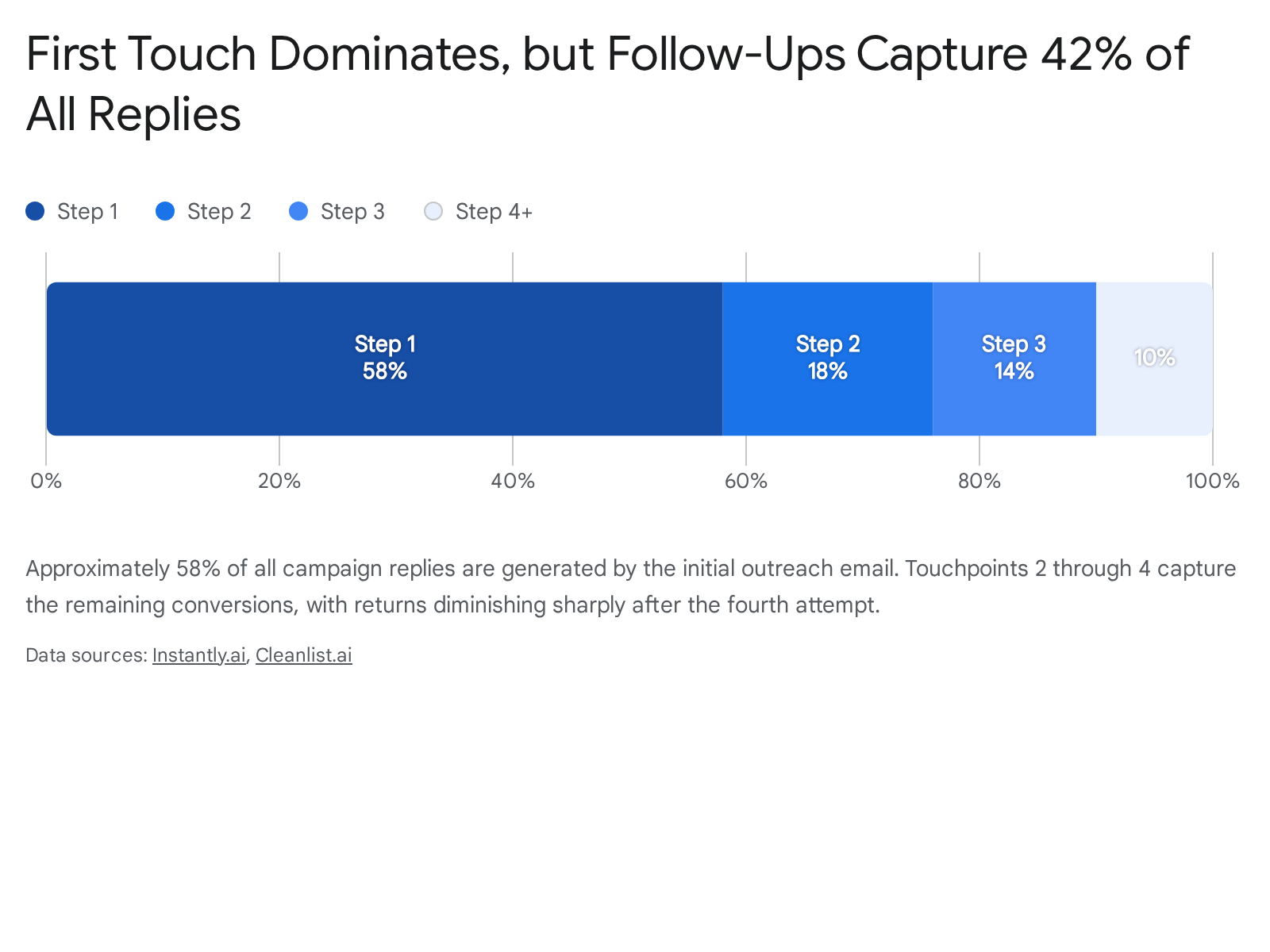
Follow-ups capture the remaining conversions, making them a mathematical necessity. A typical sequence yields a 2.2% reply rate on the first email, 1.8% on the second, and 1.4% on the third 4. However, sending beyond three or four follow-ups yields rapidly diminishing returns. Furthermore, exceeding three follow-ups significantly increases the likelihood of a recipient clicking the "Report Spam" button. Sending a fourth follow-up can push spam complaint rates to 1.6% and unsubscribe rates to 2%, which is highly detrimental to sender reputation and easily violates the strict 0.1% to 0.3% thresholds monitored by Google and Microsoft 456. The consensus "sweet spot" for sequence length in 2026 is 4 to 7 touchpoints, carefully paced over time 5.
Content Variables: AI vs. Human Copywriting
The actual text of the cold email dramatically influences both deliverability and response rates. Message brevity is heavily rewarded; emails kept between 50 and 125 words generate the highest response rates (up to 50% higher than lengthy alternatives), as decision-makers increasingly filter out long, feature-heavy pitches 1519. Subject lines containing 36 to 50 characters represent the ideal length, particularly when they provide specific context 15.
As AI adoption has saturated the market, a fascinating dynamic has emerged regarding AI-generated copy. While 70% of marketers now use AI to draft copy, raw AI output rarely performs optimally. AI-generated copy requires human tone adjustment 90% of the time, and human-edited AI copy performs 2 to 5 times better than raw AI output 20.
Extensive A/B testing throughout 2025 and 2026 reveals a nuanced picture. AI often excels at generating attention-grabbing headlines, achieving up to 11% higher click-through rates in certain tests 21. However, human-written copy consistently outperforms AI in deep persuasion and conversion. Studies evaluating thousands of B2B campaigns found that human copy generated a 3.1% conversion rate compared to 2.5% for pure AI copy, largely due to the human ability to layer psychological triggers, emotion, and industry-specific nuance that AI models tend to genericize 202122. Ultimately, the most successful strategy in 2026 is a hybrid approach: using AI to efficiently generate volume and variations, then utilizing human oversight to refine the narrative and establish emotional resonance 2022724.
The Shrinking Legal Gray Zone: Global Compliance
In 2026, the legal framework governing cold email is actively and aggressively enforced. The rise of AI-generated outreach has prompted regulators globally to crack down on unsolicited commercial email, utilizing advanced tracking to penalize violators 25.
Crucially, compliance is dictated entirely by the recipient's geographic location, not the sender's headquarters 8. A campaign that is perfectly legal in one jurisdiction can result in devastating fines in another.
The Opt-Out Model: United States CAN-SPAM Act
The CAN-SPAM Act (Controlling the Assault of Non-Solicited Pornography And Marketing) establishes the rules for commercial email in the United States. It operates on an opt-out model, meaning senders do not explicitly need prior consent to send a B2B cold email 25891029.
However, the law mandates strict transparency and operational requirements. Every commercial email must clearly identify itself as an advertisement or solicitation, include a valid physical postal address for the sender, and utilize accurate, non-deceptive header and subject line information 2589. Most importantly, it must provide a clear, functional opt-out mechanism, and the sender must honor any unsubscribe request within 10 business days 259.
The penalties for violating CAN-SPAM are severe, carrying fines of up to $51,744 for each individual non-compliant email. A single campaign of 1,000 non-compliant emails could theoretically result in over $51 million in fines 252930. Furthermore, state-level legislation adds additional risk; for example, Washington state's CEMA carries $500 per-email penalties for misleading subject lines 2529.
The Strict Consent Models: GDPR and CASL
In Europe and Canada, the regulatory environment is significantly more restrictive, abandoning the opt-out model entirely in favor of strict prior consent.
The European Union and UK (GDPR and PECR): The General Data Protection Regulation (GDPR) requires organizations to establish a documented "lawful basis" before processing personal data, which includes business email addresses 1725930. While explicit opt-in consent is the gold standard, B2B cold email is often conducted under the legal basis of "legitimate interest" 1725810. To rely on legitimate interest, the outreach must be highly relevant to the recipient's professional role, and the sender must balance their commercial goals against the individual's privacy rights 25810.
GDPR fines operate on a two-tiered system based on the severity of the infraction. Tier one fines (for administrative failures) can reach up to €10 million or 2% of the company's global annual turnover from the preceding financial year. Tier two fines, reserved for severe violations of core data protection principles or unlawful data transfers, cap at an immense €20 million or 4% of global annual turnover, whichever is higher 25301132331213.
Canada (CASL): Canada's Anti-Spam Legislation (CASL) is widely considered one of the strictest email laws globally. It requires explicit or implied consent before sending virtually all commercial electronic messages 17259303614. While express consent (a user actively opting in) is straightforward, B2B senders often rely on implied consent, which is generated by an existing business relationship or the conspicuous publication of an email address relevant to the person's role 172510.
However, CASL's strict duration limits on implied consent trap many businesses. Implied consent based on a business transaction strictly expires after three years. If a company fails to convert that into express consent, they are legally required to suppress those contacts 38. The CRTC, Canada's regulatory body, actively enforces CASL, leveraging Administrative Monetary Penalties (AMPs) of up to $1 million CAD per violation for individuals and $10 million CAD per violation for businesses 25303614383915.
Evolving Enforcement in APAC: Australia and India
As North American and European markets mature, compliance frameworks in the Asia-Pacific region have also hardened, posing new challenges for global outreach campaigns.
Australia (Spam Act 2003): The Australian Spam Act requires either express or inferred consent to send commercial electronic messages 1016. While "inferred consent" makes B2B outreach viable, Australia distinguishes itself with incredibly tight operational turnaround windows: senders must process an unsubscribe request within just 5 working days, making it one of the fastest required response windows in the world 1029.
The Australian Communications and Media Authority (ACMA) has been aggressively punitive in 2025 and 2026. They have issued multimillion-dollar fines to businesses that failed to provide functional opt-outs or sent messages without proper consent. Notable enforcement actions include a $4 million penalty against Tabcorp, a $7.5 million fine against Commonwealth Bank, and numerous high-six-figure fines against telecommunications and betting agencies for missing unsubscribe links and consent failures 1718.
India (DPDP Act 2023): India's Digital Personal Data Protection (DPDP) Act represents a paradigm shift for the region, transitioning from a relatively unregulated environment into a strict, consent-based framework. While the law was passed in 2023 and rules were finalized in late 2025, 2026 serves as the critical implementation year before full regulatory accountability takes effect by May 13, 2027 451920.
The DPDP Act demands that consent be "free, specific, informed, unconditional, and unambiguous." A landmark 2026 Supreme Court of India order further clarified that bundled consent clauses or pre-ticked boxes are legally invalid; every purpose of data collection must be individually consented to 2122. Furthermore, the government is operationalizing a Consent Manager Framework in late 2026, allowing citizens to manage or withdraw their consent across platforms 192021. This legislative shift effectively ends the era of mass bulk marketing blasts in India, forcing businesses to re-engineer their entire data and messaging infrastructure or face staggering penalties that can reach up to ₹250 crore per breach instance 192122.
| Regulatory Framework | Primary Jurisdiction | Consent Model | Key Requirement / Limitation | Maximum Penalty |
|---|---|---|---|---|
| CAN-SPAM Act | United States | Opt-out | Must honor opt-outs within 10 days; requires physical address. | $51,744 per email 25. |
| GDPR | European Union / UK | Opt-in / Legitimate Interest | "Legitimate interest" must be documented for B2B outreach. | €20M or 4% of global turnover 1133. |
| CASL | Canada | Opt-in / Implied Consent | Implied consent strictly expires after a maximum of 3 years. | $10M CAD for businesses 3614. |
| Spam Act 2003 | Australia | Express / Inferred | Extremely fast 5-working-day mandatory unsubscribe window. | Millions (AUD) 1617. |
| DPDP Act | India | Express Opt-in | Specific, unbundled consent required; mass implied outreach invalid. | ₹250 crore per breach 1922. |
Bottom line
Cold email in 2026 remains a powerful growth tool, but it has irreversibly transitioned from a high-volume numbers game into a highly regulated, infrastructure-heavy discipline. Survival in the modern inbox requires flawless technical authentication (SPF, DKIM, DMARC) and strict adherence to algorithms that punish spam complaint rates above 0.1% and open rates below 8%. While the global legal landscape threatens massive financial penalties for reckless blasting, disciplined teams leveraging micro-segmentation, verified data, and human-refined copywriting can still achieve elite reply rates exceeding 10%.