
B2B cold outreach performance on email and LinkedIn in 2026
Executive Summary
The mechanics of business-to-business cold outreach have undergone a fundamental structural transformation by the year 2026. The high-volume, low-relevance methodologies that defined outbound sales motions in the early 2020s have been systematically neutralized by a convergence of advanced algorithmic filtering, stringent regulatory enforcement, and profound shifts in buyer psychology. Outbound sales execution has subsequently fractured into two distinct operational realities: organizations deploying legacy mass-cadence tools that generate negligible returns while actively degrading their technical infrastructure, and organizations utilizing signal-based intelligence to achieve outsized conversion rates.
Data indicates that the absolute volume of outreach capacity has been artificially restricted across major digital channels. Professional networking platforms have implemented dynamic, trust-based throttling mechanisms and drastically reduced bulk messaging allocations 123. Simultaneously, enterprise email providers have shifted from passive spam filtering to the enforcement of strict cryptographic authentication and reputation-based thresholding at the SMTP level, treating unauthenticated bulk mail as an active security threat 456.
Concurrently, B2B buyers exhibit profound "pattern blindness" toward artificial intelligence-generated templates. A sweeping preference for autonomous, representative-free purchasing journeys has emerged, with buying committees increasingly relying on algorithmic agents and digital sales rooms to navigate procurement 789. The empirical mandate for 2026 is clear: relevance, driven by acute behavioral buying signals and governed by strict technical compliance, fundamentally supersedes volume.
Cold Email Engagement Benchmarks
The baseline metrics for cold email performance illustrate a massive discrepancy between top-quartile execution and the broader market average. The statistical landscape proves that while base rates have deteriorated, the ceiling for optimized campaigns remains highly lucrative.
Global Averages and Top Performer Discrepancies
In 2026, the global average reply rate for B2B cold email sits at a historic low of 3.1% to 3.43% 91012. However, this aggregated average masks the reality of a bifurcated market. Top-performing outbound campaigns consistently achieve reply rates of 8% to 12%, while bottom-tier performers - relying on static lists and generic templates - remain suppressed below a 0.5% reply rate 10.
Open rates, traditionally utilized as a primary key performance indicator, average between 27.7% and 42% globally 91011. This metric is universally considered unreliable by data analysts in 2026, as it remains heavily inflated by infrastructure features such as Apple Mail Privacy Protection, which pre-fetches tracking pixels and registers false opens across nearly 50% of the market 9. Consequently, revenue teams evaluate performance through definitive conversion metrics: positive response rates (averaging 1.4% to 2%) and meeting booked rates (averaging 0.7%, though ranging from 0.5% to 2.5% depending on deal complexity) 91011.
Sector Specific Engagement Variations
Averages stripped of industry context offer limited utility for campaign planning. Saturation levels within specific vertical markets dictate baseline expectations, revealing an inverse relationship between sector digitization and response rates.
| Industry Vertical | Average Open Rate | Average Reply Rate | Contextual Analysis |
|---|---|---|---|
| Legal Services | 36.0% - 40.0% | 8.0% - 10.0% | Highest performing vertical. Relies heavily on trust-based procurement and experiences lower overall inbox saturation 912. |
| Manufacturing | 28.0% - 33.0% | 7.0% - 10.0% | Traditional sector exhibiting less digital outreach fatigue, though prone to high bounce risks due to personnel turnover 913. |
| Healthcare & MedTech | 33.0% - 38.0% | 4.0% - 6.0% | High open rates driven by professional necessity, but conversion is gated by complex regulatory compliance concerns 913. |
| Financial Services | 19.0% - 25.0% | 3.0% - 8.0% | Highly regulated environment with strict internal email filtering algorithms resulting in lower overall engagement 913. |
| Software & SaaS | 46.0% - 47.1% | 2.0% - 4.7% | Extreme inbox saturation creates buyer immunity to templated approaches. High opens indicate monitoring, but replies are rare 9121314. |
Targeting seniority directly impacts these outcomes. While securing meetings with C-level executives yields higher ultimate pipeline value, they generate lower average reply rates (ranging between 5.2% and 6.98%) due to overwhelming inbox density. Executives require extreme brevity and acute relevance to break through cognitive filters 912.
Campaign Structural Variables
The structural execution of a campaign acts as a mathematical multiplier on the baseline metrics. List size and target precision correlate directly with success. Micro-targeted campaigns addressing 50 recipients or fewer achieve average reply rates of 5.8%, compared to a mere 2.1% for high-volume bulk sends 911. Furthermore, verified email lists yield twice the response rate of unverified lists, and five to six times the rate of purchased databases 10.
The presence of a direct "pitch" in the initial cold email has been empirically shown to reduce reply rates by up to 57%, as modern buyers categorically reject premature vendor qualification attempts 17. Follow-up velocity also drives outcomes; organizations that send two to three structured follow-up emails generate up to 42% of all their total replies from these secondary touches, increasing overall response rates by 65.8% 9. Timing optimization indicates that smaller, targeted batches sent on Mondays or Tuesdays at approximately 1:00 PM local time capture the highest engagement 11.
LinkedIn Outreach Metrics and Conversion
As a proprietary ecosystem, LinkedIn maintains a significant conversion advantage over standard email, functioning as a high-trust professional registry that boasts over 1.3 billion global members and roughly 600 million monthly active users in 2026 141815. LinkedIn advertising and outreach command a premium because 80% of all B2B leads generated through social media originate on the platform 1516.
InMail Performance Indicators
LinkedIn InMail provides unparalleled visibility, achieving average open rates of 57.5%, with hyper-targeted sends reaching up to 85% 1214. However, platform analysts note that visibility is rarely the bottleneck on LinkedIn; the challenge lies entirely in compelling action 12. The average LinkedIn InMail response rate ranges from 10% to 25%, establishing it as 2.6 to 5 times more effective at generating initial replies than cold email 121416.
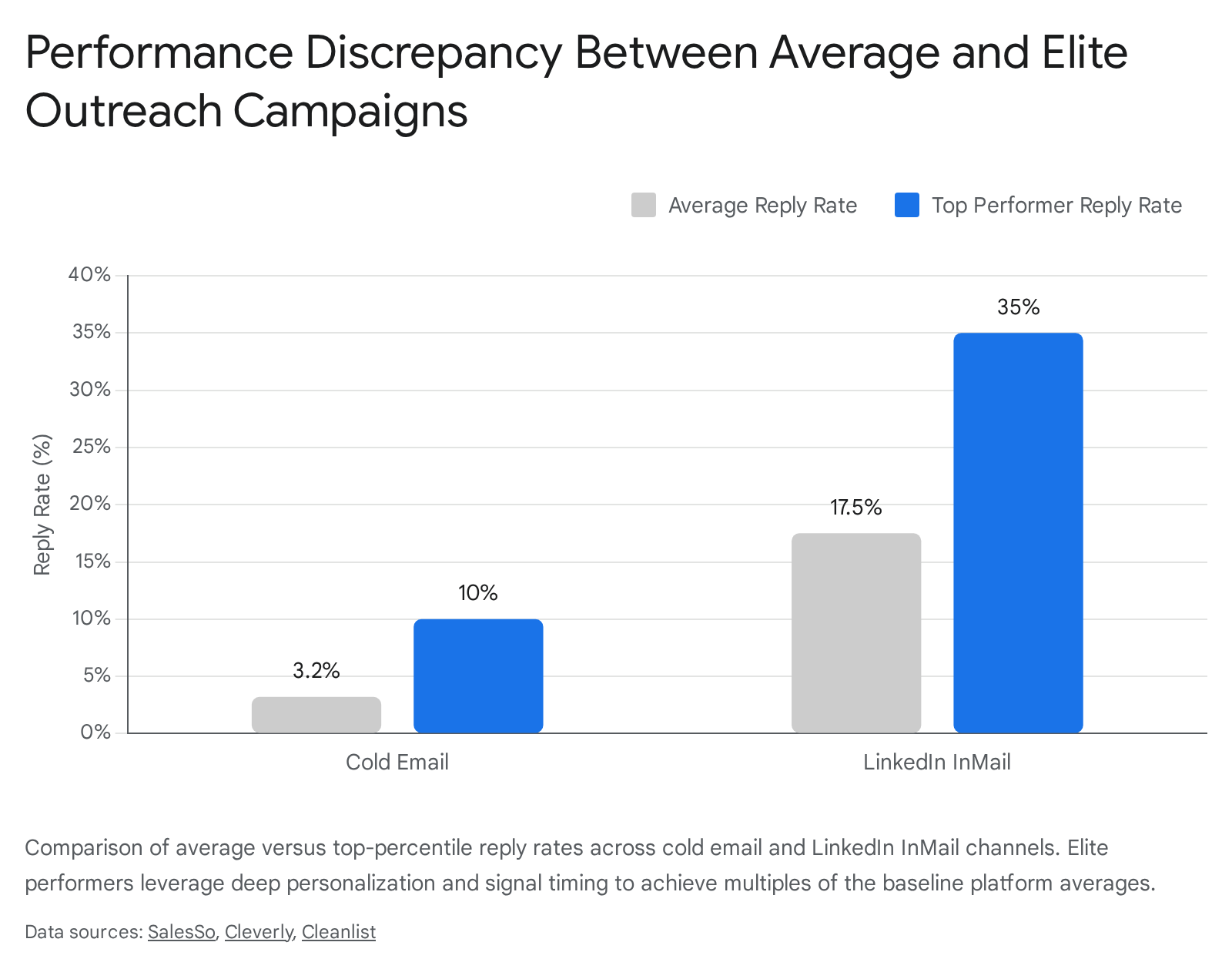
Elite social sellers consistently break the 30% to 40% response threshold 1214.
Standard connection requests benchmark at a 30% to 45% acceptance rate, provided they are accompanied by a personalized note 1214. Generic, blank connection requests are largely ignored by executive demographics, whereas personalized notes increase acceptance probability by 93% 116. Once a connection is established, direct organic messages yield a 25% to 35% response probability, surpassing the efficacy of paid cold InMails 112.
Structural and Temporal Variables
The physical structure of a LinkedIn message dictates its consumability. With 57% to 80% of platform engagement occurring on mobile devices, formatting is a strict constraint 121516. InMails constrained to under 400 characters fit neatly onto a single mobile screen without scrolling; this reduction in cognitive load yields a 22% increase in response rates 1216. Conversely, messages exceeding 1,200 characters suffer an 11% decline in engagement, as professional prospects demonstrate zero tolerance for lengthy prose 12.
Temporal optimization shows that messaging during specific professional transition windows maximizes visibility. Tuesdays and Thursdays record the highest aggregate reply rates (approximately 6.9%), specifically during the morning window of 8:00 AM to 10:00 AM and the evening commute window of 5:00 PM to 6:00 PM 12.
Algorithmic Governance and Technical Infrastructure
The defining characteristic of outbound marketing in 2026 is the weaponization of deliverability and platform compliance. Algorithms operated by Google, Microsoft, and LinkedIn no longer passively filter spam; they actively penalize senders who exhibit mechanical behavior or fail strict cryptographic standards.
Cryptographic Authentication Mandates
Following the initial regulatory shock introduced by Google and Yahoo in early 2024, the enforcement of bulk sender requirements reached strict SMTP-level rejection maturity by 2025 and 2026, matched closely by Microsoft 45617. Unauthenticated or misaligned emails are now treated by receiving servers as active security threats, resulting in immediate domain delivery deferrals or rejections 45.
Technical compliance mandates that senders deploy SPF (Sender Policy Framework) to verify authorized sending servers, and DKIM (DomainKeys Identified Mail) utilizing 2048-bit encryption to digitally sign message integrity 45618. Crucially, the enforcement of a published DMARC (Domain-based Message Authentication, Reporting, and Conformance) policy evaluates domain alignment at the exact microsecond of transmission 561823. If a third-party CRM or sales engagement tool sends an email where the visible "From" address fails to perfectly align with the DKIM cryptographic signature or the SPF return-path domain, the message fails authentication regardless of the underlying DNS setup 523.
Additionally, senders are mandated to utilize ARC (Authenticated Received Chain) authentication for forwarded messages, maintain valid Forward-confirmed reverse DNS (FCrDNS) records on all sending IP addresses, and ensure TLS 1.2+ encryption for transit 451718. Google enforces a "One-Time Rule" classifying any domain that crosses a 5,000-email daily threshold to personal accounts as a permanent bulk sender, permanently subjecting them to maximal technical scrutiny 5.
Reputation Decay and Recovery Mechanics
Beyond cryptographic signatures, the algorithmic governance of domain reputation is strictly behavioral. Organizations exceeding a 0.3% spam complaint rate face immediate rate limiting, with Google explicitly recommending senders maintain a rate below 0.1% 6171819. Bounce rates exceeding 3% trigger severe penalties across major mailbox providers, eventually resulting in total spam folder placement even for valid contacts 19. The average bounce rate across all senders is 5.1%, while elite performers maintain rates under 1.5% 1019.
Historical "grace periods" have been eliminated. Complaint spikes cause domain reputation decay within days, while reputation recovery is a complex, multi-month process 1920. Recovery requires sustained, high-engagement internal domain warming and manual adjustments to demonstrate behavioral shifts 2026. As a result, B2B sales teams are forced to utilize completely segregated secondary domains (e.g., outreach-company.com) to protect primary corporate infrastructure and contain the blast radius of deliverability penalties 6.
| Warming Phase | Daily Volume per Inbox | Target Audience | Primary Objective |
|---|---|---|---|
| Weeks 1-2 | 5-10 emails | Internal corporate team | Establish initial cryptographic trust and zero-bounce history 6. |
| Weeks 3-4 | 10-20 emails | Known highly-engaged partners | Generate guaranteed positive reply signals and open rates 6. |
| Weeks 5-8 | 20-40 emails | Warmed network prospects | Mimic natural scaling behavior without triggering volume alerts 6. |
LinkedIn Algorithmic Restrictions
LinkedIn has aggressively dismantled the architecture of high-volume, automated "spray-and-pray" sequencing, shifting from fixed limitations to fluid, reputation-based capacity mapping.
Dynamic Connection Limits
The industry myth of a universal 100-to-200 connection request limit per week has been entirely deprecated. In 2026, connection capacity is governed by a dynamic, continuous gradient known as the Trust Score or Account Health Score 23. An account's Trust Score determines its weekly action capacity.
New accounts (0-3 months old) or those flagged for suspicious behavior are restricted to 20 to 50 weekly requests 232122. Established accounts with moderate histories average 70 to 100 requests weekly 222. Only highly trusted accounts achieve the maximum 150 to 200 request capacity 232122. Premium subscriptions, such as Sales Navigator or Recruiter Lite, do not artificially inflate connection limits; they merely provide search advantages and separate InMail allocations 22122.
Four primary variables dictate an account's Trust Score capacity: 1. Connection Acceptance Rate: An acceptance rate above 40% signals relevant outreach and boosts capacity. A rate falling below 20% triggers algorithmic tightening and reduces capacity to as low as 50 requests 131421. 2. Pending Request Ratio: The platform maintains a soft cap of 500 unaccepted outgoing connection requests, with a hard cap around 700. Exceeding 500 pending requests acts as a negative signal indicating indiscriminate targeting, damaging the Trust Score faster than hitting weekly send limits. Best practice requires withdrawing requests older than two to three weeks 23. 3. Social Selling Index (SSI): An overarching score from 0 to 100 evaluating profile completeness, search precision, content engagement, and relationship building. Scores above 65 are requisite for securing maximum platform capacity 31421. 4. Organic Engagement Ratio: Pure outbound messaging without corresponding public content posting, liking, and commenting appears mechanical to the algorithm, suppressing trust 3.
The Volume Tax Penalty
The most opaque and damaging algorithmic penalty on LinkedIn in 2026 is the "Volume Tax." If an account utilizes third-party automation to send hundreds of messages but maintains a reply rate below 10% to 15%, the algorithm silently categorizes the account as a systemic spam risk 3.
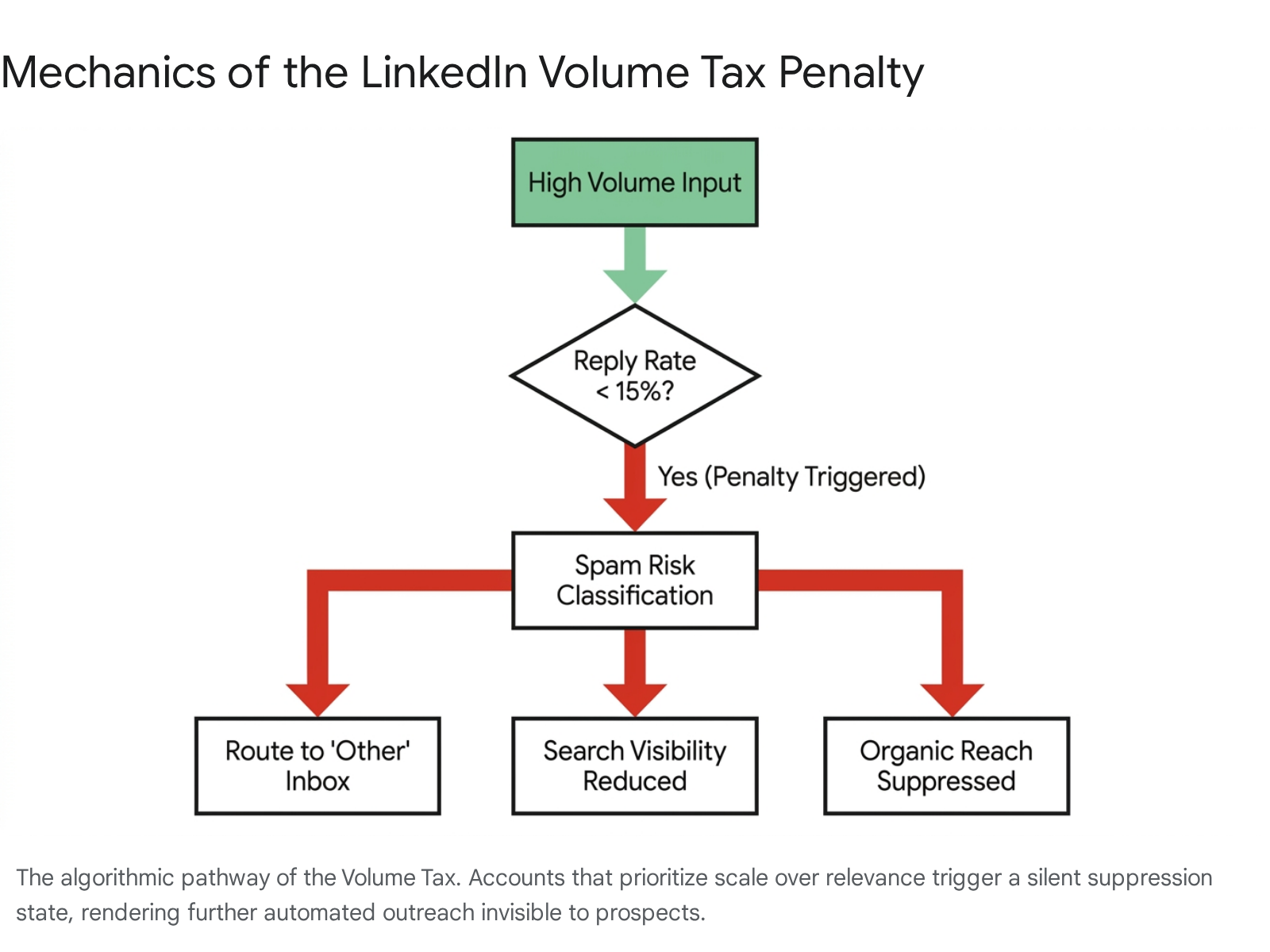
Crucially, the Volume Tax does not trigger a visible ban or login restriction. Instead, it operates as a shadow-ban. It suppresses the user's organic profile reach in public feeds, removes the profile from premium search visibility, and silently routes all subsequent automated messages directly into the recipient's secondary "Other" inbox, effectively nullifying the outreach investment 3. Teams operating under the Volume Tax frequently continue to pay for automation software, unaware that their messages are systematically hidden from prospects 3.
Global Privacy Regulations and Compliance Liability
Global data protection laws have forced cold outreach permanently out of its legal gray area. Data practices that were commonplace and considered "growth hacking" in the early 2020s represent massive corporate financial liabilities in 2026. This legislative environment has fractured Go-To-Market strategy into distinct regional compliance models.
Transnational Regulatory Frameworks
The core assumption that business contact data (B2B) sits outside consumer privacy law has been thoroughly dismantled globally 23. Regulatory bodies view named business emails, direct phone numbers, and IP addresses as protected personal data.
| Legislative Framework | Region of Enforcement | Consent Model | Financial Penalties |
|---|---|---|---|
| GDPR | European Union & UK | Opt-in (or stringent "Legitimate Interest" documentation) | Up to €20 million or 4% of global revenue 2425. |
| CAN-SPAM Act | United States (Federal) | Opt-out (Unsolicited B2B email permitted) | Over $43,280 per individual email violation 2425. |
| CCPA / CPRA | California (State) | Opt-out (with strict "Do Not Sell" data controls) | $2,500 per incident; $7,500 per intentional violation 2326. |
| CASL | Canada | Explicit or Implied (Implied consent expires in 6 months) | Penalties exceeding $1.1 million 2527. |
In the European Union, the General Data Protection Regulation (GDPR) mandates that senders maintain explicit documentation justifying a "legitimate interest" basis for communication 2526. B2B emails are classified as personal data. European data protection authorities issued over 330 fines in 2025 alone, bringing the cumulative total of GDPR fines to €7.1 billion 26.
While the United States federal CAN-SPAM Act historically allowed unsolicited commercial emails provided senders included an accurate physical address and a functioning opt-out mechanism, state-level privacy laws have radically altered the landscape 242534. The California Consumer Privacy Act (CCPA) and California Privacy Rights Act (CPRA) now fully cover B2B data, stripping away previous exemptions 2326. Businesses must honor "Do Not Sell" opt-out requests within 15 business days 26. Given the $7,500 penalty per intentional violation, a non-compliant list of just 1,000 prospects generates a potential seven-figure liability for the offending organization 23.
Strategic Divergence Between US and European Markets
These regulatory parameters, combined with distinct cultural expectations, have fostered highly divergent B2B outreach strategies across the Atlantic. European companies attempting to utilize their home-market playbook in the US consistently underperform, while US companies attempting high-velocity outreach in Europe face regulatory backlash and brand damage 28.
The United States market heavily favors an aggressive, precision-targeted outbound model 282930. B2B marketing budgets in the US are generally larger, and buyers expect rapid, multi-channel outreach orchestrated by dedicated Sales Development Representative (SDR) teams utilizing cadence software 2830. Culturally, American enterprise buyers are "vision-driven." They prioritize speed and scale, respond to bold claims regarding competitive edge, and operate within shorter sales cycles (typically two to five months in the mid-market) 2831.
Conversely, the European market heavily restricts mass outbound due to GDPR liabilities, rendering list-based cold email largely ineffective without meticulous opt-in layers 2829. This structural constraint forces European companies to excel at inbound marketing, community building, and peer-reviewed thought leadership 2930. Culturally, European buyers are "process-driven." They are deeply averse to marketing hype, demanding rigorous validation, verifiable case studies, and compliance-aware messaging - particularly regarding sustainability and operational stability - before engaging in a sales dialogue 293031. Sales cycles in Europe run 30% to 50% longer than US equivalents, requiring consensus across finance, legal, and technical stakeholders 2931.
Buyer Psychology and Artificial Intelligence Fatigue
The integration of artificial intelligence into B2B sales has reached near-universal saturation. Salesforce data reveals that 81% of sales teams have fully implemented or are actively experimenting with AI tooling 3940. However, widespread deployment has yielded contradictory empirical results. The proliferation of AI-generated messaging has fundamentally altered buyer psychology, generating extreme fatigue and altering the sequence of the procurement process.
The AI SDR Productivity Paradox
The initial promise of the fully autonomous "AI SDR" was absolute volume scaling at zero marginal labor cost. Vendors pitched software agents capable of replacing a human representative (who costs $110,000 to $139,000 annually fully loaded) with a $25,000 software agent capable of multiplying output tenfold 32.
By 2026, the empirical data highlights the fatal flaw in this volume-based model: AI generates massive scale but lacks acute situational judgment 32. Fully automated agents fail to recognize macroeconomic shifts, company hiring freezes, or the semantic nuance of a prospect responding simply to terminate the sequence 32. Consequently, as decision-makers became inundated with over 200 automated touches weekly, baseline cold email conversion rates actually halved from roughly 1% to 2% down to 0.5% to 1.5% during the period of maximum AI adoption 932.
When evaluated in controlled 90-day pipeline tests, the difference between volume-centric autonomous AI and human-curated hybrid models is stark. In a documented 2026 study, an AI-only pipeline booked 847 meetings but closed opportunities at a dismal 11% conversion rate. A hybrid model (AI assisting human judgment to refine targeting) booked only 312 meetings but converted at 38%, ultimately generating 2.3 times more revenue from 63% fewer meetings 32. Teams that treat AI as a replacement for human relationship-building generate inbox noise and domain penalties; teams that use AI exclusively to automate mundane research and augment human intelligence capture the actual revenue 4033.
Rep-Free Preferences and the Autonomous Buyer
B2B buyer behavior has structurally shifted away from initial seller engagement. According to Gartner's 2026 research, 67% of B2B buyers now actively prefer a completely rep-free purchasing experience 81234. Buyers initiate first contact with sellers in 81% of instances, reaching out only after their purchase requirements are 83% defined 44. Furthermore, 73% of buyers indicate they are now comfortable spending $50,000 or more in a single online transaction without human intervention 40.
The procurement process itself has become highly complex. The average buying committee has expanded to between 11.2 and 13 individuals for deals exceeding $50,000, spanning multiple departments and dramatically increasing the risk of internal friction 1245. A Dreamdata analysis of 66 million sessions revealed that the average B2B buying journey now spans 272 days, involving 88 distinct touchpoints across four different channels 12. Consequently, 86% of B2B purchases stall at some point in the cycle, and 81% of buyers express deep dissatisfaction with their ultimate vendor choice 1244.
Buyers are heavily utilizing generative Large Language Models (LLMs) to independently research vendors, with 94% using LLMs to shape their requirements 44. However, this AI-assisted research often fails to yield better decisions. Nineteen percent of buyers using AI applications report feeling less confident in their purchasing decisions due to hallucinations and inaccurate information provided by the models . This dynamic forces sellers to shift away from traditional "discovery theatre" - repetitive questioning that adds zero value - and focus on delivering deep validation, market context, and "value clarity" through expert consultation later in the buying cycle 847.
Agentic AI and Algorithmic Negotiation
Looking forward, Forrester predicts that the next evolution of AI in sales will transcend text generation and move into autonomous transaction execution. By 2026, 20% of B2B sellers will be forced to engage in algorithmic, agent-led quote negotiations 7.
Buying organizations are deploying autonomous AI data governance agents to evaluate vendor pricing, verify compliance contracts against internal policies, and issue immediate counteroffers. Sellers will subsequently be compelled to deploy their own counter-agents to dynamically negotiate parameters in real time 74935. This evolution removes the emotional component of early-stage negotiation, relegating vendor selection entirely to predefined financial and technical guardrails managed by multi-agent systems 51.
Signal-Based Orchestration Models
In response to volume suppression algorithms, privacy regulations, and buyer pattern blindness, elite revenue organizations have abandoned static, list-based outreach. The dominant paradigm of 2026 is "Signal-Based Selling" or "Agentic Orchestration." Instead of targeting a persona based purely on a static job title and hoping the timing aligns, sellers target acute behavioral triggers that mathematically indicate a defined window of need and budget 19405253.
Trigger Mechanisms and Intelligence Integration
The fundamental flaw of legacy models was the lack of data freshness. B2B contact databases often decay by 3% per month due to job turnover; relying on databases refreshed every six weeks leads to high bounce rates and immediate domain penalties 1940. Signal-based outreach verifies contact data in real-time at the exact point of the trigger event 19.
Signals that justify an outreach touchpoint include: * A new Vice President or Director entering their first 90 days in a role (highly likely to initiate tool evaluations) 52. * Freshly secured funding rounds coupled with aggressive hiring patterns 152. * Specific language usage in quarterly earnings calls indicating a strategic pivot 53. * High-intent consumption of relevant third-party content or peer review site activity 52.
By tying outreach to these specific triggers, response rates jump from the 1% to 5% baseline up to 15% to 25% 13953.
Multi-Channel Sequence Architecture
Legacy linear cadences relied on arbitrary timelines (e.g., sending follow-ups exactly 48 hours apart), which modern buyers immediately recognize as automated scripts 9. Modern orchestration relies on erratic, human-paced, and context-aware follow-ups spanning 14 to 21 days 95336.
A standard 2026 signal-based sequence averages between three and five highly curated steps. Expanding beyond five steps yields rapidly diminishing returns, inflating unsubscribe rates and spam complaints without generating pipeline 55. The sequence is characterized by strategic pacing across channels:
| Sequence Step | Channel | Timeline | Tactical Objective and Format |
|---|---|---|---|
| Step 1: Introduction | Email & LinkedIn | Day 1 | Contains one clear trigger reason and a low-friction ask. The message is strictly contained to under 100 words with zero initial pitching 525355. |
| Step 2: Value Addition | Days 3 - 5 | Rather than a generic "bumping this," the seller provides a specific resource, industry insight, or newly detected signal to earn attention 3655. | |
| Step 3: Social Proof | Phone Call & Email | Days 8 - 10 | A brief, one-paragraph use case demonstrating specific ROI for an identical peer company. Calls peak on Wednesdays during 10:00 AM or 4:00 PM windows 533655. |
| Step 4: Soft Close | Days 14 - 17 | Providing a highly professional, low-friction exit ("If this is not a priority, no problem") which frequently solicits a final definitive response 5355. |
A modern orchestration flow requires the sales representative to abandon the traditional "SDR Persona." Prospects actively ignore individuals explicitly attempting to extract 15 minutes of time via calendaring links 9. Instead, outreach must be framed as peer-to-peer consultation, leveraging AI not to spam the inbox, but to map the buying committee, identify external influencers, and scrape obscure account intelligence to inform a highly concise, human-written touchpoint 793356.
Cold outreach in 2026 is no longer a volume game; it is an intelligence operation. Success relies entirely on respecting the algorithmic constraints of the technical infrastructure, navigating stringent legal compliance, and demonstrating immediate, verified relevance to a highly skeptical buyer.