
Email marketing performance and metrics in 2026
Market Value and Economic Returns
In 2026, email marketing maintains its position as the most reliable and high-yielding digital communication channel, characterized by profound shifts in technical infrastructure, data privacy enforcement, and the integration of artificial intelligence. Global email users have reached an estimated 4.89 billion, surpassing earlier projections of 4.6 billion, with the steepest adoption growth occurring in Southeast Asia and Sub-Saharan Africa 12. Despite the proliferation of instant messaging, social media platforms, and collaborative workspaces, email retains a unique position as a high-intent, permission-based environment that commands continuous consumer and enterprise attention. The sheer volume of this medium is staggering, with an estimated 392.5 billion emails sent and received daily in 2026, of which nearly 48% is classified as spam 231.
The economic value of the channel has expanded sequentially, driven largely by the implementation of predictive analytics and automated lifecycle workflows. The global consensus benchmark for email marketing return on investment (ROI) in 2026 sits between $36 and $42 for every dollar spent, translating to a 3,600% to 4,200% ROI 123. This metric vastly outperforms alternative digital channels. For context, paid search averages a return of $8, social media marketing yields $10, and display advertising returns $5 per dollar spent 24. In specialized sectors such as business-to-consumer (B2C) e-commerce and retail, optimized email programs are achieving returns as high as $45 to $72 per dollar spent 2389. Furthermore, 59% of marketers identify email as their most effective channel for revenue generation, highlighting its stability amid shifting search engine algorithms and rising paid acquisition costs 4.
| Marketing Channel | Average Return per $1 Invested | Relative Effectiveness (vs. Display) |
|---|---|---|
| Email Marketing | $36.00 - $42.00 | 7.2x - 8.4x |
| Search Engine Optimization (SEO) | $22.00 | 4.4x |
| Content Marketing | $14.00 | 2.8x |
| Social Media Marketing | $10.00 | 2.0x |
| Google Ads (Paid Search) | $8.00 | 1.6x |
| Display Advertising | $5.00 | 1.0x |
Table 1: Digital Marketing Channel Return on Investment (ROI) based on 2026 consensus benchmarks. 234
This sustained profitability is not a function of increased broadcast volume. Rather, email marketing in 2026 is defined by precision and targeted delivery. The industry has decisively moved away from "batch-and-blast" methodologies toward hyper-personalized, dynamically timed micro-moments. Global email marketing revenue reached $17.9 billion in 2026 and is projected to scale to $24.2 billion by 2029, reflecting a compound annual growth rate of 10.5% 2. However, this growth occurs against a backdrop of increasingly hostile inbox environments, where mailbox providers enforce draconian authentication standards and privacy features obscure traditional engagement signals. Success in this landscape requires marketers to treat email not merely as a creative endeavor, but as an integrated system of data governance, technical compliance, and behavioral modeling.
The Psychological Impact on Consumer Behavior
The efficacy of email marketing in 2026 is heavily supported by peer-reviewed academic research investigating the cognitive, affective, and behavioral outcomes of digital communication. The integration of artificial intelligence into marketing activities represents a fundamental shift from traditional, rule-based decision-making toward adaptive, data-driven interaction models 5. AI enables firms to process large-scale consumer data in real time, allowing marketing systems to learn, predict, and respond dynamically to individual preferences.
Academic literature frequently utilizes the Theory of Planned Behavior (TPB) and the Stimulus-Organism-Response (SOR) framework to explain how personalized email marketing drives purchasing decisions 67. In these models, the email serves as the environmental stimulus, which is cognitively and affectively processed by the consumer (the organism), leading to an approach or avoidance behavior (the response) 7. Studies demonstrate that purchase behavior is strongly affected by exposure to AI-generated messages, particularly when recommendations are relevant, timely, and emotionally appealing 5. AI-driven mechanisms generally foster improved perceptions of usefulness, decision efficiency, and information relevance, which are well-established antecedents of cognitive satisfaction 7.
However, the psychological impact is not universally positive. Personalization must be carefully calibrated to avoid reactance and privacy concerns. Peer-reviewed systematic reviews highlight that while AI personalization improves conversions and website dwell time, consumers simultaneously report heightened anxiety regarding data governance 513. When personalization crosses the threshold from helpful to invasive - often referred to as the "uncanny valley" of marketing - consumers experience affective dissatisfaction, inhibiting their purchasing behavior and damaging brand trust 58. Qualitative findings underscore that effective personalization depends not only on algorithmic sophistication but also on the user's sense of autonomy and perceived transparency regarding how their data is utilized 5. Consequently, marketers who segment customers by privacy sensitivity and adopt accountable, consent-based personalization build more durable loyalty than those relying purely on aggressive algorithmic targeting 5.
Infrastructure and Deliverability Requirements
The foundational requirement for email marketing in 2026 is technical deliverability. Without rigorous authentication and list hygiene, sophisticated content strategies and psychological targeting are rendered obsolete. The landscape was permanently altered following the enforcement of stringent bulk sender rules by Google (Gmail) and Yahoo, which began in early 2024 and tightened progressively through late 2025 and 2026 1910. Mailbox providers now enforce technical trust before evaluating the actual content of the message 17.
Authentication Protocols and Sender Identity
For any domain sending 5,000 or more messages per day to personal accounts, adherence to a strict technical framework is mandatory 910. Failure to comply results in immediate SMTP rejection (4xx or 5xx errors) or direct routing to the spam folder 1011. The core authentication pillars include the Sender Policy Framework (SPF), DomainKeys Identified Mail (DKIM), and Domain-based Message Authentication, Reporting, and Conformance (DMARC).
SPF authorizes specific IP addresses to send on behalf of a domain. By 2026, SPF adoption among commercial senders reached 93%, up from 88% in previous years 1. A critical requirement remains keeping SPF records under the 10 DNS lookup limit; exceeding this limit causes authentication to fail regardless of IP authorization, a common error when businesses stack multiple marketing technology platforms 1017. DKIM applies a cryptographic signature to emails, verifying that the message was not altered in transit. Current best practices dictate the use of 2048-bit RSA keys, and DKIM adoption currently stands at 90% 110.
DMARC unites SPF and DKIM, providing instructions to receiving servers on how to handle unauthenticated messages. While DMARC record presence has climbed past 75% across Fortune 500 domains, overall global adoption sits at 64%, leaving 36% of sending domains entirely unprotected 112. The most significant deliverability vulnerability in 2026 is the "DMARC enforcement gap." A DMARC record set to p=none acts solely as a monitoring policy and provides no active protection against spoofing 111213. To achieve reliable inbox placement and qualify for visual brand indicators like Brand Indicators for Message Identification (BIMI), senders must enforce policies at p=quarantine or p=reject. Currently, only about 35% of DMARC records are configured to p=reject, meaning the majority of senders are still relying on passive monitoring 1112.
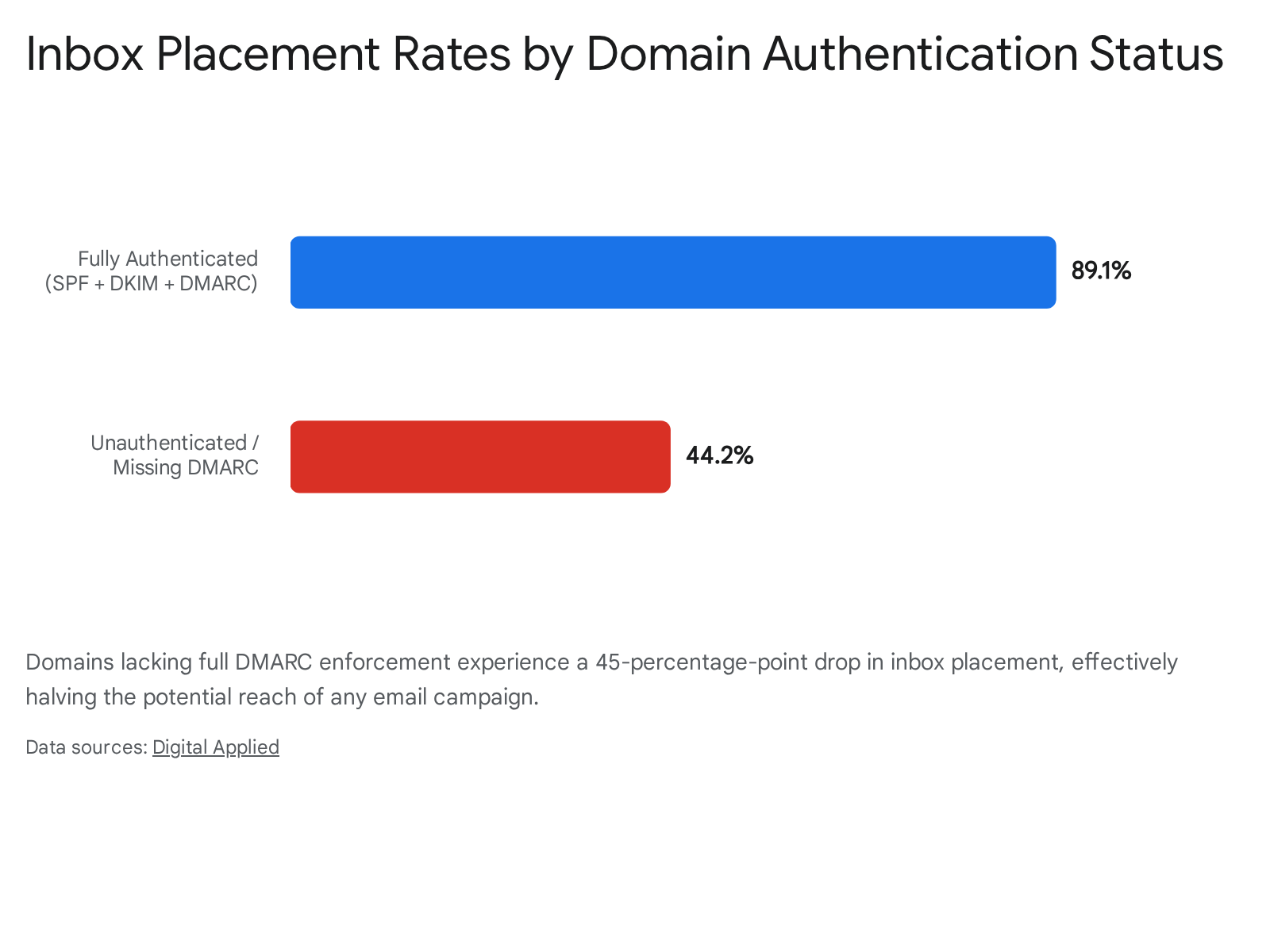
In addition to cryptographic standards, the implementation of forward and reverse DNS (FCrDNS) and TLS-encrypted transmission are mandatory baselines for bulk senders 91013. Domains that lack proper SPF, DKIM, and DMARC alignment experience average inbox placement rates of just 44.2%, compared to 89.1% for fully authenticated domains - a massive 45-percentage-point penalty 2.
Spam Thresholds and One-Click Unsubscribe
Alongside cryptographic authentication, mailbox providers actively penalize domains based on subscriber sentiment and engagement. Both Google and Yahoo strictly enforce spam complaint thresholds. The absolute maximum permissible complaint rate is 0.30% (three complaints per one thousand messages), though the operational ceiling for stable commercial senders is tightly monitored at 0.10% 91013. Senders exceeding this threshold experience immediate reputation degradation that can take up to 18 months to remediate, as reputation scores have become highly durable 12.
To facilitate list hygiene and prevent frustrated users from utilizing the detrimental "report spam" button, providers mandate the implementation of one-click unsubscribe functionality in email headers. This requires adherence to RFC 8058, utilizing List-Unsubscribe and List-Unsubscribe-Post headers 101121. Furthermore, unsubscribes must be processed administratively within two business days 1011. Despite this being a heavily publicized requirement, compliance testing in 2026 reveals that 86% of commercial emails still lack the proper header-based unsubscribe mechanics, exposing those senders to elevated spam placement 1.
Mailbox Provider Disparities and Filtering Algorithms
Deliverability is not uniform across the internet. The global average inbox placement rate is 83.1%, but performance varies wildly depending on the recipient's mail client and the provider's filtering algorithms 114. Artificial intelligence algorithms now dictate visibility, meaning messages are not simply binary categorized as inbox or spam, but are evaluated on complex engagement patterns 14.
Gmail, which controls roughly 72% of the consumer email market with over 1.8 billion active users, utilizes highly advanced AI-driven filters (including Gemini and RETVec models) to judge content value based on real-time engagement and visual patterns 11123. Despite its strictness, a properly authenticated sender with clean data can expect an 87.2% inbox placement rate at Gmail 11014. Yahoo closely follows with an 86% placement rate, reflecting its ongoing efforts to refine spam filters and sender reputation systems 14.
Conversely, Microsoft's Outlook and Office365 environments are significantly more hostile to commercial email. Outlook's average inbox placement drops to 75.6% under optimized conditions, and broader benchmark testing indicates that for average senders, up to 52% of emails sent to Microsoft properties are routed directly to the junk folder 11014. Legacy providers exhibit even steeper declines, with AOL demonstrating a 74% spam routing rate 1.
| Mailbox Provider | Global Market Presence | Average Inbox Placement Rate | Average Spam Routing Rate |
|---|---|---|---|
| ProtonMail | Niche / High-Privacy | 99.0% | 1.0% |
| Zoho Mail | Enterprise / SMB | 94.0% | 6.0% |
| Google (Gmail) | Dominant Consumer | 87.2% | 12.8% |
| Yahoo Mail | High Consumer | 86.0% | 14.0% |
| GMX | Regional European | 81.0% | 19.0% |
| Microsoft (Outlook) | Dominant Enterprise | 48.0% - 75.6% | 24.4% - 52.0% |
| AOL | Legacy Consumer | 26.0% | 74.0% |
Table 2: Global Inbox and Spam Placement Disparities by Major Mailbox Provider in 2026. 11014
These extreme disparities dictate that modern deliverability monitoring must be segmented by Internet Service Provider (ISP) to isolate and address specific infrastructure issues. A generalized metric obscures critical provider-level failures 1.
Privacy Regulations and Data Governance
The global regulatory environment surrounding data privacy and email marketing has fractured into a highly complex, aggressively enforced patchwork. Compliance is no longer solely a legal concern mitigated by general counsel; it is a direct operational deliverability signal. Mailbox providers monitor subscriber engagement heavily, and poor consent practices inevitably lead to high spam complaints, algorithmic penalties, and inbox blocklisting 1516. The most important principle in global email compliance is that the law is determined by the physical location of the recipient, not the corporate headquarters of the sender 17.
European Union Artificial Intelligence Act and GDPR
The General Data Protection Regulation (GDPR) remains the strictest baseline globally for data collection. It mandates explicit, freely given, and unbundled consent, meaning pre-ticked boxes are strictly prohibited, and requires marketers to retain cryptographic proof of opt-in, including timestamps and IP addresses 151617. Fines for GDPR violations are severe, scaling up to €20 million or 4% of global annual turnover, whichever is higher 151718.
However, a critical new variable reshaping the European landscape in 2026 is the transition of the European Union's AI Act from legislation to active enforcement 192030. As the world's first comprehensive AI regulation, it introduces a tiered, risk-based approach to algorithms. For email marketers, the most immediate and disruptive requirement is absolute transparency regarding synthetic content. Any marketing collateral - including email body copy, subject lines, images, or audio - generated by AI must be clearly and conspicuously disclosed to the recipient 1920. Furthermore, AI systems utilized for personalization, targeting, and predictive profiling may be categorized as "high-risk" under certain conditions, subjecting them to intense regulatory audits regarding data bias and algorithmic accountability 71930. Non-compliance with the AI Act carries penalties reaching up to €35 million or 7% of global annual revenue 20.
North American and Asia-Pacific Legislative Shifts
The United States continues to operate on a federal "opt-out" baseline under the 2003 CAN-SPAM Act. This framework does not require prior consent but mandates accurate header information, physical mailing addresses, non-deceptive subject lines, and honoring opt-outs within 10 days 151721. Violations of CAN-SPAM result in federal fines of up to $51,744 per email, making it a critical baseline 1832.
However, the absence of a modern federal privacy law has led to a proliferation of comprehensive state-level statutes. By 2026, approximately 20 states enforce consumer privacy laws, fundamentally altering how marketers manage domestic data 2223. California remains the regulatory vanguard with the California Privacy Rights Act (CPRA), which strictly governs the sale and sharing of personal data, grants consumers the right to demand data deletion, and requires complex risk assessments for automated decision-making 2123. In 2025 and 2026 alone, states including Delaware, Iowa, Nebraska, New Jersey, Tennessee, Minnesota, Maryland, Indiana, Kentucky, and Rhode Island enacted distinct privacy frameworks 2223. Because managing lists by individual state residency is operationally unfeasible, marketing platforms are forced to adopt the strictest state standard universally across their US operations 15. Canada maintains one of the harshest frameworks globally with Canada's Anti-Spam Legislation (CASL), which places the burden of proof entirely on the sender and does not exempt B2B communications 2124.
The Asia-Pacific (APAC) region has also tightened significantly, transitioning from historically loose frameworks to strict consent-based models. India's Digital Personal Data Protection (DPDP) Act of 2023 mandates explicit opt-in consent and clear notice provisions before any marketing email is sent, carrying sweeping penalties of up to INR 250 crore (approximately $30 million USD) 1725. Singapore's Personal Data Protection Act (PDPA) requires explicit consent and strict adherence to Do Not Call registries, serving as the compliance baseline for broader Southeast Asian operations 1725. Japan's Act on Regulation of Transmission of Specified Electronic Mail and Australia's Spam Act 2003 similarly enforce stringent anti-spam and prior-consent requirements, establishing opt-in as the global standard outside the United States 322425.
| Jurisdiction / Law | Consent Model | Key Requirements for Email Marketers | Maximum Penalty Benchmarks |
|---|---|---|---|
| EU (GDPR & ePrivacy) | Strict Opt-In | Verifiable proof of consent, no pre-checked boxes, data portability. | €20M or 4% of global turnover |
| EU (AI Act 2026) | Transparency | Mandatory disclosure of AI-generated text and imagery; audits for profiling. | €35M or 7% of global turnover |
| US (CAN-SPAM) | Opt-Out | Accurate headers, physical address, visible unsubscribe. | $51,744 per individual email |
| US (State Laws e.g., CPRA) | Opt-Out / Deletion | Right to know, right to delete, restricted behavioral profiling. | Varies by state; high civil penalties |
| Canada (CASL) | Strict Opt-In | Express consent required, no B2B exemptions, burden of proof on sender. | CAD $10M per violation |
| India (DPDP Act) | Strict Opt-In | Purpose limitation, clear notice provisions, data principal rights. | Up to INR 250 Crore (~$30M) |
Table 3: Evolution of Privacy and Anti-Spam Legislation impacting global email marketing in 2026. 151718202325
To combat the deprecation of third-party tracking cookies and navigate these strict privacy laws, marketers have aggressively pivoted to collecting "zero-party data" - information that a customer intentionally and proactively shares with a brand 4262739. Collected through interactive email elements, preference centers, and onboarding quizzes, zero-party data allows marketers to bypass algorithmic assumptions and rely on explicitly stated preferences. Brands that effectively integrate zero-party data into their customer relationship management (CRM) workflows report 35% to 60% higher open and engagement rates, as the resulting communications align precisely with user expectations while remaining completely compliant with global privacy directives 2227.
Evolution of Engagement Metrics
The framework used to evaluate email marketing success has undergone a permanent structural shift. For over a decade, the open rate served as the primary indicator of campaign health. In 2026, the traditional open rate is recognized as fundamentally unreliable, forcing an industry-wide pivot to deeper intent signals.
The Deflation of the Open Rate
Apple's Mail Privacy Protection (MPP), introduced in 2021, fundamentally disrupted engagement tracking. MPP automatically pre-loads email content - including the invisible 1x1 tracking pixels used by marketers - for users of Apple Mail, which accounts for approximately 50% of the email client market share globally 228. This pixel auto-loading registers as an "open" on the sender's end, regardless of whether the human user actually viewed the message in their inbox 241.
As of 2026, MPP continues to artificially inflate reported open rates by an estimated 15 to 20 percentage points 2642. While the reported global average open rate sits between 26.9% and 42.35%, the actual engagement-adjusted open rate, accounting for algorithmic noise, is approximately 16.8% 22643. Artificial intelligence inbox summaries, such as those generated by Gmail Gemini, further distort this metric. These intelligent inboxes auto-open messages to read and summarize content, deciding whether to surface the email to the user based on perceived value 1139. Consequently, high open rates often indicate intense algorithmic scanning activity rather than genuine human attention. Open rates function now strictly as a directional indicator to compare A/B tests within a single campaign, rather than an absolute measure of success 2.
The Shift to Intent-Based Measurement
Because opens and impressions are easily manipulated by bot activity, security filter pre-scans, and privacy proxies, the industry has universally shifted toward intent-based performance metrics 4264143. Mailbox providers now evaluate sender trust based on active engagement signals 1641.
- Click-Through Rate (CTR): Averaging 2.62% globally, CTR remains the most reliable baseline indicator of engagement, as it requires deliberate human action to navigate from the inbox to a destination URL 242644. CTR is projected to grow steadily from 3.5% in 2026 to 4.5% by 2030, driven predominantly by AI-driven personalization and behavioral triggers rather than increased send volume 843.
- Click-to-Open Rate (CTOR): Sitting at a global average of 5.63%, and reaching as high as 12.3% in highly segmented campaigns, CTOR measures the percentage of unique clicks divided by unique opens 22643. By stripping out the noise of non-engaging opens, it serves as a direct measure of whether the content and layout were actually compelling enough to drive action once the email was viewed 241.
- Interaction Rate (IR): As emails evolve from static documents to interactive applications, binary link clicks are insufficient. The Interaction Rate measures in-inbox activities such as toggling accordions, swiping image carousels, voting in polls, or utilizing embedded calculators 29. This metric proves highly valuable for top-of-funnel content aimed at brand awareness and data collection rather than immediate direct sales 3031.
- Dwell Time: Also known as time-in-content, Dwell Time tracks the active seconds a user spends with an email open and active on their screen. Higher dwell times, particularly those exceeding 30 to 60 seconds on complex B2B or healthcare content, send strong positive signals to AI-powered spam filters that the content is valuable, improving future deliverability 2948.
- Disaffection Index: Mailbox providers weight negative signals far more heavily than positive ones. The Disaffection Index is a composite metric combining unsubscribes, spam complaints, and deletions without reading 1641. It answers how quickly a brand is burning its list, which is a stronger predictor of future algorithmic deliverability penalties than historical click volume 41.
Artificial Intelligence and Campaign Automation
Artificial intelligence is the single largest variable dictating email marketing performance and organizational efficiency in 2026. Adoption has crossed into the clear majority, with 64% of marketers integrating AI into their email programs, and 61% of enterprise programs utilizing AI for core campaign creation workflows 2843. According to independent analysis by Forrester and Gartner, competitive pressure combined with the revolutionary power of AI is pushing the limits of what the email medium can do 3233. The impact is highly measurable: brands deploying full-stack AI email platforms report a 27.4% increase in click-through rates and an average revenue uplift of 41% to 63% compared to manually operated programs 128.
AI applications in email marketing are divided into two primary disciplines: predictive execution and generative composition.
Predictive Analytics and Behavioral Decisioning
Predictive AI analyzes vast datasets of historical behavior - including past purchases, browsing patterns, scroll depth on specific web pages, and previous email engagement timing - to forecast future actions and automate sending logic 827. This represents a paradigm shift from traditional static demographic segmentation to continuous, "micro-moment" personalization 2751.
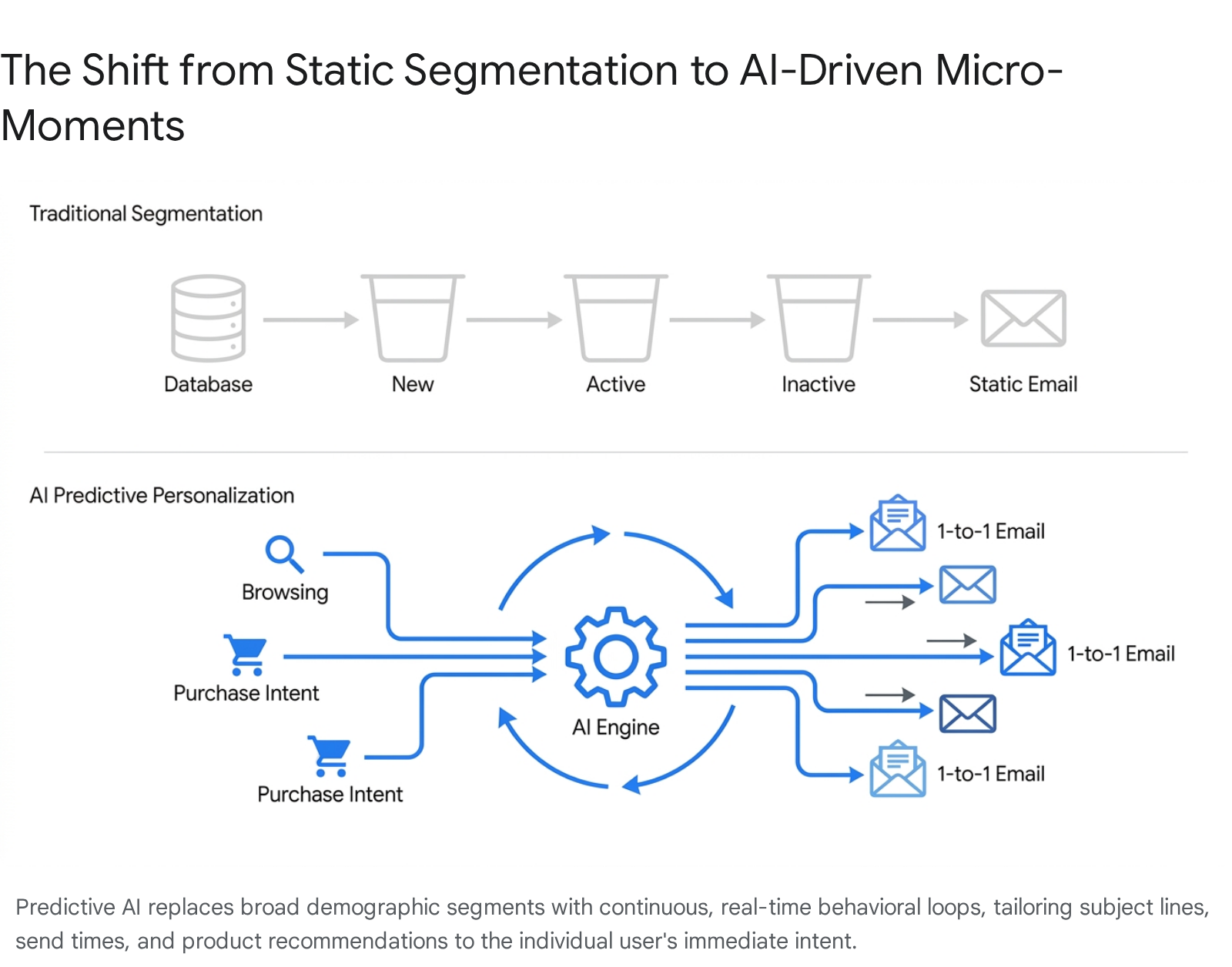
Instead of sending a generic broadcast campaign to a broad list of "recent buyers," predictive AI models identify individuals exhibiting high purchase intent or high churn risk and automatically trigger relevant, 1-to-1 communications 42751.
Key predictive implementations driving performance include: * Send-Time Optimization (STO): Rather than guessing a universal optimal send time, AI determines the exact hour and day an individual subscriber is most likely to be active in their inbox. Combining STo with AI-optimized subject lines delivers a 38% to 42% total lift in open rates and a 19% boost in conversion 124. * Adaptive Frequency: AI prevents list fatigue by analyzing individual subscriber tolerance. It automatically reduces the send frequency for unengaged users, preserving deliverability reputation and reducing overall unsubscribe rates by 29% 2. * Dynamic Product Recommendations: By injecting behavioral algorithms into the email payload, marketers serve predictive product carousels based on real-time inventory and predicted individual intent. This tactic lifts revenue per send by 17% and increases click rates significantly 2434.
The operational architecture of email marketing relies heavily on automated workflows. Triggered lifecycle emails - such as welcome series, onboarding sequences, cart abandonment recovery, and post-purchase win-backs - represent an outsized driver of total program efficiency. Automated flows account for only 2% to 5.3% of total email send volume, yet they generate approximately 41% of total email revenue 4834. The revenue per recipient (RPR) for automated flows is nearly 18 times higher than that of standard broadcast campaigns, proving that relevance and timing heavily outweigh frequency 34.
Generative Assembly and the AI-Filtered Inbox
While predictive AI decides the timing and target, generative AI creates the payload. Tools natively integrated into major enterprise platforms automatically draft subject lines, adjust tone to match brand guidelines, and assemble layout blocks 393235. According to Forrester's Q1 2026 evaluation, modern vendors are moving toward true one-to-one message creation, utilizing AI as a core functionality enabler rather than a superficial feature add-on 32.
AI-generated subject lines leveraging behavioral triggers consistently outperform human-written variants, showing a 26% to 46.2% increase in open rates 128. Generative tools also allow for multivariate testing at scale, enabling marketers to test up to 3.2 times more variations per campaign and reducing the time spent on campaign creation by 72% 2.
However, writing strategies have evolved significantly to combat the "AI Inbox." Major providers like Gmail and Apple Mail now use AI to generate summary snippets of incoming emails, reading the content before the human subscriber ever opens it 1139. If an email does not signal clear value in the first few sentences, the AI summary may misrepresent the offer or bury the message entirely 39. Therefore, subject lines and pre-headers in 2026 must be written to be parsed by machine algorithms first, prioritizing clarity and front-loaded intent over cleverness 39. The most successful implementations utilize a human-in-the-loop hybrid approach, where AI handles structural assembly and multivariate generation, while human operators review for brand voice consistency, empathy, and strategic alignment 273951.
Design Architectures and Audience Nuances
Visual presentation and codebase complexity directly impact both user engagement and spam filter deliverability. The physical environment of email consumption heavily favors mobile platforms; in 2026, roughly 72% of all emails are opened exclusively on mobile devices, with Gen Z users accounting for 81% of mobile-only email engagement 136. Consequently, designs that fail to strictly adhere to mobile-first responsive standards suffer massive engagement penalties. Furthermore, design trends and performance benchmarks diverge sharply based on whether the audience is commercial (B2B) or consumer (B2C).
The Divergence of Consumer and Enterprise Formatting
Business-to-Consumer (B2C) and Business-to-Business (B2B) email marketing exhibit fundamentally different strategic priorities, which are reflected in their distinct performance benchmarks. B2B campaigns focus on logic, ROI, and educational content to support elongated buying cycles that require internal consensus 955. B2C campaigns thrive on emotional appeal, rapid visual processing, and urgency to drive quicker purchasing decisions 9.
| Metric | B2B Average Benchmark | B2C Average Benchmark | Key Strategic Difference |
|---|---|---|---|
| Open Rate | 37.40% | 40.00% | B2C utilizes highly emotional subject lines; B2B relies on utility. |
| Click-Through Rate (CTR) | 3.20% | 2.10% | B2B audiences read to research and click with high purchase intent. |
| Click-to-Open Rate (CTOR) | 13.00% | 5.50% | B2B content generates deeper engagement post-open. |
| Send Frequency | 1 - 2 times per week | 2 - 3 times per week | B2B requires lower frequency to prevent immediate list fatigue. |
| Average Bounce Rate | 0.50% | 0.62% | B2B lists are smaller and rigorously maintained for precise targeting. |
Table 4: Performance Variations Between B2B and B2C Email Marketing in 2026. 92656
While B2C and retail sectors rely heavily on rich media and interactive elements, B2B marketing has experienced a massive resurgence in plain-text and hybrid-minimalist formatting. In 2026, 44% of B2B marketers utilize plain-text designs 2. This regression to simplicity is entirely data-driven. Modern spam filters heavily scrutinize complex HTML, embedded images, and deep CSS structures, categorizing them as bulk marketing 575859. Plain-text emails bypass these promotional filters, landing directly in primary inboxes and mimicking 1-to-1 personal communications from a colleague or sales representative 5759. From an engagement standpoint, plain-text emails in B2B contexts achieve 21% higher click-to-open rates and 17% higher overall click-through rates compared to design-heavy HTML equivalents, as B2B audiences prioritize fast, clear, high-utility text that renders perfectly across all devices, including complex enterprise security environments 5758.
Interactive Ecosystems and AMP for Email
Conversely, in the consumer space, the demand for frictionless digital experiences has driven the widespread adoption of Accelerated Mobile Pages (AMP) for Email. Initially a niche technology introduced by Google, AMP email adoption has climbed to 8.4%, with projections indicating it will secure 15% to 20% market share by 2028 237.
AMP transforms static emails into functional, dynamic mini-applications. Interactive elements allow users to submit forms, answer surveys, scroll through real-time inventory carousels, book appointments, and even complete shopping cart checkouts without ever leaving their inbox or waiting for a mobile web browser to load 293738. This reduction in transactional friction is highly effective for e-commerce; mobile-first AMP designs record a 38% higher click-through rate compared to static desktop layouts, and interactive content overall generates 52.6% to 73% more engagement than static messaging 12939.
Intelligent inboxes actively reward interactive emails with better placement, analyzing metrics like Dwell Time to determine if the user is finding value in the communication 2939. However, because AMP relies on dynamic data fetching and specialized coding, developers must implement a rigorous "fallback-first" strategy. This ensures that email clients lacking AMP support - such as certain legacy desktop applications or strict corporate firewalls - receive a fully functional, well-designed HTML alternative, protecting the user experience across all platforms 29.
| Industry Sector | Average Inbox Placement | Click-Through Rate (CTR) | Click-to-Open Rate (CTOR) | Strategic Observation |
|---|---|---|---|---|
| B2B SaaS / Tech | 92.0% | 4.10% | 13.00% | Leads in placement due to strict opt-in friction and plain-text utility. |
| Financial Services | 91.0% | 5.20% | 10.15% | High engagement driven by transactional and account-critical alerts. |
| Healthcare | 89.0% | 6.20% | 12.82% | Strong CTOR due to highly relevant, necessary communications. |
| Nonprofits & Religion | 88.0% | 6.80% | 12.00% | High emotional investment from self-selected audiences drives engagement. |
| Retail & E-commerce | 87.0% | 2.86% | 10.60% | Lower CTR due to high volume, visual scanning, and algorithmic fatigue. |
| Education | 86.0% | 9.80% | 11.50% | Lowest placement, but exceptionally high CTR when emails are delivered. |
Table 5: Deliverability and Engagement Metrics by Select Industry Sectors. 3121442
The state of email marketing in 2026 presents a paradigm of necessary sophistication. The channel has never been more technically difficult to execute, yet it has never yielded higher financial returns for those who master it. The environment actively punishes senders who rely on outdated metrics, ignore cryptographic authentication, and deploy broad, non-segmented blasts. Conversely, organizations that adopt strict DMARC enforcement, transition to AI-driven predictive personalization, leverage interactive AMP experiences, and respect the boundaries of global data privacy are commanding unprecedented engagement. In this landscape, email marketing is fundamentally an exercise in technical compliance, algorithmic precision, and radical respect for the subscriber's attention.