
How to Tell If a Decision Is Hard or Just Emotional
A genuinely hard decision is characterized by objective complexity, missing information, and competing variables that outstrip your cognitive processing bandwidth. An emotionally loaded decision, conversely, often has a clear mathematical or logical answer but is paralyzed by a psychological threat response, fear of regret, or a challenge to your core identity. Distinguishing between the two requires untangling your brain's analytical capacity limits from its deeply ingrained evolutionary survival mechanisms.
The Anatomy of a Decision: Complexity Versus Emotion
Every day, we face a barrage of choices ranging from the trivial to the life-altering. When a decision brings us to a grinding halt, we tend to label it "hard." But in the realm of behavioral science and psychology, "hard" is an imprecise term that obscures the actual mechanics of our hesitation. To resolve a state of analysis paralysis, we must first correctly diagnose the root cause of the friction.
Behavioral scientists draw a distinct line between decisions that are structurally complex and those that are emotionally loaded 1. While both can result in identical feelings of being stuck, they demand entirely different interventions. When we misdiagnose the type of decision we are facing, we apply the wrong cognitive tools, leading to prolonged distress and suboptimal outcomes.
The Cognitive Overload of Genuinely Complex Decisions
Structural complexity arises when you face a "wicked problem" that is difficult to definitively outline or scope 1. Complex decisions are marked by high levels of ambiguity, an overwhelming number of variables, competing stakeholder interests, and uncertain future trends. When grappling with a complex decision, your brain relies on what behavioral economists characterize as "System 2" thinking - a slow, deliberate, and analytical mode of processing 12.
However, System 2 has severe bandwidth limitations. When it is bombarded with too much data or an excessive number of options, it overheats and stalls 1. This phenomenon is deeply tied to the "paradox of choice" or "choice overload." A classic behavioral science demonstration of this cognitive limit is the famous jam study conducted by psychologists Sheena Iyengar and Mark Lepper 112. When shoppers were presented with a display of 24 gourmet jams, they were highly attracted to the variety, but the cognitive overload was so severe that only 3% made a purchase. When the display was reduced to just 6 jams, 30% of consumers bought a jar 12. The abundance of choice hindered the decision-making process because the cognitive effort required to weigh the pros and cons of 24 options completely drained the subjects' self-regulatory resources 12.
In complex business or life decisions, this cognitive overload manifests as a desperate search for the perfect solution. We seek just one more data point, one more expert opinion, or one more spreadsheet model to make the correct choice obvious 1. We mistakenly believe that if we gather enough information, the complexity will dissolve. But for complex decisions, complete certainty is mathematically unattainable 13.
The Hidden Weight of Emotionally Loaded Choices
Emotionally loaded decisions operate on a completely different psychological circuitry. In these scenarios, the objective data might actually be quite clear, or the number of options may be relatively small - often just a binary yes or no. The paralysis does not emerge from a lack of cognitive bandwidth, but rather from a profound threat response 1.
Emotionally loaded decisions are driven by internal states, such as the fear of failure, social anxiety, perfectionism, and the anticipated pain of regret 1. These decisions engage "System 1" thinking, which is our fast, intuitive, and highly emotional processing network 24. When System 1 perceives a threat, it triggers an evolutionary freeze response. High-stakes choices, such as proposing marriage, firing a toxic employee, or fundamentally changing career paths, carry immense emotional weight because the imagined consequence of a wrong move feels existentially dangerous 1.
To effectively diagnose your paralysis, it is helpful to conceptually map decisions along two distinct axes: Information Complexity and Emotional Stakes. Routine choices sit at the low end of both axes, easily dispatched with minimal thought. Cognitive overload occurs when information complexity is exceptionally high, but emotional stakes are relatively low. An emotional freeze occurs when the data is straightforward but the personal stakes are terrifyingly high. The most difficult scenarios - wicked problems - occupy the quadrant where extreme data complexity meets extreme emotional stakes.
| Feature | Objectively Complex Decisions | Emotionally Loaded Decisions |
|---|---|---|
| Primary Trigger | An unmanageable volume of variables, options, or data points. | Deep-seated fear, anxiety, and intensely high personal stakes. |
| Cognitive State | Cognitive overload; exhaustion of System 2 analytical processing. | Fight, flight, or freeze response; System 1 emotional override. |
| Psychological Mechanism | Choice overload; bounded rationality; decision fatigue. | Regret aversion; loss aversion; perceived identity threat. |
| Behavioral Symptom | Endless data gathering; creating elaborate spreadsheet models. | Procrastination; avoidance behavior; endlessly seeking reassurance. |
| Required Intervention | Implementing filters; defining constraints; prioritizing criteria. | Achieving psychological distancing; fear-setting; bias recognition. |
If you are dealing with an objectively complex decision, you need a structural framework to reduce the noise and limit your options. Conversely, if you are dealing with an emotionally loaded decision, gathering more data will not save you. You instead require a psychological framework to manage your fear and override your cognitive distortions.
Psychological Triggers Behind Emotional Decisions
To untangle an emotionally loaded decision, we must examine the specific cognitive biases and psychological distortions that high-stress environments trigger. Often, our brains actively trick us into believing a decision is rationally complex when it is, in fact, purely driven by emotional turbulence.
The Trap of Emotional Reasoning
The American Psychological Association defines cognitive distortions as inaccurate, irrational ways of thinking that human beings use to process information, often as a response to stress 56. One of the most insidious of these distortions is "emotional reasoning," which is the psychological process of using one's current emotional state to draw definitive conclusions about objective reality 1011.
In the context of decision-making, emotional reasoning operates on a dangerous and flawed premise: the belief that if you feel terrified about a choice, it must mean the choice is objectively dangerous 11. Emotional reasoning entirely bypasses critical thinking by elevating a subjective, fleeting feeling to the status of empirical fact 11. When we rely heavily on emotional reasoning, we frighteningly dismiss contrary empirical evidence simply because our emotional reaction does not align with the data 1011.
This cognitive distortion is incredibly common because emotions evolved as a vital survival mechanism to facilitate rapid decisions in perilous environments 1011. However, in modern contexts - such as deciding whether to accept a demanding job offer, end a long-term relationship, or launch a new product - feelings of anxiety often do not correlate with actual, physical danger. A person might delay a crucial medical procedure or refuse a lucrative promotion because the sheer prospect makes them feel overwhelmed, leading them to falsely conclude that the action itself is inherently bad 56.
Studies on professionals operating in high-stakes environments, such as clinical ethics consultants making life-or-death healthcare recommendations, demonstrate how overwhelming negative emotions can distort reasoning. Research indicates that when decision-makers experience profound frustration or sadness, they frequently report subsequent feelings of inadequacy, with a subset ultimately wishing they could reverse their decisions in hindsight 78. This underscores that even highly trained experts must actively guard against allowing emotional resonance to dictate rational policy choices.
Loss Aversion and the Fear of Regret
Another massive driver of emotional decision-making is the concept of loss aversion. Pioneered by Nobel laureates Daniel Kahneman and Amos Tversky under the umbrella of Prospect Theory, loss aversion demonstrates that human beings are fundamentally not perfectly rational calculators of expected utility 1491011. Instead, we are deeply emotional decision-makers who experience the psychological pain of losing something as approximately twice as powerful as the pleasure of gaining something of mathematically equal value 2911.
Losing one hundred dollars feels vastly worse than gaining one hundred dollars feels good 2911. Consequently, people naturally tend to make highly irrational choices to protect themselves from potential loss, often at the expense of potentially gaining much more 11. This asymmetric valuation of risk leads to a remarkably strong bias toward the status quo. In an emotionally loaded decision, the status quo - which usually translates to doing absolutely nothing - feels psychologically safer because any active choice carries the immediate risk of a mistake and subsequent regret 1.
The ambient anxiety about making the wrong choice, and the potential losses or social repercussions associated with that wrong move, looms so large that it freezes the decision-making apparatus entirely 1. This dynamic perfectly explains why people regularly agonize over seemingly minor, reversible choices - such as picking a paint color for a living room - but sometimes rush blindly into major life decisions. In the latter scenario, the psychological weight of potential regret becomes so intolerable that individuals either freeze completely or act impulsively just to escape the agonizing state of anxiety 11812.
Identity Threats and "Possible Selves"
Sometimes a decision is agonizingly hard not because of external data, but because it challenges our core identity. In organizational and psychological literature, an "identity threat" occurs when a situation, challenge, or necessary choice is perceived as pernicious to the fundamental values and meanings that compose an individual's sense of self 13.
Decisions regarding dramatic career pivots, accepting demotions, or stepping away from long-held community roles are fiercely difficult because they directly threaten our "possible selves." Possible selves are the imagined perceptions of who we desperately want to become in the future, as well as the feared versions of who we want to avoid becoming 14. For example, recent studies examining clinical psychologists adopting artificial intelligence tools reveal profound identity threats within the profession. The decision to integrate AI is not merely a software procurement choice; it threatens the practitioners' professional expertise and historical autonomy, sparking deep-seated fears of replacement and obsolescence 15.
When a necessary decision triggers an identity threat, humans frequently deploy unconscious psychological defense mechanisms. This leads to decision paralysis, manufactured apathy, or the defensive rejection of perfectly rational options 1315. If you find yourself violently resisting a choice that logically makes sense on paper, it is highly useful to step back and ask yourself if the choice is actually bad for your well-being, or if it is simply bad for the specific narrative story you currently tell about yourself.
Deciphering the Environment: Risk Versus Knightian Uncertainty
We often conflate the concepts of risk and uncertainty in daily conversation, using the words interchangeably as synonyms for the unknown. In behavioral economics and decision theory, however, the strict distinction between the two is paramount for making sound choices. Treating true uncertainty as if it were merely a calculable risk is a primary cause of decision paralysis.
The Illusion of Calculable Risk
In 1921, economists Frank Knight and John Maynard Keynes independently established a vital framework distinguishing between these two states of the unknown. Risk exists when the specific outcomes of an event are unknown, but the underlying probability distribution governing those outcomes is known 3161725. A game of casino roulette is risky; you do not know the outcome of the next specific spin, but you know the exact mathematical odds of the board over time.
Knightian uncertainty, often referred to as "true uncertainty," exists when you absolutely cannot assign reliable probabilities to the imaginable outcomes because the underlying environment, the functional relationships, and the future events are completely unknown 31617.
| Concept | Definition | Real-World Example | Optimal Strategy |
|---|---|---|---|
| Measurable Risk | The specific outcome is unknown, but the probability distribution is known. | Investing in a highly diversified index fund; playing a hand of poker. | Expected utility modeling; rigorous cost-benefit analysis. |
| Knightian Uncertainty | Both the outcome and the underlying probability distribution are entirely unknown. | Launching a novel technological product in an unprecedented global market. | Building robustness; preparing for worst-case scenarios; rapid pivoting. |
When facing Knightian uncertainty, human beings tend to panic. Because we intuitively realize that we cannot mathematically optimize our choice to guarantee success, we search endlessly for more data, falling victim to the "Value of Information" heuristic 161827. We falsely operate under the belief that if we just research the problem long enough, the fundamental uncertainty will magically transform into calculable, manageable risk 319.
The Value of Information Fallacy
While additional information is incredibly useful in environments of calculable risk, seeking infinite information under conditions of pure Knightian uncertainty is an emotionally-driven delay tactic. You cannot predict the unpredictable. The quest for perfect information becomes a maladaptive coping mechanism to avoid the emotional discomfort of taking a leap of faith.
Instead of agonizing over finding the singular optimal answer, decisions made under true uncertainty require a shift in methodology. Rather than attempting to optimize stochastic outcomes, the goal under Knightian uncertainty is to build robustness through "info-gap robust satisficing" 1627. This involves preparing for worst-case scenarios and making choices that allow you to survive and adapt regardless of how the unknowable future unfolds 1627. Acknowledging that you are in a state of true uncertainty relieves the pressure of needing to be perfectly right, allowing you to focus instead on being perfectly adaptable.
The Battle of Intuition: Should You Trust Your Gut?
If data cannot always save us in highly complex or deeply uncertain environments, can we rely on our intuition? The role of intuition in decision-making has been the subject of a legendary debate between two titans of psychology: Daniel Kahneman and Gary Klein 2021.
Kahneman, steeped in decades of studying heuristics and cognitive biases, historically argued that human intuition is deeply flawed, notoriously overconfident, and highly prone to systematic errors. He strongly advised executives and policymakers to try to postpone intuition as much as possible, warning that what feels like a profound "gut feeling" is very often just a cognitive bias in an emotional disguise 213233.
Klein, conversely, championed the framework of Naturalistic Decision Making. He studied experts operating in the field under immense time pressure - such as seasoned firefighters, military commanders, and intensive care nurses. Klein found that expert intuition is incredibly powerful and remarkably accurate. He argued that intuition is not mere guesswork, but rather a form of rapid, subconscious pattern recognition built from years of immersive experience 212223.
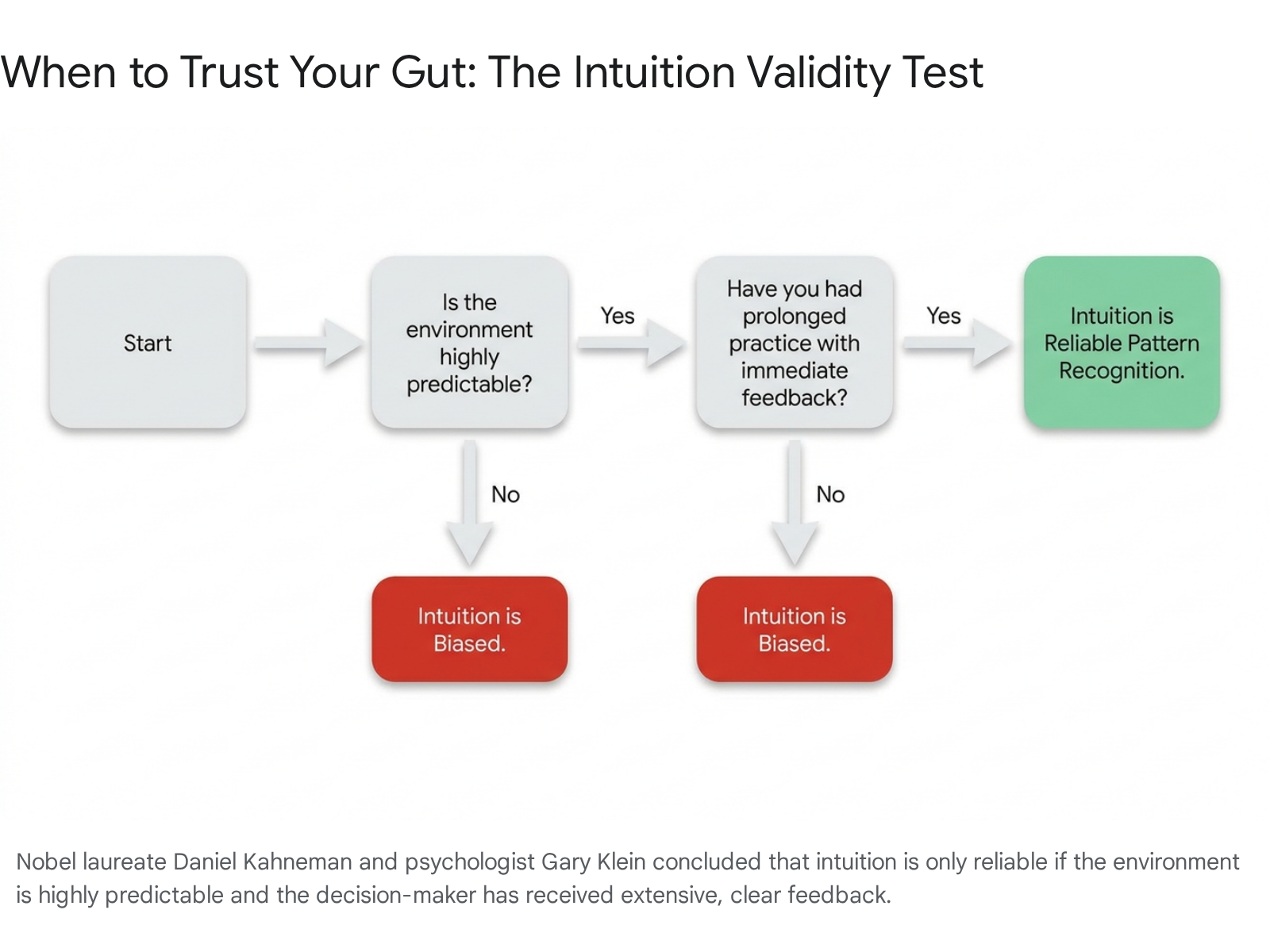
In a rare and fascinating collaborative paper titled "Conditions for intuitive expertise: a failure to disagree," Kahneman and Klein merged their opposing views to answer the ultimate question regarding when it is actually safe to trust your gut 2022.
High-Validity Environments and Feedback Loops
Kahneman and Klein concluded that the objective validity of an intuitive gut feeling depends entirely on two specific environmental conditions being met 2022:
- High-Validity Environment: The environment in which the decision takes place must have stable, predictable rules and regularities. Chess, firefighting, and routine medical diagnostics are high-validity environments because cause and effect are reliably linked 2022.
- Adequate Opportunity to Learn: The decision-maker must have had prolonged, repetitive practice in that specific environment, coupled with rapid and unambiguously clear feedback on whether their past choices were right or wrong 2022.
If you are a seasoned firefighter looking at a burning building and you get a sudden urge to evacuate your team, trust your gut. It is a rapid, subconscious assessment of environmental cues you have learned over thousands of hours of valid feedback 2223. However, if you are a corporate executive trying to predict the stock market, or an individual trying to navigate a novel geopolitical crisis, your gut feeling is practically worthless. In a "low-validity" environment, what feels like expert intuition is almost certainly an emotional response or an unchecked cognitive bias 332224.
Dual-Process Theory in Action
This academic debate surrounding intuition maps perfectly onto the "Dual-Process Theory" of cognition, a foundational framework in modern psychology. As mentioned earlier, human beings utilize two distinct systems of thinking. Type 1 processing is fast, autonomous, and intuitive, drawing heavily on brain regions like the amygdala and the basal ganglia 42526. Type 2 processing is slow, deliberate, and reflective, relying on the prefrontal cortex 42526.
When we rely heavily on our gut to navigate emotionally loaded decisions in low-validity environments, we are allowing Type 1 processing to dominate unchecked. Recent research in organizational psychology suggests that while Type 1 processing is absolutely essential for rapid adaptation and experiential learning, it remains highly vulnerable to emotional reasoning and associative biases 2526. To make a genuinely good decision, we must utilize the default-interventionist perspective of dual-process theory: we must engage Type 2 processing to actively monitor and, if necessary, consciously override the initial emotional impulses generated by Type 1 426.
Cultural Nuances in Decision-Making Architecture
The mechanics of how we approach hard choices are deeply colored by our cultural background and societal conditioning. The Western world heavily idolizes the concept of the rational, autonomous individual who makes definitive decisions completely free from outside influence. However, behavioral science confirms that this is not a universal baseline for human cognition.
Extensive research highlights profound differences in decision-making styles between highly individualistic cultures (such as the United States, the United Kingdom, and Australia) and collectivist cultures (such as Japan, Taiwan, and many nations across the African continent) 272829. Individuals raised in highly individualistic societies tend to display significantly greater confidence in analytical, independent decision-making, taking personal responsibility for highly ambiguous outcomes 2728.
In stark contrast, collectivist cultures lean heavily toward relational decision-making. In these societies, choices are deeply intertwined with family input, communal expectations, and social harmony 283031. In traditional Western behavioral science, relying on others to make a choice has sometimes been pejoratively viewed as "buck-passing," avoidance, or a distinct lack of personal autonomy 27. However, contemporary sociologists and cross-cultural psychologists vehemently argue that relational decision-making is an entirely valid, culturally appropriate expression of autonomy 303233. Making decisions as a collective effectively reduces the individual cognitive load, diffuses the terror of Knightian uncertainty, and acts as a powerful buffer against isolated emotional panic 3034.
The Irony of Emotion Norms
Given the emphasis on social harmony, one might reasonably assume that collectivist cultures would enforce much stricter norms regarding how people should authentically feel during a decision. Fascinatingly, a massive 2023 study published in the Journal of Personality and Social Psychology, which analyzed over 200,000 participants across 69 distinct countries, found the exact opposite to be true 3536.
The researchers discovered that people residing in individualistic nations actually stick much closer to their culture's established "emotion norms" than people in collectivist nations do 3536. The study revealed high levels of emotional homogeneity in Western nations. Because individualistic cultures view personal emotions as the ultimate expression of the authentic self, there is immense, unyielding societal pressure to experience the "correct" individual emotion - such as the relentless American cultural pressure to constantly "be happy" and pursue personal excitement 36.
This dynamic creates a hidden, dangerous trap for Western decision-makers. Because they are culturally conditioned to constantly monitor their internal emotional state for signs of authenticity, they are exponentially more susceptible to the cognitive distortion of emotional reasoning 1136. If a difficult decision does not make an individualist feel an immediate sense of authentic joy, excitement, or personal triumph, they may automatically assume the decision is wrong. They tragically confuse culturally conditioned emotional pressure with genuine, valid intuition.
Actionable Frameworks to Untangle Your Choices
Once you understand the psychological and cultural forces weighing heavily on your decisions, you need practical, evidence-based heuristics to break the paralysis. Whether you are battling pure cognitive overload or deep-seated emotional dread, the following frameworks can help you gain necessary clarity.
1. Jeff Bezos's Type 1 Versus Type 2 Doors
Amazon founder Jeff Bezos popularized a brilliant operational framework designed to cure organizational analysis paralysis by categorizing choices entirely based on their reversibility 13738.
Bezos separates decisions into two distinct categories: Type 1 and Type 2. Type 1 decisions are "one-way doors." They are highly consequential, heavily impactful, and practically impossible to reverse once made. Examples include selling a company, making a massive structural acquisition, or having a child. Because of their permanence, Type 1 decisions must be made slowly, carefully, and highly methodically 13739.
Type 2 decisions are "two-way doors." They are inherently changeable and highly reversible. If you make the wrong choice, you can simply open the door and walk back through to where you started. Examples include testing a new pricing model, launching a pilot feature for a software platform, or trying out a new daily habit 13739.
Most people and organizations cripple their own momentum by reflexively applying a heavyweight, slow-moving Type 1 deliberation process to a lightweight Type 2 decision 3739. Harvard Business Review research indicates that a staggering 95% of routine business decisions are actually reversible Type 2 decisions 40. If the decision causing you distress is fundamentally a two-way door, you do not need perfect information or complete emotional certainty. You must stop agonizing, make the choice quickly, and rely on the immediate feedback generated from the outcome to rapidly adjust your course 137.
2. Suzy Welch's 10-10-10 Rule
When a decision is intensely emotionally loaded, you need a psychological mechanism to forcefully create distance from your immediate, visceral feelings. Business writer and journalist Suzy Welch developed the 10-10-10 rule precisely for this purpose 53545556.
When facing a paralyzing dilemma, Welch advises asking yourself how you will realistically feel about the consequences of your decision in three distinct, escalating timeframes:
First, ask how you will feel in 10 minutes. This captures your immediate emotional state, highlighting the short-term gratification, acute anxiety, or sudden relief that follows an action 535456. Second, ask how you will feel in 10 months. This forces you to look at the practical, lived implications of the choice after the initial emotional dust has settled 535456. Finally, ask how you will feel in 10 years. This requires you to view the decision through the macro-lens of your core values, your long-term identity, and your ultimate life perspective 535456.
The human brain inherently knows that decisions are deeply rooted in feelings, but systematically evaluating long-term consequences helps immediately surface unconscious agendas, temporary fears, and cognitive distortions 5355. By projecting your mind into the distant future, you effectively bypass the immediate fight-or-flight response of System 1 and engage the reflective, analytical power of System 2. This ensures that short-term, emotionally loaded fear does not permanently sabotage your long-term structural value 5641.
3. Fear-Setting and Pre-Mortems
If you find yourself paralyzed primarily by the terror of making a mistake, practicing positive thinking will rarely help resolve the friction. Instead, behavioral science and risk management suggest leaning aggressively into the negative through a structured process called "Fear-Setting" or conducting a formal "Pre-Mortem" 3742.
A pre-mortem requires a team or an individual to fast-forward into the future and imagine that the decision they made has failed spectacularly 37. They then work backward to independently list every single potential cause for that complete failure, creating mitigation strategies for each one before the project even begins 37.
Similarly, the Fear-Setting protocol requires you to aggressively define your absolute nightmare scenario. You must write down the worst possible things that could realistically happen if you take the action you are avoiding. Then, you write down the specific preventative steps you could take to minimize the likelihood of those risks occurring. Finally, you list the exact repair steps you could take if the worst-case scenario actually materialized 42.
By explicitly defining the nightmare on paper, you effectively move the risk from the realm of boundless, terrifying Knightian uncertainty into the realm of manageable, calculable risk 31942. You usually realize that the absolute worst-case scenario is highly repairable and rarely fatal. This realization transforms fear from a paralyzing, emotionally loaded stop sign into a manageable, structural variable, freeing you to act 42.
Bottom line
A genuinely hard decision is an intricate, structural puzzle of missing data and competing variables that exhausts our analytical bandwidth, requiring simplification and robust criteria to resolve. Conversely, an emotionally loaded decision is a psychological trap characterized by loss aversion, unchecked emotional reasoning, and perceived identity threats, which cannot be solved by simply gathering more spreadsheets or data points. To break the paralysis, you must accurately diagnose the true nature of your hesitation, distinguish between reversible risks and profound uncertainties, and apply deliberate cognitive frameworks that separate your long-term values from your short-term fears.