
How the Sunk Cost Fallacy Affects Your Spending
The sunk cost fallacy is a cognitive bias that compels individuals to continue investing time, money, or effort into a failing endeavor simply because they have already committed unrecoverable resources to it. In spending decisions, this psychological trap causes people to throw good money after bad, prioritizing past expenditures over objective future benefits. Overcoming it requires a deliberate shift in perspective, training the mind to ignore historical costs and evaluate choices based solely on their forward-looking utility and opportunity costs.
The Anatomy of an Irrational Decision
At its core, the sunk cost fallacy represents a systematic deviation from rational economic theory. A purely rational actor evaluates a decision by weighing the anticipated future costs against the anticipated future benefits. Past investments - whether they involve financial capital, months of labor, or intense emotional energy - are fundamentally "sunk." Because they cannot be recovered regardless of what happens next, traditional economics dictates that they should carry absolute zero weight in present-day decision-making 11.
Yet, humans consistently violate this principle across nearly every domain of life. The concept is frequently referred to historically as the "Concorde fallacy." This moniker stems from the joint aerospace project between the British and French governments in the 1960s and 1970s to develop the Concorde supersonic passenger jet. Long before the aircraft took its first commercial flight in 1976, it became glaringly apparent to both governments that the jet would never achieve economic profitability. However, because they had already poured billions of dollars into the research and development phase, investors and politicians felt they had invested too much to quit. They continued to fund the failing project for another twenty-seven years, actively throwing good money after bad simply to justify the initial expenditure 45.
The phenomenon was formally introduced into the lexicon of behavioral economics in 1980 by Nobel laureate Richard Thaler, who sought to explain why consumers so often act in ways that contradict their own economic best interests 23. Later research by psychologists Hal Arkes and Catherine Blumer significantly expanded Thaler's definition. They demonstrated that the sunk cost effect extends far beyond monetary investments, heavily influencing how people allocate their time and physical effort 28. Whether it is an individual sitting through the final hour of a terrible movie because they paid for the ticket, or a corporate executive refusing to abandon a doomed software rollout because of the months spent coding it, the underlying behavioral mechanics remain identical 14.
The Neurological and Psychological Drivers
The inability to walk away from a sunk cost is not merely a quirk of human stubbornness; it is a complex interplay of evolutionary biology, neurochemistry, and cognitive biases. Researchers have identified several intertwined psychological forces that hijack the decision-making process when past investments are on the line.
One of the most profound drivers is loss aversion, a foundational concept in behavioral economics pioneered by Daniel Kahneman and Amos Tversky. Their research, formalized in Prospect Theory, demonstrates that humans do not process gains and losses symmetrically. The psychological pain experienced from losing a resource is roughly twice as powerful as the pleasure derived from gaining the equivalent resource 2910. When an individual abandons a failing project or an unprofitable investment, they are forced to crystallize and accept that loss. By choosing to continue the investment, the decision-maker artificially delays the painful emotional realization of the loss, clinging to a mathematically improbable hope that a turnaround will eventually validate their initial choice 411.
This aversion to loss is closely linked to a deep-seated desire to avoid the appearance of wastefulness. Human societies generally penalize waste. Consequently, stopping a project prematurely feels tantamount to admitting that the resources invested up to that point were entirely squandered. To protect their ego and sense of identity, individuals engage in intense self-justification. They double down on their original choices, attempting to prove to themselves and to outside observers that their initial instincts were correct, even when objective data suggests otherwise 11. This self-justification creates a state of cognitive dissonance, where the tension between the reality of a failing project and the individual's belief in their own competence becomes so uncomfortable that they alter their perception of the project's viability to ease the mental strain 2.
Furthermore, sunk costs are frequently compounded by unrealistic optimism and the endowment effect. Unrealistic optimism occurs when people believe they are less likely to experience negative events than their peers, causing them to overestimate their chances of success and underestimate objective risks once they have "skin in the game" 4. The endowment effect exacerbates this by causing people to overvalue things simply because they own them or have created them. In an organizational context, an executive might overvalue an internally developed software strategy simply because it belongs to their team, making the prospect of abandoning it feel like giving away something of immense value 1.
Fascinatingly, the sunk cost fallacy is not uniquely human, suggesting that its roots run deep in mammalian evolutionary biology. Neuroscientists at Stanford University conducted studies on mice and rats, measuring their responses in reward-seeking scenarios. The researchers established a baseline for how much effort an animal would expend for a sugary reward. Then, they systematically increased the "cost" of acquisition by requiring more effort or introducing mild discomfort. By measuring dopamine release in the striatum - a brain region critical for habit formation, learning, and reward processing - the scientists discovered a biological anomaly. While dopamine release was predictably influenced by the size of the reward, it also spiked significantly when the cost of the reward was raised. This biochemical reaction indicates that higher prior investments physically trigger greater dopamine reinforcement, literally hardwiring the brain to overvalue outcomes that required intense previous struggle or expenditure 845.
Does Age and Socioeconomic Status Matter?
While the neurological hardware for the sunk cost fallacy is universal, an individual's susceptibility to the bias fluctuates significantly based on their demographic background, life experience, and the environment in which they were raised. Recent empirical research has revealed striking disparities in how different age groups and socioeconomic classes respond to unrecoverable losses.
Studies tracking decision-making across the human lifespan indicate that older adults are remarkably better at avoiding the sunk cost fallacy than younger adults 146. This resistance appears to stem from developmental changes in emotional regulation and temporal perspective. As people age, they generally develop a reduced tendency to ruminate over negative events and a more sophisticated capacity for managing the regret associated with missed opportunities 6. When confronted with a failing scenario that is halfway complete, older adults demonstrate a much higher willingness to cancel the plan. Because they spend less mental energy dwelling on the hypothetical successes of the past or the perceived unfairness of the loss, they can more objectively assess the lack of future utility and decisively cut their losses 6.
Conversely, an individual's early childhood environment casts a long, enduring shadow over their financial decision-making in adulthood. Research investigating the impact of childhood socioeconomic status (SES) provides converging evidence that individuals who grew up in resource-scarce environments exhibit a substantially heightened susceptibility to the sunk cost fallacy 1617.
The mechanism behind this vulnerability relates to how the developing brain calibrates the concept of waste. In resource-abundant environments, a wasted investment is a minor setback; the penalty for abandoning a failing project is easily absorbed. However, in low-SES environments, resources are scarce and the penalty for waste is severe. Children raised in these environments are conditioned to perceive the loss of any prior investment as catastrophic 16. Consequently, when faced with a failing endeavor in adulthood, individuals from lower-SES backgrounds experience amplified loss aversion. They are highly reluctant to abandon inferior choices or cut their losses simply because the psychological trauma of acknowledging wasted resources is much more acute for them than for those raised in affluent settings 16. This dynamic is further amplified in developing nations where economic uncertainties are high. For example, a behavioral case study conducted in Nepal found that deeply ingrained economic insecurities dramatically amplified the sunk cost fallacy among both citizens and government institutions, leading to prolonged investments in vastly over-budget national infrastructure projects simply to avoid the stigma of a total financial write-off 17.
Cultural Wiring: Individualism Versus Collectivism
Beyond personal socioeconomic history, the broader cultural framework in which a person operates profoundly shapes how and where the sunk cost fallacy manifests. Cross-cultural psychological research frequently categorizes societies into two distinct paradigms: individualist cultures and collectivist cultures. Understanding the cognitive differences between these paradigms is essential for grasping how spending decisions and organizational commitments are made globally.
Individualist cultures, predominantly found in North America and Western Europe, emphasize autonomy, personal achievement, and independence. The self is viewed as a separate, distinct entity, and social status is generally awarded to those who stand out from the crowd 18789. In contrast, collectivist cultures, which are prevalent throughout East Asia, the Middle East, and parts of Africa, emphasize group harmony, interdependence, and duty to the in-group. The self is defined primarily through its relationships and societal roles, and individuals are expected to adjust their behavior to coordinate with the goals of their extended family or corporate clan 1879.
These differing visions of the self create distinct triggers for the sunk cost fallacy. In individualistic societies, the bias is frequently triggered by a need for self-enhancement and the protection of the private ego 187. Because an individualist's self-worth is intrinsically tied to their personal competence, abandoning a solo investment or a personal passion project feels like a devastating admission of personal failure. They will often escalate their commitment to a failing venture to protect their self-image as a rational, capable actor 17.
In collectivist cultures, however, the sunk cost fallacy is heavily mediated by social dynamics, specifically the concept of "face." In Chinese culture, this is articulated through the complex, interrelated concepts of mianzi and lian. Mianzi represents a person's public reputation, prestige, and social standing within their interpersonal network, while lian relates to their moral standing and basic integrity 2210. Maintaining social harmony and preserving mianzi is a primary social principle. Because violating social norms or failing publicly can lead to a catastrophic loss of face - and subsequently, a loss of vital social resources and opportunities - collectivists frequently endure massive sunk costs to protect their reputation 2210.
When a collectivist has invested heavily in a partnership, a family business, or a community endeavor, the decision to pull out is not evaluated merely on a financial spreadsheet. The overarching cost of losing face and betraying the loyalty of the in-group far outweighs the financial bleeding. This cultural phenomenon explains why collectivist individuals are often more willing to stay in highly costly, demanding relationships or continue funding unprofitable communal ventures; the social sanctions for appearing disloyal or wasteful are too severe to ignore 1810. Furthermore, because collectivism fosters holistic thinking - where objects and events are understood in relation to their broad context rather than in isolation - decision-makers in these cultures find it exceedingly difficult to separate a singular financial sunk cost from the wider web of social obligations attached to it 7.
| Cultural Paradigm | Primary Sunk Cost Trigger | Core Motivation | Decision-Making Focus | Example Scenario |
|---|---|---|---|---|
| Individualist | Ego preservation and self-enhancement. | Protecting personal autonomy and the image of individual competence. | Analytic: separating the investment from social context. | Continuing to fund a failing solo startup to avoid admitting personal defeat to peers. |
| Collectivist | Preservation of mianzi (face) and social harmony. | Protecting group reputation, demonstrating loyalty to the in-group. | Holistic: viewing the investment as intertwined with social obligations. | Maintaining a loss-making family enterprise to avoid shaming the family name in the community. |
It is worth noting that while the triggers differ, the prevalence of the fallacy remains high globally. A case study investigating decision-making in Nigeria, a nation with diverse cultural and ethnic dynamics, revealed that nearly half of all respondents committed the sunk cost fallacy in standard economic vignettes. The study also found that the fallacy was predominantly intrapersonal - meaning individuals were much more likely to fall into the trap when they were personally responsible for the initial decision, highlighting the universal role of self-justification regardless of the cultural backdrop 24.
Sunk Costs in Business Strategy and Financial Management
In the corporate arena, the sunk cost fallacy is responsible for billions of dollars in misallocated resources annually. It is the invisible force that explains why seventy percent of corporate mergers fail to deliver value, and why the vast majority of massive IT infrastructure projects end in partial or total failure 1.
Traditional economic models, such as Transaction Cost Economics (TCE), assume that human beings act as rational agents seeking to maximize utility and minimize costs. However, behavioral economics proves that executives routinely violate these assumptions 125. When an organization commits significant financial capital to a strategic direction, an institutional momentum is created. This momentum is incredibly difficult to halt, even when external market data clearly signals that the strategy is obsolete.
The demise of the Eastman Kodak Company serves as a textbook example of corporate sunk cost lock-in. Kodak engineers actually invented the first digital camera in 1975, and at its peak, the company controlled over eighty percent of the global photographic film market. When digital photography began to decimate film sales in the early 2000s, Kodak's executive leadership was unable to pivot. They were psychologically and financially addicted to the massive profit margins of their legacy film infrastructure. Rather than reassigning resources to dominate the emerging digital landscape, Kodak executives blamed early revenue drops on external factors, such as the economic fallout from the 9/11 attacks, and doubled down on marketing campaigns to save the film business. Their inability to abandon the billions they had sunk into chemical film manufacturing ultimately led to the company's bankruptcy as agile competitors seized the digital future 1. Similar patterns of escalation of commitment were observed in Blockbuster's fatal refusal to pivot toward digital streaming, anchored by their massive sunk investments in physical rental storefronts 26.
To combat this organizational inertia, data-driven businesses attempt to establish clear performance metrics and "kill criteria" before a project even begins. By utilizing predictive analytics and scenario modeling, leaders can force conversations to remain focused on future return on investment (ROI) rather than historical expenditure. Transparent, automated reporting removes the emotional attachment from the evaluation process, ensuring that decisions are based on objective facts rather than the ego-driven desire to rescue a failing initiative 26.
The Digital Exploitation of Past Investments
In the modern digital economy, the sunk cost fallacy is no longer simply a cognitive blind spot that individuals must overcome; it is a foundational feature of business models actively weaponized by platforms, subscription services, and application developers to maximize user retention and extract continuous revenue.
Subscription Creep and Engagement Debt
The software-as-a-service (SaaS) and digital media landscapes rely heavily on recurring subscription models. When a consumer pays a fixed upfront fee to access a service, that payment immediately becomes a sunk cost. Psychologically, the consumer feels compelled to engage with the service to "get their money's worth," effectively viewing the usage of the product as a way to amortize their irrecoverable expense 1427. Research shows that simply paying a fee increases a user's engagement. For instance, in Massive Open Online Courses (MOOCs), users who pay an enrollment fee are significantly more engaged than those who access the exact same material for free, purely due to the sunk cost effect 14.
However, this dynamic quickly turns predatory, leading to "subscription creep." Consumers frequently find themselves paying monthly fees for digital services they no longer use or derive value from. Because they have spent hundreds of dollars over several years, they feel an irrational obligation to maintain the subscription. They fear a sense of loss - not just of the money spent, but of the digital footprint, archived data, or curated profiles they have built on the platform. This loss of consumer surplus creates a massive misallocation of personal financial resources, funneling billions of dollars into unused tech services supported entirely by the user's wishful thinking that they might eventually need the service again 27.
The Architecture of Dark Patterns
To prevent users from breaking free of these subscription traps, digital platforms employ sophisticated user interface designs known as "dark patterns." These are deliberate design choices engineered to coerce, steer, or deceive users into making decisions that benefit the company at the expense of the consumer's best interests 111213.
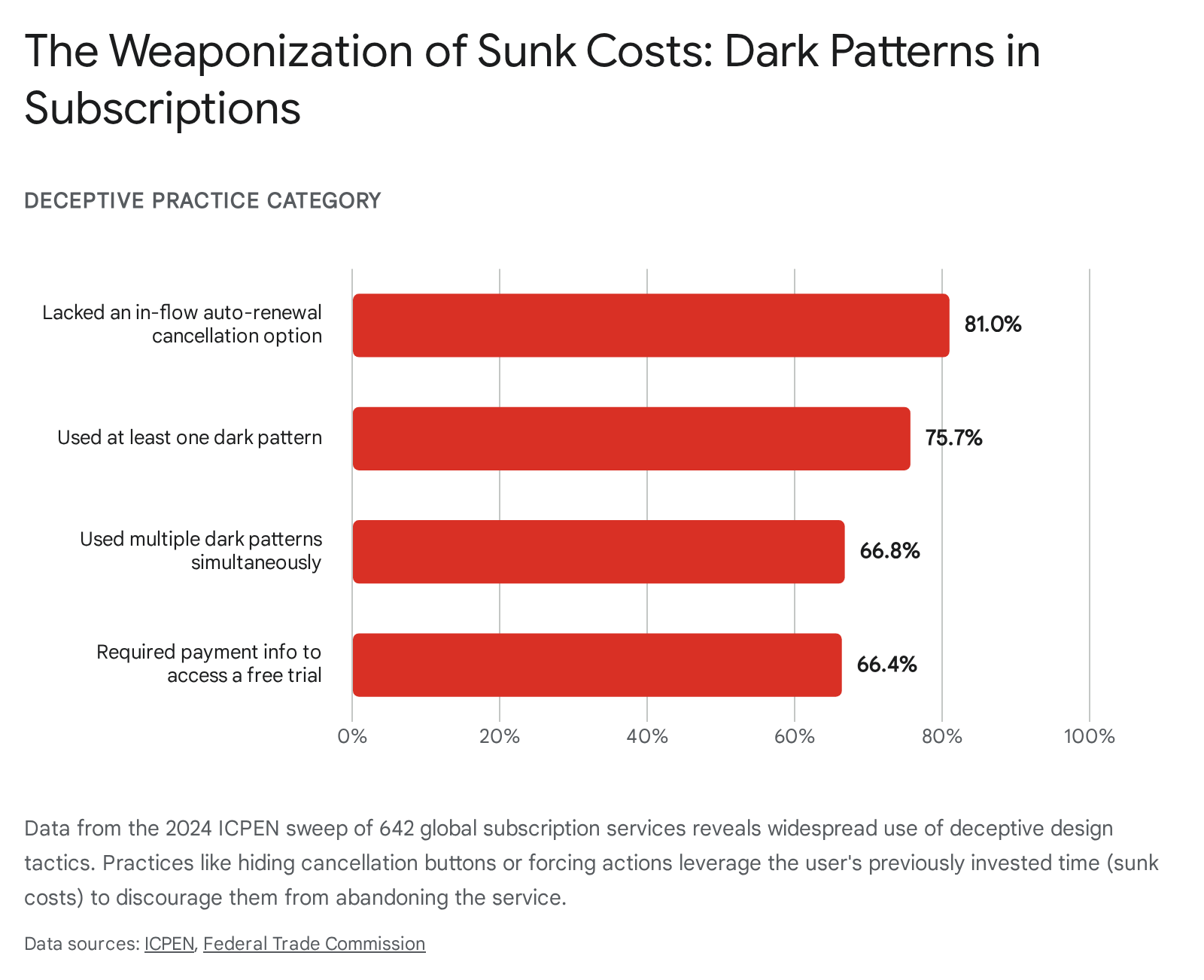
Global regulatory bodies have recently launched massive investigations into these manipulative techniques. A sweeping 2024 review conducted by the International Consumer Protection and Enforcement Network (ICPEN), in coordination with the Global Privacy Enforcement Network (GPEN) and the U.S. Federal Trade Commission, audited 642 subscription-based websites and mobile applications globally. The results revealed an astonishing landscape of digital coercion: nearly seventy-six percent of all examined platforms utilized at least one dark pattern, and over two-thirds utilized multiple patterns simultaneously 1314.
| Dark Pattern Category | Description of the Manipulative Practice | How It Exploits the Sunk Cost Fallacy |
|---|---|---|
| Sneaking / Drip-Pricing | Hiding or delaying the disclosure of critical information, such as mandatory fees or long-term costs, until the final step of a checkout process 111314. | The user has already invested time and effort navigating the interface and entering data. They accept the newly revealed fee to avoid wasting the effort already expended. |
| Subscription Traps | Automatically renewing a service after a free trial without obtaining explicit, informed consent, and hiding the cancellation toggle 13. | Forces the user to incur a monetary sunk cost instantly. Once charged, the user feels compelled to use the service rather than fight for a refund, entering the cycle of subscription creep. |
| Interface Interference | Visually obscuring important information, utilizing false hierarchies (making expensive options prominent), or pre-selecting options favorable to the business 1314. | By making the optimal choice difficult to find, the interface increases the cognitive cost of navigating away, steering the user to accept the default, sunk-cost-heavy option. |
| Obstruction / Sludge | Actively impeding activities that are in the consumer's best interest, making cancellation processes drastically more complex than enrollment processes 111213. | The sheer frustration and time required to cancel acts as a new barrier. The user abandons the cancellation attempt, surrendering to the ongoing sunk cost of the subscription. |
The Ontario Securities Commission (OSC) highlighted how these tactics are particularly dangerous in retail investing platforms. Certain trading apps utilize intermediate currencies or hide transaction costs until the very last screen before trade execution. The OSC explicitly noted that this technique is designed to activate the user's sunk cost bias. Because the investor has deliberated over the trade, transferred funds, and navigated the app, they feel highly invested in the outcome. They will accept the hidden charge to finalize the transaction, refusing to let their preparatory work go to waste 11.
To counter this, enterprises are increasingly adopting sophisticated subscription management software - such as Stripe, Chargebee, and Zuora - which, while designed to maximize recurring revenue, also standardizes billing practices and reduces subscriber friction, potentially mitigating the most aggressive forms of obstruction 3233343536.
The Psychology of Freemium Gaming and Microtransactions
Nowhere is the exploitation of the sunk cost fallacy more nakedly apparent than in the modern video game industry. Over the past decade, traditional one-time purchase models have been heavily supplanted by "live-service" or "freemium" games. These ecosystems are meticulously engineered around progression systems, event chains, and microtransactions that generate intense psychological inertia, making it agonizingly difficult for players to disengage 3738.
Developers understand that time is the ultimate sunk cost. By requiring players to invest hundreds of hours grinding for experience points, unlocking skill trees, and acquiring rare virtual cosmetics, the game transforms leisure into an economy of justification. A player who has reached the maximum level in a sprawling online role-playing game feels a profound obligation to continue playing, even if the game is no longer fun. Abandoning the game means abandoning a massive investment of time and nullifying a carefully constructed digital identity 37.
This psychological trap is vastly intensified by the introduction of "reward debt." Many modern games utilize cumulative, multi-day challenge systems that reward absolute consistency rather than isolated skill. If a player breaks a daily login streak, they incur a psychological cost: the loss of future, compounding rewards. This mechanic transforms entertainment into a daily duty, reinforcing engagement through guilt and the fear of missing out (FOMO) 3739.
The financial consequences of this design are staggering. Within these ecosystems, players frequently encounter "loot boxes" - virtual lotteries where users pay real money for a chance to win rare digital items. Because the drop rates for desirable items are often incredibly low, players frequently fall into a rapid sunk-cost spiral. After spending fifty dollars and receiving nothing of value, the player feels compelled to spend another fifty, convinced that the next draw must contain the reward that will justify the prior expenditure 383915. Academic research has established alarming correlations between high expenditure on loot boxes and problem gambling behaviors. In many instances, the financial success of these freemium platforms relies almost entirely on a tiny fraction of the player base - often referred to in industry parlance as "whales" - who are highly susceptible to these competitive dynamics and psychological traps, sometimes accumulating massive real-world debt simply to validate their initial in-game investments 391541.
Strategies for Cognitive Debiasing
Because the sunk cost fallacy is so deeply embedded in our cognitive architecture, passive awareness is rarely enough to overcome it. Behavioral economists, psychologists, and decision scientists have rigorously tested various "debiasing" techniques designed to actively disrupt the flawed mental accounting that leads to escalated commitments 1643.
A primary focus of debiasing is shifting the decision-maker from automatic, emotion-driven "System 1" thinking into deliberate, analytical "System 2" thinking. Studies demonstrate that individuals possessing a higher capacity for cognitive reflection - the ability to pause, question a heuristic impulse, and override it - are significantly less prone to sunk cost behavior 84. One highly effective method for cultivating this cognitive space is mindfulness meditation. Research indicates that both trait mindfulness and mindful states induced through brief meditation sessions actively reduce a person's tendency to let unrecoverable costs influence their current choices. Mindfulness achieves this by anchoring the individual's temporal focus entirely in the present moment, thereby severing the psychological tether to past regrets and reducing the negative emotional states that typically trigger loss aversion 414.
When attempting to rescue a failing project, the way individuals introspect matters immensely. Psychological interventions have shown that asking decision-makers to focus on how they might "improve" a bad situation often backfires, pushing them deeper into the sunk cost trap as they invent unrealistic scenarios where their investment finally pays off. Conversely, interventions that direct decision-makers to focus explicitly on their thoughts and feelings regarding the failure are highly effective at reducing the bias. By forcing individuals to confront and process the negative emotions associated with the loss, this technique suppresses unrealistic optimism and allows the decision-maker to accept reality and cancel the failing endeavor 6.
In highly structured environments, such as corporate accounting and auditing, professionals attempt to mitigate these biases through procedural debiasing. For example, the "Cognitive Checkpoint Protocol" integrates structured reflection and counterfactual reasoning directly into daily workflows, requiring auditors to explicitly search for disconfirming evidence before approving a continued expenditure 4445. Fascinatingly, this concept is even being applied to artificial intelligence. In deep reinforcement learning, AI agents can fall prey to a computational version of the sunk cost fallacy, wasting processing time on unproductive paths. Researchers have developed mechanisms like "Learn to Stop" (LEAST), which acts as an adaptive threshold, teaching the algorithm to evaluate the risk of suboptimality and strategically terminate unproductive episodes early, mimicking the very cognitive debiasing humans strive to achieve 46.
Zero-Based Thinking and Budgeting
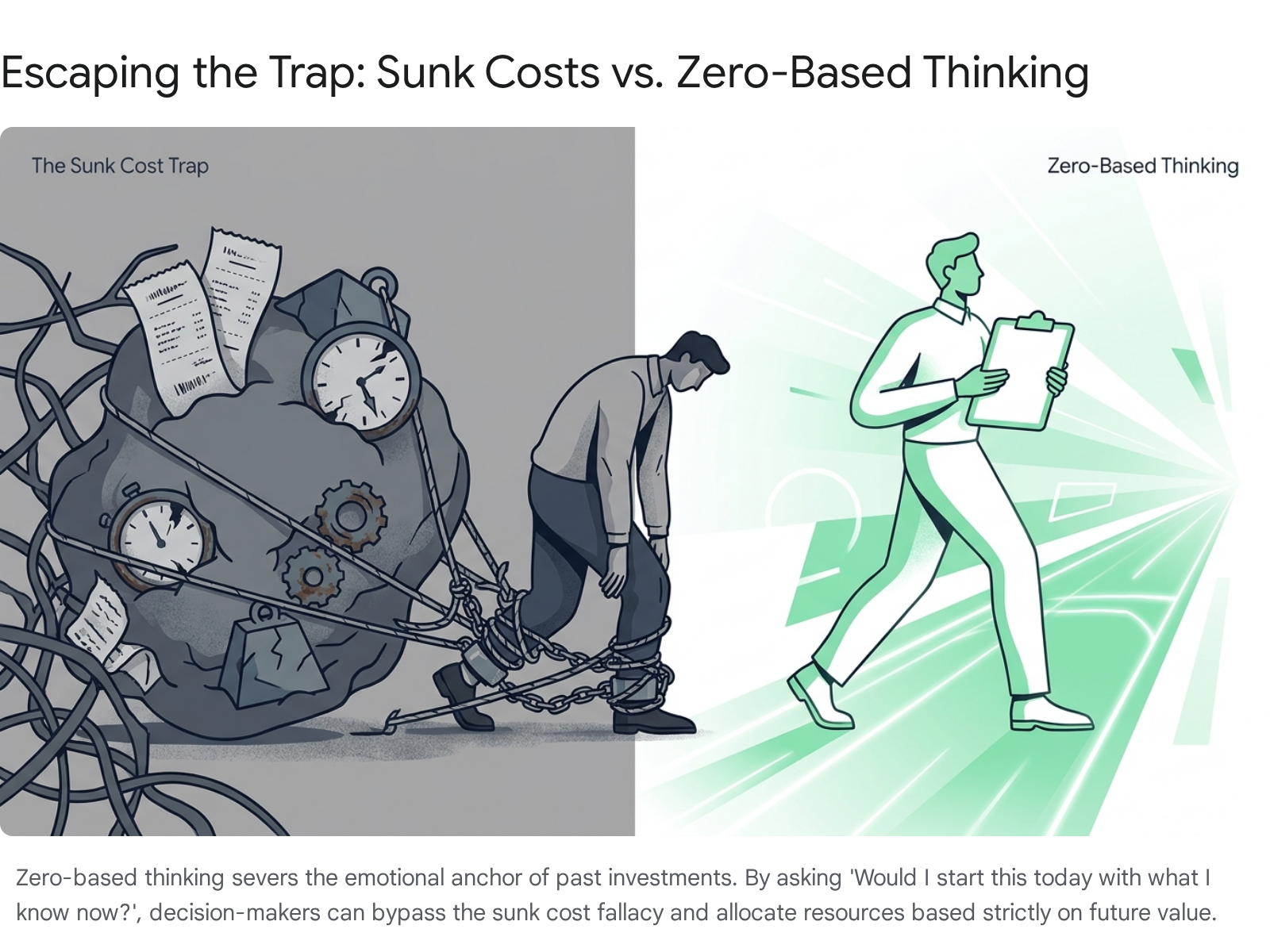
The most potent and universally applicable antidote to the sunk cost fallacy is a mental framework known as "zero-based thinking." Popularized by business strategists, this methodology requires a decision-maker to confront their commitments with a single, uncompromising question: "Knowing what I know now, if I were starting fresh today, would I begin this project, hire this person, or make this investment?" 1148. If the honest answer is no, it is a clear signal to cut losses immediately. This mental reset effectively eliminates the psychological weight of historical investments, forcing the individual to evaluate the situation strictly on its future potential 11.
This philosophy serves as the foundational architecture for Zero-Based Budgeting (ZBB). Developed in 1969 by Peter Pyhrr, an account manager at Texas Instruments, ZBB was designed to combat corporate bloat and align spending strictly with strategic objectives. Traditional budgeting is incremental; it takes the previous year's spending as a baseline and adjusts it slightly up or down. Pyhrr recognized that this traditional method inherently protects sunk costs and assumes past expenditures are permanently justified 171819.
Zero-based budgeting violently disrupts this assumption. It wipes the slate clean, starting from a "zero base" at the beginning of every single fiscal period. Every department manager must build their budget from the ground up, comprehensively justifying every single dollar of requested expenditure based on its current necessity and future return on investment 171952. While the process is undeniably time-consuming and can face steep opposition from managers protective of their fiefdoms, its rigorous application removes redundant spending, exposes inefficiencies, and enforces a relentless culture of forward-looking cost management 1853. The methodology gained such prominence that Jimmy Carter utilized Pyhrr's framework to overhaul the budget of the State of Georgia, later attempting to implement it across the United States federal government during his presidency 1718.
The zero-based methodology is equally transformative when applied to personal finance. For individuals struggling to manage household expenses or reign in impulse spending, a zero-based budget provides unparalleled clarity. Rather than hoping to have money left over at the end of the month, the individual takes their total monthly after-tax income and assigns every single dollar a specific, defined job before the month even begins 545556.
Essential expenses like housing and groceries are funded first, followed by savings, debt repayment, and finally discretionary categories like dining out or hobbies. The mathematical goal is absolute precision: Total Income minus Total Allocated Expenditures must equal exactly zero 555758. Because every dollar is accounted for, there is no ambiguous pool of cash to be mindlessly squandered. More importantly, because the budget is rebuilt from scratch each month, individuals are forced to continuously re-evaluate their priorities. If a gym membership went unused last month, the zero-based framework forces the user to actively decide if it deserves funding this month, short-circuiting the automated sunk-cost inertia that keeps unused subscriptions alive 5658.
Bottom line
The sunk cost fallacy is a powerful, evolutionarily rooted cognitive bias that consistently derails rational decision-making, compelling individuals and corporations to prioritize irrecoverable past investments over clear future utility. Its effects are pervasive, ranging from consumers trapped in manipulative, dark-pattern-laden subscription models and predatory freemium gaming loops, to massive corporate infrastructure failures. While susceptibility varies based on factors like age, socioeconomic upbringing, and the profound cultural pressures of preserving social standing, the underlying mechanism of loss aversion remains universal. Escaping this trap requires conscious cognitive effort - specifically, adopting zero-based thinking and structured introspection to sever the emotional tether to the past, ensuring that future resources are deployed solely to generate future value.