
How to Stop Procrastinating According to Science
Procrastination is fundamentally a failure of emotion regulation, not time management. The scientific consensus indicates that the most effective, evidence-based interventions for chronic procrastination are Cognitive Behavioral Therapy (CBT), "if-then" implementation intentions (often paired with mental contrasting), and mindfulness training. While popular productivity tools like the Pomodoro technique provide useful external structure, sustainable behavioral change requires psychological strategies that directly target the anxiety, task aversion, and maladaptive perfectionism underlying the delay.
The Psychological Roots of Task Avoidance
For decades, popular culture and traditional productivity literature treated procrastination as a symptom of laziness, a lack of personal ambition, or poor time management. However, modern behavioral science has reached a vastly different consensus: procrastination is an emotion-focused coping strategy 1.
When individuals procrastinate, they are not actually avoiding the task itself. Instead, they are avoiding the negative affective states - such as boredom, anxiety, frustration, incompetence, or self-doubt - that the task triggers 12. Procrastination is a behavioral response to an unwanted emotional experience.
The Procrastination Emotion Cycle
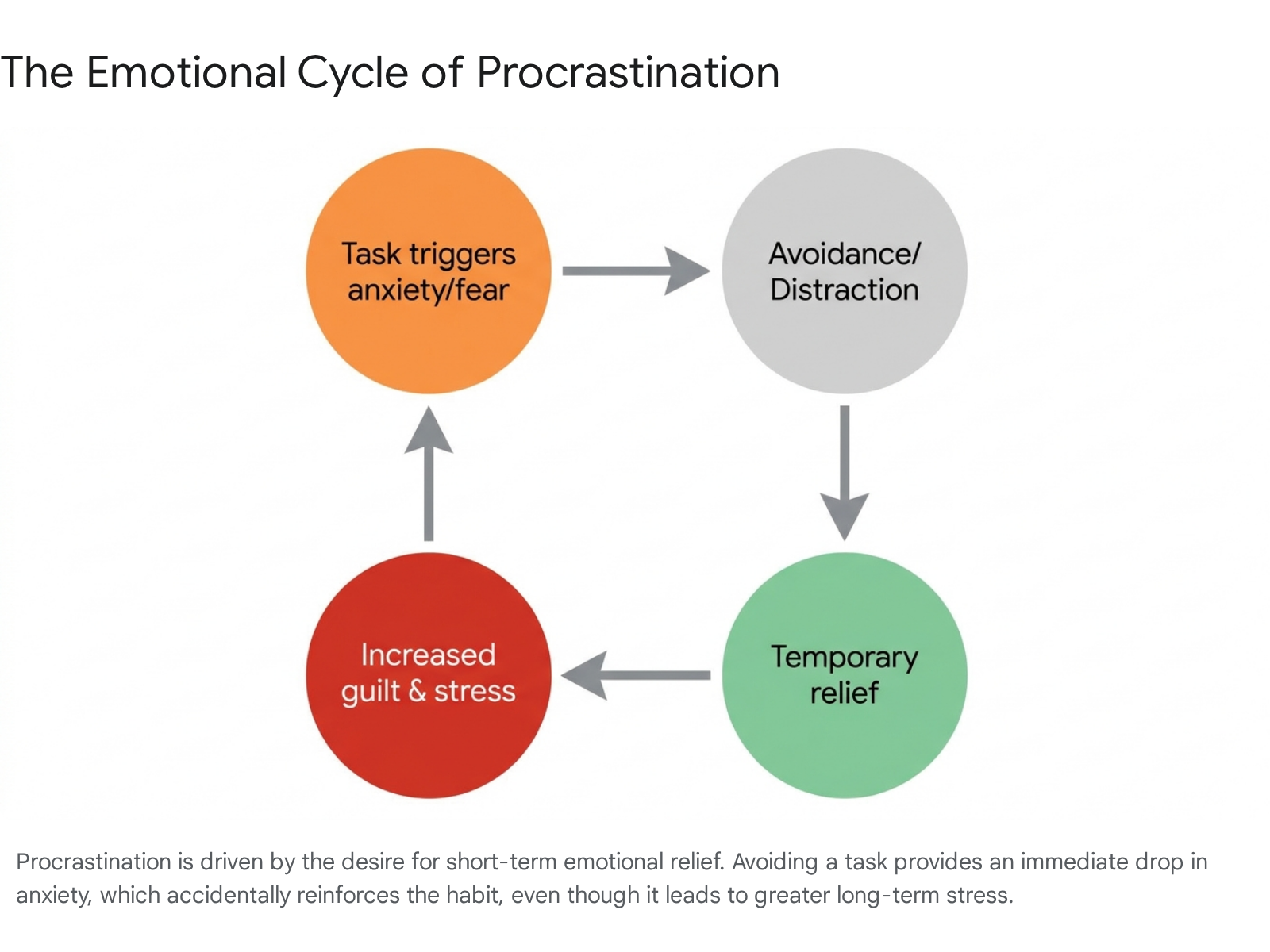
The mechanism driving this behavior is a powerful psychological feedback loop. When a person is faced with a daunting or aversive task, the brain registers emotional discomfort. To alleviate that distress, the individual delays the task and substitutes it with an activity that provides an immediate, albeit trivial, reward - such as scrolling through a smartphone, watching a video, or doing menial chores.
This substitution provides immediate, temporary relief from anxiety 2. Unfortunately, this relief accidentally reinforces the avoidance behavior. The brain learns that avoiding work makes it feel better in the short term. However, this relief is fleeting. As the deadline draws nearer, the initial anxiety returns, compounded by feelings of guilt, shame, and a heightened sense of pressure, which often triggers yet another cycle of avoidance 2.
Present Bias and Temporal Discounting
At a neurological and behavioral economic level, procrastination is heavily influenced by a cognitive quirk known as "present bias" or "temporal discounting" 43. This describes the human brain's systematic tendency to overvalue immediate rewards relative to future benefits, even when the future benefits are objectively far greater 445.
A relatable analogy for this phenomenon is the famous "Marshmallow Test" conducted by psychologist Walter Mischel in the late 1960s. When children were offered one marshmallow immediately or two marshmallows if they waited fifteen minutes, the immediate reward often felt far more compelling due to temporal impatience 43. The same logic applies to adult tasks. The immediate gratification of watching a television show holds greater concrete value to the limbic system than the abstract, delayed reward of achieving a good grade, getting a promotion, or preventing a health issue 34.
Temporal discounting dictates major life trade-offs every day. The task itself represents an immediate cost, characterized by effort, discomfort, or boredom. The benefit of completing the task represents a delayed reward. The brain discounts the future reward heavily while amplifying the immediate cost, leading to a strong preference for an immediate, less demanding activity 3. This creates an internal, invisible battle between the "present self," who prioritizes comfort, and the "future self," who must deal with the long-term consequences 36.
The Temporal Motivation Theory (TMT) Equation
To formalize these psychological impulses, behavioral scientists often rely on Temporal Motivation Theory (TMT), developed by Dr. Piers Steel. TMT models procrastination through an equation incorporating four primary variables that determine a person's motivation to complete a task 910:
| TMT Variable | Definition | Impact on Procrastination |
|---|---|---|
| Expectancy | The individual's confidence in their ability to successfully complete the task (self-efficacy). | Low expectancy increases procrastination. If you doubt your ability, you are more likely to avoid the task. |
| Value | How rewarding, meaningful, or enjoyable the task is perceived to be. | Low value increases procrastination. Aversive, boring tasks are frequently delayed. |
| Impulsiveness | The individual's tendency to be distracted by immediate rewards and their sensitivity to delay. | High impulsiveness strongly drives procrastination, making immediate distractions irresistible. |
| Delay | How far in the future the reward or consequence will be realized (e.g., deadline distance). | Greater delay reduces immediate motivation. A deadline months away generates less urgency than one tomorrow. |
According to TMT, procrastination occurs when impulsiveness and delay outweigh a person's expectancy of success and the value of the task. Successful interventions must therefore manipulate these variables - either by artificially reducing the delay, increasing the perceived value, or creating barriers to impulsive distractions 911.
The Personality Profile of a Procrastinator
While almost everyone procrastinates occasionally - with research showing it affects roughly 80% of people worldwide at some point in their lives - some individuals are dispositionally far more prone to chronic delay 12. Personality research consistently points to specific traits that leave individuals vulnerable to severe procrastination.
The Big Five Traits: Conscientiousness and Neuroticism
In the context of the Big Five personality model, low Conscientiousness is the strongest single trait predictor of chronic procrastination 1012. Meta-analyses find negative correlations of around r = -0.60 between conscientiousness and procrastination measures, which is among the strongest trait-behavior relationships documented in personality psychology 10.
Conscientiousness encompasses self-regulation, impulse control, reliability, organization, and the disposition to follow through on long-term commitments 1012. Individuals scoring low in this trait have less automatic self-regulatory behavior; they do not naturally create daily routines, resist impulses easily, or sustain effort toward distal goals without external frameworks 10.
Neuroticism, which relates to emotional instability and a propensity for experiencing negative emotions like anxiety, also plays a critical role. People with internalizing disorders often experience excessive negative emotions, low self-esteem, and impulsivity, each of which contributes heavily to procrastination 12. For individuals high in neuroticism, starting a task requires overcoming a massive hurdle of self-doubt and emotional distress.
The Role of Maladaptive Perfectionism and Trait Anxiety
One of the most paradoxical drivers of procrastination is perfectionism. While some assume perfectionists are highly productive, researchers distinguish between adaptive and maladaptive perfectionism. Maladaptive perfectionism involves harboring impossibly high standards accompanied by a paralyzing fear of failure and harsh self-criticism 78.
For maladaptive perfectionists, procrastination is a defense mechanism protecting their self-esteem. If they delay a project until the last minute and the result is mediocre, they can blame the lack of time rather than a lack of personal ability 15. Studies show a strong positive correlation between maladaptive perfectionism, trait anxiety, and procrastination 78. One cross-sectional survey of 126 participants determined that maladaptive perfectionism acts as a significant mediator between a person's baseline mindfulness and their procrastination habits. When individuals fear their work will be inadequate, their trait anxiety spikes, and they avoid the task entirely 8.
The Hidden Costs: Health, Wealth, and Well-Being
Procrastination is frequently dismissed as a minor character flaw or an eccentric habit, but extensive longitudinal and medical studies reveal that it has profound, cascading effects on an individual's life trajectory, career, and physical health.
Cardiovascular Risk, Hypertension, and Chronic Stress
The most alarming scientific findings regarding procrastination relate to physiological health. Habitual procrastination is genuinely bad for the heart.
A large-scale study of 980 volunteers led by psychologist Fuschia M. Sirois demonstrated that chronic procrastination is a severe vulnerability factor for hypertension and cardiovascular disease (CVD) 917. The study compared a community sample of individuals with hypertension and CVD to healthy controls, finding that higher procrastination scores were significantly predictive of CVD, even after controlling for age, sex, ethnicity, education level, and other major personality traits 917.
The mechanism connecting a behavioral habit to heart disease operates through two primary pathways: 1. The Direct Stress Pathway: The constant, looming anxiety of unfinished tasks elevates cortisol and keeps the body in a prolonged state of physiological arousal. Procrastinators in the CVD group engaged in significantly more behavioral disengagement and self-blame, compounding their stress load 917. 2. The Health Behavior Pathway: Procrastinators tend to delay necessary health behaviors. They postpone doctor's appointments, skip exercise routines, maintain poorer dietary habits, and delay seeking treatment for early symptoms. These delayed wellness behaviors compound the physiological risks over time 91011.
A three-wave longitudinal study spanning multiple months confirmed this procrastination-health model, finding that the link between chronic procrastination and poor health is primarily driven by heightened, chronic stress 1011.
Pain, Sleep, and Sedentary Risks
The physical toll of procrastination manifests long before severe cardiovascular events occur. An extensive Swedish cohort study of 3,525 university students assessed self-reported procrastination and health outcomes nine months later. The researchers found that procrastination was associated with subsequent mental health problems (depression and anxiety), disabling pain in the upper extremities, poor sleep quality, and higher levels of loneliness 12.
Furthermore, procrastination is intimately linked to a sedentary lifestyle - an independent risk factor for heart failure. A study tracking participants from the Mass General Brigham Biobank found that sedentary behavior exceeding 10.6 hours a day is associated with a marked 40-60 percent greater risk of heart failure and cardiovascular death 1314. Because procrastinators frequently delay physical activity in favor of sedentary distractions (such as browsing the internet or watching television), they inadvertently cross this dangerous threshold of inactivity 1315.
Lifelong Impacts on Career and Socioeconomic Status
The consequences of task delay extend far beyond the body. A nearly two-decade longitudinal study tracking individuals from youth into adulthood found that higher initial levels of procrastination predicted a range of negative life outcomes years later 16.
Those who demonstrated chronic procrastination early in life experienced lower academic achievement, which rippled into delayed entry into the workforce. Over time, these individuals saw fewer career promotions and ultimately earned reduced incomes compared to their less-procrastinating peers 16. The research confirms that procrastination is not merely a short-term academic phase but a meaningful, stable predictor of how people perform across multiple domains of life over the span of decades. Interestingly, the study found that making the transition from unstructured university life into the structured workforce helped some individuals naturally reduce their delaying behaviors, highlighting the importance of external environments on self-regulation 16.
Cultural and Demographic Variances in Procrastination
While procrastination is observed globally, its prevalence, triggers, and underlying psychological drivers vary significantly across different cultures and demographics.
A comprehensive sociodemographic meta-analysis comprising 193 quantitative studies and over 106,000 participants found that males, on average, tend to procrastinate slightly more than females across both general and academic profiles, showing a moderate but consistent effect size (r = 0.04) 1718. However, this gender gap is not universal in every specific regional study.
East vs. West: The Impact of Shame and Expectations
Cross-cultural studies consistently indicate that students from East Asian countries often report higher levels of academic procrastination - and correspondingly lower self-efficacy for self-regulation - than students from Western countries like the United States and Canada 19.
Researchers theorize this disparity is rooted in cultural environments that place immense familial and societal pressure on academic success. In cultures with high academic expectations, the fear of failure is amplified. This leads to higher levels of self-blame, shame, and an over-identification with negative states, all of which are powerful emotional triggers for task avoidance 19.
Time Orientation and Ethnic Identity
Different cultural perceptions of time also influence procrastination behaviors. A comparative cross-sectional analysis between undergraduate students in Indonesia and Egypt revealed intriguing differences. Egyptian students demonstrated significantly better self-regulation and were markedly more "future-oriented" in their time perspectives 7. Indonesian students, conversely, were more "present-oriented." As a result, Egyptian students exhibited slightly lower overall academic procrastination scores, highlighting how cultural attitudes toward the future dictate present-day task management 7.
In a unique study examining an under-researched population in New Caledonia (Oceania), researchers assessed 927 adolescents across Kanak, Polynesian, and European ethnicities 20. The study found relatively high levels of procrastination among Kanak and Polynesian adolescents compared to their European peers. Furthermore, in contrast to the global meta-analysis on gender, this specific study found that girls had significantly higher procrastination than boys. Notably, a strong ethnic identity moderated the relationship between ethnicity and procrastination for Kanak adolescents, suggesting that deep-seated cultural identity plays a complex role in self-regulation 20.
Finally, comparisons between students in Honduras and Spain found that in both Latin American and European contexts, high conscientiousness remained the strongest shield against procrastination. Additionally, higher self-esteem universally correlated with lower procrastination, as confident students were less likely to succumb to task-related anxiety 12.
Evidence-Based Interventions: What Actually Works?
Given the steep emotional, physical, and financial costs of procrastination, researchers have rigorously tested various clinical and behavioral interventions. The science firmly points away from superficial "time hacks" and toward structured psychological strategies that alter how a person relates to their tasks and emotions.
Below is a summary of the most extensively researched interventions, comparing their mechanisms and proven efficacy.
| Intervention Strategy | Primary Target / Mechanism | Typical Time Commitment | Evidence Level / Efficacy |
|---|---|---|---|
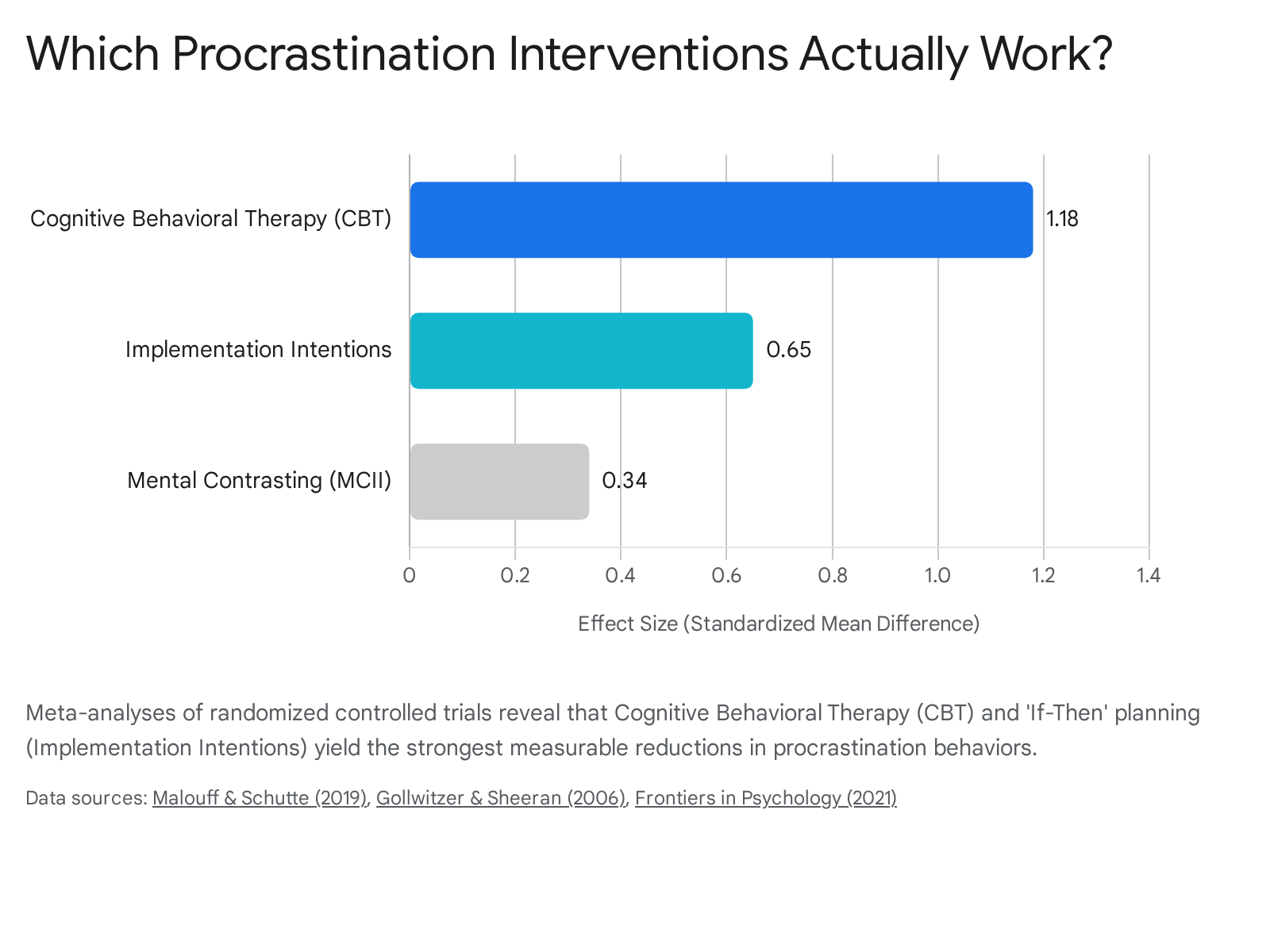
| Cognitive Behavioral Therapy (CBT) | Cognitive restructuring, emotion regulation, behavioral activation | 8-12 weeks of sessions + daily homework | Highest: Large positive effect (Hedges' g = ~1.18) 2122 |
| Implementation Intentions (If-Then Plans) | Bypassing conscious decision-making, linking cues to actions | < 5 minutes to set up | High: Medium-to-large positive effect (d = 0.65) 2324 |
| Mindfulness Training | Reducing task aversion, distress tolerance, present-moment awareness | 10 - 30 minutes daily practice | Moderate-High: Significant reductions in avoidance 252627 |
| Digital App Blockers | External constraints, limiting distractions, forced focus | Minimal (automated after setup) | Mixed: Highly effective for low self-control; causes stress in high self-control 3628 |
| Pomodoro Technique | Reducing task overwhelm, limiting fatigue | 25-minute intervals | Moderate: Improves mood/efficiency, but mixed data on reducing fatigue 2930 |
Cognitive Behavioral Therapy (CBT): The Gold Standard
Meta-analyses of randomized controlled trials consistently identify Cognitive Behavioral Therapy (CBT) as the most effective clinical treatment for severe, chronic procrastination. Across 12 randomized controlled trials encompassing 646 participants, CBT interventions demonstrated a massive positive effect size (Hedges' g = 1.18 to 1.36), drastically outperforming control groups and other therapeutic approaches like Acceptance and Commitment Therapy (ACT) 92131.
CBT operates on the foundational psychological premise that our thoughts, feelings, and behaviors are inextricably linked. Because procrastination is an emotional issue fueled by cognitive distortions, CBT therapists help individuals identify the irrational beliefs causing their avoidance 3233. Common distortions targeted in CBT include "catastrophizing" (believing a task will be impossibly difficult or painful) and perfectionism (believing that if a task isn't done flawlessly, it isn't worth starting) 233. By restructuring these thoughts, patients learn to separate their self-worth from their task performance 210.
Behavioral Activation and The 5-Minute Rule
While cognitive restructuring addresses the thought patterns, the behavioral component of CBT focuses on action. One of the most potent CBT tools for procrastination is Behavioral Activation, which works to break the physical inertia of avoidance 34.
A staple technique within this framework is the 5-Minute Rule. The concept is remarkably simple: you commit to working on an avoided task for just five minutes. You set a timer, and when it goes off, you have full permission to stop guilt-free 244.
This works because it reduces the startup requirement to its absolute smallest form, thereby drastically lowering the anxiety of beginning 210. In CBT, the underlying philosophy is that action changes emotion more reliably than emotion changes action 235. We often wait to "feel motivated" before starting a task, but CBT proves that motivation follows action. Once the five minutes are up, the initial dread has usually dissipated, momentum has built, and individuals naturally choose to continue working 24435.
Group vs. Internet-Based CBT (ICBT)
Given the treatment gap - where many more people need help for procrastination than can access therapists - researchers have evaluated scalable delivery methods. A pragmatic randomized controlled trial comparing self-guided Internet-based CBT (ICBT) to group CBT over eight weeks found massive within-group effect sizes for both formats (Cohen's d of 1.29 for ICBT and 1.24 for group CBT) 22.
Both formats successfully reduced procrastination, depression, and anxiety. However, a key nuance emerged at the six-month follow-up: participants in the group CBT format sustained their improvements over time, whereas those in the self-guided ICBT group showed some signs of deterioration 22. This suggests that while internet-delivered CBT is highly effective in the short term, the social accountability and therapeutic alliance found in group settings may be necessary to maintain lifelong behavioral changes 2236. Additionally, the efficacy of CBT relies heavily on "homework compliance" - the patient's willingness to practice self-monitoring and exposure exercises daily between sessions. Homework completion rates are strongly correlated with better clinical outcomes 3738.
Implementation Intentions: The Power of "If-Then" Planning
While CBT is highly effective, it often requires significant time, effort, and professional guidance. For a fast, self-directed, and low-cost intervention, behavioral science heavily supports Implementation Intentions, a strategy pioneered and extensively researched by psychologist Peter Gollwitzer 2324.
A landmark meta-analysis of 94 independent tests showed that implementation intentions have a medium-to-large positive effect (d = 0.65) on goal attainment 2324. Across health, academic, and professional domains, individuals utilizing this planning format achieved their goals at significantly higher rates than those who simply set standard goals 2439.
An implementation intention is a specific "if-then" plan that links a situational cue (a time, place, or event) directly to a goal-directed response. Instead of setting a vague goal like "I intend to study more this weekend," an implementation intention dictates: "If it is 9 a.m. on Saturday and I am sitting at my desk, then I will open my textbook and read for one hour" 2339.
This psychological hack works because it delegates the initiation of the action to an environmental cue, completely bypassing the need for willpower or conscious decision-making in the moment 24. By specifying the when, where, and how of goal striving in advance, you automate the behavior. When the environmental cue triggers, the action follows automatically, removing the space where the brain usually steps in to negotiate a delay or succumb to present bias 233940.
Mental Contrasting with Implementation Intentions (MCII / WOOP)
Implementation intentions become exponentially more powerful when combined with a technique called Mental Contrasting. Together, they form a strategy known as MCII, which is frequently popularized under the acronym WOOP (Wish, Outcome, Obstacle, Plan) 5141.
A meta-analysis of 21 empirical studies involving over 15,000 participants confirmed that MCII is an effective self-regulation strategy for goal attainment, demonstrating a small-to-medium effect size (g = 0.336) 4042. The science behind the WOOP framework works as follows 4143: 1. Wish & Outcome: You vividly imagine a feasible goal and the positive future of completing it. 2. Obstacle: You immediately contrast that rosy vision with the internal reality standing in your way (e.g., your tendency to get distracted by your phone, or feelings of exhaustion). 3. Plan: You form an "if-then" implementation intention specifically designed to overcome that exact obstacle (e.g., "If I feel the urge to check my phone, then I will put it in another room").
Research reveals a fascinating trap regarding positive thinking: simply daydreaming about success can actually reduce the physical energy needed to act, as the brain temporarily feels it has already achieved the goal 5141. Mental contrasting solves this by creating necessary psychological tension. It grounds your optimism in reality, signaling to the brain that effort is required to overcome the obstacle, making the subsequent "if-then" plan highly effective 4143.
Studies show MCII works across various demographics. In one intervention, 77 fifth-graders from an urban middle school were taught either MCII or a standard positive thinking strategy. The children who learned MCII showed vastly improved academic goal pursuit compared to those who only visualized success 43. Furthermore, diary studies suggest that utilizing MCII daily (rather than just as a one-off planning session at the start of a week) is particularly effective in reducing routine issues like bedtime procrastination 44.
Mindfulness Training: Disarming the Anxiety
Because procrastination is fundamentally rooted in an inability to tolerate negative emotions, mindfulness training has emerged as a surprisingly effective intervention 156.
Mindfulness involves bringing non-judgmental, compassionate awareness to the present moment, observing thoughts and physical sensations without necessarily reacting to them 344546. When a procrastinator feels the sudden, overwhelming urge to delay a task, mindfulness allows them to pause. Instead of reacting impulsively to the discomfort by seeking a distraction, they can objectively observe the emotion ("I am feeling a strong urge to avoid this because I am anxious about failing") and choose a different response 455947.
A meta-analysis synthesizing 33 studies confirmed a solid negative association between trait mindfulness and procrastination 5646. Clinical interventions demonstrate that just 10 to 30 minutes of daily mindfulness practice (such as breath-focused attention or body scans) can significantly reduce anxiety, lower depression symptoms, and subsequently decrease procrastination behavior 252659.
In a controlled experiment, 170 university students were asked to identify a task they were likely to put off. They were then separated into two groups. The group that completed just a brief, 3-minute mindfulness exercise reported a significantly stronger intention to tackle the avoided task compared to the control group 2759. The core tenet of mindfulness meditation - "simply begin again" - serves as a powerful, forgiving mantra for procrastinators. If your mind wanders or you get distracted, you do not judge yourself harshly; you simply notice the distraction, and begin the task again 1.
Time Management Frameworks: The Nuance of the Pomodoro Technique
The Pomodoro Technique - working in highly focused 25-minute intervals followed by a 5-minute break - is one of the most widely recommended anti-procrastination tools on the internet. It leverages the "Zeigarnik Effect," breaking massive, intimidating projects into small, manageable chunks that reduce the psychological resistance and overwhelm associated with starting 14862.
However, when tested in rigorous academic settings, the clinical evidence supporting its absolute superiority is surprisingly nuanced. A 2023 empirical study by Biwer et al. (and further investigated by Smits et al. in 2025) compared 87 to 94 university students using the Pomodoro technique, the Flowtime technique (studying until focus naturally wanes and taking proportional breaks), and entirely self-regulated breaks 293049.
The results were highly counter-intuitive: participants using strict Pomodoro breaks actually experienced a faster increase in fatigue and a faster decrease in motivation compared to those who took self-regulated breaks 293049. The rigid, artificial interruption of a timer can sometimes break a student's state of deep cognitive flow, making it harder to re-engage with the material 3048.
Despite this, the studies found no overall differences in total productivity levels or task completion between the groups 2949. Furthermore, students in the self-regulated group tended to take much longer breaks and reported higher levels of distractedness compared to the systematic conditions 2964. The scientific takeaway is that while Pomodoro is not a magic bullet for eliminating mental fatigue, the artificial urgency of a ticking timer provides essential scaffolding for individuals who lack self-regulation, tricking the brain into action and boosting overall efficiency 2962.
Do Digital App Blockers Actually Work?
With the rise of the digital economy, distractions are always just a click away. Digital wellbeing apps that block distracting websites, limit screen time, or track usage are incredibly popular. The scientific evidence regarding their efficacy, however, is mixed and highly dependent on the user's personality.
A comprehensive review of 13 apps designed to reduce maladaptive mobile phone use (MMPU) found that their effectiveness varied from weak to strong 50. Specific interventions, such as changing a phone display to grayscale mode, proved remarkably effective, reducing daily screen time by an average of 38 minutes 50.
A major study from Cornell University focusing on 657 students enrolled in online MOOCs found that external commitment tools - specifically apps that enforce a strict daily limit for time spent on distracting sites - were highly effective. Students using these blockers spent 24% more time on coursework, submitted 27% more assignments, and achieved grades roughly 0.29 standard deviations higher than a control group relying purely on willpower 28.
However, technology is not a universal cure. Research conducted by Microsoft's principal researchers found that the effectiveness of distraction blockers depends heavily on an individual's natural baseline of self-control 36. For people who already possess high self-control and time management skills, aggressive app blockers actually increased stress levels. Instead of taking necessary, healthy breaks, these individuals worked through bouts of severe fatigue 36. Conversely, for those who genuinely lack impulse control, external constraints are a highly successful way to bind future behavior and force focus 336.
Bottom line
The scientific consensus is clear: you cannot simply out-schedule an emotional problem. Procrastination is a deeply ingrained coping mechanism for managing anxiety, fear of failure, and perfectionism. While time-management tools like the Pomodoro technique or app blockers offer excellent structural scaffolding, the most robust, long-term solutions are psychological. Interventions like Cognitive Behavioral Therapy (CBT), the "five-minute rule," mindfulness training, and MCII/WOOP implementation intentions are proven to work because they directly disarm the emotional resistance at the starting line, proving that self-compassion and psychological flexibility are far more effective than brute-force willpower.