
Why Active Recall and Spaced Repetition Beat Cramming
To learn effectively and retain information for the long term, you must abandon passive review methods like rereading and highlighting. Instead, combine active recall - forcing your brain to retrieve information from memory - with spaced repetition, a strategic system of reviewing material at gradually increasing intervals. Together, these two evidence-based strategies intercept the brain's natural forgetting process and build durable neural pathways that last-minute cramming cannot achieve.
The Illusion of Mastery: Why Cramming Fails
Most students and lifelong learners rely on a predictable, high-stress routine: waiting until a few days before an exam, opening a textbook, highlighting key passages, and rereading their notes until the material feels familiar. This approach, known in cognitive psychology as "massed practice" or cramming, is one of the most popular study methods worldwide. It is also one of the least effective 12.
Decades of cognitive science research reveal that our intuitions about how we learn are fundamentally flawed. When you cram, you are rapidly exposing your brain to a high volume of information in a short period. This creates a temporary psychological phenomenon known as the fluency illusion 234.
When you reread a highlighted paragraph for the third time, your brain processes the text smoothly and easily. Because it requires less metabolic energy to process familiar text, you experience a drop in cognitive friction. You subconsciously interpret this ease of processing - this "fluency" - as mastery 45. Because you easily recognize the words on the page, you falsely assume you will be able to recall the underlying concepts from memory during a test or a real-world application 13.
However, recognition is not the same as recall. Recognition is handled by different regions of the brain, such as the visual cortex, whereas active recall relies heavily on the frontal cortex and temporal lobe 26.
Retrieval Strength vs. Storage Strength
Cognitive psychologists Robert and Elizabeth Bjork explain this paradox through the distinction between retrieval strength and storage strength 5. Retrieval strength measures how easily you can access a piece of information right now. Storage strength measures how deeply the information is embedded in your long-term memory 5.
Cramming produces a massive, immediate spike in retrieval strength, allowing you to pass a test the very next morning. However, because massed practice builds virtually no storage strength, that knowledge evaporates almost entirely within a matter of weeks 57. This explains why medical students who rely on cramming often cannot recall basic freshman anatomy by the time they start clinical rotations, and why language learners forget vocabulary shortly after a quiz 7.
A comprehensive 2013 meta-analysis by Dr. John Dunlosky and colleagues at Kent State University evaluated ten common learning techniques used by students. The researchers found that popular methods like highlighting, underlining, and rereading notes have "low utility." They do not promote the deep cognitive processing required for long-term retention, yet students consistently rate them as their preferred strategies 159.
The Ebbinghaus Forgetting Curve
To understand exactly why cramming fails so reliably, we must look to the late 19th century. In 1885, German psychologist Hermann Ebbinghaus conducted the first rigorous experiments on human memory and forgetting 2106. By memorizing lists of nonsense syllables (such as "WID" and "ZOF") and testing his own recall at specific intervals, he mapped the mathematical rate at which the brain discards newly acquired information 6.
The resulting graph, known as the Ebbinghaus Forgetting Curve, reveals a harsh biological reality: memory decay is immediate and steep. Without active review, humans forget approximately 50% of newly learned information within the first hour 1012. Within 24 hours, up to 70% of the information is lost, and by the end of a single week, retention drops to roughly 20% to 25% 12.
The human brain is highly economical; it constantly prunes neural connections it deems unnecessary to make room for new stimuli. Cramming attempts to fight this curve passively, essentially pouring water into a leaky bucket. To truly learn, we must intercept the forgetting curve actively.
Data indicates a stark contrast between cramming and strategic review over a 30-day period. While cramming yields moderate 24-hour recall, retention crashes to near zero within a month. Spacing out study sessions physically alters the rate of decay, maintaining retention above 80% 13.
| Time Elapsed | Cramming (Massed Practice) Retention | Spaced Repetition Retention |
|---|---|---|
| 24 Hours | 40% | 95% |
| 1 Week | 20% | 85% |
| 1 Month | 8% | 80% |
| 6 Months | 2% | 75% |
(Data compiled from major cognitive science meta-analyses measuring delayed recall 13.)
Active Recall: The Engine of Memory Formation
If rereading and highlighting are the illusion of learning, what is the reality? Cognitive science points to a principle called the Testing Effect, a concept heavily popularized by researchers Henry Roediger and Jeffrey Karpicke in the early 2000s, though its roots trace back to early 20th-century studies by Abbot and Gates 789.
The Testing Effect demonstrates that the act of retrieving information from memory is not merely a way to measure what you know; it is actually the most powerful way to create and consolidate the memory itself 1079. This process is known as active recall or retrieval practice.
When you close a textbook and struggle to explain a concept in your own words, or when you test yourself with a blank sheet of paper, you engage your brain in a difficult reconstructive process. Even if you fail to remember the exact answer, the mental struggle signals to your brain that this specific piece of information is important 1010.
In a landmark 2008 study published in the journal Science, Karpicke and Roediger tested students learning foreign language vocabulary under four different conditions. They found that once a student had successfully recalled a word, dropping it from further testing but continuing to restudy it had virtually no effect on delayed recall. However, continuing to test the student on the word (without restudying) produced a massive positive effect on retention 11.
Furthermore, students' predictions of their own performance were entirely uncorrelated with their actual test results. Those who passively restudied felt highly confident but performed poorly, while those who practiced retrieval felt they were struggling but achieved superior long-term retention 811.
In follow-up research involving complex educational texts, practicing active retrieval just one time doubled long-term retention compared to reading the text once (34% versus 15%). Engaging in repeated retrieval increased long-term retention to 80%, representing a 400% improvement over single-exposure studying 8.
The Neuroscience of Retrieval and Semantic Foraging
Using advanced functional MRI (fMRI) technology, neuroscientists have observed that active recall simultaneously activates multiple critical brain regions. It engages the prefrontal cortex (responsible for decision-making and focused thinking), the hippocampus (crucial for forming and organizing new memories), and the temporal lobe (which processes language and integrates sensory input) 6.
When we attempt to recall information - such as trying to name all the animals we can think of in a minute - we do not just read from a static mental hard drive. Cognitive scientists describe this process as "semantic foraging." Much like an animal foraging for food in physical space, our brains search locally within "patches" of related information before transitioning globally to new conceptual patches when the current mental region is depleted 1213. Active recall trains this associative search process, making the transitions between memory patches faster and more robust.
The Forest Path Analogy
To visualize why active recall works at a cellular level, neuroscientists often use the analogy of a forest path to explain a concept known as "base-level learning" and brain plasticity 2122.
Imagine your brain as a dense, overgrown forest. A specific piece of information - a mathematical formula, a foreign vocabulary word, or a historical date - is a cabin hidden deep within those woods.
When you first learn the information, you carve a rough, narrow trail to the cabin. If you never walk that trail again, the forest quickly grows back over it. This is time and memory decay taking over 21.
Rereading a textbook is the equivalent of flying over the forest in a helicopter and pointing at the cabin. You know where it is, and it feels familiar, but you aren't doing the hard work on the ground.
Active recall, on the other hand, forces you to walk the trail. Every time you retrieve the memory without external help, you are hacking away the weeds, stomping down the dirt, and widening the path 2122. With each successful retrieval, the brain increases the "activation score" of that memory chunk, strengthening the neural pathways and making the information faster and easier to access in the future 1021.
Embracing Desirable Difficulties
Active recall feels frustrating. It requires significantly more mental effort than passively reading a beautifully formatted study guide. However, this frustration is a feature, not a bug.
Psychologists refer to this cognitive friction as a "desirable difficulty" 2324. The more effort your brain has to exert to retrieve a memory (without reaching the point of complete failure), the stronger the resulting neural connection will be. If learning feels too easy, it is highly likely that durable memory consolidation is not occurring.
| Feature | Passive Review (Ineffective) | Active Recall (Highly Effective) |
|---|---|---|
| Common Methods | Rereading, highlighting, watching videos, summarizing with open notes. | Flashcards, practice tests, the Feynman Technique (teaching aloud), blank-page brain dumps. |
| Cognitive Experience | Feels easy, fluid, and highly productive. Low cognitive load. | Feels difficult, halting, and frustrating. High cognitive load. |
| Brain Activity | Relies heavily on recognition memory (visual cortex). | Forces reconstructive memory (hippocampus and prefrontal cortex). |
| Long-Term Result | Rapid decay. Creates a false sense of security (fluency illusion). | Durable retention. Identifies actual knowledge gaps accurately. |
Spaced Repetition: Timing the Retrieval
If active recall dictates how you should study, spaced repetition dictates when you should study 1025.
Spaced repetition (also called distributed practice) is the technique of reviewing information at strategically increasing intervals over time 210. Rather than spending ten hours studying a topic in a single block the night before an exam, spaced repetition breaks that same ten hours into smaller, targeted sessions spread across days, weeks, or months (e.g., two hours a day for five days) 23.
A massive 2006 meta-analysis by Cepeda and colleagues reviewed 254 studies involving over 14,000 participants. They found a definitive pattern: distributing practice over time consistently produced better retention than massing the same amount of practice into a single session 923. Depending on the length of the delay, spaced practice improves retention by 10% to 30% over cramming, using the exact same amount of study time 23.
The Biological Imperative of Sleep and Consolidation
Why does spacing work so effectively? The secret lies in sleep architecture and the biological limits of memory consolidation.
Your brain requires roughly 6 to 8 hours of sleep to properly consolidate memories, transferring them from fragile short-term working memory into durable long-term storage within the neocortex 13. During sleep, the hippocampus replays the day's events, weaving new memories into existing neural networks 26.
When you cram for an exam, you force all the information into your short-term memory and undergo only one cycle of sleep consolidation before the test. This gives the brain minimal opportunity to build structural integrity around the data.
When you space your studying, you undergo multiple sleep consolidation cycles 13. Furthermore, by waiting until a memory is just on the verge of being forgotten before you retrieve it, you maximize the desirable difficulty. The effort required to pull a fading memory back from the brink of the forgetting curve signals to the brain that this information is vital for survival, prompting it to reinforce the synaptic connections heavily 727.
Interleaved Practice: Mixing the Material
While active recall and spaced repetition are the titans of learning science, a third strategy - often overlooked but rated highly by researchers - is interleaved practice 528.
Massed practice often tricks students in another way: they study one single type of problem repeatedly before moving on to the next. For example, a math student might solve twenty addition problems, then twenty subtraction problems, then twenty multiplication problems. Because the student knows the "rule" for the block they are currently in, performance rapidly improves, creating another illusion of mastery 5.
Interleaved practice, by contrast, mixes different types of problems or concepts together. The student must solve an addition problem, followed by a division problem, followed by a subtraction problem 5. This strategy forces the brain to not only practice the execution of a skill but also to practice identifying which skill to apply given a specific context 28.
Initial research shows that interleaved practice dramatically improves student achievement, particularly in mathematics and problem-solving domains. In a study where college students learned to compute the volume of four different geometric solids, those who used interleaved practice significantly outperformed those who used massed practice on delayed tests 5.
Implementing the Science: The Leitner System
You can implement spaced repetition manually using a basic study calendar, reviewing material after 1 day, then 3 days, then 1 week, then 2 weeks 92914. However, the most efficient way to manage spaced repetition is by adapting the intervals dynamically based on your personal performance.
In the 1970s, German psychologist Sebastian Leitner developed a physical flashcard system that perfectly operationalized this concept 15. The Leitner System prioritizes studying difficult material more frequently than easy material, ensuring you do not waste valuable time reviewing concepts you have already mastered 32.
Here is how the analog Leitner System functions: 1. The Setup: Create 3 to 5 physical boxes (or distinct piles) for your flashcards. All newly created cards begin in Box 1 153233. 2. The Rules of Promotion: You review the cards in Box 1 every day. If you successfully recall a card from Box 1, it is "promoted" to Box 2. If you recall a card from Box 2, it is promoted to Box 3, and so on 1516. 3. The Penalty for Forgetting: If you fail to recall a card from any advanced box, it is immediately demoted all the way back to Box 1 153316. This is a crucial mechanism: forgetting is not a failure; it is simply the system recalibrating to ensure you heavily review your weak points. 4. The Spacing Schedule: Box 1 is reviewed daily. Box 2 is reviewed every two days. Box 3 is reviewed every four days. Box 4 is reviewed weekly. Box 5 is reviewed bi-weekly 3235.
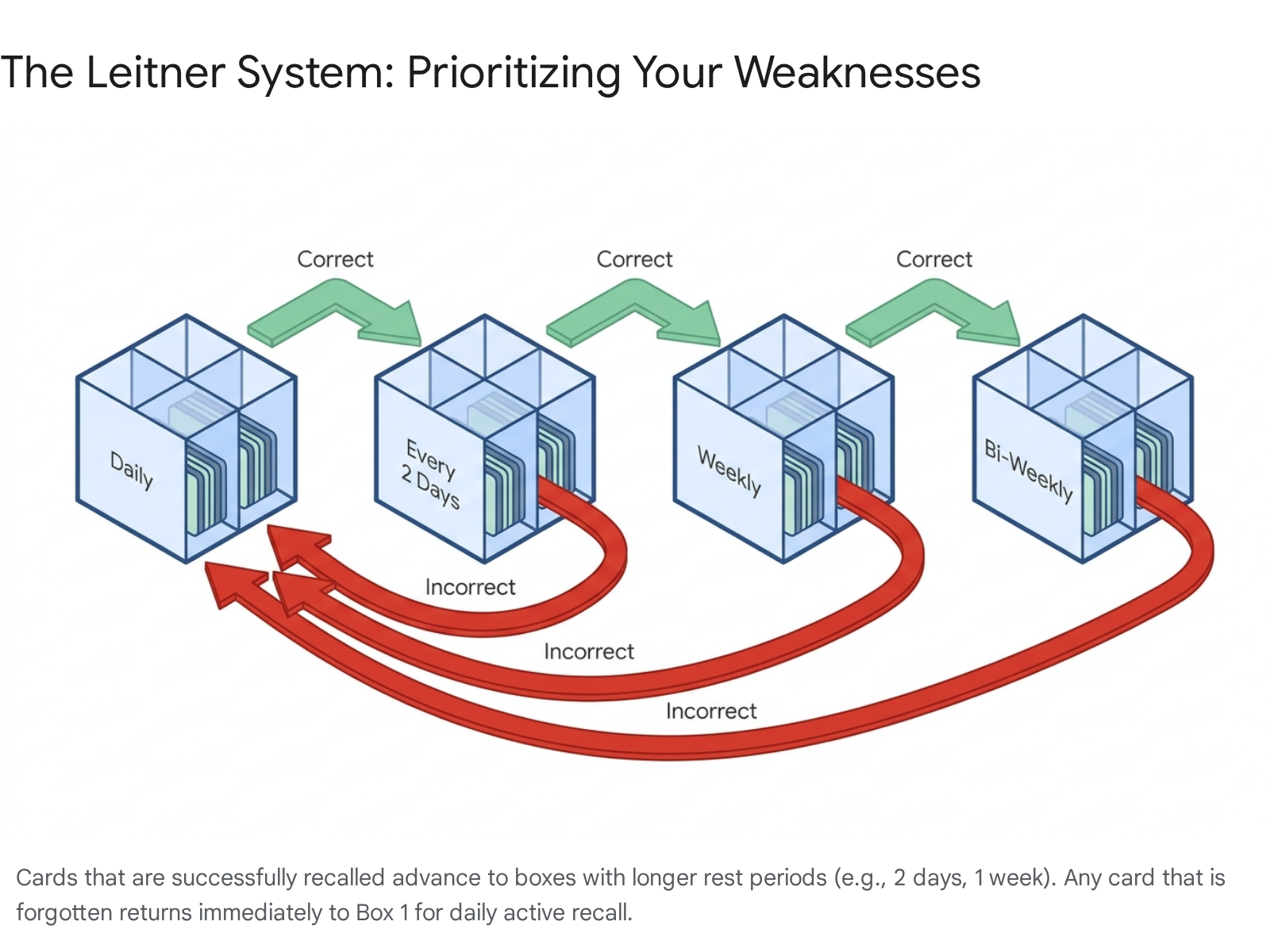
Today, the underlying logic of the Leitner system forms the algorithmic backbone of popular digital spaced-repetition software (SRS) like Anki, SuperMemo, Quizlet, and LearnLog 2327143536. These programs use modified mathematical algorithms (such as SM-2) to track your individual performance on every single card, calculating exactly when you are statistically most likely to forget a fact, and scheduling it for review on that exact day 2336.
Age and Individual Differences: Does This Work for Everyone?
A common critique of cognitive psychology studies is that they are predominantly conducted on healthy, university-aged students 9. Educators naturally question whether these high-effort strategies are appropriate for younger children or individuals with learning differences.
Recent research confirms that active recall is highly effective across varying age groups and cognitive profiles, though implementation must be adapted. Studies examining elementary-aged children (around 10 years old) show robust retrieval practice effects that significantly outperform restudying 1718. Notably, the benefits of retrieval practice in these children held true regardless of their individual reading comprehension levels or processing speeds 17.
However, young students require guided retrieval methods. While university students benefit greatly from unstructured free recall (e.g., a blank page brain dump), younger learners tend to struggle with this lack of structure. They benefit more from tests that provide a degree of scaffolding, such as short-answer questions, fill-in-the-blank prompts, and immediate accuracy feedback to prevent them from memorizing incorrect answers (error preservation) 1839.
Additionally, combining active recall with spaced repetition has proven highly beneficial for learners with ADHD or those prone to cognitive fatigue. Cramming overwhelms working memory, but spaced repetition breaks study sessions into manageable, focused chunks. This keeps cognitive demand within natural limits and prevents the burnout associated with intensive, multi-hour study blocks 1040.
Rethinking "Rote" Memorization Across Cultures
While Western educational discourse heavily champions terms like "active learning," it frequently contrasts these ideals with "rote memorization," which is often disparaged as a backward, passive, and uncreative relic of older educational systems 411943.
However, cross-cultural educational research suggests this binary is overly simplistic and culturally biased. The consistently high academic performance of students in East Asian countries (such as China, Japan, and South Korea) and the robust oral traditions of the Indian subcontinent force a critical reevaluation of what "rote" learning actually entails 192045.
Retrieval in Disguise
In many East Asian educational contexts, what Western observers quickly label as "rote learning" is not mindless, passive rereading. For many Chinese learners, repetition and memorization are highly complex, active Confucian-based memory strategies designed to consolidate vocabulary and concepts through relentless, effortful retrieval 1921.
A study of university students in China found that high achievers who valued traditional memorization methods often scored higher in English proficiency tests. This occurred precisely because their "rote" methods involved writing words from memory repeatedly - a rudimentary but highly effective physical form of active recall 21.
Similarly, the ancient Vedic education system in India relied entirely on oral traditions to preserve massive volumes of complex texts over millennia without written records 45. This was achieved not through passive reading, but through rigorous rhythmic recitation, chanting, and structured meditation 45.
Modern learning scientists increasingly recognize that these ancient practices are fundamentally aligned with the biological principles of active recall and spaced repetition 4345. When a student chants a complex formula rhythmically from memory, they are forcing the hippocampus to reconstruct the information without external visual aids.
Cultural Barriers to Pedagogical Shifts
Understanding these cultural nuances is vital for global educators. When Western-trained teachers attempt to implement modern, interactive "active learning" classrooms in non-Western contexts, they frequently encounter resistance or silence from students 222324.
This classroom silence is often misinterpreted as a lack of engagement or intelligence. However, research into the social distance of migrant and international students indicates that silence can be a culturally conditioned sign of respect, a protective measure against language barriers, or a method of careful internal cognitive processing 2324.
Educational models that successfully blend the cognitive science of spaced repetition with culturally relevant pedagogy - such as integrating rhythmic recall or respecting the deeply ingrained value of intensive, repetitive practice - yield the most robust outcomes across diverse student populations 4525.
The AI Revolution in Studying: Socratic Tutors vs. Answer Machines
In recent years, generative Artificial Intelligence (AI) and Large Language Models (LLMs) have entered the educational space, fundamentally changing how students interact with study material. Platforms like ChatGPT, Claude, and specialized tools (e.g., Recallify, StudyCards AI) allow students to instantly convert lecture PDFs into active recall flashcards, drastically reducing the manual labor of study preparation 243640.
However, the integration of AI introduces a severe double-edged sword regarding human cognition.
The Threat of Cognitive Offloading
When used improperly, AI can act as the ultimate cognitive crutch, vastly exacerbating the fluency illusion. A 2025 study from the Massachusetts Institute of Technology (MIT) monitored the brain activity of students writing essays via electroencephalography (EEG). They found that students using ChatGPT exhibited the lowest levels of neural activity and cognitive engagement compared to students using Google Search or working unaided 51. Furthermore, when later asked to recall their work, the AI-assisted students struggled significantly, suggesting that relying on AI from the outset diminishes long-term learning and memory formation 51.
This phenomenon is known as cognitive offloading - outsourcing our mental processing to an external tool. A comprehensive 2026 experimental study involving 138 undergraduates found that students given unrestricted access to a generative AI tutor suffered a severe drop in their "metacognitive monitoring accuracy" 26. Because the AI provided polished, immediate answers, students lost the ability to accurately gauge what they actually knew versus what the AI knew 526. Interaction logs showed that 76% of student prompts were simply asking the AI for direct answers or verification, entirely bypassing the desirable difficulties necessary for memory creation 26.
The Human-in-the-Loop Socratic Method
To harness AI effectively for learning, students and educators must invert how they use it. Instead of treating AI as an "answer vending machine," evidence strongly suggests configuring the AI to act as a Socratic Tutor 27282956.
The Socratic method involves learning through disciplined questioning rather than passive reading or lecturing. By explicitly prompting an AI to "ask one question at a time," "never give the full answer immediately," and "point out flaws in my logic," students can automate the most difficult parts of active recall 2730.
Research indicates that when AI provides adaptive, metacognitive feedback - forcing the student to synthesize the answer themselves rather than just reading an AI summary - retention and transfer of knowledge improve significantly 3132. A 2026 Stanford University study examining 1,000 elementary students found that using an AI tool called Tutor CoPilot, which guided human tutors to prompt students to explain their thinking rather than giving answers, increased student topic mastery by four percentage points 33.
| Goal | Ineffective AI Prompt (The "Vending Machine") | Effective AI Prompt (The "Socratic Tutor") |
|---|---|---|
| Summarizing Text | "Summarize this chapter into 5 bullet points for my exam tomorrow." | "I am going to explain the core concepts of this chapter to you from memory. Tell me what I got wrong, and what I avoided explaining." |
| Learning Concepts | "Explain the Krebs cycle to me simply." | "Act as a strict tutor. Ask me one question at a time about the Krebs cycle. If I hesitate, give me a hint, not the answer." |
| Flashcard Creation | "Generate 50 Anki flashcards from this PDF." | "Identify the 3 concepts in this PDF most likely to confuse a beginner, and quiz me on them sequentially." |
(Data sourced from modern AI active recall prompt architecture 27282930.)
Bottom line
The science of learning is unambiguous: to build durable memory, we must abandon the comfortable illusion of passive review. Active recall forces the brain to do the difficult metabolic work of reconstructing information, physically strengthening neural pathways and protecting against cognitive decay. When paired with spaced and interleaved repetition, learners can effectively flatline the Ebbinghaus forgetting curve, achieving long-term mastery in less total study time than cramming. While modern AI tools offer unprecedented leverage for organizing study material, they must be strictly configured as Socratic tutors rather than answer machines, ensuring the human brain continues to do the necessary heavy lifting of memory formation.