Scientific Research on Self-Discipline and Grit
The Evolution of Self-Regulation Theory
The capacity to regulate emotions, direct focus, and delay immediate gratification in the pursuit of long-term objectives constitutes a foundational pillar of human psychology. Historically, the academic exploration of self-discipline has been dominated by frameworks emphasizing internal moral fortitude and cognitive endurance. Over the past several decades, the conceptualization of noncognitive skills - attributes distinct from raw intelligence or talent - has driven substantial research in educational psychology, organizational behavior, and behavioral economics 1. Constructs such as self-efficacy, locus of control, and resilience paved the way for a paradigm that increasingly sought to quantify the precise traits that differentiate extraordinary achievers from the general population 123.
In 2007, this academic trajectory culminated in the formal introduction of "grit," defined by researchers as trait-level perseverance and passion for long-term goals 245. Operating under the premise that sustained stamina is a superior determinant of success compared to raw cognitive ability, grit rapidly gained traction. Early studies indicated that gritty individuals were more likely to persist through rigorous military training at West Point, achieve higher rankings in the National Spelling Bee, and maintain academic focus in elite educational environments 246. The construct offered a compelling, egalitarian narrative: achievement is not entirely dictated by the genetic lottery of intelligence, but can be cultivated through sustained effort and psychological resilience 789.
However, as the science of self-discipline has expanded into more rigorous psychometric evaluation, longitudinal tracking, and cross-cultural application, the foundational premises of grit and traditional willpower have been profoundly challenged. The replication crisis within psychological science has dismantled the prevailing "ego depletion" model of willpower, forcing a transition away from effort-based endurance toward environmental design and habit automation 101112. Concurrently, extensive meta-analyses have revealed severe construct validity vulnerabilities within grit itself, suggesting it may largely be a repackaging of preexisting personality traits rather than a novel psychological mechanism 131415. Furthermore, the sociological and clinical applications of grit have been heavily critiqued for obscuring the profound impacts of systemic inequality, socioeconomic stratification, and neurodivergent executive functioning 7161718.
This report provides an exhaustive, critical synthesis of the contemporary science of self-discipline. It systematically evaluates the psychometric integrity of the grit construct, compares its predictive validity against general cognitive ability, explores the collapse of the willpower-as-a-muscle paradigm, and delineates how modern behavioral science is redefining self-regulation through situational design, cross-cultural adaptability, and systemic awareness.
The Construct Validity of Grit
A fundamental prerequisite for any psychological metric is construct validity, which ensures that an assessment tool measures a distinct, theoretically independent phenomenon rather than merely renaming an established variable 5. The rapid ascendance of grit into educational and corporate policy preceded rigorous psychometric scrutiny, leading to significant contemporary debates regarding its independence as a construct.
The Jangle Fallacy and Conscientiousness
In psychological science, the "jangle fallacy" refers to the erroneous assumption that two identical or highly overlapping constructs are entirely distinct simply because they bear different colloquial labels 141519. Grit has been extensively criticized as a textbook manifestation of this fallacy. The Five-Factor Model of personality, established decades prior to grit research, includes the broad domain of conscientiousness, which is defined by self-discipline, achievement striving, dutifulness, and deliberation 202122.
A landmark meta-analysis conducted by Credé, Tynan, and Harms (2017), synthesizing 584 effect sizes from 88 independent samples encompassing nearly 67,000 individuals, dismantled the assertion that grit operates independently of conscientiousness. The analysis revealed that overall grit scores correlate with conscientiousness at an exceptional magnitude ($\rho = 0.84$), while the specific perseverance facet of grit correlates with conscientiousness at $\rho = 0.89$ 142324. This degree of overlap is frequently higher than the correlations observed between two different instruments designed to measure the exact same personality trait, indicating that grit is fundamentally a relabeling of conscientiousness rather than a novel psychological resource 1415.
Advanced psychometric evaluations using Multidimensional Item Response Theory (MIRT) have corroborated these meta-analytic findings. Confirmatory factor analyses demonstrate that the factor structures of grit and conscientiousness possess an almost total empirical overlap 15. Item-level analyses reveal that questions comprising the Short Grit Scale (Grit-S) - such as "I finish whatever I begin" or "I am a hard worker" - are virtually indistinguishable in semantic meaning and statistical performance from standard conscientiousness inventory items like "I carry out my plans" 131425. When hierarchical structural equation models control for baseline conscientiousness, grit provides entirely negligible incremental validity in predicting objective outcomes such as academic grades or job performance 15262728.
Dimensionality and Facet Discrepancies
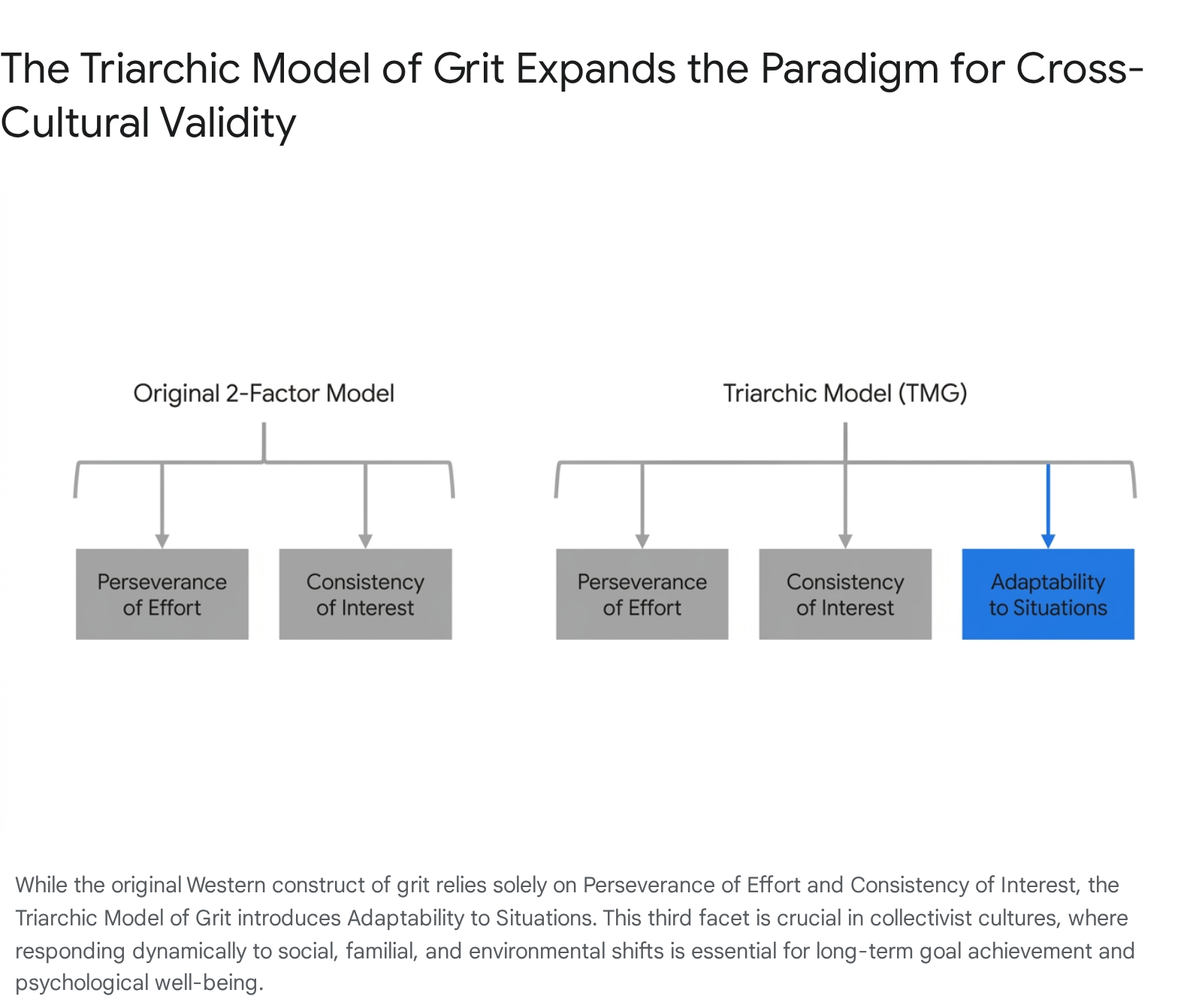
The theoretical formulation of grit posits two essential, interacting sub-facets: Perseverance of Effort (the capacity to sustain exertion through adversity) and Consistency of Interest (the ability to maintain focus on the same overarching goals over prolonged durations) 293031. However, extensive psychometric testing across diverse populations indicates that this two-factor structure is highly unstable and conceptually flawed 6253233.
Analyses indicate that the two facets function as related but statistically independent constructs rather than converging into a single, higher-order grit factor 29. Furthermore, the consistency of interest facet routinely demonstrates inadequate internal reliability and distinct methodological vulnerabilities. The Grit-S scale predominantly utilizes negatively worded items to measure consistency (e.g., "I often set a goal but later choose to pursue a different one"), which introduces significant measurement bias and method variance 152531.
Crucially, the two facets exhibit vastly different predictive utilities. The perseverance of effort facet correlates moderately with academic performance ($\rho = 0.26$), whereas consistency of interest displays a remarkably weak association ($\rho = 0.10$) and sometimes yields negative correlations with achievement in high-pressure environments 143435. These facets also diverge in their relationship to psychological well-being; perseverance is consistently linked to positive affect and life satisfaction, while rigid consistency of interest frequently correlates with emotional exhaustion, lower subjective well-being, and diminished adaptability 323435. Consequently, researchers advocate that if grit retains any practical utility, it resides entirely within the perseverance facet, rendering the composite trait both theoretically unsound and practically misleading 52324.
Predictive Validity in Academic and Occupational Performance
The primary catalyst for the widespread implementation of grit interventions was the initial assertion that it could predict long-term success more accurately than general cognitive ability or standard intelligence quotients 4821. However, subsequent replication efforts utilizing highly representative demographic samples have systematically refuted this claim, reaffirming the absolute primacy of cognitive ability and broader personality dimensions in determining performance outcomes 93637.
Cognitive Ability Versus Noncognitive Traits
Decades of industrial-organizational psychology have established general cognitive ability ($g$) as the single most robust predictor of both occupational and academic performance across virtually all domains 83637. The early studies that propelled grit to prominence suffered from a profound statistical limitation known as severe range restriction 9.
The seminal grit research frequently sampled highly elite, pre-selected populations, such as cadets at the United States Military Academy at West Point or finalists in the National Spelling Bee 2459. In these specific environments, baseline cognitive ability is artificially restricted, as virtually all participants possess exceptionally high intelligence to have gained entry. Because the variance in intelligence within these elite cohorts is mathematically minimized, the statistical weight of cognitive ability in predicting subsequent outcomes is suppressed. This suppression allows secondary, noncognitive traits like grit to appear disproportionately influential in hierarchical regression models 9.
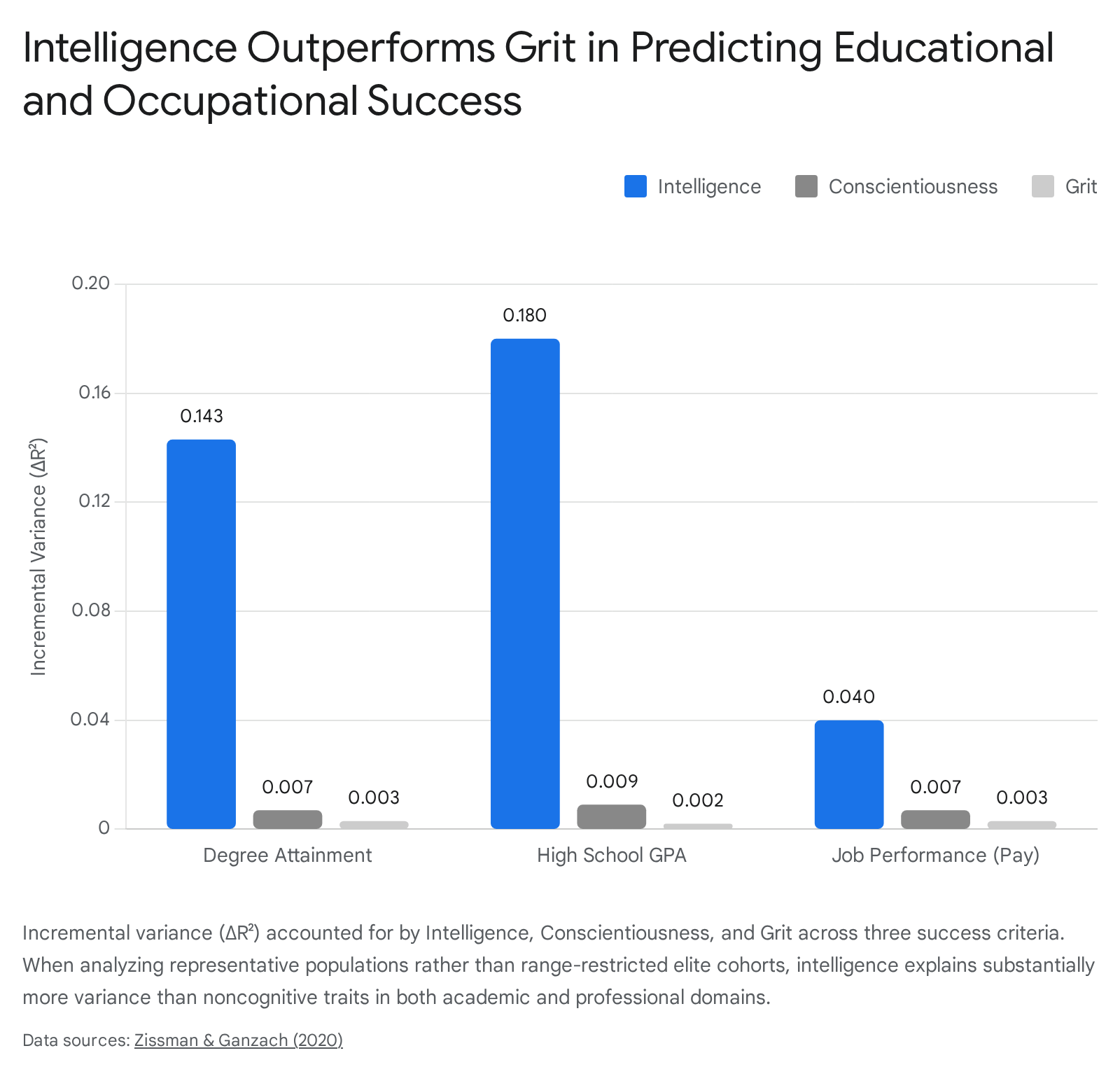
When predictive validity studies are conducted on representative samples of the general population, the narrative reverses completely. Zissman and Ganzach (2020) analyzed longitudinal data from the National Longitudinal Survey of Youth (NLSY), directly comparing the relative contributions of intelligence, conscientiousness, and grit to educational and job-market success 9. Their findings demonstrated that intelligence contributes exponentially more variance to lifelong outcomes than grit or any of its sub-facets.
| Performance Metric | Intelligence ($g$) Zero-Order Correlation ($r$) | Conscientiousness Zero-Order Correlation ($r$) | Grit Zero-Order Correlation ($r$) |
|---|---|---|---|
| Degree Attainment | 0.573 | 0.104 | 0.101 |
| High School GPA | 0.518 | 0.074 | 0.066 |
| Job Performance (Pay) | 0.311 | 0.082 | 0.084 |
Table 1: Meta-analytic synthesis of zero-order predictive validity correlations for Intelligence, Conscientiousness, and Grit across academic and professional domains, utilizing a representative national sample. Data synthesized from Zissman & Ganzach (2020). 9
In terms of incremental variance ($\Delta R^2$), intelligence contributes 48 to 90 times more explanatory power than grit regarding educational success, and approximately 13 times more regarding job-market success 9. Even conscientiousness, while highly correlated with grit, consistently contributes roughly twice as much to success outcomes as the grit construct itself 9.
Recent large-scale meta-analyses mapping cognitive ability against performance in diverse military and civilian occupations confirm that the validity of general cognitive ability does not diminish over time; it remains highly stable and predictive across differing levels of job experience and tenure 36. Furthermore, when identifying actionable noncognitive predictors of performance, pragmatic variables such as specific study skills, adjustment to college environments, job knowledge tests, and class attendance consistently outperform abstract trait measures of grit by substantial margins 131937.
The Moderating Role of Job Complexity
The predictive validity of personality traits, including conscientiousness and its perseverant facets, is not uniform across all professional environments. Meta-analytic tests examining the interaction between job characteristics and personality reveal that structural complexity significantly moderates predictive validity 3839. Conscientiousness acts as a strong predictor of performance in highly routinized jobs with low cognitive complexity, where adherence to process, punctuality, and sustained basic effort are paramount 3839.
Conversely, in highly complex occupations requiring advanced cognitive ability and continuous problem-solving, the predictive validity of conscientiousness decreases 3839. In these high-complexity environments, cognitive intelligence ($g$) and the personality trait of openness to experience become the dominant predictors of occupational success 3839. Consequently, applying grit as a universal metric for hiring or performance evaluation across all tiers of an organization ignores the established psychological consensus regarding person-situation interaction theory.
The Decline of the Strength Model of Self-Control
If the construct of grit is largely indistinguishable from conscientiousness, the precise behavioral mechanics of self-discipline - how human beings actually regulate impulses and resist temptation in the moment - warrant independent examination. For over two decades, the dominant paradigm governing the science of self-discipline was the "Strength Model of Self-Control," developed by Roy Baumeister and colleagues in the late 1990s. This model introduced the concept of "ego depletion," positing that willpower functions analogously to a physiological muscle: exerting self-control in one domain drains a finite reservoir of central mental energy, leaving the individual highly susceptible to subsequent temptations or cognitive failures 10114041.
The ego depletion theory became a cornerstone of both academic psychology and public productivity literature. It was seemingly supported by hundreds of published experiments and a comprehensive 2010 meta-analysis that reported a robust medium-to-large effect size ($d = 0.62$) 101140. However, the strength model has recently undergone a catastrophic collapse, entirely unraveling under the methodological scrutiny of psychology's broader replication crisis 104142.
Ego Depletion and the Replication Crisis
The crisis regarding willpower research escalated following the 2015 Reproducibility Project, which attempted to replicate 100 major psychology studies published in top-tier journals, finding that only 36% replicated successfully 10. This alarming failure rate prompted the commissioning of an unprecedented, pre-registered multilab replication study specifically designed to definitively confirm the ego depletion phenomenon. Involving 2,141 participants across 23 independent laboratories globally, researchers utilized standardized depletion tasks to test the strength model 101141.
The results were paradigm-shifting: the researchers found an effect size completely indistinguishable from zero 104041. Even among the participating laboratories that explicitly predicted a positive result, no evidence of ego depletion materialized 41. Subsequent forensic statistical analyses of the historical ego depletion literature revealed severe systemic flaws. When sophisticated bias-correction tools (such as Precision-Effect Test and Precision-Effect Estimate with Standard Error, or PET-PEESE) were applied to the original 2010 meta-analysis to correct for publication bias and "small-study effects" - the pervasive academic tendency to only publish small-sample studies if they yield statistically significant, exaggerated results - the historical evidence for ego depletion vanished entirely 4041. The prior literature is now widely regarded as an example of the "garbage in, garbage out" problem in meta-analytic synthesis, heavily polluted by questionable research practices and the suppression of null results 4142.
Methodological Ambiguities in Depletion Research
Beyond statistical bias, critics have identified profound conceptual and methodological ambiguities that undermine the entire depletion literature. The field lacked standardized, independent validation for what actually constituted a "depleting task" 1140. Researchers utilized highly disparate tasks - such as instructing participants to watch a video while ignoring scrolling subtitles, or asking them to write essays without using specific letters - and arbitrarily classified them as demanding self-control without objective verification 11.
Furthermore, many studies failed to include adequate manipulation checks to confirm whether the independent variable (the exertion of willpower) was actually successfully manipulated before measuring the dependent variable 42. Consequently, the scientific consensus has shifted drastically: willpower is no longer viewed as a biologically finite resource that drains like a battery, rendering the entire concept of muscular endurance in self-discipline obsolete.
Modern Frameworks of Self-Regulation and Habit Formation
With the dismantling of the ego depletion model and the realization that sheer grit accounts for minimal variance in success, the scientific understanding of self-discipline has fundamentally evolved. Modern self-regulation theory de-emphasizes raw, in-the-moment willpower in favor of structural automation: habit formation, metacognitive monitoring, and precise environmental design 124344.
Strategic Self-Control and Environmental Design
A growing consensus among behavioral scientists argues that high self-discipline is characterized not by the heroic, continuous resistance of temptation, but by the strategic avoidance of it. This paradigm is frequently termed the "Odysseus Strategy" 44. According to Greek mythology, Odysseus survived the Sirens not by relying on his momentary willpower to resist their lethal song, but by having his crew bind him to the ship's mast and plug their own ears with wax before entering the danger zone. Similarly, modern psychological research indicates that individuals who score highly on measures of conscientiousness routinely structure their environments in advance to eliminate friction for desirable behaviors and introduce heavy friction for undesirable ones 124445.
Studies tracking daily behavior demonstrate that individuals who appear highly disciplined actually experience significantly fewer temptations overall. Rather than continuously draining a hypothetical willpower reservoir, they curate environments and lifestyles that do not require constant, effortful self-regulation 45. Interventions focusing on targeted "modules" of behavior change - such as habit stacking, automatic monitoring, architectural restructuring of workspaces, and removing digital triggers - are vastly more effective at changing behavior than interventions attempting to elevate a subject's abstract grit or mental stamina 12454546. Moral and ethical decision-making, previously thought to be functions of pure character, are now understood to be heavily governed by structural systems, situational design, and environmental pressures 4748.
The Interaction of Habit and Deliberate Effort
While the shift toward habit formation is critical, the transition from deliberate self-regulation to fully automated habit is not absolute, particularly concerning highly complex tasks. Recent empirical reviews analyzing polyregulation demonstrate that behavioral complexity heavily moderates the shift from effortful control to automaticity 43.
For simple, single-step behaviors (e.g., taking a daily vitamin or putting on a seatbelt), the shift to automaticity is highly efficient, allowing the action to progress in a relatively unthinking manner without cognitive load. However, for complex behaviors requiring multiple procedural steps, extended timeframes, and sequential planning (e.g., adhering to a rigorous academic study schedule or an intricate fitness regimen), the transition to habitual processes does not eliminate the need for self-regulation 43. Even when the instigation of a complex behavior becomes habitual - meaning the decision to initiate the task is automatic - the execution phase remains highly vulnerable to situational setbacks, conflicting obligations, or shifting contexts 43. Consequently, successful individuals engage in continuous polyregulation, supplementing foundational habits with deliberate self-regulation strategies such as self-talk, metacognitive progress monitoring, and the active seeking of social support to maintain momentum during execution 43.
Psychological Well-Being as a Precursor to Discipline
A secondary, yet equally profound, paradigm shift involves the directional causality between self-discipline and emotional well-being. The traditional cultural narrative - heavily promoted by grit literature - assumes that rigorous discipline and sacrifice inevitably lead to long-term well-being and life satisfaction. However, recent longitudinal studies suggest that this causality is largely inverted: psychological well-being acts as a vital, necessary precursor to self-control, rather than merely its byproduct 4950.
Research tracking individuals over extended time intervals reveals that possessing greater self-control at baseline does not reliably predict improvements in well-being months later 4950. Conversely, individuals who report higher states of psychological well-being, positive emotion, and optimism at a given baseline consistently demonstrate markedly improved self-control and goal adherence at subsequent measurement points 4950. Positive emotional states serve to replenish the mental energy and cognitive flexibility required to manage conflicting goals, resist distractions, and persist through difficulty. Attempting to enforce rigid discipline or grit in an environment characterized by high stress, burnout, or emotional depletion is largely counterproductive, as the psychological capital necessary to sustain self-regulation is absent 274950.
Socioeconomic Contexts and the Framing of Effort
The enthusiasm for measuring and cultivating grit has faced intense sociological critique due to its frequent failure to account for systemic inequality, institutional discrimination, and socioeconomic status (SES) 171618. When the grit framework is applied indiscriminately within educational policy or public health, it risks perpetuating a deeply problematic "blame-the-victim" ideology. This narrative inherently suggests that impoverished or marginalized students fail primarily due to a lack of individual character, perseverance, or passion, rather than recognizing the overwhelming impact of structural deprivation 71651.
The Impact of Resource Scarcity on Self-Regulation
Longitudinal demographic data unequivocally demonstrates that educational attainment, college completion rates, and long-term economic mobility are highly correlated with the "birth lottery" - specifically, parental income and baseline SES 7. Currently, economic mobility in the United States is highly "sticky"; individuals born into the bottom economic quintile face profound statistical barriers to upward mobility, regardless of their individual effort. Even when low-income students excel academically and display high levels of perseverance, their statistical chances of obtaining a bachelor's degree remain drastically lower than those of their wealthy, less-gritty counterparts 7.
Poverty and systemic inequality inherently operate as a profound cognitive and emotional tax. Residence in impoverished neighborhoods, exposure to high-crime environments, and chronic experiences of racial or economic discrimination impose persistent biological weathering and toxic stress 11652. This chronic stress directly impairs cognitive functioning and actively disrupts the neurological development of self-regulatory skills in children 11652.
When formal assessments of grit are utilized in longitudinal, nationally representative data sets - such as the Early Childhood Longitudinal Study - self-reported grit demonstrates only extremely modest links to academic performance and entirely fails to explain socioeconomic or racial achievement gaps 18. True noncognitive soft skills, such as attentional focus and safe approaches to learning, play a more substantial role, but these are highly dependent on the stability of the child's environment 18. Furthermore, students from lower SES backgrounds, particularly students of color, often exhibit entirely rational concerns regarding downward socioeconomic mobility. These systemic concerns shift their cognitive focus toward immediate survival, prevention of negative outcomes, and risk mitigation, rather than the abstract, highly idealized long-term goals measured by grit scales 53.
When educational policies prioritize individual grit interventions over structural equity, they ignore the reality that "gritty" behaviors in affluent students are heavily subsidized by robust environmental support networks, financial safety nets, private tutoring, and systemic grace for failure 7. True primary prevention and performance enhancement require a socio-ecological model that addresses systemic barriers rather than merely attempting to optimize the psychological endurance of marginalized individuals .
Neurodivergence and Measurement Bias
The application of standardized grit metrics becomes particularly problematic - and clinically hazardous - when assessing neurodivergent populations, specifically individuals diagnosed with Attention-Deficit/Hyperactivity Disorder (ADHD) and Autism Spectrum Disorder (ASD). In these cohorts, the measurement of grit frequently conflates innate neurological variance with moral character, resulting in severe measurement bias and the pathologizing of executive dysfunction 17255654.
Executive Dysfunction Versus Moral Fortitude
ADHD is a neurodevelopmental condition fundamentally characterized by executive dysfunction, which manifests as profound difficulties with working memory, organization, time management, impulse control, and the regulation of attention 545556. Neurologically, this is frequently linked to hypo-connectivity in the brain's default-mode network (DMN), a hub that governs introspection, metacognition, and self-reflection 17. Similarly, autistic individuals often experience altered psychological self-representation, heightened sensory overwhelm, and differing metabolic responses to executive load 1754.
The standard Grit-S scale asks respondents to self-report their agreement with statements such as "I often set a goal but later choose to pursue a different one," "New ideas and projects sometimes distract me from previous ones," or "I have difficulty maintaining my focus on projects that take more than a few months to complete" 315657. For a neurotypical individual, agreeing with these statements might indicate a deliberate lack of perseverance or an undisciplined approach to life goals. However, for an individual with ADHD, these items effectively measure psychiatric symptoms of executive dysfunction rather than a personality trait or a lack of passion 5556.
Consequently, empirical studies utilizing tools like the Adult ADHD Self-Report Scale (ASRS) consistently demonstrate a strong inverse relationship between ADHD tendencies and grit scores; higher ADHD symptomology mathematically guarantees a low score on the grit scale 5556. The diagnostic criteria for ADHD explicitly include inattention to non-preferred tasks and intense hyperfocus on preferred interests - a direct neurological contradiction to the Consistency of Interest subscale of grit 354. Thus, evaluating a neurodivergent student or employee based on their grit score is fundamentally an assessment of their disability level, masking it as a measure of their work ethic.
Clinical Interventions Over Traditional Discipline
In neurodivergent populations, traditional punitive discipline or highly demanding "stamina-building" strategies are not only ineffective but actively harmful. Because the neurodivergent brain processes salience and dopamine differently, attempting to enforce traditional self-discipline through sheer willpower frequently leads to increased nervous system dysregulation, chronic anxiety, and severe autistic burnout 5859. The trauma of constantly masking innate traits to mimic neurotypical discipline often exacerbates mental health deterioration 5459.
For these individuals, successful goal attainment is overwhelmingly dependent on environmental design and metacognitive scaffolding rather than grit. Effective strategies involve aligning tasks with areas of intense intrinsic interest to trigger flow states (hyperfocus), modifying external structural support to bypass working memory deficits, utilizing Cognitive Behavioral Therapy (CBT) or medication to manage baseline symptoms, and prioritizing emotional co-regulation 17565658.
Cross-Cultural Perspectives and the Triarchic Model
A final, critical limitation of the original science of self-discipline is its inherent cultural bias. The initial conceptualization, validation, and popularization of the grit construct were conducted almost exclusively within WEIRD (Western, Educated, Industrialized, Rich, and Democratic) populations 31336360. This monocultural origin embedded highly specific, culturally contingent assumptions about what constitutes successful goal pursuit into the psychological measurement of grit.
Individualism Versus Collectivism
Extensive research in cross-cultural psychology, heavily influenced by the foundational dimensions identified by Geert Hofstede, demonstrates a profound cleavage between individualistic and collectivist societies regarding motivation and behavioral norms 616263. Individualistic cultures (e.g., the United States, the United Kingdom, Australia) define identity through personal characteristics, autonomy, and individual choice. These societies actively reward personal achievements, unique expression, and actions that allow an individual to stand out from the group 63616263.
In contrast, collectivist cultures (e.g., China, Japan, the Philippines, Brazil) emphasize interdependent social roles, embeddedness within a larger community, group harmony, and shared familial obligations 33636263. In a collectivist framework, identity is determined by relationships, and maintaining group solidarity often supersedes the pursuit of purely personal ambitions.
Within the highly individualistic setting of the United States, the Consistency of Interest - the rigid, uncompromising adherence to a singular, personal long-term goal despite changing social environments or external pressures - is viewed as a supreme virtue. However, in collectivist cultures, an inflexible adherence to a personal goal at the expense of family obligations, communal harmony, or changing situational demands is frequently viewed as maladaptive, selfish, or socially destructive 3362. Consequently, cross-cultural applications of the original Grit-O and Grit-S scales have consistently failed to replicate the standard two-factor structure. In Asian and Latin American contexts, the Consistency of Interest facet regularly demonstrates poor internal consistency and frequently exhibits null or negative correlations with academic achievement and subjective well-being 3233343560.
The Triarchic Model of Grit
To rectify this severe cultural limitation, international researchers, led by Jesus Alfonso Datu and colleagues, conceptualized and validated the Triarchic Model of Grit (TMG). This expanded framework argues that a valid measure of goal-directed stamina in interdependent societies must include a critical third dimension: Adaptability to Situations 3335646566.
In the Triarchic Model, adaptability is defined as the cognitive and behavioral capacity to anticipate challenges, accept changes, exhibit flexibility, and continuously adjust goal-oriented pathways in response to systemic shifts and social feedback 33356465. Longitudinal cross-lagged panel modeling conducted among Filipino adolescents demonstrates the profound utility of this expanded model. When assessing the 5Cs of Positive Youth Development (PYD) - competence, confidence, connection, character, and caring - researchers found that perseverance and adaptability are robust predictors of future competence and character. In stark contrast, rigid consistency of interest frequently predicted lower levels of competence and confidence over time 3566.
Adaptability proves vital not only in interdependent Asian societies but is increasingly recognized as critical in dynamic Western environments as well 606467. The inclusion of adaptability underscores a fundamental flaw in the early iterations of grit: psychological rigidity is functionally inferior to strategic flexibility. The capacity to continuously recalibrate goals in response to insurmountable obstacles, shifting economic landscapes, or changing personal values is a hallmark of mature self-regulation, not a symptom of weak character.
Conclusion
The pervasive cultural narrative that sheer willpower, muscular endurance, and unrelenting passion are the primary drivers of human success represents an oversimplified and scientifically obsolete paradigm. An exhaustive review of modern psychometric, neurobiological, and sociological data demands a fundamental reappraisal of how self-discipline is conceptualized and measured.
The construct of grit, while deeply resonant in popular literature, lacks incremental predictive validity and suffers profoundly from the jangle fallacy; it operates largely as a repackaging of the long-established personality trait of conscientiousness. Furthermore, when analyzed outside of artificially restricted elite environments, general cognitive ability and specific situational competencies drastically outperform noncognitive traits in predicting lifelong academic and professional success. Concurrently, the collapse of the ego depletion model has proven that willpower is not a finite biological resource to be drained and exercised.
True self-regulation is achieved not through the continuous, agonizing resistance of temptation, but through sophisticated environmental design, the automation of habits, and the protection of baseline psychological well-being. Furthermore, treating self-discipline as a universal metric of character ignores the profound cognitive taxation imposed by poverty, the biological realities of neurodivergent executive dysfunction, and the cultural necessity of interdependent adaptability. The future of behavioral science lies in moving away from moralized, willpower-centric frameworks, recognizing instead that sustainable achievement is an ecological phenomenon. Success is engineered by designing supportive systems, cultivating emotional capital, and demonstrating the cognitive flexibility necessary to navigate a complex world.