
Why We Procrastinate Even When We Know Better
Procrastination is not a failure of time management, nor is it a symptom of laziness; rather, it is a complex failure of emotion regulation driven by our neurobiology. When faced with a task that triggers negative emotions like anxiety or boredom, the brain's threat-detection center overrides our rational planning systems to prioritize immediate psychological relief. Ultimately, we delay because our brains are wired to neutralize present-moment distress, leaving our distant "future selves" to handle the long-term consequences.
We all know the familiar sting of putting things off. You have a critical deadline approaching, yet you find yourself organizing your digital files, endlessly scrolling through social media, or suddenly feeling an urgent need to deep-clean your kitchen. Despite knowing that this delay will inevitably result in heightened stress, poorer performance, and intense guilt, you do it anyway.
For decades, society has treated procrastination as a moral failing or a character flaw, labeling it as laziness, poor discipline, or a simple lack of willpower. But modern psychological and neurobiological research paints a vastly different and more forgiving picture. Studies suggest that up to 20% of adults worldwide are chronic procrastinators, making it a pervasive behavioral pattern that outpaces the prevalence of clinical depression or specific phobias 1. In academic settings, the numbers are even higher, with 80% to 95% of college students engaging in regular procrastination 2.
To understand why we voluntarily delay intended actions - despite expecting to be worse off for it - we must look under the hood of human cognition and examine the neurological and psychological forces that drive our behavior.
The Neurobiology of Delay: A Brain at War With Itself
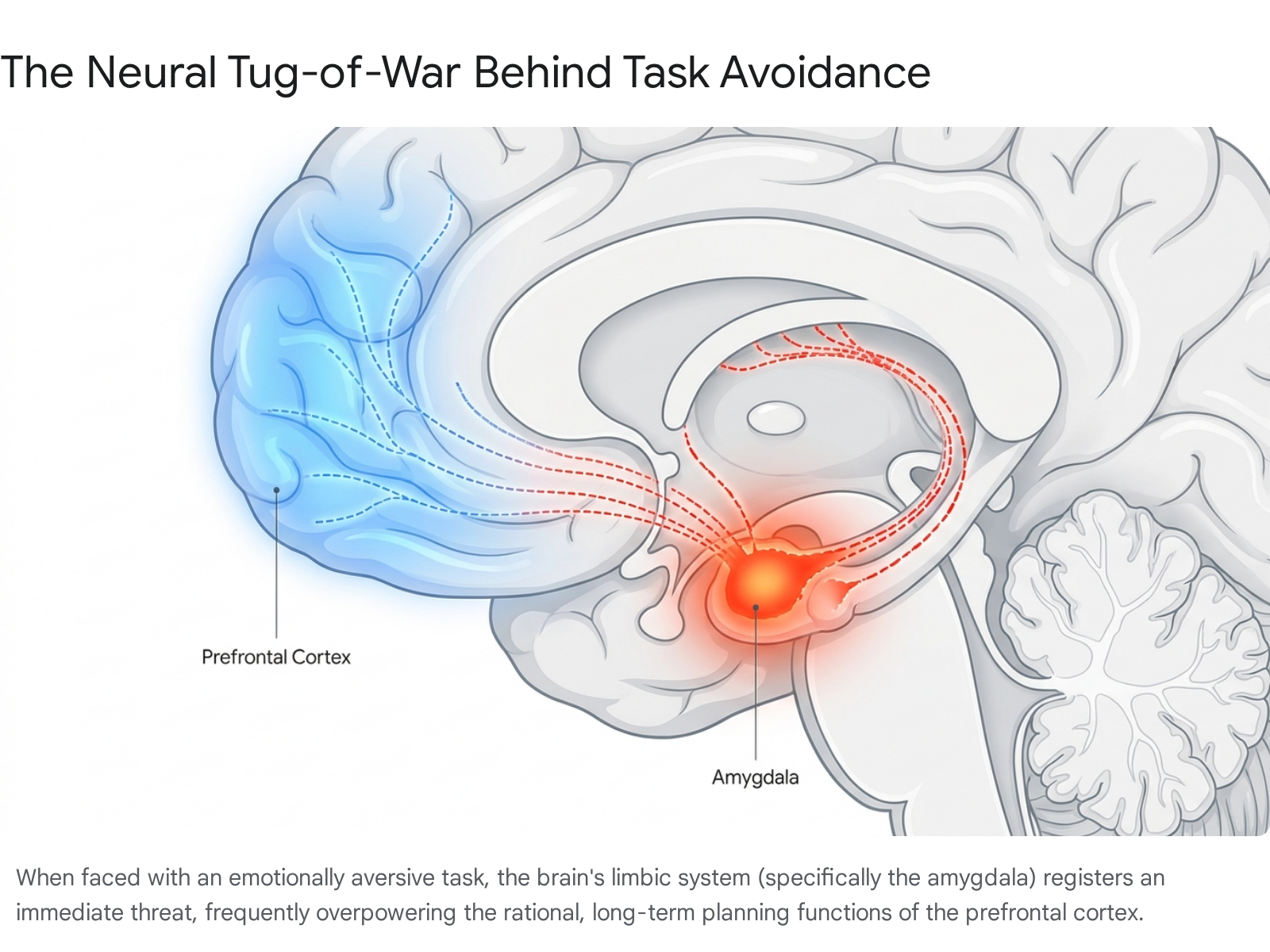
At its core, procrastination is the result of an ongoing structural and chemical conflict within the human brain. It is a literal tug-of-war between two specific regions: the evolutionarily ancient limbic system and the more recently developed prefrontal cortex 33.
The Limbic System versus the Prefrontal Cortex
The limbic system is the brain's emotional hub. It processes pleasure, pain, and basic survival instincts, and it operates with remarkable, almost instantaneous speed. Within the limbic system sits the amygdala, a small, almond-shaped structure that acts as our primary threat detector 35. When you think about a task that evokes negative emotions - such as fear of failure, confusion, boredom, or performance anxiety - the amygdala registers this task as an immediate emotional threat 54.
On the other side of the conflict is the prefrontal cortex (PFC), the brain's rational planner. Located behind the forehead, the PFC is responsible for executive functions like long-term planning, decision-making, and impulse control 35. When you sit down to write a report, study for an exam, or file taxes, your PFC is the voice of reason telling you that this action is important for your future well-being and success 5.
However, because the limbic system evolved millions of years before the prefrontal cortex, it reacts much faster and with significantly greater intensity. When the amygdala sounds the alarm about an unpleasant task, it effectively short-circuits the prefrontal cortex 35. You avoid the task not because you are lazy, but because your brain's alarm system is actively prioritizing immediate mood repair over long-term strategic planning.
Brain Structure and Connectivity: The Amygdala and dACC
Neuroimaging studies have shown that this tug-of-war is not just a passing state; it reflects measurable, physical differences in brain structure and connectivity. A prominent 2018 fMRI study by Schluter and colleagues mapped the brains of individuals with varying tendencies to procrastinate. They discovered that people who chronically procrastinate tend to have a measurably larger amygdala volume 5.
Furthermore, these individuals exhibited weaker functional connectivity between the amygdala and the dorsal anterior cingulate cortex (dACC) - a specialized region that sits within the broader frontal cortex and acts as a mediator between emotional impulses and physical action 5. In simpler terms, heavy procrastinators are equipped with a more sensitive threat-detection system combined with weaker "neural brakes" to override those emotional impulses 5.
The insula, another region of the brain responsible for interoception - our ability to sense and regulate internal bodily sensations - has also been implicated. Procrastinators may be hyper-aware of the physiological discomfort (like a tight chest or shallow breathing) that accompanies task anxiety, making the urge to escape that feeling even more overwhelming 5.
Dopamine, Impulsivity, and the Habit Loop
Adding fuel to this biological fire is dopamine, the brain's primary reward neurotransmitter. When you avoid an uncomfortable task and choose to scroll through social media or play a video game instead, your brain's reward system, specifically the ventral striatum, receives an immediate hit of dopamine 345.
This creates a potent, self-reinforcing habit loop. Your brain quickly learns a two-part lesson: avoiding the difficult task relieves anxiety (negative reinforcement), and clicking over to a distraction provides pleasure (positive reinforcement) 34. Over time, repeated procrastination physically alters the brain, strengthening the neural pathways associated with avoidance and even leading to gray matter reduction in the prefrontal cortex, which further degrades decision-making and impulse control 3.
Procrastination as Emotion Regulation
For decades, the standard advice for overcoming procrastination revolved around time management. Experts suggested buying a new planner, using the Pomodoro technique, or setting stricter deadlines. But modern researchers now overwhelmingly agree that procrastination is not a time management problem; it is fundamentally an emotion regulation problem 5678.
Task Aversiveness and Temporal Mood Repair
Leading psychology researchers, such as Dr. Timothy Pychyl and Dr. Fuschia Sirois, have advanced the theory of "temporal mood regulation" to explain why we dawdle 67. When we procrastinate, we are essentially prioritizing our short-term mood repair over our long-term goals 8.
A task becomes a trigger for procrastination when it possesses "task aversiveness" - meaning it induces negative affective states. These feelings might include resentment, boredom, frustration, perceived meaninglessness, or profound self-doubt 689. If a person has poor emotion regulation skills, they will instinctively seek a "hedonic shift" 6. To escape the negative emotions associated with the task, they shift their attention to something that makes them feel good immediately. As researchers Tice and Bratslavsky put it, we "give in to feel good" 8.
Experimental work clearly demonstrates this effect. In studies where participants underwent a negative mood induction (being made to feel sad or anxious), they spent significantly more time procrastinating rather than preparing for the next phase of the study 8.
The Vicious Cycle of Procrastination
While this avoidance strategy is highly effective at reducing stress in the present moment, the relief is entirely transient. Because the emotional relief provided by procrastination is so brief, it initiates a vicious, self-perpetuating cycle. When an individual procrastinates to regulate their mood, they ultimately generate more negative emotions, which in turn triggers more procrastination 12131415.
This mood-repair cycle typically unfolds in predictable stages:
- The Trigger (Task Appearance): You are faced with an important task, responsibility, or deadline 1310.
- Negative Emotional Response: The task elicits anxiety, fear of failure, overwhelm, or boredom 13.
- Avoidance Behavior: To neutralize the discomfort, you engage in a distraction that requires less cognitive load (e.g., watching a video, cleaning your desk) 1314.
- Temporary Relief: The brain registers a drop in stress and a spike in dopamine, creating a short-term mood boost 1314.
- The Rebound Effect (Guilt & Stress): The relief fades quickly, replaced by compounded guilt, shame, self-criticism, and the stress of a now-closer deadline 1311.
- Task Escalation: Because of the added pressure and guilt, the original task now feels vastly more intimidating than it did at step one, causing the cycle to repeat 1315.
This phenomenon explains why procrastination often cascades into complete paralysis. After delaying, the individual is in the same exact situation as before, but with less time and significantly more negative affect, making task initiation exponentially harder 12.
Comparing the Primary Theories of Procrastination
To fully grasp the mechanics of delay, researchers often look at procrastination through two primary, overlapping lenses: Emotion Regulation Theory and Temporal Discounting Theory.
| Dimension | Emotion Regulation Theory | Temporal Discounting Theory |
|---|---|---|
| Core Mechanism | Inability to tolerate negative emotions associated with a task. | Inability to properly value rewards or consequences that are delayed in time. |
| Primary Driver | Task aversiveness (fear, boredom, anxiety, frustration). | Temporal distance to a deadline (the further away, the less motivation). |
| Underlying Brain Region | Limbic System (specifically the Amygdala). | Medial Prefrontal Cortex / Reward processing pathways. |
| Primary Consequence | A self-perpetuating cycle of guilt, anxiety, and task avoidance. | "Intention-action gaps" where long-term goals are abandoned for short-term gratification. |
| Actionable Solution | Mindfulness, self-compassion, cognitive reframing of negative emotions. | Breaking long-term goals into immediate, highly salient micro-deadlines. |
Temporal Discounting and the "Stranger" in the Future
While emotion regulation explains the immediate trigger of procrastination, Temporal Discounting Theory explains why we systematically fail to act early when deadlines are far away.
The Hyperbolic Curve of Motivation
Temporal discounting is a well-documented economic and psychological concept describing how humans inherently devalue rewards or consequences the further away they are in time 121314. If you are offered $100 today or $110 in a year, most people will instinctively choose the $100 today. The future reward, despite being objectively larger, feels psychologically lighter and less motivating 59.
In the context of procrastination, our motivation follows a hyperbolic curve 913. When a deadline is months away, the negative consequences of not doing the work are heavily discounted by the brain. Motivation remains incredibly low because the perceived utility of the task is minimal. It is only when the deadline draws dangerously close that the perceived consequences spike, finally overpowering the immediate desire for comfort and forcing the individual into a panic-driven frenzy of action 13.
Research tracking real-world behavior explicitly links steep temporal discounting with high rates of procrastination. In academic and workplace environments, individuals who steeply discount future rewards are significantly more likely to delay tasks until the last possible moment 151617.
Neural Disconnect: The Empathy Gap With the Future Self
Why are we so remarkably bad at valuing the future? Groundbreaking research by Dr. Hal Hershfield at UCLA has provided a startling answer: on a neurological level, our brains treat our future selves as completely different people 1819.
Hershfield used fMRI technology to monitor the brain activity of subjects as they thought about their present selves, their future selves, and total strangers. Specifically, he looked at the medial prefrontal cortex and the rostral anterior cingulate cortex - regions that activate strongly when we think about ourselves and our own identities 19.
Remarkably, when subjects thought about themselves 10 years in the future, those specific brain regions "powered down," showing the exact same diminished activation patterns as when the subjects thought about a random stranger 181926.
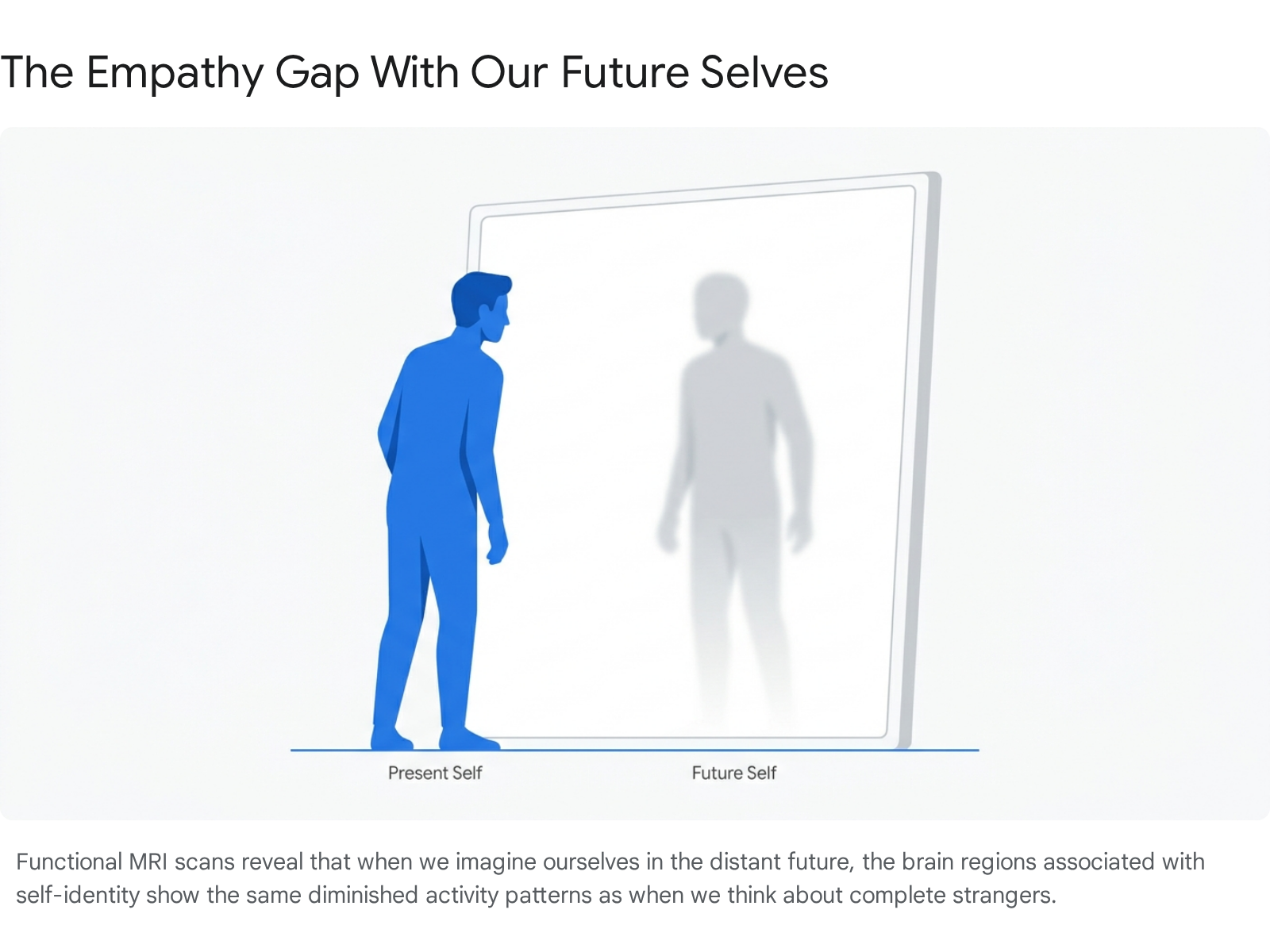
This profound lack of "future self-continuity" explains the intention-action gap. When you procrastinate, you are perfectly aware that someone will eventually suffer the consequences of a rushed project and lost sleep. But to your brain, that "someone" isn't you - it is a stranger who happens to share your name and lives in the future 192021. This dissociation allows the present self to enjoy the immediate relief of avoiding work, essentially passing the burden off to someone else 820.
Typologies: Not All Procrastinators Are the Same
While the underlying mechanisms of emotion regulation and temporal discounting exist in all human brains, some people fall victim to chronic procrastination much more frequently than others. This variance is deeply tied to personality traits, clinical typologies, and differing approaches to task execution.
The Big Five Traits: Conscientiousness and Neuroticism
In the realm of personality psychology, the "Big Five" trait model provides strong predictors for procrastinatory behavior. Research consistently demonstrates that a tendency to delay is strongly inversely correlated with Conscientiousness and positively correlated with Neuroticism 5223031.
Individuals high in conscientiousness are naturally more self-disciplined, organized, and reliable. Neuroimaging studies reveal that these individuals actually possess different neural mechanisms that aid in overriding impulses and maintaining focus 30. Conversely, individuals high in neuroticism are more prone to negative emotions, such as anxiety, depression, impulsivity, and self-doubt. Because they experience negative affect more intensely, they are significantly more vulnerable to the task-aversion triggers that initiate the mood-repair cycle 522.
Clinical Subtypes of Avoidance
Clinical psychologists often warn against treating procrastination as a monolith. A one-size-fits-all approach to behavioral change usually fails because individuals delay for very different psychological reasons. Identifying specific procrastination profiles allows for targeted, effective interventions 2324.
| Procrastination Profile | Underlying Psychological Driver | Avoidance Mechanism |
|---|---|---|
| The Perfectionist (Avoider) | Fear of failure and intense self-criticism. | Delays starting because the conditions are not "perfect," preventing any potential for flawed output 2324. |
| The Crisis-Maker | Reliance on adrenaline; low baseline conscientiousness. | Falsely believes they "work best under pressure." Delays until the physiological panic response forces action 223. |
| The Overplanner | Analysis paralysis and fear of uncertainty. | Engages in "productive procrastination" by endlessly researching and planning to avoid the vulnerability of execution 2324. |
| The People-Pleaser | Fear of interpersonal conflict; poor boundary setting. | Prioritizes others' requests to avoid saying "no," using social obligations as a shield against personal tasks 23. |
| The Worrier | General anxiety and low self-efficacy. | Avoids tasks due to an overwhelming fear of negative evaluation or a belief that the task is simply too difficult 23. |
Active versus Passive Procrastination
It is also important to differentiate between passive and active procrastination. Traditional "passive" procrastinators delay tasks involuntarily and suffer from the negative emotional fallout 2. However, researchers have identified a subset of "active" procrastinators who intentionally delay tasks because they prefer to work under pressure 2.
Studies show that active procrastinators demonstrate adaptive coping styles, productive use of time, and academic performance outcomes that are nearly identical to - and in some cases better than - those of non-procrastinators 2. For these individuals, intentional delay is a strategy rather than a self-regulatory failure.
When Delay Becomes Pathological
For some, procrastination transcends a bad habit and becomes a severe clinical issue. When procrastination severely disrupts a person's life - resulting in missed career opportunities, academic failure, relationship breakdowns, or severe mental health distress - it crosses the line into pathology.
Researchers analyzing a massive sample of 10,000 university students in Germany found that roughly 10% fit the criteria for "pathological procrastinators" 25. These researchers have advocated for diagnostic criteria similar to those in the DSM-5, proposing the PDC-5/8 criteria. Under this model, pathological procrastination involves the persistent, needless delay of important tasks, combined with strong interference in personal goals, resulting in measurable physical and psychological complaints 25.
Demographic and Cross-Cultural Perspectives
Given the psychological complexity of procrastination, researchers have naturally questioned whether it is a uniquely modern, individualistic, or Western phenomenon. Sociodemographic meta-analyses, synthesizing data from over 100,000 participants globally, have sought to answer this question 26.
The Universality of Delay Across Societies
The findings are remarkably uniform: procrastination is a universal human trait. Extensive data analysis reveals no significant differences in procrastination tendencies based on socioeconomic status (SES), educational background, family size, or broad multicultural categories (e.g., comparing populations in the United States, Russia, China, India, and Slovakia) 2627. A slight, albeit statistically significant, gender difference does exist, with males showing a slightly higher tendency to procrastinate than females (a moderate effect size of r ≈ 0.04), particularly in academic settings 26.
How Language Shapes Time Perception
However, while the act of procrastination is universal, cultural differences do emerge in how populations perceive time, which indirectly impacts temporal discounting.
A fascinating 2020 cross-cultural study demonstrated that English speakers in the U.S. tend to employ horizontal, linear representations of time and world events, whereas Mandarin speakers in China often use two-dimensional, circular representations 2829. While both groups discounted future rewards based on psychological distance, the psychological distance of past events influenced present decision-making heavily in Mandarin speakers - a correlation that was not found in English speakers 2829. Furthermore, neuroimaging contrasting Western (American) and Eastern (Korean) participants has shown that Americans display significantly greater present bias and elevated discount rates, recruiting the ventral striatum (a reward center) more heavily when making intertemporal choices 14.
The Digital Catalyst: Doomscrolling and Modern Avoidance
While the biological mechanisms of procrastination are ancient, the modern environment has effectively weaponized them. The internet, smartphones, and social media platforms are precisely engineered to hijack the brain's vulnerability to instant gratification and mood repair.
Algorithms and the Weaponization of Distraction
Historically, avoiding a difficult task required physical effort or a change of location. Today, infinite escape is available in our pockets. Because procrastination is fundamentally an attempt to regulate a negative mood, social media and digital entertainment offer frictionless, highly potent doses of dopamine to soothe an anxious amygdala 303132.
However, a particularly modern and insidious strain of digital procrastination has emerged in the form of "doomscrolling" - the compulsive consumption of a continuous stream of negative, distressing, or catastrophic news on mobile devices 33343536.
Doomscrolling as an Illusion of Control
Doomscrolling often begins as a misguided coping mechanism. When faced with an overwhelming personal task or global uncertainty (such as the COVID-19 pandemic), individuals scroll through news feeds in an attempt to feel "informed," prepared, and in control of their environment 3536. Yet, because social media algorithms heavily prioritize controversial, emotionally charged, and fear-inducing content to maximize engagement, the user is relentlessly bombarded with threat signals 3436.
Instead of repairing the user's mood, doomscrolling backfires catastrophically. The constant influx of negative imagery floods the nervous system with cortisol and adrenaline, triggering a perpetual fight-or-flight response 34. This results in emotional exhaustion, sleep disturbances (exacerbated by blue light exposure), irritability, and a state of chronic nervous system dysregulation 3436.
The procrastinator attempts to escape the mild anxiety of a work task by logging online, only to trigger a massive stress response that leaves them entirely depleted and even less capable of initiating their intended work 35. Recognizing this growing public health issue, technologists and researchers are developing interventions - such as the "Mindful Scroll" app - which use art therapy and predetermined pacing to transition users out of algorithmic panic and back into mindful presence 3233.
Evidence-Based Interventions to Break the Cycle
Because procrastination is driven by emotion regulation and future-self disconnect, traditional time management tools are largely ineffective on their own. Overcoming chronic delay requires rewiring how we handle negative emotions and how we relate to our future identities.
The Power of Self-Compassion and Mindfulness
It sounds counterintuitive to a society obsessed with hustle culture, but the most evidence-based intervention for procrastination is self-compassion 30374748.
Procrastinators often trap themselves in intense shame spirals. After wasting a day, they berate themselves with harsh self-criticism ("I am lazy," "I am a failure") 1137. This self-flagellation actually increases negative affect and anxiety 1130. Because procrastination is triggered by negative emotions, making yourself feel worse practically guarantees you will procrastinate again tomorrow as your brain seeks an escape from the pain of self-judgment 1248.
Clinical studies reveal a strong negative correlation between self-compassion and procrastination 3047. By practicing self-kindness and recognizing that task avoidance is a common human struggle (common humanity), individuals reduce the emotional weight of their failures 3037. Mindfulness disrupts the rumination process, lowering the immediate anxiety surrounding the task and allowing the prefrontal cortex to regain executive control 3047.
Bridging the Empathy Gap with the Future Self
To combat temporal discounting, individuals must consciously learn to empathize with their future selves. Dr. Hershfield's research suggests that visualization techniques are highly effective for bridging this gap 182621.
In one experiment, participants who interacted with a digitally aged, virtual-reality avatar of themselves were significantly more likely to allocate money toward a retirement account than those who did not 1921. By writing a letter to your future self, or vividly imagining the relief and satisfaction your future self will feel upon task completion, you reduce the psychological distance. Reframing a difficult task not as a present sacrifice, but as a "gift" you are giving to a friend (your future self), helps align immediate actions with long-term goals 2620.
Cognitive and Behavioral Tactics
Once the emotional hurdles are addressed, specific behavioral and environmental tactics can lower the threshold for action:
- Reduce the Friction (Task Shrinking): Lower the barrier to entry. If you are avoiding a massive project, commit only to opening the document and writing a single sentence 1337. Shrinking the task reduces the amygdala's perception of threat 4.
- Implementation Intentions: Create concrete "If-Then" plans (e.g., "If it is 9:00 AM, then I will sit at my desk for 10 minutes without my phone") to automate decisions and bypass emotional resistance 449.
- Body Doubling: Work in the physical or virtual presence of another person. This creates a mild, immediate sense of social accountability that spikes dopamine and focus, effectively overriding task aversion 14.
- Visual Timers: Using tools like Time Timers creates a stress-free sense of urgency and visually tracks the passage of time, which can improve focus and motivation, particularly for those with ADHD 14.
- Tolerate Discomfort: Accept that the beginning of a task will almost always feel bad. Recognizing that frustration and boredom are temporary sensations - not emergencies requiring immediate escape - allows you to persist through the initial resistance without seeking distraction 10.
Bottom line
Procrastination is an evolutionary mismatch; our brains are fundamentally wired to escape immediate emotional discomfort, leading us to sacrifice our long-term goals for short-term mood repair. By understanding that avoidance is driven by the amygdala's rapid threat response and our profound psychological disconnect from our "future selves," we can stop treating procrastination as a moral failing. Sustainable change requires moving away from harsh self-criticism and instead utilizing self-compassion, emotional regulation, and intentional task-shrinking to help the rational brain regain the steering wheel.