
How to Spot a Misleading Health Headline
To determine if an online health study headline is misleading, you must look past the sensational phrasing and identify the absolute risk, the study subjects, and the research design. Headlines that rely on relative risk percentages or use words like "miracle" and "breakthrough" are almost always exaggerating incremental scientific findings. A reliable diagnostic check requires confirming whether the study was conducted on humans rather than mice, whether it proves causation rather than mere correlation, and whether the publishing journal is reputable.
The Era of the Health Infodemic
We live in an age where an unprecedented volume of medical research is available at our fingertips. Yet, despite this easy access to data, public trust in physicians and hospitals has plummeted. According to a comprehensive report from The Lancet Digital Health, public trust dropped from roughly 71.5% in 2020 to just 40.1% in 2024 1. This decline is not driven by a failure of medical science itself, but by an overwhelming "infodemic" - a term the World Health Organization (WHO) uses to describe the dangerous overabundance of both accurate and inaccurate information circulating during a health crisis 2.
Every day, the internet is flooded with articles claiming that a new superfood cures cancer, a common household item is secretly toxic, or a newly discovered supplement melts away fat overnight. These headlines are engineered for an attention economy. On social media platforms, falsehoods are significantly more likely to be shared than accurate news, with some estimates suggesting misleading claims travel 70% faster and further than evidence-based realities 3. This environment fosters a society more inclined to trust a viral health hack on social media than the advice of their own doctors 1.
The consequences of this infodemic are far from benign. Incorrect information about health and disease has devastating, tangible impacts. Medical misinformation can lead people to make dangerous decisions, engage in harmful practices, avoid life-saving preventive care, and otherwise put themselves and others at risk 4. During the COVID-19 pandemic, unfounded fears about vaccines - often spurred by misleading headlines and out-of-context data - resulted in hundreds of thousands of preventable deaths 4. More recently, dangerous trends such as the misuse of weight-loss drugs like Ozempic, DIY fecal transplants, and the unregulated use of cognitive enhancers have sent thousands of individuals to emergency rooms 1.
The Mechanics of Misleading the Public
Health journalism is inherently difficult. Translating complex, heavily caveated scientific literature into accessible prose requires immense skill. However, the ecosystem of digital publishing often prioritizes immediate engagement over nuanced accuracy. When a press release from a university or a pharmaceutical company makes a bold claim, journalists - often operating under tight deadlines and without specialized scientific training - may take the claim at face value.
In some cases, the misrepresentation begins with the scientists themselves. Researchers face immense pressure to publish "statistically significant" results to secure funding and tenure. This pressure can lead to subtle exaggerations in study abstracts, which are then amplified by university public relations departments, only to be further sensationalized by headline writers 5. The result is a broken chain of communication where a minor, incremental laboratory observation is transformed into a global, viral health mandate.
To navigate this landscape, readers must develop a critical eye. By understanding a few core scientific concepts and learning to spot specific journalistic red flags, you can quickly diagnose whether a health headline is worth your time or if it belongs in the digital trash bin.
Red Flag 1: The Sensational Vocabulary
The first step in diagnosing a health headline is evaluating its tone. Authentic science is notoriously slow, cautious, and incremental. It rarely speaks in absolutes. If an article's headline sounds like a marketing pitch or a horror movie poster, it is almost certainly misrepresenting the underlying research 67.
Words That Should Trigger Skepticism
Veteran health journalists and watchdog organizations, such as the now-archived HealthNewsReview.org, have long maintained lists of "taboo" words that should rarely, if ever, appear in responsible medical reporting. Words like breakthrough, revolutionary, life-changing, game-changing, landmark, miracle, and cure are heavily overused in modern media 89.
True medical breakthroughs - on the scale of the discovery of penicillin, the polio vaccine, or the sequencing of the human genome - happen perhaps once in a generation 7. The vast majority of published studies simply add one small piece to a massive, ongoing puzzle. When a headline claims a "miracle cure" for a complex, multifactorial disease like Alzheimer's or cancer, it is preying on the hopes of vulnerable patients 67. Journalists sometimes use these words to imply a new medical intervention will drastically improve lives immediately, even when the reality is that the drug or procedure may be ten to fifteen years away from regulatory approval 8.
The Role of Fear in Generating Clicks
Conversely, some of the most misleading headlines rely heavily on fear. Headlines that declare "This 1 ingredient is killing you!" or "Your doctor won't tell you this!" are explicitly designed to exploit human anxiety 6. Research indicates that individuals who experience high levels of health anxiety are significantly more likely to believe and share false medical information online. When people are worried about their health, they are more likely to latch onto anything that promises relief or offers a clear, easily identifiable villain - even if the claims are entirely unverified 6.
Fear-based articles or videos use worry as a mechanism for engagement. Trustworthy articles, by contrast, use calm, respectful language. They focus on helping the reader understand the biological mechanisms at play rather than making them panic 6. Furthermore, if an article claims that the entire medical community is lying to the public, this is a definitive red flag. Reliable health information is based on scientific consensus built over decades by trustworthy sources like licensed physicians, public health experts, and respected research centers 6.
Decoding the Hype: A Translation Guide
To help readers recalibrate their expectations, the table below contrasts common media catchphrases with what the underlying science actually means in practice.
| The Sensational Headline Phrase | The Scientific Reality It Often Hides |
|---|---|
| "Miracle Cure" / "Wonder Drug" | The treatment showed marginal efficacy in a highly specific, small sub-population, usually in early-stage trials 7. |
| "Breakthrough" | A preliminary laboratory finding that may take 10 to 15 years to test in human clinical trials, with a high likelihood of ultimate failure 8. |
| "Game-Changer" | A new drug was approved, but it only extends progression-free survival by a few weeks compared to the current standard of care. |
| "Toxins" / "Detoxify" | A marketing term with no medical definition. The human liver and kidneys already handle physiological detoxification efficiently 9. |
| "Doctors hate this one trick" | The claim explicitly relies on undermining institutional trust to sell an unproven, unregulated supplement or lifestyle product 6. |
Red Flag 2: Relative vs. Absolute Risk
If there is one mathematical concept that will instantly upgrade a reader's ability to interpret health news, it is the distinction between relative risk and absolute risk. This distinction is the single most common statistical illusion used by publishers to make boring, incremental studies sound either terrifying or miraculous 101112.
The Illusion of "Doubling" Your Risk
Relative risk is a ratio that compares the likelihood of an event occurring in one specific group versus another 11. Absolute risk, on the other hand, is the actual, raw probability of an event happening to an individual in the real world over a specific timeframe 1013.
Headlines almost universally report relative risk because the numbers sound much larger and more dramatic, guaranteeing higher click-through rates. For example, a headline might scream: "Skipping Breakfast Doubles Your Risk of Heart Disease Death!" 11.
The word "doubles" represents a 100% relative risk increase. But to understand what that actually means for your life, you have to ask a simple, critical question: Double what? 10.
If the baseline absolute risk of a young, healthy person dying from heart disease in a given year is 1 in 10,000 (0.01%), then "doubling" that risk brings it to 2 in 10,000 (0.02%). The absolute risk increase is a mere 0.01 percentage points. Suddenly, skipping breakfast does not sound like an immediate death sentence 1112. The relative risk gives a misleading estimate of the actual risk to you as an individual, especially when the underlying risks are quite small 11.
The Hormone Replacement Therapy Panic
A classic real-world example of this statistical trap involves hormone replacement therapy (HRT) for menopause. A major study updating the evidence on the association between five years of HRT and breast cancer risk prompted global headlines warning that HRT "increases the risk of breast cancer by a third" 10.
A 33% increase - the relative risk - understandably caused widespread panic among women and led many to abandon their prescribed therapies. However, when examining the absolute risk, the numbers told a much calmer story. The data showed that for every 50 women who did not take HRT, 3 were expected to develop breast cancer over a specific period. For every 50 women who did take HRT, 4 were expected to develop breast cancer 10.
The absolute difference was exactly one additional case of breast cancer for every 50 users 10. A good piece of health journalism will always provide the baseline risk and the absolute numbers alongside the relative risk, ensuring readers have the necessary context to make informed decisions about their bodies 1012.
Additional Examples of the Risk Illusion
The disparity between relative and absolute risk appears in almost every facet of health reporting. Consider the risks associated with alcohol consumption. A study once found that women who have one alcoholic drink a day could increase their risk of breast cancer by 5% 14. While a 5% relative increase seems small, breast cancer is a common disease. Across a large population, this 5% relative increase translates to an absolute risk of an extra 60 women in every 10,000 developing breast cancer 14.
Compare this to a headline claiming that having CT scans as a child makes you "three times as likely" (a 200% relative increase) to develop brain cancer 14. Because childhood brain cancer is exceedingly rare, the absolute risk increase means only one additional case for every 10,000 children scanned 14.
| Metric | Definition | How It Sounds in a Headline | The Real-World Context |
|---|---|---|---|
| Baseline Risk | The probability of an event happening in a normal, unexposed population 10. | Rarely mentioned. | "2 in 100,000 people get this disease naturally." |
| Relative Risk | The ratio comparing the exposed group to the unexposed baseline group 11. | "Eating X increases your risk by 50%!" | "Your risk is 1.5 times higher than the baseline." |
| Absolute Risk | The raw difference in probability between the two groups 12. | "Eating X causes 1 extra case per 100,000 people." | The actual impact on the population. Usually a tiny fraction of a percent. |
If you read a health article that touts a massive percentage increase or decrease in risk but fails to mention the baseline starting point, you should view the claims with extreme suspicion 1315. As a diagnostic rule, experts point out that knowing only the relative risk is like holding a "50% off" coupon without knowing if it applies to a pack of chewing gum or a diamond necklace - the percentage is meaningless without knowing the true underlying value 12.
Red Flag 3: Mice Are Not Men
For over a century, the laboratory mouse (Mus musculus) has been the undisputed champion of biomedical research. Mice breed rapidly, are inexpensive to house, have short lifespans that allow researchers to observe a full life course quickly, and share approximately 95% of their protein-coding genes with humans 171617. Because of this genetic similarity and the ability to genetically alter them to mimic human diseases, roughly 95% of all medical experiments are conducted on lab mice 171718.
However, sharing genes is not the same as expressing those genes in the same way. The genetic regulation of immune systems, metabolic pathways, and stress responses in mice differs fundamentally from that in humans 17.
The 5 Percent Translation Rule
When you see a headline claiming that a new drug shrinks tumors, reverses cognitive decline, or melts away fat, the most critical question you can ask is: Did this happen in a human being? .
A comprehensive 2024 analysis published in the journal PLOS Biology by researchers at the University of Zurich reviewed 122 meta-analyses covering 367 treatments for 54 unique diseases. The researchers found that while positive results in animal studies often transition successfully into early human trials - aligning about 86% of the time - only a dismal 5% of therapies tested in animals are ultimately approved by regulators for human use 1920.
The failure rate is staggering and varies significantly by the type of disease being studied. For instance, of 166 therapies for circulatory system diseases that showed promise in animals, only 1% were eventually approved for humans. For mental health treatments, the approval rate was exactly 0% 19. Therapies for cancer and musculoskeletal diseases fared slightly better, with approval rates of 20% and 15%, respectively 19. Furthermore, the median lag time between an animal study and final FDA approval is a decade, meaning any headline promising an imminent cure based on mouse data is vastly overpromising 19.
The Dementia Timing Mismatch
Why do so many drugs cure mice but fail in humans? Beyond basic physiological and anatomical differences, there are often massive flaws in how the studies are designed and timed.
Consider Alzheimer's disease and other forms of dementia. For decades, researchers have successfully cured dementia in mice, only for the exact same drugs to fail completely in human clinical trials 21. A 2025 Stanford University study reviewed over 400 therapy evaluations and finally identified a massive logistical mismatch causing these failures: in mouse models, researchers typically administer the experimental drugs preventatively, long before the mice develop brain plaques or display clear symptoms of disease. In human clinical trials, however, the drugs are administered therapeutically, to patients who already exhibit advanced cognitive decline and existing disease 21.
The drug might actually work perfectly to stop the disease from forming, but because it is given too late in the human disease progression, it registers as a complete clinical failure 21. Until science develops better early-detection methods for humans, this mismatch will continue to generate misleading headlines about imminent Alzheimer's cures that never materialize 21.
The Push for Genetic Diversity
Another issue stems from the mice themselves. For decades, scientists have relied on highly inbred strains of mice to minimize genetic variables. However, these inbred mice often fail to accurately replicate complex human conditions like cancer and diabetes. Researchers at The Jackson Laboratory have noted that relying on a single inbred strain leads to inconsistent and unreliable results 22. The scientific community is currently pushing to use genetically diverse mouse models combined with human cell assays to better predict how drugs will actually perform in the diverse human population 22.
When a headline fails to mention that a study was conducted "in vitro" (in a petri dish) or "in vivo" (in an animal model), it commits a grave error of omission 26. Animal studies are vital for understanding disease mechanisms and testing basic toxicity, but they are merely the starting line of drug development, not the finish line 2026. If a headline does not specify human trials, you should assume the treatment is nowhere near ready for your medicine cabinet.
Red Flag 4: Correlation Disguised as Causation
One of the most persistent and dangerous issues in health journalism is the conflation of correlation with causation 82324.
A correlation simply means that two variables move together in a statistically significant way. As one goes up, the other goes up (or down). Causation, however, means that one variable is actively producing the change in the other 23.
News headlines often compress complex, nuanced science into a simple, linear storyline: If two things happen at the same time, one must cause the other. For example, if data shows that the consumption of ultra-processed foods is rising at the exact same time that obesity and chronic diseases are increasing, the headline will almost certainly read: "Ultra-Processed Foods Cause Obesity" 24. While this specific link has been heavily studied, initially, it was just a correlation.
The Trap of Confounding Variables
To understand why correlation does not equal causation, consider a classic statistical anomaly: Data from the Department of Agriculture and the Centers for Disease Control and Prevention once showed a strong correlation between national margarine consumption and the divorce rate in Maine 24. Does eating margarine cause couples to divorce? Of course not.
Similarly, ice cream sales and shark attacks are highly correlated. Does eating ice cream attract sharks? No. A third, unseen variable is driving both phenomena: summer weather. When temperatures rise, people buy more ice cream, and they also swim in the ocean more frequently, leading to more shark encounters. Summer heat is what statisticians call a confounder 2324.
In health research, confounding variables are everywhere, and they are notoriously difficult to isolate. Consider observational nutrition studies. A headline might declare: "Daily Glass of Red Wine Extends Your Lifespan" . This is based on real observational data showing that people who drink wine tend to live longer. However, the data cannot prove that the wine itself caused the longevity. It is highly likely that daily wine drinkers possess a higher socio-economic status, have better access to premium healthcare, eat higher-quality diets overall, and experience less chronic financial stress . Wealth and lifestyle are the confounders .
Another example involves Tylenol use during pregnancy and autism. Because fever during the first trimester of pregnancy is linked to an increased risk of autism, pregnant women taking Tylenol to treat the fever might be mistakenly blamed. The increased risk could actually be from the fever itself, not the medication used to treat it 24.
The "Linked To" Loophole
Because scientists are acutely aware of confounding variables, they rarely use the word "causes" in their research papers unless they have conducted rigorous, randomized controlled trials. Instead, they use softer phrases like "associated with" or "linked to" 5.
Unfortunately, the media often ignores this nuance. A 2014 analysis published in the British Medical Journal (BMJ) found that a staggering 81% of news articles exaggerate correlational findings, rewording them to sound causal 5. Worse still, one-third of university press releases committed the exact same sin, proving that the hype often originates from the academic institutions themselves, aiming to secure media coverage for their researchers 5.
When readers see a headline stating that a behavior "is linked to" a disease, psychological studies show they often interpret it as a direct causal claim, failing to recognize the distinction 5. Even when journalists use modal verbs like "may," "might," or "could" (e.g., "Skipping sleep may cause weight gain"), the public still frequently interprets the statement as definitive proof of causation 5.
Advancing Beyond Simple Causality
In reality, human health is rarely dictated by a single cause. We are complex biological systems living in complex environments. Recent experiences, particularly during the COVID-19 pandemic, brought to the forefront that most challenges in medicine deal with systemic, interdependent problems that defy simplistic dichotomous research methodologies 25.
Recent advances in statistical analysis, such as the Synergistic-Unique-Redundant Decomposition of causality (SURD) developed by researchers at Caltech and MIT in 2024, acknowledge that health outcomes are driven by interlocking webs of synergistic and redundant factors 26. For example, a student might get a good grade because she is smart, or because she studies hard. Both result in the same outcome, making the variables redundant. Conversely, synergistic causality involves multiple variables that must work together simultaneously to produce an effect 26.
Blaming a complex disease on a single variable makes for a catchy headline, but it betrays the fundamental nature of human biology 2526.
Red Flag 5: The Source and the Study Design
If you have established that a study was conducted in humans, and you understand the absolute risk, the next step is evaluating the quality of the study itself. Not all science is created equal, and the medical literature is increasingly polluted by low-quality, manipulated, or outright fraudulent research 1527.
The Hierarchy of Evidence
The reliability of a health claim is directly tied to the architecture of the study that produced it. The scientific community relies on a strict hierarchy of evidence 2332:
| Study Type | Description | Reliability |
|---|---|---|
| Systematic Reviews & Meta-Analyses | Aggregates data from dozens or hundreds of previous studies to find true consensus 19. | Highest. The gold standard, provided the underlying studies are high quality. |
| Randomized Controlled Trials (RCTs) | Human subjects are randomly divided into groups; one receives treatment, the other a placebo. Ideally "double-blind" to eliminate bias 32. | High. The best way to prove causation in human medicine. |
| Observational Studies (Cohort / Case-Control) | Researchers track groups of people over time to see who develops diseases based on their natural lifestyles 28. | Moderate. Can only prove correlation, never causation, due to unmeasured confounders. |
| Animal and In Vitro Studies | Testing on mice, rats, or petri dish cells 26. | Lowest. Highly speculative; only a 5% chance of translating to human therapies 20. |
A major red flag is a headline based on an observational study with an incredibly small sample size (e.g., 5 or 15 people) 1523. When sample sizes are small, statistical anomalies are magnified, making it easy to find "false positive" results that cannot be replicated in the general population 29. In fields like neuroscience and psychology, statistical power has historically been estimated at a dismal 20% to 24%, meaning there is only a tiny chance of detecting a true effect, leading to a literature filled with unreplicable false positives 29.
The Epidemic of Fraud and "Paper Mills"
Historically, readers could assume that if a study was published in a peer-reviewed journal, it was fundamentally trustworthy. That is no longer the case. The scientific publishing industry is currently experiencing a profound integrity crisis, driven by a "publish or perish" academic culture.
In 2013, roughly 1,000 scientific papers were retracted. By 2023, that number exploded to over 14,000 in a single year, smashing historical records 3536. This exponential rise is driven largely by the proliferation of "paper mills" - coordinated, industrial-scale underground networks that manufacture fake scientific papers, fabricate data, and sell authorship slots for thousands of dollars to desperate academics who need publications to secure tenure or grants 2736.
The scale of the fraud is difficult to comprehend. In recent years, the major academic publisher Wiley was forced to retract over 11,300 studies and completely shut down 19 journals associated with its Hindawi brand due to systemic manipulation of the peer-review process 3536. Even prestigious institutions are not immune. In 2026, Northwestern University agreed to pay $2.3 million after the government discovered a former researcher had falsified data in work funded by the National Institutes of Health, leading to retractions in journals like Nature Immunology 30.
The Bixonimania Hoax and AI Amplification
The danger of this fake science is that it does not stay confined to obscure academic databases. It bleeds into the mainstream media, and more dangerously, into the training data of artificial intelligence systems.
In early 2024, a Swedish medical researcher intentionally uploaded fake papers about a completely fabricated skin disease called "bixonimania" to a preprint server to test if AI language models would swallow the misinformation 27. The experiment succeeded far beyond expectations. Not only was the fake disease cited as real in a peer-reviewed journal (which was later retracted in 2026 for citing a fictitious disease), but major AI chatbots like ChatGPT and Google's Gemini began hallucinating the illness. The AI systems began telling users that bixonimania was an intriguing condition caused by excessive blue light and offered diagnostic advice for the fake disease 27.
If you encounter a highly specific, bizarre health claim, you must verify the source. Check if the authors have a history of reputable publications using tools like Google Scholar, and look at the "Limitations" section of the paper, where honest scientists list the flaws and constraints of their own work 1523.
Conflicts of Interest and "P-Hacking"
Even when researchers aren't committing outright fraud, subtle biases frequently corrupt the data. A study funded by a corporate entity that finds favorable results for its product should be viewed with extreme skepticism. Historically, industries ranging from tobacco to sugar and fossil fuels have funded research specifically designed to obscure the harmful impacts of their products and prevent public health regulations 3531. Always look for a "Conflicts of Interest" statement in the article or the original study 1523.
Furthermore, researchers sometimes engage in "p-hacking" or "outcome switching" to ensure their study gets published. A 2026 study published in the BMJ analyzed 124 cohort studies registered in ClinicalTrials.gov. They found that in 48% of the studies, researchers quietly altered their primary outcomes between the time they registered the trial and the time they published the paper 28. In 77% of these cases, the switched outcomes explicitly favored statistically significant results 28. They essentially manipulate the parameters of the data until they find something publishable.
Similarly, medical journals have recently been flooded with "disproportionality analyses" that mine open databases like the FDA Adverse Event Reporting System (FAERS) 32. Researchers use algorithms to find faint, mathematically noisy associations between random drugs and side effects (e.g., linking a diabetes drug to suicide or insomnia drugs to mental health crises) 32. While not technically fraudulent, experts classify these papers as "useless" statistical noise that generate scary headlines but offer zero real-world medical value or proof of causation 32.
The Global Danger of Health Misinformation
Why does all of this matter? Because bad health journalism, statistical manipulation, and fake science do not exist in a vacuum; they dictate human behavior, shape public policy, and often carry fatal consequences 4.
Misinformation vs. Disinformation
To understand the threat, it is vital to distinguish between two forms of false reporting. Misinformation is the spread of false information without malicious intent. It happens when a journalist accidentally misunderstands a complex statistic, or when a well-meaning relative shares an inaccurate home remedy for a cold on Facebook believing it will help 33.
Disinformation, however, is coordinated, deliberate, and weaponized. It is information explicitly fabricated to deceive the public, generate financial profit, or sow societal discord and mistrust in institutions 3334.
During the COVID-19 pandemic and subsequent global health crises, health authorities realized that disinformation was as lethal as the pathogens themselves. In Latin America, digital "troll farms" are routinely hired to flood social media comment sections, amplifying fake testimonials for unproven miracle cures like ivermectin or sowing doubt about vaccines 35. By utilizing thousands of fake accounts and AI-generated articles that mimic legitimate news outlets, these troll farms create the illusion of grassroots consensus, overwhelming the ability of ordinary citizens to separate fact from fiction 35.
Real-World Casualties
The consequences of this infodemic are stark. Misinformation surrounding vaccines has led to measurable declines in immunization rates and outbreaks of preventable diseases. In 2024, rumors spread via WhatsApp across South Africa claiming that a "different and deadly" variant of COVID-19 was circulating, causing widespread panic until the National Department of Health and local media agencies were forced to intervene and debunk the hoax 36. In Liberia, influencers falsely claimed 24,000 young women and girls were living with HIV/AIDS, forcing national health commissions to correct the data 37.
More tragically, health disinformation regularly incites real-world violence. In the Democratic Republic of Congo, viral rumors spread through social media in the Tshopo province claiming that a mysterious illness was causing male genitals to atrophy 38. The panic was amplified by local religious leaders and online testimonials. In the ensuing hysteria, angry mobs violently attacked and murdered at least four health workers who were in the region conducting unrelated vaccine research 38. Similar violent incidents occurred in Mozambique, where disinformation regarding a cholera outbreak resulted in the destruction of homes, the displacement of families, and the deaths of at least 91 people fleeing a supposedly infected region on an overcrowded ferry 3839.
When geopolitical conflicts intersect with health crises, the information ecosystem degrades further. Following the tragic blast at the Al-Ahli Hospital in Gaza, major international news outlets immediately published unverified claims that an Israeli airstrike had killed 471 people, a claim that was later retracted or heavily modified by organizations like the New York Times after evidence pointed to a misfired militant rocket 40. The incident underscored how rapidly health and casualty data can be distorted in the fog of war, and how traditional media verification processes often fail under the pressure to publish breaking news 40.
When we fail to critically evaluate health claims, we become unwitting nodes in a network that destroys public trust, diverts critical medical resources, and ultimately costs lives.
A Quick Diagnostic Checklist for Readers
You do not need a medical degree to defend yourself against misleading health headlines. By applying a few simple filters and refusing to take sensational claims at face value, you can rapidly diagnose the credibility of almost any health article you encounter online 6715.
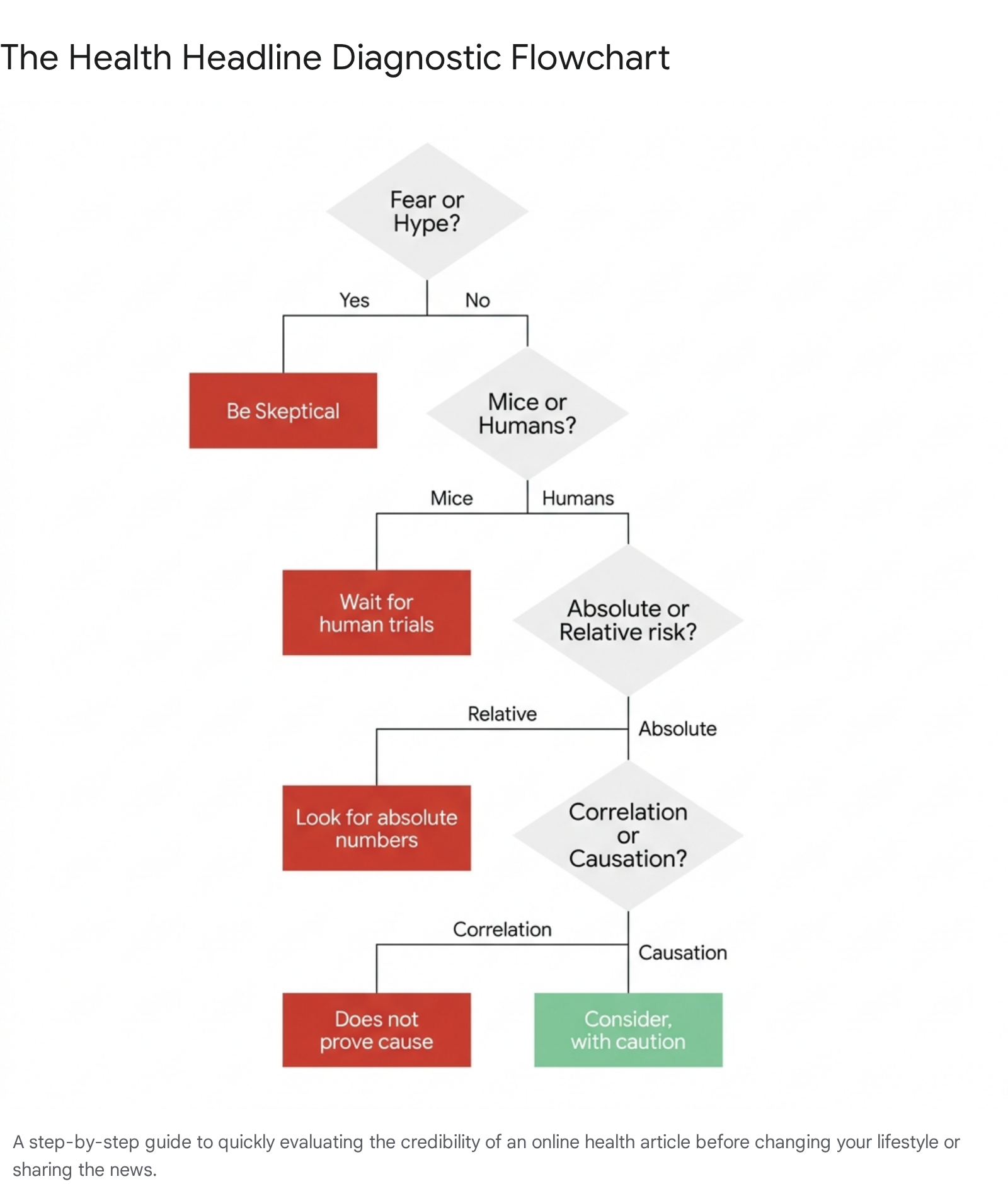
- Check the Tone: Does the article use words like miracle, cure, toxic, breakthrough, or rely heavily on fear? If so, the author is trying to manipulate your emotions for clicks, not inform you of the science.
- Check the Subjects: Was this study actually conducted in humans, or is it based on mice, rats, or petri dish cells? If it is the latter, the findings are decades away from being applicable to your life, and they have a 95% chance of failing entirely.
- Check the Numbers: Does the headline scream about a "doubled" risk or a "50% decrease"? Search the article for the absolute risk. If the article does not provide the baseline numbers, the author either doesn't understand the science or is intentionally hiding the true, minuscule impact of the finding.
- Check for Causation: Does the study prove that X causes Y (usually via a double-blind Randomized Controlled Trial), or does it merely observe that X is "linked to" Y in an observational cohort? Remember the golden rule of statistics: correlation does not equal causation.
- Check the Source and Funding: Who paid for the study? Are there obvious conflicts of interest? Furthermore, is the article trying to sell you a supplement, an online course, or a detox kit at the bottom of the page? Reliable health information should not come with an affiliate marketing link 6.
- Seek Consensus: A single study means very little in the grand scheme of science. Does this new headline align with the broad consensus of major medical organizations? If an article claims that the entire medical establishment is lying to you to protect their profits, that is a definitive red flag indicating you have stumbled into conspiracy theory, not health journalism 6.
Bottom line
The intersection of complex medical science, a sensationalist digital media landscape, and an epidemic of academic fraud has made navigating health news more difficult than ever. While exciting medical advancements do happen, the vast majority of breathless headlines - especially those relying on relative risk percentages, early-stage mouse models, and correlational data - are exaggerating the truth to capture your attention. By remaining highly skeptical of "miracle cures," actively looking for absolute risk data, and verifying the underlying study design, curious readers can protect themselves from the anxiety and real-world harm caused by the global health infodemic.