
How to Fact-Check Social Media Health Claims
Health misinformation spreads rapidly across the internet because social media algorithms are explicitly designed to prioritize emotional engagement over factual accuracy, leading to a relentless flood of science-washed trends and AI-generated fabrications. By adopting established digital literacy frameworks like the SIFT method and practicing the technique of "lateral reading," individuals can quickly evaluate the credibility of online health claims without needing advanced medical training. Establishing these automated cognitive habits is the public's best defense against predatory wellness scams, manipulative influencers, and harmful viral advice.
The Algorithmic Environment: Why Misinformation Thrives
To understand why health misinformation dominates platforms like TikTok, Instagram, X (formerly Twitter), and YouTube, it is essential to examine the structural architecture of the platforms themselves. Social media algorithms do not filter for accuracy; rather, they optimize for user retention and engagement, metrics that are heavily driven by novelty, outrage, and emotional resonance 12.
This dynamic creates an "engagement-accuracy paradox." Sensational claims - such as the discovery of a suppressed miracle cure for a chronic disease, or a terrifying hidden danger lurking in a common household food - naturally generate significantly more clicks, comments, and shares than nuanced, evidence-based public health updates 12. Consequently, the algorithm amplifies the sensational claim, pushing it into the feeds of millions. A recent analysis of elective surgery content across Instagram and YouTube demonstrated this paradox empirically: posts containing false or misleading claims garnered nearly double the normalized engagement compared to accurate, evidence-based posts, and provoked a significantly higher volume of emotionally charged comments 2.
The Cognitive Cost of Short-Form Video
The explosive rise of short-form video (SFV) platforms - most notably TikTok, Instagram Reels, and YouTube Shorts - has introduced a profound new variable into the misinformation ecosystem: cognitive overload. These platforms utilize an infinite-scrolling interface that delivers highly stimulating, fast-paced content, radically altering how users process information 315.
A comprehensive meta-analytic investigation comprising data from 98,299 participants across 71 studies found that increased SFV use is consistently associated with poorer cognitive functioning, specifically yielding strong negative correlations with sustained attention (r = -.38) and inhibitory control (r = -.41) 1. According to cognitive load theory, the sheer speed and density of short-form content overwhelms the brain's working memory capacity 67. This rapid turnover of information results in fragmented encoding and shallow processing, ultimately reducing the user's capacity for analytic thinking 56.
When individuals are stripped of their ability to engage in slow, reflective thought, they are forced to rely on fast, intuitive processing 8. This cognitive state makes them highly susceptible to charismatic influencers and repetitive falsehoods. The "illusory truth effect" demonstrates that the mere repetition of a claim - a feature built into algorithmic echo chambers - increases its perceived accuracy, regardless of its actual factual validity 82.
Global Variations: Who Is Most Vulnerable?
Susceptibility to health misinformation is not solely dictated by an individual's baseline intelligence; it is driven by complex psychological processes, underlying digital literacy skills, and broader socioeconomic contexts 103. A global report encompassing 16,000 individuals across 16 countries revealed that 70% of people globally believe at least one false health claim, with the figure rising to 75% in nations like Brazil 12.
The Digital Health Literacy Paradox
Traditional assumptions suggest that wealthier nations naturally possess higher digital health literacy. However, a massive cross-national survey of 31,000 adults across 30 countries conducted by the CUNY Graduate School of Public Health recently challenged this 45. The study found that digital health literacy is actually highest in several low- and middle-income countries (LMICs) and lowest in high-income countries (HICs) 45.
Researchers hypothesize that in many LMICs, social media has become the primary, if not sole, route to accessing health information, forcing populations to rapidly develop adaptive digital navigation skills 4. Furthermore, the acceptance of AI-generated health information varied wildly by region. Globally, 58.3% of respondents reported a willingness to accept AI health content; however, acceptance was above 75% in China, India, Pakistan, and Indonesia, while plummeting below 50% in the United States, United Kingdom, France, and Canada 45.
Demographics and Coordinated Disinformation
Different demographic cohorts experience unique vulnerabilities to misinformation. Older adults frequently face a steeper learning curve regarding digital interfaces, making them a common target for unverified alternative medicine scams and phishing attempts 616. Conversely, Generation Z - despite possessing generally superior digital navigation skills - demonstrates a heavy reliance on algorithm-driven SFVs, making them highly vulnerable to attention fragmentation and the rapid absorption of unregulated mental health and extreme diet advice 5616.
Beyond individual vulnerabilities, organized disinformation campaigns actively exploit health crises for political or financial gain. During the COVID-19 pandemic and subsequent Mpox outbreaks in Africa, rumors regarding vaccine safety and unverified treatments spread rapidly across platforms like WhatsApp and Facebook, exploiting historical mistrust of medical institutions 177. In Latin America, the rise of political "troll farms" - organized groups paid to create and amplify lies - has increasingly weaponized health disinformation 8. In nations like Ecuador, swarms of inauthentic digital media accounts mimic legitimate journalistic outlets to erode public trust, making it incredibly difficult for citizens to distinguish verified public health directives from coordinated manipulation 8.
Decoding "Science-Washing" and Viral Trends
Health misinformation rarely presents itself as an obvious, easily dismissible lie. Instead, it is frequently cloaked in legitimate scientific terminology to project an aura of credibility - a practice known as "science-washing" 20. Social media influencers routinely co-opt clinical terms like "inflammation," "hormone imbalance," "cortisol spikes," or "gut microbiome" to market unproven supplements, expensive detox programs, or restrictive fad diets 910.
The #GutTok Phenomenon
A prime example of modern science-washing is found in the viral trends surrounding digestive health. The hashtag #GutTok has amassed over six billion views on TikTok, fueled largely by promises of overnight cures for bloating and weight loss 11.
Viral videos frequently urge users to drink beet juice to rapidly "flush 8 - 10 lbs of waste," consume aloe vera daily, or embark on strict liquid juice cleanses to "reset" their gut 1112. While it is scientifically accurate that the bioactive compounds, antioxidants, and fibers in whole beets are beneficial for gastrointestinal health, the sensational claim that drinking a juice can rapidly flush pounds of toxic waste is a biological fiction 12. Furthermore, extreme juice cleanses inherently strip fruits and vegetables of their insoluble and soluble fiber - the exact nutrient most crucial for maintaining a healthy digestion process and a balanced microbiome 1112.
Gastroenterologists and dietitians emphasize that true gut health relies on a sustained, diverse intake of dietary fiber over months or years, not an overnight tonic or an expensive supplement 911.
The Illusion of Authority and HCP Influencers
Adding to the complexity of the digital landscape is the presence of credentials. Social media is saturated with individuals wearing white coats who dispense medical advice far outside their actual scope of practice, or who fail to transparently disclose financial conflicts of interest. For example, recent investigative reporting revealed that the food, beverage, and dietary supplement industries paid dozens of registered dietitian influencers to post content promoting diet sodas, sugar, and unregulated supplements, reaching millions of viewers without always clearly disclosing the corporate partnerships 13.
At the same time, because 85% of patients still trust their primary care physicians above all other sources, but face heavily backlogged and overburdened healthcare systems, many individuals are turning to credible Healthcare Provider (HCP) influencers 14. These verified physicians and nurses use social media to translate complex medical jargon into accessible advice, filling a critical public health void, but forcing users to constantly delineate between genuine medical experts and opportunistic marketers 14.
Recognizing the Red Flags
When evaluating health content online, identifying common structural and linguistic red flags can rapidly separate evidence-based information from science-washing.
| Misinformation Tactic / Red Flag | What It Typically Indicates | How to Fact-Check the Claim |
|---|---|---|
| "Hormone imbalance" or "Toxins" without specific medical context. | Science-washing buzzwords used to create fear and sell "detox" products or unregulated supplements 10. | Check if the creator's profile links to a storefront. Search the specific claim on PubMed or major health institutions 1011. |
| "The secret cure doctors won't tell you" | Conspiracy-driven marketing. Major medical breakthroughs are published globally and debated publicly, not hidden by entire professions 1516. | Search the specific "cure" alongside words like "scam," "debunked," or "clinical trial" to see the mainstream scientific consensus 1529. |
| Dramatic "Before & After" Photos | Anecdotal visual evidence designed to bypass critical thinking, evoke emotion, and imply guaranteed results 1117. | Remember that correlation is not causation. Look for peer-reviewed, double-blind studies backing the underlying mechanism, not just imagery 1011. |
| "DM me for details" or "Link in bio" | A tactic to move conversations into private messages to avoid platform fact-checkers and FDA/FTC regulatory scrutiny 11. | Disengage entirely. Legitimate public health advice is transparent, freely available, and subject to public peer review 11. |
The Threat of AI-Generated Health Content
The landscape of health misinformation is rapidly shifting with the advent of generative artificial intelligence. AI tools - including large language models (LLMs) and advanced image generators - can now mass-produce persuasive articles, deepfake videos, and photorealistic imagery at an unprecedented scale 1819.
Experimental studies indicate that AI-generated health misinformation can often be more persuasive than human-authored falsehoods 18. This is primarily due to "false fluency" - generative AI produces text that is highly coherent, grammatically perfect, and authoritative in tone. This polished presentation exploits heuristic shortcuts in the human brain, tricking users into assuming that a well-written claim is an accurate claim 18.
Furthermore, relying on consumer-facing AI chatbots for self-diagnosis introduces significant risks. While these models are trained on vast datasets of medical literature, they do not inherently "understand" medicine; they predict statistical patterns in language 33. Consequently, they can confidently hallucinate incorrect medical advice, generate plausible but fake citations, and fail to account for a user's individualized medical history or contraindicated medications 33.
Visual misinformation is also accelerating. Deepfakes and AI-generated images are frequently deployed during public health emergencies to manufacture panic or lend false credibility to fake experts 20. To spot AI-generated visual misinformation, experts recommend looking for subtle oddities - such as distorted hands, blurry background edges, or unrealistic physics - and utilizing reverse image search tools like Google Lens or TinEye to determine if the image exists elsewhere in a different context 20.
The SIFT Method: A Practical Framework
To combat the deluge of questionable health content and AI fabrications, digital literacy experts have developed a rapid evaluation framework known as the SIFT method. Created by digital literacy expert Mike Caulfield, SIFT offers four quick, actionable steps to assess online information before integrating it into your belief system or sharing it with your network 353637.
1. Stop
The first step is simply to pause. Misinformation is engineered to bypass your critical thinking by triggering a strong emotional response - whether that is fear, anger, outrage, or sudden hope for a cure 237. Before engaging with a post, recognize that your emotions are being manipulated to encourage sharing. Ask yourself if you truly know the reputation and underlying motives of the source 38. If you feel overwhelmed, stop and clarify your original information-seeking goal 38.
2. Investigate the Source (The Power of Lateral Reading)
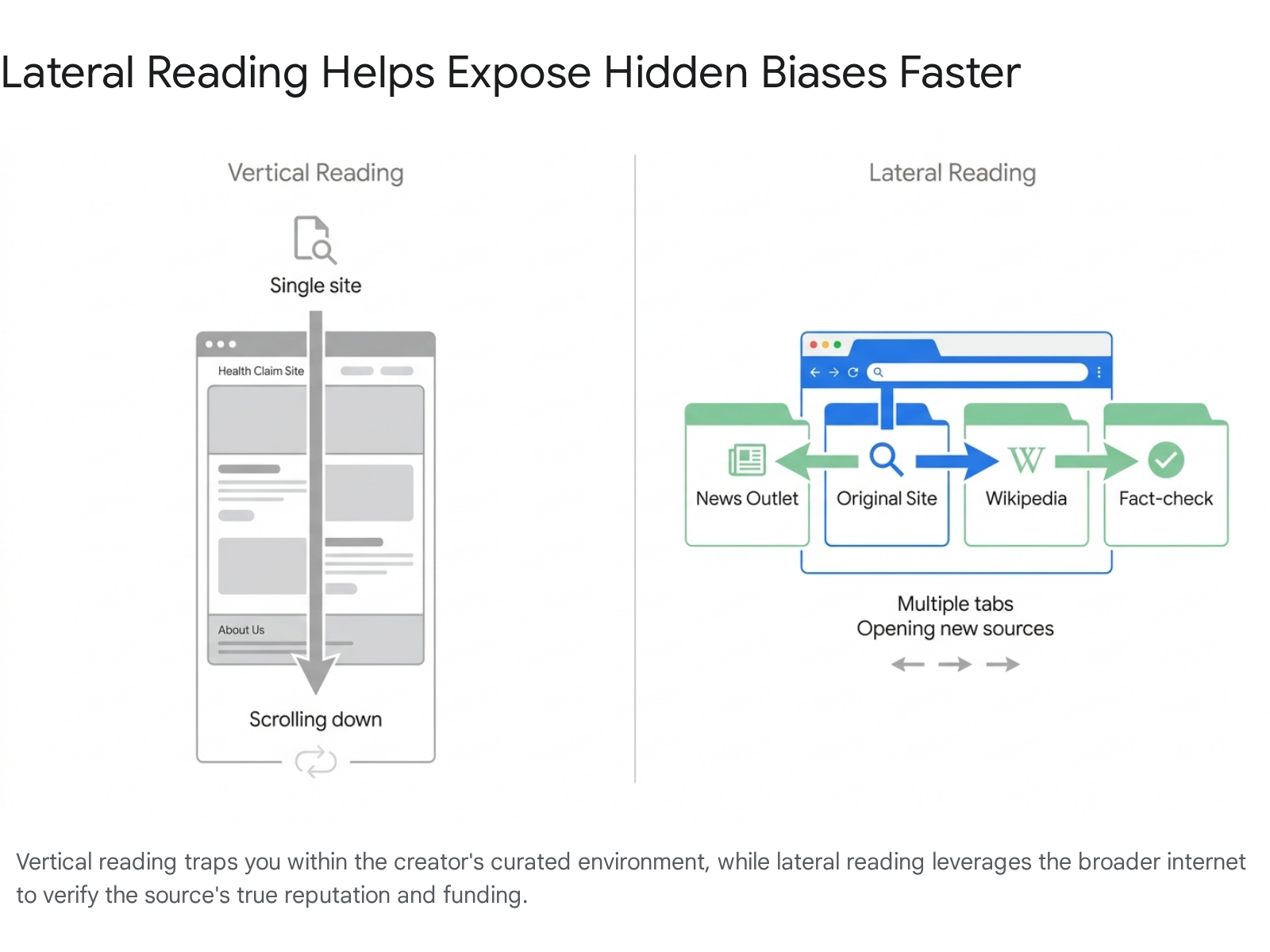
Historically, students were taught to evaluate a website by looking at its "About Us" page, checking for a ".org" domain, or examining its professional design. This technique is known as vertical reading 29. In the modern internet era, vertical reading is highly ineffective. Anyone with minimal funding can build a beautiful, professional-looking website, purchase a .org domain, and write a convincing, entirely fabricated "About Us" page 29.
Instead, professional fact-checkers use lateral reading 293921. When they encounter a new source, they do not stay on the page. They immediately open a new browser tab and search for what other authoritative, independent sources say about the original site 2939. By searching Wikipedia, dedicated fact-checking organizations (like Snopes or FactCheck.org), or credible news outlets, you can quickly discover if the "medical research institute" you are reading is actually a front for a supplement manufacturer or a known purveyor of conspiracy theories 292038.
3. Find Better Coverage
You are never obligated to rely on the first video or article you find. If a social media post makes a bold, paradigm-shifting claim about a new cancer treatment or an impending viral pandemic, search the web to see if major, trustworthy outlets are covering the same story 3637. If a "miracle breakthrough" is only being reported by obscure blogs and is entirely absent from established scientific organizations - such as the Centers for Disease Control and Prevention (CDC), the World Health Organization (WHO), or major academic medical centers - it is highly suspect 1533.
4. Trace Claims to the Original Context
Misinformation frequently relies on stripping quotes, data points, or images of their original context 3639. A post might cite a legitimate, peer-reviewed study, but deliberately exaggerate the findings to fit a narrative. Tracing the claim back to the original source allows you to see the context 39. For instance, you can verify if the research was actually conducted on humans (rather than mice or in vitro cell cultures), if the sample size was statistically significant, or if the original study authors explicitly warned against the very claim the social media influencer is now making 1035.
Does Fact-Checking Actually Work?
A common pessimistic assumption is that interventions cannot stop the virality of fake news. However, recent empirical data suggests otherwise.
A study co-authored by researchers at Yale University analyzed X's "Community Notes" feature, a crowd-sourced framework that attaches fact-checking context directly to potentially misleading posts 22. The researchers found that after a warning note was attached, posts experienced a massive drop in engagement: 46.1% fewer reposts, 44.1% fewer likes, 21.9% fewer replies, and 13.5% fewer views 22. Crucially, the researchers noted that "time is of the essence" - much of the engagement with false claims occurs in the hours before the label is applied, highlighting the need for rapid algorithmic moderation 22.
Prebunking and Cognitive Immunity
Public health communicators are also increasingly relying on "prebunking" - the psychological equivalent of a vaccine. By teaching people the tactics that bad actors use to spread misinformation (such as emotional manipulation, fake experts, or out-of-context statistics) before they actually encounter specific lies, individuals build a "cognitive immune system" 82343. The World Health Organization and other public health bodies actively promote gamified interventions - such as the online games Go Viral!, Bad News, Harmony Square, and Cranky Uncle - which interactively teach users how disinformation campaigns are built, thereby making them highly resistant to future deception 43.
How to Talk to Your Network
If you spot a friend or family member sharing false health claims, confronting them aggressively is usually counterproductive. Shaming someone publicly on a social media thread often triggers the "backfire effect," causing them to become defensive and further entrench their beliefs 1024.
Instead, experts recommend engaging with empathy 24. Recognize that people frequently share misinformation out of a genuine desire to protect their loved ones or make sense of a frightening, confusing event 24. Have conversations one-on-one, either face-to-face or via direct message. Acknowledge their underlying fear, gently correct the claim by pointing to credible sources who have no financial or political stake in the issue, and provide alternative, easy-to-understand resources 1024.
Bottom line
Social media algorithms actively reward sensational, emotionally charged health claims over nuanced scientific truth, transforming platforms into minefields of "science-washing," AI-generated fakes, and unregulated wellness scams. By adopting the SIFT method - specifically pausing your initial emotional reaction and opening new tabs to read laterally about a source's true motives - you can rapidly bypass manipulative algorithms. While no one is entirely immune to well-crafted misinformation, integrating these simple digital habits into your daily life shifts you from a passive consumer into a resilient, critical thinker.