
How to Spot the Flaws in College Rankings
College rankings, most notably those published by U.S. News & World Report, are currently facing an existential crisis of legitimacy as elite institutions boycott their methodologies and data manipulation scandals expose deep structural vulnerabilities. To combat intense academic criticism, major ranking publishers have recently overhauled their proprietary algorithms to prioritize social mobility and graduate outcomes over subjective prestige, yet peer-reviewed statistical analyses indicate that these composite scores continue to primarily reward accumulated institutional wealth. Consequently, the reliance on a single ordinal number to evaluate complex higher education environments remains a deeply flawed practice that distorts both university administrative behavior and prospective student decision-making.
Every spring, millions of families endure immense stress agonizing over minute ranking differences - debating whether a school ranked number twelve is vastly superior to one ranked number eighteen - unaware that these arbitrary numerical gaps often reflect accounting quirks and institutional endowments rather than any tangible difference in actual educational quality.
How are college rankings actually calculated?
To understand the structural flaws inherent in higher education league tables, it is necessary to deconstruct the statistical mechanics that underpin them. For decades, the dominant force in the North American market has been the U.S. News & World Report Best Colleges ranking, which has been rating national universities since 1983 1. Historically, the publication relied on an algorithm heavily weighted toward institutional inputs - the characteristics of the incoming student body and the financial resources of the university - rather than educational outputs, such as what a student actually learns or the value added to their career trajectory 23. The most honest tension in this debate is that rankings perform a real function; for a first-generation student in a rural county whose high school counselor has limited knowledge of selective institutions, a ranked list provides orientation that did not previously exist 2. However, the specific metrics used to construct that orientation are deeply problematic.
The most heavily weighted and fiercely criticized component of the U.S. News methodology is the peer assessment survey, which historically accounted for a whopping 20% of an institution's overall score 1. This metric is derived from an anonymous survey sent to university presidents, provosts, and deans of admissions, asking them to rate the academic quality of peer institutions on a scale of 1 (marginal) to 5 (distinguished) 12. The statistical unreliability of this metric is profound. Higher education administrators are effectively asked to evaluate the classroom quality of hundreds of rival institutions they have never visited 1. The response rate for this survey has plummeted in recent years, falling from 68% in 1989 to barely 31% in recent cycles, with liberal arts colleges showing an even lower response rate of 28.6% 63. As academic leaders point out, the peer assessment is akin to asking a culinary expert to rate the signature dishes at hundreds of restaurants where they have never eaten 1. Ultimately, statistical studies reveal that the peer reputation survey is merely a proxy for historical brand recognition; the top predictor of a college's peer assessment score in any given year is simply its ranking from the previous year 1.
Beyond subjective reputation, financial resources have long played a massive role in rankings. U.S. News evaluates the average spending per student on instruction, research, student services, and related educational expenditures 84. While intended to measure institutional investment in student success, this metric overwhelmingly biases the rankings in favor of wealthy institutions with massive endowments 8. Furthermore, research indicates that the pressure to increase this specific metric has led universities to prioritize spending that satisfies the ranking algorithm. A study by the National Bureau of Economic Research (NBER) found that college quality ranking exposure leads to direct increases in expenditures at public colleges, mostly funded by pulling more state appropriations per student, effectively steering public funds toward maintaining rank rather than expanding access 5.
Other traditional metrics included student selectivity (acceptance rates and standardized test scores), faculty resources (class size and the percentage of faculty with terminal degrees), and alumni giving rates 23. The inclusion of alumni giving was particularly controversial, as it inherently favored institutions whose graduates originated from, and entered into, high-income demographic brackets 811. By heavily weighting selectivity and yield, the algorithm incentivized colleges to aggressively market themselves to unqualified applicants - often via application fee waivers and the Common App - solely to reject them, thereby artificially lowering their acceptance rates and boosting their perceived prestige 2811.
What sparked the 2023/2024 methodology overhauls?
Faced with mounting academic criticism, the onset of high-profile university boycotts, and a growing public consensus that rankings exacerbate socioeconomic inequality, U.S. News & World Report implemented what its executive chairman called "the most significant methodological change in the rankings' history" ahead of the 2024 cycle 6137. These changes were largely maintained through the 2025 and 2026 iterations of the list, signaling a permanent structural shift 15.
The overhaul fundamentally stripped away several metrics that were long considered the bedrock of collegiate prestige. U.S. News entirely eliminated five traditional criteria from its formula: class size distribution, the proportion of faculty with terminal degrees, the high school class standing of incoming freshmen, the share of graduates borrowing federal loans, and the heavily criticized alumni giving rate 13716. Critics had long argued that these factors were easily manipulated and served primarily as proxies for institutional wealth and exclusivity rather than educational quality or social mobility 317.
In their place, U.S. News pivoted heavily toward social mobility and graduate outcomes, which now account for more than 50% of a school's ranking 1618. The updated algorithm placed increased weight on the graduation rates of students receiving federal Pell Grants - awarded to low- and moderate-income populations - and introduced a new metric evaluating whether a college's graduates ultimately earn more than a typical high school graduate 61316.
Initially, the 2024 methodology also included a dedicated metric for first-generation student graduation rates, allocating a combined 5% of the score to a college's success in graduating students who are the first in their families to attend college 3. However, this well-intentioned metric was quietly removed for national universities in subsequent cycles (2025/2026) due to severe data constraints 1319. First-generation status is not tracked in a standardized manner across all institutions, and the federal Integrated Postsecondary Education Data System (IPEDS) failed to provide the necessary comparative data, forcing U.S. News to abandon the metric and shift the weight entirely back toward Pell Grant outcomes 1319.
The immediate consequence of this methodological shift was a seismic reshuffling of the middle tiers of the ranking list. Large public universities, which traditionally serve higher populations of Pell Grant recipients, saw massive gains. For instance, the public University of Texas at San Antonio rocketed up 92 spots in a single year, while institutions like Rutgers and Fresno State saw significant bumps 13. Conversely, mid-tier private institutions - which had spent decades optimizing for small class sizes and high alumni giving rates - plummeted 113. New York University (NYU) dropped 10 spots, and universities like Tulane and Boston University also fell in the standings as the formula devalued their long-held traditional strengths 1.
However, the most striking takeaway from the "historic" overhaul was the absolute stasis at the very top of the list. Despite gutting the algorithm and reallocating vast swathes of the methodology to new social mobility factors, the apex of the hierarchy remained entirely unchanged: Princeton (securing the top position for the 13th consecutive year), MIT, Harvard, Stanford, and Yale retained their iron grip on the top five spots 361618. This lack of movement at the top highlighted a glaring reality: the elite institutions possess such overwhelming advantages in financial resources, baseline graduation rates, and peer reputation (which was pointedly left untouched at 20% of the formula) that no amount of methodological tweaking regarding social mobility could dislodge them 317.
Why are prestigious schools boycotting the rankings?
While mid-tier universities quietly scrambled to adjust to the new algorithm, the most prestigious graduate schools in the world launched a full-scale, public revolt against the publishing giant. The exodus began in November 2022, when Yale Law School - the perennially top-ranked law program in the nation - announced it would no longer cooperate with or submit proprietary data to U.S. News 8.
Heather K. Gerken, the dean of Yale Law, described the rankings as "profoundly flawed," arguing that the methodology actively punished schools for adhering to the core commitments of the legal profession 8. Specifically, the U.S. News algorithm penalized law schools that supported public interest careers. If a graduate accepted a low-paying public defense or non-profit fellowship funded by the university itself, U.S. News effectively classified that graduate as "unemployed," damaging the school's employment metrics 89. Furthermore, the formula for student debt failed to account for generous loan forgiveness programs provided by wealthy institutions for graduates entering public service. This created a perverse incentive for law schools to admit wealthy students who required no loans, rather than offering need-based aid to lower-income students who would graduate with debt 89.
Harvard Law School immediately followed Yale's lead, with Dean John Manning publishing a statement asserting that it had "become impossible to reconcile our principles and commitments with the methodology and incentives the U.S. News rankings reflect" 89. Within weeks, a cascade of top-tier law programs, including UC Berkeley, Georgetown, and Stanford, withdrew from the system 810. By 2023, more than a third of the 196 law schools surveyed annually had ceased cooperation, forcing U.S. News to scramble and dramatically revise its legal education formula 11.
The rebellion quickly spread to medical schools. In January 2023, Harvard Medical School - ranked No. 1 for research - pulled out of the rankings. Dean George Q. Daley stated that the system created "perverse incentives for institutions to report misleading or inaccurate data" and diverted financial aid away from genuinely needy students toward high-testing applicants merely to boost institutional metrics 10. Stanford, Columbia, the University of Pennsylvania, Mount Sinai, the University of Chicago, and Washington University in St. Louis quickly joined the medical school boycott 12. Katrina Armstrong, dean of Columbia's College of Physicians and Surgeons, noted that the commercial rankings "perpetuate a narrow and elitist perspective on medical education" 10.
The boycott eventually breached the undergraduate level, with institutions like Columbia University, the Rhode Island School of Design (RISD), and Colorado College withdrawing their data, citing a misalignment of academic values and the commercialized, highly subjective nature of the rankings industry 27. In response to the mass defection, U.S. News stated that it would continue to rank non-cooperating institutions using publicly available data, such as information mandated by the American Bar Association or data submitted to the federal government via IPEDS 628. While the boycott successfully forced U.S. News to alter its graduate methodologies to de-emphasize reputational surveys in favor of outcome measures, it also laid bare the immense, distortive power a private media company wields over the strategic priorities of American higher education.
Can universities game the system?
The pressure to climb the U.S. News rankings is not merely a matter of institutional vanity; it carries massive, quantifiable financial implications. Higher rankings lead directly to increased application volumes, higher student yields, and improved bond ratings, while drops can cost universities millions in lost tuition revenue and alumni donations 21129. This high-stakes environment has inevitably bred systemic data manipulation, leading to several high-profile scandals that expose the fragility of a ranking system reliant on self-reported, unverified data 1113.
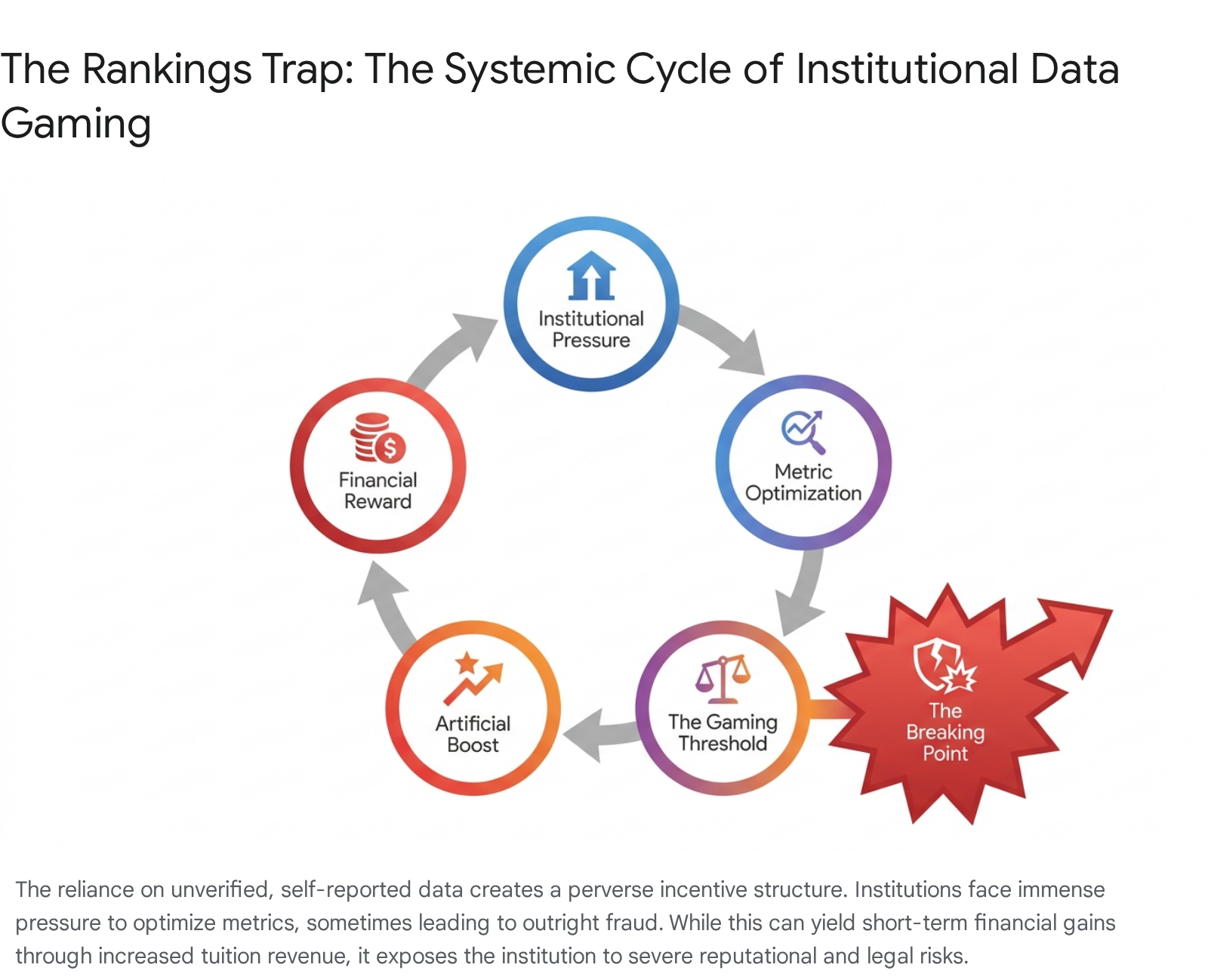
The Columbia University Data Scandal
In one of the most embarrassing episodes in the history of the Ivy League, Columbia University was exposed for systemic data inflation in 2022. The exposure did not come from an external auditor or accrediting body, but from a whistleblower within: Michael Thaddeus, a mathematics professor and former department chair at Columbia 1314. Thaddeus published a meticulous, peer-reviewed-style statistical analysis on his personal website, deconstructing the data Columbia had submitted to U.S. News, which had propelled the university to a No. 2 national ranking 133233.
Thaddeus proved that Columbia had fabricated data across multiple key metrics. The university claimed that 82.5% of its undergraduate classes had fewer than 20 students; Thaddeus, utilizing the university's own course directory, calculated the true figure was between 62.7% and 66.9% 3234. Columbia claimed that 100% of its faculty held terminal degrees in their fields; the actual number was closer to 96% 1334. Furthermore, the university claimed that 96.5% of its faculty were full-time, when federal data indicated the true figure was 74.1% 34.
Most egregiously, Thaddeus exposed how Columbia manipulated the heavily weighted "Financial Resources" metric. The university claimed an eye-popping $3.1 billion spent on instructional costs 33. Thaddeus revealed that Columbia achieved this figure by improperly lumping the massive costs of patient care at its medical hospital into the instructional budget for undergraduate education, vastly overstating its investment in students compared to peers like NYU, which explicitly separated clinical costs 1333. Following the exposé, Columbia initially defended its numbers, but eventually admitted to relying on "outdated and/or incorrect methodologies" 1314. The university was subsequently relegated to No. 18 by U.S. News 1334. Thaddeus noted that the scandal exposed the shoddiness of the ranking industry itself, stating that the lists are based on data "that have very little to do with the academic merit of an institution and that the data might not be accurate in the first place" 13.
The Temple University Fox School of Business Fraud
While Columbia's manipulation involved creative accounting and definitional stretching, Temple University's Fox School of Business engaged in outright, multi-year fraud 35. Under the leadership of Dean Moshe Porat, the business school embarked on a concerted, strategic effort to dominate the U.S. News online MBA rankings, establishing a culture where rankings were the ultimate administrative priority 3515.
Between 2014 and 2018, Temple intentionally submitted falsified data. The school claimed that 100% of its incoming online MBA students had submitted GMAT scores, a key indicator of selectivity; in reality, only about 20% had actually done so 1617. The school also artificially inflated undergraduate GPAs, underreported admissions offers to appear more exclusive, padded student-faculty ratios, and lied about student debt levels 351718. The fraud worked brilliantly for a time, earning Temple the No. 1 ranking for online MBAs for four consecutive years and driving massive, lucrative enrollment increases 3517.
When the fraud was uncovered, the fallout was catastrophic. Dean Porat was ousted (and later criminally convicted of wire fraud), the school was stripped of its ranking entirely, and Temple was forced to pay a $5.5 million class-action settlement to defrauded students, alongside a $700,000 civil fine to the U.S. Department of Education 351618. An independent investigation by the law firm Jones Day revealed a concerted cover-up and the disbanding of data-oversight committees 3515. The Department of Education noted that Temple had "knowingly and intentionally submitted false information to artificially inflate" its status, republishing the fake rankings thousands of times on billboards and buses to deceive consumers and harm competitors 3518. The incident has since sparked calls for federal "instructional spending screens" - similar to the Medical Loss Ratio in healthcare - to ensure universities are penalized if they divert tuition dollars away from education and into fraudulent marketing 1920.
The Claremont McKenna SAT Inflation
Data gaming is not restricted to massive research universities or graduate programs. In 2012, Claremont McKenna College, a prestigious liberal arts institution in California, admitted that a senior administrator had been systematically falsifying SAT scores for nearly a decade 294243.
The college revealed that its Vice President and Dean of Admission, Richard Vos, had been artificially inflating the median SAT scores of incoming classes by an average of 10 to 20 points each year since 2005 to secure and maintain the college's position in the top 10 liberal arts rankings 2943. Independent investigations by campus publications revealed that the school even manufactured scores for students who had not submitted them, bumping 28 non-reporting students into higher percentiles to manipulate the college's overall statistical profile 29. The scandal highlighted how even a minor manipulation of inputs - just 10 or 20 points on a standardized test - could significantly alter a school's perceived prestige, forcing the resignation of the dean and severely damaging the institution's integrity while maintaining a high rank 2921.
How do global rankings measure prestige?
The obsession with quantifying higher education is not a uniquely North American phenomenon. Globally, millions of international students rely on lists published by Quacquarelli Symonds (QS) and Times Higher Education (THE) to navigate their educational options. However, these global rankings operate on fundamentally different methodologies than domestic systems like U.S. News, highlighting the arbitrary nature of defining "the best" university 2246.
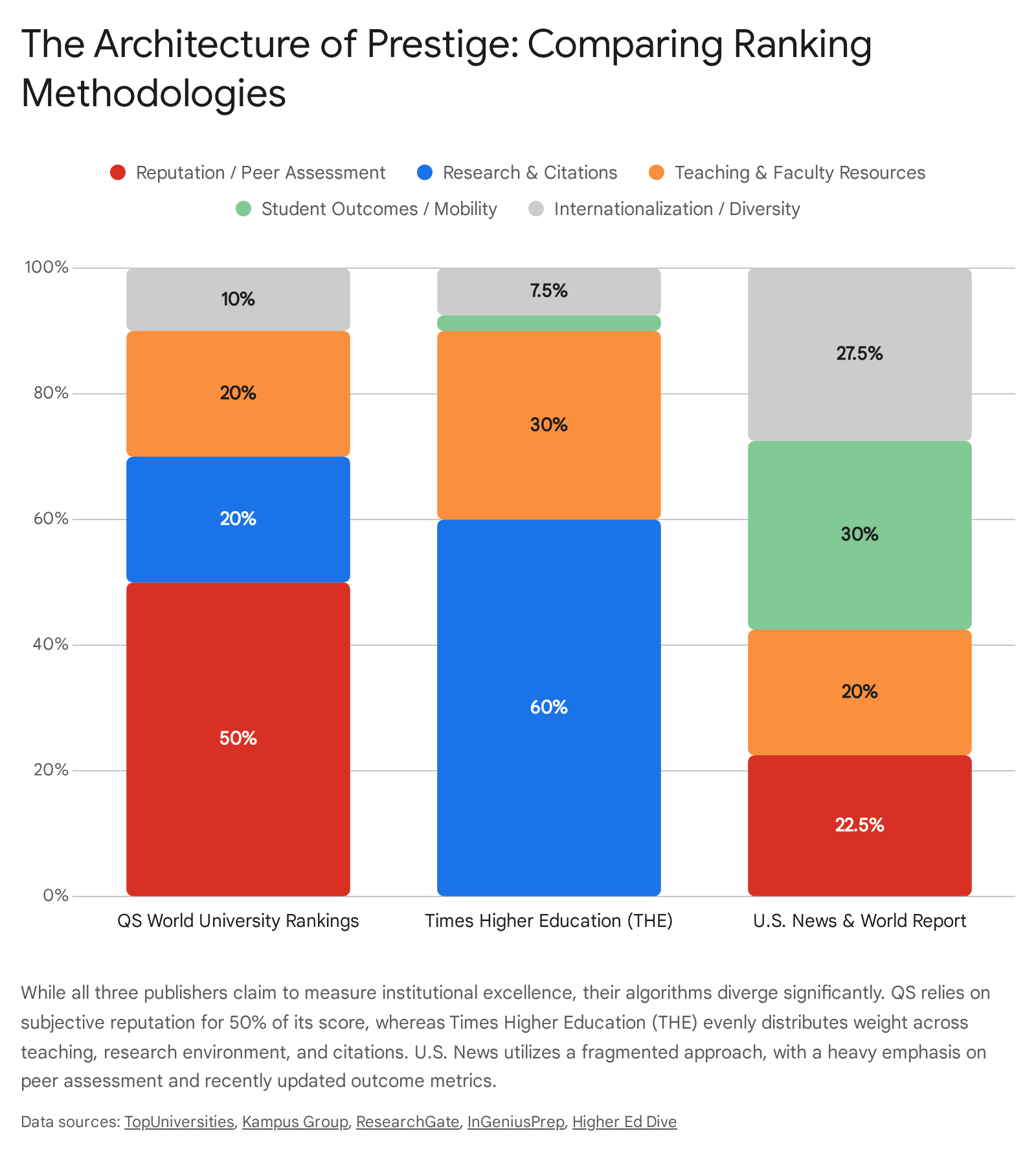
The QS World University Rankings are arguably the most widely viewed global tables, but they are also among the most heavily criticized by academics for their extreme reliance on subjective metrics 23. A staggering 50% of an institution's QS ranking is derived entirely from reputation surveys: 40% from a global academic reputation survey and 10% from an employer reputation survey 2246. This methodology inherently favors centuries-old, brand-name institutions in the English-speaking world, as academics and employers naturally vote for the institutions with the highest historical visibility and legacy 462348.
In 2009, Times Higher Education split from QS to develop its own methodology in partnership with Thomson Reuters (and later Elsevier), citing the need for a more robust and less subjective framework 4623. The THE methodology places significantly more weight on quantifiable research outputs. While it still includes reputation surveys (accounting for 33% across teaching and research), it heavily weights research influence (citations), industry income, and internationalization, assessing universities across 13 to 18 indicators 4649.
Because of these stark methodological differences, a university's global standing can fluctuate wildly depending on which list is consulted. An institution like Princeton University, which consistently dominates the undergraduate-focused U.S. News rankings, often falls outside the top 10 in the QS global rankings (placing 17th in 2024) 18. This occurs because Princeton lacks the massive, postgraduate medical and engineering research complexes that generate the high citation volumes rewarded by global metrics 18. Furthermore, both global systems suffer from inherent structural biases, particularly language bias (metrics like citation counts inherently favor English-language publications) and resource bias (wealthier institutions inherently generate higher research volumes and attract international faculty), largely disregarding regional contexts and the quality of localized undergraduate teaching 4850.
What do ranking metrics actually measure?
The central fallacy of the college ranking industry is the conflation of a composite institutional score with individual student outcomes. When families look at a ranking, they assume they are looking at a measurement of educational quality - how much a student will learn, how well they will be mentored, and how successful they will be upon graduation 22452. In reality, these metrics largely measure historical prestige, institutional inputs, and accumulated capital 225.
The American Educational Research Association (AERA) and other academic critics have pointed out that criticisms of rankings fall into two categories: methodological and structural 250. Methodological criticisms target specific formula choices, which can be corrected. Structural criticisms, however, argue that any single-number ranking of educational institutions is fundamentally invalid, regardless of the methodology 2. The danger of averaging disparate metrics into a single ordinal number is that it creates a false sense of precision 3354. As economists and statisticians have pointed out, aggregating ordinal variables that measure entirely different value dimensions (e.g., blending a subjective reputation survey with federal loan repayment data) is mathematically suspect 54. It reduces the vast complexity of higher education into a simplified league table that fails to account for the unique needs, majors, and career goals of individual students 55.
To understand the disconnect between what rankings claim to measure and what they statistically capture, one must examine the specific variables historically and currently used in the algorithms.
| The Ranking Metric | What the Public Thinks it Measures | What it Actually Measures / The Statistical Flaw |
|---|---|---|
| Peer Assessment Survey (e.g., U.S. News, QS) | The objective academic quality of the curriculum and faculty as judged by higher education experts. | Brand Recognition / Echo Chamber: Administrators cannot objectively evaluate hundreds of schools. The top predictor of a peer score is the school's rank the previous year 1. |
| Financial Resources per Student | How much money the university invests directly into improving the undergraduate learning experience. | Institutional Wealth / Accounting Quirks: Heavily biases wealthy, centuries-old endowments. Frequently distorted by classifying massive graduate research or medical hospital costs as "instructional" spending 81333. |
| Acceptance Rate / Selectivity | The academic rigor and exclusivity of the institution. | Marketing Efficacy: Incentivizes schools to aggressively market to unqualified applicants (or eliminate application fees) solely to reject them, artificially lowering the acceptance rate 2811. |
| Alumni Giving Rate (Removed by U.S. News in 2024) | How satisfied and grateful alumni are with the education they received. | Demographic Wealth: Inherently rewards institutions that enroll wealthy students who pursue high-income careers. Often gamed by soliciting $1 donations to boost participation percentages 811. |
| Standardized Test Scores (SAT/ACT) | The intellectual caliber of the student body and the rigor of the classroom. | Socioeconomic Status: Test scores correlate heavily with family income and access to expensive test preparation. Fails to measure what the student actually learns during college 2627. |
| Class Size Limits (Removed by U.S. News in 2024) | The intimacy of the learning environment and access to professors. | Administrative Gaming: Easily manipulated. Schools create arbitrary 19-person seminars while packing introductory courses with hundreds of students to meet statistical thresholds 3234. |
Practical takeaways: Building personalized criteria beyond prestige
If commercial rankings are fundamentally flawed and susceptible to manipulation, how should prospective students and their families evaluate colleges? The overwhelming consensus among higher education researchers, economists, and college counselors is to abandon generalized prestige scores in favor of personalized criteria focused on net cost, major-specific strengths, and value-added outcomes 255558.
Rather than asking which school is universally considered "the best," prospective students should ask which school will add the most value to their specific trajectory. In a landmark 2015 study, the Brookings Institution analyzed the "value-added" by thousands of two- and four-year colleges 2528. The value-added approach attempts to isolate the college's actual contribution to a student's economic success - measured by mid-career salary, loan repayment rates, and occupational earning power - by adjusting for the students' demographic characteristics and test scores at the time of admission 2526.
The findings upended traditional prestige hierarchies. The analysis found that many less-heralded institutions dramatically outperformed the Ivy League in actually preparing students for high-income careers 2527. Specialized technical schools, such as the Rose-Hulman Institute of Technology or the South Dakota School of Mines, and maritime academies, like SUNY Maritime College, scored exceptionally high in value-added earnings 2528. The Brookings research revealed that the curriculum value - the specific fields of study offered by the college, particularly a STEM orientation - and the actual technical skills alumni acquire are far stronger predictors of long-term economic success than the overall composite prestige of the institution 2527.
Alternative ranking systems and college search tools are beginning to adopt this more practical philosophy. The Wall Street Journal/College Pulse rankings have shifted heavily toward a return-on-investment (ROI) lens, measuring the impact a college has on graduates' salaries in relation to the net cost of attending 60. This approach rewards schools that provide strong job placement and manageable debt loads, regardless of their historical endowment or peer reputation 6061. Similarly, Money.com evaluates institutions based heavily on affordability and post-graduation outcomes, stripping away subjective reputational metrics 60.
To escape the rankings trap, families must define their own non-negotiable parameters and utilize objective data tools. First, evaluations should be conducted by department, not by the university as a whole. A university ranked No. 50 overall might have a top-10 program in a specific field like aerospace engineering or supply chain management. Prospective students should investigate departmental metrics, asking whether the classes in the chosen major are taught by full-time faculty or adjuncts, and examining the job placement rates specifically for that department 55.
Second, instead of relying on commercial algorithms, families should utilize government databases like the Department of Education's College Scorecard 25. This federal tool allows users to see the median earnings and debt loads of actual graduates, broken down by specific fields of study at specific institutions.
Third, families must assess cultural and environmental fit, which rankings cannot quantify. Tools like the Fiske Guide to Colleges offer qualitative, balanced profiles of academic strengths and social environments 55. Furthermore, digital platforms like Corsava allow students to sort their preferences - such as desiring an urban versus rural campus, or a collaborative versus competitive atmosphere - to find environments where they are most likely to thrive academically and mentally 62.
Finally, financial reality must be prioritized over prestige. A degree from a top-20 institution is rarely worth the accumulation of crippling undergraduate debt, especially if the student plans to pursue graduate education or a career in public service 960. Families must have transparent conversations about net cost - what the student will actually pay after institutional grants and scholarships - rather than the published sticker price 58. By defining success based on individual goals, financial realities, and intended career outcomes, students can reclaim agency in the admissions process, selecting institutions that serve as true engines of opportunity rather than mere status symbols.
Bottom line
The dominant college ranking systems are mathematically flawed constructs that historically rewarded institutional wealth and exclusivity while masquerading as objective arbiters of educational quality. While recent methodological overhauls by publishers like U.S. News have commendably shifted focus toward social mobility, the absolute lack of movement at the top of the lists - coupled with widespread boycotts by elite graduate schools and a history of institutional data fraud - proves that these algorithms remain tethered to an echo chamber of prestige. Prospective students and their families must stop outsourcing their college decisions to commercial magazines and instead build personalized, criteria-driven lists based on net affordability, major-specific outcomes, and the true "value-added" an institution provides to its graduates.