
How Speech-to-Text AI Turns Sound into Words Step-by-Step
To answer directly: Speech-to-text artificial intelligence converts continuous sound waves into discrete text by first transforming analog audio signals into a digital, frequency-based visual representation known as a spectrogram. It then feeds this mathematical matrix into a deep neural network - typically a Transformer-based end-to-end architecture - which uses self-attention mechanisms to analyze the acoustic features and probabilistically predict the most likely sequence of textual tokens that corresponds to the auditory input, applying contextual language models to refine the final output.
Picture walking down a bustling city street, a siren wailing in the distance, while dictating a hurried text message into a smartphone. Within milliseconds, the device ignores the siren, isolates the human voice, and translates the chaotic acoustic vibrations of the air into a perfectly spelled, grammatically correct sentence on the screen. This everyday phenomenon feels like cognitive comprehension, but it is entirely a product of rigorous statistical mathematics and acoustic physics. Modern automatic speech recognition (ASR) systems do not "listen" in the biological sense; they calculate.
The transition from early, fragile dictation software to highly robust, real-time transcription engines marks one of the most significant leaps in applied artificial intelligence over the past decade. This report provides an exhaustive, evidence-based examination of the modern speech-to-text pipeline, charting the journey from a raw sound wave to a finished transcript. It contrasts the legacy architectures of the past with state-of-the-art end-to-end models like OpenAI's Whisper, dissects the ongoing challenges of demographic and linguistic bias in decoding global dialects, and offers practical guidance for optimizing audio capture for machine transcription.
Does the AI Actually "Understand" What is Being Said?
Before dissecting the mechanics of the speech-to-text pipeline, it is necessary to address a pervasive misconception: the illusion of machine comprehension. Because modern AI systems respond fluently, adapt to context, and correctly punctuate sentences based on grammatical rules, users frequently anthropomorphize these tools, assuming the machine possesses a semantic understanding of the words it transcribes 1. This is fundamentally incorrect. Speech-to-text algorithms, alongside the Large Language Models (LLMs) that often power their decoding phases, operate exclusively on the principle of probabilistic prediction 11. They do not extract meaning; they extract patterns.
The Illusion of Comprehension vs. Statistical Probability
When a human being communicates, the process is driven by communicative relevance, intentionality, cultural context, and social cooperation 1. Human speech is spontaneous and deeply tied to interiority and cognitive intent, where thought often arises in the exact act of articulation 2. The linguistic functioning of a speaking being emerges from a relation to an already-constituted symbolic order, deeply embedded with emotional and cultural weight 2.
Conversely, a machine learning model is a stochastic engine that calculates the statistical likelihood of a specific sequence of characters appearing given a specific sequence of acoustic inputs 11. It learns to speak purely by example, trained on patterns embedded in massive corpora of human speech and writing 2. When a model encounters a word with multiple latent meanings - such as "bank" (a financial institution) versus "bank" (the side of a river) - it does not understand which definition is in play 2. Instead, the system relies on the surrounding contextual tokens to estimate which usage is statistically more probable based on its training data. If the preceding words are "deposit" and "check," the mathematical weights of the network overwhelmingly favor transcribing the acoustic signal as the financial "bank."
Psychoanalytic interpretations of this interaction suggest that users often engage in "disavowal" (Verleugnung) - they know the machine is merely a probabilistic engine, yet they subconsciously refuse to accept it, treating the system as a conversational agent because humans are wired for social cooperation 12. Recognizing the reality of statistical prediction is paramount for accurately evaluating ASR systems, as conflating simulation with comprehension masks the system's structural limitations.
The Limits of Probability: AI Hallucination in Silence
The purely probabilistic nature of these models is most glaringly exposed through the phenomenon of AI hallucination. In models like Whisper, silent passages or extremely quiet background noise can trigger the system to generate text that was never spoken 4. Because the Transformer decoder is trained to autoregressively predict the next token, a lack of clear acoustic input can cause the model to default to highly probable text sequences it memorized during training 43. For instance, prolonged silence might be transcribed as a standard YouTube sign-off or podcast intro music description simply because those phrases were highly represented in the model's training data during periods of low acoustic activity 3. Treating user confusion around these errors as a failure of "common sense" ignores the reality of how these systems are engineered; they are text interpreters optimizing an objective function, not sentient listeners 1.
How Does a Machine "Hear" Sound? The Acoustic Frontend
The journey from a spoken utterance to a written word begins in the physical realm. Human speech is generated by expelling air from the lungs through the vocal cords, which vibrate to create sound waves. The mouth, tongue, and lips then shape these waves into distinct phonetic sounds. To a computer, however, these sound waves are entirely illegible analog phenomena until they are digitized and mathematically transformed.
Analog-to-Digital Conversion and Sampling
A microphone's diaphragm vibrates in response to sound waves, creating a continuous analog electrical signal. To process this, the system must convert the continuous analog wave into discrete digital numbers via an Analog-to-Digital Converter (ADC). This is done through a process known as sampling. The standard sampling rate for modern ASR systems is 16,000 Hertz (16 kHz), meaning the system takes 16,000 snapshots of the audio wave's amplitude every single second 36. This rate is deliberately chosen based on the Nyquist-Shannon sampling theorem, which dictates that a 16 kHz sampling rate can accurately capture frequencies up to 8 kHz 34. Because human speech intelligibility relies almost entirely on frequencies below 8 kHz, this sampling rate is perfectly optimized to capture necessary linguistic data while minimizing unnecessary computational overhead.
Extracting the Acoustic Fingerprint: The Spectrogram
Raw audio waveforms are notoriously difficult for neural networks to analyze directly because speech features are hidden within complex time-domain fluctuations. The critical information for language comprehension - specifically the distinct resonant frequencies of the vocal tract known as formants - exists in the frequency domain, not the time domain.
To reveal this hidden structure, the ASR pipeline slices the digital audio into incredibly short, overlapping windows. Typically, these windows are 25 milliseconds wide, and the system moves forward in increments (strides) of 10 milliseconds 38. The system applies a mathematical operation called a Fast Fourier Transform (FFT) to each 25ms window 5. The FFT decomposes the complex, tangled sound wave into its constituent frequencies, revealing exactly how much acoustic energy exists at high, mid, and low pitches during that fraction of a second 5.
However, human hearing is not linear. Biological ears are highly sensitive to minute differences in low-pitched sounds but struggle to differentiate between similar high-pitched sounds. To mimic human auditory perception, the frequency data extracted by the FFT is warped onto a non-linear, logarithmic scale known as the Mel-scale 5. The resulting features are often captured as Mel-Frequency Cepstral Coefficients (MFCCs) or as a continuous visual matrix 56.
The culmination of this signal processing is a Log-magnitude Mel Spectrogram 311. This spectrogram can be conceptualized as an image - a two-dimensional matrix where the X-axis represents time, the Y-axis represents frequency (often binned into 80 distinct channels), and the color intensity of each pixel represents the amplitude or loudness of the sound at that specific frequency and moment 3611.
This 80-channel log-mel spectrogram serves as the ultimate "acoustic fingerprint" of the audio 578. Just as a chemical fingerprint allows forensic scientists to identify a substance regardless of its purity, the acoustic fingerprint allows the AI to identify the core phonetic structures of a word, stripping away irrelevant acoustic variations - such as the specific timbre of a speaker's voice or room reverberation - and leaving behind a dense, highly informative mathematical representation of the speech 679.
What Are the Architectural Differences Between Legacy and Modern Systems?
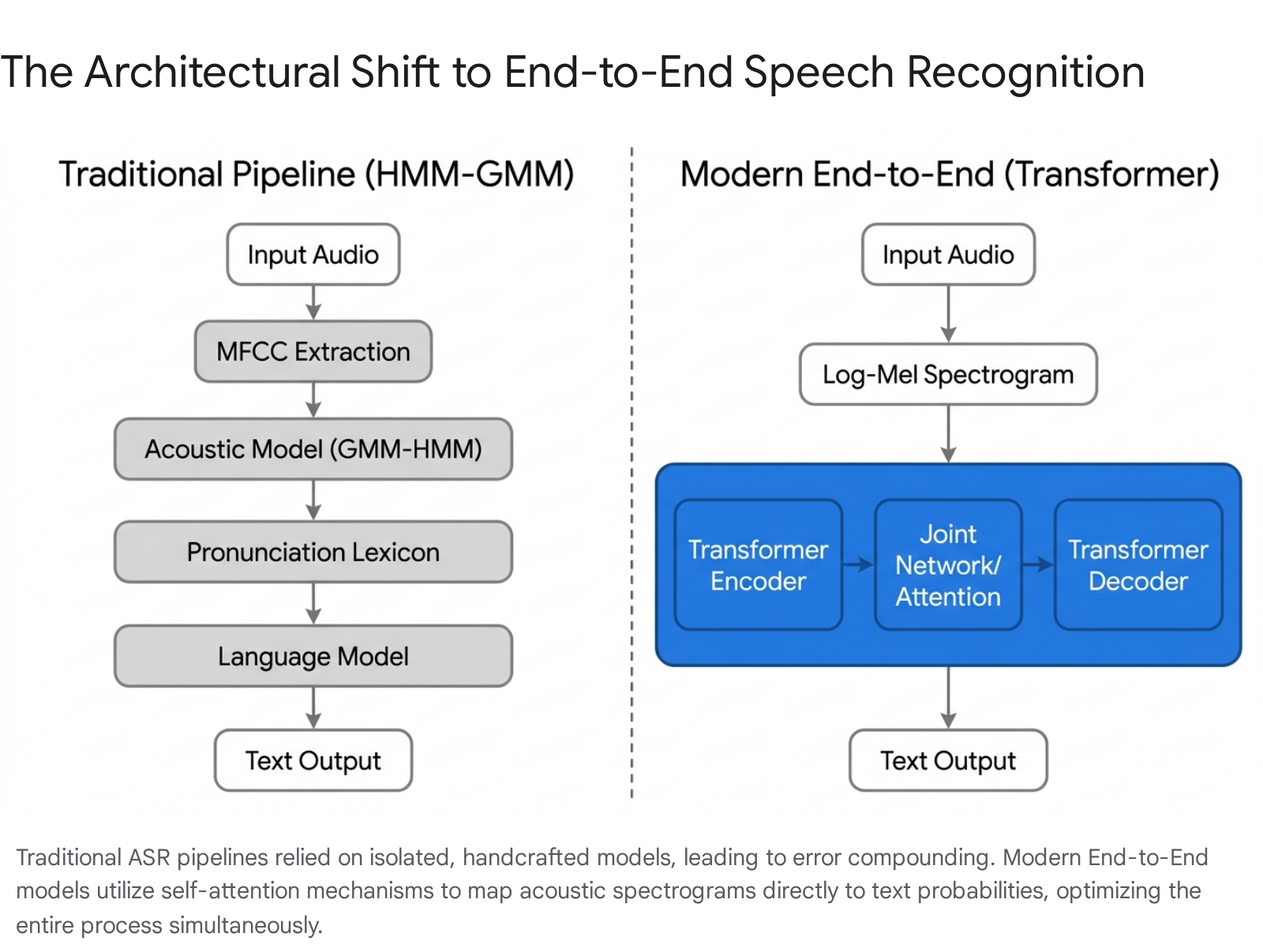
Once the acoustic fingerprint has been generated, it must be translated into text. For decades, the standard approach to this translation relied on a modular, multi-step pipeline. Today, the industry has almost entirely shifted toward unified, "end-to-end" (E2E) deep learning models 101611. To understand the capabilities of modern AI, one must examine the fundamental architectural differences that drove this paradigm shift.
The Legacy Era: GMM-HMM Pipelines
Prior to the deep learning boom, ASR systems utilized a complex, disjointed pipeline governed by Hidden Markov Models (HMMs) and Gaussian Mixture Models (GMMs) 816111213. A traditional system was manually engineered into three entirely distinct computational components:
- The Acoustic Model (AM): This module was responsible for mapping the acoustic fingerprints (the MFCCs) to individual sub-word sounds called phonemes 1620. Because a single phoneme (like the "t" sound) possesses a different acoustic signature depending on the speaker's accent, gender, and surrounding words, GMMs were used to model the statistical probability of various acoustic features representing specific phonemes, creating a multimodal distribution of possible sounds 820.
- The Pronunciation Lexicon: This was a handcrafted dictionary, painstakingly created by expert phoneticians, that explicitly mapped sequences of phonemes to actual written words (for example, dictating that the sequential sounds /k/ /ae/ /t/ formally map to the English word "cat") 161120.
- The Language Model (LM): An N-gram statistical model that evaluated the probability of word sequences to ensure grammatical logic, effectively preventing the system from producing phonetic matches that made no contextual sense 811.
While functional and historically significant, this legacy approach was inherently fragile. Errors in the acoustic model would compound and multiply as they were passed down the line to the lexicon and language models 162122. Furthermore, training these systems required strict "forced alignment" - matching specific audio frames to specific phonemes with exact temporal boundaries 2014. Creating this forced-aligned training data required immense manual labor and domain expertise for every single new language or dialect added to the system, severely limiting scalability 20.
The End-to-End (E2E) Transformer Revolution
Modern architectures collapse this fragile, multi-stage pipeline into a single, unified neural network. An end-to-end (E2E) model directly maps an input sequence of acoustic features to an output sequence of words (or sub-word characters), optimizing a single objective function globally rather than optimizing disjointed components locally 102015. This shift eliminates the need for handcrafted pronunciation lexicons and forced-aligned phonetic data.
The foundation of this revolution relies on several specific architectures:
- Connectionist Temporal Classification (CTC): CTC loss revolutionized training by removing the need for pre-aligned data. It allows the network to output a probability distribution over all possible alignments by introducing a "blank" token, effectively learning to map variable-length audio inputs to variable-length text outputs without knowing exactly when a word was spoken 16201416.
- Recurrent Neural Network Transducers (RNN-T): An evolution of CTC that includes a prediction network to model the output sequence history and a joint network that fuses acoustic and linguistic representations, making it highly effective for real-time streaming recognition 161220.
- Transformers and Attention-Based Encoder-Decoders (AED): The true breakthrough occurred with the introduction of the Transformer architecture, which leverages a mechanism called "self-attention" 1612. Unlike older RNNs that process audio sequentially left-to-right, a Transformer's self-attention mechanism analyzes the entire acoustic sequence simultaneously 12. It calculates the relevance of every acoustic frame to every other acoustic frame, allowing the model to capture long-range dependencies and deeply contextualized representations 161226.
- Conformers: The current state-of-the-art approach explicitly combines the global self-attention of Transformers with the local feature-extraction capabilities of Convolutional Neural Networks (CNNs). This hybrid "macaron-like" structure allows the model to simultaneously process fine-grained local acoustic patterns and long-range semantic context 1620.
The following table summarizes the critical differences between the legacy and modern eras of speech recognition architecture:
| Feature / Architecture Aspect | Traditional Pipeline (HMM-GMM / DNN-HMM) | Modern End-to-End (Transformer / E2E) |
|---|---|---|
| Pipeline Structure | Disjointed: Independent Acoustic Model, Pronunciation Lexicon, and Language Model optimized separately 161120. | Unified: A single integrated neural network mapping acoustic frames directly to text probabilities 101115. |
| Alignment Requirement | Requires strict "forced alignment" of audio frames to precise phoneme labels during training 2014. | Alignment is learned dynamically using mechanisms like CTC or Attention without pre-aligned timestamps 16201416. |
| Contextual Processing | Localized context; relies heavily on sequential, state-by-state transitions governed by the Markov property 816. | Global context; multi-head self-attention captures long-range dependencies across the entire utterance simultaneously 161226. |
| Error Propagation | High risk of compounding errors cascading from the acoustic model to the language model 162122. | Joint optimization minimizes cascaded errors by training against a single, global loss function 101516. |
| Feature Engineering | Heavy reliance on manually engineered features and handcrafted phonetic dictionaries curated by linguists 81120. | Model learns robust, high-level representations directly from log-mel spectrograms with minimal human intervention 1112. |
| Training Efficiency | Poor parallelization due to strict sequential decoding constraints 12. | Highly parallelizable across GPUs during training, drastically reducing the time required to process massive datasets 12. |
How Do Modern End-to-End Models Like Whisper Work? (2023+ Developments)
The zenith of the end-to-end transformer era is exemplified by models like OpenAI's Whisper, which fundamentally altered the landscape of open-source speech recognition. Whisper eschews the traditional approach of training on tightly constrained, cleanly recorded, dataset-specific audio (such as the canonical LibriSpeech audiobook dataset). Instead, it adopts a massive "weak supervision" approach 32728.
Scale, Architecture, and Weak Supervision
Whisper's core architecture relies on a highly scalable encoder-decoder Transformer, but its unprecedented robustness is derived directly from its training scale. The initial foundational model was trained on 680,000 hours of multilingual, multi-task supervised data scraped indiscriminately from the internet 4272930. This dataset intentionally included highly varied acoustic conditions: stadium echoes, background traffic, overlapping speech, and recordings from low-quality mobile phone microphones 4272930.
Of this 680,000-hour corpus, approximately 117,000 hours consisted of multilingual audio covering 96 different languages, while another 125,000 hours provided "X-to-English" speech translation data 272830. By feeding the model special task-specific tokens within its vocabulary array, Whisper utilizes a single output head to perform transcription, translation, language identification, and voice activity detection simultaneously 462729. Furthermore, because it operates sequentially on text tokens, it bypasses the need for disjointed text normalization components, naturally injecting correct punctuation and capitalization into its output based on linguistic context 627.
The 2024 Evolution: Large-v3, Turbo, and Optimized Variants
The trajectory of Whisper's development throughout late 2023 and 2024 highlights the industry's drive toward lowering error rates while concurrently solving the high latency costs associated with massive Transformer models.
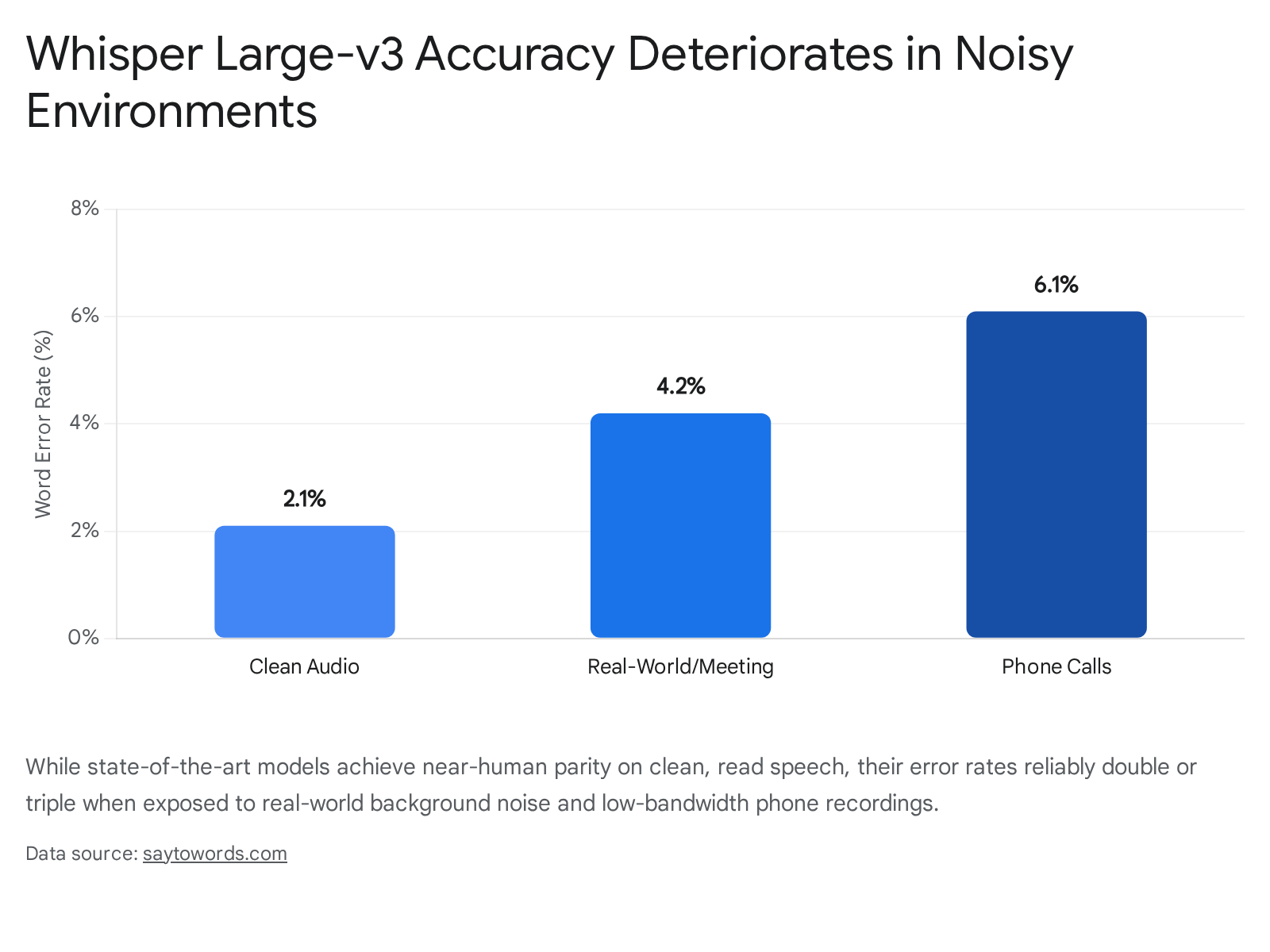
Released in late 2023, the Whisper large-v3 model maintained the 1.55 billion parameter count of its predecessor (large-v2) but expanded its training data to a staggering 5 million total hours (including 1 million weakly labeled and 4 million pseudo-labeled hours) 4203117. This massive data injection resulted in significant accuracy enhancements. On clean read speech benchmarks, large-v3 achieves a Word Error Rate (WER) of approximately 2.1% to 2.7%, representing a 10% to 12.5% improvement over large-v2 313334. More importantly, on noisy, real-world conversational audio - such as phone calls and meetings - large-v3 maintains a highly competitive WER of 8% to 12%, rivaling the best closed-source commercial APIs 313334.
To address the severe computational constraints of running a 1.55-billion parameter model in real-time, researchers and open-source communities have developed highly optimized variants. In late 2024, OpenAI introduced Large-v3 Turbo, a distilled, compressed version of large-v3 utilizing a pruned decoder. It delivers approximately 8x the processing speed while suffering only a marginal (~0.3%) increase in overall word error rate, making it the preferred architecture for self-hosted, real-time edge deployments 33343536.
The diverse ecosystem of optimized Whisper architectures currently dominating the speech-to-text landscape is detailed below:
| Whisper Variant | Release / Era | Key Architectural Innovation | Performance & Use Case Characteristics |
|---|---|---|---|
| Whisper Large-v3 | Late 2023 | Expanded training corpus to 5 million hours (weakly & pseudo-labeled) 2031. | 1.55B parameters. Achieves baseline ~2.7% WER on clean English. Best for maximum accuracy in batch processing 3133. |
| Large-v3 Turbo | Late 2024 | Distilled architecture featuring a pruned decoder to drastically reduce parameter overhead 333435. | ~800M parameters. Achieves 8x the speed of the standard Large model with less than 0.5% WER degradation. Ideal for production APIs 333435. |
| Distil-Whisper | Late 2023 | Utilizes knowledge distillation on 21,000 hours of open data, reducing transformer layers while matching the teacher model 37. | 51% fewer parameters than Large-v3, resulting in 5.8x faster inference speeds while remaining within a 1% WER margin 37. |
| WhisperX | 2023/2024 | Integrates external forced-alignment phoneme models alongside the Whisper backbone 37. | Specifically engineered to solve Whisper's hallucination and timestamp inaccuracies, providing highly precise word-level timestamps 1437. |
| Whisper-Medusa | 2024 | Replaces the standard sequential autoregressive decoder with a multi-head framework 37. | Mitigates the bottleneck of sequential token emission, predicting multiple tokens simultaneously to increase inference speed by 1.5x 37. |
Why Do Models Struggle with Non-Western Languages and Regional Dialects?
Word Error Rate (WER) is the standard metric for assessing ASR accuracy, calculated by summing the number of word substitutions, insertions, and deletions, and dividing that sum by the total number of words in the reference transcript 431353818. While top-tier models achieve sub-3% WERs on clean, Standard American English 313336, the technology systematically discriminates against voices that deviate from the demographic norm of its training data.
ASR bias is not a technical glitch; it is a structural artifact of how deep learning datasets are curated. Models prioritize the linguistic patterns most heavily represented in their training corpora, leading to what researchers term "linguistic stereotyping" within artificial intelligence 1920. This results in profound performance disparities that disproportionately impact minority groups and the Global South.
Demographic and Regional Dialect Bias in Western Languages
Extensive auditing of ASR models reveals profound disparities based on race, gender, and regional dialects. LLM training data is overwhelmingly dominated by well-articulated, standard U.S. and European English (making up nearly 90% to 93% of training tokens in major foundational models) 42. Consequently, models struggle dramatically with minority dialects, sociolects, and accents.
A landmark 2024 study evaluating state-of-the-art ASR models on the Spotify Podcast Dataset demonstrated that Standard American English (SAE) transcriptions significantly outperformed minority dialects, specifically African American Vernacular English (AAVE), Spanglish, and Chicano English 212223. The study isolated a striking intersectional bias: men of color, particularly Black and Latino men speaking minority dialects, faced the absolute highest risk of severe transcription errors across all demographics 2122. This aligns with broader audits revealing that transcriptions of Black speakers in American English are over 10 times more likely to be deemed completely "unusable" compared to white speakers 42.
This bias is frequently exacerbated by phenomena like code-switching - the practice of alternating between two or more languages or dialects within a single conversation 42. Because ASR language models calculate probability distributions based on monolingual norms, abrupt syntactical or phonetic shifts mid-sentence completely disrupt the model's predictive sequence, causing rapid transcription collapse 42.
The systemic devaluation of dialect diversity in ASR design stems from "privilege hazard" - the phenomenon where researchers who speak a dominant, "standard" accent fail to recognize the structural flaws in their acoustic models because the technology works perfectly for them 24.
The Global South: Data Scaling in African and Arabic Languages
The bias extends globally, crippling transcription performance in non-Western languages. A comprehensive 2024 benchmarking study analyzed ASR performance across 13 low-resource African languages, rigorously evaluating models like Whisper, MMS (Massively Multilingual Speech), XLS-R, and W2v-BERT 4725.
The findings illuminate the complex reality of data scaling in the developing world. The study revealed that models like MMS and W2v-BERT demonstrate highly efficient data utilization in extreme low-resource regimes (functioning on under 10 hours of training data), whereas models like XLS-R scale much more effectively as the data volume expands 4725. For a language like Kinyarwanda, researchers found that a "practical performance" threshold (a WER of ~12.5%) only emerges after fine-tuning the model on roughly 50 hours of high-quality data 49.
However, deep error analysis in languages like Kikuyu revealed that pursuing mere "data volume" is insufficient without rigorous attention to "data quality." An astonishing 38.6% of high-error cases (WER > 40%) in the Kikuyu dataset were traced directly back to noisy, unclear ground-truth reference transcripts 49. The models were failing because the human-annotated reference data contained explicit noise markers, non-alphabetic characters, and transcription errors, proving that the foundation of equitable ASR relies heavily on rigorous, community-engaged linguistic annotation 49.
Similar structural barriers exist in Arabic ASR. Despite advances in NLP, Arabic hate speech detection and transcription remain heavily constrained due to severe dialectal diversity, profound morphological complexity, and the pervasive reality of diglossia (the coexistence of formal Modern Standard Arabic alongside distinct regional dialects) 262752. Analysis of large-scale datasets, such as those targeting the Jordanian dialect, reveals that models trained on standard Arabic routinely fail to parse the unique sociopolitical and cultural subtleties inherent in regional variations, leading to massive hallucination rates in AI transcription outputs 2652.
Furthermore, applying modern AI to highly endangered, low-resource languages poses unique operational challenges. A 2024 study focused on Čakavian, a severely endangered variety spoken in Croatia, compared the efficacy of training a custom Kaldi-based pipeline (Elpis) against adapting the pre-trained Whisper model. The study concluded that while the traditional Kaldi pipeline was less computationally expensive, the multi-lingual inductive biases within Whisper allowed it to adapt significantly better to the sparse data, achieving a median WER of 35.48% - a viable starting point for linguistic documentation efforts 28.
The Structural Challenge: Tonal vs. Non-Tonal Languages
Perhaps the most fascinating challenge in global ASR equity relates to the fundamental physical structure of languages: tonality. In tonal languages - such as Mandarin, Vietnamese, and Thai - the pitch contour (the fundamental frequency, or $f_0$) of a syllable determines its lexical meaning. Changing the pitch changes the word entirely. Conversely, a non-tonal language, like English or Turkish, uses pitch strictly for prosody, emotion, or sentence structure (e.g., raising pitch to indicate a question), but not to distinguish individual dictionary words 2955.
Recent studies utilizing "pitch flattening" techniques - using vocoder-based signal processing to artificially remove pitch contours from audio recordings - have proven precisely how dependent ASR models are on these tonal features. When pitch was mathematically flattened, non-tonal languages experienced a marginal WER degradation of 5% to 8%, indicating that pitch provides only supplementary prosodic cues for segmentation 29.
In stark contrast, tonal languages suffered catastrophic performance degradation under pitch flattening. Thai WER increased by 23.2%, Mandarin by 19.4%, and Vietnamese by 11.8% 29. Analysis of tone confusion matrices showed that without pitch cues, complex contour tones (like the rising or falling-rising tones in Mandarin) collapsed entirely toward flat, level tones in the model's predictions 29.
This provides vital insight into how Transformer models function: while E2E models do not have an explicit, hard-coded "pitch detector" like older acoustic models, their self-supervised representations implicitly encode the $f_0$ contour directly into their statistical weightings 2955. Consequently, systems designed for tonal languages possess a massive "syllable-level functional load" heavily reliant on pitch, making them uniquely vulnerable to acoustic distortion, poor microphone quality, or rhythmic anomalies 29.
Cross-Linguistic Rhythmic Transfer
The structural disparities in ASR performance are further complicated by second-language (L2) speakers and rhythmic transfer. Speech rhythm is broadly categorized into stress-timed (like English), syllable-timed (like Hindi), or mora-timed (like Japanese) variations 3031. A 2024 sociolinguistic study analyzing Assamese native speakers communicating in Hindi as a second language revealed that the speakers subconsciously mapped the rhythmic pacing of their native Assamese onto their spoken Hindi 31. Because the ASR systems were statistically calibrated for standard, syllable-timed Hindi rhythmic patterns, the unexpected mora-timed rhythm introduced by the Assamese speakers caused significant transcription degradation 31. This highlights that simply collecting diverse vocabulary data is insufficient; ASR training corpora must account for the structural acoustic rhythms of non-native speakers to achieve true global efficacy.
How Do Pauses, Rhythm, and Speech Disorders Affect Transcription?
The cadence and rhythm of human speech are equally as critical to ASR performance as the clarity of the audio signal. Predictive algorithms are heavily optimized for the rhythmic cadence of standard conversational or read speech. When the speaking rate deviates significantly from this narrow statistical norm, the Transformer's attention mechanisms fail to align the acoustic frames with the expected text tokens, causing transcription accuracy to plummet.
The Challenge of Dysarthric Speech
This vulnerability is most vividly demonstrated in studies of dysarthric speech - a motor speech disorder characterized by slow, slurred articulation resulting from neurological damage 5832. Deep learning models struggle profoundly with dysarthric speech because the extended, atypical syllable durations disrupt the temporal alignments the model learned during training on healthy speakers 5832.
To overcome the lack of large-scale dysarthric datasets, researchers frequently attempt to train models using synthetic dysarthric speech generated via voice-cloning and text-to-speech technologies. However, a 2024 study evaluating a Transformer-based ASR model on Polish dysarthric speech exposed a critical flaw in this approach. The model, fine-tuned on synthetic data, achieved a highly respectable 20.5% WER on synthetic testing samples. Yet, when exposed to actual, real-world Polish dysarthric speech, the model collapsed, suffering a massive 71.9% WER 32. This staggering performance gap proved that the neural network had merely overfitted to the artificial artifacts of the synthetic generation process, rather than learning the genuine, chaotic rhythm deviations of the motor disorder 32. Unsupervised rhythm and voice conversion (RnV) frameworks - which attempt to modify the rhythm of dysarthric speech to mathematically resemble healthy speech prior to transcription - have shown early promise in lowering WER for severe cases, but remain highly experimental 58.
The Role of Pausing in Predictive Modeling
Even for neurotypical speakers, the speed and spacing of words heavily dictate accuracy. ASR models utilize silent pauses in the audio to determine token boundaries, chunking logic, and the injection of punctuation 6033. Human speech naturally incorporates short pauses (roughly 0.15 seconds between phrases), medium pauses (0.50 seconds between clauses), and long pauses (1.50 seconds between major concepts) 6033. Read speech tends to be highly uniform in its pausing, whereas spontaneous conversational speech features erratic, highly variable pausing structures, which is why models generally achieve significantly better WER on read audiobook datasets than on spontaneous podcast datasets 603334.
When humans speak spontaneously, they instinctively resort to filler words ("um," "uh," "like") to signal they are thinking and hold the floor 6063. From a machine learning perspective, these filler words are highly destructive. They not only clutter the final transcript but severely disrupt the language model's probabilistic predictions by injecting syntactical anomalies into the token sequence 63. A clean, silent pause, conversely, gives the AI's internal attention mechanisms a clear boundary marker, allowing the decoder to accurately resolve the preceding sequence without cascading contextual errors 63.
What Are the Practical Takeaways for Optimizing Audio Capture?
Given the probabilistic nature of modern speech recognition, the accuracy of the final transcript is heavily dictated by the quality of the raw acoustic input. ASR systems rely on subtle acoustic cues - formants, pitch contours, syllable timing, and micro-pauses - to distinguish between phonetically similar words (e.g., "mat" and "bat") 64. When these cues are obscured or distorted by external factors, transcription errors multiply exponentially.
Microphone Quality and Signal-to-Noise Ratio (SNR)
The relationship between the desired speech signal and background noise is quantified mathematically as the Signal-to-Noise Ratio (SNR). Research consistently indicates that as the SNR drops from 15 Decibels (dB) to 5 dB, the Word Error Rate of an ASR system generally doubles 64.
Not all noise is treated equally by deep learning models. Environmental acoustic interference is classified primarily into two distinct categories: * Stationary Noise: Constant, unchanging sounds across a specific frequency band, such as HVAC hums, computer fans, or steady machinery 64. * Non-Stationary Noise: Unpredictable, highly variable sounds, such as traffic, sirens, or the most destructive interference of all - competing overlapping human speech (often referred to as babble noise) 64.
Historically, audio engineers attempted to solve noise issues prior to transcription using traditional filtering algorithms like spectral subtraction 64. This method estimates the ambient noise profile during silent periods and mathematically subtracts that specific frequency wave from the entire audio signal 64. However, because human speech consonants and environmental noise often share the exact same frequency bands, spectral subtraction frequently strips away vital, low-energy phonetic data 64. This creates a paradox: heavy filtering can artificially improve the perceived sound quality to a human listener while actually increasing the ASR's Word Error Rate by up to 15%, because the neural network is starved of the micro-acoustic data it requires 64.
Actionable Guidance for Superior Transcription
To achieve maximum accuracy with modern End-to-End systems like Whisper, professionals should adhere to the following evidence-based protocols:
- Feed the AI Raw Audio: Because modern E2E models are already trained on hundreds of thousands of hours of noisy, multi-condition data, their internal weights are highly optimized to ignore standard background noise 42964. Therefore, always provide the ASR with the raw, uncompressed audio signal (PCM/WAV format) 464. Disable external noise gates, automatic gain control (AGC), and software compression algorithms prior to transcription, as these destroy the acoustic fingerprint 464.
- Prioritize Hardware Proximity over Software Fixing: Using a high-quality directional microphone in close physical proximity to the speaker to naturally increase the SNR will always yield significantly better results than attempting to post-process a poorly captured recording 35.
- Utilize Grammatical Pausing: Speakers should actively avoid unnaturally rapid, rapid-fire delivery, which blurs phonetic boundaries and causes the Transformer's attention mechanism to drift 6667. Instead, employ intentional grammatical pauses (0.5 to 1.5 seconds) placed where commas or periods would logically exist in written text 6066.
- Replace Fillers with Silence: Consciously replace conversational filler words with absolute silence 6063. This provides the autoregressive decoder with clean token boundaries, preventing the probabilistic model from generating hallucinated text based on corrupted syntactical patterns 63.
Bottom Line
The transformation of sound into text by artificial intelligence represents a triumph of probabilistic mathematics and acoustic engineering. The paradigm shift from traditional, highly fragmented GMM-HMM architectures to unified, Transformer-based End-to-End models like Whisper has dramatically simplified the processing pipeline while propelling accuracy to near-human parity on clean datasets.
However, acknowledging the mathematical brilliance of these systems requires concurrently recognizing their structural limitations. Modern ASR systems do not possess semantic understanding or cognitive comprehension; they are stochastic predictive engines subject to severe hallucination and confusion in the absence of clear acoustic data. Furthermore, their accuracy is inexorably tied to the demographic and linguistic diversity of their training corpora. Significant, systemic biases remain embedded in the technology, disproportionately impacting non-Western languages, tonal dialects, second-language speakers, and minority vernaculars.
Ultimately, the efficacy of speech-to-text AI relies on a delicate triad: it depends equally on the architectural capability of the neural network, the physical clarity of the acoustic environment (SNR), and the rhythmic cadence of the speaker. As these models scale toward universal deployment across edge devices and enterprise APIs, addressing the massive data disparities of the Global South and refining acoustic robustness in non-standard dialects will dictate the boundary between a tool that hears a select few, and a technology that equitably transcribes everyone.