
How AI Generates Images Step by Step
AI image generators do not retrieve or collage existing photos; instead, they translate text into mathematical coordinates to guide a process that progressively removes static noise from a blank, compressed digital canvas. This complex pipeline relies on diffusion models to organize random pixels into recognizable patterns based on learned statistical probabilities. The result is an entirely novel image sculpted from mathematical chaos, operating in a way that mimics thermodynamics rather than a traditional search engine.
The Collage Myth Versus Statistical Reality
Before exploring the technical architecture of how modern artificial intelligence synthesizes visuals, it is crucial to dismantle the most pervasive misconception surrounding the technology: the "collage" theory.
A widespread belief among the general public and traditional artists is that generative AI acts as a highly sophisticated search engine 12. According to this myth, when a user requests an image, the AI scours a massive internal database of copyrighted artwork, cuts these existing images into digital puzzle pieces, and seamlessly stitches them together to form a "new" composition 12. Because human digital artists often use photo-bashing and collage techniques, assuming the machine operates the same way is a rational, albeit mathematically incorrect, assumption 1.
In reality, generative AI models do not store a database of images inside their underlying code 3. When a model is trained on a dataset - such as the massive LAION-5B database, which contains billions of image-text pairs - it is not saving those files to a hard drive 34. Instead, it is analyzing them to learn the statistical patterns and spatial relationships of visual data 35.
If an AI analyzes a million photographs of a dog, it learns the mathematical probability of where a wet nose, specific fur textures, and floppy ears should appear in relation to lighting and background environments. Once the training is complete, the original images are discarded 3. When you prompt the AI to generate a dog, it does not retrieve a stored photo. It draws upon its learned statistical weights to organize completely random pixels into a coherent pattern from scratch 3. The machine is generating entirely new pixel arrangements based on mathematical probabilities, a process that requires a multi-step pipeline to translate human language into a high-fidelity visual output 6.
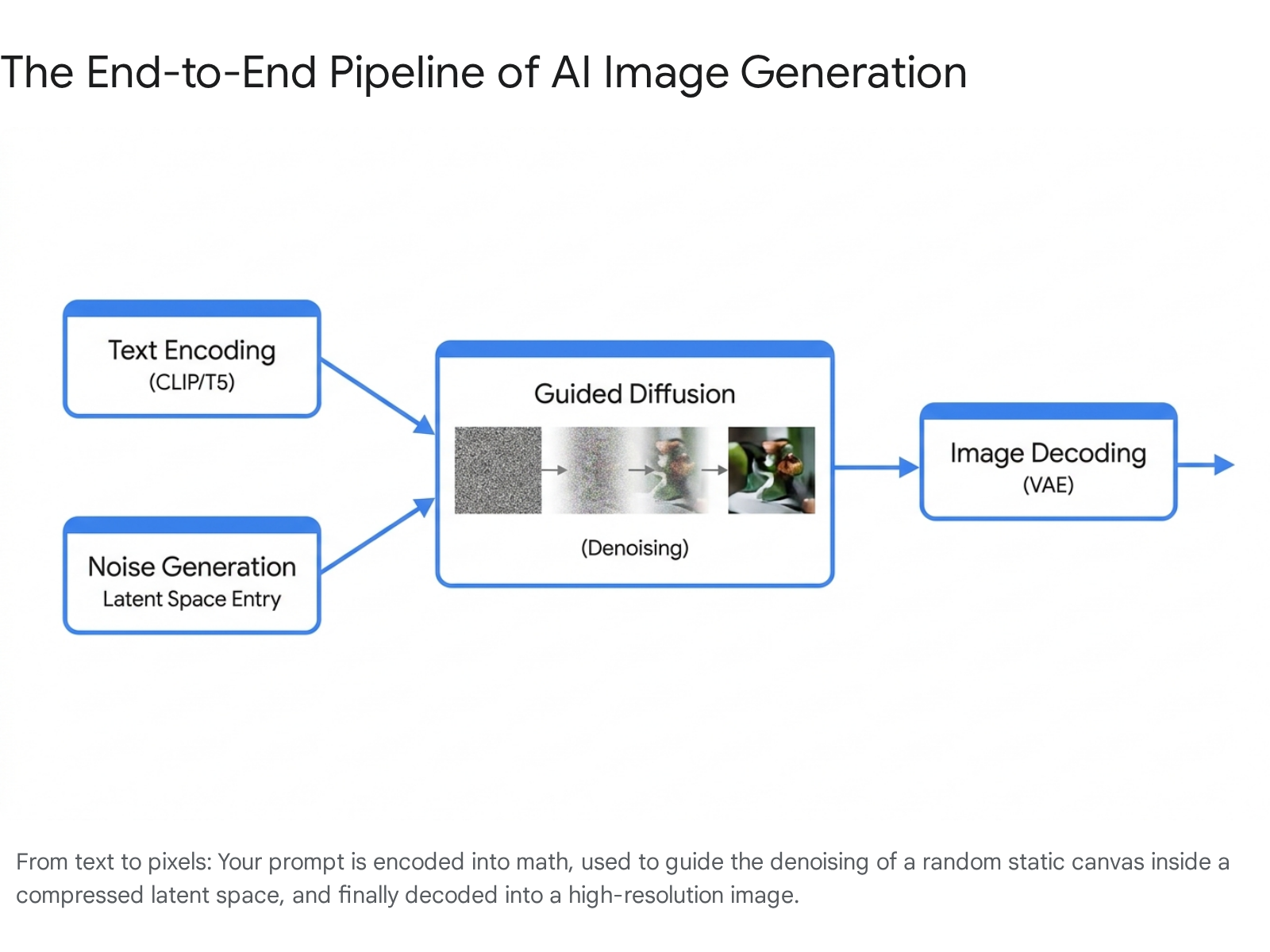
Step 1: Text Encoding (Bridging Language and Mathematics)
If a computer only understands numerical arrays, how does it comprehend a prompt like "a cyberpunk golden retriever drinking coffee in neon rain"? The critical bridge between human linguistics and machine vision is the text encoder. When a user submits a prompt, the system first breaks the sentence down into manageable chunks called "tokens." These tokens are then passed through an encoder, which translates the words into a multidimensional numerical vector known as an embedding 67.
An embedding acts as a set of GPS coordinates for meaning within a vast, shared mathematical space 8. In this high-dimensional architecture, concepts that share semantic meaning reside close to one another 68. For example, the vector for "puppy" and the vector for "dog" are located in the same mathematical neighborhood, while the vector for "galaxy" is positioned entirely elsewhere 6. This spatial mapping allows the AI to understand relationships between words.
The Foundation: Contrastive Language-Image Pretraining (CLIP)
The breakthrough that made modern text-to-image generation possible was the development of CLIP (Contrastive Language-Image Pretraining) by OpenAI in 2021 9. CLIP was designed to teach artificial intelligence how to connect visual content with descriptive text seamlessly 810.
To train CLIP, researchers utilized 400 million pairs of images and their corresponding text captions scraped from the internet 911. The system employed two separate translating mechanisms: an image encoder (typically a ResNet50 or Vision Transformer model) and a text encoder 811. During training, the image encoder would scan a photo of a dog and output a numerical vector, while the text encoder would read the caption "a photo of a dog" and output its own vector 89. Crucially, both vectors were projected into the exact same shared dimensional space 89.
The training objective utilized a method called contrastive learning 811. When given a batch of $N$ images and $N$ texts, the model computed a similarity score for every possible combination, resulting in an $N \times N$ grid 89. The model adjusted its internal weights to maximize the cosine similarity for the correct pairs (the diagonal of the grid) and minimize the similarity for incorrect pairings 8911. Through this rigorous mathematical matchmaking, CLIP learned an incredibly robust universal language of numbers where an image and its accurate description pointed in the exact same direction 8.
While revolutionary, relying strictly on CLIP introduced specific failure modes. CLIP behaves like a "bag of words" model; it excels at understanding the overall visual vibe or semantic association of a prompt but struggles profoundly with syntax, grammar, and character sequences 1213. If you ask a CLIP-based model for "a red sphere on top of a blue cube," it understands "red," "blue," "sphere," and "cube," but often misattributes the colors or ignores the spatial command "on top of" 12. This phenomenon, known as misattribution or concept bleeding, was a hallmark of early AI image generators 12. Furthermore, because CLIP does not read words as sequential letters but as holistic concepts, it was historically incapable of spelling text correctly within an image 13.
The Shift to T5 and Dual-Encoder Architectures
To resolve the limitations of CLIP, the developers of next-generation models like Stable Diffusion 3 (SD3) and FLUX.1 introduced a hybrid approach, augmenting the pipeline with massive text-to-text Large Language Models (LLMs) like T5-XXL (Text-to-Text Transfer Transformer) 13141.
Unlike CLIP, which is purely contrastive, T5 is a generative language model trained on massive text corpora (like the C4 dataset) to understand deep linguistic structures, grammar, and sequential logic 13116. T5 actually "reads" the sequence of characters. When you request a neon sign that says "OPEN," T5 understands that O-P-E-N is a specific sequence of characters that must appear in order 13.
Modern models leverage both encoders simultaneously 14. In FLUX.1, for instance, the CLIP encoder processes the first 77 tokens of a prompt to establish the overarching visual aesthetics and subject matter 14. Concurrently, the T5-XXL encoder processes up to 512 tokens, extracting granular details, deep contextual relationships, and precise typography instructions 1417. This dual-encoder strategy is the primary reason why contemporary models can follow complex, multi-paragraph prompts and flawlessly render legible text on storefronts or book covers 1417.
| Feature | CLIP Text Encoder | T5-XXL Text Encoder |
|---|---|---|
| Primary Function | Maps images and text into a shared multi-modal semantic space using contrastive learning. | Deep natural language understanding, grammar processing, and sequential text interpretation. |
| Architectural Strength | Exceptional at capturing the overall visual "vibe," artistic style, and broad subject matter. | Exceptional at understanding complex syntax, spatial relationships, and exact spelling. |
| Architectural Weakness | Suffers from concept bleeding; fails at spelling, character sequences, and complex spatial logic (e.g., "left of"). | Lacks direct visual training; can allocate parameter space to non-visual concepts, increasing computational overhead. |
| Token Processing Limit | Typically capped at 77 tokens due to its architectural design. | Can process up to 512 tokens, enabling paragraph-length descriptive prompts. |
| Role in Modern Models | Used for foundational visual-semantic alignment and aesthetic direction. | Used for granular prompt comprehension, multi-subject separation, and in-image text generation. |
Table 1: A comparative analysis of the primary text encoders driving modern AI image generation pipelines 121314116.
Step 2: The Latent Space Canvas
Once the text prompt has been encoded into a guiding mathematical vector, the AI requires a canvas to generate the image. However, working directly with raw pixels is computationally devastating. A standard 512x512 RGB image contains 786,432 individual data points (dimensions) 1819. Trying to train a deep neural network to calculate and manipulate nearly a million pixels simultaneously at every step of generation requires an unfeasible amount of VRAM and processing power 1819.
To bypass this hardware bottleneck, modern systems employ Latent Diffusion Models (LDMs), popularized by the original release of Stable Diffusion 20. LDMs do not operate in "pixel space"; they operate in "latent space" 18.
Compression and the Variational Autoencoder (VAE)
Latent space is a highly compressed, lower-dimensional mathematical representation of data 1819. Before the diffusion process can occur, a separate neural network known as a Variational Autoencoder (VAE) is utilized 18. The VAE consists of an encoder that compresses raw, high-resolution pixel data into a dense, compact latent vector, and a decoder that reconstructs the original image from this compressed state 1819.
For example, the VAE might compress a 786,432-dimension pixel image into a 64x64x4 latent grid, reducing the data footprint to just 16,384 dimensions 1819. This massive reduction makes subsequent mathematical operations exponentially more efficient, allowing these complex models to run on consumer-grade GPUs rather than requiring enterprise-level supercomputers 18.
The Geography of Latent Space
Latent space is not merely a zipped file format; it is a continuous, semantic geography 1921. When the VAE compresses an image, it discards irrelevant pixel noise and retains the core semantic features 19. In this lower-dimensional vector space, every point maps to a meaningful encoding of data 19.
Because the space is continuous and interpolative, moving slightly along a specific mathematical axis changes the corresponding image in a logical, semantic way 1921. For instance, one direction in the latent space might correspond to the concept of "age," while another corresponds to "a smile." By performing basic vector arithmetic - such as taking a latent vector of a face and moving it along the mathematical axis corresponding to glasses - the model edits the underlying concept without having to manually adjust tens of thousands of individual pixels 1922.
When a user initiates an image generation request, the model does not start with a blank pixel canvas. It generates a small, mathematically dense matrix of pure random Gaussian noise directly inside this latent space 618. This invisible block of mathematical static serves as the raw material from which the final image will be carved 623.
Step 3: The Diffusion Engine
With the text embeddings established as a guide and the latent noise generated as a canvas, the core engine of the system takes over: the diffusion model.
Introduced as a generative framework in 2015, diffusion models draw their conceptual inspiration from non-equilibrium thermodynamics and the physical process of diffusion, where particles spread from high concentration to low concentration 2024. The models operate on a two-stage probabilistic framework that trains artificial intelligence to master the act of destruction in order to learn the act of creation 25.
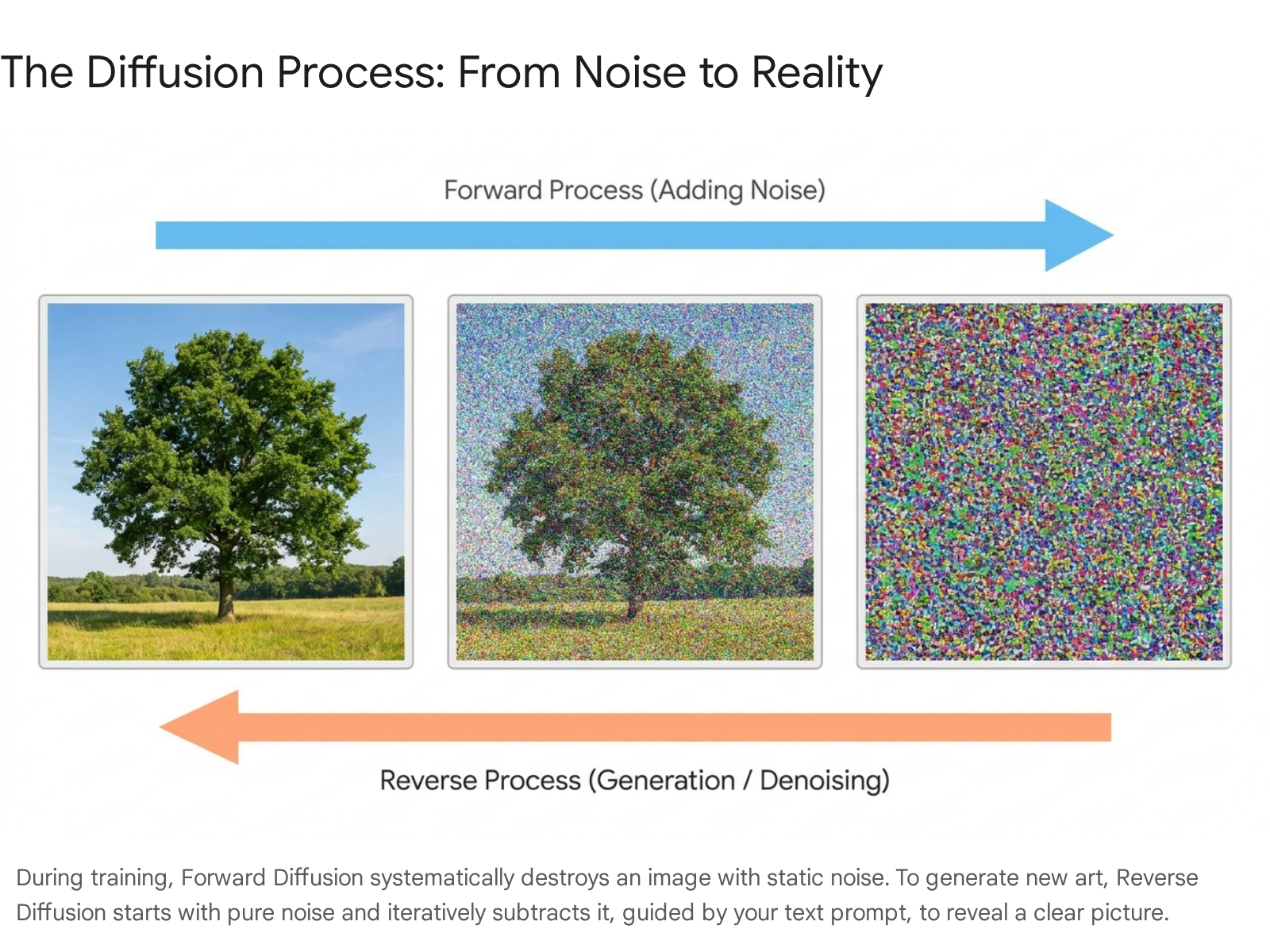
Forward Diffusion: Controlled Destruction
The foundation of the model's knowledge is built during the training phase through a process called Forward Diffusion 726. The forward process is a fixed, predefined Markov chain that takes a clean, real image from the training dataset and systematically destroys it 202425.
Over a series of hundreds or thousands of timesteps ($T$), the algorithm incrementally adds a small, calculated amount of random Gaussian noise to the image 2026. Think of it like taking a pristine photograph and slowly sprinkling layers of sand over it 26. The degradation is slow and smooth, governed by a mathematical noise schedule (often a linear or cosine schedule) that dictates exactly how much noise is applied at each step 26. By the end of timestep $T$, the original structured data is entirely obliterated, leaving behind a matrix of near-pure, isotropic Gaussian noise 242526.
This forward process is not a neural network learning anything; it is a rigid mathematical formulation 25. However, it serves a vital purpose: it maps the exact trajectory from a structured image distribution to a chaotic noise distribution, providing the training data necessary for the next phase 20.
Reverse Diffusion: The Denoising Loop
The true intelligence of the generative model lies in the Reverse Diffusion process 2425. The goal here is to train a deep neural network to iteratively reverse the forward process - to look at a state of chaos and reconstruct order 2024.
Starting at timestep $T$ with a completely noisy latent image, the neural network acts as a noise estimator (or score function) 2025. At each step, it analyzes the current noisy image and predicts exactly which mathematical components represent the added Gaussian noise 2026. It then subtracts that estimated noise, stepping backward to timestep $T-1$ 2024.
The network does not attempt to recreate the final image in a single, impossible leap 26. It takes dozens of small, iterative steps. With each pass, the noise is reduced, and structure begins to emerge from the static - first vague outlines, then broad colors, and finally, hyper-realistic fine details 2526.
When you use an AI image generator, the model is exclusively running this reverse process 6. It initializes a brand new block of random noise and utilizes text conditioning via cross-attention mechanisms 7. The text embeddings generated in Step 1 are injected into the neural network, acting as a gravitational pull that forces the denoising process to carve out a specific shape (e.g., a futuristic city) rather than returning a random unconditioned image 72426.
Steering the Output: Seeds, Steps, and Guidance Scales
To grant users control over this highly probabilistic mathematical system, AI generators expose several core parameters that dictate how the denoising algorithm behaves. Understanding these parameters is essential for advanced prompt engineering.
- The Seed: The seed is a specific integer used to initialize the exact pattern of random noise in the latent space at the very beginning of the generation process 2728. Because computers generate "randomness" algorithmically, providing the same seed number will always produce the exact same starting static 29. If a user inputs the same text prompt, the same guidance parameters, and the exact same seed, the diffusion model will trace an identical mathematical path and produce an identical image 2728. By locking the seed, users can tweak a single word in their prompt to see exactly how the model alters the composition, making the seed invaluable for character consistency and reproducible experimentation 27.
- Inference Steps: This parameter dictates the number of iterative denoising loops the model will undergo 2729. Setting the steps too low (e.g., under 15) usually results in an image that looks blurry, abstract, or structurally deformed, as the model has not had enough iterations to fully remove the noise 2930. Increasing the steps refines the detail and crispness of the image 29. However, this operates on a curve of diminishing returns; once the underlying noise is resolved, additional steps merely consume computing power without noticeably improving image quality, and in some cases, can over-process fine details 30.
- Guidance Scale (CFG): Classifier-Free Guidance (CFG) is the hyperparameter that controls how aggressively the image generation process must adhere to the text prompt 2730. Geometrically, the guidance scale acts as a manifold-contracting force within the latent space 2. A low CFG scale gives the model immense creative freedom, allowing it to rely heavily on its unconditioned training data, resulting in highly diverse, artistic, but potentially inaccurate images 2730. Conversely, a high CFG scale forces the math to adhere strictly to the target data manifold dictated by the text embedding 272. If the CFG scale is pushed too high, the mathematical vectors overcorrect, leading to severe visual degradation, unnatural contrast, and a loss of image diversity 272.
Next-Generation Architectures: Transformers and Flow Matching
For the first several years of the generative AI boom, the neural network performing the reverse denoising loop was almost exclusively a U-Net architecture 24253. U-Nets are incredibly effective at image-to-image tasks, utilizing convolutional layers to downsample and upsample spatial data 24. This was the backbone of models like Stable Diffusion 1.5 and Midjourney v5. However, as developers pushed for higher resolutions, deeper prompt adherence, and better typography, the limitations of the U-Net became apparent 33.
In 2024, the landscape shifted dramatically. The latest state-of-the-art models - including Stable Diffusion 3 (SD3) and FLUX.1 - abandoned the U-Net entirely in favor of Diffusion Transformers (DiTs) 417435.
Multimodal Diffusion Transformers (MMDiT)
The core innovation in SD3 and FLUX.1 is the Multimodal Diffusion Transformer (MMDiT) 134. Because text embeddings and image vectors are conceptually entirely different modalities, traditional models struggled to fuse them efficiently 4. The MMDiT architecture solves this by utilizing two separate, parallel sets of weights - one track for the image data and one track for the language representations 4134.
Instead of processing them in isolation, these parallel tracks interact bidirectionally at every single transformer block 13. The image tokens attend to the text tokens, and the text tokens attend to the image tokens, allowing the two modalities to evolve together in a shared space 13174. This deep, continuous integration is the primary reason why newer models possess a staggering understanding of spatial logic and typography, seamlessly embedding complex textual phrases onto signs and clothing 134.
Scaling these massive transformer models introduced severe engineering hurdles. Stability AI researchers noted a phenomenon termed "attention entropy collapse," where the numerical values inside the attention mechanism would grow infinitely large during training, resulting in system crashes 13. To stabilize the training of these high-resolution models, engineers implemented Query-Key (QK) Normalization, applying a scaling function to the vectors before attention calculations to act as a mathematical governor on the system 1336.
Rectified Flow Matching
Alongside the shift to transformers, modern models have updated the underlying physics of the diffusion process itself, moving from traditional stochastic diffusion to Rectified Flow Matching 4173337.
Traditional diffusion formulates the transition from noise to data as a curved, chaotic trajectory 334. Navigating this curved mathematical path during inference requires the model to take many tiny, incremental steps to avoid drifting off course 33. Rectified flow matching fundamentally alters this by connecting the noise distribution and the data distribution on a direct, linear trajectory 417334.
Because the inference path is a straight line, the model can sample the path in significantly fewer steps without losing fidelity, drastically improving computational efficiency and generation speed 334. Furthermore, researchers introduced specialized trajectory sampling schedules (such as logit-normal sampling) during training. Instead of training the model evenly across the entire straight line, they bias the training to focus heavily on the middle portions of the trajectory 4134. The extreme ends - pure noise and near-perfect images - are computationally easy to predict 13. The middle phase, where an abstract blob must be perceptually resolved into a detailed face or object, represents the most challenging prediction task 134. By heavily weighting this middle phase during training, the models learn to resolve fine details much faster 44.
Step 4: Decoding Back to Reality
Once the MMDiT has completed its flow-matching denoising loop and fully sculpted the target concept out of the static, the image generation process is still not complete. The resulting data is still a dense, lower-dimensional latent vector 618. It is entirely unviewable by human eyes.
In the final step of the pipeline, this refined latent vector is passed back through the VAE's Decoder network 61823. The decoder mathematically decompresses the semantic features, mapping them back into the high-dimensional pixel space 61821. It assigns specific RGB color values to hundreds of thousands of individual pixels, finally rendering the high-resolution image that appears on your screen 618.
The Anatomy Problem: Why AI Struggles with Human Hands
Despite crossing the threshold into photorealism, generative AI continues to exhibit a notorious, glaring flaw: it is historically terrible at rendering human hands 38395. The internet is replete with AI-generated portraits featuring individuals with six fingers, merged knuckles, and impossible biomechanical poses 386. This is not a random software glitch; it is a direct manifestation of how neural networks process information.
The human hand is anatomically intricate. It contains 27 distinct bones, an array of tendons, and a massive number of joints packed into a small area, granting it numerous degrees of freedom 3857. Hands can fold, point, grasp, and articulate in millions of varying configurations 387.
However, diffusion models are fundamentally two-dimensional image generators 7. They possess absolutely no inherent comprehension of 3D geometry, spatial hierarchies, or biomechanical constraints 387. They optimize for perceptual similarity based entirely on the statistical correlations they observed in 2D training data 387.
When an AI analyzes thousands of photographs of hands scraped from the internet, it rarely sees a flat, perfectly spread palm 39. It sees hands holding cups, resting on hips, or waving, where fingers are frequently obscured or overlapping 39. The AI algorithm successfully recognizes the overarching pattern - that a hand is a cluster of elongated, skin-toned shapes attached to an arm 7. Yet, because it is a "black box" optimization system, it does not explicitly understand the biological rule that a human hand must possess exactly four fingers and one opposable thumb 387. It merely mimics the visual texture it has seen, resulting in structural hallucinations when forced to generate a pose that bridges gaps in its training data 387.
While recent models like FLUX.1 have drastically improved hand rendering through massive parameter scaling and deeper text-to-image alignment, and developers have introduced post-processing solutions like HandRefiner (which uses 3D mesh reconstruction conditioning), the foundational limitation remains: the AI is painting a 2D surface based on probabilities, not simulating a 3D skeleton 3843.
Identifying AI Hallucinations and Artifacts
As AI models become increasingly sophisticated, distinguishing a synthetic image from an authentic photograph at a glance is nearly impossible 4445. However, because diffusion models operate via specific mathematical constraints, they leave behind characteristic visual signatures - known as artifacts - when the generation process breaks down 46.
By understanding the root causes of these artifacts, users can both identify deepfakes and troubleshoot their own generation pipelines 46.
- Color Banding and Posterization: When the CFG scale is pushed too high (typically exceeding 10 or 12), the model's vectors overcorrect, pushing pixel values to extreme contrasts 46. This manifests as "color banding," where smooth tonal transitions - like the gradient of a blue sky or the shading on a cheek - break down into harsh, visible steps of color that resemble a low-quality, compressed JPEG 46.
- Duplication and Tiling: Every diffusion model is trained at an optimal native resolution (e.g., 512x512 or 1024x1024) 1846. If a user requests an image generation size significantly larger than the model's native training dimensions without utilizing dedicated upscaling tools, the model often hallucinates by tiling the subject 46. This results in grotesque outputs featuring two heads, duplicated bodies, or repeating background structures 46.
- Background Gibberish and Nonsense Text: While modern models utilizing T5 encoders excel at rendering the primary text requested in a prompt, background text often falls victim to the "bag of words" limitation 8. Distant street signs, spines of books on a shelf, or small logos on clothing frequently degrade into alien symbols, garbled letters, or repetitive character strings 468.
- Functional and Physical Implausibilities: AI generators do not understand the laws of physics 48. They merely replicate the appearance of lighting and structure. Careful inspection of an AI image will often reveal physical impossibilities: shadows falling in contradictory directions from multiple nonexistent light sources, reflections in mirrors or bodies of water that do not match the subject, or objects seamlessly melting into one another (e.g., a coffee cup handle blending directly into the grain of a wooden table) 48.
The Generative AI Landscape: FLUX, DALL-E 3, and Stable Diffusion 3.5
The current state of AI image generation is dominated by three flagship models: FLUX.1, DALL-E 3, and Stable Diffusion 3.5 1749. Each model represents a fundamentally different philosophical approach to the same mathematical problem, resulting in vastly different capabilities, aesthetic outputs, and user experiences 1749.
FLUX.1 (Black Forest Labs)
Developed by Black Forest Labs - a company founded by the original researchers who created Stable Diffusion - FLUX.1 is widely considered the current industry benchmark for photorealism and prompt adherence 3537509. Scaled to a massive 12 billion parameters, FLUX utilizes a hybrid architecture of multimodal and parallel diffusion transformer blocks driven by rectified flow matching 37.
By employing both CLIP ViT-L and T5-XXL text encoders, FLUX excels at rendering highly detailed human anatomy, accurate material textures, and flawless typography within images 173752. It is available in three variants: schnell (a distilled, high-speed open-weight model), dev (an open-weight model for non-commercial use), and pro (a closed, state-of-the-art API model) 35509. Its primary limitation is its immense size, requiring significant GPU hardware for local deployment 43.
DALL-E 3 (OpenAI)
OpenAI's DALL-E 3 takes a conversational, highly integrated approach 4953. DALL-E 3 is unique because of its invisible integration with ChatGPT-4 535455. During development, OpenAI researchers discovered that diffusion models perform exponentially better when trained on highly descriptive, paragraph-length captions 1057. To achieve this, they trained a bespoke image captioner to relabel their entire dataset, utilizing a mixture of 95% highly descriptive synthetic captions and only 5% ground truth captions 5557.
Because the average user types very short prompts, OpenAI implemented an automatic "prompt rewriting" feature 5411. When a user asks ChatGPT for an image, the LLM intercepts the prompt and silently expands it into a dense, highly descriptive paragraph before sending it to the diffusion model 5455. While this guarantees stunning, reliable results and excellent typography for beginners, recent studies (such as those from UC Berkeley) have shown that this automatic LLM rewriting can strip away granular control from advanced users, forcefully adding complexity to scenes where minimalism was desired 5960.
Stable Diffusion 3.5 (Stability AI)
Stability AI's SD3.5 represents an open-source, highly versatile middle ground 3649. Utilizing the MMDiT architecture and flow matching, SD3.5 is available in Large (8B parameters) and Medium (2.5B parameters) variations, making it highly accessible for developers and artists running local hardware 3661. While it lags slightly behind FLUX in pure photorealism and text rendering, it boasts an unrivaled community ecosystem 4349. SD3.5 allows for deep customization, fine-tuning, and the integration of control nets, making it the preferred choice for power users who require absolute control over artistic stylization and generation workflows 4953.
| Feature | FLUX.1 (Black Forest Labs) | DALL-E 3 (OpenAI) | Stable Diffusion 3.5 (Stability AI) |
|---|---|---|---|
| Architectural Framework | 12B parameter Transformer (DiT) utilizing Rectified Flow Matching 3537. | Proprietary LLM-based architecture, highly literal interpretation 6263. | MMDiT architecture (8B / 2.5B variants) with Flow Matching 461. |
| Prompt Engineering & Understanding | Exceptional. Dual text encoders (CLIP + T5-XXL) allow for deep semantic comprehension of long prompts 1417. | Conversational. Uses GPT-4 to invisibly upsample and rewrite user prompts for maximum detail 545511. | Strong baseline adherence, but requires more precise manual prompt engineering 3643. |
| Text Rendering & Typography | Current industry leader. Reliably renders complex, multi-word text naturally inside images 174952. | Highly reliable, though it occasionally duplicates characters or warps longer phrases 495262. | Vastly improved over SDXL, but still struggles with text fidelity compared to FLUX 4912. |
| Aesthetic Identity | Unrivaled photorealism, accurate anatomical detail, and natural cinematic lighting 17434962. | Highly polished, distinctly stylized "rendered" and illustrative aesthetics 496365. | Highly versatile; excels in customized artistic, anime, and heavily stylized outputs 4353. |
| Deployment & Ecosystem | Open weights (Schnell/Dev) for local use, plus a closed Pro API. High VRAM hardware requirements 17359. | Closed system ecosystem. Exclusively accessed via ChatGPT Plus or Microsoft Copilot APIs 1753. | Fully open weights supported by a massive community ecosystem for fine-tuning and LoRAs 4961. |
Table 2: A comparative analysis of the underlying architecture, capabilities, and ecosystems of the leading generative AI image models in 2026 1749536162.
The Generalization vs. Memorization Debate
As these models continue to scale, a pressing technical and legal question remains: Do diffusion models actually create novel images, or do they simply memorize their training data and regurgitate copyrighted material?
Extensive empirical studies and theoretical analyses reveal that diffusion models are primarily engines of generalization, not memorization 661314. The theoretical goal of the denoising score-matching objective is to learn the gradient of the entire data distribution, allowing the model to sample novel points from the latent manifold 6614.
However, memorization can occur under specific conditions 66. Research indicates that memorization is a function of the training dynamics, specifically relating to dataset size and noise scales 6669. Models exhibit memorization behavior primarily when trained on small, duplicated datasets, and this memorization is typically restricted to the low-noise scales at the very end of the diffusion process (the phase responsible for rendering high-frequency details) 666915.
Theoretical analysis identifies two distinct timescales during model training: an early time ($\tau_{gen}$) where the model learns the broad statistical features necessary to generate high-quality, generalized samples, and a much later time ($\tau_{mem}$) where the model overfits and begins to memorize specific training points 13. Because $\tau_{mem}$ increases linearly with the size of the dataset, training massive models on billions of images creates a massive window of implicit dynamical regularization 1314. By employing early stopping techniques and training aggressively on high-noise scales, developers successfully prevent models from crossing the threshold into memorization, ensuring that the outputs generated by users are genuinely novel mathematical creations rather than collaged replicas 131469.
Bottom line
AI image generation is not a sophisticated search engine, but a complex thermodynamic-inspired mathematical pipeline that sculpts order out of chaos. By translating human language into numerical embeddings via dual encoders like CLIP and T5-XXL, the AI utilizes a reverse diffusion process to iteratively subtract static noise within a highly compressed latent space, ultimately decoding a brand-new arrangement of pixels. While the technology still wrestles with 3D geometry - evidenced by lingering struggles with human anatomy and physical impossibilities - the architectural shift toward multimodal transformers and rectified flow matching has successfully ushered in an era of near-perfect photorealism and precise typography.