
How Screen Time Before Bed Affects Sleep
While blue light was long blamed for sleepless nights, recent 2026 research reveals that the real culprit is cognitive hyperarousal caused by interactive content. Studies now show that using a smartphone specifically in bed significantly increases insomnia risk by keeping the brain on high alert, whereas simply looking at a screen earlier in the evening has a surprisingly minimal impact on total sleep duration. Ultimately, what you do on your device and where you do it matters far more than the physiological glow of the screen itself.
The Rise and Fall of the Blue Light Panic
For over a decade, the dominant narrative in public health and sleep hygiene has been both simple and alarming: the blue light emitted by smartphones, tablets, and laptops is biologically destroying human sleep. To understand why modern sleep science is rapidly moving away from this absolute claim, it is necessary to examine the origins of the blue light hypothesis and how new technologies and methodologies have challenged it.
The Biology of Melanopsin
The fear surrounding electronic screens largely stems from an accurate biological premise combined with highly artificial early experimental designs. Inside the human eye are specialized light-sensitive ganglion cells containing a protein called melanopsin 12. These specific cells are not responsible for helping humans perceive shapes, depth, or colors. Instead, they act as ambient light meters, communicating directly with the suprachiasmatic nucleus (SCN), which serves as the brain's master biological clock 3.
This system uses light - particularly short-wavelength blue light, which is abundant in daytime sunlight - to anchor human circadian rhythms 45. As the sun sets and blue light fades from the environment, the SCN signals the pineal gland to begin releasing melatonin, a naturally occurring hormone that lowers body temperature, reduces alertness, and physically prepares the body for sleep 45.
An immensely influential 2014 laboratory study seemed to confirm everyone's worst fears about modern technology. Researchers asked a small group of participants to read before bed - half on a light-emitting iPad, and half from a traditional physical book. The study concluded that those using the iPad took longer to fall asleep, produced less melatonin, and reported feeling significantly groggier the following morning 1. The scientific community and the media immediately pointed to the device's LED screen, which emits heavy concentrations of light in the blue part of the visible spectrum, as the definitive culprit 12.
Re-evaluating Screen Lux Levels
However, as sleep science advanced into 2024 and 2026, researchers began to heavily scrutinize the real-world applicability of these early laboratory findings. In controlled experimental settings designed to test the limits of melatonin suppression, participants were often kept in unnaturally dim lighting throughout the entire day before being exposed to a highly concentrated, bright source of light right before bed 16.
In the reality of everyday life, human exposure to light is vastly different. Modern research suggests that the absolute intensity and volume of light matter significantly more than the specific wavelength or color 1. When researchers measure the light emitted from standard smartphones, the output is relatively weak. Recent clinical evaluations have shown that even at maximum brightness, modern screens typically emit a maximum of around 80 lux 7. For context, standard indoor room lighting often exceeds 100 lux, while clinical light therapy used to purposefully shift a person's circadian rhythm (such as treatments for severe jet lag or seasonal affective disorder) requires an intensity of at least 500 to 1,000 lux 47.
A comprehensive 2024 study conducted in Switzerland further eroded the blue light panic. Researchers exposed healthy subjects to three different light scenarios - dim blue, yellow, and white light - for an hour before bedtime. They found no significant differences in melatonin levels, subjective reports of sleepiness, or physiological alertness across the different color spectrums 28. The researchers concluded that while any light exposure before bed can have a marginal impact, the specific variation in light color along the blue-yellow dimension does not play a highly relevant role in disrupting the human internal clock at standard device intensities 2.
When sleep scientists aggregate the global data on evening screen light exposure, the physiological delay in sleep onset is remarkably small. An analysis of 11 distinct global studies revealed that pre-bed screen use delays sleep onset by an average of just 9.9 minutes 7. While a ten-minute delay is a measurable physiological response, it is a negligible disruption compared to the hours of agonizing wakefulness that millions of people experience and attribute to their devices. To understand what is actually keeping people awake, the focus must shift from the eye to the brain.
The Biology of Sleep: Process S and Process C
To comprehend why smartphones are so disruptive to rest, it is necessary to step away from the digital screen and examine the foundational architecture of human sleep. Modern sleep medicine relies on the "Two-Process Model," originally developed by the pioneering sleep researcher Alexander Borbély, which explains that daily alertness is governed by two independent but deeply interacting biological systems: Process C and Process S 359.
The Two-Process Model Explained
Process C refers to the Circadian process. Operating on a roughly 24-hour cycle, this process dictates the timing of human wakefulness and sleepiness 59. It is heavily influenced by environmental cues - primarily the natural cycle of sunlight and darkness - and it ensures that a person feels generally alert during the daytime and naturally sleepy at night, regardless of how many hours they have been awake 59.
Process S represents the homeostatic sleep drive. This mechanism can be thought of as a biological pressure cooker. From the moment an individual wakes up in the morning, a specific chemical compound called adenosine begins to continuously build up in the brain 3511. The longer a person stays awake, the more adenosine accumulates, creating an increasingly heavy, unavoidable pressure to sleep 511. Many sleep experts refer to this mechanism through the "17-hour rule," noting that after approximately 16 to 17 hours of sustained wakefulness, adenosine levels reach a peak concentration, perfectly priming the brain to enter deep, restorative sleep 11.
When a person finally falls asleep, the brain goes to work clearing out this adenosine, effectively resetting the pressure gauge for the following day. Caffeine functions by artificially binding to and blocking these adenosine receptors, temporarily masking the biological sleep pressure without actually reducing the accumulated chemical debt 35.
During a healthy, uninterrupted night of sleep, the brain transitions through multiple distinct stages, oscillating between Non-Rapid Eye Movement (NREM) and Rapid Eye Movement (REM) sleep in repeating cycles that last roughly 90 to 120 minutes 3510. As the brain transitions into deep NREM sleep, the fast, frenetic, and incoherent electrical activity of wakefulness slows down dramatically. The brain begins to produce massive, synchronized, slow electrical waves 13.
This slow-wave deep sleep serves an utterly essential biological function. During these phases, specialized glial cells in the brain shrink by up to 60%, allowing cerebrospinal fluid to pulse through the neural pathways 14. This fluid washes away metabolic detritus that has built up during the day, including beta-amyloid proteins that are closely associated with neurodegenerative diseases 14. REM sleep, which typically follows deep NREM sleep, is characterized by highly active brain waves that closely mirror wakefulness. This is the stage where the vast majority of dreaming occurs, and it is considered critical for complex emotional regulation, creative problem-solving, and memory consolidation 31014.
The "Gas and Brake" Analogy
If Process S ensures that the body has enough chemical sleep pressure (adenosine) to sleep, and Process C ensures that the circadian timing is correct, why do so many individuals lie awake in the dark, scrolling on their phones despite being utterly exhausted?
Sleep psychologists explain this modern paradox using the "Gas and Brake" model 11111217. In this highly accurate analogy, the homeostatic sleep drive (Process S) acts as the gas pedal. The longer a person is awake, the more gas they put into the system, steadily pushing the body toward unconsciousness 1111. However, the human brain also evolved with a highly sensitive, survival-oriented brake pedal: the hyperarousal system 111112.
For evolutionary survival, the brain must possess the ability to override the biological need for sleep if there is an immediate threat in the environment. If an early human was exhausted but sensed a predator nearby, the brain would immediately flood the central nervous system with cortisol and adrenaline, slamming on the physiological brakes to keep the individual awake, alert, and alive 411.
Today, modern humans rarely face physical predators at bedtime, but the brain's ancient hyperarousal system cannot distinguish between the existential threat of a dangerous animal and the acute psychological stress of a late-night work email, an inflammatory social media post, or the sudden excitement of a fast-paced video game 111117.
When an individual uses a smartphone before bed, they are rarely just staring at a static, calming image. They are actively engaging with sophisticated algorithms designed to elicit strong emotional responses and capture attention. This engagement directly activates the internal brake. Even if the individual has a full tank of gas (high adenosine levels and overwhelming physical exhaustion), the brain hits the brakes, creating a frustrating state of being "tired but wired" 11.
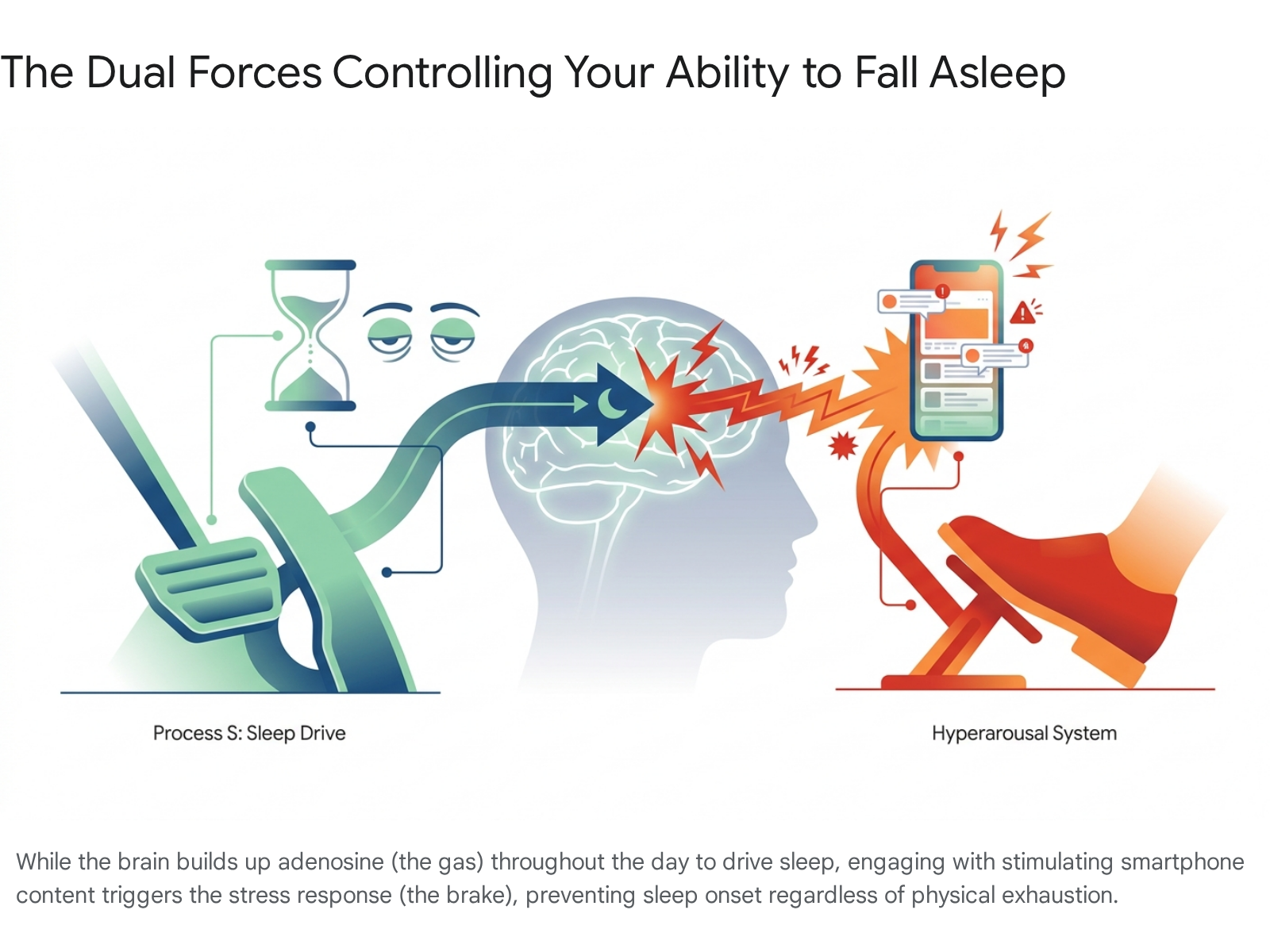
This abrupt mismatch between physical exhaustion and mental stimulation severely disrupts the sleep transition. Just as a passenger sleeping in a moving vehicle will suddenly wake up if the car rapidly slows down or changes velocity - because the subconscious body registers the sudden change as a potential alarm or threat - the brain struggles to transition into restorative sleep if it is abruptly forced from a state of high-stimulation digital scrolling into total darkness 1813. The transition from wakefulness to sleep must be gradual to be effective.
The Content Equation: Active vs. Passive Media
If cognitive arousal is the true enemy of sleep initiation, then it follows that all screen time is not created equal. A critical distinction in modern 2026 sleep research is the profound physiological difference between passive screen exposure and active screen engagement 1415.
The Cognitive Load of Interactivity
Passive screen time involves consuming digital media with minimal interactive requirements or emotional demands. Common examples include watching a familiar television show, listening to an audiobook, or reading a non-stressful narrative on an e-reader 1416. In these scenarios, the user operates purely as a spectator. The brain is not required to make rapid decisions, formulate complex replies, or process the sudden, unpredictable spikes of dopamine associated with interactive reward systems.
Conversely, active screen time requires constant cognitive input, fine motor engagement, and rapid emotional processing. This category includes playing fast-paced video games, rapid-fire text messaging, participating in active group chats, and - most notably - scrolling through algorithm-driven social media feeds 1417.
Social Media and Pre-Sleep Arousal
Social media is a particularly potent disruptor of sleep because it frequently triggers a psychological phenomenon known as "negative social comparison," which directly leads to severe pre-sleep cognitive arousal 18. When a user scrolls through highly curated, idealized images of their peers, or reads through inflammatory, anxiety-inducing news content, it sparks a cascade of involuntary emotional reactions.
A 2024 survey of 830 emerging adults successfully tested a serial mediation model to explain this effect. The study proved that emotional investment in social media directly increases negative social comparison, which subsequently spikes pre-sleep cognitive arousal, ultimately leading to higher insomnia severity and diminished sleep quality 18. When a young adult experiences "Fear Of Missing Out" (FOMO) or heightened stress from a late-night timeline session, they are directly activating their sympathetic nervous system, rendering sleep nearly impossible 18.
Recent large-scale epidemiological studies heavily support this active-versus-passive divide. An extensive analysis of 195,668 adolescents across 38 European and North American countries revealed that high levels of computer use and video gaming (active media) were associated with significantly higher odds of sleep-onset difficulties compared to merely watching television (passive media) 15. Specifically, girls who engaged in heavy computer use (more than four hours a day) had a 61% higher risk of sleep difficulties, whereas heavy television viewing only increased the risk by 19% 15.
Similarly, a 2026 study analyzing data from the Texas School Physical Activity and Nutrition (SPAN) survey found widely divergent associations among high school students depending on the media type. Spending more than two hours a day playing interactive video or computer games was firmly associated with greater odds of short sleep duration among 8th graders 1719. Conversely, in certain demographic subgroups (such as 11th graders), passive television viewing actually showed a mildly protective association with sleep duration 1719. Researchers theorize that passive viewing can sometimes act as a wind-down mechanism, helping students mentally detach and transition away from the day's rigorous academic stress, whereas gaming keeps the mind entirely engaged 1719.
| Feature | Passive Screen Time | Active Screen Time |
|---|---|---|
| Examples | Watching TV, movies, listening to podcasts, reading e-books | Video games, social media scrolling, texting, emailing |
| Cognitive Load | Low (Spectator mode) | High (Decision-making, replying, strategizing) |
| Emotional Arousal | Low to Moderate (Predictable narratives) | High (Unpredictable rewards, social comparison, news anxiety) |
| Impact on Sleep Latency | Minor delay (often functions as a wind-down routine for some) | Significant delay (triggers the "Brake" / hyperarousal system) |
| Overall Sleep Impact | Modest reduction (primarily due to simple time displacement) | Severe reduction (due to delayed onset and nighttime awakenings) |
Table 1: Comparing the distinct physiological and psychological impacts of passive versus active screen engagement before sleep 1415171819.
Methodological Shifts: Within-Person vs. Between-Person
One of the most profound and necessary developments in sleep science leading up to 2026 has been a fundamental methodological shift in how researchers measure the impact of screens. Historically, the dire public health warnings regarding technology and sleep were based almost entirely on between-person studies 202122.
The Problem with Traditional Surveys
In a standard between-person study, researchers take a large, diverse group of individuals, ask them to estimate how much daily screen time they get, and ask them how much they generally sleep. The data almost inevitably shows that the teenagers who report using their phones for six hours a day sleep much worse than the teenagers who report using their phones for only one hour a day 2029.
While statistically true, this methodology is plagued by massive confounding variables. Is the heavy screen time directly causing the poor sleep, or is an underlying, unmeasured factor - such as chronic clinical anxiety, an unstable home environment, or a natural extreme night-owl chronotype - causing both the heavy screen use and the poor sleep? Furthermore, qualitative studies have revealed that many youths actively use technology to distract themselves from intrusive, negative thoughts that would otherwise keep them awake 23. In these specific cases, the screen is being utilized as a coping mechanism for pre-existing insomnia rather than acting as the root cause of the disorder 23.
The 2026 Meta-Analysis Breakthrough
To resolve this "chicken-or-egg" dilemma, the scientific community recently pivoted to conducting within-person studies. In these more rigorous designs, researchers track the exact same individual over several weeks or months, comparing their sleep architecture on nights when they use screens heavily against their own sleep on nights when they barely use screens at all 2021.
A landmark 2026 systematic review and meta-analysis published in JAMA Pediatrics synthesized data from 25 distinct within-person studies, successfully tracking 4,562 youths 212231. The results fundamentally challenged conventional clinical wisdom. The exhaustive study found that daily, short-term fluctuations in screen time have only a "small but significant" correlation with later sleep onset 2131. On days when a teenager used screens significantly more than their own personal baseline, their bedtime was delayed by a matter of minutes, not hours 21.
More importantly, the meta-analysis found no significant associations between daily screen time fluctuations and total sleep time, overall sleep efficiency, wake after sleep onset, or subjective sleep quality 2122. The researchers carefully concluded that while screens may push bedtime back slightly due to simple time displacement (e.g., staying up an extra 15 minutes to finish a video game level or a YouTube video), engaging with screens is "not inherently detrimental to other aspects of sleep health" on a day-to-day basis 2131.
This nuanced understanding is critical for modern public health messaging. Blanket bans on all evening screen time may be unnecessarily draconian, causing needless friction in households 20. The modern data suggests that an extra hour of screen time on a random Tuesday evening is highly unlikely to destroy a healthy individual's sleep architecture for that night, provided the screen use does not cross a specific, highly dangerous physical boundary: the mattress.
| Study Design Type | Methodology | Typical Findings Regarding Screen Time & Sleep | Limitations |
|---|---|---|---|
| Between-Person | Compares different groups of people (e.g., heavy users vs. light users) at a single point in time. | Strong negative associations; high screen time strongly linked to severe sleep deprivation. | Cannot prove causation; highly susceptible to confounding variables (e.g., underlying anxiety). |
| Within-Person | Tracks the same individual over time, comparing their high-screen days to their own low-screen days. | Small delay in sleep onset; no significant degradation of overall sleep efficiency or total duration. | Requires complex daily tracking; effects may seem artificially small if the user's baseline is already compromised. |
Table 2: Comparing historical cross-sectional methodologies against modern longitudinal tracking designs 20212231.
The Geography of the Bedroom: Why Location is Critical
While the JAMA Pediatrics meta-analysis found relatively modest effects for general daily screen use, the clinical narrative changes dramatically when researchers isolate where the screen is being used. The most destructive technological habit across all demographics is bringing the device into the bed itself.
Time Displacement in the Mattress
When a smartphone crosses the physical threshold of the bedroom and is utilized after the lights have been turned out, the negative health impacts skyrocket. A massive, comprehensive study of over 45,000 university students in Norway (the SHOT2022 study), published in Frontiers in Psychiatry, meticulously mapped this modern phenomenon 16242526.
The Norwegian researchers found that for every single additional hour of screen time spent specifically in bed, a student's odds of experiencing clinical symptoms of insomnia spiked by a massive 59%, and their total nightly sleep duration dropped by an average of 24 minutes 162426. Interestingly, this study found that the specific type of activity (social media versus streaming versus gaming) mattered less than the simple fact that the screen was being used in the bed, reinforcing the idea that "time displacement" - the act of replacing intended sleep time with screen time - is a primary mechanism of sleep loss in this context 242627.
This extreme time displacement is insidious and builds over time. A separate 2025 study examining adult populations across the United States and Puerto Rico corroborated these international findings, noting that nightly in-bed screen users lost an average of nearly an hour of sleep per week compared to those who kept their bedrooms completely screen-free 1628.
Classical Conditioning and Sleep Hygiene
Beyond simple time displacement, the physical separation of the device from the sleeping environment is vital due to the psychological principles of classical conditioning. In behavioral psychology, the human brain relies heavily on distinct environmental cues to trigger complex states of consciousness 14.
If an individual only uses their bed for sleep, the brain creates a powerful, subconscious learned association: bed equals sleep 14. When that person physically lies down, the brain naturally and automatically begins the physiological wind-down sequence. However, if an individual routinely spends three hours a night lying in bed answering stressful work emails, scrolling through social media, and watching exciting videos, they actively train their brain to associate the mattress with wakefulness, anxiety, and entertainment 1114.
When treating cases of severe clinical insomnia, sleep physicians almost universally enforce a strict behavioral rule known as stimulus control therapy: if a patient cannot fall asleep within 20 minutes, they must physically leave the bed and engage in a low-arousal activity in a completely different room until they feel overwhelmingly tired 14. The explicit goal of this therapy is to completely break the psychological association between the bed and the frustration of forced wakefulness 14. Using a smartphone in bed achieves the exact opposite result, deeply reinforcing the bed as a hub of cognitive activity and rendering natural sleep exceptionally difficult 13.
The Perception Gap: Subjective Feelings vs. Objective Data
As society attempts to optimize sleep in 2026, millions of people rely on consumer wearable technology - such as smartwatches, biometric rings, and bedside radar trackers - to quantify their rest. However, a fascinating and deeply challenging theme emerging in recent clinical research is the massive discrepancy between subjective sleep (how a person feels they slept) and objective sleep (what physiological sensors show they actually did).
The Inaccuracy of Self-Reported Sleep
Humans are notoriously bad at estimating their own sleep metrics. When a person is lying awake in a dark room, the perception of time dilates significantly. A frustrated individual might feel confident they tossed and turned for two full hours when, physiologically, they were only awake for 30 minutes. Conversely, individuals suffering from chronic, severe sleep deprivation often completely lose the baseline against which to judge their own exhaustion, claiming they feel "fine" on five hours of sleep despite objective neurocognitive testing demonstrating severe impairments in processing speed and memory 10.
A highly revealing 2025 study analyzed health checkup data by utilizing rigorous in-home sleep electroencephalogram (EEG) measurements and comparing them directly alongside popular subjective questionnaires like the Pittsburgh Sleep Quality Index (PSQI) 2930. The researchers uncovered a stunning mismatch between perception and reality: * 66% of individuals who subjectively perceived their sleep as "poor" exhibited absolutely no objective sleep problems on the physiological EEG 30. * 45% of individuals who self-reported their sleep as "sufficient" were identified by the EEG data as being potentially sleep-deprived 30.
Misappraised Poor Sleep and Anxiety
This phenomenon, termed "misappraised poor sleep," is particularly common among individuals with higher baseline depression severity or clinical anxiety 31. When someone is highly anxious about their sleep performance, their subjective perception of sleep onset latency (the exact time it takes to transition from wakefulness to sleep) and wakefulness after sleep onset (how long they stay awake if they wake up in the middle of the night) becomes wildly exaggerated 3132.
This massive discrepancy extends directly to how users report their own screen time. Studies comparing self-reported smartphone use to objectively measured use (via passive tracking applications installed on the device) routinely find that people systematically underestimate their screen time, often by an hour or more per day 3334. A study conducted during the COVID-19 lockdowns in Portugal found that individuals systematically underestimated their smartphone screen time by approximately 71 minutes per day 33.
This compounded human error - drastically underestimating our actual screen time while simultaneously misjudging our true sleep duration - makes it incredibly difficult for individuals to accurately identify the root causes of their daytime fatigue using solely their own memory 333536.
In clinical trials that utilize modern consumer wearables, the mathematical correlations between self-reported sleep metrics and physiological sleep measures are generally remarkably weak. For highly specific metrics like nighttime awakenings and overall sleep efficiency, the Pearson correlation coefficients frequently drop below 0.2, indicating almost no reliable relationship between what the person felt and what the device recorded 3145. Interestingly, self-reported sleep disturbances tend to correlate more strongly with next-day neurocognitive performance (such as processing speed) than objective EEG metrics do. This suggests that a person's psychological belief about how poorly they slept plays a massive role in how poorly they will actually function the next day, regardless of the objective biological reality 3145.
| Metric | Accuracy of Self-Report (Subjective) | Correlation with Objective Device Data | Clinical Observation |
|---|---|---|---|
| Total Sleep Duration | Moderate | Moderate (r ≈ 0.36 to 0.47) | People generally overestimate their total sleep time by ~30 to 45 minutes 313537. |
| Sleep Onset Latency (Time to fall asleep) | Very Poor | Extremely Weak (r ≈ 0.03) | Highly anxious individuals drastically overestimate how long it took them to fall asleep 31. |
| Nighttime Awakenings | Poor | Weak (r ≈ 0.16) | Individuals routinely fail to remember brief, micro-awakenings that devices easily capture 3136. |
| Screen Time Duration | Very Poor | Varies widely | Users systematically underestimate daily screen time, often by over an hour 3334. |
Table 3: The reliability of human perception compared to objective technological measurements in sleep science 313334353637.
Global Trends and Cultural Context
The complex relationship between digital screen time and sleep is not geographically uniform; it is deeply shaped and moderated by cultural norms, rigid academic expectations, and societal structures 38.
Academic Pressures in Eastern Cultures
A comprehensive 2024 meta-analysis published in the Journal of Medical Internet Research, which rigorously evaluated over 41,700 participants across more than 20 countries, found significant cultural divergence in how electronic media ultimately affects sleep 39. The statistical correlation between heavy screen use and severe poor sleep outcomes was found to be notably stronger in Eastern cultures compared to Western cultures 242539.
This regional disparity is largely driven by differing cultural pressures regarding productivity, education, and the value of rest. In many East Asian societies, intense academic and professional competition functionally normalizes the sacrifice of sleep for achievement 3849. A 2025 qualitative study evaluating Taiwanese families vividly illuminated this dynamic. The research revealed that parents highly valued sleep in theory, actively setting strict bedtimes for their children 49. However, in daily practice, overwhelming academic demands, late-night tutoring, and unfinished homework consistently forced parents to override their own rules, pushing their children's actual sleep durations down to a mere six or seven hours a night 49.
In these specific high-pressure environments, late-night screen time (which is often entirely required for remote learning, digital assignments, or exam preparation) is not simply a recreational distraction to be minimized, but a mandated societal activity that systematically and structurally displaces essential rest 49.
Western Screen Habits
Conversely, studies tracking adolescents and young adults in Western countries like the United States, the Netherlands, or Australia often report slightly longer overall nocturnal sleep durations 38. However, these populations battle entirely different screen-related cultural challenges. The primary issue in Western demographics is the pervasive normalization of keeping smartphones actively in the bedroom for continuous social connectivity, streaming, and entertainment up until the exact moment of sleep 38. While the underlying reasons for the screen time differ globally, the physiological outcome - delayed sleep onset and disrupted architecture - remains a universal challenge.
Actionable Sleep Strategies for the Digital Age
Given the highly complex interplay of circadian biology, cognitive hyperarousal, subjective misperception, and deeply ingrained cultural habits, achieving restorative sleep in a hyper-connected world requires more than simply buying a pair of blue-light-blocking glasses. The most effective, evidence-based interventions in 2026 are primarily behavioral.
Health organizations, neuroscientists, and sleep psychologists recommend a multi-tiered, realistic approach to managing evening screen time:
Engineering the Sleep Environment
-
Enforce a Strict Bedroom Ban: The single most effective behavioral change an individual can make is removing the smartphone from the bedroom entirely. The American Academy of Pediatrics strongly advocates for establishing permanent screen-free zones in the home, particularly where children and teenagers sleep 40. Psychologists refer to this practice as "guarding the last quiet border of the day" 13. By charging the phone in the kitchen or living room overnight, an individual eliminates the powerful temptation of in-bed doomscrolling and allows the brain to preserve the vital psychological association between the mattress and unconsciousness 1316. Experts strongly recommend utilizing a traditional, non-connected digital or analog alarm clock to wake up 16.
-
The 30-to-60 Minute Buffer: Establish a consistent, non-negotiable cutoff time for active screen use before your target bedtime. While aggressively stopping all screen time two full hours before bed is biologically optimal, real-world data suggests that a 30-to-60 minute buffer is highly effective and far more sustainable for the average modern adult 131651. Use this dedicated buffer time to engage in passive, low-arousal activities that signal safety to the brain, such as reading a physical book, practicing light stretching, journaling, or listening to a calm podcast 16.
Managing Light and Arousal
-
Optimize Device Settings (Brightness over Color): While the devastating role of blue light has been historically overstated relative to the dangers of cognitive arousal, bright light of any color still suppresses melatonin production. If you absolutely must use a device in the evening for work or study, lowering the absolute brightness of the screen is crucial. Research has definitively shown that dropping screen brightness from a standard 100 lux down to 30 lux can reduce melatonin suppression by approximately 50% 51. Furthermore, utilize device settings to switch the screen to warm tones (around 2400 K) in the evening, which lowers the overall light intensity and is generally less abrasive to the eyes in dark environments 51.
-
Audit Your Content: It is vital to recognize the deep physiological difference between active and passive media. If you are going to use a screen in the evening, intentionally opt for predictable, slow-paced, non-interactive content 15. Actively avoid social media platforms that rely on infinite scroll mechanics, as well as content that is specifically designed to evoke anger, anxiety, or negative social comparison in the critical hours leading up to sleep 18.
Bottom line
The refined science of 2026 clarifies that smartphones disrupt human rest not primarily through the biological suppression of melatonin by blue light, but by triggering the brain's psychological hyperarousal system. Engaging with interactive, stimulating content keeps the mind in a state of alert anticipation, acting as a powerful biological brake against the body's natural sleep drive. While normal daily fluctuations in general evening screen time have only a modest overall impact on sleep onset, bringing the device physically into bed dramatically increases the risk of severe insomnia and measurable sleep loss due to classical conditioning and time displacement. Ultimately, building a rigid physical and temporal boundary between your digital life and your sleeping environment remains the single most potent tool for achieving restorative rest.