Impact of remote work on employee happiness in 2026
Remote Work Adoption and Trajectory in 2026
The transition from traditional, centralized office environments to distributed work models represents a permanent structural shift in global labor markets. While initially catalyzed by a global public health crisis, remote and hybrid work arrangements have stabilized into established organizational norms by 2026. The empirical data conclusively refutes early predictions that remote work was a temporary anomaly; instead, adoption has plateaued at a level significantly higher than pre-2020 baselines.
Global Stabilization and Regional Variations
As of the first quarter of 2026, approximately 22.8% to 26% of all paid workdays in the United States are performed remotely, representing between 34 and 37.1 million workers 123. This stabilization follows a slight global decline from an average of 1.6 remote working days per week in 2022 to 1.33 days in 2023, eventually settling at approximately 1.25 to 1.27 days per week across 2024, 2025, and 2026 24. The U.S. telework rate has consistently remained between 18% and 24% since late 2022, cementing distributed work as a permanent fixture of the macroeconomic landscape 3.
However, adoption rates exhibit profound regional variations, heavily influenced by cultural socialization norms, residential infrastructure, and labor policies. The Global Survey of Working Arrangements (G-SWA), which compiled data from over 16,000 tertiary-educated workers across 40 countries, indicates that English-speaking nations lead global remote work adoption 4.
| Global Region | Average Remote Work Days per Week (2025/2026) | Remote Work Cultural Status |
|---|---|---|
| North America, UK, Australia | 1.5 to 2.0 days | Highly institutionalized, widespread hybrid adoption 24. |
| Western & Northern Europe | 1.0 to 1.5 days | Moderately institutionalized, supported by labor regulations 4. |
| Latin America & Caribbean | ~1.0 days | Emerging adoption, highly dependent on industry sector 4. |
| East & South Asia | 0.5 to 1.0 days | Minimal adoption, strong cultural return to traditional on-site norms 45. |
In regions such as Japan and South Korea, despite temporary pandemic-era telework adoption, on-site work has resolutely returned as the cultural default, averaging 0.5 days at home per week or fewer 35. Conversely, in countries like the Netherlands and Finland, over 70% of employees work remotely either fully or partially, supported by national legislation regarding the right to flexible arrangements 5.
The Ascendance of the Hybrid Work Model
The binary debate between fully remote and fully in-office work has largely been resolved by an overwhelming demographic preference for hybrid arrangements. Among remote-capable employees in the United States, approximately 52% to 55% operate in a hybrid capacity, while 26% to 27% are fully remote, and roughly 20% to 21% are fully on-site 25786.
Globally, 83% of employees in remote-capable roles identify a hybrid setup as their ideal working arrangement 5767. This preference highlights a collective desire among knowledge workers to balance the autonomy and deep focus afforded by the home environment with the collaborative and social benefits of the physical office. The "3-2 model" (three days in-office, two days remote) has emerged as a common corporate standard for hybrid deployments, though optimal ratios vary significantly based on individual roles and organizational culture 28.
Employee Life Evaluation and the Thriving Metric
The core inquiry regarding whether remote work makes employees happier requires a bifurcated analysis. Happiness in the occupational context is not a monolithic metric; it encompasses long-term life evaluation, daily emotional experiences, and psychological safety. When evaluating long-term life satisfaction, remote and hybrid workers report significantly higher baseline happiness than their fully in-office counterparts.
Overall Job Satisfaction and Life Evaluation
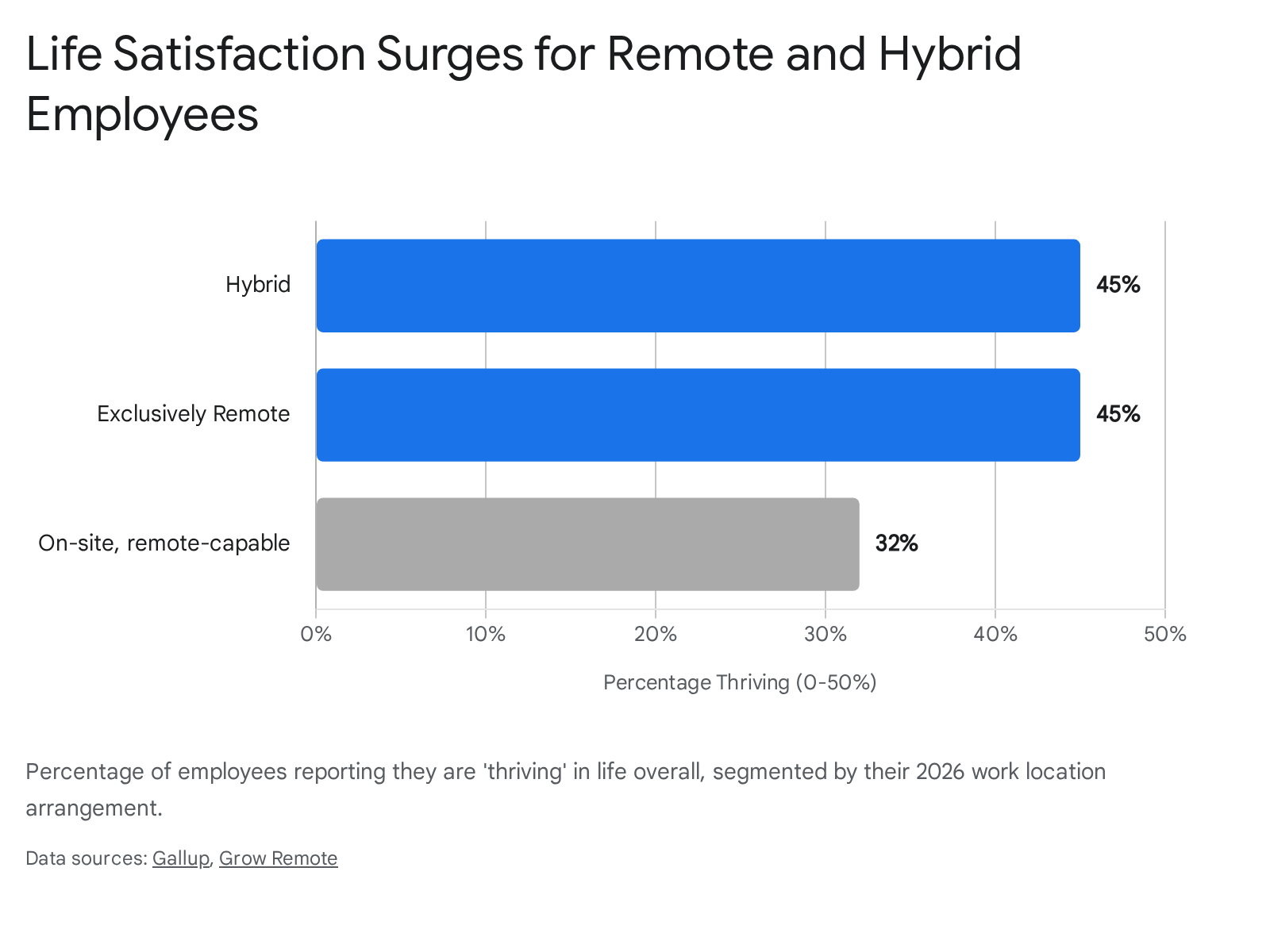
According to Gallup's State of the Global Workplace: 2026 Report, exclusively remote workers experienced a substantial increase in holistic life evaluation over the past year. The percentage of fully remote workers classified as "thriving" - the highest tier of life evaluation - jumped from 36% in the 2025 data to 45% in 2026 9. Hybrid workers maintain a similarly high thriving rate of 45% 910.
Conversely, the thriving rate for on-site remote-capable workers plummeted from 42% in 2025 to 32% in 2026, indicating a sharpening divergence in general life satisfaction between those granted geographic flexibility and those denied it 9. A vast majority of professionals (82% to 99%) report that flexible work positively impacts their mental health, primarily driven by the reclamation of commute time, increased agency over daily schedules, and the ability to seamlessly integrate personal and professional responsibilities 56711.
Commuting and the Reallocation of Time
The elimination of the daily commute is frequently cited as the most concrete lifestyle upgrade provided by distributed work models. United States remote workers save an average of 55 minutes per day by not commuting, accumulating to an average of two hours to eight hours of recovered time per week depending on regional infrastructure 71112.
Research indicates that employees do not squander this recovered time. Approximately 40% of saved commute time is directly reallocated back into primary work tasks, bolstering overall productivity 1. The remaining time is distributed among vital wellbeing activities: 77% of workers use the time for family engagement, 71% for additional sleep (amounting to 19 to 24 extra minutes of sleep per workday), and 70% for exercise 512.
However, remote work does not automatically guarantee a more physically active lifestyle. Data reveals that 47% of full-time office employees engage in physical workouts during the traditional workday, compared to only 22% of fully remote workers, suggesting that the incidental movement and structured breaks of the office environment have physiological benefits 12. Despite this, 84% of remote and hybrid workers report that the ability to prepare meals at home significantly improves the nutritional quality of their diets compared to eating in traditional office settings 12.
Daily Emotional Experiences and the Mental Health Paradox
While flexible work models foster long-term satisfaction and thriving, the 2026 data reveals a phenomenon frequently termed the "mental health paradox" of remote work. Remote employees report the highest levels of structural engagement and life evaluation, yet simultaneously experience acute daily emotional distress at rates exceeding those of their in-office peers.
Stress, Anger, and Sadness by Work Location
This contradiction is best explained through the Job Demands-Resources (JD-R) theoretical framework. The JD-R model posits that occupational wellbeing is determined by the balance between job resources (e.g., autonomy, support) and job demands (e.g., workload, isolation) 1613. Remote work provides immense resources - such as the elimination of commutes and physical comfort - which drive overall thriving. Simultaneously, it introduces novel psychosocial hazards, including digital overload and boundary erosion, which drive daily distress.
| Daily Emotion Experienced | Exclusively Remote | Hybrid | On-Site (Remote-Capable) |
|---|---|---|---|
| High Daily Stress | 41% to 46% | 46% | 39% |
| Daily Anger | 24% to 25% | 18% to 23% | 20% to 22% |
| Daily Sadness | 30% | 21% to 24% | 20% |
| Daily Loneliness | 23% to 24% | 22% to 24% | 18% |
Data aggregated from the 2026 Gallup State of the Global Workplace survey tracking daily emotional prevalence among global knowledge workers 91014.
The data demonstrates that fully remote and hybrid workers report the highest levels of daily stress (46%), which is noticeably higher than the 39% reported by on-site remote-capable workers 910. Exclusively remote workers also report the highest levels of daily anger and daily sadness 1014. The cognitive burden of managing time independently, coordinating asynchronously across time zones, and lacking immediate physical access to colleagues contributes heavily to this elevated emotional taxation 1415.
Social Isolation and Workplace Loneliness
Isolation plays a pivotal role in the mental health paradox. Between 22% and 43% of remote workers identify loneliness as their primary occupational struggle, a metric that has steadily increased since pre-2020 baselines 1220. Furthermore, 67% of fully remote employees report feeling less connected to their colleagues, and over half state that it is difficult to maintain relationships in a purely virtual setting 512.
Prolonged disconnection strips away the built-in social cues of the office - casual conversations, shared routines, and micro-interactions - which serve as vital emotional anchors for many personality types 16. The absence of face-to-face contact triggers biological stress responses over time, elevating the risk of anxiety and depression. Statistically, remote (40%) and hybrid workers (38%) report slightly higher rates of anxiety and depression compared to strictly in-person workers (35%) 5. The psychological impact of isolation is particularly severe for individuals living alone and for new hires who have not yet established professional networks within the organization 1520.
Psychological Safety and Workplace Attachment
An unexpected and highly significant finding in the 2026 data landscape is the enhancement of psychological safety in distributed environments. While remote workers suffer from a lack of casual social connection, they paradoxically feel safer executing their core professional duties without fear of interpersonal reprisal.
The Democratization of the Digital Interface
A comprehensive 2026 study of 3,900 employees revealed that 65% of remote workers and 60% of hybrid workers scored above the group average for psychological safety, compared to only 48% of office workers 22. Furthermore, on-site employees are 66% more likely to feel that mistakes are held against them, 57% more likely to feel that people are rejected for being different, and 36% more likely to find it difficult to ask teammates for help 17.
Remote environments fundamentally alter the mechanics of interpersonal communication. The uniformity of communication mediums - such as equally sized digital squares on a video conference - removes physical markers of dominance and hierarchy 17. Asynchronous text communication allows employees to process information, regulate emotional responses, and articulate thoughts carefully without the immediate pressure of in-person confrontation. This reduction in physical intimidation and office politics fosters an environment where marginalized, introverted, or neurodivergent voices feel significantly more secure contributing ideas and reporting errors.
Autonomy and Self-Esteem Outcomes
High psychological safety directly correlates with improved resilience. The aforementioned study demonstrated that just 5% of highly resilient employees who felt psychologically safe reported feeling burned out, compared to 60% of employees operating with low resilience and low psychological safety 17. Remote workers also score higher on metrics of self-confidence; 51% of remote workers scored above average on self-confidence indices, whereas office workers were the least likely to score highly on self-esteem metrics 22. The autonomy inherent in managing one's own environment and schedule translates directly into higher professional self-efficacy.
Psychological Detachment and Occupational Burnout
While flexible work models foster long-term satisfaction and psychological safety, they carry a high risk of occupational burnout. In 2025 and 2026, burnout prevalence remains a critical organizational challenge, with multiple industry reports indicating that up to 86% of full-time remote workers experience burnout symptoms, compared to roughly 35% of in-office employees and 28% of hybrid workers 5111215. The primary driver of this exhaustion is the inability to achieve psychological detachment from work.
Digital Fatigue and Boundary Erosion
Psychological detachment refers to an individual's ability to mentally disconnect from job-related tasks and stressors during off-hours. When the home serves simultaneously as a sanctuary and an office, temporal and spatial boundaries collapse. This collapse frequently results in "soft overtime" - unpaid, undocumented labor performed outside contracted hours 18.
The data on boundary erosion is stark: 81% of remote workers check business communications outside regular hours, 63% perform work on weekends, 34% work during planned vacations, and approximately 40% struggle to disconnect entirely 512. This "always-on" culture is exacerbated by digital fatigue. Employees face a continuous cognitive load from managing instant messaging, emails, and video conferences, leading to mental exhaustion 1518.
The phenomenon of "telepressure" - the urge to respond immediately to work-related messages regardless of the time of day - creates a state of hyper-arousal that prevents physiological and psychological recovery 19. Furthermore, the pressure to "look busy" or prove productivity when out of physical sight affects 88% of remote workers, causing them to leave messaging applications active or engage in performative digital socialization 26.
Fixed Versus Flexible Agreements
Recent academic research highlights a critical nuance in how the specific structure of a remote work agreement affects mental health. A comprehensive study of 24,763 public sector workers in Norway investigated the relationship between different types of hybrid models, availability demands, and clinical mental distress 20.
The study established a vital distinction between "flexible" and "fixed" hybrid arrangements. Employees utilizing flexible agreements - granting them the absolute autonomy to choose when and where they work on a fluid basis - were generally less likely to report overall mental distress compared to fully on-site peers 20. However, these same workers reported significantly higher availability demands, higher work-life conflict, and higher life-work conflict 20. The total freedom to work at any time paradoxically translated into an implicit organizational expectation to be reachable at all times, fueling boundary erosion.
Conversely, employees with fixed agreements - mandated to work from home on specific, scheduled days - did not experience the same reduction in general mental distress, but they reported significantly lower availability demands and no increase in work-life conflict 20. Fixed schedules provide the structural temporal boundaries that prevent work obligations from bleeding into personal time. This finding suggests that absolute, unstructured autonomy is less protective against burnout than structured, predictable flexibility.
Technostress and the Moderating Role of Boundary Control
The integration of advanced communication technology into the home environment generates "technostress," a modern psychological hazard resulting from continuous interaction with digital interfaces. Research examining 405 full-time hybrid workers demonstrated that impaired psychological detachment fully mediates the relationship between technostress and burnout, but this effect is evident specifically during remote work days, not in-office days 21.
When examining the policy-to-burnout pathway, work-life boundary control acts as the primary moderating variable. Organizations that fail to offer formal guidelines regarding communication hours or remote work boundaries exhibit clinical levels of employee depersonalization and burnout 13. To mitigate this, multiple European nations have expanded "right to disconnect" legislation, legally protecting an employee's right to ignore business communications outside of formal working hours 1218.
Demographic Variances in Remote Work Outcomes
The assumption that remote work affects all employees uniformly is a statistical fallacy. Satisfaction, productivity, the ability to detach, and the desire for flexibility vary sharply across generational lines, gender, and career stages.
Generation Z and the Mentorship Deficit
Generation Z (born 1997 - 2012) exhibits the most complex and contradictory relationship with distributed work. Despite being true digital natives, Gen Z workers are not universally advocating for fully remote roles. In 2025 and 2026 surveys, a remarkable 71% of Gen Z employees stated a preference for a hybrid environment - the highest of any generational cohort - while only 23% desired fully remote work, and a mere 6% preferred fully in-person work 8.
This preference is driven by an acute need for mentorship, career visibility, and social connection. Having entered the workforce during a period of massive macroeconomic disruption, many Gen Z employees lack established professional networks 2223. Fully remote setups inherently hinder spontaneous learning - the desk-side troubleshooting, ambient listening, and observation of senior colleagues where tacit industry knowledge is transferred 1624. Consequently, Gen Z workers report the highest levels of isolation (with 20% experiencing high-frequency loneliness) and are the demographic most affected by severe burnout (38%) 25.
| Generational Cohort | Primary Work Preference | Remote Work Mental Health / Burnout Status |
|---|---|---|
| Generation Z | Hybrid (71%) | Highest rates of burnout (38%) and high-frequency isolation (20%) 825. |
| Millennials | Hybrid / Remote | High willingness to trade salary for flexibility; 37% report burnout 81225. |
| Generation X | Hybrid / Remote | Highest overall wellbeing score (7.8/10) and lowest burnout rates (27%) 25. |
| Baby Boomers | Hybrid / On-Site | Moderate burnout (37%); lower priority on flexibility compared to salary 1233. |
To address this mentorship deficit, organizations are rapidly abandoning traditional, title-based mentoring in favor of digital-first interventions. Trends in 2026 include "flash mentoring" for specific, immediate skill acquisition, and "multi-directional" or reverse mentoring, where Gen Z employees share digital fluency expertise with senior leaders in exchange for strategic business acumen 2226. Furthermore, Gen Z prioritizes purposeful work over traditional hierarchical advancement; 89% consider purpose vital to job satisfaction, while only 6% aspire to traditional senior leadership roles 826. If developmental needs are not met in a hybrid environment, this generation exhibits extreme mobility, changing jobs every 1.1 years on average 2635.
Mid-Career Stability and Generation X
In stark contrast to early-career professionals, Generation X (born 1965 - 1980) has emerged as the demographic best adapted to remote work realities. Gen X workers report the highest overall mental wellbeing scores (7.8 out of 10) and the lowest rates of burnout (27%) in distributed environments 25.
This success is attributed to the advantages of mid-career stability. Gen X professionals generally possess established internal networks, clear role definitions, and higher baseline digital literacy in enterprise tools, allowing them to navigate remote workflows with less supervision and anxiety 25. Furthermore, they are the most likely to highlight the elimination of the commute as a primary driver of reduced stress, utilizing the saved time to manage the dual caregiving responsibilities associated with their life stage - caring for both teenage children and aging parents 25.
Gender Dynamics and Caregiving Outcomes
Remote work operates as a powerful mechanism for gender equity, though not without complications. Women report higher rates of mental health improvement (84%) and productivity gains (66%) from flexible arrangements compared to men (77% and 59%, respectively) 525. Flexibility serves as a vital pressure release valve for women, who statistically continue to bear a disproportionate share of domestic and childcare duties globally.
However, the physical conflation of the home and the workplace can exacerbate severe role conflict. When boundaries blur, women often report higher negative health effects from the simultaneous, competing demands of professional tasks and visible domestic obligations 15. Furthermore, male workers are more likely to benefit from the informal networking and favoritism prevalent in traditional office environments, making equal access to hybrid visibility a critical inclusion metric 27. Regardless of gender, employees with young children are overwhelmingly more likely to utilize a hybrid schedule, whereas workers without children naturally gravitate toward either fully remote or fully on-site extremes 34.
Physical Environments and Socioeconomic Mediators
The degree to which remote work improves or degrades happiness is not solely dependent on psychological factors; it is heavily contingent upon socioeconomic realities, specifically the quality of the residential built environment.
Housing Density and Dedicated Home Offices
The assumption that remote work provides comfort ignores the vast disparities in modern housing. Factors such as housing density, the presence of dedicated office space, and indoor environmental quality (including ventilation and natural light) directly mediate the relationship between remote work and job satisfaction 2829.
Employees residing in high-density housing, shared apartments, or those lacking a separate, ergonomic workspace report higher anxiety and lower productivity. Studies indicate that a dedicated, enclosed workroom makes the home alternative attractive and sustainable, whereas working from multi-use spaces (such as living rooms or bedrooms) compounds technostress and disrupts sleep hygiene 39. Furthermore, active environment-improving behaviors - such as opening windows to increase ventilation during working hours - have been empirically linked to higher perceived productivity, increased willingness to continue WFH, and lower burnout tendencies 29.
Relocation and Multilocal Living
The decoupling of the workplace from the residential home has initiated profound shifts in geographic mobility. Remote work affords individuals the freedom to choose where they live based on lifestyle, affordability, and proximity to family, rather than commute optimization. This has led to an increase in "multilocal living" - the strategy of living and spending time in more than one dwelling across different regions 30.
While this freedom boosts individual happiness, it introduces systemic challenges. Remote work is generally restricted to the knowledge economy, creating a spatial inequality wherein remote-capable professionals drive up housing costs in rural or suburban "zoom towns," exacerbating socio-spatial divisions between the digital workforce and the in-person service sector 30. Furthermore, nearly 37% of remote workers indicate a desire to work internationally as digital nomads, contributing to the 40 million digital nomads worldwide and challenging traditional models of taxation and corporate compliance 41.
Productivity, Collaboration, and Organizational Culture
The debate over whether remote work harms organizational output has been largely settled by macroeconomic data and rigorous experimental studies in 2025 and 2026. The consensus indicates that flexibility does not destroy productivity; rather, it fundamentally changes the nature of how work is accomplished.
Measurable Output and the Deep Focus Advantage
Objective tracking and self-reported data consistently indicate that remote workers maintain or exceed the productivity of on-site workers. The Bureau of Labor Statistics estimated a 0.05% to 0.08% increase in Total Factor Productivity for every 1% increase in remote work participation across an industry 211. Furthermore, randomized experimental studies - such as Stanford University's analysis of Trip.com - demonstrated that hybrid teams are approximately 5% more productive than fully in-office teams, while also experiencing a massive 33% drop in attrition 220.
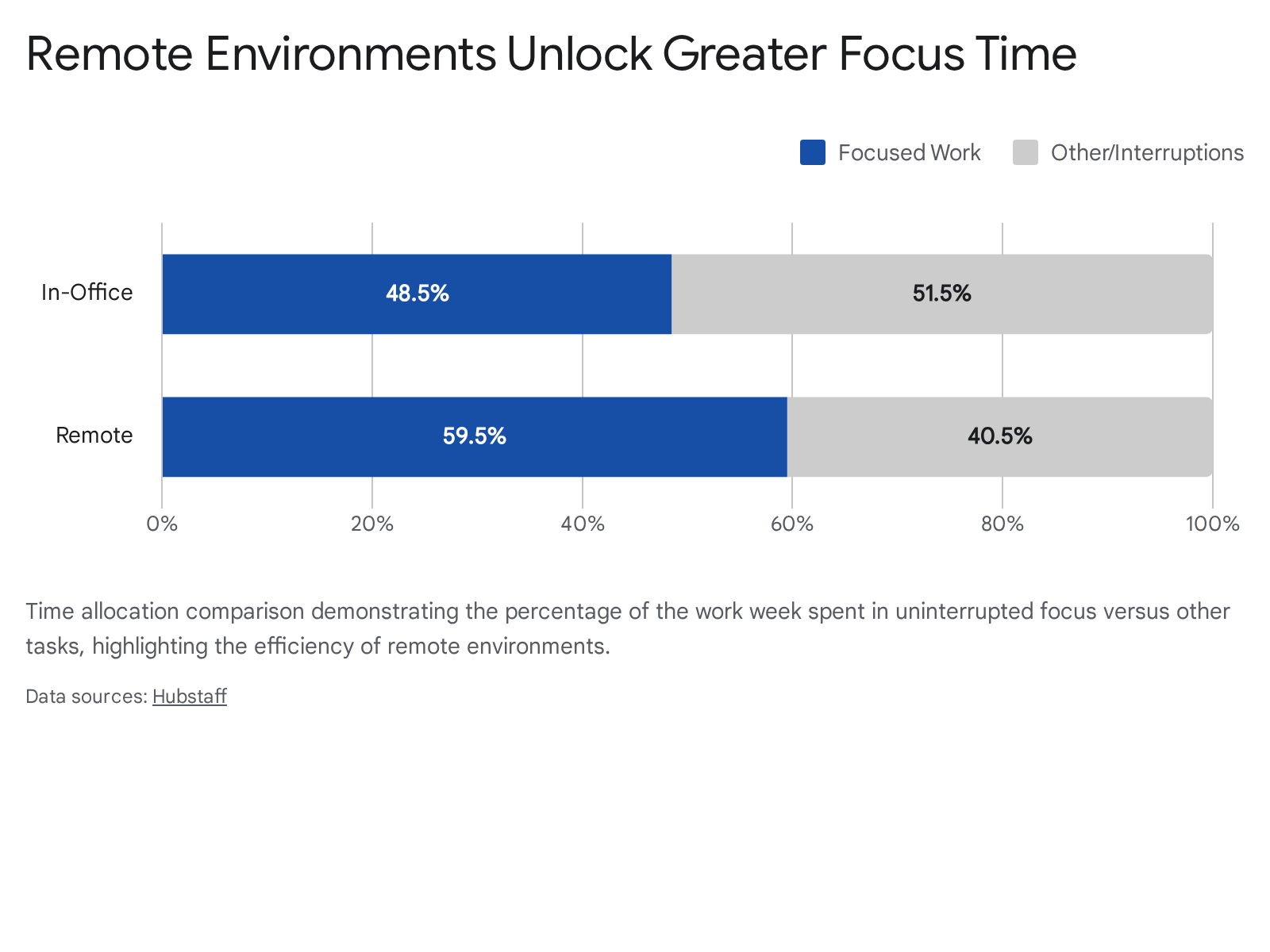
The primary driver of this enhanced output is uninterrupted focus time. Remote workers spend an average of 59.4% of their work week in deep, focused execution, compared to just 48.5% for traditional office workers 20.
By avoiding ambient office distractions, loud environments, and casual interruptions from colleagues, remote employees experience 18% fewer disruptions. Because it takes an average of 23 minutes to cognitively refocus after an interruption, this reduction in context-switching saves remote workers an estimated 62 hours of productive work time annually 20.
Collaboration Penalties and Team Cohesion
However, these substantial gains in individual execution speed come at a measurable cost to collaborative efficiency. Over 53% of remote workers acknowledge that it is harder to feel like part of a team, and 56% of managers report that fostering team cohesion is significantly more difficult when distributed 731.
Data indicates that 85% of collaboration failures in distributed teams are caused by poor communication management rather than the geographic distance itself, resulting in an estimated 3 hours of wasted time per employee per week due to misunderstandings or siloed information 31. Tasks requiring spontaneous ideation, rapid complex problem-solving, and cross-functional alignment inherently suffer in fully asynchronous or remote environments. This tension between high individual productivity and low collaborative friction is the primary reason organizations and employees alike have gravitated toward the hybrid model, utilizing remote days for heads-down execution and office days strictly for high-bandwidth collaboration.
The Impact of Return-to-Office Mandates
Despite the empirical data supporting the economic and psychological efficacy of flexible work, a significant tension exists between employee expectations and executive policy. Throughout 2025 and 2026, many major organizations have implemented strict Return-to-Office (RTO) mandates, a phenomenon termed "hybrid creep" as stipulations for on-site attendance steadily increase to four or five days per week 532.
The Flexibility Gap and Voluntary Attrition
Executives frequently justify RTO mandates by citing concerns over company culture, spontaneous innovation, and obscured productivity. However, these mandates directly conflict with the preferences of the modern workforce. Industry data reveals a severe "Flexibility Gap": while roughly 30% of companies plan to require 5-day office returns, 98% of workers wish to retain some form of remote work, and 86% state that remote capability is the number one factor in applying for a new job, exceeding even competitive pay 1287.
The implementation of RTO mandates is highly correlated with detrimental psychological and organizational outcomes. When faced with forced full-time office returns, job satisfaction predictably plummets 2633. For instance, a 2025 report highlighted that 91% of employees at a major technology firm expressed intense dissatisfaction over mandated physical attendance, leading to widespread morale degradation 26.
The most severe consequence of rigid in-office policies is mass talent attrition. Approximately 61% to 76% of employees indicate they would consider quitting or actively looking for a new job if stripped of remote options 125. High-performing employees are 16% more likely to possess a "low intent to stay" when facing strict RTO policies 26. Labor market analysts in 2026 increasingly view aggressive RTO mandates as "layoffs in disguise" - a strategic, cost-saving maneuver by organizations to reduce headcount through voluntary resignation rather than enduring the financial severance costs and negative public relations associated with formal layoffs 32.
Autonomy and the Choice-Based Arrangement
The data makes a clear distinction between the mental health outcomes of voluntary remote work versus mandated work arrangements of any kind. Employees who have the agency to choose between onsite, hybrid, or remote setups are 14 times less likely to emotionally disengage or "quit and stay" (quiet quitting) 5.
The friction of RTO fundamentally undermines its purported goals of culture building. Employees forced into the office frequently arrive to find their immediate teammates are located in different global offices or working remotely that day. This results in an "in-office but still remote" dynamic, where employees spend time and money commuting simply to sit at a desk and engage in the exact same virtual video calls they would have taken from home. This dynamic erodes the value proposition of the office, delivering neither the flexibility of home nor the collaborative benefits of in-person interaction, generating profound resentment 8.
Synthesized Conclusions on Work Location and Happiness
The research question of whether working from home makes people happier yields a definitive but highly nuanced affirmative based on the 2026 data. Flexible work arrangements significantly elevate baseline life satisfaction, grant workers unprecedented autonomy over their schedules, eliminate the financial and physiological toll of commuting, and provide an environment of high psychological safety that democratizes participation. Furthermore, they objectively unlock higher volumes of deep, focused work.
However, remote work is not a panacea for occupational distress; it simply exchanges the traditional stressors of the physical office - such as commute fatigue, micromanagement, and rigid schedules - for a novel set of digital stressors. Techno-invasion, social isolation, and severe boundary erosion pose immense psychological hazards. The inability to psychologically detach from work remains the primary threat to the modern remote worker's wellbeing, driving a persistent crisis of occupational burnout.
The empirical evidence from the 2025 and 2026 labor market points unequivocally to the structured hybrid model as the optimal compromise. By anchoring teams with fixed, intentional in-office days for socialization, complex collaboration, and mentorship - thereby satisfying the deep developmental needs of early-career professionals - while simultaneously preserving remote days for autonomous, deep-focus execution, organizations can maximize both economic output and human flourishing. Ultimately, employee happiness in the modern workforce is less dependent on geographic location and vastly more dependent on the presence of organizational trust, systemic autonomy, and the defense of intentional boundaries.