
Design Principles for Virtual and Hybrid Workshop Facilitation
Virtual and hybrid facilitation has evolved from a temporary contingency measure into a standardized, multi-modal practice embedded within global learning and development (L&D) strategies. The normalization of distributed work environments necessitates a departure from the direct translation of in-person training models toward digitally native facilitation architectures. The current landscape requires practitioners to operate across physical, virtual, and asynchronous formats, a shift validated by data indicating that hybrid learning is now the default setting for a majority of organizations 11. This analysis examines the empirical differences between in-person, hybrid, and virtual facilitation, focusing on the design principles that maximize adult learner outcomes, mitigate cognitive fatigue, and accommodate cultural and neurodiverse populations.
Foundational Principles of Adult Learning in Digital Contexts
The foundation of effective virtual and hybrid facilitation is rooted in andragogy, the method and practice of teaching adult learners. First popularized by Malcolm Knowles, the core principles of adult learning emphasize self-direction, the utilization of prior experience, immediate relevance, and a problem-centered orientation 234. In traditional physical classrooms, autonomy and relevance are often negotiated organically through body language, spontaneous dialogue, and physical grouping. In virtual environments, these variables must be systematically engineered into the digital interface and session architecture from the outset.
The demand for optimized learning design is underscored by industry data reflecting shifting investments in corporate training. According to the Association for Talent Development (ATD) 2025 State of the Industry Report, average learning hours per employee decreased to 13.7 hours in 2024 from a peak of 35 hours in 2020, while direct expenditures remained relatively high at $1,254 per employee 5. This compression of available training time requires facilitators to deliver higher-impact sessions in shorter intervals. Consequently, blended learning programs - combining synchronous virtual facilitation with asynchronous self-paced modules - have seen rising adoption, currently utilized by over 40% of organizations to maximize flexibility 56.
Applying Andragogy to Virtual Interfaces
Adults learn most effectively when they exercise autonomy over their learning journey and perceive the instruction as immediately applicable to their professional realities 2. Research indicates that adult learners resist instruction when information is perceived as externally imposed without clear justification 4. Virtual facilitation addresses this resistance through self-directed learning paths, which allow users to navigate unlocked course modules, select case studies relevant to their specific job roles, and manage their own pacing during asynchronous segments 478.
Furthermore, the principle of relevance dictates that adults require practical application for new knowledge. Instructional design in 2025 emphasizes relevance-first content, where real-world problems and task analyses are presented before abstract theoretical concepts are introduced 78. To demonstrate how these theoretical principles translate into functional virtual workshop mechanics, the following table maps Knowles' core principles to specific digital facilitation techniques and software applications.
| Andragogical Principle | Facilitation Requirement | Application in Virtual Environments |
|---|---|---|
| Self-Direction | Autonomy and process control | Allowing learners to navigate digital whiteboards (e.g., Miro) independently; unlocking LMS navigation; using choice-based virtual breakout rooms 479. |
| Experience | Tapping into prior knowledge | Utilizing peer-to-peer reflection in breakout sessions; bypassing redundant introductory modules for experienced staff through adaptive pathways 247. |
| Relevance | Connection to real-world tasks | Framing sessions around immediate workplace problems; using collaborative boards for team-specific workflow mapping and problem-solving 3711. |
| Orientation to Learning | Task-based, active application | Replacing extended lectures with digital simulation activities, scenario-based polling, and real-time connection-mapping exercises 2910. |
| Internal Motivation | Understanding the strategic "Why" | Clearly defining the business or personal benefit of the session upfront; linking outcomes to reduced friction in daily operational tasks 378. |
Cognitive Load Management in Virtual Spaces
The cognitive architecture of adult learners features a highly limited working memory capacity, generally restricted to processing four distinct elements simultaneously 11. According to Cognitive Load Theory (CLT), developed by John Sweller, instructional design must balance three types of cognitive load: intrinsic (the inherent complexity of the topic), extraneous (unnecessary effort caused by poor design or environmental friction), and germane (the productive effort devoted to schema formation and long-term learning) 11.
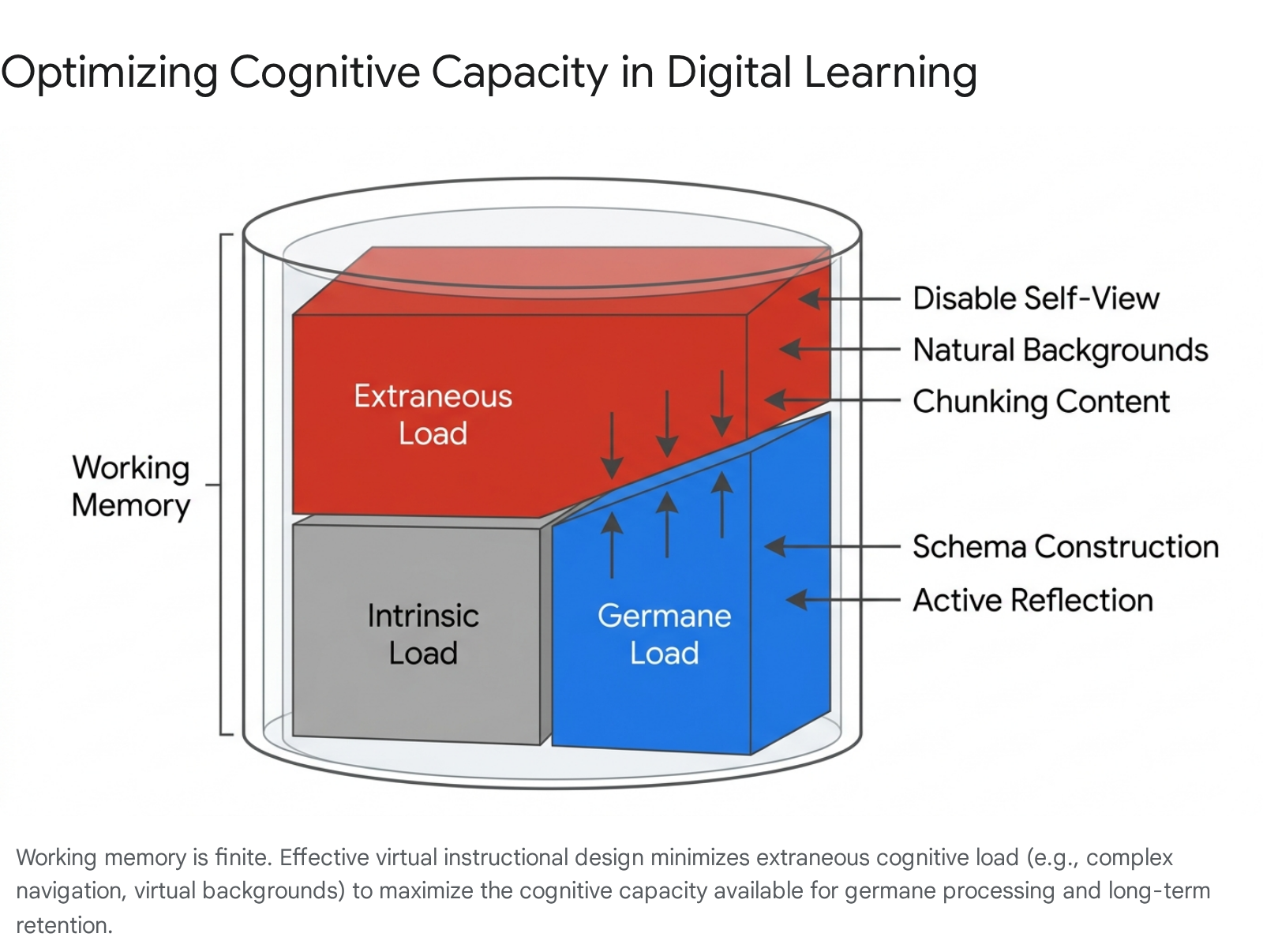
Virtual learning environments inherently increase extraneous cognitive load if the digital interface and facilitation pacing are not carefully managed.
Interface Interventions and Videoconference Fatigue
The phenomenon commonly referred to as "Zoom fatigue" is heavily influenced by specific videoconferencing settings that manipulate cognitive strain. A 2025 study analyzing cognitive load in virtual classes found that the use of virtual backgrounds significantly increases extraneous cognitive load 12. The human visual processing system must constantly work to separate the speaker from the artificial background, consuming resources that could otherwise be dedicated to the subject matter. Conversely, the study found that natural backgrounds increased germane cognitive load, suggesting that the cognitive resources saved by avoiding digital background rendering could be used more efficiently for understanding complex tasks 12.
Similarly, the self-view function serves as a major source of extraneous load. The study reported that disabling the self-view function significantly reduced overall fatigue and extraneous cognitive load by eliminating the unnatural phenomenon of continuous self-monitoring, which forces the brain into a state of hyper-awareness 12. Active participation mechanisms, such as answering polls or utilizing online collaboration tools, were also linked to decreased fatigue and lower extraneous load compared to passive observation 12.
Multimedia Design and Curriculum Pacing
To optimize germane load, facilitators are adopting evidence-based design strategies derived from Richard Mayer's Principles of Multimedia Learning. The segmenting principle involves chunking content into microlearning segments - typically lasting between six and eighteen minutes - followed immediately by an application or reflection exercise to allow working memory to clear 111513.
Furthermore, visual design in virtual presentations must strictly adhere to the coherence and signaling principles. This involves eliminating decorative animations or redundant information that does not serve a direct instructional purpose, and using visual cues, such as high-contrast text or arrows, to guide the learner's attention 111314. The modality principle also dictates that facilitators should combine spoken narration with visual graphics rather than placing heavy amounts of redundant text on the screen, which quickly overloads visual processing channels and forces learners into a state of split attention 1314.
Comparative Analysis of Facilitation Modalities
The transition from physical spaces to virtual and hybrid environments requires the acknowledgment that a direct translation of traditional workshops to digital platforms is structurally ineffective 1815. A successful virtual workshop relies on a unique architectural approach that accounts for fundamental differences in human communication, attention degradation, and spatial dynamics.
In-Person Dynamics and Nonverbal Communication
For decades, the necessity of in-person facilitation has been anecdotally justified by the claim that 93% of human communication is nonverbal, broken down into 55% body language, 38% tone of voice, and only 7% spoken words 1617. However, this statistic is a widespread misinterpretation of Dr. Albert Mehrabian's 1967 research. Mehrabian's original studies focused strictly on the decoding of inconsistent communications regarding single-word emotional attitudes, establishing a framework for how listeners infer attitudes when tone and body language contradict the spoken word 1722. The data was never intended to serve as a blanket rule for all professional or academic discourse 22.
Despite the debunking of the precise numerical ratio, contemporary empirical research confirms that the loss of nonverbal data in virtual environments creates significant friction. A 2023 study conducted at Yale University utilized functional near-infrared spectroscopy (fNIRS) to compare the neural activity of pairs interacting in person through clear glass versus pairs interacting via digital monitors. The neuroimaging data revealed that virtual meetings produced substantially less activity in the neural regions associated with facial processing and social interaction 18. In-person interactions facilitated longer gazes, richer social context processing, and increased cross-brain synchrony 18. Consequently, complex facilitation interventions - such as conflict mediation, nuanced consensus building, and deep relationship formation - often require substantially more effort in purely virtual formats 11819.
Quantitative Assessment of Modality Efficacy
To compensate for the loss of natural neural synchrony, virtual facilitation relies heavily on structured interaction. Studies comparing the effectiveness of virtual and in-person conferences have demonstrated that while informal interaction is significantly more effective at driving collaboration in physical settings, formal interaction - such as highly structured tasks and timed virtual breakouts - plays an equal or greater role in team formation across virtual modalities 20.
The friction introduced by digital mediation is quantifiable. A 2024 analysis of scientific review meetings conducted by the National Institutes of Health compared reviewer engagement, discussion quality, and attention span across face-to-face, hybrid, and purely virtual formats 21. The findings revealed a consistent hierarchy where in-person formats received the highest ratings, followed closely by hybrid formats, with purely virtual formats trailing behind.
| Evaluation Metric | Face-to-Face Mean Score | Hybrid Mean Score | Virtual Mean Score | Statistical Implication |
|---|---|---|---|---|
| Reviewer Engagement | 4.58 (Scale 1 - 5) | 4.45 (Scale 1 - 5) | 4.13 (Scale 1 - 5) | Face-to-face outpaces virtual substantially ($d = 0.62$). Hybrid maintains near parity with in-person 21. |
| Discussion Quality | 4.61 (Scale 1 - 5) | 4.53 (Scale 1 - 5) | 4.34 (Scale 1 - 5) | Discussion productivity remains high in hybrid models, significantly outperforming purely virtual environments 21. |
| Attention Span | 8.52 (Scale 1 - 10) | 8.55 (In-person cohort) / 8.02 (Remote cohort) | 7.56 (Scale 1 - 10) | Attention degrades most severely in fully virtual settings. Hybrid remote attendees remain more focused than purely virtual attendees 21. |
The data indicates that while face-to-face meetings yield the highest overall scores, hybrid formats preserve much of the engagement and discussion quality when properly structured. However, within the hybrid model itself, a divide exists: the in-person cohort of a hybrid meeting consistently reports higher attention spans and better discussion quality than their remote counterparts attending the same session 21. This disparity highlights the specific design challenges inherent in hybrid architecture.
Hybrid Architecture and Remote-First Equity
Hybrid facilitation is widely cited by industry practitioners as the most demanding operational modality 1. The primary risk of a hybrid session is the creation of a two-tiered experience, where in-room participants naturally dominate the dialogue due to physical proximity and shared nonverbal cues, while remote participants are relegated to a secondary, observational role 22.
To establish parity, organizations and expert facilitators increasingly enforce a "remote-first" design philosophy. The core tenet of remote-first hybrid design stipulates that if even one participant joins remotely, the entire architecture of the meeting must default to virtual equity mechanisms 2223. Implementing this philosophy requires specific tactical interventions. First, facilitators often mandate that all participants, including those physically co-located in a primary conference room, log into the virtual platform on individual devices with their cameras enabled 1923. This levels the visual playing field, ensuring that remote participants can read individual facial expressions rather than deciphering a wide, distant shot of a boardroom table 1924.
Second, all documentation, brainstorming, and ideation must achieve digital collaboration parity. Facilitators abandon physical flipcharts and whiteboards in favor of cloud-based visual collaboration tools (such as Miro or Mural), ensuring that remote participants possess the same viewing and editing capabilities as those in the room 91924. Finally, the assignment of specific meeting roles is crucial. Best practices dictate designating a dedicated "remote advocate" - an individual physically present in the room whose sole responsibility is to monitor virtual raised hands, vocalize chat comments, and ensure remote participants are explicitly invited to speak before consensus decisions are finalized 1924.
Technological Integration and Interaction Design
The structural redesign of virtual and hybrid workshops also requires a fundamental shift in time allocation. In traditional physical settings, facilitators could rely on a loosely timed agenda, adjusting organically to the energy of the room. Virtual facilitation demands a far more rigorous script. Experts recommend that the process design for virtual interventions be inverted: 50% of the total effort should be allocated to pre-meeting planning, asynchronous reading, and platform setup; 20% to the actual synchronous meeting interaction; and 30% to follow-up and implementation 15.
Because concentration spans are shorter in intensive virtual environments, the duration of standard facilitation sessions has contracted. While pre-2020 workshops frequently lasted full or half days, current data indicates that 90-minute to two-hour sessions are now the optimal threshold for online delivery 115. If a workshop requires extensive deliberation, the curriculum must be split into a series of smaller meetings spread over several days or weeks, forcing the facilitator to carefully sequence deliverables and maintain momentum asynchronously 1530.
Engagement frequency must also be elevated. Design strategies recommend constant touchpoints, pausing instruction roughly every five minutes to engage participants through varied interactive tools, and strictly limiting uninterrupted presentation blocks to ten minutes 15. Facilitators utilize a rotation of interaction modalities - switching between rapid text-based chats, anonymous live polling, and small-group breakout rooms - to interrupt passive consumption and force active cognitive retrieval 1524. While gamification has proven effective for driving engagement, studies warn that virtual gamification requires highly stable networking and clear communication protocols; poorly executed virtual gamification can actually yield lower cognitive outcomes than non-gamified online courses due to extraneous technical confusion 31.
Cross-Cultural Dynamics in Virtual Teams
Global virtual teams bring diverse perspectives that serve as valuable informational resources, inspiring creativity and enhancing collective intelligence 1025. However, because virtual interactions are mediated through software that standardizes communication interfaces, deeply ingrained cultural dimensions become highly pronounced, serving as potential catalysts for interpersonal tension and communication breakdowns 25.
High-Context Versus Low-Context Communication
Anthropologist Edward T. Hall's framework distinguishing between high-context and low-context cultures provides a critical lens for understanding virtual facilitation friction 262728. High-context cultures rely heavily on implicit messages, shared history, unspoken understandings, and nonverbal cues to convey meaning. Conversely, low-context cultures prioritize explicit, direct, and literal verbal or written communication 2829.
Digital platforms inherently favor low-context communication paradigms. Chat applications reward brevity, asynchronous email flattens vocal tone, and video conferencing compresses complex body language into a two-dimensional grid 28. Consequently, participants from high-context cultures (e.g., Japan, China, Saudi Arabia, Brazil) frequently find that their primary communication toolkit is systematically stripped away in virtual environments. This imbalance exacerbates miscommunication when interacting with low-context communicators (e.g., from the United States, Germany, the Netherlands). Low-context communicators may view high-context peers as evasive, inefficient, or lacking transparency, while high-context individuals may view low-context communicators as excessively blunt, transactional, and deficient in trust-building 2728.
| Cultural Dimension | Virtual Manifestation in High-Context Cultures | Virtual Manifestation in Low-Context Cultures |
|---|---|---|
| Trust Building | Requires preliminary informal interaction (virtual coffee, unstructured check-ins) before business agenda begins 2728. | Built swiftly through demonstrated competence, professional credentials, and contractual clarity on digital platforms 28. |
| Handling Disagreement | Indirect; relies on silence, ambiguous questioning, or third-party mediation outside the main video room to preserve harmony 2837. | Open debate within the main session; constructive honesty is expected and explicitly documented 28. |
| Time Orientation | Polychronic; virtual meeting agendas are viewed as fluid, prioritizing the flow of the relationship over the clock 28. | Monochronic; strict adherence to timed agendas and rigid virtual countdown clocks (e.g., breakout room timers) 28. |
| Information Processing | Prefer holistic understanding; highly dependent on synchronous visual and audio cues to parse meaning 30. | Comfortable with asynchronous, highly codified, written documentation disconnected from social presence 30. |
To accommodate high-context communicators and build equitable virtual spaces, facilitators must intentionally construct relational padding into the agenda. This involves utilizing lengthy, structured check-ins at the beginning of sessions to build social trust, establishing virtual communities of practice with bilingual moderators, and allowing asynchronous alignment periods before formal decisions are forced in live virtual meetings 153730.
Power Distance and Psychological Safety
Geert Hofstede's cultural dimension of power distance - the degree to which less powerful members of a society expect and accept that power is distributed unequally - also heavily dictates virtual participation norms 2531. In high power distance cultures, communication is typically hierarchical, and subordinates are expected to defer to authority, often hesitating to speak unless explicitly invited by a senior leader 2529.
In a virtual space, unstructured "open floors" or chaotic brainstorming sessions routinely fail with high power distance teams. A subordinate from a hierarchical culture may wait indefinitely for an invitation to speak, interpreting their own silence as a display of respect. A facilitator from a low power distance culture, however, may misinterpret that same silence as disengagement or a lack of comprehension 2937. To build psychological safety and ensure comprehensive participation across hierarchical boundaries, facilitators must leverage specific features of the virtual environment. Anonymous digital polling, round-robin turn-taking explicitly enforced by the facilitator, and small breakout rooms where authority figures are absent allow facilitators to bypass hierarchical constraints and safely extract insights from all participants without violating cultural norms 192432.
Transnational Virtual Exchange and Regional Applications
The application of cross-cultural virtual facilitation has gained significant traction in academic and institutional settings through Collaborative Online International Learning (COIL) and virtual exchange programs. In Latin America, institutions in Brazil, Mexico, and Colombia have utilized these programs to bridge cultural divides and democratize international education without the logistical barriers of physical mobility 333435. These exchanges demonstrate that carefully facilitated virtual interactions can significantly enhance intercultural competence, provided the instructional design accounts for language barriers and varying technological access 3334.
Similarly, mixed-methods research evaluating virtual simulations among Arab and Jewish students in Israel highlighted that technology-mediated environments can serve as neutral ground, fostering empathy and cross-cultural understanding despite historical conflict 10. However, the efficacy of these programs remains contingent on addressing digital equity; research in the Middle East and North Africa (MENA) region indicates that while awareness of digital heritage and virtual collaboration is rising, unequal access to digital infrastructure continues to limit deep adoption among certain demographics 36.
Equity, Accessibility, and Visual Presence Policies
A prominent and highly contested issue in modern virtual facilitation revolves around visual presence - specifically, the institutional enforcement of "camera-on" policies. Initially, corporate entities and educational institutions mandated continuous video usage under the assumption that visibility serves as a proxy for engagement and accountability. However, recent empirical research reveals that blanket camera mandates are frequently counterproductive, inherently inequitable, and psychologically taxing for participants 4537.
The Cognitive and Affective Costs of Surveillance
Mandatory camera usage is closely linked to an exacerbation of virtual meeting fatigue. An experimental four-week study demonstrated that employees forced to keep their cameras activated reported significantly higher levels of exhaustion, which correlated directly with reduced active participation and lower instances of voicing opinions during meetings 45. The constant demand for performative visibility - maintaining an attentive professional expression and remaining perfectly framed within the camera's field of view - creates a continuous, low-level cognitive drain that detracts from the germane processing required to absorb the meeting's content 45.
Furthermore, strict camera mandates often signal a culture of surveillance and distrust. Research on surveillance-oriented management indicates that monitored employees experience increased stress, decreased job satisfaction, and reduced overall commitment to the organization 45. While webcams can theoretically increase perceived connection and accountability, studies consistently indicate that this affective benefit only materializes when camera use is driven by user agency and psychological safety, not rigid institutional mandates 37.
Intersectional Marginalization and Digital Equity
From an equity perspective, camera mandates disproportionately burden marginalized populations. Continuous video feeds expose personal home environments, creating safety and privacy concerns related to socioeconomic status, domestic circumstances, and specific cultural or religious norms regarding gender and modesty 373839. For low-income or rural participants, bandwidth constraints and shared living spaces make uninterrupted video transmission technically unfeasible or deeply disruptive 373940.
Additionally, the reliance on automated visual technologies introduces algorithmic bias into the facilitation space. Research shows that automated surveillance features, such as background-blurring AI and facial detection systems, frequently suffer from racial and gender biases, regularly failing to properly identify or track individuals with darker skin tones 38. This forces marginalized participants to constantly adjust lighting or positioning to accommodate flawed software, further increasing cognitive load.
Evidence-based virtual facilitation has largely abandoned tracking engagement through mere visual presence. Instead, experts measure engagement through substantive, multi-modal interaction. Inclusive practices focus on providing multiple pathways for contribution, such as allowing participants to engage via chat, anonymous polls, or collaborative documents without penalty for disabling video 45. Distributing highly structured agendas in advance reduces anxiety and enables meaningful preparation, particularly benefiting neurodivergent individuals and non-native speakers 45. By shifting the focus from surveillance to empowerment, facilitators create environments that genuinely support productivity and inclusion 45.
Evaluating Facilitation Outcomes and Engagement Metrics
As organizations increase their financial investments in continuous learning, reskilling, and leadership development, facilitators and instructional designers face heightened pressure to validate the operational impact of their programs 4142. Consequently, the methodology for measuring the success of virtual and hybrid workshops has fundamentally shifted from tracking basic participation to analyzing behavioral changes and business outcomes.
Moving Beyond Vanity Metrics
Historically, training effectiveness was measured using "vanity metrics" - such as attendance rates, course completions, total hours logged, and post-session satisfaction surveys (often colloquially termed "smile sheets") 415243. While these metrics provide a basic snapshot of logistical compliance and immediate audience reception, they possess little to no correlation with actual knowledge retention or subsequent on-the-job application. According to a benchmarking study utilizing the McKinsey ACADEMIES framework, while roughly 50% of organizations track whether employees acquired new knowledge during a session, fewer than 13% track whether that training resulted in actual behavior change in the workplace 43.
The failure to connect learning to operational metrics is significant; a recent study found that 92% of business leaders fail to see the tangible impact of learning initiatives within their organizations, and only 13% of companies formally evaluate the ROI of their L&D efforts 41. To bridge this gap, contemporary L&D analytics align with comprehensive frameworks that categorize metrics into ascending tiers of impact.
| Measurement Tier | Focus Area | Specific Metrics Tracked | Utility and Limitations |
|---|---|---|---|
| Tier 1: Activity | Basic Engagement | Registrations, live attendance rates, drop-off rates, time spent in platform 5254. | Identifies logistical bottlenecks and platform reach; offers no insight into learning quality or retention. |
| Tier 2: Performance | Knowledge Acquisition | Pre- and post-assessment scores, simulation performance, certification success rates 52. | Validates immediate instructional design efficacy and short-term cognitive retention. |
| Tier 3: Behavior | On-the-job Application | 30/60/90-day supervisor observation scores, peer feedback, utilization rates of new software 52. | Demonstrates the actual transfer of learning from the virtual classroom into daily workflows. |
| Tier 4: Business Impact | Organizational ROI | Increased sales conversion, lower error/rework rates, improved CSAT/NPS, higher employee retention 424355. | Justifies L&D budget to executive stakeholders; proves the strategic value of the facilitation function. |
Advanced Analytics and Behavioral Change
Achieving Tier 3 and Tier 4 measurement requires sophisticated data integration. Facilitators and L&D leaders now utilize continuous feedback loops and predictive learning dashboards that map specific skills gaps against job roles and regional trends 5255. Rather than viewing training as a discrete, isolated event, modern measurement strategies track composite indicators, such as a "Learning Personalization Score," to assess whether training genuinely prepares staff for complex, future roles and supports internal mobility 5255.
Furthermore, within the virtual events themselves, granular session data is leveraged to refine future delivery. Virtual platforms track real-time interaction rates - such as poll responses (which consistently average the highest interaction volume), resource downloads, and chat contributions - providing a diagnostic map of which instructional segments successfully maintained attention and which induced cognitive disengagement 1156. Ultimately, transitioning from a volume-based training approach to a value-based learning strategy requires organizations to tie these precise digital engagement markers to tangible operational outcomes, transforming the virtual facilitation function from an administrative cost center into a measurable driver of organizational performance 4252.