
The science of building emotional fitness
Introduction to the Evolving Paradigm of Emotional Fitness
The conceptualization of emotional fitness has undergone a profound transformation within the behavioral sciences, shifting from lay concepts of subjective well-being toward a rigorous, neurobiologically grounded framework. Historically, psychological resilience and emotional regulation were often treated as static traits, abstract cognitive abilities, or simple subsets of general intelligence 12. Early psychometric models, such as those proposing emotional literacy, emotional depth, and emotional alchemy, laid the groundwork for viewing affect regulation as a distinct competency 13. However, contemporary research defines emotional fitness as the dynamic, trainable integration of cognitive processes, autonomic nervous system regulation, and socio-cultural adaptability that dictates an individual's capacity to expend metabolic energy, navigate acute stressors, and achieve optimal performance 44.
As the field of affective neuroscience advances, a critical reassessment of popular analogies and mainstream mental health paradigms is required. The widespread comparison of emotional regulation to physical fitness - while useful as a foundational heuristic for public health messaging - presents distinct scientific limitations when analyzed through the lens of metabolic depletion, central fatigue, and cognitive neuroscience 57. Furthermore, the globalization of psychological science has exposed the highly individualistic biases inherent in Western therapeutic models. These models typically isolate the locus of regulation within the autonomous individual, ignoring extensive ethnological data that highlights the efficacy of communal frameworks of resilience, such as the African philosophy of Ubuntu and the Japanese concepts of Gaman and Naikan 8610.
This comprehensive report synthesizes peer-reviewed developments from 2023 to 2026 across psychology, neuroscience, and anthropology. It meticulously deconstructs pervasive misconceptions surrounding emotional regulation, evaluates the molecular and neurological basis of habit formation, rigorously compares top-down versus bottom-up regulatory modalities, interrogates the physical fitness analogy to reveal its breaking points, and proposes a universally applicable, scientifically robust model of emotional fitness.
Deconstructing Misconceptions: Pathologizing Affect and the Misinterpretation of Stoicism
A critical barrier to the scientific understanding of emotional fitness is the proliferation of cultural misconceptions, primarily driven by popular self-help and corporate wellness industries that habitually strip psychological constructs of their clinical nuance. Foremost among these is the conflation of emotional fitness with "toxic positivity" and the mischaracterization of stoicism as rigid emotional suppression. These distortions not only misinform the public but actively impede the application of evidence-based psychological interventions.
Toxic Positivity and the Erasure of Emotional Diversity
In popular discourse and corporate wellness programs, emotional fitness is often erroneously equated with the continuous manifestation of positive affect, forcing optimism, and the relentless optimization of subjective happiness. Behavioral science literature strongly critiques this paradigm, identifying it as a form of toxic positivity that constructs an artificial norm of "good feeling" while pathologizing natural, difficult affect as an aberration requiring discipline 712. This relentless pursuit of positivity forces an erasure of emotional diversity, framing sadness, anger, or anxiety as failures of emotional competency rather than adaptive, evolutionary biological signals 712.
Clinical psychology demonstrates that true emotional fitness is fundamentally proactive and involves confronting the full, unrestricted range of human emotions, analogous to a rigorous physical workout that induces temporary discomfort to build long-term capacity 13. The suppression or denial of negative affect in the service of forced optimism paradoxically impairs psychological well-being, leading to heightened sympathetic nervous system arousal and increased vulnerability to psychopathology 1214. Research indicates that the deliberate cultivation of authentic positive emotions acts as a protective buffer, but this is distinct from masking distress 15. For instance, a 2024 longitudinal study by University College London highlighted the importance of emotional fluctuation during stressful periods, demonstrating that experiencing and processing negative emotions alongside positive ones is crucial for navigating life's challenges 15.
Furthermore, corporate applications of emotional wellness often fail when they promote positivity without structural support. Policies that espouse mental health awareness but penalize employees for taking days to regulate their emotional health send mixed signals, undermining the very concept of emotional fitness by demanding surface-level compliance over genuine well-being 13. Emotionally fit individuals do not experience fewer negative emotions; rather, they demonstrate superior emotional granularity and the capacity to tolerate distress without engaging in maladaptive avoidance behaviors 1. Thus, emotional fitness is characterized by authenticity, equanimity, and the capacity for emotional containment, rather than the relentless curation of an artificial happiness 1316.
The Reassessment of Stoicism: Emotional Containment vs. Suppression
Similarly, the ancient philosophy of Stoicism is frequently misinterpreted in lay contexts as the total suppression of emotion - a "stiff upper lip" mentality that demands individuals become unfeeling automatons 1718. Academic psychology and recent psychiatric research actively debunk this caricature, demonstrating that authentic Stoicism aligns closely with modern evidence-based cognitive therapies, serving as a framework for emotional containment rather than emotional denial 171819.
Stoicism, when accurately operationalized in clinical literature and tracing back to philosophers like Zeno of Citium, Seneca, and Marcus Aurelius, acts as a sophisticated tool for self-mastery 1617. It teaches individuals to differentiate between stimuli within their locus of control and those outside of it, effectively acting as an early historical model for cognitive reappraisal 1719. It does not demand the absence of feeling; rather, it aims for "Emotional Virtue," where an individual acknowledges natural human responses - like grief over a loss - but refuses to let destructive emotions like prolonged despair dictate their long-term behavior 1617.
Empirical studies on modern stoic attitudes indicate that individuals who score high on stoic principles exhibit enhanced psychological flexibility, reduced reliance on external validation, and superior stress buffering capabilities 19. A particularly revealing 2025 study examining stoicism and social comparison found the highest stoicism scores among marginalized populations, specifically non-binary individuals. This aligns with minority stress theory, which posits that marginalized individuals often develop advanced emotional endurance and stoic coping mechanisms in response to chronic discrimination and lack of structural support 19.
Crucially, the clinical literature distinguishes between expressive suppression (inhibiting the outward manifestation of emotion, which correlates with anxiety, higher amygdala activation, and physiological illness) and stoic reappraisal (modifying the internal interpretation of an event to down-regulate its emotional impact, which enhances well-being) 1989. Genuine stoicism functions as a protective factor that fosters psychological flourishing and emotional flexibility, effectively serving as an advanced tier of emotional fitness 1819.
The Neurobiology of Habit Formation and Emotional Plasticity
The acquisition and maintenance of emotional fitness rely entirely on the brain's capacity for structural and functional adaptation, known as neuroplasticity. Historically, emotional triggers, reactive mental loops, and baseline temperaments were considered fixed personality traits, hardwired by early childhood development 22. Contemporary neuroscience refutes this deterministic view, establishing that the brain's emotional regulation networks - particularly the reciprocal connections between the prefrontal cortex (responsible for executive planning and impulse control) and the amygdala (the hyper-vigilant threat detection center) - are highly trainable throughout the lifespan 22.
Through "self-directed neuroplasticity," individuals can intentionally reshape their neural architecture by consistently choosing novel cognitive and somatic responses to stress, thereby strengthening adaptive neural pathways while allowing maladaptive ones to atrophy 22. Recent (2024 - 2026) breakthroughs in molecular and cognitive neuroscience have significantly refined our understanding of how these emotional habits are formed, disrupted, and permanently rewired at the synaptic level.
The Basal Ganglia and the Mechanics of the Habit Loop
Habit formation operates via a neurological loop comprising a cue, a routine, and a reward, primarily orchestrated by the basal ganglia, a subcortical structure integral to motor control and procedural learning 2324. As a specific emotional response (e.g., anxiety-driven rumination or, conversely, mindful pausing) is repeated, the basal ganglia solidify these neural pathways to conserve cognitive effort, transitioning the behavior from conscious execution to automaticity 23. While this evolutionary mechanism is highly efficient for routine survival, it makes ingrained emotional reactivity - such as reaching for a maladaptive coping mechanism when stressed - exceptionally difficult to consciously override 23. Behavioral research indicates that forming a new, complex automatic behavior takes an average of 66 days of consistent repetition, underscoring that emotional fitness requires sustained, long-term conditioning rather than brief interventions 23.
Molecular Catalysts in Reward Learning and Habit Acceleration
The speed at which these habits form is not uniform; it is governed by underlying biochemical states. In late 2025, neuroscientific research from Georgetown University Medical Center uncovered specific molecular mechanisms that modulate the speed and intensity of habit formation, offering insight into why certain maladaptive emotional responses become entrenched so rapidly 10. Studies identified the KCC2 brain protein as a critical regulator of reward learning 10. When KCC2 levels decrease, dopamine neurons fire with heightened intensity and synchrony 10. This amplified dopamine-driven learning signal accelerates the rate at which environmental cues become neurologically linked to rewards, mirroring the rapid neural adaptations seen in addictive behaviors 10. This discovery elucidates why emotional habits rooted in rapid stress relief or instant gratification form with exceptional power, requiring targeted interventions to disrupt the synchronized bursts of neural activity that lock them in 10.
Cognitive Blueprints for Rewiring Emotional Patterns
Understanding the neurobiology of habit formation has led to new cognitive blueprints for behavioral modification. A 2024 study by cognitive neuroscientists at Trinity College Dublin established that making habit change achievable requires transitioning from effortful control to engaging goal-directed systems 11. Disengaging from constant, effortful cognitive suppression and instead restructuring the environment to alter cues is proven more effective for long-term behavioral change 11.
The research highlights that stress, time pressure, and cognitive fatigue severely compromise the prefrontal cortex's regulatory capacity, inevitably triggering a regression to the basal ganglia-driven automatic patterns 11. Therefore, cultivating emotional fitness requires building environments and routines that support new neural pathways until they achieve automaticity, moving beyond sheer willpower to leverage biological learning systems 11. Neuroplastic interventions, such as mindfulness-based therapies, Eye Movement Desensitization and Reprocessing (EMDR), and neurofeedback, physically reshape the brain's wiring by increasing gray matter density and promoting the release of brain-derived neurotrophic factor (BDNF), a protein that acts as a fertilizer for new neural connections 222427.
Modalities of Emotional Regulation: Top-Down vs. Bottom-Up Architecture
The practical application of emotional fitness involves specific regulatory "repetitions" or exercises, much like a physical training regimen. A dominant debate in contemporary clinical literature centers on the comparative efficacy of top-down cognitive strategies versus bottom-up somatic regulation. While historical models often favored cognitive interventions, recent empirical trials emphasize that these modalities are not mutually exclusive but function as highly synergistic, complementary systems addressing different dimensions of the nervous system 928.
Top-Down Processing: Cognitive Reappraisal and Executive Control
Top-down emotion regulation is initiated in the higher-order cognitive regions of the brain, predominantly the dorsolateral and ventrolateral prefrontal cortices, which cascade downward to modulate the limbic system's emotional output 9. The quintessential top-down exercise is cognitive reappraisal - the conscious, deliberate reinterpretation of an emotion-eliciting stimulus to alter its meaning and down-regulate its emotional impact 2912.
Clinical trials evaluating Cognitive Behavioral Therapy (CBT) demonstrate that top-down strategies excel in cognitive and motivational domains 28. For example, a 2025 randomized controlled trial comparing therapies in high-stress athletes revealed that CBT produced massive gains in goal attainment, cognitive reappraisal, self-efficacy, and metacognitive control 28. Top-down regulation allows individuals to construct narratives that neutralize perceived threats and align behaviors with long-term goals.
However, reliance solely on top-down regulation has documented neurobiological limitations. When an individual is experiencing extreme physiological arousal, attempting to cognitively reappraise the situation can sometimes paradoxically increase amygdala activation, as the prefrontal cortex struggles to override a flooded nervous system 9. This suggests that cognitive strategies, while essential for long-term restructuring, may fail during acute stress if the underlying physiological state is not first addressed 9.
Bottom-Up Processing: Somatic Regulation and Interoceptive Awareness
Conversely, bottom-up processing is initiated by somatosensory, viscerosensory, and chemosensory receptors traveling via afferent pathways from the periphery (the body) to the brainstem, eventually influencing higher-order cortical areas and high-level mental processes 13. Modalities such as Mind-Body Physical Therapy (MBPT), the Trauma Resiliency Model (TRM), and experiential emotion regulation prioritize tracking physical sensations, slowing the breath, and engaging the autonomic nervous system directly before engaging in cognitive narrative 281433.
The efficacy of bottom-up strategies in physiological regulation is profound. In the aforementioned 2025 athlete trial, participants utilizing MBPT demonstrated superior physiological benefits compared to those using cognitive strategies, showcasing significantly greater increases in heart rate variability (HRV) and profound reductions in muscle tension 28. Bottom-up approaches facilitate rapid autonomic recalibration by bypassing cognitive resistance and focusing on "experiential awareness" - an active, non-intervening, accepting approach that acknowledges raw sensory affective experiences without immediate evaluative intervention 2912. This approach has been shown to reduce amygdala activation effectively during implicit emotional stimulation where cognitive reappraisal fails 9.
The Dual-Framework Integrative Model
At the intersection of these two modalities lies interoceptive ability (IAc) - the conscious capacity to detect, interpret, and integrate internal physiological signals 1315. High interoceptive awareness correlates strongly with superior emotion regulation, as it allows individuals to accurately read their body's autonomic state and select the appropriate regulatory tool 1516. Data from fMRI and EEG analyses show similar patterns of brain activity during both interoceptive tasks and emotion elicitation, confirming the brain-body axis's central role in emotional processing 15.
The most robust emotional fitness protocols in current literature reject the binary choice between top-down and bottom-up methods. Instead, they recommend a novel dual-framework integrative model 28. This paradigm sequences bottom-up somatic grounding (e.g., resonance frequency breathing, somatic tracking) to stabilize severe physiological arousal and parasympathetic function, subsequently layered with top-down cognitive reappraisal to restructure the long-term meaning of the stressor, thereby providing personalized, holistic mental training 28.
The Physical Fitness Analogy: Pillars, Mapping, and Scientific Limitations
The comparison between physical and emotional fitness provides an intuitive, accessible heuristic for the general public and organizational psychology. It correctly implies that psychological resilience requires proactive, ongoing training (analogous to visiting the gym) rather than waiting for pathological symptoms to emerge (analogous to visiting the doctor) 121317. By mapping established physical fitness constructs to their validated psychological equivalents, researchers have constructed comprehensive emotional conditioning programs 2437.
Mapping the Pillars of Emotional Fitness
The structural mapping of physical domains to cognitive-affective capacities reveals a highly sophisticated framework for mental conditioning. Based on recent models, including the 7 Pillars of Mental Fitness framework (2025) and military resilience literature, the following table delineates the evidence-based emotional equivalents to physical fitness pillars, moving beyond vague self-help terms into measurable psychophysiological constructs 2173738.
| Physical Fitness Pillar | Emotional Fitness Equivalent | Neurobiological / Psychological Mechanism | Clinical Manifestation / Associated Skills |
|---|---|---|---|
| Strength | Attitude, Grit, and Self-Efficacy | Fortification of prefrontal-amygdala connectivity; sustained activation of dopaminergic reward pathways 237. | The capacity to confront intense acute adversity; maintaining goal-directed behavior under extreme psychological pressure; maintaining optimism and strategic clarity 21737. |
| Endurance | Sustained Focus and Emotional Containment | Resistance to attentional drift; prolonged basal ganglia and prefrontal engagement; adaptive confidence 373839. | Tolerating chronic stress, uncertainty, and ambiguity over long durations without resorting to maladaptive coping mechanisms, emotional exhaustion, or cognitive burnout 373839. |
| Flexibility | Adaptability and Cognitive Reappraisal | Neuroplasticity; rapid shifting of functional brain networks (e.g., Central Executive Network to Default Mode Network) 237. | The ability to pivot perspectives quickly; abandoning ineffective strategies; accommodating new, conflicting information without ego-defensiveness; psychological flexibility 23739. |
| Recovery | Autonomic Shifting (Vagal Tone) | Parasympathetic nervous system activation via the vagus nerve (cranial nerve X); cholinergic anti-inflammatory reflex 374041. | Efficient down-regulation from sympathetic fight-or-flight states to restorative states; somatic grounding; self-compassion; achieving high Heart Rate Variability (HRV) 37404118. |
Where the Analogy Breaks Down: Muscle Fatigue vs. Ego Depletion
Despite the pedagogical utility of the aforementioned mapping, the physical fitness analogy fundamentally breaks down upon rigorous scientific scrutiny, specifically regarding the mechanisms of fatigue, breakdown points, and resource depletion 5743. In exercise physiology, physical fatigue (Performance Fatigability) is a localized, metabolic phenomenon 5. Prolonged muscular exertion leads to the depletion of intracellular adenosine triphosphate (ATP), the accumulation of metabolites (e.g., lactate, inorganic phosphate), and a literal failure of the neuromuscular junction to generate force 54319. The muscle objectively runs out of the biochemical fuel required to contract, regardless of the individual's willpower.
For decades, psychological science assumed a parallel model for mental exertion, known as the Ego Depletion theory. This model posited that self-control and emotional regulation relied on a finite, domain-general metabolic resource (often theorized as brain glucose) that depleted with use. Under this theory, prolonged emotional regulation led to a state of "cognitive burnout," where the individual literally lacked the energy to maintain emotional control 2046.
However, multi-lab replication efforts and meta-analyses published between 2023 and 2026 have systematically dismantled the limited-resource model of ego depletion 464748. The brain does not "run out of fuel" during strenuous emotional regulation in the same way a bicep depletes ATP 747. Observation of psychophysiology reveals that the cognitive activity required for emotional regulation over standard periods is insufficient to deplete central energy or catecholamine resources 48.
Instead, modern neuroscience replaces the ego depletion model with the Motivational Shift or Opportunity Cost Model 72021. According to this updated paradigm, cognitive fatigue is not a mechanical breakdown or energy deficit; it is an unconscious, strategic reallocation of attention and motivation by the brain 721. As an individual exerts prolonged emotional control, extracellular glutamate begins to accumulate in cognitive control regions such as the lateral prefrontal cortex 50. This localized biochemical shift acts as a signaling mechanism, altering the brain's internal cost-benefit analysis. The brain computes that the opportunity cost of continuing the highly effortful task (e.g., suppressing frustration) is too high compared to the potential rewards of a less demanding, gratifying alternative 721.
Consequently, the individual experiences a motivational shift: attention drifts away from cues related to self-control and toward stimuli associated with immediate reward 21. Formalized through active inference and the Kullback-Leibler divergence model, cognitive effort is defined as the information cost of deviating from habitual to goal-directed actions 20. The feeling of "burnout" is a consequence of constrained complexity, where the brain reduces effort because the perceived subjective cost outweighs the subjective value 2022.
This distinction is practically vital for emotional fitness conditioning. Emotional endurance is not preserved by trying to "push through" a non-existent metabolic wall, but by continually realigning the subjective value and motivation of the task at hand 723. Integrating self-report, physiological, and emotional perspectives - such as the 2026 F.L.A.M.E.S. framework - demonstrates that managing fatigue requires goal setting, motivational self-talk, and attentional control to alter the brain's cost-benefit computations, rather than attempting to "rest" a depleted energy store 53.
The Autonomic Conditioning Loop and Vagal Tone
A cornerstone of emotional recovery - and a prime example of measurable physiological emotional fitness - is the functioning of the vagus nerve. The vagus nerve serves as the primary bidirectional neuroanatomical highway of the parasympathetic nervous system, connecting the brainstem to major organs including the heart, lungs, and enteric nervous system 4041.
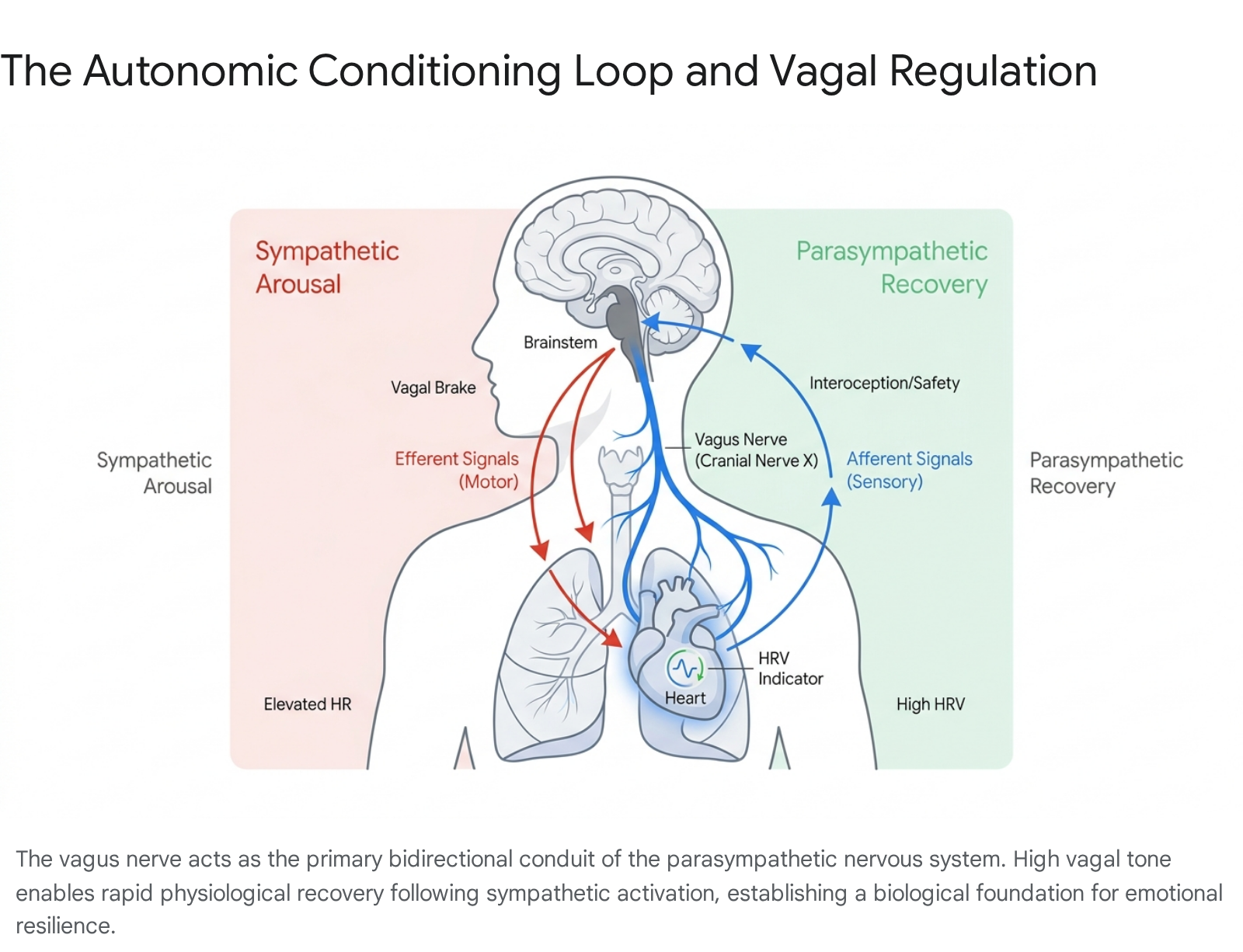
The efficiency with which this system operates is quantified as "vagal tone," typically measured non-invasively through High-Frequency Heart Rate Variability (HRV) 4118.
Vagal tone acts as a neurological brake on sympathetic (fight-or-flight) arousal. In an emotionally fit individual, the withdrawal of the vagal brake allows for a rapid sympathetic response to a stressor (adaptive arousal), followed by an equally rapid re-engagement of the vagal brake to restore homeostasis once the threat has passed 4118. Low vagal tone is highly correlated with rumination, chronic inflammation, delayed recovery from stress, and psychiatric morbidity 4041.
Conversely, high vagal tone facilitates a positive physiological feedback loop: it accelerates recovery from acute stressors, enhances executive function (including working memory and sustained attention), and promotes prosocial behaviors by signaling systemic safety to the organism 185424. Emotional fitness regimes actively condition this loop through somatic interventions. Practices such as resonance frequency breathing (breathing at specific slow rates to maximize HRV), contrast therapy (deliberate thermal exposure to cold to trigger a parasympathetic surge), and mindfulness training functionally expand the individual's "regulation bandwidth" 404118. These interventions trigger the cholinergic anti-inflammatory reflex, limiting cytokine release after psychological stress and physically fortifying the body's resilience architecture 18.
Decolonizing Emotional Fitness: Communal and Geographically Diverse Paradigms
A critical limitation in the global application of emotional fitness literature is the overwhelming individualistic bias characteristic of Western psychological models 5657. Western paradigms prioritize self-reliance, an internal locus of control, independent self-regulation, and personal accountability 145657. Consequently, when emotional failure occurs in these contexts, the burden of regulation is placed entirely on the individual's cognitive bandwidth, often overlooking structural or communal deficits 5825. However, cross-cultural psychology and ethnological data demonstrate that optimal emotional resilience is frequently a communal property, co-regulated through social harmony, shared practices, and collective environmental design 562627.
Ubuntu and the Collective Allostatic Buffer Model
In sub-Saharan African philosophy, the concept of Ubuntu translates roughly to "I am because we are," establishing that individual identity and psychological well-being are inextricably bound to the community 825. Recent developments in African-centered neuroscience (2024 - 2025) have operationalized this philosophy into the Collective Allostatic Buffer Model (CABM) 8.
The CABM elevates the concept of allostatic load (the cumulative physiological wear and tear on the body from chronic stress) from an individual metric to a collective scope 8. In high-Ubuntu cultures, emotional regulation relies heavily on the brain's Mirror Neuron System (MNS) and inter-brain neural synchrony 8. Communal rituals, shared processing of trauma, and active empathy generate a profound neurobiological buffering effect. This collective regulation coactivates serotonin, dopamine, and oxytocin pathways across multiple individuals simultaneously, accelerating trauma recovery far beyond what individual cognitive reappraisal could achieve alone 8.
The phenomenon of "biobehavioural synchrony" within Ubuntu allows individuals experiencing extreme acute stress to benefit from the physiological stability of the group. By decoupling internal distress from autonomic panic through socially supported self-regulation, the community effectively shares the metabolic cost of emotional recovery 8. Real-world applications of these principles, such as the Community-Based Social Healing (CBSH) model deployed in Rwanda, integrate breath-body-mind practices within a communal context, resulting in significant reductions in PTSD, depression, and anxiety, proving the efficacy of culturally sensitive, relational dimensions of healing 28. Longitudinal neurodevelopmental studies of resilient emotion regulation in South African cohorts further highlight that factors predicting developmental success must be culturally adapted, as individualistic resilience markers common in High-Income Countries (HICs) do not uniformly map onto populations reliant on community affiliation and spiritual connectedness 2930.
Japanese Paradigms: Gaman and Naikan Therapy
Japanese cultural frameworks provide an equally sophisticated approach to communal emotion regulation, diverging significantly from Western ideals of immediate emotional expression. The concept of Gaman, often inadequately translated as "endurance" or "perseverance," is frequently misjudged by Western psychologists as traumatic emotional suppression or silent suffering 10. However, culturally contextualized analyses reveal Gaman as a highly structured form of emotional endurance deployed in the service of social harmony (omoiyari) 10.
Gaman is not emotional neglect; it is the capacity to endure discomfort without collapsing into chaotic expression, explicitly to avoid burdening the collective 10. For instance, Western psychology historically interprets the ability to delay gratification (e.g., the Marshmallow Test) as an innate marker of individual willpower. In contrast, systems utilizing Gaman frame delayed gratification and frustration tolerance as a reflection of environmental trust and relational safety, cultivated through incremental, socially predictable challenges rather than sheer psychological force 10. In this paradigm, misbehavior is not viewed as defiance, but as a signal of missing capacity or underdeveloped frustration tolerance, requiring patient, communal instruction rather than punitive individual correction 10.
Furthermore, indigenous Japanese psychotherapeutic models, such as Naikan Therapy, emphasize structured self-reflection and deep introspection concerning one's relationships, sacrifices made by others, and obligations to the community 63132. This approach contrasts sharply with Western therapies focused on self-esteem or individual trauma processing. 2025 and 2026 psychophysiological trials investigating Naikan Therapy reveal profound biological outcomes. Following rigorous 5-day Naikan protocols, participants demonstrated massive, statistically significant increases in salivary oxytocin levels (enhancing social bonding and prosocial emotion regulation) and significant decreases in salivary cortisol (reducing stress reactivity) 63167. These findings illustrate that introspective practices prioritizing communal gratitude and relational obligation directly modulate the neuroendocrine system, securing emotional fitness through interconnectedness and altruism rather than independent ego-strengthening 3267.
Indigenous Holistic Frameworks
Similarly, First Nations and Indigenous frameworks in North America reject the fragmented view of mental health. Health is understood as an integrated web of physical, mental, spiritual, and emotional balance 33. Indigenous scholars have reinterpreted individualistic psychological models, such as Maslow's hierarchy of needs, to reflect ecological worldviews where emotional resilience is fostered through extended family networks, social connectedness, and specific cultural values like kindness, sharing, and harmony 33. In these contexts, emotional fitness is not merely an internal physiological state but an active engagement with, and regulation by, the broader social and natural environment 3334. Aligning with normative practices of one's culture fundamentally dictates the pathways to achieving positive collective identity and psychological wellbeing 273435.
Conclusion
The behavioral science of emotional fitness has decisively matured beyond simplistic self-help paradigms and purely subjective measures of happiness. Emotional fitness is a proactive, multifaceted physiological and cognitive state that rejects the suppression of negative affect and the pathologization of normal emotional variances in favor of holistic emotional containment, cognitive flexibility, and robust autonomic recovery.
While the physical fitness analogy remains a highly effective pedagogical tool for conceptualizing the pillars of resilience (strength, endurance, flexibility, recovery), it requires precise scientific qualification. Emotional fatigue does not stem from the mechanical or metabolic depletion of brain regions, but from a strategic, neurological reallocation of motivation away from effortful control. Recognizing this opportunity cost model of fatigue is paramount for developing interventions that sustain resilience through value alignment and environmental design rather than brute cognitive force.
Furthermore, optimizing the human autonomic conditioning loop through bottom-up somatic strategies (targeting vagal tone and interoception) proves just as vital as, and often prerequisite to, top-down cognitive restructuring. Ultimately, as psychological science globalizes, the integration of communal regulatory frameworks - such as Ubuntu and Naikan - is indispensable. Recognizing that the highest echelons of emotional fitness are often achieved through inter-brain synchrony, shared allostatic buffering, and prosocial obligation will define the next frontier of resilience research and global mental health intervention.