
Cross-cultural parenting styles and child outcomes
The study of parenting styles and their impact on child development has historically been dominated by Western paradigms, which prioritize individual autonomy, open communication, and psychological independence. However, as cross-cultural psychology and global educational assessments expand, it becomes evident that the definitions of a thriving child - and the parenting methods required to produce one - vary significantly across geographic and cultural contexts 12.
Through the synthesis of global academic performance metrics, psychological well-being reports, and anthropological research, a highly nuanced picture emerges. While baseline parental behaviors, such as high involvement and emotional warmth, universally benefit children, the specific manifestation of these behaviors differs radically 34. In Western contexts, optimal parenting is often equated with democratic negotiation; in East Asian contexts, it is associated with rigorous training and governance; in Latin American cultures, it is rooted in collective familial loyalty; and in Indigenous and African communities, child-rearing extends far beyond the nuclear dyad into expansive networks of community caregiving 567.
Western Parenting Paradigms
For decades, the standard vocabulary for evaluating parenting styles has been rooted in the foundational work of clinical psychologist Diana Baumrind. Developed in the 1960s, this typology remains highly influential in developmental psychology, though its universal applicability is increasingly subject to scholarly debate 13.
The Authoritative Framework
Baumrind's framework categorizes parenting based on two primary dimensions: responsiveness (warmth and support) and demandingness (behavioral and psychological control) 138. The intersection of these dimensions produces four distinct styles: authoritative (high responsiveness, high demandingness), authoritarian (low responsiveness, high demandingness), permissive (high responsiveness, low demandingness), and neglectful (low responsiveness, low demandingness) 23.
In Western, individualistic societies, the authoritative parenting style is consistently correlated with the most favorable child outcomes. Authoritative parents establish clear rules and high expectations but maintain open, democratic communication, allowing children to understand the reasoning behind rules rather than demanding blind obedience 29. Research conducted primarily on North American and European populations indicates that children raised in authoritative households exhibit higher self-esteem, superior emotional regulation, advanced social skills, and higher academic achievement compared to their peers raised in authoritarian or permissive environments 391012.
However, the assumption that authoritative parenting is universally superior has drawn substantial critique from cross-cultural psychologists. Critics argue that the framework exhibits a Eurocentric bias, inherently valuing traits like negotiation and emotional expressiveness - traits necessary for success in individualistic capitalist societies but not necessarily prioritized or adaptive in collectivistic cultures 1. Furthermore, researchers such as Wendy S. Grolnick and Catherine Lewis have cautioned against the emphasis on parental control within the authoritative model, suggesting that even firm control can undermine a child's intrinsic motivation and self-determination if not carefully calibrated to the child's specific developmental and cultural context 910.
The French Cadre System
Within the Western context, distinct regional variations exist that prioritize structure without the intense parental micromanagement sometimes seen in North American authoritative parenting. The French parenting approach, frequently characterized by the concept of le cadre (the framework), offers a distinct model that balances strict behavioral boundaries with significant child autonomy 111412.
The cadre system relies on establishing firm, non-negotiable limits - particularly regarding social etiquette, respect for adults, and family routines like mealtimes - while allowing children complete freedom to explore, play, and make decisions within those boundaries 1116. This approach minimizes power struggles by making rules objective and impersonal. Linguistically, French parents often use impersonal conjugations, such as il faut (meaning "it must be"), to convey that rules are societal axioms rather than personal dictates, reinforcing a child's understanding of structural authority 1217.
A cornerstone of the French method is the cultivation of patience and delayed gratification. Parents deliberately avoid responding instantaneously to every minor request, utilizing brief delays to help children develop frustration tolerance and emotional self-regulation 1113. This methodology aligns with longitudinal psychological research demonstrating that children capable of delaying gratification tend to exhibit higher academic performance and social resilience later in life 13. Furthermore, the French model emphasizes the preservation of the parents' individual identities and marital relationship, actively resisting the child-centeredness that dominates modern intensive parenting trends. By relying on robust childcare infrastructure and expecting children to engage in independent, unstructured play, French parents foster self-reliance in their children while mitigating parental burnout 1113.
East Asian Parenting Frameworks
When Baumrind's typologies are applied to East Asian populations, researchers repeatedly encounter a statistical anomaly: Asian parents frequently score highest on authoritarian measures (which emphasize strict control and obedience), yet their children consistently demonstrate the highest levels of academic achievement - an outcome typically associated with authoritative parenting in the West 11920. This discrepancy highlights the limitations of applying Western psychological constructs to Eastern cultural realities.
Indigenous Constructs of Training and Governance
To accurately interpret East Asian parenting, researchers must analyze indigenous cultural constructs rooted in Confucian philosophy, specifically chiao shun (training) and guan (caring or governing) 191415.
In a Western context, strict behavioral control is often correlated with parental hostility or emotional distance, negatively impacting child development 1617. In contrast, within Chinese and broader East Asian cultures, chiao shun frames strict discipline and rigorous monitoring as profound expressions of parental love and involvement 1415. The goal of this training is to socialize the child to behave in socially appropriate ways, maintain interpersonal harmony, and achieve academic success, which ultimately reflects favorably on the entire family unit 71425.
The concept of guan translates to "to govern," but in the context of parenting, it carries a positive connotation synonymous with caring for and deeply investing in a child's future. When East Asian parents employ harsh language or strict discipline, it is rarely a manifestation of rejection; rather, it indicates high expectations and parental trust that the child is capable of meeting standard behavioral and academic norms 16. Empirical studies utilizing culture-specific questionnaires reveal that while Chinese immigrant mothers score higher on authoritarian scales than European-American mothers, they also exhibit distinct patterns of continuous monitoring and care that fall outside the traditional authoritarian definition 1918. In these contexts, children do not typically feel alienated by strict discipline, as they understand it to be a culturally normative expression of parental dedication 1619.
The Paradox of Academic Performance and Well-Being
The intense focus on academic achievement within East Asian parenting frameworks produces remarkable educational outcomes, but it also reveals a complex paradox regarding student well-being when analyzed on a global scale.
Data from the Organisation for Economic Co-operation and Development (OECD) Programme for International Student Assessment (PISA) consistently shows East Asian education systems dominating global rankings. In the PISA 2022 assessment, which evaluated approximately 700,000 15-year-olds representing 29 million students across 81 countries and economies, Singapore emerged as the top performer globally in mathematics, reading, and science 202122. Singaporean students scored 575 points in mathematics, significantly ahead of the OECD average of 472 2324. Following closely were Macao (China), Chinese Taipei, Hong Kong (China), Japan, and Korea 2425.
These East Asian systems demonstrated extraordinary academic resilience. While the global educational disruptions caused by the COVID-19 pandemic resulted in an unprecedented 15-point drop in mathematics and a 10-point drop in reading across the broader OECD, systems like Japan, Korea, and Chinese Taipei maintained or improved their learning outcomes 202325.
However, the pursuit of academic excellence frequently exacts a psychological toll. Cross-national analyses of student well-being indicate that while East Asian students achieve superior academic results, they often report lower overall life satisfaction compared to their Western peers 262728. Data from UNICEF's Innocenti Report Card 19 indicates that while Japan and the Republic of Korea rank in the top tier for academic skills, they fall into the bottom third for children's mental well-being 26.
The following table summarizes the divergence between academic proficiency and child well-being across selected high-income nations, demonstrating the complex outcomes of varying cultural and educational frameworks.
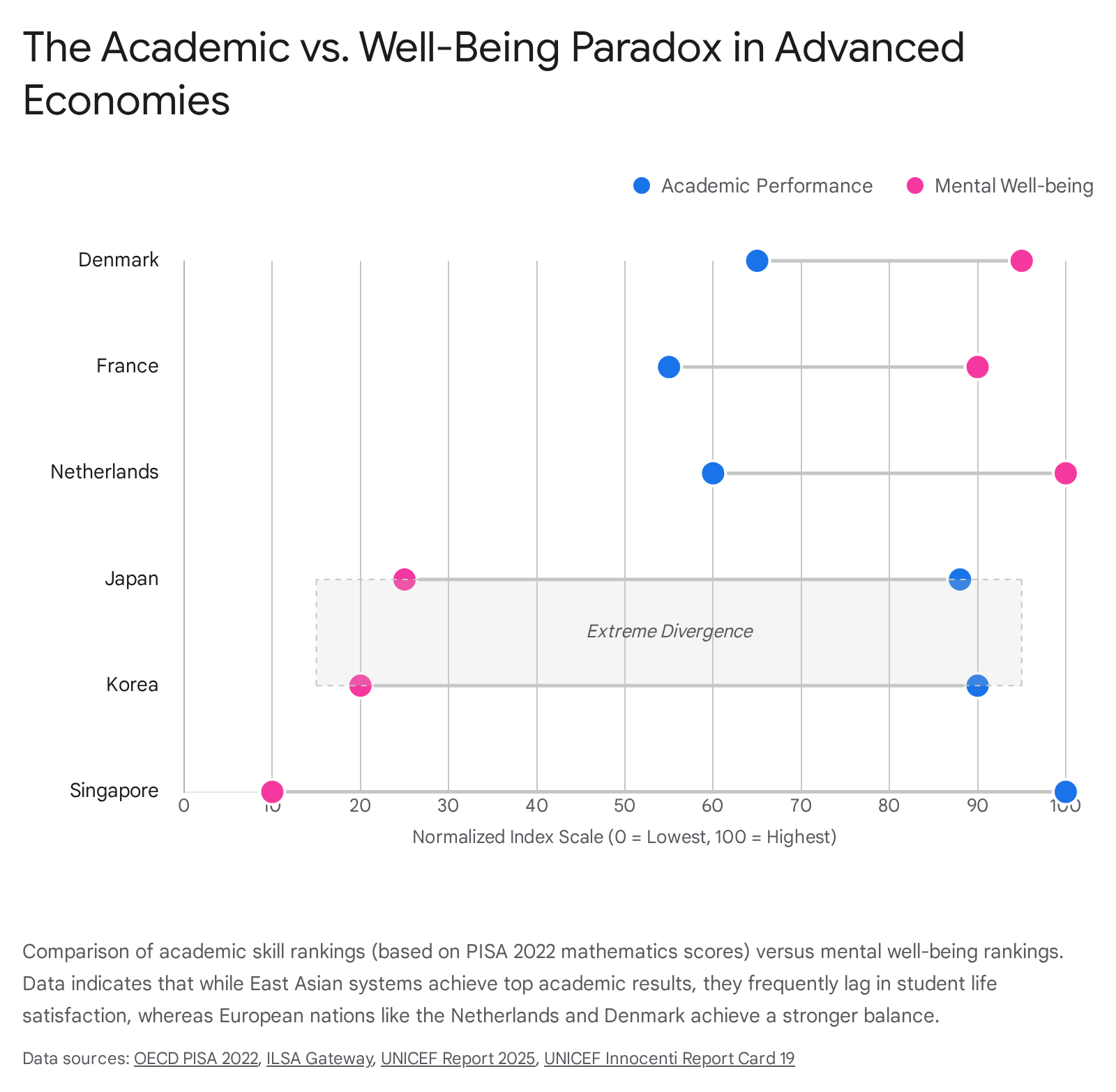
| Country / Region | Primary Parenting & Educational Focus | PISA 2022 Math Score (OECD Avg: 472) | UNICEF Report Card 19 Overall Well-Being Rank | Notable Well-Being Observations |
|---|---|---|---|---|
| Singapore | High academic rigor, Chiao Shun variants | 575 | N/A (Not ranked by UNICEF) | Highest global academic performance; rigorous training environment. |
| Japan | Academic excellence, strict social conformity | 536 | Middle-Tier | Top third for skills, but bottom third for mental health. |
| South Korea | Academic excellence, intense educational pressure | 527 | Middle-Tier | Top third for skills, but bottom third for mental health. |
| Netherlands | Authoritative, child-centered autonomy | 493 | 1st | Leads across mental health, physical health, and academic baseline. |
| Denmark | Egalitarian, democratic communication | 489 | 2nd | High life satisfaction; low academic performance drop post-COVID. |
| France | Le Cadre, delayed gratification | 474 | 3rd | Strong physical health and balanced mental well-being outcomes. |
| Bulgaria | Mixed transitional, economic inequality | 417 | Bottom-Tier | Ranks 34th in physical health; 29.2% childhood obesity rate. |
Sources: OECD PISA 2022 Volume I & II 202529; UNICEF Innocenti Report Card 19 2630.
Recent psychological research examining students in mainland China suggests the relationship between well-being and academic pressure is highly nuanced. While overall life satisfaction (hedonic well-being) may be lower, these students frequently report higher levels of "meaning in life" (eudaimonic well-being) than the OECD average 2728. This suggests that East Asian parenting and cultural paradigms successfully instill a deep sense of purpose and duty, even if momentary happiness is sacrificed in the pursuit of long-term collective success 2728.
Latin American Cultural Dynamics
In Latin American communities, both within their countries of origin and in diaspora populations, child-rearing is heavily influenced by cultural values that prioritize the collective family unit over the individual.
Dimensions of Familismo and Respeto
The foundational construct of Latin American parenting is familismo (familism), an orientation characterized by profound familial interconnectedness, intense loyalty, and a core belief that the needs of the family supersede the needs of the individual 313233. Familismo is multifaceted, encompassing structural dimensions (shared living arrangements and physical proximity), behavioral dimensions (financial support and instrumental caregiving), and attitudinal dimensions (emotional closeness and reliance on family as a primary reference group for decision-making) 3233.
Closely linked to familismo is the concept of respeto (respect), which dictates hierarchical relationships and deference to authority figures, particularly elders and parents 1617. In parenting, the combination of familismo and respeto often manifests in high levels of parental monitoring and consistent discipline. Parents actively manage their children's social environments to ensure alignment with familial goals, utilizing the extended family network to enforce rules and provide guidance 3435.
Behavioral Mechanisms and Youth Adjustment
The Behavioral Process Model of Familism suggests a specific pathway through which these cultural values translate into positive child outcomes. High parental endorsement of familismo promotes warm, supportive parenting alongside consistent monitoring. This environment fosters an internalization of familism values within the youth, which subsequently acts as a protective buffer against psychological distress and high-risk behaviors 343536.
Empirical research extensively supports the protective nature of these values, a phenomenon sometimes referred to within the United States as the "Hispanic Paradox." Under this paradox, Hispanic immigrants often exhibit better physical and mental health outcomes than their socioeconomic status would traditionally predict 3132. Adolescents who internalize familismo demonstrate lower internalizing symptoms (such as depression and anxiety), higher academic engagement, and fewer externalizing behaviors 313237. Because they view their own success as deeply tied to the family's honor and economic stability, they are motivated to achieve academically not for individual glory, but to support the collective unit 37.
Longitudinal studies tracking parenting trajectories in Mexican-origin families reveal that these cultural values remain relatively stable across different family structures, with adolescents in both intact and stepfamilies showing similar adherence to familism beliefs 36. However, the intensive obligations of familismo can occasionally present challenges. The pressure to succeed academically to elevate the family can generate significant stress, and expectations to assist with household duties, childcare, or financial contributions (often referred to as parentification) can sometimes conflict with a child's individual educational pursuits 313338.
Collective Child-Rearing Systems
While Western models emphasize the isolated parent-child dyad, African and Indigenous models of child-rearing decentralize parenting, viewing the physical, emotional, and cultural development of a child as a collective, community-wide responsibility.
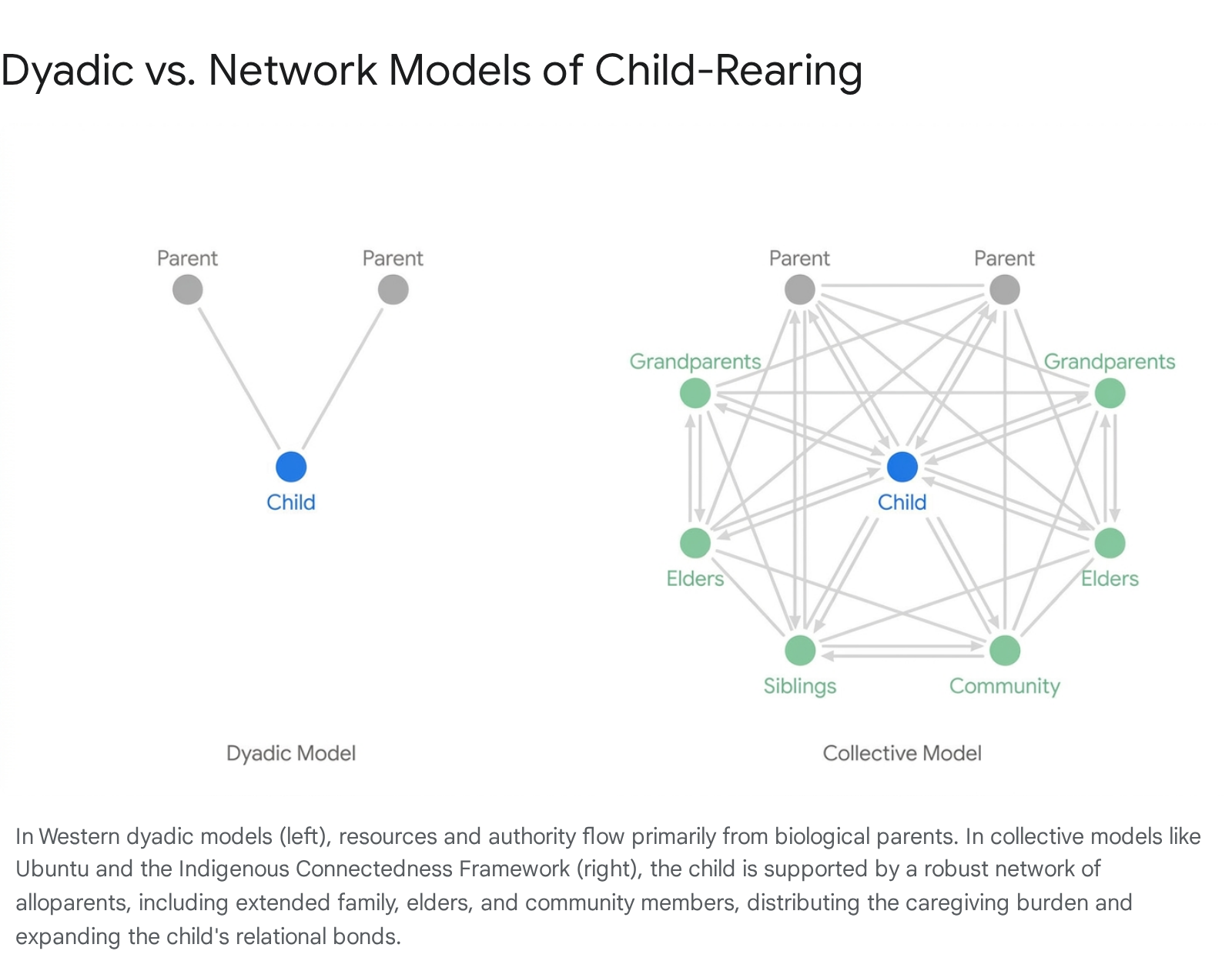
Alloparenting and Cooperative Breeding
The collective care models seen in African and Indigenous societies are supported by evolutionary anthropology through the concept of alloparenting (or cooperative breeding). Human mothers are biologically unusual among primates in their heavy reliance on non-maternal helpers (allomothers or alloparents) - including grandmothers, older siblings, and community members - to ensure the survival and development of their young 53940.
Alloparenting distributes the physical and emotional burden of child-rearing, significantly reducing maternal stress. Anthropological studies on the Aka foragers of the Central African Republic demonstrate that mothers receive substantial childcare assistance from varied sources depending on whether they reside in matrilocal or patrilocal arrangements, with this shared investment directly correlating to infant survival and health outcomes 39. Furthermore, being raised by multiple caregivers enhances a child's socio-emotional development, as they learn to navigate diverse attachment bonds, build trust across a broader social network, and develop high levels of empathy and adaptability 541.
Ubuntu Philosophy in African Contexts
In sub-Saharan Africa, parenting is inextricably linked to the philosophical concept of Ubuntu. Often translated as "I am because we are," Ubuntu signifies that a person's humanity is intrinsically dependent on their relationship with others 642.
Within an Ubuntu framework, parenting is not a private, isolated endeavor restricted to biological parents. It is a shared communal responsibility involving extended family, community elders, and neighbors 5642. The phrase "it takes a village to raise a child" is a literal operationalization of this philosophy. Under Ubuntu parenting, children are taught across three pillars: interpersonal values (regard for others), intrapersonal values (regard for self), and environmental values (regard for community) 6. Discipline and skill development are distributed across the community network; any adult has the authority and the obligation to guide, correct, and protect any child 642.
This communal approach provides children with a massive network of emotional and instrumental support, fostering a deep sense of belonging, accountability, and social cohesion 643. Researchers argue that integrating Ubuntu principles into modern child welfare and healthcare systems can mitigate contemporary child-rearing challenges, such as the isolation often experienced in nuclear or single-parent households, and can act as a countermeasure against family decay caused by rapid urbanization 424344.
The Indigenous Connectedness Framework
Similarly, Indigenous communities in North America and globally rely on highly interconnected systems of care. Developed through community-based participatory research with tribal communities, the Indigenous Connectedness Framework (ICF) conceptualizes child well-being not merely through individual developmental milestones, but through the strength of a child's connections across various ecological levels 54546.
The framework identifies five core domains of connectedness that must be nurtured to produce thriving children.
| Dimension of Connectedness | Description within Indigenous Parenting Frameworks | Protective Function for Child Outcomes |
|---|---|---|
| Family | Extending beyond the nuclear dyad to include grandmothers, aunts, uncles, and older siblings as primary caregivers. | Provides physical safety, emotional security, and distributes caregiving stress 546. |
| Community | Shared responsibility for discipline, education, and socialization by non-biologically related tribal members. | Instills social norms, accountability, and a broad safety net against isolation 547. |
| Intergenerational Ties | Transmission of tribal history, oral traditions, and language from elders to youth. | Promotes cultural identity, ethnic pride, and executive functioning skills 464748. |
| Environment / Land | Land-based learning, traditional foodways, and recognizing more-than-human relatives. | Fosters physical health, early relational wellbeing, and environmental stewardship 54647. |
| Spirituality | Participation in ceremonies, ancestral reverence, and alignment with traditional worldviews. | Anchors the child's moral framework and counters existential distress 4648. |
In Indigenous frameworks, healthy development is fundamentally relational. This deep connection to culture and ancestry is not merely decorative; empirical research demonstrates that high cultural connectedness serves as a profound protective factor for Indigenous children. It significantly improves executive functioning (EF) skills - such as working memory, cognitive flexibility, and inhibition - which are critical for academic achievement and emotional regulation 46.
Furthermore, the ICF provides a mechanism for healing from historical trauma. By framing risk factors as "disconnecting forces" - such as the forced assimilation policies of the Indian Adoption Project and the trauma inflicted by residential boarding schools, which actively sought to sever children from their language and kinship networks - the framework identifies cultural revitalization as the primary method of intervention 484950. Culturally grounded programs that emphasize intergenerational knowledge exchange and community caregiving are shown to successfully counter this historical suppression, improving both parental mental health and child outcomes 474851.
Globalization and the Evolution of Parenting
As the global economy becomes increasingly interconnected, parenting practices are undergoing rapid transformations. Demographic shifts, economic pressures, and digital technology are fundamentally altering the environments in which children are raised, prompting adaptations in parenting strategies worldwide.
The Spread of Intensive Parenting
One of the most pervasive global trends is the rise of "intensive parenting," an ideology that originated in Western middle-class contexts but has rapidly spread across high-income countries globally 526153. Intensive parenting is characterized by a time-intensive, financially draining, and hyper-child-centered approach to child-rearing 6153.
This ideology rests on several psychological dimensions: essentialism (the belief that parents, particularly mothers, have a natural and exclusive role as primary caregivers), stimulation (the drive to constantly elicit and maximize a child's cognitive development through structured activities), and child-centeredness (prioritizing the child's needs above all adult needs) 52. Driven by heightened socio-economic competition and the desire to secure a child's future in an unpredictable, cutthroat world, parents increasingly view childhood as a critical period of human capital accumulation 6154.
While intensive parenting can result in high academic achievement and enriched skill sets, it frequently exacts a severe toll on family well-being. The ideology exerts immense pressure on parents, particularly mothers, leading to high rates of parental burnout, maternal guilt, and maternal gatekeeping behaviors 5253. Macro-economic analyses suggest that the crushing financial and temporal demands of intensive parenting are negatively associated with total fertility rates in high-income nations, as parents restrict family size to concentrate resources on fewer children 61. Furthermore, for the children, excessive overparenting and relentless achievement pressure can result in heightened anxiety, diminished intrinsic motivation, and emotional burnout during adolescence 5261.
Socioeconomic Inequality and Child Outcomes
The pressures of modern parenting are vividly reflected in international child well-being metrics. UNICEF's Innocenti Report Cards 19 and 20, which examine child outcomes across 44 OECD and EU countries, demonstrate that economic inequality severely impacts child well-being, compromising hard-won progress in global health and education 265556.
Following the educational disruptions of the COVID-19 pandemic, academic skills experienced a sharp decrease globally. UNICEF estimates that across the 43 wealthiest countries, approximately 8 million 15-year-olds - roughly half of the demographic cohort - are functionally illiterate and innumerate, meaning they lack the basic skills necessary to understand simple texts or algorithms 5557.
These outcomes are deeply stratified by socioeconomic inequality. Countries with wide gaps between the rich and poor see exacerbated child deprivations. For instance, in Australia, which ranks 28th out of 40 for income inequality, 85% of children from the wealthiest quintile possess basic proficiency in reading and math, compared to only 50% from the poorest quintile 58. Physical health is similarly impacted; children growing up in the most unequal countries are 1.7 times more likely to be overweight or obese, largely due to stress, poor dietary environments, and the inaccessibility of healthy foods in lower-income brackets 2658. In countries like Bulgaria, the childhood obesity rate has climbed to nearly 29.2% 30.
Additionally, excessive use of digital technology and social media has triggered global concerns over children's mental well-being 5559. On average across the OECD, the proportion of adolescents reporting high life satisfaction dropped from 36% in 2015 to just 26% in 2022, indicating that modern socioeconomic stressors are fundamentally altering the experience of childhood 59.
Cultural Hybridization and Acculturation
In response to globalization and widespread migration, many families are engaging in "cultural hybridization," blending indigenous child-rearing practices with the norms of their host or highly globalized societies 71960.
Immigrant parents frequently navigate a complex dualism: they seek to preserve their heritage cultures - such as the discipline and academic focus of Chiao Shun or the collective loyalty of Familismo - while simultaneously adopting Western strategies that promote the individualism and assertiveness required to succeed in global market economies 41960. Research into Chinese-Canadian and Asian-American families reveals a conscious effort to synthesize the "best of both worlds." These parents often attempt to balance traditional strictness and respect for authority with more open, democratic communication styles, transitioning from authoritarian to more egalitarian family dynamics 71961.
This hybridization requires immense flexibility and can be a source of acculturative stress, as parents and children negotiate conflicting value systems 425. However, when successful, it equips children with a bicultural competence that allows them to thrive in diverse environments, possessing both the internal drive and communal discipline cultivated by traditional methods, alongside the creative autonomy and self-advocacy fostered by Western approaches 460.
Conclusion
Cross-cultural research unequivocally demonstrates that there is no single universally superior way to raise a child. Parenting strategies are highly adaptive mechanisms calibrated to the specific socio-economic, historical, and cultural realities of a given society.
The Western authoritative model effectively produces the independent, self-directed individuals required by individualistic, market-driven economies 39. The East Asian models of Chiao Shun and Guan drive unparalleled academic excellence through rigorous, highly involved training, prioritizing long-term meaning and societal contribution over momentary hedonic happiness 142728. Latin American Familismo and African and Indigenous collective care models foster deep psychological resilience and social cohesion by embedding the child within a dense, protective network of mutual obligation and alloparental support 53342.
To determine which approach "produces thriving kids," researchers and policymakers must first contextualize the metrics of thriving. If the goal is pure academic dominance, East Asian training models lead the world 23. If the goal is holistic life satisfaction and balanced psychological well-being, the structured autonomy found in Northern European and French frameworks currently yields the most consistent results 112655. Ultimately, the cross-cultural data suggests that the most successful parenting approaches are those that provide high levels of warmth, involvement, and stability - whether expressed through democratic negotiation, strict academic monitoring, or expansive community caregiving - while remaining adaptable to the evolving, unpredictable demands of the 21st century.