
Science of child motivation and reward effectiveness
The mechanisms driving human motivation during childhood represent a complex intersection of neurobiology, developmental psychology, and environmental conditioning. Historically, behavioral paradigms relied heavily on operant conditioning, utilizing extrinsic reinforcement and tangible rewards to shape child behavior, encourage compliance, and drive academic achievement. For decades, the prevailing educational and parental consensus assumed that behavior followed by a rewarding consequence would reliably increase in frequency. However, extensive longitudinal research and converging empirical evidence from cognitive neuroscience reveal a profound paradox: while external rewards can reliably compel short-term compliance, they frequently degrade a child's intrinsic drive, ultimately compromising long-term engagement, emotional resilience, and autonomous learning 123.
Understanding precisely why rewards backfire requires a granular examination of how the developing brain processes valuation, how fundamental psychological needs dictate intrinsic motivation, how environmental adversity alters neural circuitry, and how specific pedagogical contingencies alter behavioral trajectories. This analysis synthesizes neurobiological data, large-scale psychological frameworks, and cross-cultural meta-analyses to articulate the science of child motivation and identify evidence-based alternatives to traditional reward systems.
Neurobiological Foundations of Reward Processing
To understand behavioral motivation, it is necessary to examine the underlying neural architecture that computes value, predicts outcomes, and generates the physiological drive to act. Brain development in early childhood is characterized by rapid neural proliferation, with more than one million new neural connections forming every second in the first few years of life 456. This is followed by systematic synaptic pruning, which establishes the foundational limbic and cortical circuits governing attention, emotional regulation, and decision-making 45. The developing brain is shaped by the continuous interaction between genetic blueprints and environmental experiences, particularly responsive "serve and return" interactions with caregivers 56.
Dopamine Pathways and Reward Prediction Errors
At the core of motivational neuroscience is the mesolimbic dopamine system, which operates on the computational principle of reward prediction error (RPE). Formalized by classical associative learning models, such as the Rescorla-Wagner model, RPE represents the quantitative discrepancy between an expected outcome and the actual outcome experienced by the individual 78. Learning and behavioral adaptation occur primarily when outcomes deviate from expectations.
When a child experiences a better-than-expected outcome (a positive prediction error), midbrain dopaminergic neurons in regions such as the ventral tegmental area (VTA) exhibit rapid, phasic firing. This dopamine release strengthens the synaptic association between the preceding action and the reward, updating the brain's expectations and influencing future decision-making 789. Conversely, when an expected reward is omitted, a negative prediction error occurs, suppressing dopaminergic activity and weakening the behavioral association 78. Through this mechanism, the brain resolves the "credit assignment problem" - the challenge of determining exactly which action in a complex sequence is responsible for a positive outcome 10. Dopamine does not merely signal pleasure; it acts as a teaching signal that actively shapes and fine-tunes the entire behavioral structure over time 10.
Adolescent Hypersensitivity to Prediction Errors
The neural circuitry governing reward processing does not remain static throughout childhood. During adolescence, the brain undergoes distinct functional shifts that dramatically alter motivational drives. Functional magnetic resonance imaging (fMRI) studies indicate that neural prediction error signals within the striatum peak significantly during adolescence 11.
While adults show robust activation in ventral striatal regions when processing prediction errors, adolescents exhibit heightened activity in more dorsal regions of the striatum 11. This heightened dopaminergic responsivity to rewards, coupled with a prefrontal cortex that is still maturing in its capacity for cognitive control and risk assessment, explains the pronounced reward-seeking and impulsive behaviors characteristic of adolescent development 1112. The adolescent brain is highly optimized to pursue novel appetitive reinforcers, making this developmental window particularly sensitive to both the benefits of intrinsic engagement and the pitfalls of extrinsic conditioning 12.
Neural Correlates of the Overjustification Effect
The behavioral phenomenon wherein extrinsic rewards diminish preexisting intrinsic motivation is known as the overjustification effect. Initially documented in the early 1970s by researchers Lepper, Greene, and Nisbett, early studies demonstrated that nursery school children who expected a tangible reward for drawing subsequently spent significantly less free time engaging in the activity compared to children who received no reward 1314. The external reward overjustified the behavior, causing the children to attribute their engagement to the prize rather than their inherent enjoyment of the task 1315.
Advancements in functional neuroimaging have since mapped the specific neurological decay of intrinsic motivation when monetary or tangible rewards are introduced and subsequently withdrawn. A landmark neuroimaging study by Murayama et al. (2010) measured the precise neural dynamics of this undermining effect 116. During the initial phase of the experiment, when performance-based rewards were provided, participants exhibited heightened activation in the bilateral anterior striatum (specifically the caudate head) and the midbrain, regions central to the corticobasal ganglia valuation system 16.
However, once the external reward was removed in the second session, activation in these regions did not simply return to a baseline state. Instead, activation dropped significantly below the levels of control participants who had never received rewards, indicating that the brain had structurally recalibrated its valuation of the task 16. Furthermore, during the preparatory phase of the task, activation in the right lateral prefrontal cortex (LPFC) - a region associated with cognitive control and goal-directed preparation - also collapsed in the previously rewarded group 16.
By learning to expect an external cue for dopamine release, the corticobasal ganglia valuation network ceased to independently generate the motivational drive for the activity itself 116. The researchers quantified this dynamic through a "neural undermining index," demonstrating a direct negative correlation: individuals with the steepest drop in frontostriatal and LPFC activation were the least likely to voluntarily engage with the task during unrewarded free-choice periods 16. The brain had essentially learned to outsource its motivation to the external environment.
Intrinsic Motivation Through State Curiosity
Contrasting sharply with externally reinforced behavior, intrinsic motivation is heavily driven by states of curiosity. Curiosity functions as an intrinsic reward mechanism, stimulating the brain to explore novel stimuli, seek out challenges, and master skills without the promise of external compensation. The developing brain recognizes mastery, novelty, and exploration as inherently rewarding, which explains why young children can engage in sustained imaginative play without external incentives 1.
Recent fMRI research investigating 5- to 8-year-old children demonstrated that high states of curiosity significantly enhance learning efficiency and memory retention 1718. When children reported high levels of excitement and curiosity about learning new information, researchers observed greater activation across multiple interconnected neural networks. Specifically, high curiosity states were associated with increased activation in the inferior frontal gyrus, the lateral occipital cortex, the thalamus, and the putamen 171920.
Furthermore, curiosity was shown to modulate activity in the amygdala and engage dopaminergic pathways, which in turn prime the hippocampus for efficient memory encoding 171921. By simultaneously activating the brain's reward centers and fronto-parietal attention networks, curiosity enhances neuroplasticity and strengthens long-term memory via the default mode network (DMN) 2021. This neurological evidence underscores that the developing brain is intrinsically wired to seek, process, and retain information when internally stimulated, entirely independent of arbitrary external behavioral charts or point systems.
Impact of Early Life Adversity on Motivational Circuits
The trajectory of motivational brain circuitry is highly vulnerable to environmental disruptions, particularly during critical periods of early childhood. Early life stress (ELS), childhood trauma, and maltreatment can permanently alter the structural connectivity of the brain, fundamentally shifting how a child processes rewards, evaluates threats, and regulates impulses 2223.
While overt physical abuse is widely recognized for its psychological impact, child neglect is the most common form of maltreatment and exerts profound, often invisible, effects on neural development 24. A 2025 neuroimaging study utilizing diffusion tensor imaging analyzed the white matter microstructure of children who had experienced neglect without other forms of abuse. The whole-brain analysis revealed significant abnormalities in three critical communication pathways: the right corticospinal tract (governing motor skills), the right superior longitudinal fasciculus (governing attention, language, and executive functions), and the left cingulum (connecting emotional and cognitive systems for emotional regulation) 24.
These structural alterations directly correlate with severe conduct problems, behavioral difficulties, and elevated impulsivity 2425. In environments characterized by neglect or abuse, the brain adapts by prioritizing vigilance to threat over long-term goal planning. This survival adaptation alters the connectivity between the amygdala (fear processing) and the prefrontal cortex (emotion regulation), resulting in heightened avoidance motivation and a reduced capacity to engage in intrinsically motivated, exploratory learning 222526. Children with these altered neural systems are highly susceptible to the cycle of victimization and often struggle to form secure peer relationships, necessitating trauma-informed approaches to behavioral management rather than punitive or highly transactional reward systems 27.
Psychological Frameworks: Self-Determination Theory
The neurobiological mechanisms of reward processing and curiosity integrate seamlessly with established psychological models of human behavior, most notably Self-Determination Theory (SDT). Developed in the 1970s and 1980s by Richard Ryan and Edward Deci, SDT initiated a "Copernican turn" in the field of psychology by moving away from behaviorist models that viewed human beings as passive entities solely shaped by external reinforcements 328. Instead, SDT is an organismic framework postulating that individuals possess an inherent, proactive propensity toward psychological growth, integration, and mastery 329.
However, SDT emphasizes that these proactive tendencies are not automatic; they require highly specific supportive conditions to robustly unfold. Central to SDT is Basic Psychological Needs Theory, which argues that human flourishing, intrinsic motivation, and wellness depend entirely on the satisfaction of three universal psychological needs 3282930:
- Autonomy: The need to feel a sense of volition, willingness, and ownership over one's actions. Autonomy is supported when children perceive that their behaviors align with their own interests and values, and that they have a voice in their learning process. It is systematically thwarted when children feel controlled, coerced, or compelled by external pressures, punishments, or contingent rewards 3283031.
- Competence: The psychological need to feel effective, capable, and successful in navigating challenges. Competence thrives in well-structured environments that provide optimal challenges aligned with the child's developmental stage, along with informative, non-evaluative feedback that scaffolds their growth 3283031.
- Relatedness: The fundamental need for social connection, belonging, and secure attachment. Relatedness is fostered when caregivers and educators convey genuine respect, caring, and emotional attunement, allowing the child to feel safe and valued within their social environment 3283031.
When educational or familial environments successfully satisfy these three needs, children exhibit robust intrinsic motivation, engage in deeper conceptual learning, and demonstrate greater emotional well-being 332. Conversely, environments that rely heavily on behavioral control to enforce compliance systematically thwart the need for autonomy, leading to amotivation, increased psychological distress, and superficial rote learning 3.
Organismic Integration Theory and the Motivation Continuum
A common misconception regarding motivation is that it exists as a strict dichotomy between intrinsic and extrinsic states. Organismic Integration Theory (OIT), a sub-theory of SDT, provides a more nuanced framework, classifying extrinsic motivation along a continuum based on the degree to which a behavior has been internalized by the individual 29. Children frequently must perform tasks that are not inherently enjoyable (e.g., household chores, rote academic drills). OIT explains how these behaviors can still be executed with varying degrees of autonomy.
| Regulatory Style | Locus of Causality | Description of Motivational State | Psychological Impact |
|---|---|---|---|
| External Regulation | Purely External | Behavior is performed strictly to satisfy an external demand, obtain a tangible reward, or avoid a punishment. | Highly controlled; compliance ceases immediately when the contingency is removed. Associated with anxiety and low well-being 2933. |
| Introjected Regulation | Somewhat External | Behavior is driven by internal pressures, such as avoiding guilt/shame or seeking ego-enhancement and pride. | Moderately controlled; the child acts to protect their self-esteem but does not fully endorse the value of the action 293334. |
| Identified Regulation | Somewhat Internal | The child consciously values the behavioral goal and accepts the action as personally important, even if the task is not fun. | Moderately autonomous; the child takes ownership of the action because they understand its utility 293334. |
| Integrated Regulation | Internal | The behavior is fully assimilated into the child's core values and identity. | Highly autonomous; similar to intrinsic motivation, yielding positive emotional experiences and lasting engagement 293334. |
The objective of optimal parenting and education is not to eliminate all extrinsic motivation, but to facilitate the internalization process, moving a child from external regulation toward identified and integrated regulation 2934. This internalization occurs most effectively in autonomy-supportive environments that provide meaningful rationales for tasks rather than relying on arbitrary bribes.
Cognitive Evaluation Theory
Another critical component of SDT is Cognitive Evaluation Theory (CET), which explicitly addresses how external events - like rewards, evaluations, surveillance, and deadlines - affect intrinsic motivation. CET asserts that every reward contains two distinct psychological components: a controlling aspect and an informational aspect 35.
If a reward is administered in a manner that the child perceives primarily as a mechanism of behavioral control (e.g., "If you sit quietly for an hour, you will earn ten minutes of screen time"), it shifts the child's perceived locus of causality from internal to external. This directly undermines the psychological need for autonomy, thereby destroying intrinsic motivation. Conversely, if a reward or feedback is perceived as informational (e.g., descriptive praise that affirms the child's competence without attempting to dictate future behavior), it can maintain or even enhance intrinsic motivation by satisfying the need for competence 35. Because tangible rewards (money, toys, privileges) are most frequently utilized specifically to compel a child to perform an action they otherwise would resist, they are overwhelmingly experienced as controlling mechanisms, triggering the undermining effect 35.
The Meta-Analytic Debate on Extrinsic Rewards
The theoretical predictions of Cognitive Evaluation Theory have been subjected to rigorous empirical testing, resulting in decades of highly contentious debate regarding the true impact of extrinsic rewards on behavior and learning.
In the late 1990s, behaviorist-leaning researchers, notably Cameron and Pierce, published meta-analyses challenging the overjustification hypothesis. They argued that the negative effects of rewards were limited, highly situational, and easily prevented in applied settings 353637. They concluded that extrinsic rewards could be used effectively to maintain student motivation and academic achievement without severe detrimental effects to intrinsic drive 37.
In direct response to these claims, Deci, Koestner, and Ryan (1999) conducted a highly comprehensive and statistically rigorous meta-analysis of 128 experiments to rectify methodological concerns in previous reviews. Their findings provided sweeping empirical support for Cognitive Evaluation Theory, demonstrating that expected tangible rewards have pervasive, substantial, and highly reliable undermining effects on intrinsic motivation 353536.
More recently, a definitive 2022 meta-analysis by Lehtivuori re-examined the extrinsic reward literature, synthesizing decades of laboratory and organizational data 2. The analysis confirmed that the undermining effect is not a myth; however, its severity is highly dependent on the exact contingency of the reward - specifically, what the child is required to do to receive the payout.
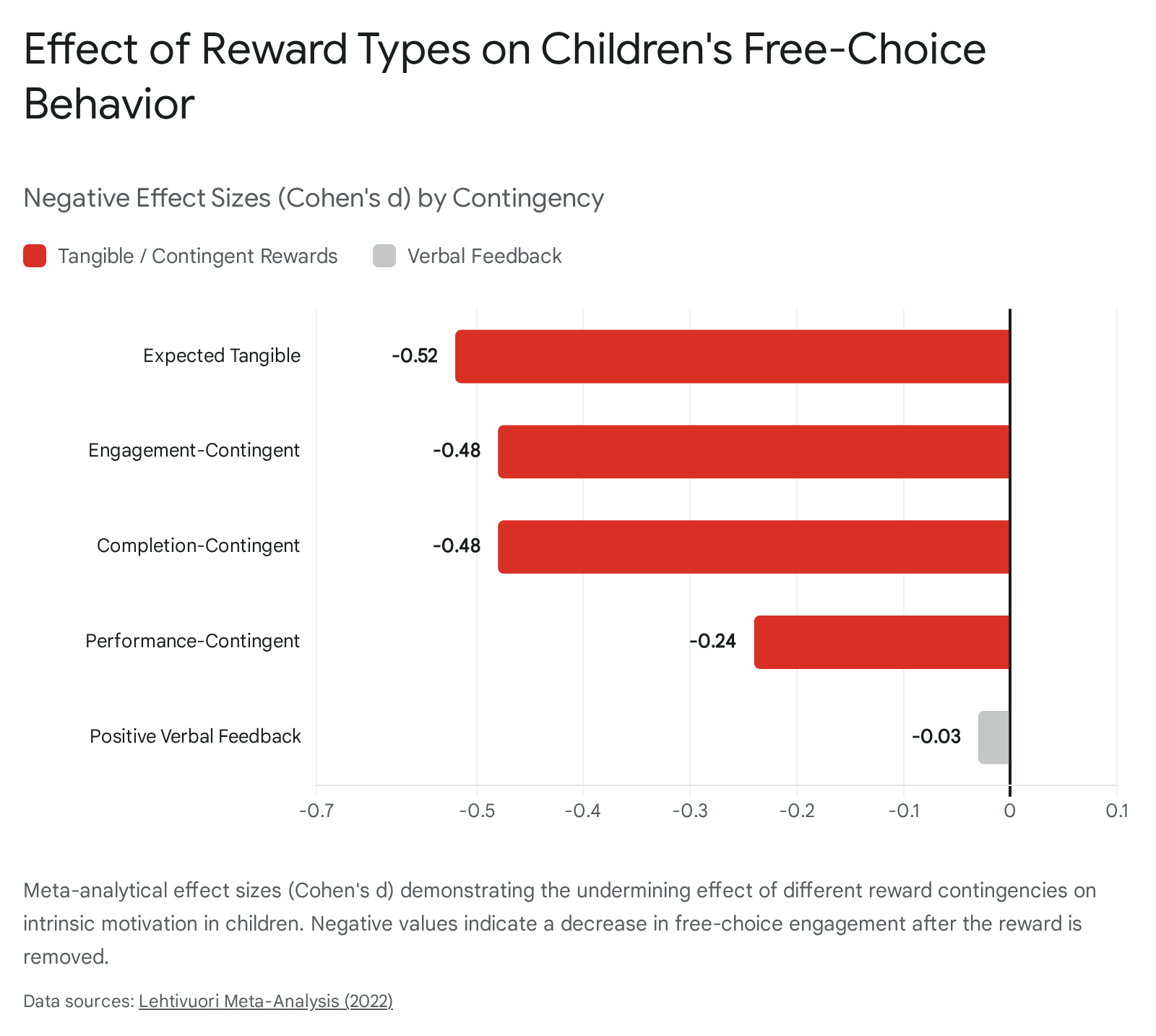
The data from the 2022 meta-analysis clearly indicates that when tangible rewards are expected beforehand and tied to either task engagement or task completion, children reliably reduce their spontaneous, free-choice engagement with the task once the reward system is removed 2. By contrast, unexpected tangible rewards - those given after the fact with no prior promise - do not significantly undermine intrinsic motivation, as they are less likely to be perceived by the child as the controlling reason for performing the task 35. Ultimately, continuous reliance on expected rewards may successfully "get students in the door," but it invariably teaches the child to associate the learning activity strictly with the extrinsic payoff, collapsing their natural interest in the subject matter itself 38.
Language as a Motivational Modulator: Praise Paradigms
While positive verbal feedback generally avoids the severe undermining effects associated with tangible rewards, the specific linguistic structure of the praise dramatically alters a child's psychological resilience and ongoing motivation. Research pioneered by developmental psychologist Carol Dweck distinguishes between two primary categories of verbal reinforcement: "person praise" and "process praise" 403940.
| Praise Paradigm | Focus of Feedback | Implicit Message to Child | Resulting Psychological Mindset | Behavioral Response to Setbacks |
|---|---|---|---|---|
| Person Praise (e.g., "You are so smart," "You are a natural artist") | Fixed, innate traits and global intelligence. | Success is determined by genetic gifts that cannot be controlled or altered 4040. | Fixed Mindset (Entity Theory) 4341. | Avoids challenges to protect their "smart" label. Interprets failure as proof of incompetence. Exhibits helpless responses and self-doubt 404043. |
| Process Praise (e.g., "You worked incredibly hard," "I like the strategy you used") | Effort, persistence, strategy, and strategic choices. | Success is the result of intentional effort, practice, and controllable actions 4039. | Growth Mindset (Incremental Theory) 4341. | Embraces difficult challenges. Interprets failure as an opportunity to learn. Demonstrates high resilience and problem-solving adaptability 404043. |
Although parents and educators often utilize person praise with the intention of boosting a child's global self-esteem, clinical studies demonstrate that praising intelligence actually makes children more risk-averse 4041. In laboratory settings, children who received intelligence-based praise were significantly more likely to choose easier subsequent tasks to avoid failure and maintain their positive label. Conversely, children praised for their effort were far more willing to take on highly challenging tasks, demonstrating a love for learning independent of immediate success 4039.
Meta-analytical data confirms that shifting the ratio of verbal feedback heavily toward process praise encourages children to adopt an incremental framework regarding their own abilities. This focus on process supports the psychological need for competence by highlighting actionable strategies for improvement, ensuring the child does not tie their core self-worth entirely to external evaluations 394043.
Application in Neurodivergent Populations
While the detrimental effects of controlling rewards and person praise are well-documented in neurotypical development, the application of behavioral contingencies requires nuanced recalibration for neurodivergent children, particularly those diagnosed with Attention-Deficit/Hyperactivity Disorder (ADHD) and Autism Spectrum Disorder (ASD).
Atypical Reward Circuitry in Autism and ADHD
Neuroimaging studies reveal distinct structural and functional differences in the reward networks of children with ASD and ADHD, necessitating different pedagogical approaches. In individuals with ADHD, researchers frequently observe ventral striatum hyporesponsiveness. This manifests behaviorally as an atypical sensitivity to delayed rewards; the ADHD brain requires immediate, high-frequency dopamine stimulation to sustain attention on non-preferred tasks 12424344. This biological reality dictates that children with ADHD are not exhibiting a "lack of willpower" or intentional defiance when they fail to persist on unrewarded tasks. Rather, their neural architecture requires immediate external feedback to bridge inherent deficits in executive functioning 4344.
Similarly, neuroimaging of children with ASD demonstrates reduced activation in the ventral striatum and attenuated ventromedial prefrontal cortex responses to specific social stimuli 4245. The "social motivation hypothesis" suggests that from early development, children with ASD may not perceive standard social cues - such as a caregiver's smile, eye contact, or generalized verbal praise - as inherently rewarding 424345. Consequently, relying solely on intrinsic social motivation is often insufficient for early skill acquisition in this population.
Scaffolding and Fading Reinforcement Protocols
Because of these documented neurological differences, immediate extrinsic rewards - often structured as "token economies," sticker charts, or highly structured behavior plans - are highly effective and frequently necessary initial clinical interventions for neurodivergent populations 444647. In specialized educational settings and Applied Behavior Analysis (ABA), customized reward systems utilizing tangible tokens, sensory-friendly items, or hyper-focused special interests serve as critical behavioral scaffolding. They provide the immediate neurological feedback required to initiate communication skills, emotional regulation, and functional daily living behaviors 475152.
However, the scientific consensus within behavioral psychology dictates that these extrinsic systems must operate as temporary developmental bridges rather than permanent behavioral crutches. Relying indefinitely on token economies risks creating severe prompt dependency, wherein the child will only execute the desired behavior when the specific reward is visible or guaranteed 5348.
To mitigate this risk, clinicians must employ rigorous reinforcement fading protocols. Fading involves the systematic and highly structured reduction of external support, deliberately transferring behavioral control from the artificial reward to natural environmental cues and intrinsic satisfaction 5348.
| Fading Protocol | Clinical Mechanism | Application Example |
|---|---|---|
| Schedule Thinning | Transitioning from a continuous reinforcement schedule (rewarding every instance of behavior) to an intermittent or variable schedule. | Initially giving a token for every math problem completed, then shifting to one token for every three problems, and eventually rewarding only the completion of the entire worksheet 5349. |
| Time Delay Strategies | Progressively increasing the duration the child must wait between demonstrating the correct response and receiving the reinforcer. | A child learning impulse control is asked to wait 5 seconds before receiving a preferred item. This delay is systematically increased to minutes, building distress tolerance 5356. |
| Stimulus Fading | Gradually altering or removing the physical or visual prompts associated with the reward system until the child responds to natural cues. | A visual cue card reminding a child to raise their hand is slowly moved further away across sessions, or made lighter in color, until the child raises their hand independently 5348. |
The ultimate clinical objective of these fading protocols is to successfully transition the neurodivergent child from relying on arbitrary extrinsic rewards to responding to natural social reinforcement or their own intrinsic satisfaction, thereby ensuring the long-term maintenance and generalization of the acquired skills 534950.
Cross-Cultural Variances in Motivation and Autonomy
A frequent academic critique of Self-Determination Theory is the assertion that its foundational emphasis on "autonomy" reflects a distinctly Western, individualistic bias. Critics argue that the theory may not accurately apply to children raised in Eastern, collectivist cultures, which historically prioritize interdependence, familial obligation, group harmony, and hierarchical respect over individual self-expression 5152536154.
Universality Versus Cultural Specificity
To address this debate, recent large-scale, cross-cultural studies have robustly tested the universality of the basic psychological needs. Analyzing comprehensive data from the Program for International Student Assessment (PISA), which encompassed 92,325 students across 11 Eastern and Western societies (including the US, UK, Japan, Shanghai, and South Korea), researchers utilized multi-group structural equation modeling to evaluate the cross-cultural impact of autonomy, competence, and relatedness on student achievement 545564.
The findings provided sweeping empirical support for the universality of SDT. Across all cultural contexts, the provision of autonomy support and relatedness were equally strong predictors of student achievement, engagement, and psychological well-being 5564. When parents or educators provided autonomy support - defined clinically as acknowledging the child's perspective, providing meaningful rationales for requests, and allowing volitional choice - students demonstrated significantly lower psychological distress regardless of their nation's baseline individualism or collectivism 556456.
However, the PISA study did identify specific cultural variations that moderate motivation: the need for competence support was found to exert a stronger statistical influence on academic achievement in Western students than in Eastern students, highlighting specific areas where motivational variables are subject to cultural nuance 5564.
Moderating Variables in Parenting Practices
To reconcile the apparent tension between the universal need for autonomy and the realities of cultural hierarchy, developmental scientists draw a critical distinction between two distinct forms of autonomy promotion: the promotion of independence (encouraging a child to act separately and self-reliantly) versus the promotion of volitional functioning (encouraging a child to act willingly and authentically, even when complying with group norms) 5767.
A comprehensive 2024 meta-analysis encompassing data from 53 countries demonstrated that the psychological benefits of promoting volitional functioning are universally positive. However, the benefits of promoting independence vary significantly based on a nation's "power distance" - the degree to which hierarchical inequality and strict authority are accepted within the society. In cultures with high power distance, forcefully promoting independent separation from the family yields weaker psychological benefits, and can sometimes induce conflict. Yet, supporting the child's internal volition and giving them a sense of willingness remains universally protective against internalizing and externalizing problem behaviors 5667.
Conversely, parental psychological control - the practice of using guilt, love withdrawal, or emotional coercion to dictate a child's behavior - correlates universally with child ill-being, elevated depressive symptoms, and anxiety across all measured cultures, regardless of collectivist traditions 5658.
Pedagogical and Behavioral Alternatives to Rewards
Given the robust neurobiological and psychological evidence that arbitrary tangible rewards systematically erode intrinsic motivation, and that autonomy support universally fosters resilience, practical applications in pedagogy and parenting must shift away from transactional behaviorism.
Re-evaluating Behavior Modification Charts
Traditional behavior modification systems - such as public sticker charts, color-coded clip charts, and classroom token jars - are highly prevalent tools used to manage childhood behavior. While these systems are undeniably effective at producing short-term obedience, they structurally suffer from several severe developmental limitations 697071.
First, they rely entirely on external motivation, teaching children to evaluate their own behavior through a purely transactional lens ("What do I get for doing this?") rather than developing empathy, ethical reasoning, or an understanding of community impact 6970. Second, these systems do not teach the underlying skills of self-regulation; they demand outward performance without addressing the emotional dysregulation, sensory overload, or skill deficits that actually cause the misbehavior 6971. Finally, public behavior charts risk inducing chronic shame. A child who struggles to regulate themselves may be permanently labeled as the "bad kid" on the red setting of a clip chart, fracturing the relational trust required for genuine behavioral intervention and exacerbating negative conduct 7071.
Evidence-Based Autonomy-Supportive Interventions
To cultivate lasting intrinsic motivation and healthy psychological development, practitioners and caregivers are advised to abandon arbitrary reward charts in favor of autonomy-supportive interventions that align with the three pillars of Self-Determination Theory 69725974:
- Fostering Autonomy Through Choice: Instead of issuing rigid directives backed by the threat of punishment or the promise of a reward, providing structured, age-appropriate choices allows children to exercise executive control. Allowing a child to sequence their own routines (e.g., "Would you prefer to clean up your blocks now or after your snack?") fulfills the biological need for autonomy while maintaining necessary adult boundaries 697475.
- Replacing Punishments with Natural Consequences: Rather than imposing arbitrary punishments or withdrawing prizes, allowing children to experience the safe, logical consequences of their actions builds functional cause-and-effect reasoning. If a child refuses to wear a jacket, feeling cold teaches the utility of the jacket far better than a verbal reprimand. This shifts the regulatory burden from the adult enforcer to the physical or social environment 695974.
- Utilizing Descriptive Encouragement: Shifting away from evaluative person praise ("You are such a good boy") toward descriptive encouragement ("I noticed you shared your toys even though you were still playing with them"). This builds the child's sense of competence by highlighting specific successful strategies, fostering a growth mindset without tethering the child to a constant need for external validation 697274.
- Prioritizing Relational Safety: Recognizing that misbehavior often signals unmet physiological needs or a dysregulated nervous system. Addressing the emotional state through calm co-regulation and connection satisfies the psychological need for relatedness. A child who feels emotionally safe and securely attached is far more capable of behavioral compliance, academic risk-taking, and intrinsically motivated learning 7071.
The science of motivation indicates that while extrinsic rewards provide an immediate, predictable neurological surge capable of compelling short-term behavior, they structurally bypass and subsequently weaken the brain's internal mechanisms for valuing tasks. Except in specific therapeutic scaffolding contexts for neurodivergent populations where baseline limbic functions require temporary external bridging, the reliance on transactional rewards degrades the human capacity for autonomous growth. Nurturing authentic intrinsic motivation requires the systematic abandonment of control-based behavioral charts in favor of environments that fulfill the fundamental psychological requirements of autonomy, competence, and relational safety.