
How the Quantum Zeno Effect Works
The quantum Zeno effect is a verified phenomenon in quantum mechanics where the continuous observation or measurement of a fragile quantum system effectively prevents it from changing its state. By repeatedly forcing a particle to "choose" a definitive reality before it has the time to naturally evolve, the system becomes caught in a loop of resets and remains frozen in its initial condition. Today, this counterintuitive rule of physics has transitioned from a philosophical paradox into an essential engineering tool, used to stabilize qubits in modern quantum computers and push atomic sensors past classical limits.
Zeno's arrow and the classical illusions of time
To understand how observation can freeze time for a subatomic particle, it is helpful to look back at the origins of the concept. In the fifth century BCE, the Greek philosopher Zeno of Elea proposed a series of thought experiments designed to prove that the concept of motion is a fundamental illusion 12. The most famous of these is the arrow paradox.
Zeno argued that if you look at an arrow flying through the air at any instantaneous, infinitely thin snapshot in time, the arrow occupies a specific point in space. During that exact frozen instant, the arrow does not travel any distance 212. If time is entirely composed of an infinite number of these motionless snapshots, he reasoned, then the arrow is mathematically at rest during its entire flight 123. According to Zeno's logic, a moving arrow is actually always at rest.
Thousands of years later, the mathematical development of calculus essentially solved Zeno's classical paradox by proving that an infinite sum of vanishingly small distances and time intervals can equal a finite, smooth progression of distance 267. In the macroscopic world of classical physics, a watched arrow moves through the air in exactly the same way as an unwatched one 23.
This classical reality also applies to everyday objects. A popular adage suggests that "a watched pot never boils," referring to the psychological illusion that time seems to drag when we are eagerly anticipating an event 28. In classical mechanics, applying heat to a pot of water will cause the molecules to gain kinetic energy and eventually boil at the exact same rate regardless of whether a human is staring at it 24.
However, in the bizarre realm of quantum mechanics, the rules of classical physics break down entirely. When dealing with unstable subatomic particles, electrons, and photons, the "watched pot" truly does not boil. The simple act of observing a quantum system fundamentally interrupts its ability to evolve 810.
The mechanics of freezing quantum reality
The concept that measurement dictates reality is foundational to quantum mechanics. However, the specific phenomenon of observation freezing a system in place was first hinted at in 1954 by the brilliant mathematician Alan Turing in a private letter to his colleague Robin Gandy 512. Turing noted a strange paradox hidden in the mathematics of quantum theory: it seemed that frequent measurements could artificially slow down a system's evolution 12.
It was not until 1977 that physicists Baidyanath Misra and E. C. George Sudarshan published a landmark paper that rigorously formalized this concept 1614. Drawing a direct analogy to the ancient Greek philosopher, they named the phenomenon the "quantum Zeno's paradox" 17. They proved mathematically that an unstable particle, which would normally decay in a fraction of a second, could be completely prevented from decaying if it were measured continuously 1168.
To understand how this is physically possible, we have to look at how quantum systems evolve and how the act of measurement actively disrupts them.
Superpositions and the wave function
In the macroscopic world, an object exists in a definitive state. A coin on a table is either showing heads or tails. But before a quantum system is measured, it exists in a state of probability known as a superposition 3189.
Imagine an electron inside a box. If we leave it entirely undisturbed, the electron does not sit in one specific location or possess one specific energy level. Instead, its behavior is governed by the Schrödinger equation, which describes the electron as a wave function - a mathematical landscape of probabilities 3510. The electron exists as a blurry cloud of potential, simultaneously occupying multiple possible states 69.
If the system is an unstable radioactive atom, it exists in a superposition of being both "decayed" and "undecayed" simultaneously 616. Over time, if left completely isolated, the wave function evolves. The probability of finding the atom in the "undecayed" state smoothly decreases, while the probability of finding it in the "decayed" state smoothly increases 716.
The reduction postulate and the measurement interaction
The smooth evolution of the wave function only continues as long as the system remains perfectly isolated. When an external observer makes a measurement to check the status of the particle, the system is forced to interact with the macroscopic world 359.
This interaction triggers what early quantum pioneer John von Neumann called the "reduction postulate," more commonly known as wave function collapse 1711. The instant the system is measured, the blurry cloud of superposition vanishes. The universe forces the particle to definitively "choose" one reality, dropping into a specific, measurable state with probabilities dictated by a mathematical rule known as the Born rule 185.
Crucially, in quantum mechanics, measurement is not a passive act of observation. It is an aggressive, physical intervention. You cannot look at a quantum system without knocking it out of its delicate superposition and resetting its state 3109.
The quadratic time trick
The true secret to the quantum Zeno effect lies in how a quantum system behaves in the very first fractions of a nanosecond after it has been measured and reset 214.
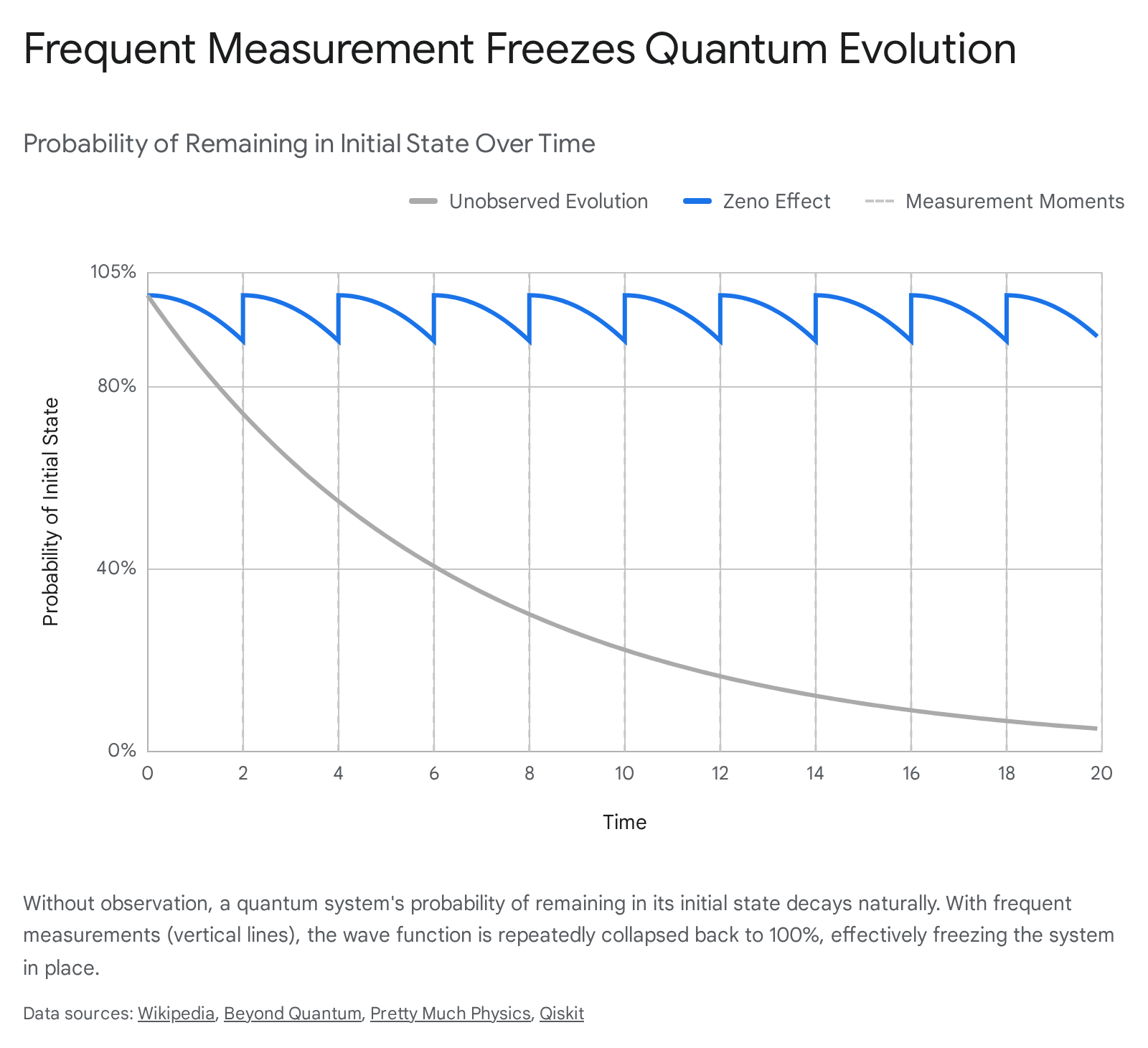
When a particle is definitively measured to be in its initial state (for example, "undecayed"), its wave function collapses to 100% certainty in that state 110. The moment the measurement ends, the clock restarts, and the wave function begins to evolve toward the "decayed" state once again 710.
If you look at the decay of a large bulk of radioactive material over a long period, the decay follows a smooth exponential curve - like a sliding board sloping downward 1711. However, if you look at the evolution of a single quantum system over an infinitesimally short period of time, the mathematics look very different. By performing a Taylor expansion of the Schrödinger equation around the exact moment of the start time ($t=0$), physicists discovered a universal phenomenon: for a very brief window, the system's probability of changing states does not drop linearly or exponentially 610. Instead, it drops quadratically 1412.
In plain language, a quadratic change means that the system is incredibly sluggish to start moving. The probability of the particle remaining in its initial state stays almost perfectly flat at 100% for a tiny fraction of a second before it begins to meaningfully curve downward toward decay 212.
If an observer applies a second measurement while the system is still in this sluggish, flat quadratic window, the wave function collapses again. Because the probability of the particle having changed states is still vanishingly small, it almost certainly collapses right back into its exact starting state 310.
Once collapsed, the system is completely reset. The evolutionary clock returns to zero 3810.
If the observer measures the system a third time, a fourth time, and a thousandth time, all within these tiny quadratic windows, the system is locked in an infinite loop of resets 10910. It never has enough uninterrupted time to build up the momentum to leave its initial state. The quantum Zeno effect effectively halts the system's evolution simply by resetting its reality faster than it is naturally capable of changing 1323.
The Quantum Anti-Zeno Effect: When watching speeds things up
If staring intensely at a quantum system can freeze its evolution, a natural question arises: could watching it actually force it to decay faster? In 1997, physicists A. G. Kofman and G. Kurizki proposed that in certain contexts, frequent measurements could indeed accelerate the evolution of a quantum system 612. This phenomenon is known as the quantum anti-Zeno effect 4612.
The difference between the Zeno and anti-Zeno effects comes down to the precise frequency of the measurements and the nature of the chaotic environment surrounding the quantum system 41124.
When an unstable particle decays, it does so by shedding energy into its surrounding environment. The environment possesses a specific "spectral density" - a unique spectrum of vibrational frequencies that it is capable of absorbing 24. For the particle to successfully decay, its own energy fluctuations must perfectly overlap and resonate with the frequencies of the environment 611.
If a measurement is performed at an extremely rapid interval, it dominates the system, repeatedly collapsing the wave function and triggering the freezing Zeno effect 11. However, if the measurements are applied at a slightly slower interval - falling outside the "Zeno time" threshold but still occurring frequently - the measurements inject energy and uncertainty into the system without fully locking it down 611.
This measurement-induced disruption actively broadens the particle's energy spectrum 11. By widening its spectral line, the particle suddenly finds it much easier to match the frequencies of the surrounding environment 11. The measurement essentially rips open new energetic pathways, allowing the particle to shed its energy and transition to a new state much faster than it would if it had been left completely unobserved 611.
Comparing the two regimes
Today, physicists view both phenomena not as contradictory paradoxes, but as two distinct regimes of a unified effect. They occur whenever a non-commuting "measurement-like" interaction competes with a system's natural evolution 711.
| Feature | Quantum Zeno Effect (QZE) | Quantum Anti-Zeno Effect (AZE) |
|---|---|---|
| Core Phenomenon | Suppresses or freezes the natural evolution of a quantum state 111. | Enhances the decay or state mixing caused by measurement 1112. |
| Dynamics Regime | Overdamped: Evolution is characterized by suppressed exponential decay or rare "telegraphic" jumps between states 11. | Underdamped: Evolution is characterized by damped oscillations or increased transition rates 11. |
| Measurement Rate | Extremely rapid; the measurement rate heavily dominates the unitary oscillation frequency 11. | Slower; the measurement rate precedes the Zeno regime and allows for spectral overlap 611. |
| Physical Mechanism | Continuous wave function collapse strictly "resets" the system before it can evolve out of the quadratic phase 310. | Measurement-induced dephasing broadens the system's energy spectrum, enabling faster transfer to a detuned environment 11. |
| Classic Example | Preventing a trapped beryllium ion from jumping to a different energy level using lasers 1925. | Accelerating the decay of an unstable radioactive particle or enhancing the loss of a tunneling atom 1611. |
Depending on the spectral density of the environment (whether it is a sub-Ohmic or super-Ohmic environment) and the transition frequency of the system, a single physical setup can sometimes display both Zeno and anti-Zeno dynamics simply by tweaking how fast the measurement pulses are fired 424.
From philosophy to the laboratory: Proving the effect
For over a decade after Misra and Sudarshan published their 1977 theory, the quantum Zeno effect remained a fascinating piece of mathematics trapped on blackboards. Proving it in the real world was immensely difficult because it required isolating fragile quantum systems from the messy, warm environment of the macroscopic world, and then probing them with unprecedented speed and precision 17.
The most famous experimental proof arrived in 1990, led by physicist Wayne Itano and his colleagues at the National Institute of Standards and Technology (NIST) 110925.
The NIST team utilized a device called a Penning trap to suspend approximately 5,000 beryllium ions in a vacuum using electric and magnetic fields. Left to their own devices under the influence of a steady, continuous radio frequency drive, the beryllium ions would smoothly and predictably transition from a low-energy ground state to a higher-energy state 25.
To apply a "measurement," the NIST team fired ultra-short pulses of a resonant ultraviolet laser at the trapped ions. If an ion was still sitting in the ground state, it would absorb the laser light and immediately scatter photons, creating a bright flash of fluorescence that the scientists could detect. If the ion had already moved to the higher energy state, it would not interact with the laser and would remain dark .
To visualize this laboratory setup, imagine an ion suspended in a magnetic trap. A continuous radio frequency drive smoothly pushes the ion to transition between a lower and a higher energy level. However, a bright ultraviolet laser beam periodically strikes the lower energy level. If the ion is still there, it scatters photons in a burst of fluorescence, effectively halting the transition and resetting the wave function back to the starting line. The researchers discovered that if they applied the radio waves but interrupted them with frequent laser pulses, the ions never transitioned to the higher energy state. By executing a sequence of 64 incredibly rapid laser measurements, the team almost entirely froze the beryllium ions in their starting state, providing the first tangible evidence that observation could stop time at the atomic level 25.
The optical pumping controversy
While the 1990 NIST experiment made global headlines and cemented the Zeno effect in the public consciousness, it also sparked a fierce and highly technical academic debate 271314.
Critics argued that Itano's team had not proven the "true" quantum Zeno effect as formulated by Misra and Sudarshan. They suggested an entirely classical explanation for the frozen ions: the ultraviolet laser pulses were not just gently "measuring" the state of the ions; they were physically knocking them back down into the ground state through a well-known mechanical process called optical pumping 12730.
Was this a profound paradox of conscious observation, or simply a laser physically resetting a microscopic battery?
This debate forced the global physics community to heavily refine what exactly constitutes a "measurement" in quantum mechanics 14. A true measurement does not require an observer to look at a dial or a laser to physically push a particle. It simply requires the quantum system to become irreversibly entangled with a macroscopic environment in a way that distinguishes its state 11431.
In 2001, a landmark experiment by Mark Raizen's group at the University of Texas decisively ended the optical pumping debate. Instead of changing internal energy levels, Raizen's team watched ultracold sodium atoms physically tunneling out of an accelerating optical lattice 1. By subtly flashing the lattice, they continuously measured the atoms' physical positions. Because quantum tunneling has no classical equivalent like optical pumping, the results were indisputable: frequent measurements definitively suppressed the tunneling (proving the Zeno effect), while slightly less frequent measurements enhanced the tunneling (proving the anti-Zeno effect) 1.
The quantum Zeno effect was undeniably real, and it relied purely on the mathematics of wave function collapse 18.
Harnessing the Zeno effect in quantum computing
Decades ago, the quantum Zeno effect was treated as an obscure philosophical oddity. Today, it has transitioned from a paradox into a vital engineering toolbox 4. Its most critical modern application lies in the race to build utility-scale quantum computers 31.
The threat of decoherence
The greatest hurdle to building useful quantum computers is decoherence. Unlike classical computer bits, which are robustly locked into states of 1 or 0, quantum bits (qubits) operate in delicate superpositions, allowing them to process vast amounts of complex data simultaneously 3233.
However, qubits are incredibly fragile. The slightest interaction with the outside world - a stray photon, a minuscule change in temperature, or faint electromagnetic radiation - acts as an unintentional "measurement." This causes the qubit's wave function to spontaneously collapse, destroying the superposition and introducing catastrophic errors into the calculation 311535. Even in state-of-the-art supercooled processors, quantum devices typically experience at least one failure in every thousand operations 15.
If quantum computers are to eventually simulate complex chemical compounds, discover new drugs, or break classical encryption, they require millions of qubits operating without error 3216.
Surface codes and stabilizer measurements
To overcome decoherence, technology giants like Google, IBM, and Microsoft employ a strategy known as quantum error correction 1516. This involves abandoning the idea of perfect individual qubits. Instead, engineers encode one highly reliable "logical" qubit across dozens or hundreds of slightly flawed physical qubits arranged in a 2D grid, known as a surface code 311535.
The quantum Zeno effect is the fundamental operating principle that makes surface codes work 1131.
In an error-corrected computer, the system must constantly monitor the qubits for errors. However, directly measuring the data qubits would instantly destroy the computation. Instead, engineers surround the data qubits with "measure qubits" (or ancilla qubits) 371718. The computer performs rapid, continuous "stabilizer measurements" on these measure qubits 1719.
These measurements are mathematically designed to check the parity - the relative alignment or relationship - of the surrounding data qubits without actually peeking at the specific 1s and 0s stored inside them 1719.
By continuously pinging the environment around the data qubits, the computer actively triggers the Zeno effect. This frequent, weak measurement acts as an informational caretaker. It essentially projects any small, drifting phase or bit-flip errors back into the safe "code space" before they have the time to accumulate and permanently destroy the quantum information 81131.
Breakthroughs in scaling: Google's Willow chip
For nearly 30 years, theoretical physicists knew that Zeno-style error correction should work, but executing it flawlessly on physical hardware remained out of reach. The process required such immense overhead that adding more physical qubits to the system usually introduced more noise than the error correction could fix 1620.
This paradigm shifted dramatically at the end of 2024 and into 2025. Following their early success with the Sycamore processor architecture, Google's Quantum AI team unveiled the Willow chip 1721. Willow features 105 physical qubits and represents a historic milestone: it successfully operated "below threshold."
By utilizing advanced surface codes and Zeno stabilizer measurements, Google proved that increasing the size of the logical qubit grid from 3x3, to 5x5, and finally to 7x7 physical qubits actually drove the error rate down exponentially 152021. With each increase in size, the encoded error rate was suppressed by a factor of two 15. Because of this breakthrough in Zeno-driven error correction, Willow was able to perform a standard benchmark computation in under five minutes that would theoretically take a classical supercomputer 10 septillion years 3321.
Competitors are following similar trajectories. IBM plans to scale their fault-tolerant, error-corrected quantum computers through the end of the decade, aiming to release the "Starling" system with 200 logical qubits by 2029, and the "Blue Jay" system capable of executing 1 billion gates across 2,000 logical qubits by 2033 432245. All of these systems rely on the Zeno effect to freeze errors in their tracks.
Redefining time with optical atomic clocks
Beyond quantum computing, the Zeno effect is revolutionizing how humanity measures the fundamental flow of time itself.
Every time you use a navigation app, check a timestamp on a financial transaction, or synchronize a telecommunications network, you are relying on the precision of atomic clocks 23. Since the mid-20th century, the global standard for timekeeping has relied on measuring the microwave oscillations of cesium atoms 24. The official United States timekeeper, the NIST-F4 clock in Boulder, Colorado, uses lasers to cool a ball of cesium atoms to near absolute zero, tracking them as they "tick" over 9 billion times per second. It is so accurate it would not lose a single second over 100 million years .
However, physicists are now developing a next-generation technology known as optical atomic clocks 2349. By substituting cesium with atoms like ytterbium or strontium, and tracking them with optical lasers instead of microwaves, these clocks can track light frequencies that tick up to 100 trillion times per second 2324. This operates at a precision equivalent to measuring the distance from the Earth to the Moon down to one-millionth of a millimeter 24.
Pushing past the Standard Quantum Limit
Despite this incredible precision, optical atomic clocks face a hard physical barrier known as the Standard Quantum Limit (SQL). Even at absolute zero, individual atoms experience uncorrelated quantum projection noise 2349. When millions of atoms are interrogated simultaneously, this inherent quantum fuzziness obscures the pure, rock-steady ticking of the clock 2349.
To surpass the Standard Quantum Limit, researchers are utilizing Zeno-like dynamics to actively restrict the state-space available to the atoms 449.
In 2025, a team of MIT physicists successfully demonstrated a method to drastically reduce this quantum noise in an ytterbium clock. By using a cavity formed by two curved mirrors, they induced quantum entanglement among several hundred atoms 2349. By repeatedly measuring the atoms with a non-destructive, cavity-based probe - similar to the stabilizer measurements used in quantum computers - the scientists actively restricted the system's ability to drift out of sync.
This continuous, weak measurement acts as a Zeno mechanism, freezing out unwanted thermal noise and quantum fluctuations. By leveraging this "spin squeezing" technique, the researchers doubled the precision of the optical clock, achieving a fractional frequency precision of 1.1 * 10^-18, allowing it to discern twice as many ticks per second as an un-squeezed system 2349. In the future, these ultra-precise clocks could become portable, allowing geologists to measure microscopic shifts in Earth's gravity or aiding astrophysicists in the search for dark matter 23.
Quantum MRI and biological diamond sensors
The medical field is also preparing for a massive technological leap fueled by the quantum Zeno effect. Magnetic resonance imaging (MRI) is already fundamentally a quantum technology. It works by placing the human body inside a massive magnetic field and blasting it with radio waves, which interacts with the nuclear spins of hydrogen atoms in the body's water molecules (the Zeeman effect) 252652.
However, conventional MRI machines have strict physical limitations. They lack the sensitivity to image structures smaller than a millimeter, and they can only detect the bulk, averaged signal from trillions of atomic spins acting together 26. To image early inflammatory responses or individual cancer cells, doctors need a tool that can resolve magnetic fields at the microscopic level 2627.
Nitrogen-Vacancy (NV) centers
To achieve this, researchers are turning to a highly specialized quantum sensor known as a Nitrogen-Vacancy (NV) center 2628.
An NV center is a microscopic defect engineered into a synthetic diamond crystal lattice. In a perfect diamond, every carbon atom is bonded to four others. In an NV center, one carbon atom is replaced by a nitrogen atom, and the adjacent space in the lattice is left entirely empty 293031.
This specific atomic arrangement traps electrons in the vacant space 2931. Unlike the fragile qubits in a quantum computer that require massive cryogenic refrigerators, the stiff carbon bonds of the diamond lattice protect the trapped electrons, allowing them to maintain their quantum coherence at normal room temperature 293031.
QuantuMRI and Zeno protection
Because the electrons in the NV center are highly sensitive to their environment, they make incredibly precise magnetic sensors 2628. Using a technique called Optically Detected Magnetic Resonance (ODMR), researchers can shoot a green laser into the diamond, forcing the NV center to emit a red fluorescence whose intensity changes based on the surrounding magnetic fields 2931.
However, to use these sensors in noisy biological environments - like inside a living cell or a human tissue sample - the NV center's quantum state must be protected from decoherence 2958.
This is where the quantum Zeno effect is applied. Researchers use "dynamical decoupling" - a sequence of rapid, continuous microwave pulses that periodically reset the spin of the NV center 312931. These rapid measurement pulses trigger the Zeno effect, effectively freezing out the chaotic background noise of the environment and extending the life of the sensor's delicate quantum state 2629.
Backed by millions of dollars in recent grants, international research teams are actively developing "QuantuMRI" platforms. By combining these Zeno-stabilized diamond sensors with optical microscopy, scientists hope to read out biological signals like temperature, pH, and ion concentration deep within living tissue at a resolution of ten millionths of a meter, entirely revolutionizing early disease detection 262732.
Debunking quantum mysticism and consciousness
Because the entire premise of the quantum Zeno effect relies on the word "measurement," the phenomenon has inevitably been absorbed into the long-standing, heated debate about the role of the human mind in quantum mechanics.
A niche sector of philosophy, often heavily intertwined with "quantum mysticism," claims that because a "watched" particle stops moving, human consciousness must possess a magical ability to actively manifest, manipulate, or freeze physical reality 19. Proponents of these theories argue that the universe requires a conscious observer to function.
From a strict physics standpoint, this is a profound misunderstanding of both quantum mechanics and the Zeno effect 1114.
In quantum theory, a "measurement" absolutely does not require a human brain, an eye, or a conscious thought. Measurement is simply a mathematical term used to describe a physical interaction between a fragile quantum system and a much larger, macroscopic object 110.
When an unstable particle interacts with a stray photon of light, a roaming gas molecule, or the metal casing of a laboratory vacuum chamber, it becomes physically entangled with that environment 12149. The environment effectively absorbs information about the particle, forcing its delicate wave function to undergo decoherence and collapse into a definitive state 19.
The universe is constantly "measuring" itself. If a radioactive atom is placed in a sealed box, the presence or absence of a human standing outside the room has absolutely no bearing on its rate of decay. The quantum Zeno effect is an act of physical thermodynamics, information transfer, and environmental coupling, not telekinesis 1812.
The quantum cognition hypothesis
While supernatural mysticism is heavily debunked by physicists, there are serious - albeit highly controversial - academic efforts attempting to apply the mathematics of the Zeno effect to the study of human neuroscience.
Theoretical physicist Henry Stapp and psychiatrist Jeffrey Schwartz proposed a model where the human brain operates akin to a quantum computer. In this hypothesis, the brain generates potential thoughts and actions as superpositions of different neural pathways 18. The mind's act of "effortful attention" is theorized to act as a rapid, repeated quantum measurement 1833. By focusing intensely on one specific idea or behavioral goal, the mind continually triggers the Zeno effect, mathematically locking the brain into a specific physical neural state and preventing it from evolving into wandering thoughts or habitual behaviors 1833.
Schwartz famously used this Zeno metaphor as a framework for treating obsessive-compulsive disorder (OCD), suggesting that patients could "rewire" their neural circuitry by using sustained, effortful focus to lock in positive behaviors 1833. Similarly, cognitive scientists have explored quantum decision-making models where the Zeno effect mathematically describes why continuously questioning a jury member about their beliefs actually paralyzes their cognitive state, significantly slowing down their ability to change their opinion even when presented with new evidence 34.
It is vital to note that these are primarily mathematical models and structural metaphors. Mainstream neuroscience overwhelmingly maintains that the human brain is far too warm, wet, and chaotic to sustain actual quantum superpositions for the duration required to influence conscious thought 2534. Until concrete experimental evidence proves that quantum coherence can survive in the human brain, the application of the quantum Zeno effect to human consciousness remains an intriguing psychological hypothesis rather than a biological reality 134.
Bottom line
The quantum Zeno effect is a rigorously verified physical phenomenon where repeated interactions with a macroscopic environment force a fragile quantum system to constantly collapse, effectively halting its natural evolution. Far from a philosophical parlor trick or a mystical endorsement of human consciousness, it is a crucial thermodynamic mechanism driving the modern technological revolution. By leveraging the power of continuous observation, engineers are actively using the Zeno effect to freeze out destructive errors in utility-scale quantum computers, protect biological diamond sensors, and push atomic clocks past the boundaries of classical physics.