
The Quantum Zeno and Anti-Zeno Effects Explained
The quantum Zeno effect occurs when frequent measurements "freeze" a quantum system, entirely preventing it from changing its state. Conversely, the quantum anti-Zeno effect happens when measurements performed at intermediate intervals accelerate a system's evolution or decay, pushing it to change faster than it naturally would. Both phenomena demonstrate that in the quantum realm, observation is an active physical intervention that fundamentally alters how a system interacts with its environment.
The Ancient Roots of a Modern Quantum Paradox
For thousands of years, philosophers and scientists have debated the nature of time, motion, and change. The Greek philosopher Zeno of Elea proposed a famous set of thought experiments in the fifth century BCE to argue that motion is an illusion. In his "arrow paradox," Zeno asserted that if you observe an arrow in flight at any single, frozen instant of time, the arrow occupies a specific, exact point in space 12. Because it occupies a defined space in that exact instant, it is indistinguishable from a stationary arrow. If time is simply a sequence of these frozen, motionless instants, Zeno concluded, motion itself cannot truly exist 23.
Calculus and classical mechanics eventually resolved Zeno's paradox for macroscopic objects by formalizing the concepts of continuous limits and instantaneous velocity. However, the advent of quantum mechanics in the 20th century resurrected Zeno's logic in a startlingly literal way 12.
In the quantum world, the act of measurement is not a passive recording of reality. According to the foundational principles of quantum mechanics - specifically the Copenhagen interpretation - a system exists in a probabilistic "superposition" of multiple possible states until it is observed. The act of measurement forces the system's wave function to "collapse" into a single, definite state 142.
The mathematical groundwork for what happens when a system is measured repeatedly was laid early on. In 1932, mathematician John von Neumann formalized the operator approach to quantum measurement, deriving the remarkable result that if one ignores continuous Hamiltonian evolution, suitably designed continuous measurements could steer any pure state into any other pure state 34. Later, in 1954, the pioneering computer scientist Alan Turing noted in private correspondence with his colleague Robin Grandy that standard quantum theory implies continuous observation should entirely halt a system's evolution - a concept sometimes historically referred to as Turing's paradox 4. Theoretical work continued through the 1960s with physicists like Beskow, Nilsson, and Khalfin exploring the non-exponential nature of short-time quantum decay 5.
However, the concept was finally formalized and brought to widespread scientific attention in a landmark 1977 paper by physicists Baidyanath Misra and E. C. George Sudarshan. They rigorously analyzed the continuous measurement of a projection operator and coined the term "quantum Zeno effect" 12. Misra and Sudarshan demonstrated mathematically that if an unstable quantum particle is observed continuously to see whether it has decayed, the constant collapse of its wave function prevents the decay process from ever beginning 34.
In popular science and media, this is sometimes referred to as the "Weeping Angel" effect, drawing a rough analogy to the fictional Doctor Who monsters that are frozen as stone statues as long as they are being observed, but move with terrifying speed the moment an observer blinks 6. While a playful analogy, it captures the core truth: a watched quantum pot never boils 3610.
The Mathematics of Freezing Time
To understand exactly why the quantum Zeno effect happens, we must delve into the short-term mathematical behavior of quantum systems and contrast it with classical physics.
In classical physics, processes like radioactive decay are modeled as purely exponential. If you possess a lump of unstable uranium, the probability of any given atom decaying over a set period is constant. It is a "memoryless" process; the atom does not care how long it has existed, and the probability of decay remains identical from one second to the next 11. If you measure an exponentially decaying system repeatedly, it does not change the overall decay rate.
Quantum mechanics paints a significantly different picture for the very brief moments immediately following the preparation or measurement of a quantum state. According to the Schrödinger equation, the initial evolution of an unstable quantum system is not exponential, but quadratic 4107.
If a system starts in a specific initial state, the survival probability $P(t)$ - the chance that the system is still found in that exact state after a very short time interval $t$ - can be derived using a Taylor series expansion of the time evolution operator. For very short times, this is approximated by:
$P(t) \approx 1 - \left(\frac{t}{\tau_Z}\right)^2$
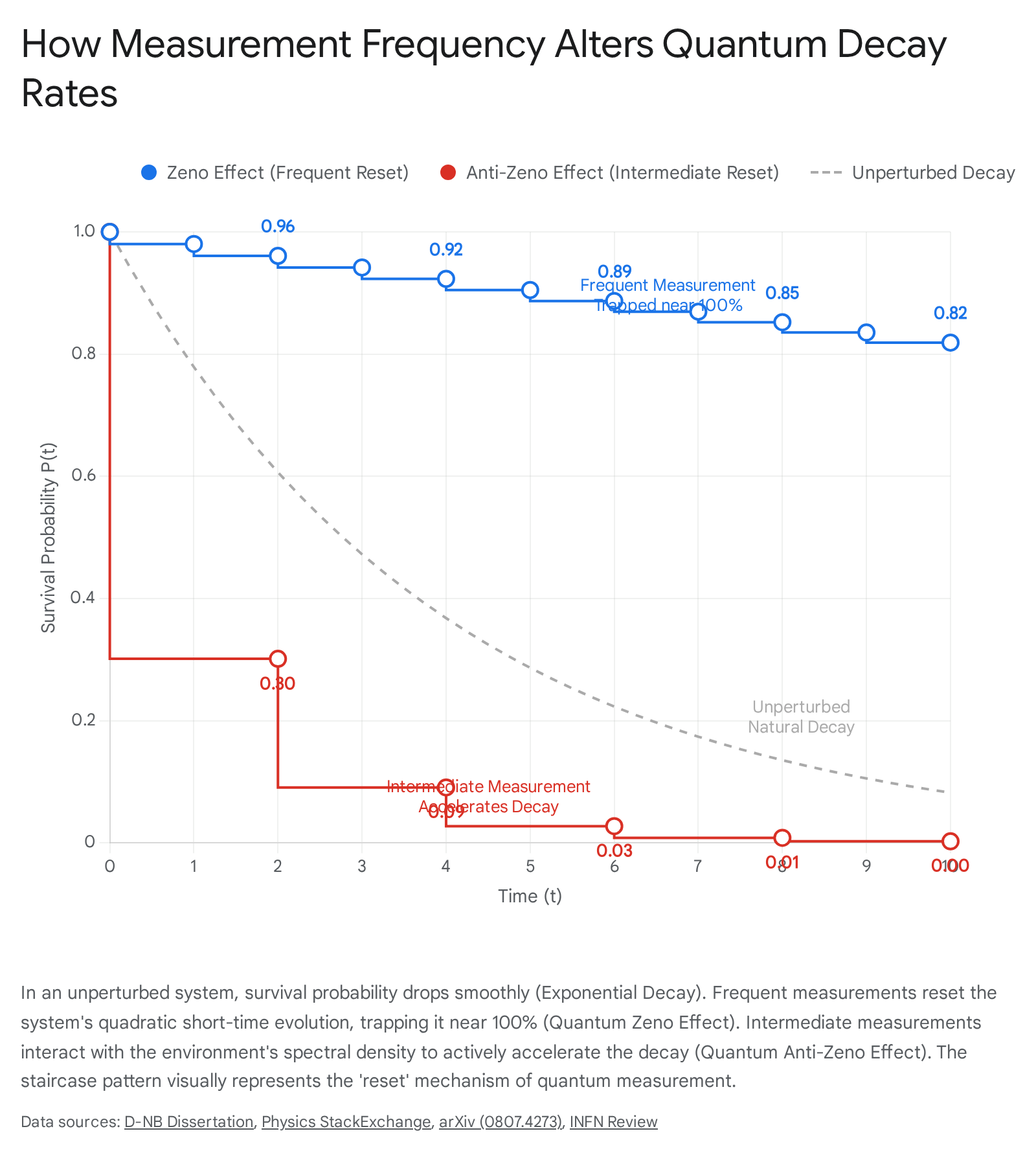
Here, $\tau_Z$ represents the Zeno time. The Zeno time is a characteristic timescale inversely proportional to the energy uncertainty of the initial state (specifically, the variance of the system's Hamiltonian) 510117. Because the survival probability drops off quadratically ($t^2$) rather than linearly or exponentially ($t$), the curve starts completely flat. The system barely changes during the first fraction of a microsecond.
This quadratic flat-lining is the underlying engine of the Zeno effect. Imagine you wait a very short time $t$ (where $t$ is much less than the Zeno time $\tau_Z$), and then make a measurement. The wave function collapses, and because the probability has barely dipped, the system is found in its initial state with a probability of nearly 100%.
Crucially, after the measurement, the system loses its memory of the evolution. The "clock" is reset, and the system starts a brand-new quadratic curve 1113. If you perform $N$ measurements over a total time $T$, such that the interval between measurements is $t = T/N$, the overall survival probability over the entire period becomes:
$P(T) \approx \left[1 - \left(\frac{T}{N \tau_Z}\right)^2\right]^N$
As $N$ approaches infinity - meaning the measurements become continuous - the survival probability $P(T)$ approaches exactly 1 108. By constantly collapsing the wave function with a rapid "strobe light" of frequent measurements, the quadratic short-time evolution is never allowed to build up momentum and transition into the standard exponential decay regime dictated by Fermi's Golden Rule 58916. The system is permanently trapped in its initial configuration.
What Actually Constitutes a "Measurement"?
When discussing the quantum Zeno effect, a common misconception arises from the word "observation." In classical terms, observation implies a conscious human being looking at an experiment. This anthropocentric view often leads to profound confusion regarding quantum mechanics 69.
In the context of the quantum Zeno effect, an observation or measurement does not require a human observer, consciousness, or even a traditional laboratory measuring device 2917. Instead, a measurement is defined as any physical interaction that entangles the quantum system with a macroscopic environment in a way that extracts information about the system's state.
This interaction can be highly intentional, such as firing a rapid sequence of ultraviolet laser pulses at an ion to determine its energy level 21317. If the photon interacts with the ion, the system's state is definitively "known" to the environment, causing wave function collapse. However, the interaction can also be completely passive and natural. Strong, continuous coupling to a noisy thermal environment, stochastic electromagnetic fields, or the spontaneous emission and absorption of particles all function as "measurements" 2.
When an unstable particle is subjected to strong continuous damping or continuous coupling to a reservoir, the environment acts as a relentless observer. This is why the definition of the quantum Zeno effect has expanded over the decades from a purely mathematical thought experiment involving idealized projection operators into a broad framework encompassing any suppression of unitary time evolution provided by environmental interactions 23.
The Quantum Anti-Zeno Effect: Speeding Up the Clock
If watching a quantum pot prevents it from boiling, it seems logical to assume that looking away allows it to boil at its normal rate. But the quantum world is rarely so intuitive. What if checking the pot actually makes it boil faster? This phenomenon is the quantum anti-Zeno effect, sometimes referred to as the inverse Zeno effect or the Heraclitus effect (a nod to the philosopher Heraclitus, who famously declared that "everything flows" and changes) 1010.
In the late 1990s and early 2000s, theoretical physicists realized that the Zeno effect only tells half the story. Under certain specific conditions, performing measurements at intermediate intervals - not continuously, but not infinitely spaced out either - can actively accelerate the transition or decay of a quantum state 21011. Instead of suppressing the decay rate, the measurements push the system to decay much faster than its natural, unperturbed exponential timeline.
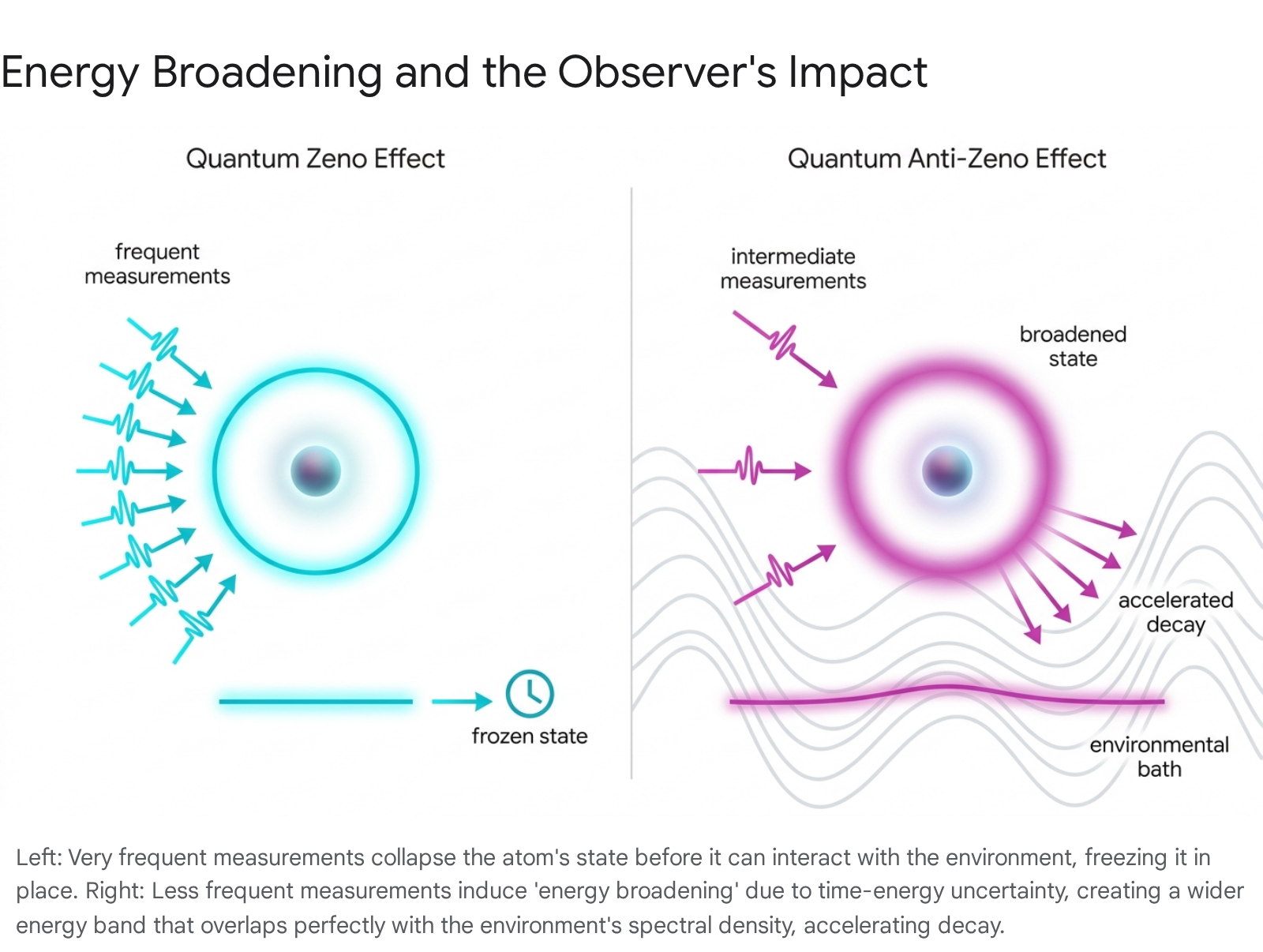
To understand why measurement can act as a catalyst for change, one must look at the Heisenberg uncertainty principle, specifically the relationship between time and energy ($\Delta E \Delta t \ge \hbar/2$). The uncertainty principle states that you cannot perfectly know both the energy of a quantum state and the exact time it exists in that state.
When you measure a system quickly, you effectively confine it in time. This severe temporal confinement creates a corresponding uncertainty, or "broadening," in the system's energy 48.
Quantum systems do not exist in a vacuum; they interact with a surrounding environment, known as a "bath." For an excited atom to decay and emit a photon, there must be an available energy state in the environment to receive that energy. In an unperturbed system, the atom's strict, narrow energy level might not perfectly align with the optimal energy states available in the bath, resulting in a slow decay.
However, when you measure the atom, the measurement-induced energy broadening acts like a "smear" across the energy spectrum 4. This smeared energy state suddenly overlaps much more strongly with the available states in the surrounding environment. Like loosening a tight knot so more threads can slip through, the measurement inadvertently opens up new, highly efficient resonant pathways for the system to decay 4.
Comparing the Zeno and Anti-Zeno Regimes
The distinction between these two phenomena lies entirely in the interplay between the frequency of the observation and the nature of the environmental bath.
| Feature | Quantum Zeno Effect (QZE) | Quantum Anti-Zeno Effect (QAZE) |
|---|---|---|
| Measurement Frequency | Very high (interval $t < \tau_Z$) | Intermediate (interval $t > \tau_Z$) |
| Impact on System | Suppresses unitary evolution / prevents decay | Accelerates transitions / speeds up decay |
| Mathematical Driver | Resets the quadratic flat-line of $P(t)$ | Capitalizes on measurement-induced energy broadening |
| Colloquial Analogy | "A watched pot never boils" | "A stirred pot cools faster" |
| Environmental Overlap | Decreases effective overlap with the bath's spectrum | Increases effective overlap with the bath's spectrum |
Spectral Density and the Environmental Bath
The specific tipping point where the quantum Zeno effect turns into the quantum anti-Zeno effect - or vice versa - is dictated by a property known as the "spectral density" of the environment 82021.
Spectral density is a mathematical description of how many energy states the environment has available at different frequencies. You can visualize it as an acoustic filter. The effective lifetime of a repeatedly measured quantum state is determined by the mathematical overlap between this environmental spectral density and a generalized "filter function" created by the measurement pulses 81120.
Physicists categorize environmental baths based on how their spectral density behaves at low frequencies, parameterized by an "Ohmicity" parameter $s$:
- Ohmic Environments ($s = 1$): In an Ohmic environment, the spectral density increases linearly with frequency at the low end. This represents standard thermodynamic friction or "white noise." If the noise is entirely flat and featureless across the spectrum, the Zeno effect is highly difficult to observe because the measurement broadening does not significantly change the overlap with the environment 82223.
- Sub-Ohmic Environments ($s < 1$): The spectral density rises sharply at low frequencies and acts essentially as a "low-pass" filter, heavily damping high frequencies. Theoretical research indicates that sub-Ohmic environments typically lead to the quantum Zeno effect, as measurement broadening pushes the system's energy out of the optimal overlap zone 2123.
- Super-Ohmic Environments ($s > 1$): The spectral density rises quadratically (or higher), acting more like a "band-pass" filter that suppresses both very low and very high frequencies. Super-Ohmic environments generally favor the quantum anti-Zeno effect, because the measurement-induced energy broadening allows the system to reach the optimal middle frequencies where the environment can easily absorb its energy 112123.
Crossing the Boundary: System-Environment Coupling Strength
Early theoretical models of the Zeno and anti-Zeno effects relied heavily on the "weak coupling" regime, assuming that the quantum system interacts very delicately with its environment. Under weak coupling, physicists can calculate the transition point between Zeno and anti-Zeno linearly using standard perturbation theory 8112024.
However, modern research has pushed heavily into the "strong coupling" and "ultrastrong coupling" regimes, where the quantum system and the environmental bath are tightly and complexly entangled 102425. To solve the mathematics here, physicists use a mathematical maneuver called a "polaron transformation," which effectively shifts the mathematical frame of reference so the coupling appears weak enough in the transformed frame to allow for calculations 102426.
Remarkably, in the strong coupling regime, the rules shift entirely. In weak coupling, increasing the interaction with the environment generally increases the decay rate. But in strong coupling, researchers have found that increasing the system-environment coupling strength can actually decrease the effective decay rate, fundamentally altering where the boundary between the Zeno and anti-Zeno regimes lies 10.
Furthermore, when physicists examine a general "spin-boson" model - a realistic scenario where an atom undergoes both population decay (losing energy) and quantum dephasing (losing its quantum superposition phase) simultaneously - they find multiple, highly complex crossover points. Depending on the exact timing of the measurements, the system's survival probability exhibits a highly structured curve. Decreasing the measurement interval can reduce the decay rate, but decreasing it further might increase it again, resulting in rapid, multiple transitions back and forth between Zeno and anti-Zeno regimes 222527.
From Theory to Laboratory: The First Experimental Proofs
For decades after Misra and Sudarshan's 1977 paper, the quantum Zeno effect was treated largely as a mathematical curiosity - a strange artifact of the Schrödinger equation that might be impossible to isolate in the physical world due to the difficulty of measuring a system without outright destroying it. That changed dramatically over the last thirty-five years.
The 1990 NIST Beryllium Experiment
In 1988, physicist Richard Cook proposed a practical experimental approach using oscillating two-level atomic systems 24. In 1989, David J. Wineland (who would later win the 2012 Nobel Prize in Physics) and his team, led by Wayne Itano at the National Institute of Standards and Technology (NIST), conducted the first definitive experimental proof of the quantum Zeno effect 2.
The NIST team stored approximately 5,000 beryllium ions ($^9\text{Be}^+$) in a cylindrical electromagnetic Penning trap and laser-cooled them to temperatures below 250 millikelvins 2. They applied a resonant radio-frequency (RF) pulse designed to smoothly drive the ions from a lower ground state to a higher excited state. If applied alone, this RF pulse would cause the entire population of beryllium ions to migrate to the excited state over a specific duration.
However, to test the Zeno effect, the researchers repeatedly interrupted this RF transition by firing extremely short pulses of ultraviolet (UV) light at the ions. This UV light acted as the "measurement." The photons were calibrated to interact only with ions that remained in the lower ground state. Just as theoretical physicists predicted, these frequent UV measurements constantly collapsed the ions' wave functions back into the ground state. The measurement disrupted the RF-driven evolution, and the ions were effectively frozen in their initial state, extending their lifetime in the ground state significantly 1213.
The 2001 Sodium Optical Lattice Experiment
While the NIST experiment proved the Zeno effect, it took another decade to definitively observe its inverse. In 2001, physicist Mark G. Raizen and his group at the University of Texas at Austin achieved a major breakthrough by observing both the quantum Zeno and anti-Zeno effects in the same experimental setup, proving that the phenomenon applied to truly unstable, decaying systems 212.
Raizen's team trapped ultracold sodium atoms in a far-detuned "optical lattice" - a landscape of potential energy hills and valleys created by interfering laser beams. By actively accelerating this optical lattice, they allowed the sodium atoms to gradually escape the trap via a process known as quantum tunneling 212.
The researchers repeatedly interrupted this tunneling process to measure how many atoms remained trapped. When they measured the system at highly frequent intervals (interrupting every few microseconds), the tunneling was strongly suppressed, confirming the Zeno effect 12. But crucially, when they spaced the measurements out to specific intermediate intervals, the atoms escaped the trap much faster than they would have if left entirely unobserved. This was the first definitive observation of the anti-Zeno effect 212. The experimental decay curves matched theoretical simulations with remarkable accuracy, proving that depending strictly on the frequency of the observer's gaze, measurement can act as a powerful catalyst for quantum transformation 412.
Recent Breakthroughs in Complex Systems (2024 - 2026)
Today, experimental physics has moved far beyond simply proving that the Zeno and anti-Zeno effects exist. Researchers worldwide are actively exploring their boundaries in complex, many-body systems and leveraging them to uncover new fundamental physics.
Parity-Time Symmetry and Acoustic Waveguides
Recent research out of the University of Science and Technology of China (USTC) and other international laboratories has demonstrated these effects in sophisticated new paradigms. In a notable study, experimentalists utilized a momentum-state lattice of cold atoms to study the quantum Zeno effect across "Parity-Time (PT) symmetry breaking" transitions 29. They constructed a synthetic two-level system with passive PT symmetry, introducing effective dissipation through repeated couplings to a reservoir.
They discovered that the Zeno and anti-Zeno regimes are strictly bounded by "exceptional points" in the system's phase diagram - points where the eigenvalues of the system coalesce. This revealed deep connections between quantum observation, measurement-induced dissipation, and topological boundaries 29. Furthermore, in 2024, researchers successfully mapped these dynamics onto macroscopic classical wave analogs. By using spatially modulated acoustic waveguides acting as segmented barriers, they recreated Zeno-like freezing and anti-Zeno acceleration of topological boundary states using sound waves, proving that the mathematics of measurement-induced decay apply broadly across different physics domains 30.
Stabilizing Dark States in Cavity QED
Other research groups have explored the stabilization of "dark states" in cavity quantum electrodynamics (QED). A dark state is a highly specific quantum superposition configuration that does not interact with the surrounding electromagnetic field - it neither absorbs nor emits light, making it effectively decoupled from its environment and highly desirable for storing quantum information 13.
By using the Tavis-Cummings model within a Lindblad master equation framework, researchers in 2026 investigated a system of two atoms coupled to a single-mode cavity. They applied continuous thermal dephasing to the system, which acts identically to a continuous, non-demolition measurement 2713. Through systematic tuning, they showed that they could toggle the cavity QED system between Zeno and anti-Zeno behavior simply by altering the intensity of the dephasing noise. At low dephasing intensities, the noise accelerated the loss of dark-state coherence (anti-Zeno regime). However, strong dephasing forced the system into a protective Zeno regime, severely slowing the dynamics and preserving a finite dark-state component with remarkable robustness, a critical finding for future quantum memory storage 2713.
Negative Time and Weak Measurements
The paradoxical nature of the Zeno effect is also central to recent debates regarding how much time particles spend interacting with matter. In a bizarre 2026 experiment, physicists fired single photons into a cloud of ultracold atoms to measure "dwell time." To measure the photon's presence without triggering the quantum Zeno effect - which would instantly freeze the atoms and destroy the interaction - they utilized "weak measurements" 14.
A weak measurement is a highly imprecise but carefully calibrated observation that gathers statistical information over many trials without causing an absolute wave function collapse. By firing an unrelated weak laser beam through the atomic cloud to probe tiny phase shifts, they bypassed Zeno dynamics. The stunning result showed that photons appear to spend a "negative" amount of time interacting with the atoms - exiting the cloud, on average, before they theoretically entered it 14. This experiment highlights how avoiding the Zeno effect allows researchers to uncover some of the most counterintuitive phenomena in quantum mechanics.
Practical Applications Driving the Second Quantum Revolution
The quantum Zeno effect entered the late 2020s not as a foundational curiosity, but as an essential engineering tool powering the "second quantum revolution" 11516. As researchers attempt to build scalable quantum devices, managing the incredibly disruptive nature of measurement has become the paramount technological challenge.
Quantum Error Correction and Logical Qubits
The most vital application of the quantum Zeno effect today is in quantum computing, specifically within the realm of Quantum Error Correction (QEC) 1.
Quantum bits (qubits) are highly fragile. The slightest interaction with the outside world causes "decoherence," scrambling the delicate quantum information they hold. To build a fault-tolerant quantum computer, engineers must detect and correct these errors in real-time. The paradox is that directly measuring the data stored on the qubit to check for errors would cause a wave function collapse, destroying the calculation entirely.
The solution relies on what are known as "syndrome measurements" and surface codes. Instead of measuring the data qubit itself, the system relies on an adjacent "ancilla" qubit that has been entangled with the data qubit 3536. The system measures the ancilla qubit, which acts as a parity check, projecting the data qubits back into a safe "code space" without revealing their specific informational state.
This error correction process is fundamentally driven by Zeno dynamics 1. By frequently performing these syndrome measurements, the quantum computer effectively freezes the physical errors, preventing them from propagating and corrupting the logical information 1. In 2024, major milestones published by companies like Google Quantum AI and Quantinuum demonstrated actual logical-qubit lifetime extensions using these exact Zeno-like measurement protocols 11738. For the first time, the protective Zeno effect on the error syndromes outpaced the underlying physical error rate, pushing fault tolerance out of the theoretical realm and into engineering reality 1.
Furthermore, researchers have utilized the Zeno effect to generate universal control between non-interacting qubits. By applying strong Zeno measurements that impart a geometric phase on a system conditioned on a specific non-local subspace, engineers have successfully turned single-qubit operations into multi-qubit entangling "Zeno gates" 18.
Quantum Thermodynamics and Heat Engines
Beyond computing, the Zeno effect is being leveraged to rewrite the rules of thermodynamics at the atomic scale. In classical internal combustion engines, pistons compress and expand a gas to generate work. In proposed "quantum heat engines" and "quantum heat pumps," the working fluid might be a single atom, a spin system, or a quantum harmonic oscillator 4041.
In a theoretical framework published in late 2024, researchers proposed replacing traditional "adiabatic" transformations (thermodynamic strokes that occur without transferring heat) with "quantum Zeno strokes" 40. During a compression stroke in a quantum engine, frequent, highly selective non-demolition measurements are performed on the working fluid's external state. The quantum Zeno effect prevents the fluid from transitioning to different energy levels. This effectively creates a perfect, frictionless, isentropic (constant entropy) compression. Current models suggest that utilizing these Zeno strokes allows quantum engines and heat pumps to achieve optimal thermodynamic performance significantly faster than existing shortcut-to-adiabaticity techniques 4041.
Ultra-Precise Nuclear Clocks
The interplay of the Zeno effect is also critical to the development of the next generation of timekeepers. Currently, the gold standard for global timekeeping is the cesium atomic clock, which relies on the microwave energy transitions of electrons in an atom's outer shell. But a new frontier is rapidly opening: the nuclear optical clock, which relies on the energy transitions of the nucleus itself 192021.
The leading candidate for this technology is the Thorium-229 ($^{229}\text{Th}$) nucleus, which possesses a uniquely low-energy excited state that can be directly probed by a laser 2021. Because the nucleus is far smaller and denser than the electron cloud, it is highly shielded from external electromagnetic disturbances, promising unprecedented precision that could measure gravitational waves, probe dark matter, and test whether fundamental constants like the speed of light change over time 20. However, probing these quantum states involves managing the system's decay rates meticulously. Engineers must balance their measurement protocols to optimize readout efficiency while simultaneously avoiding accidentally Zeno-freezing the clock transitions 2122.
Furthermore, ultra-precise clock research in 2026 has suggested that trapped-ion atomic clocks can now measure "quantum superpositions of time." Because time in Einstein's relativity is affected by motion and gravity, a clock whose spatial motion is placed in a quantum superposition will actually experience the passage of time in a superposition - ticking faster and slower simultaneously 2223. Managing both Zeno and anti-Zeno effects in these highly sensitive experimental setups is absolutely essential to prevent the measurement apparatus from prematurely collapsing these delicate time-entangled states 23.
A Unified Theoretical Picture
As the practical applications of measurement-induced dynamics have exploded across computing, thermodynamics, and metrology, the terminology surrounding the Zeno effect has occasionally become fragmented. Over the last decade, the Zeno effect has been studied under selective and non-selective measurements, with pulsed lasers and continuous noise, and even in purely dissipative systems where no explicit physical "observer" or measurement device is present 1547.
In 2025, researchers from Chapman University and the University of Southern California published a comprehensive review aiming to establish a definitive "unified picture" of the quantum Zeno and anti-Zeno effects 15472449. They demonstrated mathematically that whether you are using a pulsed laser to check an atom's state, or immersing a qubit in a continuous thermal bath, the underlying physics is completely identical.
The Zeno and anti-Zeno effects are simply different behavioral regimes of a single unified phenomenon. This unified effect occurs whenever a measurement-like process competes with a non-commuting quantum evolution 154724. If the measurement process dominates the dynamics, it creates a heavily overdamped state, completely suppressing evolution and mixing (the Zeno regime). If the system's evolution resonates with the structured frequencies of the measurement or the surrounding environment, it creates an underdamped state, accelerating the decay (the anti-Zeno regime) 4749.
This unified lens is critical for the future of quantum technology. By moving past the philosophical baggage of the classical "observer effect" and treating measurement simply as another tunable physical interaction, quantum engineers can fluidly design systems that leverage both suppression and acceleration on demand 47.
Bottom line
The quantum Zeno effect demonstrates that frequent measurement can trap a quantum system in its initial state, completely suppressing its natural evolution. Conversely, the quantum anti-Zeno effect reveals that intermediate measurements can interact with environmental energy states to actively accelerate a system's decay. Both effects have transcended philosophical thought experiments; they are now actively exploited in modern quantum computing for critical error correction and show immense promise in the design of frictionless quantum heat engines and ultra-precise nuclear clocks. Moving forward, the primary technological challenge remains fine-tuning the interaction between delicate quantum systems and their environments to control exactly when observation acts as an impenetrable shield, and when it acts as a rapid catalyst.