
Time crystals and time-translation symmetry
Introduction to Time-Crystalline Matter
In the classical understanding of condensed matter physics, the phases of matter are defined by their spatial organization and their relationship to fundamental symmetries. The transition from a disordered liquid to an ordered solid crystal involves the spontaneous breaking of continuous spatial translation symmetry. In a liquid, the statistical probability of finding a particle is uniform across space; the system possesses continuous spatial symmetry because it looks statistically identical regardless of the observer's location 123. When the liquid freezes into a solid crystal, this continuous symmetry is broken. The particles settle into distinct, periodic lattice points, leaving the system with only discrete spatial translation symmetry, meaning the environment only repeats at specific integer intervals corresponding to the lattice parameters 145.
In 2012, theoretical physicist and Nobel laureate Frank Wilczek proposed an extension of this concept into the fourth dimension. He posited that if matter can spontaneously break spatial symmetry to form ordered structures in space, a quantum system might also spontaneously break time-translation symmetry to form ordered structures in time 4678. This theoretical state of matter, dubbed a "time crystal," would consist of particles that exhibit periodic, self-sustaining motion even in their lowest possible energy state, or quantum ground state 479. In physical space, the transition from a random gas to an ordered three-dimensional lattice visually and mathematically represents the breaking of spatial symmetry. In the temporal dimension, this transition manifests as a shift from a static or uniform quantum state into one that oscillates between distinct configurations along a timeline, maintaining this rhythm while residing in a non-equilibrium state.
Initially met with skepticism and debated rigorously through the lens of thermodynamics, time crystals have since transitioned from mathematical curiosities to experimentally verified phases of non-equilibrium matter. Over the past decade, and particularly culminating in a series of breakthroughs between 2024 and 2026, researchers have synthesized discrete time crystals, continuous dissipative time crystals, time quasicrystals, and macroscopic space-time crystals 10111112. These discoveries challenge classical assumptions regarding thermodynamic equilibrium, energy dissipation, and the fundamental nature of time, offering unprecedented opportunities for quantum memory, precision metrology, and materials science 1314.
Thermodynamic Framework and Symmetry Breaking
To comprehend the mechanics of a time crystal, it is necessary to examine the intersection of Noether's theorem, symmetry breaking, and the laws of thermodynamics. Time crystals present a unique challenge to classical thermodynamic models because they exhibit persistent motion without acting as perpetual motion machines capable of doing mechanical work.
Noether's Theorem and Conservation Laws
Emmy Noether's landmark 1918 theorem established a rigorous mathematical correspondence between continuous symmetries in physical laws and conservation principles. The theorem posits that for every continuous symmetry of the action of a physical system, there is a corresponding conserved quantity 15. According to the theorem, spatial translation symmetry dictates the conservation of momentum, meaning the laws of physics remain invariant regardless of physical location. Rotational symmetry corresponds to the conservation of angular momentum. Crucially, time-translation symmetry corresponds to the conservation of energy, dictating that the fundamental laws of physics do not change over time 151618.
A standard spatial crystal spontaneously breaks continuous spatial symmetry into discrete symmetry without altering the underlying laws of physics. Looking at the fundamental Hamiltonian of the universe, shifting one's viewpoint continuously makes no difference. However, within the reference frame of the crystal lattice, shifting continuously changes the physical environment - for example, an observer's view might suddenly become obstructed by an atom or align with a row of lattice gaps 5. Only by shifting by exactly one lattice constant does the original environment restore itself, establishing a discrete symmetry. Time crystals apply this exact principle to temporal symmetry. While the underlying physical laws remain invariant over time, the macroscopic state of the time crystal itself does not; it breaks continuous time-translation symmetry, exhibiting periodic behavior at discrete temporal intervals without violating the conservation of energy 516.
Evasion of Thermodynamic Equilibrium
A common misconception regarding time crystals is that they represent a form of perpetual motion that violates the second law of thermodynamics. Classical perpetual motion machines attempt to extract continuous mechanical work from a system, an impossibility due to entropy, energy dissipation, and thermalization 71720. Time crystals, conversely, do not generate usable kinetic energy and cannot perform mechanical work. They exist as non-equilibrium quantum states that move without energy loss, maintaining a dynamic sequence that does not run down 42021.
Because time crystals do not reach thermal equilibrium, they evade the standard thermodynamic pull toward maximum entropy. In isolated systems, this is often achieved through a phenomenon known as Many-Body Localization (MBL). MBL is the extension of Anderson localization - which describes how single particles can be trapped by lattice disorder - to interacting multi-particle systems 20. When a quantum many-body system features sufficient disorder and interaction, it becomes localized, preventing the propagation of energy and spin through the system 20. Instead of absorbing energy from an external periodic drive and heating up to a featureless, infinite-temperature thermal state, an MBL system traps the energy 21. It maintains a stable, non-thermal arrangement that can oscillate indefinitely. The particles cycle through identical configurations endlessly, representing motion without traditional kinetic dissipation 421.
Another conceptual analogy is the Kapitza pendulum, an inverted pendulum that achieves a dynamically stable non-equilibrium state when its suspension point oscillates vertically at high frequencies 20. Just as the driving oscillation prevents the pendulum from falling into its expected ground state without causing runaway energy increase, the external driving in discrete time crystals provides a stable region in phase space that prevents thermalization 20.
The Evolution from Wilczek's Ground State
Frank Wilczek's original 2012 proposal theorized that continuous time crystals could exist in closed quantum systems in thermal equilibrium at their lowest energy state. However, subsequent "no-go" theorems formulated by the physics community proved that continuous time-translation symmetry breaking is fundamentally impossible in isolated equilibrium systems 221819.
Consequently, the field shifted toward driven, non-equilibrium environments. Researchers discovered that discrete time crystals could exist in periodically driven systems, also known as Floquet systems. In these environments, the system is repeatedly stimulated - such as by a rhythmic laser pulse or microwave burst - but its response locks into a sub-harmonic frequency. This means the crystal oscillates at a fraction (or integer multiple) of the driving frequency, establishing an independent temporal periodicity that breaks the discrete time-translation symmetry of the drive itself 4132122. Later advancements moved beyond discrete driving, proving that true continuous time crystals can emerge in open, dissipative systems where the system continuously exchanges energy with its environment, relying on competition between driving and decay rather than strict isolation 1118.
Categorization of Time-Crystalline Phases
As the theoretical understanding of non-equilibrium dynamics has expanded, the taxonomy of time crystals has diversified. Recent experimental observations have identified distinct temporal orderings that parallel the diverse structural architectures found in classical spatial materials, ranging from perfectly ordered lattices to complex quasicrystals 192021.
| Time-Crystalline Phase | Symmetry Broken | Driving Mechanism | Key Characteristic | Notable Realization |
|---|---|---|---|---|
| Discrete Time Crystal (DTC) | Discrete Time-Translation | Periodic / Floquet Driving | Oscillates at an integer multiple (sub-harmonic) of the external driving frequency. | Superconducting qubits (Google Sycamore, 2021) 721 |
| Continuous Time Crystal (CTC) | Continuous Time-Translation | Constant / Dissipative | Oscillates spontaneously at an intrinsic frequency independent of external timing. | Room-temperature Rydberg gas (Tsinghua, 2024) 1822 |
| Time Quasicrystal | Discrete Time-Translation | Multi-frequency Microwave | Temporal patterns are highly structured and strictly rule-based but never exactly repeat. | Nitrogen-vacancy centers in diamond (WashU, 2025) 1023 |
| Time Rondeau Crystal | Discrete Time-Translation | Structured Random Drives | Features predictable stroboscopic (long-term) order coexisting with short-term chaotic disorder. | Carbon-13 spins in diamond (UC Berkeley, 2025) 2029 |
| Space-Time Crystal | Spatial & Temporal | Constant Illumination | Breaks both space and time symmetries simultaneously, yielding visible mesoscale structures. | Liquid crystal topological solitons (CU Boulder, 2025) 1124 |
Time Quasicrystals
While standard time crystals repeat identical patterns over time, a time quasicrystal exhibits temporal order without exact periodic repetition. This phase is analogous to a Penrose tiling in spatial geometry - a structural matrix that follows strict geometric rules to fill space without ever looping into perfectly identical repeating blocks 1020. A time quasicrystal cycles through states in a highly organized, predictable manner that never perfectly repeats its temporal sequence 20.
In 2025, researchers at Washington University in St. Louis synthesized a time quasicrystal by bombarding a millimeter-sized diamond with high-energy nitrogen ions. This bombardment displaced carbon atoms, leaving behind empty atomic chambers known as nitrogen-vacancy (NV) centers 1025. By driving these NV centers with multiple, incommensurate microwave frequencies, the electron spins redistributed in a quasi-periodic rhythm. The system maintained stability over hundreds of cycles, demonstrating that non-repeating but structured temporal order can be achieved in solid-state quantum platforms 102325.
Time Rondeau Crystals
Taking inspiration from classical music, physicists at UC Berkeley and the Max Planck Institute reported the first observation of a "time rondeau crystal" in 2025 1220. A musical rondeau features a recurring primary theme interspersed with contrasting variations. Similarly, a time rondeau crystal exhibits a complex temporal duality: it maintains perfect, predictable long-term (stroboscopic) order while allowing for chaotic, random fluctuations in the short term (micromotion) 212926.
The researchers utilized carbon-13 nuclear spins within a diamond lattice. Through a process involving laser excitation to spin-polarize the NV centers, followed by the application of complex, structured but partially random microwave pulses, the team transferred the spin to the carbon-13 nuclei, hyperpolarizing the system by a factor of 1,000 2126. The resulting phase demonstrated that a time crystal does not require perfect cyclical rigidity to maintain its macroscopic identity. It can absorb and accommodate short-term disorder - fluctuating unpredictably between primary measurement intervals - while reliably preserving an unbroken long-term temporal architecture 122126.
Major Experimental Realizations
The transition of time crystals from mathematical hypotheses to observable physical phenomena has relied on vastly different experimental platforms. Early validations required extreme isolation and cryogenic temperatures, while recent breakthroughs have achieved time-crystalline order in room-temperature macroscopic systems.
Floquet Systems and Superconducting Qubits
Early experimental validations of discrete time crystals relied heavily on trapped ions and synthetic diamonds operating near absolute zero 7. A major technological milestone occurred in 2021 when researchers successfully simulated a discrete time crystal using a quantum computer 7202127. Using 57 superconducting qubits on Google's Sycamore processor, the team programmed the hardware to simulate an interacting spin-1/2 chain with built-in disorder, inducing the necessary Many-Body Localization to prevent the system from thermalizing 721.
By applying a sequence of quantum gates repetitively - a digital analogue to Floquet driving - the researchers forced the qubits into a discrete time-crystalline state 2021. The qubits flipped their states repeatedly, but critically, the pattern of the qubit states repeated every two cycles of the applied gate sequence rather than every single cycle 21. Because the system was localized, it absorbed no thermal energy from the computational driving. The qubits returned to identical configurations period after period, exhibiting perfect phase coherence and providing undeniable evidence of an out-of-equilibrium phase of matter maintained indefinitely without energy dissipation 202127.
Room-Temperature Continuous Time Crystals in Rydberg Gases
A historic limitation of time crystal research has been the requirement for extreme isolation and ultracold "deep freeze" conditions, which severely limits practical technological integration 282930. In 2024, researchers from Tsinghua University, in collaboration with scientists from Austria and Denmark, overcame this barrier by creating a continuous time crystal at room temperature 282931.
The Tsinghua team utilized a thermal gas of rubidium-85 atoms enclosed in a standard glass vapor cell. Using finely tuned lasers, they continuously excited the rubidium atoms into "Rydberg states." A Rydberg atom is a highly inflated atomic state where the outermost valence electron is pushed far from the nucleus, causing the atom to swell to roughly a micron across - hundreds of times its normal size 293233. These bloated, giant atoms exhibit exaggerated electric dipole moments, allowing them to exert strong pushes and pulls on neighboring atoms over comparatively vast distances, knitting the gas into a strongly interacting community 32.
By continuously pumping the system with lasers via a process known as electromagnetically induced transparency (EIT), the team introduced balanced dissipation 18. The simultaneous excitation of atoms into multiple Rydberg states created a built-in tug-of-war. The competition between distinct Rydberg components caused the entire macroscopic ensemble to spontaneously lock into a rhythmic limit cycle 18223234. Because this system was driven continuously rather than periodically, it was a true continuous time crystal. Its temporal rhythm emerged spontaneously, remained phase-coherent, and proved exceptionally stable against temporal noise, effectively demonstrating potentially infinite stability under standard room-temperature conditions 182229.
Time-Crystal Optomechanics
The utility of any phase of matter depends heavily on its ability to interact with the broader physical world. Until 2025, time crystals were maintained in strict isolation, as the act of measuring or mechanically coupling them to external systems generally caused rapid decoherence, destroying the time-translation symmetry breaking 353637. Researchers at Aalto University breached this isolation by creating the first "time-crystal optomechanical system" 3638.
The Aalto team cooled a Helium-3 superfluid to near absolute zero and injected magnons - magnetic quasiparticles that represent collective spin-wave excitations - using radio waves 3537. When the radio injection ceased, the magnons coalesced into a magnon Bose-Einstein Condensate (BEC) time crystal that maintained internal periodic motion 353940. Remarkably, as the time crystal began its autonomous oscillation, it successfully coupled to an external macroscopic mechanical oscillator: a gravity wave mode rippling on the physical surface of the superfluid liquid 4041.
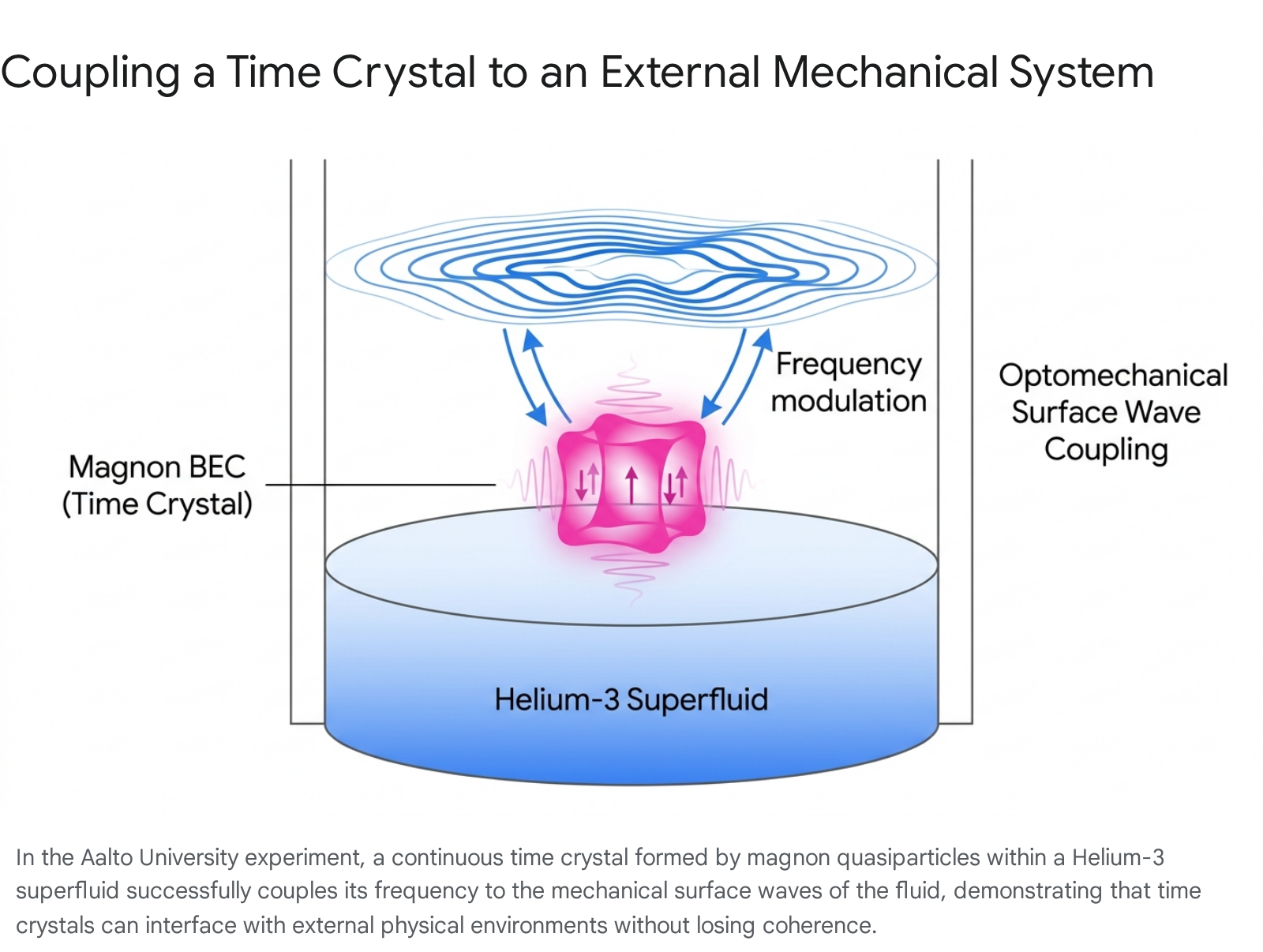
The interaction was strictly defined by the oscillator, meaning the free surface motion of the liquid modulated the time crystal's frequency without destroying its internal quantum coherence 4041. This dynamic evolved analogously to a cavity optomechanical system, demonstrating that the inherent robustness of time crystals could be harnessed to drive and read macroscopic mechanical systems 3641. This capability is a critical requisite for deploying time crystals in practical sensing technologies and mechanical resonators 4042.
Macroscopic Space-Time Crystals in Liquid Soft Matter
While most time crystals require sophisticated sensors or highly specialized environments to detect their quantum state oscillations, a 2025 study from the University of Colorado Boulder produced time crystals that are observable under standard optical microscopes and, under specific conditions, the naked eye 68.
The research team confined a nematic liquid crystal - similar to the materials used in modern LCD screens - between two glass plates coated with a photoresponsive azobenzene dye 611. Unlike quantum gases or rigid atomic lattices, this soft matter system consists of rod-shaped molecules that can flow freely while maintaining parallel alignment. When researchers illuminated the setup with constant-intensity, unstructured blue light, the azobenzene dye molecules at the surface rotated, mechanically twisting the adjacent liquid crystal molecules 1143.
This continuous forcing initiated a feedback loop deep within the liquid bulk, giving rise to "topological solitons." These solitons act as stable, localized twists or kinks in the crystal structure that behave mathematically and physically like independent particles 61124. Driven solely by the ambient light, the solitons arranged themselves into a rigid, repeating lattice that simultaneously moved in a perpetual, swirling waltz. The resulting structure spontaneously broke both continuous spatial symmetry and continuous temporal symmetry, manifesting as a true "space-time crystal" visible as undulating, psychedelic neon stripes 6112444. The pattern displayed extreme resilience, healing itself when disrupted by spatiotemporal dislocations and persisting indefinitely as long as the light source remained active 8244344.
Dynamics in Open and Dissipative Quantum Systems
For years, prevailing wisdom in condensed matter physics suggested that quantum fluctuations and decoherence caused by a system's interaction with its environment would ultimately destroy time-crystalline order 2945. Dissipative systems - where energy is continuously pumped in and lost through coupling to a bath - were initially viewed as hostile to the delicate temporal structures predicted by early theoretical frameworks 946.
However, rigorous theoretical modeling published in Physical Review Letters in 2025 by physicists at TU Wien demonstrated a counterintuitive mechanism: quantum correlations can actively synthesize and stabilize continuous time crystals 3114547.
Beyond Mean-Field Theory: Quantum Fluctuations as Stabilizers
The TU Wien team modeled a two-dimensional lattice of interacting three-level particles held in place by laser beams, analogous to arrays of Rydberg atoms 4548. Traditional analysis of such systems relies on "mean-field theory," an approximation technique that averages out the chaotic quantum fluctuations of individual particles to predict macroscopic behavior, easing the computational burden of simulating massive multi-particle ensembles 911. Under classical mean-field models, this open, dissipative lattice naturally settles into a stationary, non-oscillating steady state without limit cycles 1148.
By abandoning the mean-field approximation and incorporating exact quantum correlations and beyond-mean-field effects, the researchers uncovered the emergence of two distinct continuous time crystal phases (qCTC-I and qCTC-II) 114748. The complex, many-body quantum interactions between the particles induced a collective, self-sustaining temporal rhythm 245. Rather than acting as a disruptive force that dampens oscillations, the quantum fluctuations served as the foundational scaffolding for the continuous time-translation symmetry breaking 239. This discovery fundamentally shifted the understanding of open quantum systems, proving that robust time crystals can emerge intrinsically from local dissipation and long-range interactions without the need for strict isolation or classical non-linear limit cycles 2934.
Technological Implications and Practical Applications
The maturation of time crystal research from a theoretical debate regarding the limits of thermodynamics to the macroscopic realization of diverse crystalline phases has catalyzed intense interest across multiple technological domains. The defining characteristic of a time crystal - its ability to maintain perfect, stable periodicity without thermodynamic decay - offers unique engineering advantages 1321.
Robust Quantum Memory and State Protection
The most immediate application for time-crystalline structures lies in quantum computing architecture. Quantum bits (qubits) are notoriously fragile; minor environmental disturbances cause them to undergo rapid decoherence, losing the delicate superposition and entanglement states necessary for quantum computation 7.
Time crystals provide a naturally resilient environment for quantum information storage. Because time crystals are stabilized by Many-Body Localization or robust dissipative dynamics, they inherently resist external perturbations and environmental noise 134256. Researchers hypothesize that quantum states could be encoded within the relative phase of the time crystal's oscillation or within specific sub-harmonic modes 721. By coupling data to a magnon time crystal - as demonstrated by the optomechanical surface wave experiments - information could theoretically be stored for minutes rather than milliseconds 3642. This represents an exponential improvement over current quantum memory systems, potentially solving one of the most significant bottlenecks in scaling quantum computers and extending the range of Quantum Key Distribution (QKD) protocols 214256.
Precision Metrology and Quantum Clocks
Modern precision timekeeping relies on atomic clocks, which utilize the highly predictable microwave frequencies of transitioning electrons in ultracold atoms. However, even the most advanced quartz and atomic oscillators suffer from minor thermal drift, require external driving mechanisms, and necessitate periodic calibration 23.
Because a continuous time crystal spontaneously sets its own frequency - determined entirely by the internal physical constants of its many-body interactions rather than an external conductor - it does not lose energy to friction, heat, or standard mechanical decay 131432. Theoretical models from the Institute for Cross-Disciplinary Physics and Complex Systems (IFISC) suggest that dissipative time crystals could function as ultra-precise quantum clocks operating with minimal energy loss 14. By continuously monitoring the stochastic "ticks" (photon emissions) of the oscillating spins, engineers could create timing devices with sub-Hertz stability 1314. Furthermore, acting as high-sensitivity frequency combs, time crystals could dramatically enhance the resolution of sensors used to detect faint magnetic fields, quantum level disturbances, or even subtle gravitational waves 293536.
Optical Devices and 2D-Time Barcodes
The synthesis of macroscopic, visible space-time crystals in liquid materials opens entirely new pathways for commercial and optical applications outside the realm of quantum computing 624. Because the topological solitons in these liquid crystals respond to unstructured light by generating highly specific, stable spatiotemporal patterns, governments and corporations could utilize them for advanced anti-counterfeiting measures 64457.
By embedding space-time crystalline materials into currency, secure documents, or sensitive hardware, authenticators could shine a standard light source to reveal a dynamic "time watermark" - a cryptographic pattern that relies not only on a physical image but on a highly specific temporal oscillation sequence 6434457. Furthermore, researchers estimate that stacking multiple space-time crystals could result in a dynamic "time barcode." This format utilizes the temporal dimension to encode overlapping sets of information at the same spatial coordinates over time, potentially yielding storage densities capable of handling over 100,000 bits per second in a highly compact form factor 6843.
Conclusion
Time crystals represent a profound expansion of humanity's understanding of condensed matter physics and the fundamental symmetries of nature. Originating as a controversial theoretical premise that seemingly challenged the bedrock laws of thermodynamics, time crystals are now established as an entirely new, verified class of non-equilibrium matter. They have definitively proven that spontaneous symmetry breaking is not confined to the physical dimensions of space, but can extend into the flow of time itself, yielding systems that oscillate eternally in their lowest energy states.
The rapid experimental progress achieved in recent years indicates a field in the midst of a technological renaissance. From the demonstration of time rondeau crystals that harmonize stroboscopic order with short-term chaos, to the creation of robust, room-temperature dissipative time crystals and fully visible macroscopic space-time structures, researchers have proven that temporal order is a versatile, controllable property of matter. By harnessing these perpetual, frictionless internal rhythms, future technologies may overcome the decoherence limits of quantum memory, achieve unprecedented sub-Hertz precision in global metrology, and utilize the temporal dimension for secure, high-density macroscopic data storage. Time crystals stand not merely as an evasion of thermodynamic decay, but as the foundation for the next generation of quantum and optical engineering.