
How the Placebo Effect Actually Works
The placebo effect is a real, measurable physiological phenomenon, but it does not magically cure underlying diseases or shrink tumors. Instead, placebos trigger hardwired neurobiological changes in the brain that significantly relieve symptoms modulated by the central nervous system, such as chronic pain, irritable bowel syndrome, fatigue, and depression. Driven by patient expectations, subconscious conditioning, and the ritual of clinical care, the brain releases its own potent neurotransmitters - like endorphins and dopamine - to physically alter how the body experiences illness.
The Myth and Reality of "Nothing"
For decades, the placebo effect was largely misunderstood by both the general public and the medical establishment. It was frequently dismissed as a statistical nuisance, a sign of extreme patient suggestibility, or proof that an illness was simply "all in your head" 12. A placebo - which translates from Latin as "I shall please" - is traditionally defined as a pharmacologically inactive substance or a sham procedure designed to have no direct therapeutic benefit 3. The most familiar example is a sugar pill or a saline injection used in the control group of a clinical trial to test the efficacy of a new drug 3.
The idea that the mind can induce physical healing has a remarkably long history, with vivid accounts of apparent placebo effects appearing as early as Michel de Montaigne's 1580 Essays 4. However, the modern clinical fascination with placebos began in earnest in 1955 when Dr. Henry Beecher, an anesthesiologist at Harvard Medical School, published a highly influential, landmark paper in the Journal of the American Medical Association titled "The Powerful Placebo" 45.
The Flawed Foundation of Placebo Science
Beecher had been studying pharmacologically inert treatments and reviewed evidence from fifteen clinical trials. He concluded that, across various conditions, 35 percent of patients were "satisfactorily relieved" by a placebo alone 4. Because this effect seemed to occur equally across a wide variety of conditions, Beecher inferred that a fundamental, common mechanism was at work 4.
It is difficult to overstate the impact Beecher's paper had on modern medicine. It was cited close to a thousand times in scientific journals, legitimizing the idea that placebos are widely effective for therapy 4. This notion went largely unchallenged for forty years. It shaped the design of the entire pharmaceutical industry, which regulators built around the requirement that a legitimate medical treatment must be proven to do more than simply produce a placebo response 6. Billions of dollars are made when a drug clears this hurdle, even if the active drug's performance over the placebo group is miniscule 6.
However, in the last two decades, there has been a growing recognition that much of the evidence advanced by Beecher and his successors was tainted by profound methodological errors 4. Beecher failed to account for the natural history of diseases, statistical regression to the mean, and reporting biases 4. Despite these corrections in the scientific community, the grip of the placebo on the popular imagination remains unshakeable, often touted as a mystical demonstration of the mind's ability to heal the body 4.
The Shift to Modern Science
Today, medical science recognizes that a placebo pill itself has zero direct effect on the body 1. An inert sugar pill is just a sugar pill. Rather, it is the act of administration - the psychosocial context surrounding the delivery of the pill - that acts as the catalyst for a cascade of biological responses 7.
The placebo effect is not a single entity. It is a complex psychobiological phenomenon attributable to different mechanisms depending on the medical condition 78. By abandoning the flawed concept that inert substances have magical healing powers, and instead focusing on how the brain's perception of a therapeutic ritual alters human biology, researchers have begun to map the true power and limitations of the placebo effect 6.
What Placebos Can and Cannot Treat
A common, dangerous misconception is that positive thinking and belief alone can cure any disease. Placebos will not lower cholesterol, eradicate bacterial infections, or halt the cellular progression of a tumor 910. If a medical condition requires a specific, physical mechanism to halt a pathogen, repair tissue damage, or alter genetic expression, a placebo cannot replace an active pharmacological drug.
However, placebos excel at managing symptoms that rely on the brain's perception and processing. They are highly effective for conditions where the patient's subjective experience is the primary indicator of illness 1411.
Subjective vs. Objective Symptoms
To understand placebo efficacy, researchers distinguish between "subjective continuous endpoints" and "objective binary endpoints" 14.
Objective binary endpoints are black-and-white physiological outcomes, such as whether or not a patient relapses after nicotine withdrawal, or whether a tumor shrinks 1. Placebos have virtually no effect on these outcomes 1. Retrospective analyses of hundreds of clinical studies demonstrate that placebo treatments exert very little influence on objective endpoints when compared to no-treatment control groups 14.
Conversely, placebos are highly effective on subjective continuous endpoints. These are symptoms that exist on a spectrum and are regulated by the central nervous system, such as pain, anxiety, fatigue, and nausea 1410. Because the brain actively modulates how intense these symptoms feel, the brain has the power to dial that intensity up or down based on the context of receiving treatment 12.
| Medical Condition / Symptom | Placebo Efficacy | Primary Mechanism |
|---|---|---|
| Chronic Pain & Migraines | High | Pain is actively modulated by the central nervous system; placebos trigger the release of endogenous opioids (natural painkillers) to block pain signals 913. |
| Depression & Anxiety | High | These conditions involve neurotransmitter imbalances and emotional regulation; the expectation of care triggers dopamine release and alters activity in the amygdala 1114. |
| Irritable Bowel Syndrome (IBS) | High | The gut-brain axis is highly sensitive to stress; placebos can significantly alter intestinal motility and blunt visceral pain perception 5. |
| Parkinson's Disease (Motor Symptoms) | Moderate to High | The expectation of receiving anti-Parkinsonian medication triggers the brain's release of dopamine in the striatum, temporarily improving motor control 1112. |
| Cancer / Tumor Growth | None | Placebos cannot alter cellular mutation or shrink tumors. However, they are highly effective at managing cancer treatment side effects like nausea and fatigue 910. |
| Bacterial Infections | None | An inert pill cannot kill bacteria; relying on a placebo instead of antibiotics for a severe infection provides no objective benefit and is medically dangerous. |
The Limits of Placebos
Even within subjective conditions, the placebo effect is not a miracle cure. While conditions like depression show a high placebo response - with some researchers estimating that nearly 50 percent of the response to active antidepressant drugs is actually due to the placebo effect itself - the response is less consistent in conditions like bipolar depression 1114. Furthermore, while placebos may make a patient feel significantly better, they will not cure the underlying pathology of chronic illness. They provide symptomatic relief, acting as a powerful analgesic or mood stabilizer, but they do not reverse the root cause of systemic diseases 9.
The Neurobiology: How the Brain Heals the Body
The most critical shift in modern placebo research has been the ability to literally watch the placebo effect happen inside the brain. Using advanced functional neuroimaging techniques, such as PET scans and functional magnetic resonance imaging (fMRI), researchers have proven that the placebo effect transcends mere mental factors and involves tangible, physical processes in the brain and body 111. When a patient takes a placebo believing it to be a powerful drug, their brain's pharmacy opens.
The Endorphin and Dopamine Connection
Neurobiologically, the most widely studied form of placebo response is placebo analgesia - where patients experience a profound reduction in pain due to a sham treatment 71315. When patients are given a placebo and informed that it is a strong painkiller, their brains activate endogenous opioid systems 1315. This process involves the massive release of endorphins, which bind to the exact same mu-opioid receptors in the brain that are targeted by synthetic analgesic drugs like morphine 213.
We know this is a physical reality because the effect can be pharmacologically blocked. If researchers administer a drug like naloxone - which is an opioid receptor antagonist used to reverse opioid overdoses - the placebo pain relief completely vanishes 716. Furthermore, the administration of cholecystokinin (CCK), a peptide that naturally antagonizes the effects of endogenous opioids, also eliminates the placebo response, proving that placebo analgesia relies on specific biochemical pathways 7.
Similar biochemical reactions occur outside of pain management. In patients with Parkinson's disease, brain pathology results in a severe lack of dopamine. Yet, landmark PET scan studies have revealed that administering a placebo to a Parkinson's patient triggers a significant release of dopamine in the striatum, mimicking the effects of real dopamine-boosting drugs 1112. The amount of dopamine released correlates directly with the patient's conscious expectation of how well the "drug" will improve their clinical status 12. Furthermore, individuals who show placebo-induced improvements in motor performance also exhibit measurable increases in the firing of neurons in the subthalamic nucleus 12.
The Newly Discovered Neural Circuit (rACC→Pn→Cerebellum)
While the involvement of endorphins and dopamine has been known for several years, researchers are continuously uncovering the precise neural pathways that govern these phenomena. A groundbreaking 2024 article published in the journal Nature identified a highly specific neural circuit responsible for placebo pain relief 13.
This newly mapped circuit is known as the rACC→Pn→cerebellum pathway 13.
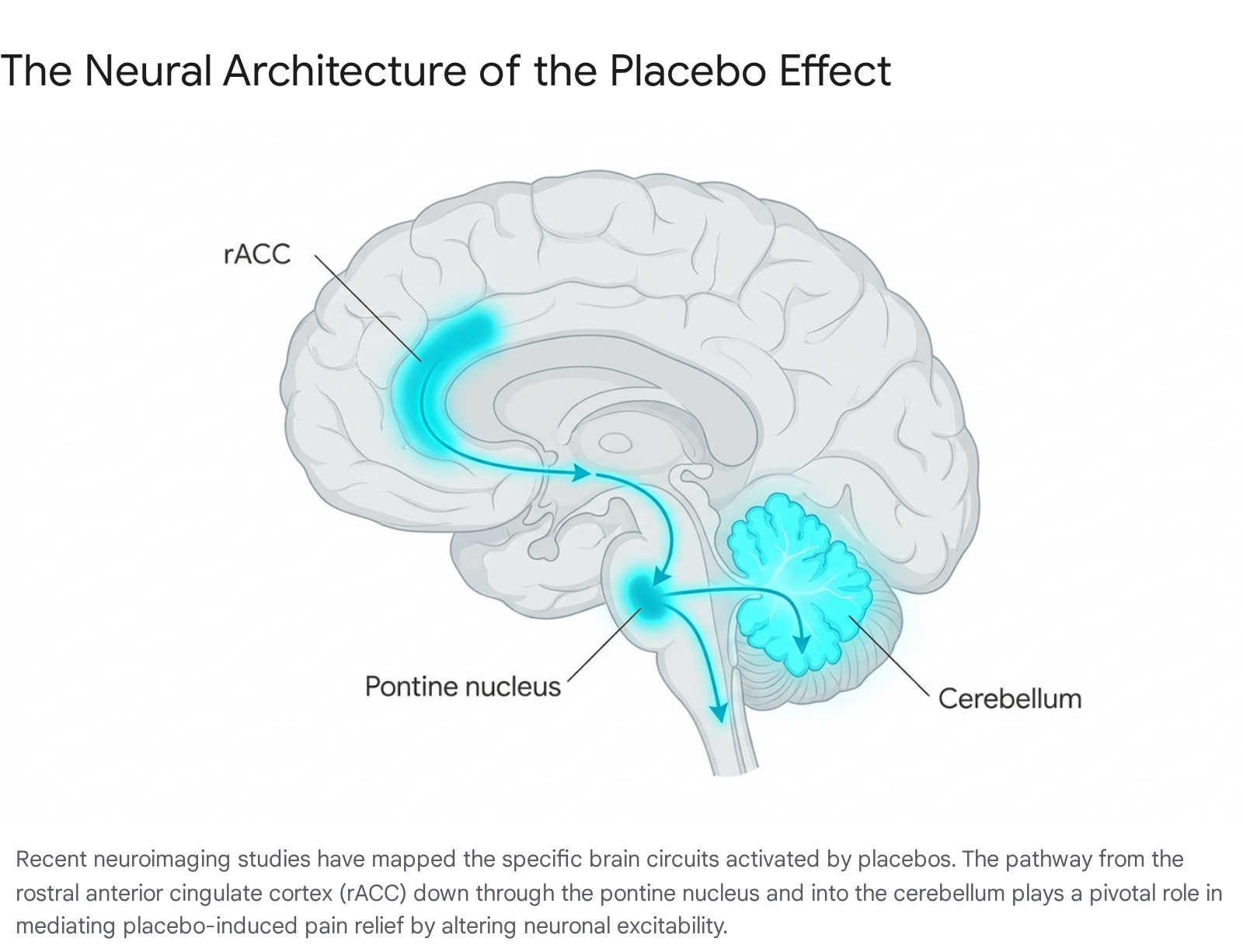
It begins in the rostral anterior cingulate cortex (rACC), a brain region crucial for processing emotional regulation and pain expectation 13. Neurons in the rACC project downward to the pontine nucleus (Pn), a structure in the brainstem involved in cortico-cerebellar communication, which then relays the signal to the cerebellum 13.
Researchers found that the rACC plays a pivotal role in mediating the placebo effect. By utilizing advanced techniques like optogenetics and in vivo calcium imaging, scientists observed that activating these specific neurons induced profound analgesia even without the presence of placebo conditioning 13. Conversely, inhibiting this pathway disrupted the pain relief 13. Molecular analysis also revealed a high concentration of opioid receptors in the Pn neurons, perfectly bridging the gap between anatomical brain structures and the biochemical release of endorphins 13. This circuit proves that the placebo effect reduces pain perception through enhanced synaptic plasticity and neuronal excitability along a dedicated, hardwired biological route 13.
Systemic Physiological Changes
Beyond subjective symptom relief in the brain, placebo administration can also induce measurable systemic physiological changes throughout the body. For instance, studies examining the sympathetic control of the heart have found that placebo analgesia is accompanied by a visibly reduced heart rate and a decreased beta-adrenergic response 7. Because stress and pain elevate heart rate and blood pressure, the anxiety-reducing nature of the placebo effect naturally calms the cardiovascular system 37. Just as the mind can contribute to a physical disorder through stress, it can utilize the placebo effect to contribute to a physiological cure 3. Furthermore, because the endogenous opioids activated by placebos affect the respiratory centers, placebo administration can also influence breathing rates 7.
The Psychology: Why the Mind Believes the Body is Healing
If the placebo effect relies on no active chemical ingredients, what is actually flipping the switch in the brain to release dopamine and endorphins? Psychologists, neuroscientists, and medical anthropologists generally point to two primary, interacting mechanisms: conscious expectation and unconscious classical conditioning 1717. These psychological processes are so powerful that they dictate the efficacy of real, pharmacologically active drugs as well as inert placebos.
The Power of Expectation (The Bayesian Brain)
Conscious expectation is the most readily apparent driver of the placebo effect. When a doctor hands you a pill, outlines its benefits, and confidently states that it will relieve your headache, you consciously expect the pain to go away 17. This expectation fundamentally alters how your brain perceives and processes sensory information.
Leading placebo researcher Ted Kaptchuk, who directs the Program in Placebo Studies at Harvard Medical School, proposes that the placebo effect is best understood through the model of the "Bayesian brain" and Prediction and Error Processing (PEP) 181920. Historically, science viewed the brain as a passive receiver of sensory inputs - pain signals travel up the spinal cord, and the brain simply registers them. The Bayesian model, however, argues that the brain is a highly active predictive engine. It constantly generates predictions about what it expects to feel based on prior knowledge and immediate environmental context 19.
Under the PEP model, sensory predictions are embedded in and inseparable from our actual perceptions. When you undergo a medical ritual - going to a clinic, talking to a doctor in a white coat, swallowing a pill - your brain predicts that relief is imminent 919. In many cases, the brain simply alters its own sensory perception to match its confident prediction of healing, literally dialing down the volume on pain, fatigue, or nausea to correct the "error" between its expectation of health and the reality of sickness 19. Placebo effects are neurologically encoded predictions; they are less about what patients consciously think, and more about how the brain biologically enacts and performs relief based on contextual cues 19.
The importance of this expectation is dramatically highlighted in "hidden vs. open" drug administration studies. Research has revealed that real, potent drugs have a significantly reduced efficacy when they are administered covertly (unbeknownst to the patient via a hidden automated pump) compared to when they are administered openly by a physician 8. If the psychological component of expectation is eliminated by means of hidden administration, the total therapeutic effect of the drug drops, proving that the psychological context enhances real chemical interventions 8.
Classical Conditioning
While expectation requires conscious awareness, the placebo effect is also deeply rooted in classical conditioning, the exact same subconscious learning mechanism famously demonstrated by Ivan Pavlov and his salivating dogs 117.
Throughout a patient's life, they learn to associate certain stimuli with feeling better. You take an aspirin, and twenty minutes later, your headache fades. Over years of repeated medical experiences, the physical shape of a pill, its taste, the smell of a hospital, and the act of swallowing become conditioned stimuli 11721. Eventually, simply undergoing the ritual of swallowing a pill - even if it is secretly replaced with an inert sugar pill - is enough to trigger the brain's learned physiological response of pain relief 17.
This conditioning happens entirely below the level of conscious thought. This mechanism explains why placebo effects can be observed even in animals and infants, who lack conscious medical expectations but still possess the biological capability to associate a clinical environment or administration ritual with physical relief 21. Through repeated association with active ingredients, the ritual of giving a placebo becomes a conditioned stimulus capable of causing the alleviation of pain, immune suppression, or other organic symptoms 22. Conversely, if a patient receives a series of placebos and notices that the "medication" is helping less than it used to, their positive attitude reduces, the conditioning fades, and the placebo effect diminishes - a process known as deconditioning 1.
The Doctor-Patient Relationship
The therapeutic encounter itself is an incredibly powerful placebo. When evaluating what triggers the brain's healing response, the relationship between the patient and the healthcare provider is paramount. Research clearly demonstrates that the empathy, warmth, friendliness, and competence of a physician can dramatically influence clinical outcomes 162324.
Medical communication is a main pathway through which placebo effects are induced. When a patient trusts their practitioner, feels heard, and receives clear information about treatment rationale and efficacy, their anxiety naturally drops 1623. Because stress activates the hypothalamic-pituitary-adrenal axis, increasing blood pressure and exacerbating pain sensitivity, the simple act of being cared for in a clinical setting initiates a physiological calming response 3825.
A patient-centered approach rooted in demonstrating care positively enhances a patient's experience within the clinical environment, activating psychosociobiological adaptations associated with the placebo phenomenon 16. Simply put, doctors who care deeply for their patients create stronger biological responses to treatment.
Medical Rituals and The Therapeutic Encounter
We cannot separate the placebo effect from the elaborate rituals of modern medicine. When clinical trials compare drugs with placebos, the entire environmental and ritual factor is at work 9. Patients must travel to a clinic at specific times, wait in specialized rooms, undergo physical examinations by medical professionals in white coats, receive exotic pills, and submit to strange procedures 9.
More elaborate, detailed, time-consuming, fashionable, or dangerous treatments are universally perceived by patients as being more effective 26. This ritualistic environment signals to the brain that "healing is happening," driving the predictive error processing mechanisms 9. The perception of receiving intense attention and care has a profound impact on how the body perceives symptoms, confirming the old medical tenet that curing the disease is not sufficient; caring for the patient is of tantamount importance 924.
Cultural Variations in the Placebo Effect
The meaning we assign to a medical treatment is profoundly shaped by our culture, leading to fascinating geographic, demographic, and sociological variations in how placebos work 2526. Because the placebo effect depends entirely on what an individual perceives as a legitimate, powerful treatment, changing the color, size, aesthetic, or delivery method of a sham treatment drastically changes its biological impact 262827.
Pill Color, Size, and Delivery
Pharmaceutical companies have long understood that a drug's physical characteristics influence its therapeutic effects, a phenomenon thoroughly documented since the 1950s 2827. Research shows that larger-sized pills suggest a stronger dose than smaller pills, and taking two placebo pills produces a more potent healing response than swallowing just one 3.
Delivery method also matters heavily. In the United States and many Western nations, sham injections produce a significantly more powerful placebo effect than oral sugar pills 326. Treatments using advanced technology or devices, such as lasers, are perceived as even more effective 26. Culturally, patients perceive needles and invasive technological procedures as more "serious," dangerous, and potent than a standard tablet, elevating their expectation of healing 26.
The color of a pill sets immediate subconscious expectations about its effect. Across multiple cross-cultural surveys, distinct colors consistently yield non-chance distributions in the classification of perceived drug effects 2827.
| Placebo Pill Color | Primary Cultural Association | Perceived Medical Efficacy |
|---|---|---|
| Red or Yellow | Energy, power, and aggression. | Acts as a strong stimulant. Highly rated for alerting effects. |
| Blue or Green | Calmness, serenity, environment, and health. | Acts as a depressant, sedative, or anti-anxiety treatment. |
| White | Purity and calm. | Consistently viewed as the most effective for pain relief and antacids. |
| Pink | Mild stimulation. | Less drowsy than blue pills; associated with mild uplifting effects. |
Sources: 262827
However, these color associations are not strictly universal and vary notably across demographics and time 27. While white pills are broadly viewed as the most effective for pain relief by Caucasian populations and in countries like the United States, China, and Colombia, historical studies from the 1980s noted significant racial disparities in perception 2627. African American populations, likely influenced by differing cultural experiences and marketing exposures, perceived white pills as stimulants and black pills as analgesics - the exact reverse of Caucasian expectations at the time 2728.
Even the color of the clinical environment matters. Studies utilizing virtual reality environments found that placing a patient in a room with blue hospital walls significantly decreased anxiety compared to other colors, further shaping the baseline for a positive placebo response 26.
Geography and Health Beliefs (Germany vs. Brazil)
Broader cultural anxieties and local medical priorities heavily dictate placebo efficacy. Because placebo and nocebo effects operate within a specific cultural context that accepts a treatment as legitimate, we see massive variations in placebo healing rates across different countries 252629.
Medical anthropologist Daniel Moerman extensively reviewed clinical trials for ulcer treatments and found astonishing disparities. The average placebo healing rate for ulcers was a massive 59 percent for German participants, whereas the rate was just 22 percent for Dutch and Danish participants, and a remarkably low 7 percent for participants in Brazil 2529.
Yet, these high responsiveness rates do not apply universally across all diseases for a given culture. When examining treatments for high blood pressure (hypertension), Moerman found that German participants exhibited exceptionally low placebo responses 26. Anthropologists hypothesize this is because Germans are culturally highly concerned about having low blood pressure, making hypertension treatment a lower priority or a subject of different cultural anxieties, thus altering their expectation of symptom relief 26. Ultimately, a voodoo hex may act as a powerful negative placebo (nocebo) in Haiti due to deeply ingrained cultural scripts, but it will have absolutely no biological effect on a skeptic in Wisconsin 25.
Shifts in Perception Over Time
As societal attitudes change and public understanding evolves, so too do placebo responses. The perceived efficacy of certain shapes of pills changes based on current pharmaceutical marketing trends. For example, while capsules were once universally preferred, later studies found that oval capsules are now strongly preferred primarily for antibiotic treatments, while round tablets are preferred for most other types of daily medications 26.
Similarly, the perception that pills are effective treatments for mental health conditions has shifted over the decades. As antidepressants became more prevalent and socially accepted in society, the cultural belief in their efficacy grew, thereby actually increasing the baseline placebo effectiveness observed in psychiatric clinical trials 226.
Open-Label Placebos: Healing Without Deception
Historically, the medical community operated under a strict dogma: a placebo only works if the patient is thoroughly deceived. Henry Beecher and the generations of clinical researchers that followed him assumed that if a patient knew they were taking a sugar pill, the psychological magic would instantly evaporate 519.
This assumption created a massive ethical roadblock for clinical practice. Lying to patients violates the core tenets of modern medical ethics, specifically respect for autonomy and informed consent. Because physicians cannot ethically deceive their patients, placebos were effectively quarantined from everyday medicine and restricted strictly to use as comparative control arms in randomized research trials 19.
But over the last fifteen years, researchers like Ted Kaptchuk at Harvard have turned this long-held assumption on its head by testing a radically counterintuitive hypothesis: Open-Label Placebos (OLPs). These are placebos prescribed honestly, with full transparency 52030.
The End of the Deception Dogma
In OLP trials, there is no deception. Doctors explicitly tell patients: "This is a placebo. It contains no active medicine. However, clinical studies show that placebos can trigger the body's natural healing processes through the mind-body connection, much like Pavlov's dogs salivated when they heard a bell" 1930. Patients are told that they do not even need to believe the pill will work; their only responsibility is to take the pills as prescribed and allow the ritual to engage their automatic neurobiological systems 19.
Astonishingly, open-label placebos still work 19.
The Landmark IBS Trial
A landmark six-week randomized clinical trial involving 262 adults with moderate to severe Irritable Bowel Syndrome (IBS) fundamentally challenged the deception dogma 533. IBS is a chronic gastrointestinal disorder characterized by severe abdominal pain, and it is notoriously difficult to treat with conventional medicine 5.
The participants were divided into three arms: 1. Open-Label Placebo (OLP): Patients knowingly took inert pills, labeled as placebos. 2. Double-Blind Placebo (DBP): Patients were deceived, taking placebos but believing they might be receiving an active experimental drug. 3. No-Pill Control (NPC): Patients received the same medical attention but were given no pills to take.
The results were paradigm-shifting. The Open-Label Placebo group saw a 90.6-point improvement on the IBS Severity Scoring System 533. This result was statistically indistinguishable from the 100.3-point improvement observed in the deceptive Double-Blind Placebo group 533. Furthermore, both placebo groups dwarfed the 52.3-point improvement of those who took nothing 533.
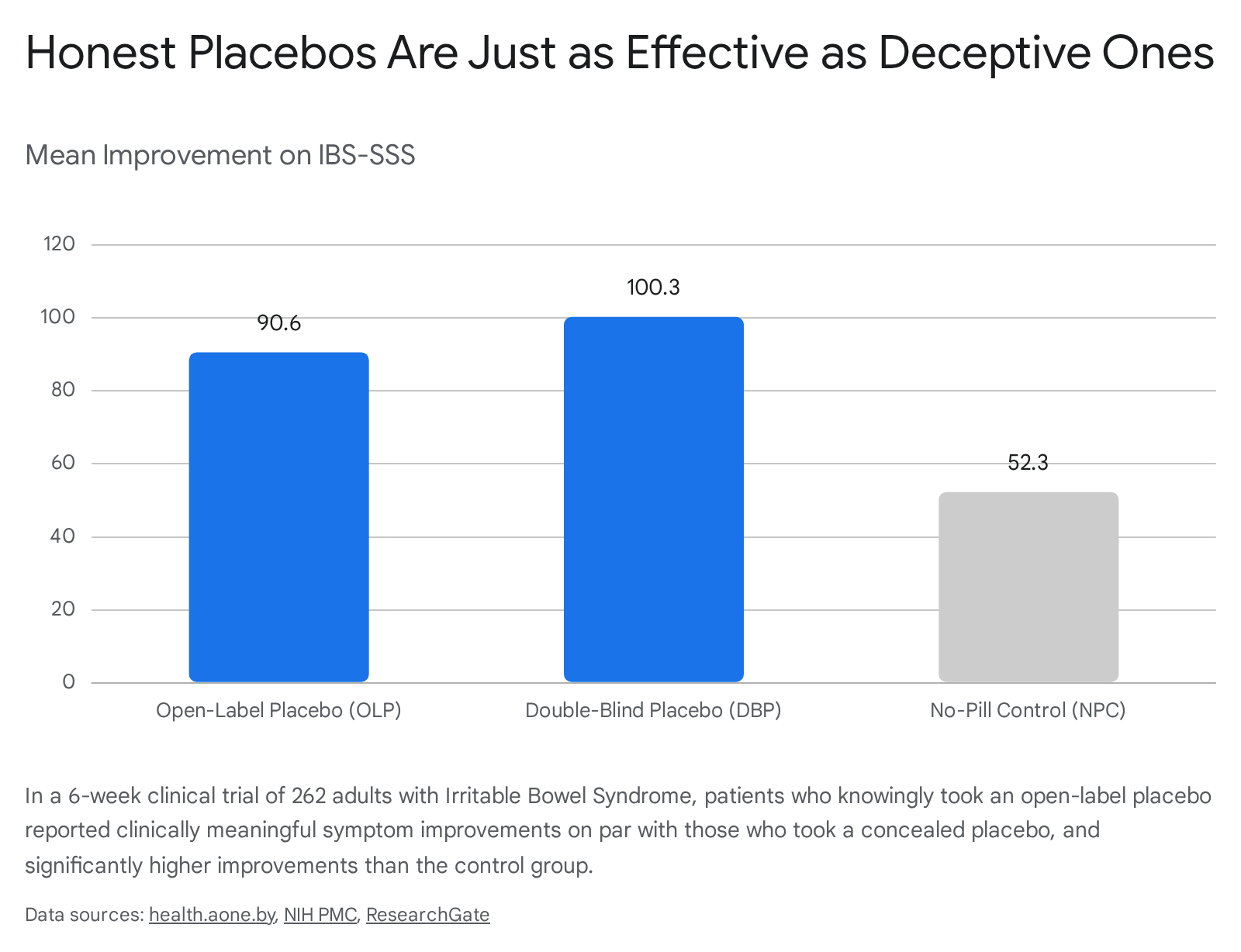
Astonishingly, 69 percent of participants in the open-label group reported a clinically meaningful reduction in IBS severity, proving that concealment is not required for the placebo effect to be highly effective .
Emerging Applications in Chronic Pain and Addiction
Since the initial IBS trial, systematic reviews have confirmed that open-label placebos can safely and ethically produce significant benefits for a wide range of chronic conditions, including chronic lower back pain, cancer-related fatigue, menopausal hot flushes, and allergic rhinitis 30333431. In trials targeting chronic musculoskeletal pain, open-label placebos enhanced pain reduction by 1.49 points on a 10-point scale, compared to only a 0.24-point change for patients who solely continued their standard treatment 34.
Recent clinical trials from 2023 - 2025 have even pushed OLP research into the realm of addiction management. In a study of 131 patients being treated for opioid use disorder, researchers administered a conditioned open-label placebo alongside a standard 90-day methadone regimen 11. While the open-label placebo did not reduce the required dosage of methadone, the patients receiving the placebo demonstrated significantly higher treatment retention rates and reported substantially better sleep quality than the control group 11.
The resounding success of OLPs proves that the ritual of pill-taking, combined with an open, educational, and empathetic doctor-patient interaction, is enough to engage the brain's predictive coding and conditioning systems without violating ethical transparency 1931.
The Dark Side: The Nocebo Effect
If positive expectations can heal, negative expectations can harm. This phenomenon is known as the nocebo effect (Latin for "I shall harm"), and it is the shadow counterpart to the placebo effect 1125.
Expecting Harm
When a patient expects a medical treatment to be painful or to cause severe side effects, they are highly likely to experience those exact adverse effects, even if they are only given an inert sugar pill 1625. The nocebo effect is not just psychological anxiety; it triggers distinct, measurable biological pathways 1516.
Physiologically, anticipating harm activates the hypothalamic-pituitary-adrenal (HPA) axis, triggering the body's stress response 25. This surge in anxiety chemically deactivates dopamine release and promotes the release of cholecystokinin (CCK), resulting in hyperalgesia - a heightened, amplified sensitivity to pain 1525. Voodoo curses and magical hexes are extreme, culturally specific examples of the nocebo effect, where a profound belief in impending harm literally causes physical deterioration 25.
Clinical and Ethical Challenges
In modern medicine, the nocebo effect presents a massive hurdle. During randomized clinical trials, researchers consistently note that participants assigned to the placebo control arms often report the exact side effects listed in the informed consent forms for the active experimental drug - such as headaches, nausea, dry mouth, or intense fatigue 2328. It is estimated that between 4 and 25 percent of patients who drop out of clinical trials due to "unacceptable levels of side effects" were actually taking a harmless placebo 10. Their debilitating symptoms were generated entirely by the nocebo response.
Furthermore, a patient's lack of trust in the medical system can induce nocebo responses. Sustained racial disparities in healthcare, where minority patients report receiving less empathy and attention from physicians, can reinforce mistrust and lead to consistently higher nocebo responses or blunted placebo responses 26. A negative psychosocial context, a rushed doctor, or a pessimistic prognosis can inadvertently harm the patient 22.
Managing the nocebo effect presents a delicate ethical challenge for doctors. Physicians are legally and ethically bound to warn patients about the potential side effects of drugs through informed consent 1015. However, focusing heavily on minor side effects can unintentionally plant the psychological seeds that cause those exact side effects to manifest 15. Researchers suggest that healthcare providers must learn to balance transparency with careful communication, educating patients about potential positive outcomes while mitigating anxiety to avoid triggering nocebo responses 1523.
Statistical Illusions vs. True Healing
While the neurobiological mechanisms of the placebo effect - dopamine, endorphins, and neural circuits - are now undeniable, it is equally important to recognize that not every patient who improves after taking a sugar pill is experiencing a true mind-body healing response. Much of what was historically labeled "the placebo effect" in early clinical trials was actually a mix of statistical illusions, reporting bias, and the body's natural biology 293632.
Two main confounding factors constantly mimic the placebo effect:
Spontaneous Remission
Many conditions, such as the common cold, mild migraines, or muscle strains, are naturally self-limiting 3. The human immune system and cellular repair mechanisms will eventually resolve these issues on their own, with or without medical intervention. If a patient takes a placebo right before their immune system finally clears a lingering infection, they will incorrectly attribute their recovery to the placebo pill 329. The end of symptoms is simply a biological coincidence, often referred to as the natural history of the disease 329.
Regression to the Mean
In statistics, the concept of "regression to the mean" dictates that extreme outliers tend to move closer to the average over time 3632. Patients usually seek medical treatment or decide to enroll in clinical trials when their symptoms - such as back pain or severe depression - are at their absolute, unbearable worst 2936. Because their pain is statistically unlikely to remain at that peak extreme forever, they will naturally regress to their mean baseline and feel slightly better a week later, regardless of whether they took a real drug, a placebo, or nothing at all 32.
Studies estimating the impact of regression to the mean suggest that it accounts for a massive portion of the improvements historically attributed to placebos, even affecting biochemical tests where high-abnormal patients naturally drift downward over time 32.
The Importance of Three-Arm Trials
Because spontaneous remission and statistical regression occur in every patient population, it is scientifically impossible to measure the true placebo effect by simply looking at how much a placebo group improves 14. The placebo group will always show improvement due to these natural statistical drifts 32.
To separate true, neurobiologically driven placebo effects from these statistical illusions, modern researchers must use three-arm clinical trials 1433. This design compares an active drug group, a placebo group, and an untreated (no-pill) control group 14. Both the placebo group and the untreated group will benefit equally from regression to the mean and spontaneous remission. Therefore, the difference between the untreated group and the placebo group represents the true, isolated, psychologically driven placebo effect 1433.
Bottom line
The placebo effect is not a trick, a statistical illusion, or evidence of an imaginary illness. It is a powerful, hardwired neurobiological response where the brain - triggered by expectations, classical conditioning, and the reassuring ritual of medical care - releases endogenous chemicals like endorphins and dopamine to physically alleviate subjective symptoms such as pain, anxiety, and fatigue. While placebos cannot cure objective diseases like tumors or bacterial infections, recent landmark studies proving that transparent, "open-label" placebos still provide significant relief suggest that the medical community has only just begun to ethically harness the full therapeutic potential of the mind-body connection.