
Do Gratitude Practices Actually Work
Research demonstrates that structured gratitude practices offer small but reliable improvements to subjective wellbeing and mild reductions in symptoms of depression and anxiety. By activating the brain's reward circuitry and downregulating stress hormones, these exercises can foster long-term emotional resilience. However, gratitude is not a cure-all and can actively backfire if it is overused, misapplied in severe clinical settings, or weaponized as "toxic positivity" to suppress genuine emotional pain.
The Scientific Consensus on Saying Thanks
For much of human history, gratitude was largely relegated to the realms of philosophy, ethics, and theology. However, in the early 2000s, the positive psychology movement - led by researchers like Robert Emmons and Michael McCullough - began operationalizing gratitude as a measurable, trainable cognitive skill 123. Today, the scientific consensus supports the idea that deliberately focusing on positive life elements yields tangible mental health benefits, though the magnitude of these effects requires careful, nuanced interpretation.
Evaluating the Meta-Analyses on Wellbeing
The efficacy of gratitude practices has been tested across hundreds of studies globally. To determine whether these practices universally improve human flourishing, a landmark 2025 meta-analysis published in the Proceedings of the National Academy of Sciences (PNAS) synthesized data from 145 studies involving over 24,000 participants across 28 countries 243. The researchers sought to definitively answer whether gratitude interventions work, and if so, for whom.
The findings revealed that gratitude interventions generated a small but statistically significant overall increase in subjective wellbeing, yielding a Hedges' g effect size of 0.19 2. The researchers noted that these practices were most effective when the primary outcome measured was an increase in positive emotions, rather than a decrease in negative emotions 23. Furthermore, the interventions proved more potent when participants engaged in multiple types of gratitude exercises rather than relying on a single method 23.
When examining mental illness rather than general wellbeing, the effects of gratitude appear slightly more pronounced. A separate meta-analysis of 70 studies, encompassing more than 26,000 child, adolescent, and adult participants, observed a moderate negative correlation between gratitude and depression, with an effect size of r = -0.39 67. After adjusting for potential small-sample biases, the effect size remained robust at r = -0.36, indicating that individuals who experience higher levels of gratitude consistently report lower levels of clinical depression 67. Dozens of randomized clinical trials confirm that patients undergoing gratitude interventions experience better mental health and fewer symptoms of anxiety 45.
The Challenge of Active Control Groups
Despite these positive findings, behavioral scientists emphasize a crucial methodological caveat regarding the nature of control groups in psychological research. When researchers compare gratitude journaling to a neutral activity - such as listing daily hassles or writing down mundane everyday events - gratitude interventions show a clear, statistically significant benefit 101112.
However, when gratitude is compared to "active control groups" that involve other positively valenced activities, the unique benefits of gratitude often narrow. Active controls might include exercises like identifying personal character strengths, performing random acts of kindness, or savoring a pleasurable memory 614. In these rigorous comparisons, gratitude interventions do not always outperform the alternative positive activities 789. This suggests that while gratitude interventions are highly effective, they are not necessarily a unique psychological panacea. Instead, they represent one of several valid cognitive tools that help shift human attentional bias away from threat and toward reward 810.
Publication Bias in Positive Psychology
A persistent concern in positive psychology research is publication bias, often referred to as the "file drawer problem." This occurs when studies demonstrating significant, positive effects are published, while studies showing no effect are ignored, creating an artificially inflated perception of an intervention's efficacy 711.
Early reviews of gratitude research raised concerns that the literature might be skewed by small-sample bias and the selective reporting of positive outcomes 7820. However, the rigorous 2025 PNAS meta-analysis actively tested for this using advanced statistical modeling. The researchers found no credible evidence of publication bias inflating their results; in fact, their models indicated that studies reporting non-significant or negative results were actually slightly more likely to be published in this specific domain 8. This provides a high degree of confidence that the small but reliable benefits of gratitude practices are genuine phenomena rather than statistical artifacts 811.
How Gratitude Rewires the Brain
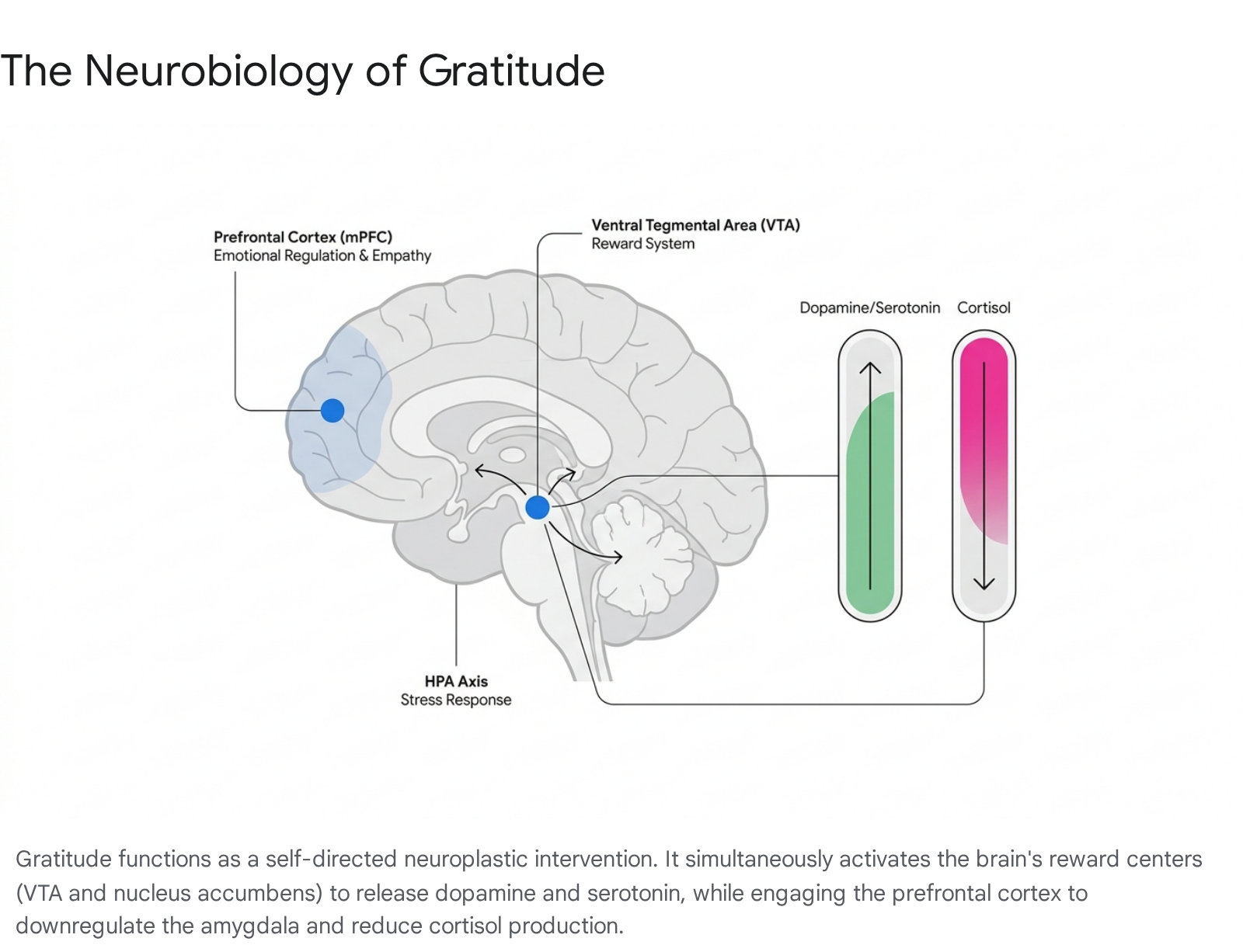
The psychological benefits of gratitude are deeply anchored in observable neurobiological mechanisms. Consistent gratitude practice acts as a self-directed neuroplastic intervention, physically strengthening the neural circuits associated with social connection, cognitive reappraisal, and reward, while simultaneously weakening the pathways tied to threat and negativity 2112.
Activating the Reward System
When individuals experience or express genuine gratitude, it activates the brain's primary reward pathways. Functional magnetic resonance imaging (fMRI) studies demonstrate that grateful reflection stimulates the ventral tegmental area (VTA) and the nucleus accumbens 123. These specific brain regions form a crucial hub in the brain's reward circuitry and are densely packed with dopamine receptors 123.
Dopamine is the neurotransmitter primarily associated with pleasure, motivation, and positive reinforcement. When a person practices gratitude, the resulting release of dopamine reinforces the behavior, creating a positive feedback loop 123. The brain begins to associate the act of scanning the environment for positive elements with chemical rewards. Alongside dopamine, gratitude practices also stimulate the release of serotonin, a neurotransmitter that is fundamentally crucial for mood regulation and emotional equilibrium 124. This dual release of "feel-good" chemicals is why regular gratitude practice can make optimistic thinking feel increasingly automatic over time 12.
Downregulating the Stress Response
In addition to boosting positive neurotransmitters, gratitude actively suppresses the body's physiological stress responses. Psychophysiological data reveal that feelings of appreciation downregulate the hypothalamic-pituitary-adrenal (HPA) axis 21. This downregulation results in significantly reduced levels of cortisol, which serves as the body's primary stress hormone 11225.
By decreasing cortisol production, gratitude helps shift the autonomic nervous system away from a sympathetic "fight-or-flight" state and toward a parasympathetic "rest-and-digest" state 1226. This neurological shift promotes deep relaxation and reduces the hyperarousal that often accompanies chronic anxiety 112. Consequently, individuals who regularly practice gratitude exhibit decreased inflammatory biomarkers, lower blood pressure, and increased cardiac vagal tone, all of which contribute to better long-term cardiovascular health 211226.
Enhancing Cognitive Flexibility
Beyond immediate chemical rewards, long-term gratitude practices induce structural and functional changes in the medial prefrontal cortex (mPFC) and the anterior cingulate cortex (ACC) 212325. These areas of the brain are responsible for advanced emotional regulation, empathy, moral cognition, and complex decision-making 122527.
Increased activation in the prefrontal cortex allows individuals to better regulate amygdala reactivity. The amygdala is the brain's threat-detection center; when it is highly reactive, individuals are prone to anxiety and panic. Gratitude strengthens the top-down regulation of these negative emotional responses 21. This enhanced brain activity suggests that gratitude plays a crucial role in fostering cognitive flexibility, allowing individuals to experience negative or threatening stimuli without becoming entirely overwhelmed by fear 2125.
Physical Health and Sleep Improvements
The physiological stabilization brought on by gratitude extends beyond the brain, offering measurable improvements to physical health. One of the most consistently reported benefits of gratitude journaling is improved sleep quality 12613.
Because gratitude downregulates the sympathetic nervous system, it reduces the nighttime hyperarousal and rumination that typically interfere with sleep onset 114. Studies indicate that individuals who practice gratitude before bed fall asleep faster, sleep more deeply, and report feeling more refreshed upon waking 113. This improved sleep architecture subsequently contributes to better daytime cognitive function, higher energy levels, and stronger emotional regulation, creating a virtuous cycle of physical and mental health 113. Furthermore, grateful adults are statistically more likely to engage in healthy behaviors, such as regular exercise and balanced eating, and they report fewer generalized physical complaints and lower levels of chronic pain 24263031.
Popular Gratitude Interventions Compared
Not all gratitude practices are created equal. Researchers have developed and tested a variety of exercises over the past two decades, observing that the structure, target, and social nature of the intervention greatly influence its psychological impact.
| Intervention Type | Methodology | Time Commitment | Key Benefits | Potential Drawbacks |
|---|---|---|---|---|
| Three Good Things | Listing three positive events daily or weekly, and explaining why they occurred. | 5 - 10 minutes per session | Highly durable boosts in wellbeing; directly combats negativity bias. | Can feel repetitive; susceptible to habituation if done too frequently. |
| Gratitude Letter / Visit | Writing a detailed letter of thanks to a benefactor, sometimes delivered in person. | 15 - 30 minutes, single or infrequent sessions | Produces massive short-term spikes in positive affect and social connectedness. | Can induce feelings of guilt or indebtedness, particularly in collectivist cultures. |
| Mental Subtraction | Imagining life if a positive event, achievement, or person had never entered it. | 5 - 10 minutes per session | Highly potent; counters hedonic adaptation by resetting one's baseline. | Can be uncomfortable as it requires dwelling temporarily on hypothetical loss. |
The "Three Good Things" Exercise
The "Three Good Things" exercise, sometimes referred to as "counting blessings," is arguably the most widely validated positive psychology intervention in the scientific literature 1432. In this practice, participants are instructed to reflect on their day and write down three positive experiences, no matter how small. Crucially, they are also asked to reflect on why those good things happened 1432.
This specific mechanism - attributing causality - is what makes the exercise effective. By forcing the brain to analyze the root causes of positive outcomes, individuals begin to recognize their own agency or the benevolence of others 14. This directly counteracts the brain's evolutionary "negativity bias," which naturally prioritizes threats and problems over safety and joy 1433. Clinical trials initiated by Martin Seligman demonstrated that patients who continued this exercise beyond an initial one-week period experienced sustained increases in happiness and decreases in depressive symptoms that were still measurable up to six months later 1032.
Gratitude Letters and the Complexity of Indebtedness
Writing a letter of gratitude to someone who has never been properly thanked is known for producing the largest acute spikes in happiness and positive affect among all interventions 111011. Delivering this letter in person, often called a "gratitude visit," fosters profound social connectedness and elevation 21134.
However, this interpersonal approach carries unique psychological complexities. Research indicates that while gratitude letters boost positive emotions, they also reliably increase feelings of indebtedness 1115. For some individuals, the act of documenting exactly how much someone else has helped them highlights a perceived imbalance in the relationship. This can lead to an uncomfortable obligation to "repay" the kindness, mingling appreciation with mild anxiety 1136. This effect is particularly pronounced when the intervention is applied without considering cultural context, as the social dynamics of debt and reciprocity vary wildly across the globe.
The Counterintuitive Power of Mental Subtraction
Humans possess a psychological trait known as "hedonic adaptation." This is the tendency to quickly get used to positive changes in our lives, eventually taking them for granted 1638. A supportive spouse, a reliable job, or a safe neighborhood eventually becomes the invisible baseline expectation. Traditional gratitude lists sometimes fail to overcome this adaptation because listing familiar blessings can feel rote.
"Mental subtraction" attempts to bypass hedonic adaptation by asking individuals to vividly imagine their lives without a specific positive element 3338. Participants might be asked to visualize what their current reality would look like if they had never met their partner, or if a specific career achievement had never occurred 3817. By cognitively simulating the absence of a blessing, individuals effectively reset their psychological baseline. Studies indicate that mental subtraction can elicit deeper, more authentic feelings of appreciation than simply listing good things, as it provides a stark emotional contrast that awakens the brain's reward centers to the value of what is already present 113817.
The "Dosage" Dilemma: How Often Should You Journal?
A common misconception in the wellness space is that if practicing gratitude is beneficial, then practicing it more frequently must be even better. However, psychological research strongly contravenes this assumption. Overdosing on gratitude practices can trigger habituation, diminishing returns, and even an inadvertent decline in wellbeing.
Habituation and the Effort-as-Information Heuristic
Seminal research spearheaded by psychologist Sonja Lyubomirsky evaluated the impact of varying the frequency of gratitude journaling. The study demonstrated that participants who journaled their gratitude once or twice a week experienced significant boosts in happiness over a six-week period 164018. Conversely, participants who were instructed to write in their gratitude journals three times a week, or every single day, saw no such benefits - and in some cases, their wellbeing actually decreased from baseline 164018.
This counterintuitive phenomenon is driven by two distinct psychological factors. First, the human brain rapidly adapts to repetitive stimuli. Writing about blessings every single day makes the exercise feel mundane and obligatory, stripping it of its emotional resonance and novelty 161920. Second, forced daily journaling can activate what psychologists call the "effort-as-information heuristic" 18. If a person is tired and struggles to think of three novel things to be grateful for on a random Tuesday evening, their brain may subconsciously misinterpret this difficulty. The individual might conclude, "If it is this hard for me to find something to be grateful for today, my life must actually be quite bleak" 18.
Finding the Optimal Frequency
Because of these psychological pitfalls, behavioral scientists and clinicians generally recommend aiming for depth over breadth. Engaging in detailed, highly specific gratitude journaling one to three times per week is vastly superior to generating shallow, repetitive daily lists 151619. Focusing deeply on a single meaningful interaction, and writing elaborately about why it matters, yields a stronger neurobiological response than briefly cataloging ten disparate things 151619. Interventions that are delivered in micro-practices, rather than massed single doses, produce the most durable long-term gains, provided they do not cross the threshold into daily fatigue 10.
Who Benefits Most? From First-Graders to Parents
Historically, gratitude research focused heavily on university students and adult populations. However, recent longitudinal studies have expanded to evaluate how these interventions impact diverse demographics, revealing profound benefits for both early childhood development and family dynamics.
Early Childhood and Mentoring
Recent research demonstrates that it is never too early to cultivate gratitude. A rigorous 28-week study conducted by researchers at Clemson University in 2024 evaluated the impact of gratitude interventions on first-graders, children who were approximately six years old 1213. The children engaged in simple, 10-to-15-minute daily practices, such as writing thank-you cards, creating gratitude collages, and basic journaling 12.
The findings were striking. Even at this young age, the children showed significant boosts in overall wellbeing, greater academic interest, and increased prosocial behavior 1213. When the children expressed gratitude, friends were the most common theme, highlighting the vital role of social connection in early development 12. Furthermore, gratitude practices were identified as an evidence-based strategy to help young people recover from trauma and isolation, building emotional regulation skills that act as a buffer against anxiety 12. In mentoring programs, integrating group gratitude activities has been shown to reduce risky behaviors in adolescents and foster a widespread positive community impact 12.
Impact on Parenting and Family Dynamics
Gratitude interventions also offer unique benefits to caregivers. Parents are frequently inundated with advice on how to improve their children's development, but caregiver wellbeing is often neglected. A 2024 study published in the journal Emotion evaluated the effects of daily gratitude on parents 21.
Through both a daily experience study and a short-term longitudinal experiment, researchers found that parents who expressed gratitude experienced greater personal wellbeing and improved overall family functioning 21. Notably, the gratitude expressed did not need to be directed at the children; general gratitude for any aspect of life was sufficient to improve the parent-child relationship 21. This suggests that promoting a parent's general emotional health through gratitude acts as a rising tide that lifts the entire family dynamic, without requiring the parent to expend additional energy focusing explicitly on parenting tasks 21.
Toxic Positivity and When Gratitude Backfires
As gratitude has migrated from clinical research into mainstream wellness culture, it has frequently been commodified and misapplied. The most common and damaging distortion of gratitude is "toxic positivity" - the culturally pervasive demand to view all experiences in a positive light, resulting in the denial, suppression, or invalidation of authentic emotional pain 30314546.
Distinguishing Healthy Gratitude from Toxic Positivity
True gratitude and toxic positivity operate via fundamentally opposed psychological mechanisms. Healthy gratitude is fiercely grounded in reality; it acknowledges that suffering, grief, and joy can coexist simultaneously 24274647. A healthy gratitude practice allows a person to truthfully state, "I am deeply grieving and anxious about my diagnosis, and I am grateful for the friend who brought me dinner today." It does not ask the individual to erase the negative to appreciate the positive 273146.
In stark contrast, toxic positivity suppresses negative affect with dismissive platitudes 304648. Phrases like, "Just be grateful it isn't worse," "Look on the bright side," or "Everything happens for a reason" are designed to shut down uncomfortable conversations and bypass difficult emotions 304648. Suppressing negative emotions through forced optimism is actively harmful to physical and mental health. It prevents cognitive processing, spikes cortisol levels, and leaves individuals feeling isolated, ashamed, and misunderstood 27304649.
Clinical Contraindications: When Not to Practice
Because gratitude requires a degree of cognitive flexibility and emotional bandwidth, it is not safe or effective for everyone at all times. Mental health professionals explicitly warn that gratitude interventions can backfire and cause iatrogenic (treatment-induced) harm in several specific clinical scenarios:
- Severe Depression and Anxiety: In the depths of a major depressive episode, patients often suffer from profound self-loathing and anhedonia (the inability to feel pleasure). Asking a severely depressed individual to list their blessings can perversely highlight their inability to feel joy, thereby deepening their feelings of failure, guilt, and hopelessness 51. Similarly, for individuals with severe anxiety, open-ended journaling can become a trigger for catastrophic rumination 51.
- Recent Trauma: In the immediate aftermath of a traumatic event, pushing a patient to find a "silver lining" or practice gratitude is a form of emotional avoidance 51. Trauma-informed care prioritizes safety and emotional stabilization before introducing interventions that might feel dismissive of a survivor's acute pain 51.
- Active Eating Disorders: Patients dealing with anorexia nervosa, bulimia, or binge-eating disorder can inadvertently use gratitude journaling to reinforce their pathology. For instance, a patient might express gratitude for their willpower to restrict food, or use journaling to rationalize a binge-purge cycle under the guise of "learning resilience" .
In these complex clinical presentations, positive psychology tools should only be introduced under the direct supervision of a licensed clinician, ensuring they complement rather than disrupt evidence-based treatments 51.
Cultural Nuances: Does Gratitude Translate Worldwide?
A significant historical limitation in psychological research, including the study of gratitude, is its over-reliance on "WEIRD" populations - meaning people from Western, Educated, Industrialized, Rich, and Democratic societies (primarily white American college students) 352. As researchers have expanded their scope globally over the past decade, it has become evident that gratitude is not experienced, expressed, or conceptualized uniformly across different cultures 3352.
Concrete vs. Connective Gratitude
The cultural framework in which a person is raised deeply influences how they perceive interpersonal benefits. In highly individualistic cultures, such as the United States, gratitude is typically viewed as a straightforward, positive emotion that asserts personal autonomy and yields personal wellbeing 334. However, in collectivist cultures - which account for roughly 85% of the global population - social harmony is often maintained through complex, enduring networks of reciprocal obligation 352.
This divergence is visible early in life. Research led by Jonathan Tudge examining children across seven different nations found that American youth default to "concrete gratitude" 352. When granted a wish, American children tend to say thank you for the specific item or favor. In contrast, children in China and South Korea demonstrate "connective gratitude" 352. They are more likely to pay back a kindness with a reciprocal action that honors the relationship and the social hierarchy, rather than merely offering verbal thanks for an object 352.
The Western Bias in Positive Psychology
Because of these differing social structures, standardized Western gratitude interventions do not always produce identical results globally. In randomized controlled trials involving participants from India, Taiwan, and South Korea, writing direct gratitude letters did not reliably improve life satisfaction to the same degree as it did for Anglo Americans 333452.
In many Eastern cultures, receiving a favor places the recipient in a state of social debt. Consequently, expressing gratitude through a formal letter often elicits a complex mixture of emotions, mingling genuine appreciation with acute feelings of guilt, sadness, embarrassment, and indebtedness 33452. For example, one study noted that Indian participants who wrote gratitude letters reported feeling positive emotions but also significantly more guilt and a persistent desire to offer a reciprocal gift as a token of debt repayment 52. This highlights the absolute necessity of tailoring wellbeing interventions to local cultural frameworks, rather than assuming a single psychological exercise will universally promote happiness 33452.
The Booming Commercial Gratitude Industry
The scientific validation of gratitude has not remained confined to academia; it has spawned a massive commercial ecosystem. What was once a private, introspective exercise has been heavily monetized, transforming into a global sector that spans physical publishing, corporate gifting, and advanced digital technology.
The Rise of AI-Powered Digital Journal Apps
The most rapid commercial growth is occurring in the digital wellness sector. The global market for digital journal apps - which predominantly feature gratitude prompts, mood tracking, and mindfulness exercises - was valued at $5.1 billion in 2024 by Straits Research, with projections estimating it will reach $13.58 billion by 2033, growing at an 11.5% CAGR 53. (Other market analysts, using narrower definitions specifically for "gratitude journal apps," place the market size closer to $310 million in 2024, but forecast a similarly aggressive growth rate of 15.2% over the next decade 54).
This rapid economic expansion is largely driven by a paradigm shift in how these applications operate. Older digital journals were simply passive text repositories. Today, the market is dominated by AI-integrated platforms that act as active, personalized therapeutic aids 535455. Modern applications utilize machine learning algorithms to prompt users with targeted reflection questions, perform sentiment analysis on their text entries, and integrate with wearable technology 5355. This integration allows users to correlate their gratitude journaling habits with real-time biometric data, such as heart rate variability and sleep patterns, turning abstract wellbeing into quantified self-care 5355.
Corporate Wellness and the Gifting Market
The commercialization of gratitude also extends heavily into the corporate sphere. The global corporate gifting market, which utilizes tangible gifts to express institutional gratitude to employees and clients, was valued at nearly $840 billion in 2024 and is projected to exceed $919 billion in 2025 56.
Businesses are increasingly recognizing the high return on investment associated with formal gratitude programs. Market research indicates that companies investing strategically in corporate gifting see substantial boosts in client retention and employee engagement, as recipients feel their contributions are visibly valued 5657. Concurrently, corporate wellness programs are purchasing enterprise licenses for digital gratitude applications, embedding cognitive wellbeing practices directly into institutional health strategies as a bulwark against workforce burnout 5455.
Bottom line
Practicing gratitude is a scientifically validated method for enhancing subjective wellbeing, improving sleep, and buffering against the physiological effects of daily stress. By strengthening the brain's reward networks and calming the nervous system, structured exercises like the "Three Good Things" protocol and mental subtraction can build lasting emotional resilience. However, gratitude is not a cure for clinical mental illness, and weaponizing forced positivity to mask genuine pain is actively harmful; true gratitude is most effective when practiced in moderation, tailored to cultural contexts, and utilized alongside the authentic processing of life's inevitable hardships.