
How to Find and Win College Scholarships
Finding and winning college scholarships requires treating the application process like a highly organized, year-round endeavor that prioritizes low-competition local awards over highly advertised national sweepstakes. Success depends on maintaining a strategic timeline, submitting the Free Application for Federal Student Aid (FAFSA) early to unlock institutional aid, and tailoring application essays to match each benefactor's specific goals. By utilizing trusted search platforms, leveraging artificial intelligence ethically for editing, and avoiding data-harvesting scams, students can significantly reduce their out-of-pocket tuition costs.
The Financial Reality of Higher Education
Going to college represents one of the most significant financial investments a family will ever make, and the price tag continues to climb. For the 2025 - 2026 academic year, the average published tuition and fees for a public four-year university sit at $11,950 for in-state students and $31,880 for out-of-state students 1. For private nonprofit four-year institutions, that figure jumps to an average of $45,000 1.
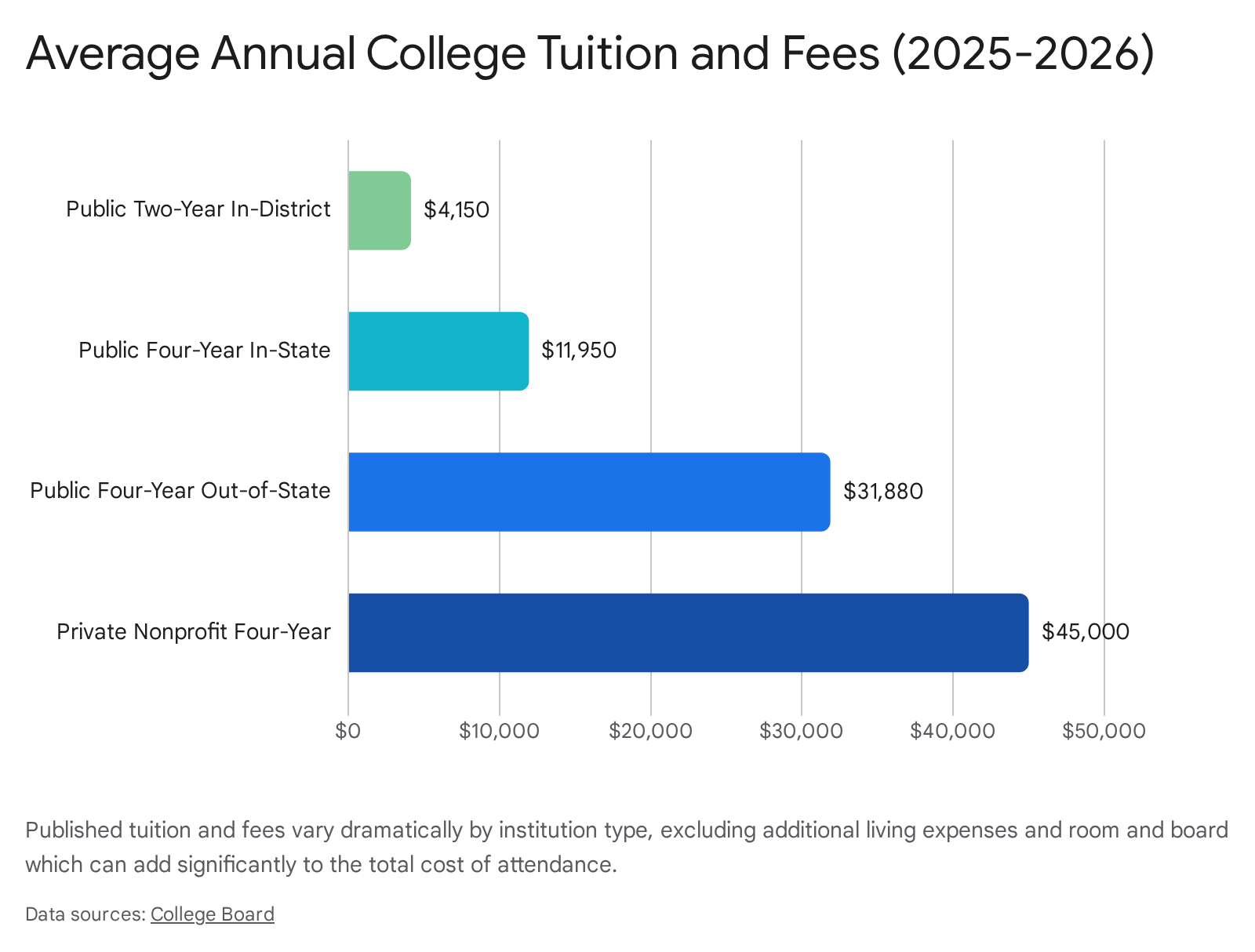
When additional necessities like housing, food, books, and transportation are factored in, the total annual cost of attendance can easily exceed $60,000 to $80,000 at private colleges 22.
Despite these daunting sticker prices, there is a vast reservoir of unused financial aid. An estimated $100 million in private scholarship money and up to $2 billion in federal Pell Grants go unclaimed every single year 345. Much of this money is left on the table simply because students assume they will not qualify, do not know where to look, or miss critical filing deadlines 7. Furthermore, nearly 41% of high school students fail to complete the FAFSA, instantly locking themselves out of billions in available federal and state grants 5.
Currently, only about 7% to 11% of college students receive a private scholarship 57. This low success rate is largely because a vast majority of students rely solely on heavily trafficked national search engines rather than developing a targeted, localized application strategy. Understanding that scholarships are not exclusively reserved for high school valedictorians or elite athletes is the first step toward securing funding. Private capital exists for students of specific ethnic backgrounds, intended majors, hobbies, community affiliations, and varying income levels. Securing this money requires shifting focus from looking for a single "full ride" to building a diverse portfolio of smaller, stackable awards.
The Core Strategy: Local vs. National Scholarships
When students begin their scholarship search, they routinely gravitate toward the most heavily advertised, high-dollar awards found on the internet. While these national scholarships offer substantial payouts, they feature lottery-level odds. A smarter, significantly more lucrative strategy involves prioritizing local awards where the statistical probability of winning is exponentially higher.
Local scholarships are funded by organizations tied to a specific geographic area, such as a single county, a municipality, or even a specific high school. Benefactors typically include local banks, credit unions, Rotary and Lions clubs, religious organizations, parent-teacher associations, community foundations, and local employers 8. The primary advantage of local scholarships is the dramatically reduced applicant pool. While a national corporate scholarship might attract tens of thousands of applicants, a $1,000 scholarship offered by a local law firm might only receive a few dozen entries 89.
Because these awards are geographically restricted, the competition is inherently capped. Data indicates that private national scholarships generally yield success rates of roughly 7% to 10%, but acceptance rates for hyper-local or niche scholarships can rise well above 20% to 30% simply because so few eligible students take the time to apply 8. Local organizations are deeply invested in their communities and actively want to fund students they feel a geographic or personal connection to 9. Winning three or four local scholarships worth $1,000 each takes roughly the same amount of effort as applying for one highly competitive national award, but yields a significantly higher probability of an actual payout 910.
Students can uncover local scholarships by consulting their high school guidance counselor's office, which often holds exclusive lists of local benefactors. Reviewing high school graduation programs from previous years is another highly effective tactic to see exactly which local groups historically award money to graduating seniors 10. Additionally, contacting parents' employers, labor unions, or checking the websites of local community foundations and Chambers of Commerce will often reveal unadvertised opportunities 1112.
While local awards should form the bedrock of a student's strategy, national scholarships still have a place in a diversified application portfolio. National scholarships are generally hosted on large aggregator databases and offer larger cash payouts, sometimes covering full tuition 8. However, they often require extensive materials, including multiple personal essays, academic portfolios, recommendation letters, and sometimes rigorous video interviews 9.
A common trap for applicants is the "No-Essay Sweepstakes" scholarship. These are heavily promoted on national databases and require only a name and email address to enter. Because the barrier to entry is zero, millions of students apply, rendering them essentially data-collection lotteries 8. Students are vastly better served spending two hours writing a thoughtful, tailored essay for a $500 local award than spending ten minutes clicking through dozens of national no-essay sweepstakes.
| Feature Comparison | Local Scholarships | National Scholarships |
|---|---|---|
| Primary Funding Source | Rotary clubs, local businesses, community foundations | Major corporations, national non-profits, federal entities |
| Applicant Pool Size | Very small (dozens to hundreds of applicants) | Massive (tens to hundreds of thousands of applicants) |
| Average Award Size | Smaller ($500 to $2,500) | Larger ($5,000 to Full Tuition) |
| Statistical Probability of Winning | High (often 20% to 30% for specific niche awards) | Very Low (often less than 1% due to volume) |
| Discovery Channels | High school counselors, local library, regional employers | Large search engines (Fastweb, Scholarships.com, BigFuture) |
Digital Search Platforms and Data Privacy
To access both regional and national awards, students rely heavily on scholarship search engines. These digital platforms require users to create an extensive profile detailing their GPA, intended major, demographic background, and extracurricular interests. The platforms then utilize matching algorithms to curate a personalized list of opportunities 67.
Choosing the right platform is critical, as they vary wildly in their interface, exclusivity, and approach to user privacy. Fastweb stands as one of the oldest and most trusted platforms, boasting an expansive database of over 1.5 million scholarships valued at more than $3.4 billion 67. Its algorithm updates daily, pushing new matches directly to a student's dashboard. While it is highly regarded for its sheer volume, users must be diligent in manually filtering out heavily advertised sweepstakes that clutter the feed 615.
Scholarships.com offers an even larger database, featuring more than 3.7 million programs. It excels in its granular filtering capabilities, allowing users to drill down into highly specific demographic and major-related categories 817. The platform frequently uncovers hyper-local awards that other engines miss, making it a powerful tool for discovering niche funding 18.
BigFuture, administered by the College Board, integrates directly with the organization responsible for the SAT and Advanced Placement (AP) exams. It curates over 6,000 heavily vetted, highly legitimate scholarship programs 617. Because it operates under a major educational nonprofit, it is particularly strong and trustworthy for students who are already utilizing College Board services for their broader college planning 17.
Bold.org takes a fundamentally different approach. Unlike traditional aggregators that link out to third-party applications, Bold.org functions directly with donors. This means that 99% of the scholarships listed on Bold.org are exclusive to the platform and can be applied for directly within the site using a single unified profile 9. It features a sleek, modern interface and is highly popular among students who prefer a streamlined application process without navigating away to external websites 920.
Appily, formerly known as Cappex, combines college admission tools with scholarship matching. It is unique in its dual functionality, showing students their statistical admission chances at specific colleges while simultaneously matching them with institutional and merit-based scholarships tied directly to those exact schools 1710. Finally, Going Merry is designed to mimic the Common App format, allowing students to autofill their demographic information and core essays across multiple scholarship applications simultaneously, which saves significant administrative time during peak application seasons 618.
| Search Platform | Core Advantage | Platform Structure |
|---|---|---|
| Fastweb | Massive volume of opportunities | Aggregator linking to external applications |
| Scholarships.com | Highly granular filtering tools | Aggregator with a 3.7 million award database |
| BigFuture (College Board) | Vetted legitimacy and SAT integration | Curated database managed by an educational nonprofit |
| Bold.org | Exclusive, donor-funded awards | Direct application hosted entirely on the platform |
| Appily (Cappex) | Tied directly to college admission odds | Dual-purpose institutional matching tool |
| Going Merry | Common App-style bulk applications | Autofill capabilities across multiple awards |
The Data Harvesting Risk in Scholarship Searches
Students must be highly protective of their personal data when utilizing search engines. The darker reality of the scholarship industry is that many "free" platforms operate primarily as lead generators. Their underlying business model relies on harvesting student data - including phone numbers, physical addresses, and academic interests - and selling it to marketing partners, student loan companies, and even colleges looking for prospective applicants to boost their marketing metrics 112312.
Platforms like ScholarshipPoints and its parent company Edvisors have historically collected and sold prospective students' personal information under the guise of offering scholarship sweepstakes 12. While some major platforms explicitly note in their lengthy privacy policies that user data may be shared with third parties or advertising networks, other organizations operate as non-profits and strictly prohibit the sale of personal information 111213. For example, platforms like ScholarTrail actively advertise their minimal data collection policies, ensuring an automatic purge of personally identifiable information after periods of inactivity to prevent long-term data exploitation 11.
To minimize spam and protect their digital footprint, students are strongly advised to create a dedicated, professional email address specifically for scholarship applications 26. This simple operational step prevents a student's primary personal inbox from being permanently overwhelmed by promotional college marketing emails and third-party solicitations.
Navigating the Free Application for Federal Student Aid (FAFSA)
While hunting for private scholarships is crucial, the most substantial and reliable source of college funding comes directly from the federal government and the colleges themselves. Accessing this money requires filing the Free Application for Federal Student Aid (FAFSA). The FAFSA serves as the absolute gateway to federal Pell Grants, federal work-study programs, low-interest federal student loans, and nearly all state-level and institutional aid 1415.
The financial aid landscape underwent a massive legislative overhaul starting in the 2024 - 2025 academic year due to the FAFSA Simplification Act 161731. The initial rollout of this new system was historically plagued by technical glitches and severe delays, causing widespread panic among financial aid offices and families. However, the system has stabilized and shown significant improvements for the 2025 - 2026 and 2026 - 2027 application cycles 3218.
A core change under the new FAFSA framework is the shift from the Expected Family Contribution (EFC) to the Student Aid Index (SAI) 141634. The SAI is designed to be a more accurate measure of a family's true ability to pay. Unlike the old EFC, which stopped at zero, the SAI can drop as low as negative $1,500, allowing financial aid administrators to more accurately identify and support students with the most profound financial need 35.
Additionally, under the FUTURE Act, all applicants and their "contributors" (which includes parents or spouses) must now actively consent to the Direct Data Exchange (FA-DDX). This system allows the Department of Education to pull tax information directly from the Internal Revenue Service, dramatically streamlining the user experience and reducing the number of questions on the form from over 100 to as few as 18 to 36 141731.
The legislation also overhauled Pell Grant access, linking eligibility directly to family size and the federal poverty guidelines rather than complex, opaque formulas 1735. This pivotal change allows students to predict their exact Pell Grant eligibility before they even begin applying to colleges, expanding maximum Pell Grant access to an estimated 1.5 million additional students nationwide 1431. However, a major drawback for middle-class families under the new system is the complete removal of the "sibling discount." The new FAFSA formula no longer divides a family's financial responsibility by the number of children they have enrolled in college simultaneously, meaning families with multiple college students may see a reduction in their overall aid eligibility 1531.
Filing the FAFSA as early as possible is vital because many state grants and institutional scholarships are awarded on a first-come, first-served basis until funds are completely depleted 19. Historically, the FAFSA opened reliably on October 1 each year 31. Due to the Simplification Act overhauls, recent launch dates have fluctuated. For the 2025 - 2026 school year, the FAFSA underwent an extensive beta testing period before launching to the general public in late November 2024 3738. Looking ahead to the 2026 - 2027 academic year, the Department of Education successfully stabilized the platform, launching the application early on September 24, 2025, beating their own October 1 target 3237.
Students must proactively track three separate FAFSA deadlines. The college deadline is set by individual universities, which often establish priority filing dates between November 1 and March 1 to distribute their limited pool of institutional merit and need-based aid. The state deadline is set by state higher education agencies to distribute state-funded grants; for instance, California's priority deadline is typically in early April, while Texas requires priority submission by mid-March 19. Finally, the federal deadline is June 30 at the end of the academic year for which aid is sought, though waiting until this final deadline guarantees that all first-come, first-served state and institutional money will be exhausted 37.
State-Sponsored and Career-Specific Aid
Many students overlook massive pools of state-funded aid. State governments heavily subsidize their own public universities to keep talented high school graduates from leaving the local economy and draining the regional talent pool. These programs range from entirely need-based grants to highly competitive, prestigious merit awards 3940.
Georgia's HOPE and Zell Miller Scholarships are among the most famous state programs. Funded entirely by the state lottery, these programs heavily reward academic achievement for students attending in-state institutions. The standard HOPE scholarship requires a 3.0 GPA and the completion of specific academic rigor courses, covering a significant portion of in-state tuition. The elite Zell Miller tier demands a 3.7 GPA alongside strict standardized test benchmarks, often covering full standard in-state tuition at Georgia's public universities 3941.
Florida operates a similar model with its Bright Futures program, offering tiered awards. Top academic scholars can receive 100% tuition and fee coverage at in-state public colleges through the Florida Academic Scholars award, while the second tier receives 75% coverage 3941. New York's Excelsior Scholarship operates as a first-in-the-nation program offering tuition-free access to eligible middle-class families attending public SUNY and CUNY universities 39. Out west, California's Cal Grants are administered based on a hybrid of financial need and academic performance; these grants do not have to be repaid and are critical for lowering the cost of attendance at University of California (UC) and California State University (CSU) campuses 3942.
Beyond general merit and need, many state programs feature career-specific incentives. To address severe labor shortages, states frequently offer generous funding for students pursuing nursing, STEM fields, or K-12 education. However, these specialized awards often come with stringent strings attached. Recipients are usually required to work within the state in their specific field for a set number of years post-graduation. If a student leaves the state, fails to complete the specific degree program, or switches careers, the state scholarship may legally convert into an interest-bearing student loan that must be repaid 3940.
Funding Pathways for Undocumented Students
Undocumented students and DACA (Deferred Action for Childhood Arrivals) recipients face immense systemic barriers when attempting to finance higher education. Because they do not possess U.S. citizenship or eligible noncitizen status, they are entirely barred by federal law from receiving federal financial aid, meaning they cannot access Pell Grants or federal student loans under any circumstances 4344.
However, they remain eligible for substantial private scholarships and, depending heavily on where they reside, state-level financial aid. Private national scholarships exist specifically to bridge this massive funding gap. TheDream.US is the most prominent organization in this space, offering the National Scholarship, which provides up to $33,000 for tuition at partner colleges. They also offer the Opportunity Scholarship, providing up to $80,000 for students living in "locked-out" states where they are legally barred from accessing in-state tuition 432021. Other vital lifelines include QuestBridge, which matches high-need students with elite colleges for full-ride packages regardless of immigration status, as well as the Hispanic Scholarship Fund and Golden Door Scholars 4344.
At the legislative level, state policies dictate whether undocumented students can access affordable education. "Comprehensive access" states, such as California (via the California Dream Act, AB 130) and New York, have passed legislation offering undocumented students access to both in-state tuition rates and state-funded financial aid 442122. Conversely, "restrictive" or "prohibitive" states actively bar undocumented students from receiving in-state tuition discounts, and in extreme legislative cases, prohibit them from enrolling in state public institutions entirely, forcing them to rely exclusively on private universities and private funding 4422.
Aid Strategies for Transfer and Current Students
The search for free money does not conclude once a student enrolls in their freshman year of college. Many current undergraduates leave money on the table by forgetting to apply for renewal awards or specialized departmental scholarships offered directly by their academic major's advising office. Scholarships awarded for sophomore, junior, and senior years often have significantly less competition because students succumb to application fatigue after high school 4849.
Transfer students face unique financial challenges, as the financial aid packages negotiated during a freshman year do not automatically move to a new university. When transferring, students must formally update their FAFSA with their new institution's school code to trigger a new financial aid assessment 50.
Fortunately, many four-year universities actively and aggressively recruit transfer students from community colleges to meet their enrollment goals, offering dedicated transfer scholarships in the process. Merit-based transfer scholarships generally require a minimum college GPA, typically hovering between 3.0 and 3.5. Furthermore, academic honor societies like Phi Theta Kappa offer exclusive, highly lucrative awards specifically for high-achieving community college students transferring to four-year institutions 4923. Transfer students must be acutely aware of renewal requirements, which generally mandate maintaining full-time enrollment status and a specific cumulative GPA to keep the scholarship active through graduation 49.
The Multi-Year Application Lifecycle
A pervasive and damaging myth among high school students is the concept of the "senior year rush" - the idea that scholarships are only applied for during the frantic spring semester of 12th grade 52. In reality, successful scholarship hunting is a multi-year, year-round endeavor. Scholarship deadlines cluster heavily between November and March, and waiting until the spring of senior year guarantees that a student will miss the vast majority of available funding 26.
The groundwork for a successful scholarship portfolio is laid long before college applications are due. During early high school, students should focus on building a robust academic and extracurricular profile, leaning into leadership roles and rigorous coursework that scholarship committees look for 53. By the spring and summer of their junior year, students should actively begin researching awards and compiling a master list. The summer before senior year is the most critical preparation period; students should utilize this downtime to draft a "master personal statement" that can be easily modified for various prompts, update their professional resumes, and formally request letters of recommendation from teachers before the chaotic fall semester begins 2652.
As senior year begins in September, students must finalize a tracking spreadsheet outlining every targeted scholarship, its strict deadline, and its specific required materials 2654. October and November are dominated by submitting the FAFSA immediately upon its release, as well as applying for college-specific merit scholarships, which frequently share early-action admission deadlines falling between November 1 and December 15 2654.
The winter months from December through March represent the absolute peak season for national and local scholarship deadlines. Students should treat this period aggressively, establishing a routine to submit at least one tailored application per week 54. As spring arrives, students can pivot their focus to late-deadline local awards or "no essay" scholarships if they are experiencing essay burnout, utilizing this time to also carefully review and negotiate their incoming college financial aid award letters 5254.
The Role of Parental Support
While the scholarship search is ultimately the student's responsibility, parents play an indispensable role as project managers, editors, and financial advisors. The process is inherently overwhelming for a teenager balancing high school academics, extracurriculars, and standard college applications. Strategic parental support can be the deciding factor between a fully funded degree and a decade of crippling student loan debt.
Parents must initiate the process by teaching foundational financial literacy. Before falling in love with a specific college, parents must have an honest, realistic conversation with their child about what the family can actually afford out-of-pocket and the long-term dangers of student loan debt. Utilizing Net Price Calculators available on college websites can help families estimate the true, localized cost of attendance after assumed financial aid is factored in 532425.
Operationally, parents can help alleviate stress by building a master calendar to track deadlines, required essays, and teacher recommendation letters. Designating a specific, recurring time each week dedicated solely to scholarship hunting helps create a manageable routine rather than a frantic scramble 5324. Parents should also serve as an editorial board, offering to proofread essays for clarity, tone, and grammar, ensuring the student is actually answering the specific prompt provided by the committee rather than submitting a generic response 24.
Crucially, because the FAFSA requires highly detailed tax and asset information, parents must take the lead on completing the parent portion of the application. Obtaining an FSA ID early and ensuring all relevant tax documents are prepared will prevent delays in securing federal and institutional aid 1524. Finally, scholarship applications involve a high volume of rejection. Parents must act as an emotional anchor, helping their students maintain momentum and resilience, celebrating the small victories, and constantly reinforcing that persistence is the primary variable in winning free money 4824.
The Intersection of Generative AI and Applications
The integration of artificial intelligence into the college admissions and scholarship ecosystem represents the most significant behavioral shift of the decade. By 2024, institutional surveys indicated that between 65% and 86% of students were already utilizing generative AI tools like ChatGPT to assist with their academic coursework and application essays 57. In the 2025 and 2026 application cycles, the use of AI is considered ubiquitous, but navigating its ethical implementation requires a delicate balance.
Scholarship committees ultimately want to hear an authentic, human student voice. Therefore, AI should function strictly as a sophisticated writing coach and structural editor, never as a ghostwriter 58. When an AI generates an essay entirely from scratch, the result is overwhelmingly generic, overly formal, and completely stripped of the nuanced emotional details and lived experiences that actually win over human judges .
Students can safely and ethically use AI by inputting their resume and asking the model to suggest which specific life experiences best align with a scholarship's unique prompt, aiding in ideation and brainstorming. AI is also highly effective for structural outlining, creating a logical narrative flow based on bullet points provided directly by the student. Finally, using AI for proofreading - fixing grammatical errors, improving awkward transitions, or tightening word counts without altering the core narrative - is generally considered acceptable and highly beneficial 6061. The golden rule for modern applications is to keep the substance, the specific anecdotes, and the emotional reflection entirely human, while using AI solely to polish the mechanics of the language 58.
As AI use has surged, scholarship providers and university admissions offices have aggressively responded by integrating AI detection software into their submission portals. Tools like GPTZero and Turnitin are routinely used by major benefactors to screen out machine-generated content 6263. These detection tools analyze text for two primary statistical metrics: perplexity and burstiness. Perplexity measures how predictable the language is; because AI models are fundamentally designed to predict the most logical next word, their writing is highly predictable and consequently scores low on perplexity 6263. Burstiness measures the variation in sentence structure. Human writers naturally mix short, punchy sentences with long, complex ones, whereas AI tends to write in uniform, robotic sentence lengths 6263.
If a student's essay is flagged for high AI probability, the consequences can be devastating. Organizations like the Coca-Cola Scholars Foundation and the Fulbright Scholarship Program explicitly ban AI-generated content and mandate originality attestations; getting caught can result in immediate disqualification or the permanent revocation of previously awarded funds 62. However, detection tools are notoriously imperfect and frequently generate false positives, particularly discriminating against international students or non-native English speakers 63. Recognizing this flaw, many top-tier universities generally rely on honor codes rather than automatic disqualification algorithms. Institutions like Yale and Caltech explicitly permit the use of AI for basic grammar checking, provided the core intellectual content is not machine-generated 60. Students must meticulously verify the specific AI policy of each individual scholarship provider before submitting their work to avoid catastrophic disqualification 61.
Identifying and Evading Scholarship Fraud
Where there is a high concentration of money and anxiety, there are predators. The Federal Trade Commission (FTC) continuously reports that students and parents lose millions of dollars annually to scholarship scams and financial aid fraud 64. As the rising cost of education creates intense financial desperation for families, scammers heavily exploit that vulnerability using increasingly sophisticated digital tactics 65.
Legitimate scholarship programs are fundamentally designed to give money away, not collect it. The most absolute, unbreakable rule of the scholarship search is that a student should never pay a fee to apply for a scholarship 6426. Students should immediately abandon an application if an organization presents any processing fees, handling charges, or refundable deposits 6426.
Another common tactic is the "Guaranteed Win" trap. Selection criteria for real academic or community awards are inherently competitive. If a company claims that a scholarship is guaranteed or offers a money-back promise, it is a classic scam designed solely to lower the applicant's skepticism and secure an upfront payment 2667. Similarly, if a student receives an unsolicited email or text claiming they are a "finalist" for a contest they have no memory of actively entering, the communication is fraudulent 6426. Scammers will also frequently contact families claiming they qualify for a "free government education grant" but require a release fee paid via wire transfer, gift card, or cryptocurrency. Families must understand that real federal aid is distributed exclusively through the FAFSA and official university financial aid offices, never via unsolicited text messages 67.
Beyond direct financial theft, modern scholarship scams focus heavily on covert data harvesting. Cybercriminals create fake, professional-looking scholarship portals designed to quietly collect Social Security numbers, bank account details, and detailed demographic profiles 27. Once this highly sensitive data is harvested, it is either sold on illicit marketplaces to other bad actors or used directly to perpetrate secondary scams. For example, scammers may use leaked student data - such as a student's specific academic major and enrollment year - to place highly targeted phishing calls. During these calls, criminals impersonate university financial aid officials, using the stolen academic data to build trust, and then demand bank routing numbers for alleged "scholarship disbursement" 27. Students must remain hyper-vigilant and never hand over sensitive financial information until they have independently verified the absolute legitimacy of the granting organization 6569.
Bottom line
Finding and winning scholarships is a high-yield marathon that requires organizational discipline, an early start, and a strategic focus on low-competition local awards. Students who treat the process as a multi-year project - leveraging early FAFSA submission, ethical AI editing, and state-specific grants - stand the absolute best chance of graduating debt-free. While the digital landscape of AI detection software and federal aid portals continues to shift, the core strategy remains unchanged: persistent, tailored applications to fully vetted organizations yield the highest financial returns.