
How to Apply to US Colleges as an International Student
Applying to a United States college as an international student involves a highly competitive 12-to-18-month process of academic preparation, financial planning, and navigating stringent immigration protocols. Prospective students must secure admission while also successfully passing rigorous F-1 visa interviews, which increasingly feature extensive social media background checks and historically high scrutiny. Understanding application deadlines, shifting standardized testing policies, and precise funding requirements is critical to securing both educational enrollment and legal entry into the United States.
The Current Landscape of International Enrollment
The appeal of U.S. higher education remains exceptionally strong globally, despite increasing logistical hurdles for applicants. For the 2024 - 2025 academic year, the United States hosted nearly 1.18 million international students, representing a 5% increase from the previous year and building upon a 7% expansion the year prior 123. These students contribute an estimated $50 billion to the U.S. economy annually, supporting academic institutions and local communities, particularly in top destination states like California, New York, and Texas 1.
A significant demographic shift is underway regarding the origin of these students. India has surpassed China to become the leading source of international students in the U.S., with over 363,000 students enrolled - a 10% year-over-year increase 13. This surge is heavily driven by graduate enrollments and participation in Optional Practical Training (OPT) programs 4. Concurrently, enrollment from China declined slightly by 4% to roughly 265,900 students, though China remains the primary source for undergraduate admissions 13. U.S. institutions are also aggressively diversifying their recruitment efforts, leading to a notable 13% increase in students arriving from Sub-Saharan Africa, with countries like Ghana and Nigeria seeing record-high applicant numbers 135.
Academically, international students predominantly pursue degrees in Science, Technology, Engineering, and Mathematics (STEM). Approximately 57% of all international students are enrolled in STEM programs, with computer science, data analytics, and engineering ranking as the most popular fields 13. This focus aligns with the post-graduation employment opportunities offered by the U.S. government, as STEM graduates are eligible for extended work authorization.
Application Timelines and Admission Cycles
The U.S. university application process operates on a protracted timeline. Educational advisors consistently recommend that international students begin their preparations 12 to 18 months before their intended start date 678. This extended runway is necessary to accommodate standardized test scheduling, document gathering, and the unpredictable nature of international visa processing.
U.S. colleges typically offer three primary intake periods: * Fall Intake (August/September): This is the primary and most competitive admission cycle. It offers the widest range of degree programs, maximum financial aid opportunities, and a higher availability of on-campus jobs 68. Applications for the Fall intake generally open in August of the preceding year. * Spring Intake (January/February): Serving as a secondary admission cycle, the Spring intake is an excellent alternative for students who miss Fall deadlines or require more time to prepare their applications. Applications typically run from July through November of the prior year 68. * Summer Intake (May/June): A highly limited cycle, usually restricted to specific language programs, cultural exchanges, or specialized short-term courses 8.
Structuring the Application Timeline
For the primary Fall intake, applicants must choose an application strategy that dictates their submission deadlines. "Early Action" (EA) and "Early Decision" (ED) deadlines generally fall between November 1 and November 15 of the year prior to enrollment 69. Early Decision is binding, meaning the student is contractually obligated to attend if accepted. These early rounds often yield slightly higher acceptance rates and provide priority consideration for institutional scholarships 6. "Regular Decision" (RD) deadlines are typically concentrated between January 1 and February 1, with universities releasing their decisions in March or April 679. Some institutions evaluate applications continuously through "Rolling Admissions" until all seats are filled; however, international students are advised to apply early even at rolling admission schools to ensure adequate time for the summer F-1 visa rush 67.
| Application Phase | Timeline (Relative to Fall Start Date) | Key Action Items for International Applicants |
|---|---|---|
| Research & Preparation | 12 to 18 Months Prior | Research university programs, assess financial aid policies (need-blind vs. need-aware), and begin preparing for standardized tests (SAT/ACT) and English proficiency exams (TOEFL/IELTS/DET). |
| Early Applications | 10 to 12 Months Prior | Submit applications for Early Action (EA) or Early Decision (ED) programs. Deadlines typically fall between November 1 and November 15. |
| Regular Decision | 6 to 9 Months Prior | Submit Regular Decision applications, generally due between January 1 and February 1. Monitor university portals for missing documents. |
| Visa Preparation | 3 to 5 Months Prior | Receive admission decisions (March/April). Accept an offer, secure the Form I-20 by proving liquid financial assets, pay the SEVIS fee, and schedule the F-1 visa interview. |
Data synthesized from international student advising guidelines and typical U.S. university admissions cycles 689.
The Return of Standardized Testing
A major component of the U.S. application process involves proving academic readiness through standardized testing. The policies surrounding these exams have been highly dynamic over the past few years, with major shifts occurring for the 2025 - 2026 application cycle.
During the COVID-19 pandemic, the vast majority of U.S. universities adopted "test-optional" or "test-blind" policies due to global testing center closures. However, data from recent admissions cycles indicates a strong reversal among highly selective institutions. Institutional research at several top universities suggests that standardized test scores remain a robust predictor of collegiate academic success, prompting many to reinstate mandatory testing requirements 10.
For the 2025 - 2026 academic year, a significant portion of the Ivy League and elite technical institutes have mandated the submission of SAT or ACT scores for all applicants, including international students. Institutions that have reinstated testing requirements include the Massachusetts Institute of Technology (MIT), Harvard University, Yale University, Brown University, and Dartmouth College 111213. Stanford University has announced it will require standardized test scores beginning with the Fall 2025 application cycle for the Class of 2030 139. Furthermore, major public university systems, including the University of Texas at Austin, the University of Florida, and the Georgia Institute of Technology, strictly require test scores 111213.
Conversely, the entire University of California (UC) system - which encompasses highly sought-after campuses like UC Berkeley, UCLA, and UC San Diego - remains strictly "test-blind" 11. This means that UC admissions officers will not consider SAT or ACT scores in admission decisions, even if an applicant proactively submits them.
Thousands of other universities remain "test-optional," allowing students to decide whether their scores accurately reflect their academic potential. At test-optional institutions, withholding a score does not inherently penalize the applicant, though strong scores can bolster applications from international students whose secondary school grading systems may be unfamiliar to U.S. admissions officers 1213.
Demonstrating English Language Proficiency
If an applicant's primary language is not English, or if their secondary education was not conducted primarily in English, they must formally prove their language proficiency 1011. The traditional gatekeepers for this requirement have been the Test of English as a Foreign Language (TOEFL) and the International English Language Testing System (IELTS). However, the landscape has rapidly shifted with the ascendance of alternative assessments.
The Rise of the Duolingo English Test (DET)
The Duolingo English Test (DET) has gained massive global traction as an adaptive, online test that can be taken entirely at home 1218. Priced at roughly $65, the DET is significantly more affordable than the TOEFL or IELTS, which generally cost over $200 1819. The DET takes approximately one hour to complete, delivers results within 48 hours, and allows students to send their scores to an unlimited number of universities at no additional cost 181321.
The DET is currently accepted by over 5,000 institutions globally, including highly selective schools like Yale, Columbia, and MIT 2223. However, acceptance is not universal, and required scores vary drastically based on a university's academic rigor. Graduate programs, in particular, often demand higher scores or refuse the DET entirely in favor of the TOEFL or IELTS 1222.
For undergraduate admissions, minimum accepted DET scores generally range from 90 to 120, depending on the university's prestige 12. Elite institutions maintain much stricter benchmarks: * Columbia University and Barnard College require a DET score of 135, among the highest thresholds in the country 2224. * Stanford University does not officially require any English proficiency exam but strongly encourages international students to self-report scores. For those choosing the DET, a score of 125 or higher is recommended to be competitive 2526. * The University of California system explicitly accepts the DET but requires a minimum score of 115 across all its campuses 1014. * Princeton University explicitly does not accept the DET for undergraduate admissions, requiring applicants to submit the TOEFL, IELTS, or PTE Academic instead 2815.
| English Proficiency Exam | Typical Cost | Test Duration | Results Turnaround | Score Sending Fees |
|---|---|---|---|---|
| Duolingo English Test (DET) | ~$65 | ~1 hour | Within 48 hours | Free, unlimited |
| TOEFL iBT | ~$195 - $245 | ~3 hours | 4 to 8 days | $20 per institution (after 4 free) |
| IELTS Academic | ~$215 - $260 | ~2 hours 45 mins | 3 to 13 days | $25 per institution (after 5 free) |
| PTE Academic | ~$200 - $230 | ~2 hours | 1 to 2 days | Varies by region |
Comparative data on English proficiency examinations for the 2025 - 2026 application cycle 181923. Institutional acceptance varies widely.
Many universities offer waivers for English proficiency testing if the student has completed a certain number of years of education in an English-speaking country or at an institution where English is the primary medium of instruction 101530.
The Financial Reality: Need-Blind vs. Need-Aware Admissions
Financing a U.S. college education is frequently the most significant barrier for international applicants. A four-year undergraduate degree at a top private American university can cost between $300,000 and $350,000, factoring in tuition, housing, textbooks, and living expenses 31. Because federal U.S. financial aid (such as Pell Grants or federal student loans) is strictly restricted to U.S. citizens and permanent residents, international students must rely heavily on institutional aid, external scholarships, or personal funds 32.
When evaluating applications, U.S. universities employ one of two fundamental financial philosophies: "Need-Blind" or "Need-Aware."
Need-Aware Admissions
The vast majority of U.S. universities operate under a need-aware (or need-sensitive) policy for international students 3133. This means the admissions committee explicitly factors in an applicant's ability to pay when deciding whether to offer admission 3334. Universities have finite financial aid budgets; therefore, if two international applicants possess identical academic profiles, the institution may admit the student who requires no financial assistance over the one who needs a full scholarship 3133.
Applying to a need-aware institution does not preclude an international student from receiving financial aid. Many prestigious need-aware universities - such as Stanford, Duke, and the University of Chicago - offer exceptionally generous financial aid packages to the international students they do admit 3116. However, requesting substantial financial aid at these institutions mathematically increases the difficulty of gaining admission.
Need-Blind Admissions
A need-blind admissions policy dictates that the university evaluates an applicant based entirely on their academic merits, extracurricular achievements, and personal essays, without any visibility into their financial background or ability to pay 3133. Furthermore, the most supportive of these universities pledge to meet 100% of an admitted student's "demonstrated financial need" entirely through grants and campus employment, entirely avoiding student loans 3317.
While a large number of U.S. colleges are need-blind for domestic citizens, the list of universities that extend this policy to international students is extraordinarily exclusive. As of the 2025 - 2026 academic cycle, only a select group of heavily endowed institutions offer true need-blind admissions coupled with 100% full-need financial aid for global applicants 3417.
| Elite U.S. Universities | Need-Blind for International Students? | Meets 100% Demonstrated Need Without Loans? |
|---|---|---|
| Amherst College | Yes | Yes 3416 |
| Bowdoin College | Yes (Adopted 2022) | Yes 17 |
| Brown University | Yes (Effective Fall 2025) | Yes 1617 |
| Dartmouth College | Yes (Adopted 2022) | Yes 1617 |
| Harvard University | Yes | Yes 1617 |
| Massachusetts Institute of Technology (MIT) | Yes | Yes 1617 |
| Princeton University | Yes | Yes 1617 |
| Yale University | Yes | Yes 1617 |
| University of Notre Dame | Yes (Adopted 2025) | Yes 17 |
| Washington & Lee University | Yes (Adopted 2024) | Yes 17 |
Admissions at these institutions are exceptionally competitive, often featuring single-digit acceptance rates regardless of an applicant's financial status 3133.
The F-1 Student Visa Journey and Proof of Funds
Admission to a U.S. college is only the first hurdle; securing legal entry into the country is often equally daunting 18. Once admitted, an international student must obtain an F-1 nonimmigrant student visa. The F-1 process is highly regulated, marked by intense consular scrutiny, mandatory financial proofs, and the payment of specific tracking fees.
Securing the Form I-20
Before an applicant can schedule a visa interview, their chosen university must issue a Form I-20 (Certificate of Eligibility for Nonimmigrant Student Status) 19. To receive the I-20, the student must demonstrate to the university's Designated School Official (DSO) that they possess the liquid financial resources necessary to cover at least the first full academic year of tuition and living expenses 204041.
Both universities and consular officers require official, verifiable documentation to prove these funds. Acceptable proof generally includes: * Recent bank statements (typically no older than 90 days) showing sufficient liquid savings 2042. * Fixed deposit receipts that can be readily encashed 4042. * Official educational loan approval or sanction letters 4142. * University scholarship award letters 1941.
All financial documents must ideally be in English (or accompanied by certified translations), printed on official institutional letterhead, signed or stamped by the bank, and clearly display the account holder's name 2041. If a family member or third party is sponsoring the student's education, an Affidavit of Support must accompany the financial records to confirm their willingness to fund the education 1941.
Visa Wait Times and Interview Scheduling
Upon receiving the I-20 and paying the mandatory SEVIS I-901 fee (which funds the tracking system for international students), applicants must complete the DS-160 online visa application and schedule an interview at a U.S. embassy or consulate 1921.
Visa interview wait times fluctuate wildly based on global events, consular staffing levels, and regional demand 2122. In major international markets, the wait for an F-1 interview can range from a few weeks to several months: * India: F-1 applicants generally face waits of 25 to 60 days, though wait times can spike heavily immediately prior to the start of a semester. Consulates in Mumbai and New Delhi frequently prioritize students over tourist visa applicants 23. * Brazil: Consulates in São Paulo, Rio de Janeiro, and Brasília have recovered quickly from pandemic backlogs, generally processing student visas in under 30 days 23. * Nigeria: Consulates in Abuja and Lagos experience intense, continuous demand. While students receive some prioritization, wait times can fluctuate heavily, historically stretching up to 165 days 2346. * China: Wait times vary sharply by consulate location. Shanghai routinely offers appointments in roughly 34 days, while posts in Beijing can experience backlogs stretching to 105 days 4624.
If a student's academic program begins before the earliest available interview date, they can formally request an expedited appointment. To do so, the applicant must have already paid all application fees, scheduled the first available standard appointment, and provided documentary proof of their impending academic start date 212325.
The Visa Denial Crisis
Securing an F-1 visa is significantly more difficult today than it has been in recent history. Recent data reveals that the overall U.S. F-1 student visa refusal rate hit a 10-year high of roughly 41% during the 2024 - 2025 period 26. This represents a near tripling of the rejection rate compared to Fiscal Year 2014, when only 15% of F-1 applicants were denied 26. However, this aggregate global number obscures severe geographic disparities that heavily impact students from the Global South.
While students from Europe face a relatively low visa refusal rate of around 9%, applicants from Asia face an average refusal rate of 41% 242627. Rejections in key South Asian markets have surged recently; in 2025, 61% of Indian F-1 applicants and 81% of Nepali applicants were refused 27.
The situation is most severe across the African continent, where the average refusal rate sits at 64% 2728.
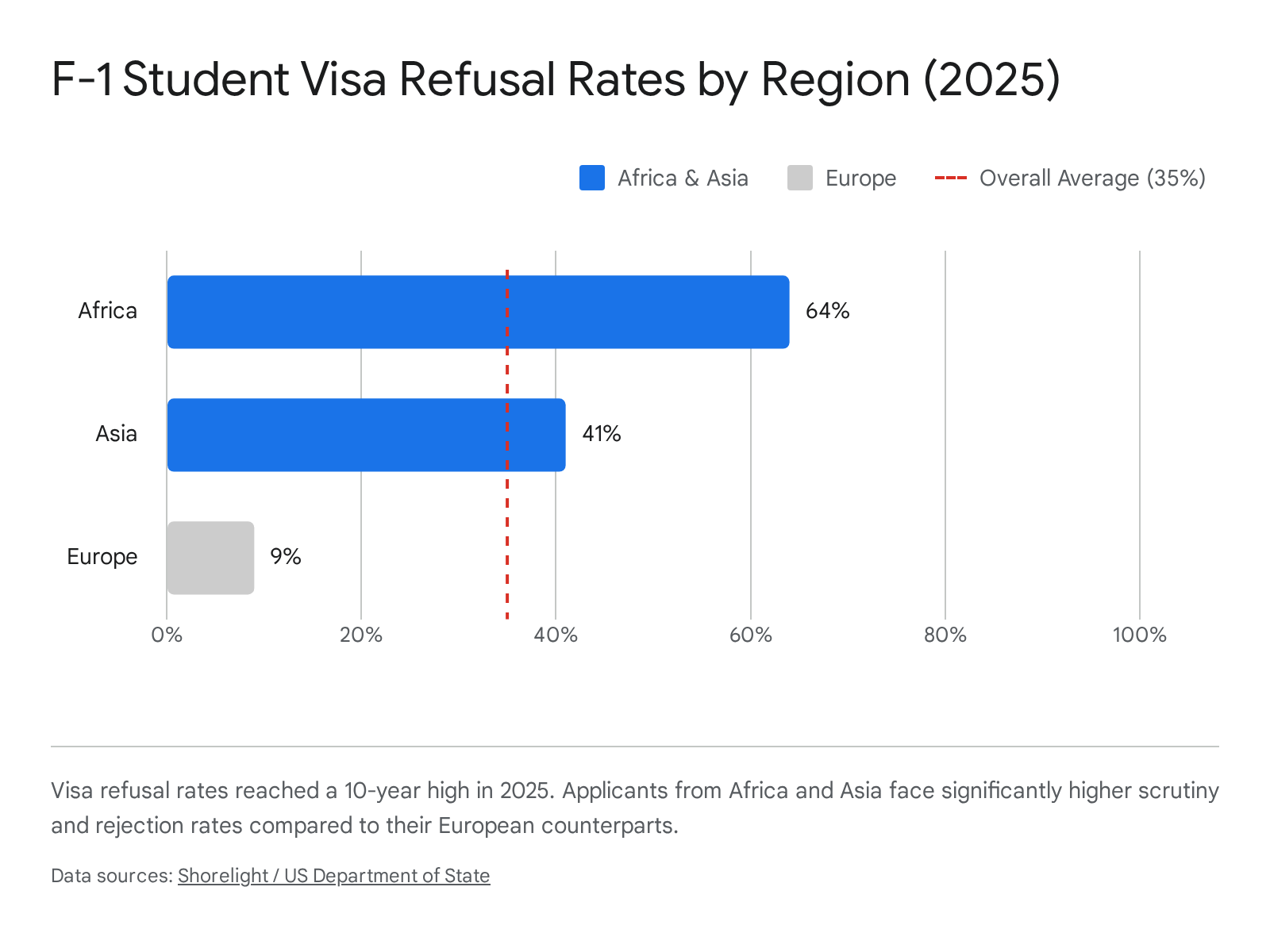
In specific nations, such as Ghana, Sierra Leone, and Somalia, the student visa denial rate routinely exceeds 80% 27.
Consular officers frequently cite Section 214(b) of the Immigration and Nationality Act as the legal basis for these denials 52. Under U.S. law, every nonimmigrant visa applicant is presumed to have "immigrant intent." The burden of proof rests entirely on the student to demonstrate deep, binding ties to their home country and definitively prove they will depart the U.S. upon completing their studies 2852. If an applicant cannot confidently articulate their post-graduation plans, why they chose a specific university, or how their degree translates to a career back home, they risk immediate rejection under 214(b) 52.
A refused application is not merely a bureaucratic setback; it carries a massive financial penalty. Because visa and application fees are strictly non-refundable, a denied cycle can cost a student thousands of dollars.
| Cost Category for a Refused Application | Typical Financial Loss (USD) |
|---|---|
| University Application Fees | $150 - $2,000 |
| Housing Deposits (Often non-refundable) | $500 - $2,000 |
| Education Agent Fees | $500 - $5,000 |
| Standardized Tests (IELTS, TOEFL, SAT) | $200 - $350 |
| Credential Evaluation Services | $100 - $300 |
| Total Estimated Sunk Cost | $3,000 - $8,000+ |
Estimated financial losses associated with a failed U.S. university application and visa cycle 26.
Enhanced Vetting: The 2025 Social Media Screening Mandate
In June 2025, the U.S. Department of State implemented a highly restrictive and controversial expansion of its visa screening protocols. All applicants for F, M, and J nonimmigrant visas are now explicitly required to adjust the privacy settings on all of their social media accounts to "public" to facilitate comprehensive vetting by consular officers 255329.
When completing the DS-160 visa application form, students must comprehensively disclose all social media usernames and handles they have utilized over the past five years 2555. This mandate covers massive global platforms like Facebook, Instagram, LinkedIn, TikTok, YouTube, and X (formerly Twitter), as well as regional networks like VK or Douban 56. The requirement applies universally to both first-time applicants and current students seeking visa renewals 5355.
During the vetting process, authorities check the applicant's digital footprint for several critical red flags: 1. Identity and Consistency Checks: Officers cross-reference the applicant's stated educational background, location history, and employment claims against their online persona to ensure the DS-160 application is truthful 57. 2. Fraud Detection: Reviewers look for evidence of fake identities, forged educational documents, or intent to illegally immigrate (e.g., online "jokes" about overstaying a visa or working illegally) 5758. 3. Security and Ideological Screening: The screening explicitly targets online activity indicating links to violent groups, support for designated extremist organizations, or "hostility toward the citizens, culture, government, institutions, or founding principles of the United States" 525329.
Immigration attorneys and educational advisors strongly warn against attempting to circumvent these rules. Concealing accounts, creating fake "clean" profiles, or abruptly deleting extensive post histories right before an interview raises immediate suspicion of fraud 5658. Omitting a known social media handle on the DS-160 can lead to an automatic visa denial and render the student ineligible for future U.S. visas 25. Advisors suggest that students professionally review their public profiles, archive politically sensitive or inappropriate posts well in advance of applying, and ensure their online presence perfectly matches the academic intent stated in their visa interview 5658.
Employment Rules on an F-1 Visa: What is Actually Allowed?
A pervasive misconception among international applicants is that they can freely work off-campus to cover their tuition and living expenses while studying in the U.S. 3218. In reality, U.S. immigration law heavily restricts the employment of F-1 students. Engaging in unauthorized labor is a severe federal violation that can result in immediate deportation and the permanent termination of a student's SEVIS record 5960.
On-Campus Employment
F-1 students are legally permitted to work on their university campus without needing prior approval from U.S. Citizenship and Immigration Services (USCIS) 6130. However, this employment is governed by strict parameters: * Hourly Limits: Students may work a maximum of 20 hours per week while academic classes are in session 596130. * Vacation Allowances: During official school holidays and annual summer vacations, students may work full-time (over 20 hours), provided they intend to register for the upcoming academic semester 5961. * Location and Purpose: The work must physically take place on the school's premises and directly provide services to the student body (e.g., working in the university library, cafeteria, or serving as a teaching assistant). Employment with commercial entities operating on campus that do not directly serve students (such as a private construction firm building a new facility) is prohibited 596130.
Crucially, on-campus jobs are usually low-paying and highly competitive 60. Furthermore, because these jobs are not guaranteed, consular officers will not allow students to use projected on-campus earnings as proof of financial resources during the visa interview 61.
Off-Campus Employment
Working off-campus during the first academic year is strictly prohibited under all circumstances 60. After completing one full academic year in good standing, students may apply for off-campus employment, but only under highly specific, heavily regulated frameworks: 1. Practical Training (CPT and OPT): Curricular Practical Training (CPT) allows students to engage in paid internships that are an integral, required part of their academic curriculum. Optional Practical Training (OPT) allows graduates to work in a job directly related to their field of study for 12 months post-graduation. Students graduating with degrees in designated STEM fields can apply for a 24-month extension to their OPT 1861. 2. Severe Economic Hardship: In highly unusual circumstances, USCIS may grant off-campus work authorization if a student faces unexpected, severe financial distress that is entirely beyond their control. Examples include the sudden death of a primary financial sponsor or massive currency devaluation in their home country 5961. The student must definitively prove that on-campus employment is unavailable or insufficient to meet their needs. This authorization requires the formal support of the university's DSO, the filing of Form I-765 ("Application for Employment Authorization"), and the payment of filing fees to USCIS 5930.
Bottom line
Applying to a U.S. college as an international student is an arduous, multi-year undertaking that demands meticulous academic and financial planning. While top U.S. institutions continue to provide world-class education and occasionally unparalleled financial aid through need-blind policies, applicants must be strategic regarding standardized testing choices and acutely aware of the steep sunk costs involved. Most importantly, securing collegiate admission does not guarantee entry into the country. With visa refusal rates at historic highs for students from the Global South and the implementation of intense 2025 social media screenings, applicants must ensure their financial documentation is flawless and their online presence aligns perfectly with their stated intent to study and return home.