
How Do Colleges Calculate Merit Scholarships
Most merit scholarships are not simply rewards for academic excellence, but rather strategic tuition discounts calculated by colleges to meet precise enrollment and revenue goals. Institutions typically determine these awards either through transparent, published grids that cross-reference a student's GPA with their standardized test scores, or through complex enrollment management algorithms that predict a student's likelihood of enrolling. By analyzing a combination of academic metrics, financial background, and demonstrated interest, colleges calculate the exact financial incentive required to secure a student's attendance without overspending their institutional budget.
The Illusion of the Sticker Price
To understand how merit scholarships are calculated step by step, it is first necessary to understand that higher education pricing closely resembles the airline industry. When you sit on a commercial flight, the passenger to your left and the passenger to your right almost certainly paid entirely different fares for the exact same journey 11. Colleges operate on a similar economic principle known as price discrimination, facilitated through a system broadly termed "tuition discounting" 12.
For the vast majority of private colleges - and increasingly, public universities - the "sticker price" advertised on the institution's website is a largely theoretical number 43. Instead of charging every student the same flat rate, institutions employ a "high-tuition, high-aid" model 6. Under this system, colleges set the published price artificially high. This allows them to capture maximum revenue from the wealthiest families who are capable of paying the full cost of attendance without assistance 136. For the rest of the applicant pool, the college offers "discounts" in the form of need-based grants and merit-based scholarships 136.
These merit scholarships are essentially foregone revenue. They represent money the college strategically chooses not to collect in order to incentivize a specific student to enroll 45.
Record-Breaking Discount Rates
The scale of this tuition discounting has reached unprecedented levels. Data indicates a notable and consistent upward trend in how much money colleges are quietly shaving off their sticker prices. According to the National Association of College and University Business Officers (NACUBO) Tuition Discounting Study, the average discount rate for first-time, full-time undergraduates at private nonprofit colleges hit a record high of 56.3% for the 2024-2025 academic year 446.
This statistic means that for every dollar of undergraduate tuition and fees that these private institutions could theoretically have charged, they actually awarded roughly 56 cents back to incoming freshmen in the form of institutional grants and scholarships 4610.
The historical data demonstrates a consistent upward trend over the last decade, proving that heavy discounting is now a structural feature of higher education finance rather than a temporary anomaly.
| Academic Year | Average Freshman Discount Rate (Private Colleges) |
|---|---|
| 2014 - 2015 | 47.1% 3 |
| 2015 - 2016 | 48.0% 44 |
| 2022 - 2023 | 56.2% 7 |
| 2023 - 2024 | 56.1% 35 |
| 2024 - 2025 | 56.3% 446 |
Today, roughly 90% of all first-year students at surveyed private colleges receive some form of institutional aid 34. If a family looks at a private college's $60,000 published tuition and immediately assumes it is out of reach, they may be walking away from what is functionally a $30,000 education once the college's automatic merit discounts are applied 4.
The Demographic Cliff Accelerating the Trend
Colleges are not offering these massive discounts out of sheer generosity; they are responding to intense market pressures. Higher education is currently navigating a phenomenon known as the "enrollment cliff" - a severe demographic shift stemming from the sharp decline in U.S. birth rates during the 2008 Great Recession 12138.
Between 2025 and 2029, the number of traditional college-age high school graduates in the United States is projected to plummet by roughly 15% 121315. This demographic contraction translates to a loss of approximately 576,000 potential students over a four-year span 8.
Faced with a shrinking customer base, increased competition for a smaller pool of applicants, and shifting cultural perspectives regarding the value and return on investment of a four-year degree, colleges are utilizing merit aid more aggressively than ever 12138. They are essentially buying the students they need to keep their campuses fully operational, their dormitories occupied, and their tuition revenues stable 113.
The Ivy League Exception
Before examining exactly how colleges calculate these merit aid packages, it is vital to establish who does not use these calculations. The most elite, highly selective institutions in the country do not offer merit scholarships of any kind 1617.
The Ivy League (Harvard, Yale, Princeton, Columbia, Penn, Brown, Dartmouth, and Cornell), alongside highly selective peers such as Stanford, MIT, and Caltech, adhere to a strict, decades-old policy of providing exclusively need-based aid 161718.
The rationale behind this policy is straightforward: every student admitted to these institutions is an academic superstar who has already passed an extraordinarily rigorous merit threshold 1719. If an institution like Princeton were to offer scholarships based on high SAT scores or perfect GPAs, they would essentially have to award them to their entire incoming class, rendering the concept of "merit" meaningless in that context 1719. Furthermore, because these universities possess massive endowments and routinely turn away thousands of highly qualified applicants each year, they do not need to use financial carrots to convince admitted students to enroll 17.
For the vast majority of other colleges - the roughly 3,900 degree-granting institutions that educate the bulk of American undergraduates - merit aid remains a critical survival and enrollment tool 1720. These schools calculate awards using two primary methods: the transparent "merit grid" and the opaque "enrollment algorithm."
Calculation Method 1: The Transparent Merit Grid
The most straightforward way colleges calculate merit scholarships is through an automatic merit aid grid 2122. A merit grid is a public, two-dimensional matrix published directly on a university's admissions or financial aid website. It cross-references a student's high school GPA with their standardized test score (SAT or ACT) to output a guaranteed scholarship dollar amount 212223.
If an applicant meets the exact criteria on the grid and is admitted to the university, the scholarship is automatically applied to their financial aid package 2324. At these institutions, no separate essays, interviews, or complex secondary applications are required to secure the baseline merit funding 23.
How Grids Drive Academic Behavior
These grids are highly predictable, turning high school academic performance into a calculable financial asset before a student even applies.
For example, at the University of Alabama - an institution famous in higher education circles for its aggressive out-of-state merit recruitment - a non-resident student with a 3.5 GPA and a 1350 SAT might receive a specific, mid-tier financial award 2325. If that student studies diligently and improves their SAT score by just 10 points to a 1360, they jump to the next tier on the college's grid, unlocking an additional $9,000 per year, which equates to $36,000 over four years 23. In this transparent scenario, answering a few more math or reading questions correctly translates directly to massive tuition savings 2223.
Other notable examples of public universities utilizing transparent merit grids include: * Florida Gulf Coast University: Offers specific tiers for non-residents, such as $15,000 per year for students with a 3.75 weighted GPA and a 1320 SAT, dropping to $10,000 annually for a 3.5 GPA and a 1200 SAT 23. * University of Missouri: Features automatic scholarship tiers where a 3.8 GPA paired with a 25 ACT can yield $34,000 over four years 22. * Texas Tech University: Offers Presidential Scholarships based on a sliding scale. A 3.0 GPA with an 1100 SAT or 22 ACT earns $1,000 annually, while a 1500+ SAT combined with a high GPA can yield $4,000 to $9,000 annually 24. * University of Tennessee: Offers out-of-state "Volunteer Scholarships" in strict tiers: a 1300+ SAT with a 3.8+ GPA earns $3,000 a year, while a 1490 - 1600 SAT with a 4.0+ GPA earns $18,000 a year 23.
The Anatomy of a Merit Grid
To illustrate how these calculations are structured, below is a generalized representation of how public universities typically format these grids for out-of-state applicants. The financial reward scales exponentially at the highest tiers, reflecting the college's desire to poach top talent from other regions 21927.
| High School GPA (Unweighted) | SAT Score Range | ACT Score Range | Estimated Annual Award | 4-Year Value |
|---|---|---|---|---|
| 3.00 - 3.24 | 1100 - 1190 | 22 - 24 | $2,000 - $4,000 | $8,000 - $16,000 |
| 3.25 - 3.49 | 1200 - 1290 | 25 - 27 | $5,000 - $8,000 | $20,000 - $32,000 |
| 3.50 - 3.74 | 1300 - 1390 | 28 - 30 | $10,000 - $15,000 | $40,000 - $60,000 |
| 3.75 - 3.99 | 1400 - 1490 | 31 - 33 | $18,000 - $22,000 | $72,000 - $88,000 |
| 4.00+ | 1500 - 1600 | 34 - 36 | Full Tuition | Over $100,000 |
Note: Specific award amounts vary wildly by institution. Many schools explicitly state that these awards are capped based on available annual funding, meaning applying early in the admissions cycle is highly recommended to secure the posted amounts 2328.
Calculation Method 2: Enrollment Management Algorithms
While large public universities favor transparent grids to drive application volume, many private colleges and mid-tier state schools rely on a "black box" approach. They utilize sophisticated enrollment management algorithms - often purchased from specialized third-party vendors like EAB, Ruffalo Noel Levitz, Capture Higher Ed, or Othot - to calculate individualized merit aid packages 1011.
The primary goal of these algorithms is not simply to reward smart students; the goal is to maximize the university's "net tuition revenue" 10. The software achieves this through a highly specific, two-stage mathematical process 12.
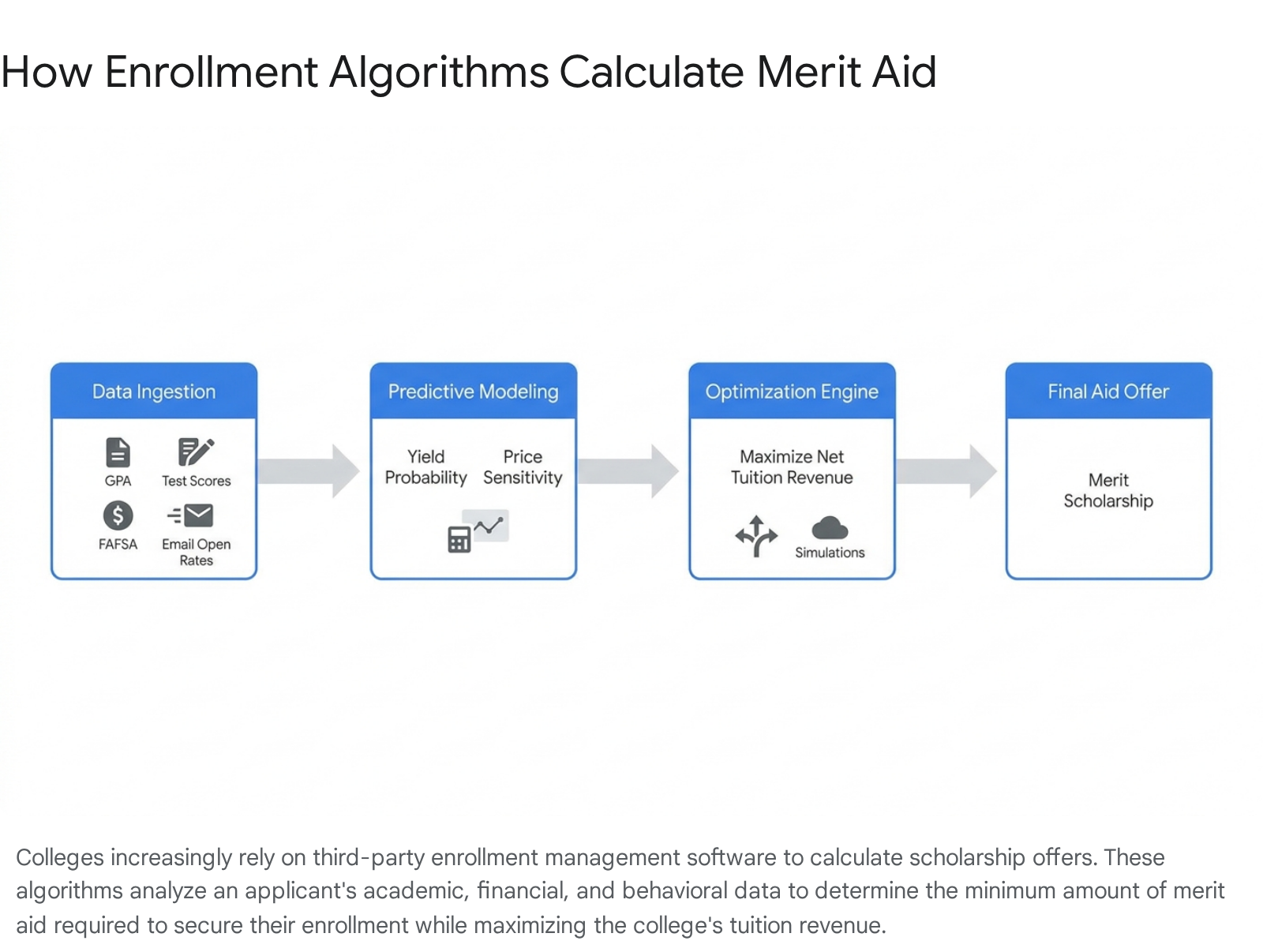
Stage 1: Predicting Student Yield and Price Sensitivity
In the first stage, the algorithm ingests a massive amount of data about the accepted applicant. This includes traditional academic metrics (high school GPA, standardized test scores, high school rigor), financial data (family income derived from the FAFSA, ZIP code demographics), and geographic location 10.
Crucially, modern algorithms also evaluate demonstrated interest 1032. The software meticulously tracks a student's engagement with the college: how many times they have opened promotional emails, how quickly they click links, whether they took an official campus tour, and how fast they submitted their application 1032.
Using historical data from previous admissions cycles, the machine learning model calculates the exact percentage likelihood that this specific student will actually enroll if accepted - a vital admissions metric known as "yield" 1012. This predictive model determines a student's individual "price sensitivity" 10. It attempts to mathematically answer the question: How much of a discount does this exact student need to choose us over their competing options?
Stage 2: Scholarship Optimization
Once the algorithm knows how likely a student is to enroll, it enters the optimization phase 12. The college's financial aid office sets specific constraints in the software. For instance, an enrollment manager might input: "We have a $20 million institutional financial aid budget, we need an incoming class of 1,000 students, and we want to maintain an average SAT score of 1300 to protect our rankings."
The algorithm then runs thousands of simulations to find the optimal distribution of scholarship dollars across the entire accepted applicant pool to meet those exact goals without overspending 1112.
Because the algorithm is designed to optimize the college's budget, it functions by identifying the minimum amount of aid required to convince a student to attend 12.
Consequently, an incredibly high-achieving student might actually receive a low merit offer from a "safety school" if the algorithm determines that the student is highly unlikely to enroll there anyway (a practice sometimes referred to as yield protection) 33. Conversely, a moderately achieving student who has shown massive demonstrated interest and perfectly fits a demographic or geographic gap the college needs to fill might be targeted with a highly lucrative "cocktail party" scholarship to guarantee their attendance 1013.
This complex system explains why strong applicants are often surprised by minimal merit aid offers at certain institutions, while simultaneously receiving massive scholarships from others 33. The math is not just evaluating the student's brain; it is evaluating their predicted buying behavior.
The Impact of Test-Optional Policies on the Math
The COVID-19 pandemic triggered a seismic shift in college admissions, forcing thousands of institutions to temporarily drop their standardized testing requirements 3514. While some highly selective institutions - such as MIT, Harvard, Dartmouth, and Georgetown - have recently reinstated mandatory testing for the 2025 and 2026 admissions cycles, the vast majority of U.S. colleges have made their test-optional policies permanent 32351437. Today, more than 80% of all four-year colleges do not require the ACT or SAT 14.
This created a massive logistical hurdle for financial aid offices: How do you calculate a merit scholarship using an automated grid or an algorithm if the student has no test score to plug into the equation?
Colleges have adapted to this test-optional reality in several distinct ways:
1. The Shift to GPA-Centric Evaluation
Many public universities simply removed the SAT/ACT axis from their merit grids 38. Schools like Utah State University, the University of Nebraska-Lincoln, and Southern Illinois University Edwardsville announced that specific GPA thresholds alone (e.g., a 3.0 or higher) would dictate baseline scholarship eligibility 39.
2. Holistic Scholarship Review
Private colleges without fixed grids often shifted to holistic reviews for non-submitters, heavily weighting the rigor of the high school curriculum (such as the number of AP or IB classes taken), positive character attributes, and the quality of application essays 1516. Institutions like Lawrence Technological University and Clark University explicitly state in their policies that students who do not submit test scores are automatically reviewed for merit aid upon acceptance and are not disadvantaged in the process 16.
3. The Hidden Penalty of Not Testing
Despite the pervasive "optional" label, not submitting test scores can still have severe financial consequences. A report by the National Center for Fair & Open Testing (FairTest) revealed that while the majority of merit aid has decoupled from testing, approximately 25% of all current "merit" aid scholarships still strictly require test scores for eligibility 14.
At many state flagship universities, the highest tiers of guaranteed scholarship money are quietly reserved exclusively for those who submit top-percentile ACT or SAT scores 281438. Furthermore, some out-of-state tuition waivers explicitly require standardized test scores to qualify 4243. When a student applies test-optional, the remainder of their application - specifically their unweighted GPA and the strength of their high school transcript - must shoulder the entire burden of the merit calculation 381745.
Geographic Math: Out-of-State Waivers and Reciprocity
One of the most powerful forms of merit aid operates on geography rather than pure academics. Public universities charge out-of-state residents vastly more than in-state residents. For the 2025-2026 academic year, the College Board reports that average public four-year tuition is $31,880 for out-of-state students, compared to just $11,950 for in-state residents 618.
However, to combat demographic declines and fill empty seats in their own backyards, many public universities offer "out-of-state tuition waivers" that effectively erase this premium 4243. These are essentially massive merit scholarships that reduce a non-resident's tuition down to the in-state rate, provided they meet specific GPA and testing criteria 4243.
Furthermore, states have banded together to create massive, formalized tuition reciprocity compacts. These programs recalculate tuition based on regional borders.
The Western Undergraduate Exchange (WUE)
Administered by the Western Interstate Commission for Higher Education (WICHE), this program allows students from 16 Western states and territories (including California, Washington, Colorado, and Hawaii) to attend out-of-state public universities within the region at a steep discount 192021.
Under WUE, eligible students pay no more than 150% of the institution's standard resident tuition rate, which is vastly cheaper than the standard non-resident rate 1921. To calculate this, a college must verify the student is a permanent resident of a participating state and often requires a minimum academic threshold, such as an unweighted high school GPA of 3.3 or 3.5, depending on the specific campus's competitiveness 1922.
The Midwest Student Exchange Program (MSEP)
Covering eight Midwestern states (including Indiana, Kansas, Minnesota, and Missouri), the MSEP functions similarly to the WUE 2324.
Public institutions in the compact agree to cap tuition at 150% of the in-state rate for eligible non-residents, while participating private institutions agree to offer an automatic 10% reduction on their published tuition rates 2425. The average MSEP student saves approximately $7,000 annually through this geographic discount 2326.
| Reciprocity Program | Region | Public University Discount | Private University Discount | Participating States (Examples) |
|---|---|---|---|---|
| WUE 1920 | West | Capped at 150% of in-state tuition | N/A | CA, WA, OR, CO, AZ, NV, HI, AK |
| MSEP 2455 | Midwest | Capped at 150% of in-state tuition | 10% tuition reduction | IN, KS, MN, MO, NE, ND, OH, WI |
Reverse-Engineering the Math: The Common Data Set
Because enrollment algorithms are proprietary and tuition discounting is heavily obfuscated by marketing, families often struggle to figure out if a college is actually generous with merit aid before they apply. Fortunately, almost every major college in the United States fills out a standardized, publicly available document called the Common Data Set (CDS) 2728.
The CDS is the raw data file that colleges submit to publishers like U.S. News & World Report and the College Board to generate their annual rankings and profiles 272858. While colleges do not actively market the CDS to the general public, it is freely available on almost every university's "Institutional Research" webpage 2058.
To see exactly how a college calculates and awards its merit aid, families can look at Section H: Financial Aid, specifically Section H2A of the document 275829.
Decoding Section H2A
Section H2A details "Non-need-based Scholarships and Grants." This is the exact section that reveals how much "free money" a college gives to wealthy or affluent students who do not qualify for any federal or state need-based aid 205829.
By looking at the CDS, an applicant can calculate their exact odds of receiving merit aid. They can see: 1. The Number of Awards: How many freshmen with zero financial need received an institutional merit award 2758. 2. The Average Size: The exact average dollar amount of those non-need-based scholarships 2758.
For example, if a college admits 2,000 freshmen, and Section H2A reveals that 1,800 of them received non-need-based aid averaging $25,000, it is abundantly clear that the college utilizes heavy tuition discounting and aggressively awards merit aid as a standard recruitment tool 58. Conversely, if Section H2A shows that only 40 students out of a large class received an average of $2,000, the college clearly relies on a strictly need-based model and does not negotiate on price 58.
The Final Step: Negotiating the Calculation
Because merit aid is fundamentally an enrollment management tool designed to secure a class, the initial calculation is not always final. Colleges want to protect their "yield" (the percentage of admitted students who actually enroll), which gives highly desirable students a degree of leverage in the final months before National College Decision Day 103061.
While it is practically impossible to negotiate with a hard-coded grid at a massive public university, private colleges and mid-sized institutions are frequently open to an "appeal" or a "request for reconsideration" regarding merit aid 3062.
The most successful appeals are calculated, data-driven requests rather than emotional pleas 306263. The negotiation process generally involves:
- Providing Leverage: The strongest bargaining chip an applicant has is a better merit aid offer from a "peer institution." If a student can show an admissions office that a similarly ranked college is offering them more money, the college may match the offer to prevent losing a qualified student to a direct competitor 3064.
- Naming a Specific Number: Rather than vaguely asking the financial aid office for "more money," successful negotiators calculate the exact gap they need closed to enroll. Asking an admissions office for a specific, realistic amount (e.g., an additional $3,000 to perfectly match a competitor's net price) gives the college a calculable return on investment to consider 62.
- Providing New Academic Data: If a student has achieved a higher GPA, scored better on a retaken SAT/ACT, or secured significant honors since submitting their original application, they should present this data. It provides the financial aid office with the documented justification they need to override the initial algorithm and increase the award 6364.
Bottom line
Merit scholarships are rarely pure rewards for academic excellence; rather, they are complex pricing discounts designed to help colleges hit their enrollment targets and maximize net tuition revenue in an increasingly competitive market. While some public universities use highly transparent grids that guarantee funding based on GPA and test scores, many private institutions rely on opaque algorithms that predict an applicant's price sensitivity and likelihood to enroll. Ultimately, students who understand this system - by researching the Common Data Set, strategically submitting standardized test scores, and leveraging competing offers - can successfully secure tens of thousands of dollars in tuition discounts.