
How to Manage Public Speaking Anxiety with Science
The most effective evidence-based techniques for managing public speaking anxiety combine cognitive reappraisal - reframing nervous arousal as performance-enhancing excitement - with structured physiological regulation and gradual exposure, increasingly facilitated by artificial intelligence and virtual reality environments. While an estimated seventy-five percent of the population experiences glossophobia to the point where they might jokingly prefer being in the casket to delivering the eulogy, the pounding heart and sweaty palms are not signs of impending doom; they are merely ancient survival mechanisms misfiring in a modern boardroom 1123.
Understanding the etiology, psychological dimensions, and physiological manifestations of speech anxiety is paramount for effective intervention. This comprehensive analysis evaluates the physiological mechanisms of performance apprehension, distinguishes it from broader social anxiety disorders, debunks pervasive but ineffective advice, and synthesizes recent technological and cultural advancements in the management of this widespread condition. Through an examination of clinical psychology, neuroscience, and communication theory, this report provides a thorough framework for mitigating one of humanity's most common fears.
What Exactly Happens in the Body During a Panic Response to Public Speaking?
To understand public speaking anxiety (PSA), it is necessary to examine the evolutionary frameworks that govern human threat detection. The biological reaction to standing before an audience is deeply rooted in ancestral survival strategies that have not yet adapted to the nuances of contemporary professional environments.
The Smoke Detector Principle and Evolutionary Mismatch
Evolutionary psychology posits that human anxiety functions according to the "smoke detector principle" 5458. A physical smoke detector is deliberately engineered with high sensitivity; the minor annoyance of a false alarm triggered by burnt toast is a trivial cost compared to the catastrophic consequence of failing to detect a genuine, lethal fire 9. Similarly, the human threat-detection system, governed largely by the amygdala, was calibrated in the Environment of Evolutionary Adaptedness (EEA), where threats such as predators or hostile rival groups were frequent, unpredictable, and deadly 9.
In ancient tribal structures, social exclusion or exile equated to a death sentence, as early humans relied entirely on the collective group for food, shelter, and physical protection 10. Therefore, the fear of negative evaluation by a group is a primal, hardwired survival instinct. When an individual stands before an audience, the brain perceives the concentrated gaze of multiple individuals as a potential predatory or exclusionary threat, triggering a false alarm 1012. This represents a profound evolutionary mismatch: an ancient biological alarm system sounding in a modern, non-lethal environment.
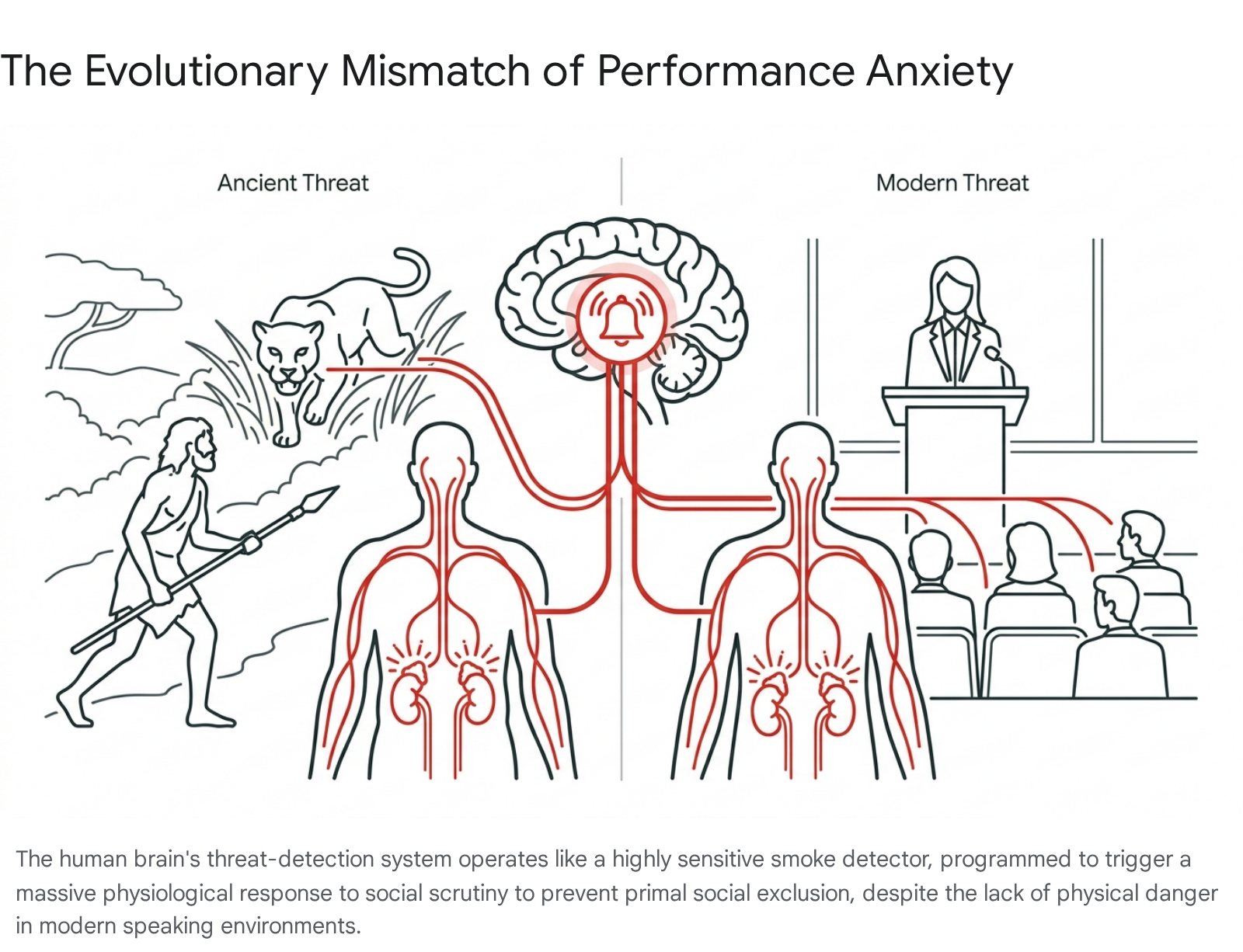
The brain treats a panel of harmless colleagues or a conference audience as a circle of predators, deploying a rapid and overwhelming physiological defense mechanism to a purely psychological stressor 1126.
The Physiological Cascade: Fight, Flight, or Freeze
Once the amygdala detects this perceived threat, it bypasses the rational, deliberative prefrontal cortex and immediately signals the adrenal glands to release a massive surge of stress hormones, primarily adrenaline (epinephrine), noradrenaline, and cortisol 36141516. This activates the sympathetic nervous system, initiating a rapid physiological transformation designed for immediate, explosive physical action - the classic "fight or flight" response 127.
This hormonal flooding induces several somatic symptoms that actively and severely interfere with the mechanics of speaking. Heart rate and blood pressure soar to pump oxygen-rich blood to the large skeletal muscles in the arms and legs, preparing the body to run or fight 1416. As a result, blood is forcefully diverted away from the extremities and the digestive system, causing cold hands, trembling, and the sensation of "butterflies," nausea, or churning in the stomach 10616. The respiratory rate dramatically increases, leading to shallow chest breathing rather than deep diaphragmatic breathing. This lack of oxygenation restricts vocal projection, causes the voice to quiver, and leads to a breathless delivery 161418. Simultaneously, saliva production halts because digestion is no longer a biological priority during a perceived life-or-death crisis, resulting in severe dry mouth, scientifically known as xerostomia 1108.
In extreme cases, when the cortisol surge overwhelms the system and the sympathetic response reaches its absolute metabolic limit, the parasympathetic nervous system abruptly engages to force the body into a "freeze" response 116. In the wild, freezing or "playing dead" was a final, desperate survival strategy against predators whose vision was based on movement. On a modern stage or in a boardroom, this freeze response manifests as psychological dissociation, mental fog, or the terrifying phenomenon of the mind going completely blank 11216. Under severe stress, the prefrontal cortex - the highly evolved brain area responsible for working memory, logic, language formulation, and cognitive control - is functionally suppressed. The brain reroutes all available energy toward immediate survival mechanisms, making it nearly impossible to retrieve memorized information or engage in complex cognitive tasks 112.
Is Public Speaking Anxiety the Same as Social Anxiety Disorder?
A persistent clinical question is whether public speaking anxiety is simply a symptom of a broader Social Anxiety Disorder (SAD) or a distinct psychological phenomenon. The distinction is not merely academic hair-splitting; it has profound real-world implications for selecting appropriate, efficacious treatment modalities and setting realistic recovery expectations.
According to the Diagnostic and Statistical Manual of Mental Disorders (DSM-5-TR), Social Anxiety Disorder encompasses an intense fear of social interactions where an individual is exposed to potential scrutiny, judgment, or negative evaluation by others 910. Historically, the psychiatric community debated whether to classify fear of public speaking as a separate entity. Currently, the DSM-5-TR recognizes a specific, delineating subtype known as "performance-only" SAD 1022. Individuals with this specific performance-only subtype experience intense anxiety limited exclusively to public speaking, performing on stage, or delivering formal presentations, but they do not experience significant distress or impairment in routine, everyday social interactions, such as meeting strangers, conversing with peers, or attending informal social gatherings 222324.
Empirical research reveals both quantitative and qualitative differences between generalized SAD and performance-only PSA. Studies spanning dozens of clinical cohorts indicate that individuals with anxiety restricted to public speaking exhibit significantly higher levels of acute autonomic arousal - such as drastically elevated heart rates, hyperventilation, and extreme trembling - immediately before and during a speech task compared to individuals with generalized SAD 10. The PSA-only reaction closely resembles the sudden onset of a specific phobia, characterized by a rapid, acute, panic-like spike, whereas generalized SAD presents as a more pervasive, chronic distress across highly varied and unstructured social domains 10.
These fundamental differences in symptomatic expression directly influence treatment efficacy. Research comparing Cognitive Behavioral Therapy (CBT) and Acceptance and Commitment Therapy (ACT) for social anxiety found that the level of specific behavioral avoidance during a public speaking task acts as a robust moderator for long-term treatment outcomes 11. Individuals who demonstrated high levels of avoidance specifically toward public speaking tasks benefited more substantially from CBT in reducing long-term stress reactivity 11. Theoretically, this is because experiential avoidance (the avoidance of internal thoughts and feelings, characteristic of broader SAD) responds differently to therapeutic interventions than behavioral avoidance (the avoidance of specific external triggers like a podium or an audience) 911. Therefore, accurately conceptualizing whether the client's anxiety is driven by generalized internal threat or specific external performance threat is essential for effective clinical management and targeted exposure therapies 1126.
What Are the Most Common Myths and Ineffective Advice for Stage Fright?
The sheer ubiquity of public speaking anxiety has led to a vast proliferation of folk remedies, corporate training clichés, and well-intentioned advice that empirical psychology and behavioral science have largely proven ineffective, and in many cases, actively detrimental to the speaker's performance.
The "Imagine the Audience in Their Underwear" Fallacy
Perhaps the most persistent, universally repeated myth in public speaking lore is the suggestion to picture the audience in their underwear in order to reduce intimidation. Behavioral analysis, neuroscience, and professional communication experts unequivocally advise against this strategy 271229. From a cognitive psychology perspective, the act of public speaking already requires immense working memory capacity. A speaker must recall the structure of their argument, monitor audience non-verbal reactions, regulate physical pacing, and articulate complex ideas simultaneously. Forcing the brain to consciously generate and continuously maintain a complex, distracting, and wholly irrelevant visual hallucination consumes precious cognitive resources 27. This dramatically increases cognitive load, heightening the likelihood of the speaker losing their train of thought or stumbling over their words. Furthermore, this tactic attempts to use forced humor as a psychological avoidance mechanism rather than addressing the physiological arousal directly. It ultimately fails to suppress the autonomic stress response, leaving the speaker just as physiologically aroused but cognitively distracted.
The "Just Relax" Paradox
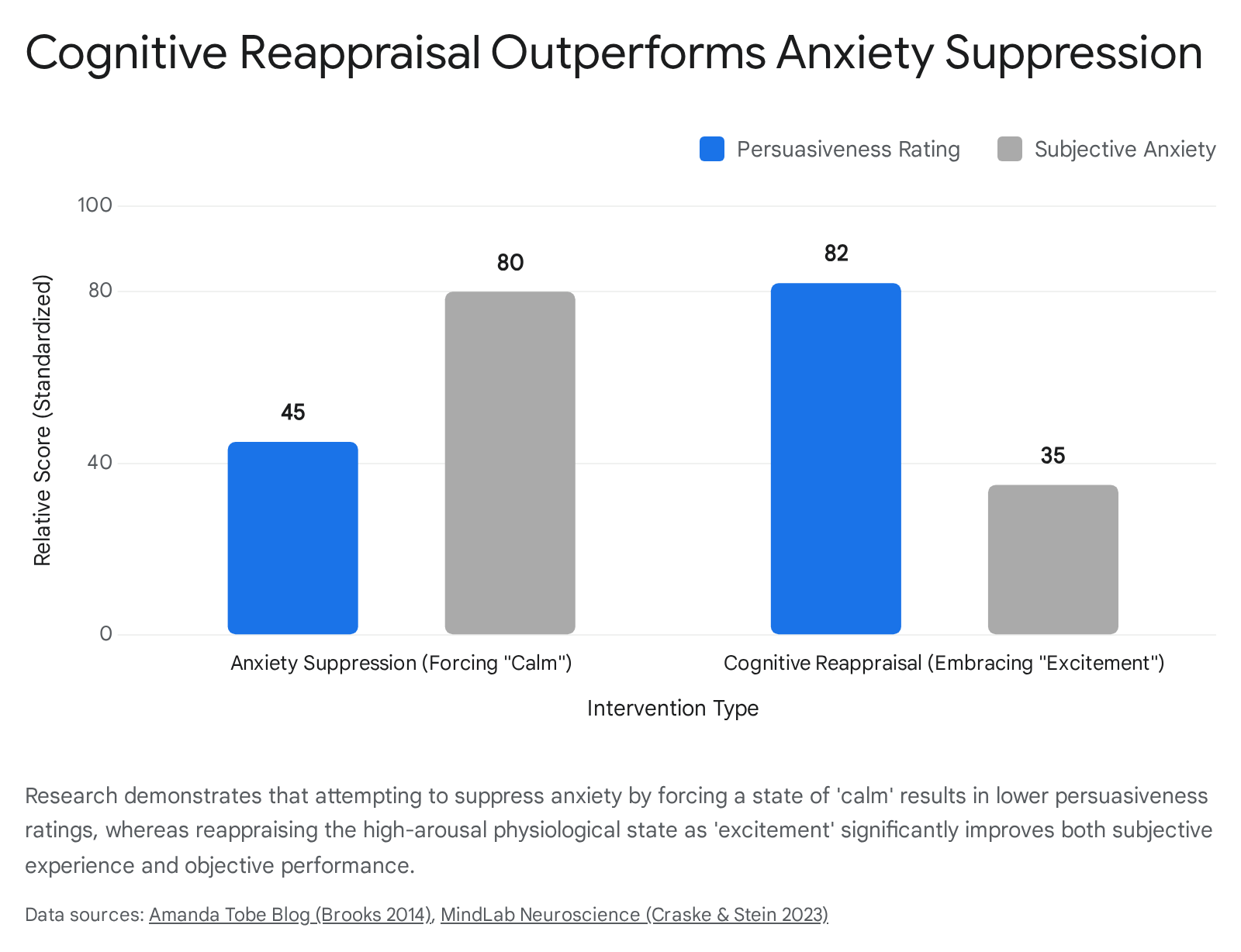
Another incredibly common, intuitive piece of advice offered to nervous speakers is to "take a deep breath and just try to calm down" or "relax." While well-meaning, Harvard research studies reveal that this is deeply flawed, counterproductive advice 30. Anxiety is a high-arousal emotional state characterized by an elevated heart rate, rapid breathing, and heightened neuro-chemical alertness. Calmness, conversely, is a low-arousal emotional state. Attempting to shift directly from an extreme high-arousal state to a serene low-arousal state requires a massive emotional and physiological deceleration that the human amygdala is fundamentally unwilling to allow when it actively perceives a threat in the environment 30. Instructing a panicked individual to "calm down" often induces secondary anxiety, as the speaker becomes frustrated and panicked by their inability to control their own heart rate.
Instead, robust research indicates that cognitive reappraisal - relabeling the high-arousal state of anxiety as the equally high-arousal state of excitement - is far more effective 1230. Anxiety and excitement are distinct emotions, but they share nearly identical physiological profiles; both feature a pounding heart, a surge of adrenaline, and a sense of hyper-vigilance 1230. Because the physical sensations are identical, the brain is highly susceptible to cognitive reframing. When individuals are instructed to state aloud, "I am excited," immediately before a presentation, they report significantly lower subjective anxiety. More importantly, they are rated as more persuasive, competent, and confident by independent observers compared to those who try to force themselves to be calm 1230.
The Trap of Perfect Memorization vs. Extemporaneous Speaking
Many highly anxious speakers attempt to cope with their fear by writing a full manuscript of their presentation and memorizing it word-for-word, harboring the belief that absolute perfection and rote recall will shield them from judgment or failure. Clinical and communication research identifies this as a highly maladaptive, high-risk strategy that frequently backfires 31321314.
Memorized delivery places an immense, unsustainable burden on human memory, which is notoriously fallible under conditions of acute stress 15. Because the prefrontal cortex shuts down during the "fight or flight" response, accessing perfectly sequenced strings of text becomes extraordinarily difficult. If a speaker relying on a memorized manuscript drops a single word, skips a sentence, or loses their place due to a momentary distraction, the entire mental architecture of the speech collapses. This often leads to a total cognitive freeze and an inability to recover smoothly 3214. Furthermore, even when executed perfectly, a memorized speech typically sounds monotonous, rehearsed, and robotic, effectively severing the authentic interpersonal connection with the audience 3216.
Instead, the evidence-based consensus among communication departments and psychological researchers advocates for extemporaneous speaking 13151718. In an extemporaneous delivery, the speaker thoroughly prepares and internalizes the macro-structure of the presentation - the introduction, core arguments, critical transitions, and conclusion - using a brief outline, but dynamically invents the exact micro-wording in the moment 1517. This conversational approach significantly reduces the cognitive burden of rote memory, allows for agile adaptation to audience reactions or time constraints, and completely prevents the catastrophic failure associated with forgetting a specific scripted sentence 321417.
Do Beta-Blockers Actually Work for Presentation Anxiety?
In highly competitive corporate, academic, and artistic environments, the use of beta-blockers - primarily medications such as propranolol and atenolol - has become a pervasive, yet frequently misunderstood, method for managing performance anxiety 740. Originally developed and approved by the FDA for the treatment of cardiovascular conditions such as hypertension, angina, and irregular heart arrhythmias, these medications are frequently prescribed off-label by physicians to treat situational performance anxiety 741.
Pharmacological Mechanism and Physiological Efficacy
Beta-blockers operate by physically blocking the beta-adrenergic receptors located in the heart, blood vessels, and lungs 7. When the brain's amygdala perceives a threat and triggers the adrenal glands to release adrenaline and noradrenaline, these chemical messengers flood the bloodstream but are physically prevented from binding to their target receptors. Consequently, the medication effectively blunts the somatic, physiological symptoms of the fight-or-flight response. The heart rate is artificially prevented from racing, blood pressure remains stable, the visible tremors in the hands and voice are mitigated, the flushing of the skin is reduced, and hyperventilation is suppressed 784041. For individuals whose anxiety manifests primarily as severely disruptive physical symptoms, a standard dose of propranolol taken prior to a performance can provide profound relief 840.
However, the clinical psychiatric literature presents crucial, often overlooked caveats regarding their holistic efficacy. While beta-blockers excel at managing the physical, downstream manifestations of anxiety, they do absolutely nothing to alter the upstream cognitive architecture of fear 40. They do not stop psychological rumination, they do not alleviate the fear of negative evaluation, and they do not silence the internal cognitive loop of self-doubt 40. In robust, placebo-controlled clinical trials, beta-blockers have consistently failed to demonstrate efficacy in treating underlying generalized anxiety disorders or long-term phobias, operating strictly as a localized, acute symptom-management tool rather than a therapeutic cure 741.
The Psychological Dependency Trap
While generally considered medically safe for occasional use in healthy adults without contraindicating cardiovascular issues, the reliance on beta-blockers introduces a significant psychological risk: the dependency trap 40. Executives, musicians, and public speakers may begin to attribute their speaking success entirely to the pharmacological intervention rather than their own inherent competence or preparation. This inadvertently reinforces the core anxiety pattern - solidifying the internal belief that the individual is inherently incapable of surviving a public presentation without the aid of a pill 40. Thus, while beta-blockers can serve as a highly effective temporary bridge for severe physiological responders, long-term resolution of public speaking anxiety requires neuroplastic retraining of the nervous system through cognitive behavioral therapy and structured skill development 4041.
How Have AI and Virtual Reality Transformed Exposure Therapy Since 2023?
The most significant recent advancements in the treatment of public speaking anxiety involve the sophisticated integration of immersive technologies and artificial intelligence. These developments provide scalable, highly controlled, and emotionally safe environments for exposure therapy and communication skill acquisition, fundamentally altering the therapeutic landscape.
Virtual Reality Exposure Therapy (VRET)
Exposure therapy - systematically and gradually facing the source of fear to facilitate habituation - is the gold standard for treating specific phobias. However, it has historically been logistically difficult to implement for public speaking anxiety due to the challenge of repeatedly gathering a live, realistic audience for practice sessions. Virtual Reality Exposure Therapy (VRET) has bridged this critical gap, demonstrating empirical efficacy that is highly comparable to traditional in vivo (real-world) exposure 21920.
Recent applications, such as the PublicVR system tested in rigorous academic trials at Brunel University London and the University of Greenwich, allow users to don a VR headset and deliver presentations in fully immersive, simulated boardrooms and auditoriums populated by responsive 3D avatars 1. These advanced systems integrate real-time feedback mechanisms, projecting unobtrusive visual cues regarding pacing, volume, and eye contact directly into the user's field of vision without disrupting the natural presentation flow 1.
Furthermore, researchers are pioneering the novel concept of "overexposure therapy" in VR environments 2. This protocol involves training individuals in extreme, hyper-distracting scenarios - such as delivering a speech to a photorealistic stadium audience of 10,000 hostile, restless, or entirely inattentive avatars - which they are highly unlikely to ever encounter in physical reality 2. By experiencing and psychologically surviving the absolute worst-case scenario virtually, the baseline anxiety associated with standard, mundane corporate presentations is drastically recalibrated downward 2. Crucially, VRET boasts significantly lower patient drop-out rates compared to traditional in vivo exposure therapy, as the controlled, confidential, and physically safe nature of the digital simulation is perceived as substantially less threatening by highly anxious patients 219.
AI-Driven Speech Coaching and Therapeutic Apps
The rapid proliferation of artificial intelligence, particularly large language models and voice-analysis algorithms, has revolutionized asynchronous anxiety management and coaching. In 2023, a landmark clinical pilot study led by researchers at the University of Illinois Chicago evaluated Lumen, an AI voice-based virtual coach delivering a form of problem-solving behavioral therapy via the Amazon Alexa platform 21. The study found that patients using the AI coach showed measurable, significant improvements in problem-solving skills and reductions in anxiety 21. These behavioral improvements correlated directly with increased neuro-activity in the dorsolateral prefrontal cortex - the specific brain region associated with cognitive control and emotional regulation that is typically suppressed during a panic response 21. Similarly, newly developed platforms like the PATH app leverage sophisticated retrieval-augmented generation (RAG) architecture to provide empathetic, evidence-based CBT interventions via 24/7 AI companions, offering immediate, scalable support outside of traditional clinical hours 22.
Beyond clinical therapy, commercial AI applications such as Orai, Speeko, Poised, and tonen act as continuous, real-time biofeedback loops for professionals 46474849. These applications actively analyze vocal inputs during practice sessions or live virtual meetings to track pacing, conciseness, empathetic tone, and the frequency of filler words, providing objective, data-driven metrics that demystify performance quality 4647. Other emerging tools, such as the Learn Cues platform, focus on the concept of "calibrating uncertainty" by explicitly training users to accurately decode non-verbal body language and micro-expressions from audiences 50. Because social anxiety thrives in ambiguous, unstructured environments where audience reactions are uncertain, applications that train speakers to accurately interpret social signals significantly reduce the paralyzing fear of misjudgment. By replacing the terrifying unknown with measurable awareness, these tools replace panic with predictable control 4950. Advanced AI models are even being utilized to predict social anxiety severity by analyzing complex, non-linear interactions between an individual's intolerance of uncertainty, their reliance on safety behaviors, and their baseline fear of evaluation 51.
Does Cultural Background Influence How We Experience and Treat Speech Anxiety?
A comprehensive, scientifically rigorous understanding of public speaking anxiety cannot be divorced from its sociocultural context. The prevailing psychological and psychiatric literature has historically relied heavily on Western-centric models of anxiety, often assuming an overly simplistic East-West binary 2324. Recent cross-cultural research, however, reveals a far more complex and nuanced reality regarding how different societies process and treat social threats.
Individualism vs. Collectivism and the Strict Norm Hypothesis
Culture heavily dictates the expression and severity of social anxiety by defining collective expectations of socially appropriate behavior, shaping the perception of threats, and constructing the sense of the "social self" 5425. In highly collectivist societies, cultural values heavily prioritize social harmony, group cohesion, conformity, and loyalty to the in-group over individual expression 2456. Consequently, the act of speaking in public - where an individual separates themselves from the group to assert a distinct viewpoint - carries a significantly higher inherent risk of violating established group norms, leading to intense, culturally mediated fears of negative evaluation and subsequent ostracization 2627.
Epidemiological studies consistently demonstrate that highly collectivist countries (such as Japan, South Korea, and various Southeast Asian nations) report generally higher baseline levels of social anxiety and more positive attitudes toward socially avoidant behaviors compared to individualist nations 2728. In Japan, for instance, there is a distinctly recognized cultural presentation of social phobia characterized not merely by a self-focused fear of embarrassing oneself, but by an acute, empathetic anxiety over causing anxiety or discomfort in others by behaving improperly or conspicuously 23. This phenomenon aligns with the "strict norm hypothesis," which suggests that in collectivist environments, the stringent social norms designed to ensure group harmony inherently evoke anxiety due to the severe social consequences of violation 27.
Conversely, in highly individualist cultures, where personal assertion, self-promotion, and direct verbal communication are highly valued and socially rewarded, the inability to speak confidently in public can result in harsher immediate occupational and social penalties 5627. Therefore, while the raw prevalence of social anxiety might be higher in collectivist nations, the subjective impairment and professional detriment experienced by individuals with PSA may actually be more severe in individualistic Western societies 27.
Linguistic Insecurity and Stereotype Threats in Global Contexts
In increasingly diverse educational and professional environments, public speaking anxiety is frequently exacerbated by compounding sociocultural and linguistic barriers. For English as a Foreign Language (EFL) learners, the sheer cognitive load of simultaneously translating complex thoughts into a secondary language while managing the baseline fear of public speaking creates an intense layer of communication apprehension 26606162. This is particularly prevalent in global academic settings where standard Western dialects and pronunciations are rigidly enforced. This enforcement leads to profound "linguistic insecurity," where a gap forms between the speaker's high self-expectations and their actual verbal performance, triggering intense anxiety and avoidance behaviors 2661.
Furthermore, in specific African and Middle Eastern contexts, deeply entrenched socio-cultural stereotypes - such as traditional gender roles that explicitly discourage or limit women from addressing large, mixed-gender groups - can induce severe stereotype threat, fundamentally altering baseline anxiety levels and contributing to underrepresentation in leadership 63. To successfully mitigate these specific cultural anxieties, modern communication management techniques recommend leaning into indigenous rhetorical traditions rather than importing purely Western paradigms. For example, utilizing the rich, historical oral storytelling heritage found in many African societies can be highly effective 63. By incorporating personal anecdotes, communal histories, and culturally resonant folktales into formal presentations, speakers can shift their cognitive focus away from their internal, individual anxiety and onto the shared, collective experience, effectively lowering their physiological stress response by aligning the presentation format with culturally familiar norms 63.
What Are the Most Effective Evidence-Based Techniques for Immediate and Long-Term Relief?
Addressing public speaking anxiety effectively requires a systematic, dual-pronged approach: deploying acute interventions to manage the physiological symptoms in the moments immediately preceding the speech, and engaging in long-term behavioral restructuring to alter the psychological relationship to performance.
Structured Interventions for Public Speaking Anxiety
| Intervention Category | Technique | Implementation Timing | Mechanism of Action | Evidence & Efficacy |
|---|---|---|---|---|
| Immediate Relief (Pre-Speech) | 4-7-8 Diaphragmatic Breathing | 2-5 minutes before taking the stage | Inhaling for 4 seconds, holding for 7, and exhaling for 8 actively stimulates the vagus nerve, forcing the parasympathetic nervous system to override the sympathetic fight-or-flight response. | Lowers circulating cortisol and heart rate within 90 seconds of initiation 1264. |
| Immediate Relief (Pre-Speech) | Cognitive Reappraisal | Immediately upon feeling anxious arousal | Explicitly stating "I am excited" to cognitively re-label high-arousal negative anxiety as high-arousal positive anticipation. | Prevents the cognitive friction of attempting to force a low-arousal "calm" state; improves persuasiveness metrics 1230. |
| Immediate Relief (During Speech) | Strategic Visual Focus | Continuously during delivery | Avoiding the most highly expressive (negative/bored) faces in the audience and systematically scanning the room to prevent psychological fixation on a single perceived threat. | Prevents evolutionary attentional bias from artificially amplifying the perception of audience hostility 65. |
| Long-Term Relief (Preparation) | Extemporaneous Outlining | Days/weeks prior to speech | Preparing a structural outline rather than a memorized word-for-word manuscript to drastically reduce reliance on fragile working memory under stress. | Prevents the total cognitive collapse and "freeze" response associated with dropping a memorized word 3217. |
| Long-Term Relief (Skill Building) | Overexposure VR Therapy | Weeks prior to event via digital tools | Practicing in simulated, highly distracting virtual environments (e.g., noisy stadiums) to safely desensitize the amygdala to standard boardroom stressors. | Accelerates fear extinction, reduces baseline performance anxiety, and boasts low clinical dropout rates 212. |
| Long-Term Relief (Somatic) | Corp-Oral Embodied Strategies | Consistent practice during rehearsal | Utilizing expansive body language, deliberate gesture enhancement, and grounding techniques to physically signal environmental safety to the brain. | Increases cortical activation in emotional regulation areas, decreasing subjective anxiety and heart rate 2967. |
The Power of Embodied Strategies
Recent psychophysiological studies highlight the profound impact of "embodied pedagogy" in actively regulating performance anxiety. Programs like the Corp-Oral training protocol demonstrate that physical posture and movement can directly dictate the mind's emotional state, rather than merely reflecting it 2967. Anxiety inherently causes the human body to physically contract - resulting in hunched shoulders, shallow chest breathing, and a rigid, closed posture - as an evolutionary protective measure to shield vital organs 15. By deliberately adopting expansive physical postures prior to and during speaking - standing tall, keeping feet firmly planted armpit-width apart, and utilizing broad, outward gestures - speakers engage in "embodied cognition" 1529. This expansive physicality physically disrupts the physiological feedback loop of fear, signaling to the brain's threat centers that the environment is dominant and safe, thereby lowering cortisol production and increasing feelings of confidence and composure 12152930.
Strategic Audience Engagement and Attentional Bias
Research conducted by psychologists at Harvard University highlights a subtle but highly destructive cognitive bias that frequently occurs during presentations: humans are evolutionarily wired to fixate on the most expressive faces in a crowd, particularly those displaying intense negative emotions 65. When a highly anxious speaker scans an audience, their gaze is almost magnetically drawn to the single individual who is frowning, looking confused, or visibly disengaged. This attentional bias causes the speaker to erroneously project that single negative reaction onto the entire group, concluding that the entire room is hostile, which triggers an immediate panic spiral 65. The evidence-based clinical countermeasure is the "entire room scan technique." This protocol requires the speaker to actively and consciously force their gaze away from overly expressive negative faces, deliberately distributing sustained eye contact evenly across neutral and positive audience members 65. This active visual management maintains an accurate, calibrated read of the room and prevents a localized negative reaction from inducing a systemic physiological panic response.
Practical Takeaways
Translating complex clinical research, neuroscience, and technological advancements into actionable, daily routines requires acknowledging a degree of calibrated uncertainty: because human neurobiology, psychological triggers, and cultural backgrounds vary wildly, there is no monolithic, universally guaranteed cure for public speaking anxiety 50. An intervention that highly benefits a CEO in New York may be entirely inappropriate for an EFL student in Jakarta. However, individuals can systematically build a highly resilient, personalized toolkit based on the following proven principles.
First, speakers must stop fighting their own physiological arousal and recognize that a racing heart is an evolutionary feature, not a catastrophic bug. Individuals should actively greet the anxiety by acknowledging it ("This is my body preparing me with energy to perform"), and reappraise the physical sensation as excitement, abandoning any futile attempts to force a state of total calmness 3031. Trying to suppress the fight-or-flight response only signals to the brain that there is indeed something terrifying to fight against.
Second, speakers must abandon the rigid security blanket of the written script. Attempting to rote-memorize a presentation guarantees that the speaker will be fighting both the audience's scrutiny and the limits of their own fragile working memory. Speakers should transition to extemporaneous speaking, practicing from a skeletal outline consisting only of core themes and crucial transition points. This preserves cognitive bandwidth, prevents the catastrophic "freeze" response, and maintains a sense of authentic, conversational engagement with the audience 321417.
Third, speakers must learn to mechanically engage the vagus nerve to physically brake the nervous system. In the final minutes before stepping to the podium, utilizing the 4-7-8 breathing method (inhaling for four seconds, holding for seven, and exhaling for eight) forces the diaphragm to expand. The elongated exhalation is the precise mechanical trigger required to activate the parasympathetic nervous system, slowing the heart rate and clearing the cognitive fog 1264.
Finally, individuals should eagerly leverage emerging technology to bridge the gap between rehearsal and reality. Utilizing AI speech coaches can help identify objective delivery flaws - such as pacing issues or filler word reliance - removing the paralyzing ambiguity from preparation. Whenever accessible, employing virtual reality simulations allows speakers to safely and repeatedly desensitize the brain's threat-detection centers to the glare of an audience long before the actual, high-stakes event takes place 246.
Bottom Line
Public speaking anxiety is not a personal failing or a professional deficit; it is an incredibly common evolutionary survival mechanism reacting entirely inappropriately to modern social scrutiny. While pharmaceutical interventions like beta-blockers can temporarily suppress the outward physical tremors of the fight-or-flight response, they fail entirely to resolve the underlying cognitive architecture of the fear. The most reliable, enduring interventions demand a multi-disciplinary approach: utilizing diaphragmatic breathing to mechanically regulate the nervous system, employing cognitive reappraisal to transform physiological dread into performance-enhancing excitement, abandoning rote memorization in favor of agile, extemporaneous structuring, and leveraging cutting-edge AI and VR technologies to safely and systematically desensitize the brain.