
What Is Climate Anxiety and How to Cope
Climate anxiety is a chronic, rational fear of environmental doom driven by the escalating realities of global climate change. While youth and populations in the Global South feel its impacts most acutely, evidence-based coping strategies like climate-aware therapy and collective action can help individuals transform their paralyzing distress into meaningful resilience.
Defining the Psychological Toll of a Warming Planet
As global temperatures climb and extreme weather events become frequent fixtures in the daily news cycle, the profound psychological toll of a warming planet has come into sharp focus. The rapidly changing climate poses severe threats to communities in every nation, fundamentally altering the environmental and social determinants of physical and mental health 12. According to the World Health Organization, an estimated 3.6 billion people currently live in areas that are highly susceptible to climate change 2. While the biophysical impacts - such as rising sea levels, desertification, and lethal heatwaves - are well documented, the concurrent mental health crisis has only recently begun to receive the rigorous academic and clinical attention it demands 34.
The American Psychological Association and leading eco-psychology organizations define climate anxiety, often used interchangeably with eco-anxiety, as a "chronic fear of environmental doom" 567. It encompasses a complex, multi-dimensional spectrum of emotional responses to the reality of climate change and biodiversity loss. Unlike traditional phobias, which are often rooted in irrational or disproportionate fears, climate anxiety is anchored in verifiable scientific reality. It is a response to undeniable empirical data indicating that planetary boundaries are being overshot, threatening global food systems, health infrastructure, and economic stability 17.
Researchers and mental health professionals recognize that climate distress is rarely a monolithic emotion. Instead, it manifests through several distinct, though overlapping, psychological experiences:
- Eco-anxiety: Anticipatory fear, persistent worry, and existential dread regarding future environmental disasters, the long-term livability of the planet, and the anticipated consequences for human life 389.
- Eco-grief: A profound sense of sadness and bereavement regarding the loss of species, ecosystems, and natural landscapes that have already been destroyed or irrevocably altered by human activity 39.
- Solastalgia: A specialized concept used to describe the unique emotional distress caused by environmental degradation close to home. It is the visceral feeling of homesickness experienced when one is still living in their home environment, but that environment has been completely transformed by climate shocks 410.
- Eco-anger: Frustration and rage directed at policymakers, governments, and massive corporations for their perceived inaction, systemic betrayal, or active contribution to environmental destruction 911.
- Environmental Guilt (Eco-guilt): The feeling of personal remorse, culpability, or responsibility for harming the environment through one's own daily consumption choices and carbon footprint 913.
For millions of individuals, recognizing these ecological realities triggers an acute sense of distress regarding the future of humanity, the physical safety of their families, and the irreversible loss of natural spaces 514. This distress is further compounded by recent data from the 2024 Lancet Countdown report, which revealed that of the 15 indicators monitoring climate change-related health hazards, 10 reached concerning new records in their most recent year of data, including unprecedented levels of fossil fuel-related emissions and global drought 112.
The Diagnostic Debate: Is Climate Anxiety a Mental Illness?
As the prevalence of climate anxiety surges globally, a major debate has emerged within the psychiatric and psychological communities regarding whether this phenomenon belongs in formal diagnostic manuals, such as the American Psychiatric Association's Diagnostic and Statistical Manual of Mental Disorders (DSM-5). Currently, climate anxiety is not officially recognized as a distinct mental health disorder or clinical pathology 51314.
Most researchers, climate-aware therapists, and psychiatrists strongly warn against pathologizing or "medicalizing" climate anxiety. The prevailing clinical consensus is that feeling anxious, angry, or deeply saddened about a burning planet is a normal, healthy, and entirely rational response to a genuine existential emergency 57715. As Bernadka Dubicka, a child and adolescent psychiatrist, notes, grief over environmental destruction is akin to the bereavement experienced when losing a loved one - it is a natural response, not an indication of psychological sickness. Treating it purely as an individual medical defect ignores the external, systemic reality causing the distress 5.
However, while the root cause of the anxiety is rational, the manifestation of that anxiety can easily reach clinical levels of impairment. For many individuals, climate distress is not merely a background worry; it precipitates severe mental health challenges that severely disrupt daily functioning. Clinical research consistently correlates high levels of eco-anxiety with symptoms of clinical depression, panic attacks, insomnia, post-traumatic stress disorder (PTSD), obsessive rumination, and substance abuse 814161718. Because of this undeniable clinical burden, some mental health professionals advocate for the inclusion of climate-related stressors in the DSM-5. Proponents suggest assigning it a "V code" - a classification for conditions that may require focused clinical attention but are not necessarily primary mental disorders, similar to problems related to extreme poverty, job loss, or bereavement 5. Advocates argue that formally recognizing climate distress would validate patients' experiences and mobilize better training and resources for unprepared healthcare providers 578.
The Generational Divide: Why Youth Are Most Affected
Climate anxiety is a truly global phenomenon, but its psychological intensity is not distributed equally. Research demonstrates striking demographic divides, with the heaviest emotional burdens falling squarely on young people, who are inheriting a planet shaped by decisions they had no part in making.
Younger generations anticipate living longer with the escalating consequences of climate-related crises than their parents will, resulting in a profound anticipatory grief 19. A landmark 2021 global survey, peer-reviewed and published in Lancet Planetary Health, provided the most comprehensive look to date at youth climate anxiety. The study investigated the mental health of 10,000 people aged 16 to 25 across ten distinct countries, yielding stark and alarming statistics 192021:
- 75% of young respondents agreed with the statement that "the future is frightening."
- 59% reported feeling "very" or "extremely" worried about climate change.
- 45% stated that their feelings about climate change negatively affected their daily life, sleep, and overall functioning.
- 39% reported a profound hesitancy to have their own children in the future due to the looming threat of the climate crisis. This hesitancy was relatively consistent across most surveyed nations, ranging between 36% and 48%, with only Nigeria standing as a notable outlier at 22% 2021.
This staggering psychological burden is frequently compounded by a deep sense of institutional and governmental betrayal. In the same Lancet study, 65% of young people globally felt that government responses to climate change were actively failing them. Furthermore, 64% believed that government officials were lying about the impact of the measures they were taking, and 58% stated that governments were betraying future generations 2021.
This perceived lack of adult action and structural accountability amplifies feelings of helplessness, isolation, and moral injury. For younger generations, climate anxiety is framed just as much as an issue of intergenerational injustice as it is an environmental one, leaving many feeling invalidated, abandoned, and angry at those in power 19.
Geographic Disparities: The Global South vs. The Global North
While the climate anxiety experienced by youth in the Global North (such as in the United States, the United Kingdom, and Finland) is heavily documented and widely discussed in Western media, empirical studies consistently show that populations in the Global South bear a vastly disproportionate burden of both the physical and psychological impacts of climate change 3420.
The Lancet survey highlighted significant variations in how imminent the climate threat feels depending on geography. The study included four countries in the Global South (Brazil, India, Nigeria, and the Philippines) and six in the Global North (Australia, France, Finland, Portugal, the U.K., and the U.S.). When young people were asked if they believed their own family's physical security would be threatened by climate change, an average of 65.5% of respondents in the Global South said yes, compared to just 42% in the Global North 20.
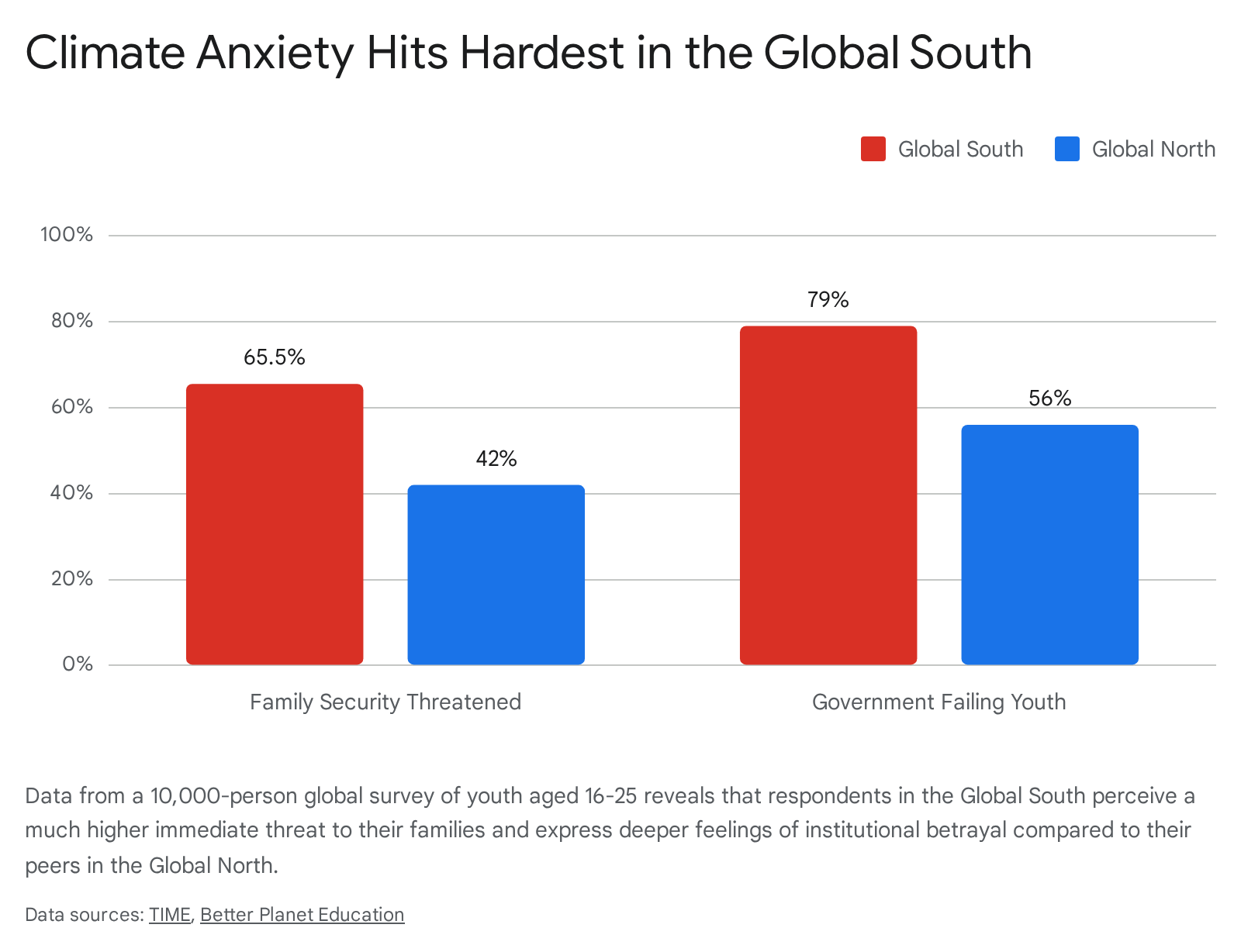
Furthermore, negative perceptions of government responses varied wildly by political context. Feelings of governmental betrayal were most prevalent in Brazil, where 79% of respondents felt failed by a government that had overseen the massive dismantling of environmental protections. In contrast, respondents in Finland were the least likely to hold a negative perception, though even there, 47% still believed their government was failing young people 2021.
In developing nations across Sub-Saharan Africa, South Asia, and Southeast Asia, climate anxiety is rarely just a form of anticipatory grief; it is deeply intertwined with direct, present-day trauma and acute physical survival 3422.
Mental Health Impacts in Southeast Asia
Populations in South and Southeast Asia are navigating severe, recurrent disruptions that trigger intense psychological trauma. A systematic review of observational studies focusing on extreme weather events in this region identified profound psychosocial impacts linked directly to floods, storm surges, typhoons, cyclones, extreme heat, and riverbank erosion 22. Survivors of these catastrophic events frequently exhibit high rates of PTSD, major depressive disorder, generalized anxiety, and suicidal ideation. Studies evaluating affected populations in Southeast Asia have recorded mental health disorder prevalence rates ranging dramatically from 6.4% to over 80% following major disasters, with post-disaster food insecurity and socioeconomic devastation exacerbating these risks 26. In recognition of this escalating crisis, the WHO has recently called upon member states in the Southeast Asia Region to urgently strengthen their mental health systems to address climate-induced psychosocial burdens 23.
The Climate Trauma Landscape in Africa
Similarly, the African continent displays immense structural vulnerabilities to climate change, characterized by high proportions of the population heavily dependent on natural resources, coupled with weak regional mental health infrastructure 3. Sub-Saharan regions are enduring more frequent and prolonged droughts, severe flash floods, and advancing desertification. These are not mere environmental statistics; they result in widespread crop failures, loss of livestock, forced population displacement, and acute food insecurity 328. Preliminary research indicates that these climate disruptions threaten intergenerational identity processes as ancestral lands are lost, and social cohesion is fractured when land is no longer arable 28. This environmental degradation leads to psychopathologies including anxiety, depression, increased interpersonal violence, disturbed sleep, and substance abuse 428.
Intersectional Vulnerabilities to Climate Distress
Beyond geography and age, climate change acts as a potent "threat multiplier," undermining many of the baseline social determinants required for good physical and mental health 2. The WHO notes that climate-sensitive health risks are disproportionately borne by the most disadvantaged populations, compounding new existential fears over existing systemic inequalities 224.
An analysis of global research into the mental health impacts of climate change highlights several specific demographic groups that exhibit significantly higher vulnerability to developing severe psychological difficulties following climate disruptions.
| Vulnerable Population | Primary Climate-Related Mental Health Impacts | Key Drivers of Psychological Distress |
|---|---|---|
| Youth & Adolescents | High anticipatory eco-anxiety, eco-grief, feelings of hopelessness and doom. | Intergenerational injustice, lack of political power, grim scientific projections for their lifespan 1920. |
| Global South Residents | Acute PTSD, severe clinical depression, high acute stress, emotional distress. | Direct exposure to catastrophic floods/droughts, immediate food and water insecurity, economic decimation 2625. |
| Indigenous Communities | Deep solastalgia, cultural bereavement, existential grief, suicidality. | Loss of sacred ancestral lands, disruption of traditional ecological practices, biodiversity collapse 428. |
| Climate Migrants | Severe anxiety disorders, identity loss, high general psychological distress. | Forced geographic displacement, loss of community support networks, housing instability and trauma 425. |
| Agricultural Workers | High stress, depression, anxiety over financial ruin. | Unpredictable rainfall, total crop failures, livestock death, loss of generational livelihood 34. |
Direct and Indirect Triggers of Climate Anxiety
Climate distress infiltrates daily life through two primary pathways: direct physical exposure to the consequences of a warming world, and indirect, vicarious exposure mediated through news consumption, social media, and cultural awareness 825.
Direct Exposure to Extreme Weather Events
The most acute and measurable form of climate distress arises from direct physical exposure to extreme, climate-related disasters 825. Individuals forced to evacuate their communities due to encroaching mega-wildfires, those whose homes are inundated and destroyed by flash floods, or those enduring weeks of lethal, prolonged heatwaves frequently suffer immediate and lasting psychological trauma 182425.
This direct exposure predictably leads to higher incidences of post-traumatic stress disorder, acute stress disorders, and generalized anxiety. For these individuals, climate anxiety is not an abstract, theoretical concept regarding the global temperature in the year 2050; it is the visceral memory of being displaced, the tangible loss of physical safety, and the chronic stress of rebuilding a life in an increasingly volatile environment 52824. Heatwaves alone have been directly linked to a rising number of hospitalizations for psychiatric disorders, and rates of suicide have been shown to increase during periods of extreme ambient heat 18.
Vicarious Trauma and the Social Media Echo Chamber
For the billions of people who are not currently in the direct path of an active natural disaster, climate anxiety is often experienced vicariously. This indirect trauma is heavily mediated by digital news consumption, scientific reports, and social media algorithms 826.
The digital age ensures that anyone with a smartphone is intimately and constantly aware of global ecological collapse. A steady, unyielding diet of alarming climate reports, viral images of burning rainforests, and data concerning mass extinction can quickly lead to cognitive overload and chronic "doomscrolling" 71327. This constant exposure shapes risk perception profoundly.
A 2024 study led by researchers at the University of Buffalo investigated this phenomenon by surveying 1,400 adults regarding their social media habits and emotional responses to climate change. The researchers found a clear correlation between greater social media use and heightened climate anxiety 26. Crucially, the study differentiated between two distinct psychological states: * Climate Distress: A general, rational concern and anxiety about the realities of climate change. * Climate Doom: A fatalistic, absolute belief that climate change will inevitably lead to the total breakdown of social, political, and economic systems 26.
The study found that specific platforms - namely TikTok and Snapchat - were more closely associated with fostering "climate doom" and a subsequent support for radical action (such as sabotaging fossil fuel infrastructure), whereas users of Instagram, Reddit, and X exhibited different risk perceptions and levels of skepticism 26. While moderate exposure to climate news can effectively raise civic awareness, algorithmic amplification often fosters a paralyzing sense of helplessness, making the crisis feel entirely insurmountable to the individual consumer 2628.
This indirect exposure heavily impacts younger demographics. A survey by Project Information Literacy of nearly 1,600 undergraduate students found that 78% felt anxious about their future due to climate change. However, many students actively avoid deep engagement with climate news, stating they have become "numb" to the bleak tone of media coverage, choosing instead to curate information streams that do not overwhelm their daily cognitive load 28.
The Psychology of Green Consumerism
One of the most common behavioral outcomes of climate anxiety is its profound influence on daily consumer choices. As individuals attempt to regain a sense of agency and control over a seemingly uncontrollable global threat, many channel their anxiety into sustainable purchasing habits and "green consumerism" 1634.
Research indicates that there is a complex, often U-shaped relationship between climate distress and pro-environmental behavior 1316. * Moderate Anxiety as a Motivator: Individuals experiencing manageable levels of eco-anxiety or eco-guilt (remorse over one's own carbon footprint) are often highly motivated to engage in sustainable behaviors. This includes adopting plant-based diets, intentionally reducing air travel, purchasing ethical fashion, participating in local recycling programs, and engaging in climate activism 131629. For these individuals, anxiety acts as a potent cognitive-affective engine, driving them to align their daily actions with their moral values 36. * High Anxiety as a Paralyzer: Conversely, when climate anxiety tips into overwhelming dread, emotional exhaustion, or burnout, it can severely demotivate action. Individuals facing extreme "climate doom" may exhibit psychological withdrawal or fatalism, concluding that their personal efforts - like carrying a reusable coffee cup or avoiding single-use plastics - are entirely meaningless in the face of massive global industrial pollution 13.
Consumerism itself is also a source of deep psychological tension. In modern, fast-paced societies where overconsumption, social signaling, and dopamine-fueled gratification are normalized, the desire to live sustainably constantly clashes with structural and economic realities 3429. This friction fosters a perpetual cycle of eco-guilt when individuals inevitably fail to live a perfectly "zero-waste" lifestyle within a system designed for disposable convenience 34. Some studies, such as those examining consumers in India and Italy, suggest that to deal with this emotional dissonance, many consumers eventually resort to escapism - avoiding thinking about the environmental crisis altogether to normalize their plight and reduce their stress levels 14.
Understanding Adaptive and Maladaptive Coping Mechanisms
Because human-induced climate change is an ongoing reality that will persist for generations, the goal of psychological intervention is not to "cure" individuals of their fears or convince them that the threat is not real. Instead, the focus is on building robust emotional resilience and helping people manage their distress constructively so they can live meaningfully and act purposefully 17303132.
Psychological research generally divides responses to climate anxiety into two broad categories: adaptive (functional) and maladaptive (dysfunctional) coping strategies 3033.
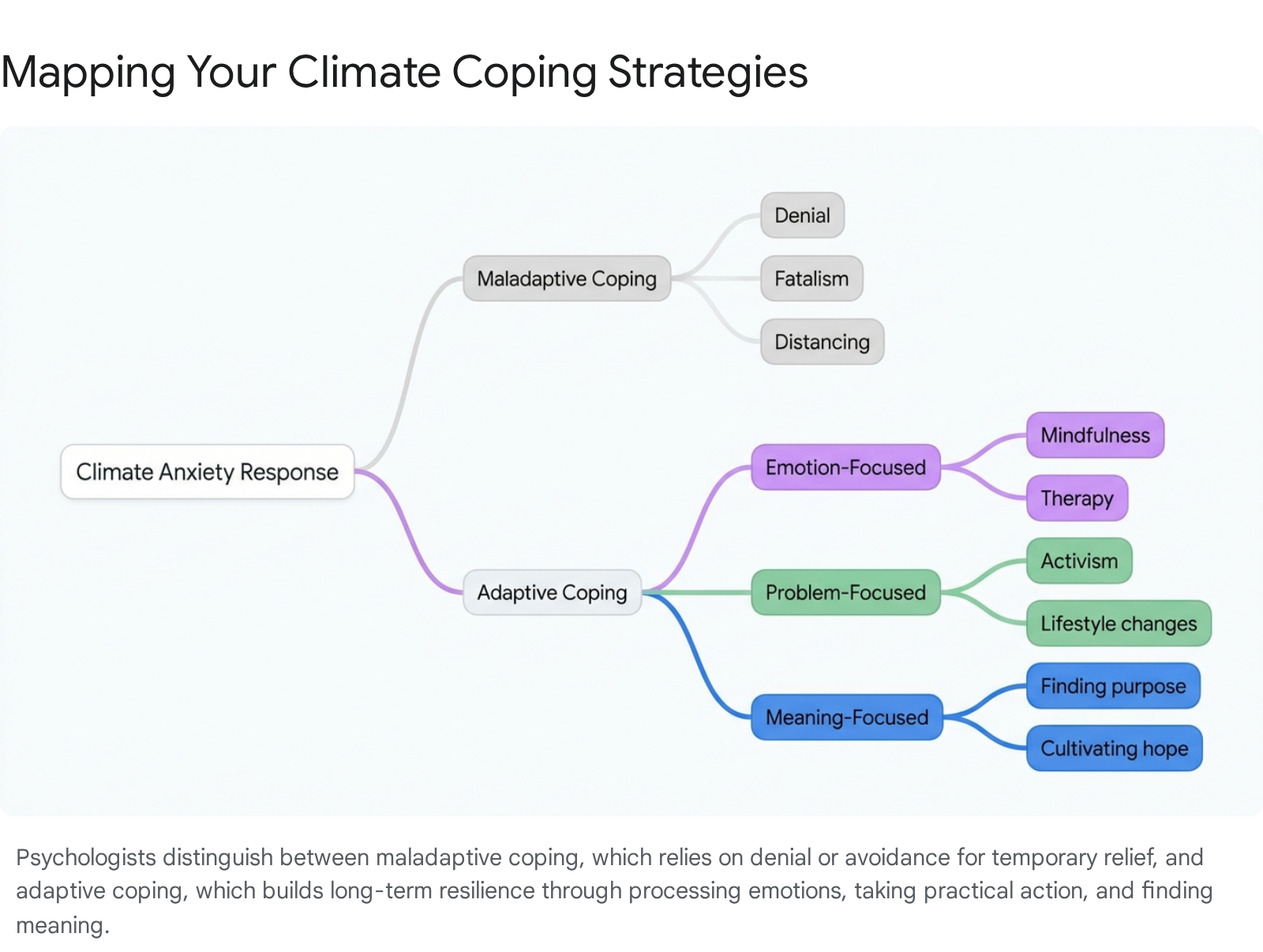
Maladaptive strategies are those that offer short-term psychological relief but ultimately fail to address the root issue, nor do they prepare the individual for physical reality. This includes outright climate denial, intentionally downplaying the severity of the crisis, aggressive distancing from distressing news, impaired emotional regulation, or yielding to absolute fatalism (the belief that humanity is doomed and nothing can be done) 153031. A study led by the University of Arizona surveyed 334 parents regarding their climate anxiety and found that roughly 30% fell into this "maladaptive avoidance" profile, exhibiting less guilt, less personal responsibility, and a lower likelihood of engaging in pro-environmental behaviors 3435.
Adaptive strategies, by contrast, help individuals manage their emotional stress while remaining actively engaged with the problem. The remaining 70% of parents in the Arizona study exhibited "adaptive approach coping," demonstrating higher environmental concern, a desire to problem-solve, and a belief that their actions could make a difference 3435.
According to prominent frameworks in the literature, such as the Climate Anxiety Compass, adaptive coping can be broken down into three distinct, healthy approaches 153236:
Emotion-Focused Coping
These strategies are aimed at processing, tolerating, and regulating the heavy, complex feelings associated with the ecological crisis. Emotion-focused coping involves practices such as mindfulness meditation, journaling, expressing eco-grief in a safe space, or participating in support groups. The goal is to alleviate the intense isolation and emotional burden of climate anxiety without trying to immediately "fix" the external climate problem 15323637.
Problem-Focused Coping
This involves taking direct, practical action to address the root causes of the anxiety or mitigate personal risk. Problem-focused coping includes lifestyle adjustments to lower one's personal carbon footprint, voting for climate-conscious policies, engaging in environmental activism, or preparing a personal emergency resilience plan for localized extreme weather events (such as floods or wildfires) 153236. While highly effective, relying solely on problem-focused coping can lead to burnout, as an individual cannot single-handedly solve global climate change 32.
Meaning-Focused Coping
This strategy involves cognitive reframing to find ongoing purpose and hope despite the grim reality of the situation. Meaning-focused coping involves trusting that scientists, activists, and broader coalitions are working toward progress. It emphasizes finding personal meaning in contributing to the solution, reflecting on core values, and maintaining a commitment to doing what is right, regardless of whether ultimate global success is guaranteed 1532.
Therapeutic Interventions: The Rise of Climate-Aware Therapy
As demand for mental health support skyrockets in tandem with rising global temperatures, a new, specialized psychological discipline has emerged: climate-aware therapy. Historically, many patients seeking help for climate anxiety found that traditional therapists - untrained in this specific existential threat - might inadvertently dismiss their fears as irrational catastrophizing or general anxiety 101131.
A climate-aware therapist is a professionally trained clinician who explicitly recognizes that the climate crisis is a real, macro-level threat impacting people on a deeply personal level. These clinicians empathize with emotional distress, provide a non-judgmental space free of denialism, and possess the skills to help clients transform eco-paralysis into resilience 1031.
A primary, evidence-based psychological framework utilized heavily in this emerging space is Acceptance and Commitment Therapy (ACT) 1138. Unlike traditional Cognitive Behavioral Therapy (CBT), which often seeks to challenge, correct, and reframe "unhelpful" thoughts, ACT focuses on building psychological flexibility. The core principles of ACT, when applied to climate anxiety, include 1138:
- Mindful Awareness: Cultivating the ability to stay present with uncomfortable feelings of grief, dread, and anger without immediately trying to numb them, escape them, or spiral into doomscrolling 1138.
- Acceptance: Openly acknowledging that climate change is happening and validating that it is entirely normal and human to feel devastated by it. This principle encourages dropping the psychological resistance to a harsh reality 3138.
- Value-Based Action: Moving forward by asking the client, "Given this difficult reality, what kind of person do you want to be?" This shifts the individual away from emotional paralysis and toward concrete actions that align with their core personal values, whether that entails planting a community garden, joining a political protest, or simply supporting vulnerable neighbors 1138.
Furthermore, clinical experts strongly emphasize that group action and collective engagement are uniquely therapeutic for those suffering from climate distress. Group work actively stimulates neural reward pathways associated with social connection, providing a powerful, almost transcendent antidote to the profound alienation and isolation that frequently accompanies climate despair 1037.
The Big Debate: Individual Responsibility vs. Systemic Change
When individuals attempt to cope with their climate anxiety through problem-focused actions, they inevitably hit a wall of deep frustration: Does choosing to ride a bicycle or bringing a reusable tote bag to the grocery store actually matter when massive fossil fuel corporations and nation-states are responsible for the vast majority of global emissions?
This inherent tension between individual behavior and systemic change is a frequent source of psychological friction, burnout, and debate 463940. Historically, the concept of the "personal carbon footprint" was heavily popularized in a 2004 advertising campaign by the fossil fuel giant BP. This highly successful marketing strategy effectively shifted the narrative of responsibility away from industrial polluters and placed the burden directly onto everyday consumers, leading many to feel overwhelming, paralyzing eco-guilt for driving a car or heating their homes in a society built entirely around fossil fuel infrastructure 4150.
Recent research by the World Resources Institute highlights the profound limits of personal action in a vacuum. The study demonstrated that if an individual adopted eleven aggressive pro-climate behaviors (such as flying less, eating a plant-based diet, and drastically reducing energy use), they could theoretically reduce their emissions by about 6.53 tonnes per year. However, if society's overarching infrastructure remains unchanged, that individual can only realistically achieve about one-tenth of their potential emissions savings (0.63 tonnes). The remaining 90% of potential savings remains locked away, entirely dependent on systemic interventions - such as greening the national electrical grid, redesigning mass urban transit, and enforcing strict corporate accountability 50.
Why Individual Action Still Matters
Given these stark numbers, it is incredibly tempting for anxious individuals to abandon personal behavioral changes entirely, succumbing to the belief that only governments and corporations matter. However, behavioral scientists, psychologists, and climate experts warn that framing individual action and systemic change as a mutually exclusive choice is a dangerous false dichotomy 404142. They are, in fact, two sides of the same coin, and leaning into both is essential for both psychological well-being and actual, measurable climate progress.
- Social Signaling and Normalization: Humans are highly social creatures whose individual survival historically depended upon cooperation and fitting into group norms. When you install solar panels, eat a plant-based diet, or openly discuss climate change with peers, you create a powerful social signal 4043. Research shows that these behaviors shift local cultural expectations. When sustainable choices become visibly normal within a community, it drastically reduces the social friction for others to adopt them, creating a ripple effect that changes collective behavior 3943.
- Bottom-Up Political Pressure: Systemic change rarely happens in a vacuum; it requires immense political will and public demand. Engaged individuals who make sustainable choices are significantly more likely to vote for climate-conscious leaders, attend local town halls, and demand corporate accountability 4150. Individual action builds the necessary momentum and public mandate for massive governmental infrastructure investments. A cross-cultural study by the UNSW Institute for Climate Risk & Response, surveying people in Australia and Iran, found that encouraging individual climate actions did not erode public support for government-led systemic interventions. Instead, they act synergistically, building bottom-up pressure 40.
- Psychological Agency and Emotional Coping: From a purely mental health perspective, individual action is absolutely crucial for staving off despair 4642. Taking tangible, value-aligned steps - even modest ones contained in immediate space and time - provides a desperately needed sense of agency and hope. It breaks the psychological cycle of helplessness, allowing anxious individuals to align their daily lives with their moral compass and find meaning amidst a generational challenge 4639.
As one climate researcher aptly noted, individual actions are the critical levers that incentivize wider change; they inspire systemic reforms, while systemic reforms ultimately build the infrastructure that empowers individuals to act more effectively and sustainably 4641.
Bottom line
Climate anxiety is a rational, pervasive, and increasingly severe psychological response to the empirical realities of global environmental degradation. While it is not formally classified as a mental illness, it can cause debilitating clinical distress, particularly for youth bearing the weight of intergenerational injustice and for populations in the Global South facing immediate, traumatic climate disasters. By acknowledging these complex emotions without judgment and moving from isolated panic to adaptive, collective, and value-driven action, individuals can protect their long-term mental health while contributing meaningfully to the systemic transformations the planet urgently requires.