
How Colleges Recalculate Your GPA Step by Step
When you apply to college, admissions officers strip non-academic electives from your transcript and mathematically convert your remaining grades to a standard 4.0 scale. They then apply their own institutional weights to advanced courses like Advanced Placement (AP) or International Baccalaureate (IB) to gauge your true academic rigor. This process ensures applicants from thousands of different high schools are evaluated on a single, standardized playing field.
Why Your Transcript GPA Is Not Enough
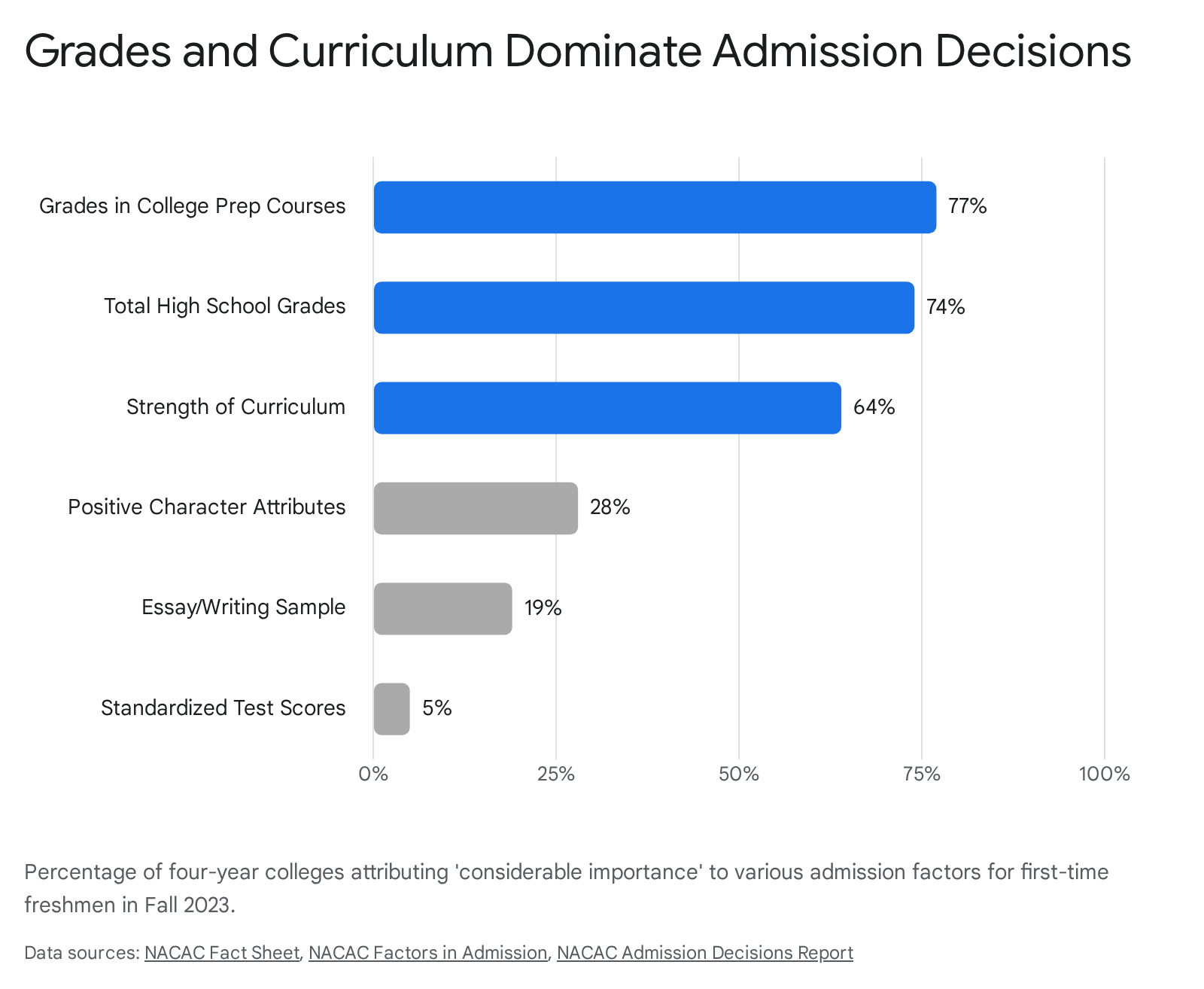
When an admissions office opens a student's file, the high school transcript is the most heavily scrutinized document inside. According to the National Association for College Admission Counseling (NACAC) Fall 2023 State of College Admission report, higher education institutions place overwhelming emphasis on day-to-day academic performance. A staggering 77% of four-year colleges rank a student's grades in college-preparatory courses as a factor of "considerable importance" in their admissions decisions 12. Furthermore, 64% point to the overall strength of a student's curriculum as a primary deciding factor 2. Standardized test scores, by comparison, have sharply declined in importance following the widespread adoption of test-optional policies, with only about 5% of colleges now viewing them as having considerable importance 13.
However, the primary metric used to summarize a student's performance - the Grade Point Average (GPA) - is fundamentally flawed as a comparative tool. There are over 23,500 high schools in the United States, and virtually no two schools calculate a GPA in the exact same way 4.
Some schools use a 100-point numerical scale, while others use a 4.0, 5.0, or even 12.0 letter-grade scale 456. Many high schools issue a "weighted" GPA that adds bonus points for advanced classes, but they differ wildly on the math. One school might add 1.0 point for an AP class and 0.5 for an honors class, while a neighboring district might add 1.0 point for both, or perhaps nothing at all for honors 47. Furthermore, some transcripts fold every single class - including physical education, marching band, and health - into the cumulative average, masking a student's actual performance in rigorous academic subjects 789.
If a college simply accepted transcript GPAs at face value, a student with a 4.2 from a school with heavy grade inflation and generous weighting might appear stronger than a student with a 3.8 from a notoriously rigorous preparatory academy 611. To solve this disparity, admissions offices level the playing field through a systematic mathematical process called GPA recalculation 57.
The Step-by-Step Recalculation Process
While the exact mathematical formula varies from one university to the next, almost all selective colleges follow a similar framework to process a student's raw transcript. This systematic breakdown isolates core academic performance, converts varying grading scales into a universal language, and assigns institutional value to the rigor of a student's chosen curriculum.
Isolating the Academic Core
The first thing admissions officers do is look at the courses on your transcript and discard the non-academic padding. Colleges are trying to predict how well you will handle rigorous, college-level academics. Earning an A in a non-academic elective does not provide reliable data for that prediction 712.
When recalculating a GPA, universities generally isolate five core academic subjects: English (or language arts), mathematics, sciences, social studies (or history), and foreign languages 71314. Highly selective colleges expect to see a progression of rigor across all four years in these five core areas 1315.
Classes like physical education, health, driver's education, digital media, yearbook, and many fine arts courses are typically removed from the mathematical equation entirely 7891617. This step often shocks applicants who have padded their schedules with easy electives in hopes of boosting their class rank. If a student earns a 95% in PE, a 98% in Art, but a 79% in Algebra II and an 82% in Chemistry, their high school transcript might show a cumulative GPA of roughly 3.4. However, once the college strips away the art and gym grades, the student's recalculated "core" GPA could plummet to a 2.5 79. Conversely, if a student took incredibly difficult core classes and received a C in a mandatory, unweighted PE class due to athletic struggles, removing the PE grade could actually cause their recalculated GPA to rise 181920.
Converting to a Standard 4.0 Scale
Once the core courses are isolated, the college converts the grades earned in those classes to a standardized 4.0 unweighted scale 71521. If a high school uses a 100-point numerical system, the admissions office will use a conversion matrix to map those percentages to standard letter grades, and then to grade points.
Many large institutions utilize a "flat" grading system during this recalculation phase, meaning they do not differentiate between pluses and minuses 202223. At a school using this flat recalculation method, an A- (which is typically worth a 3.7 at high schools that use plus/minus weighting) becomes mathematically identical to a flawless A+ 2024.
The table below illustrates how different high school grading marks generally translate to a college's baseline 4.0 unweighted scale before any bonus points are applied.
| High School Letter Grade | 100-Point Scale Equivalent | Unweighted College Grade Points |
|---|---|---|
| A+, A, A- | 90 - 100 | 4.0 |
| B+, B, B- | 80 - 89 | 3.0 |
| C+, C, C- | 70 - 79 | 2.0 |
| D+, D, D- | 60 - 69 | 1.0 |
| F | 0 - 59 | 0.0 |
Reweighting for Course Rigor
The unweighted core GPA acts as a helpful baseline, but it unfairly penalizes students who took highly rigorous courses. Earning a B in AP Physics requires significantly more intellectual effort than earning an A in standard earth science. To account for this, most universities calculate a "weighted" GPA by adding bonus points - often called quality points - to grades earned in advanced classes 2526.
However, colleges rarely trust the high school's weighting system 67. Instead, they apply their own specific quality points. Because Advanced Placement, International Baccalaureate, and Cambridge AICE classes follow strict, internationally standardized curricula, colleges universally recognize their rigor 25288. Most universities that recalculate a weighted GPA will add 1.0 extra point for these classes, magically transforming a 4.0 A into a 5.0, and a 3.0 B into a 4.0 2530.
Dual enrollment classes taken at a local community college or university while in high school are usually treated with the same respect as AP and IB courses, often receiving a 1.0 point bump 258. However, this is not a universal policy. Some universities do not weight dual enrollment classes because the rigor of community colleges varies so widely across different states and districts 79.
Honors courses are the most heavily debated tier in college admissions. Because there is no national standard for what constitutes an "honors" class, an honors course at a highly competitive preparatory school might be harder than an AP class elsewhere, while an honors class at a struggling public school might just be the standard curriculum supplemented with extra homework 2832. As a result, colleges are split on how to reward them. Many will award a 0.5 point bump for honors classes, making an A worth 4.5 points 26830. Others adamantly refuse to award any extra GPA weight for honors courses at all, preferring instead to simply view them as a mild indicator of academic ambition during the holistic review 1432.
How Specific Universities Recalculate GPA
Because colleges set their own institutional priorities, the exact same high school transcript can yield wildly different GPAs depending on where the student applies. Public university systems, which receive tens of thousands of applications, generally rely on strict, publicly available mathematical formulas to process their massive applicant pools efficiently.
The University of California (UC) System
The University of California system - which governs highly selective campuses like UC Berkeley and UCLA - utilizes one of the most famous and rigid recalculation methods in the country 16.
When you apply to a UC school, they only calculate your GPA using courses taken in the 10th and 11th grades, including the summers immediately following 9th and 11th grade 103435. Freshman year grades are completely ignored in the GPA calculation under the pedagogical philosophy that 9th grade is a volatile transition year for young students 2010.
Furthermore, UCs only count specific, state-approved core classes known as "A-G courses" 24103637. The UC system assigns points on a strict flat scale, completely ignoring pluses and minuses 1037. To calculate the weighted UC GPA, the system grants one bonus point for approved AP, IB, and UC-designated honors courses 1034. However, for the standard "Weighted and Capped" GPA used in most UC admissions profiles, the university strictly caps these bonus points at a maximum of 8 semesters, which equates to four year-long courses 103437. This deliberate cap prevents students from artificially inflating their GPAs by taking a dozen AP classes at the expense of their mental health and extracurricular development 24.
Competing Southern Publics: UGA, UF, and Georgia Tech
The nuances of recalculation become incredibly apparent when comparing major public universities in the Southeast. The University of Georgia (UGA) uses a standard 4.0 scale and looks strictly at the five core academic areas 1415. Crucially, UGA applies a 0.5 point weight to grades earned in AP and IB courses 14938. However, UGA does not add any extra weight for dual enrollment courses or high school honors classes 1415932. If you get an A in an honors physics class, UGA calculates it as a flat 4.0.
Conversely, the University of Florida (UF) isolates core courses but offers a much more generous weighting policy. When UF recalculates your transcript, they give a full 1.0 point extra weight to all AP, IB, AICE, and core-subject dual enrollment courses 811. Furthermore, UF extends a 0.5 point extra weight to Honors, Pre-AP, and Pre-IB classes 811. Because of this generous weighting system, the middle 50% of admitted students at UF often possess recalculated GPAs between 4.4 and 4.6 840.
Georgia Tech takes yet another approach. Rather than mandating their own algorithm immediately, Georgia Tech actually prefers to use the 100-point scale or the weighted GPA provided directly by your high school, provided it is printed on the official transcript 1242. If a high school does not provide a functional GPA, Georgia Tech will recalculate a weighted 4.0 GPA using only core courses, adding 0.5 points for AP, IB, Dual Enrollment, and Cambridge A-Level courses 1242. Like UGA, Georgia Tech does not award mathematical weight to honors courses, though they do mentally factor them into the holistic evaluation of a student's curriculum rigor 32. For transfer students, Georgia Tech calculates a specialized "Math and Lab Science GPA" that strictly isolates higher-level calculus and lab sciences to ensure applicants can survive their rigorous STEM environment 13.
UT Austin and UNC Chapel Hill
The University of Texas at Austin (UT Austin) operates under unique legislative constraints. Because Texas state law guarantees admission to UT Austin for in-state students who graduate in the top 6% of their high school class, class rank supersedes the raw recalculation of GPA for a massive portion of the applicant pool 44. For those applying outside the top 6%, UT Austin heavily scrutinizes course rigor; the average admitted student typically sports an unweighted GPA over 3.8 and has survived a grueling gauntlet of 10 to 14 AP, IB, or Honors courses 444546.
The University of North Carolina at Chapel Hill (UNC) focuses heavily on a weighted GPA for its initial baseline. For the 2025 - 2026 admissions cycle, the UNC system has mandated that students with a weighted high school GPA of 2.5 or above are eligible to apply without submitting standardized test scores, whereas those with a weighted GPA between 2.5 and 2.79 must submit an SAT or ACT score to prove their academic viability 4714. When evaluating competitiveness for Chapel Hill specifically, the bar is exceptionally high; the middle 50% of admitted students possess a weighted GPA between 4.14 and 4.71, with the class average sitting at a remarkably high 4.49 474915.
The table below summarizes the disparate ways major public universities treat advanced coursework when recalculating high school transcripts.
| University | Restricts to Core Subjects? | AP/IB Weight | Honors Weight | Dual Enrollment Weight | Institutional Quirks |
|---|---|---|---|---|---|
| UC System | Yes (A-G courses) | +1.0 point | +1.0 point (CA only) | +1.0 point | Ignores 9th grade; caps bonus weight at 8 semesters. |
| Florida (UF) | Yes | +1.0 point | +0.5 point | +1.0 point | Generous weighting yields high 4.4 - 4.6 average admit GPAs. |
| Georgia (UGA) | Yes | +0.5 point | 0 points | 0 points | Strips all non-academic electives; no dual enrollment bump. |
| Georgia Tech | Yes (if calculating) | +0.5 point | 0 points | +0.5 point | Prefers the high school's own 100-pt or weighted GPA first. |
| South Carolina | Yes | +1.0 point | +0.5 point | +1.0 point | Uses state uniform grading policy for out-of-state comparison. |
How Elite Private Colleges Evaluate Grades
While massive public universities rely on data-driven recalculation formulas to process tens of thousands of applicants efficiently, elite private institutions like Stanford, MIT, and the Ivy League take a radically different approach. Selective private colleges rarely plug grades into a rigid computer algorithm to spit out a newly weighted decimal. In fact, MIT explicitly states that its admissions office "does not use a specific formula or uniform scale to recalculate GPAs" 2351. Instead, these highly selective universities perform a deeply contextual, line-by-line reading of a student's transcript 51151.
When an admissions officer at a school like Stanford, Harvard, or Cornell reads your file, they evaluate your individual course grades directly alongside a crucial document called the "School Profile" 67611. The School Profile is submitted by your high school guidance counselor and outlines exactly how your school grades its students, what advanced courses are actually offered on campus, and historical data on grade distributions 76.
This means that elite private colleges do not need to mechanically unweight your GPA to understand your academic capability. If your specific high school uses an obscure 12.0 scale, Cornell will evaluate you against the historical performance of other applicants from your school on that exact same 12.0 scale 6. If your rural high school only offers three AP classes, MIT will not numerically penalize your GPA for lacking advanced credits compared to a student from a private boarding school that offers twenty APs. Instead, they look at "contextual rigor" - asking whether you took the most challenging courses actually available to you at your specific institution 6155152.
To aid in this contextual evaluation, the Common App requires school counselors to rate the rigor of an applicant's curriculum on a 1-to-5 scale, ranging from "less demanding" to "most demanding" 52. Admissions officers then cross-reference this counselor rating with the transcript to ensure the student truly pushed themselves 52.
While they eschew rigid mathematical formulas, selective privates still mentally perform the same fundamental task as the public universities: they strip out the noise 162016. An Ivy League admissions officer is not going to be swayed by a high weighted GPA if it is inflated by an A+ in introductory pottery and driver's education; they are looking exclusively to see if you maintained flawless performance in calculus, physics, and advanced literature 616. Furthermore, much like the UC system, Stanford explicitly ignores 9th-grade marks, viewing freshman year as an unstable transition period and focusing their academic evaluation heavily on 10th and 11th-grade performance 205455.
Ultimately, at the most selective schools in the country, a perfect 4.0 unweighted GPA is simply a baseline expectation. What separates admitted students is the demonstrated intellectual curiosity and the absolute contextual rigor of the schedule they voluntarily subjected themselves to 61116.
Self-Reporting and Automated Algorithms
If colleges recalculate GPAs anyway, you might wonder why you are asked to report your GPA on applications like the Common App in the first place.
The Common App requires students to manually enter their GPA, select the scale their high school uses, and indicate whether that GPA is weighted or unweighted 56. Admissions officers use this self-reported number as a quick-glance reference and to understand how you perceive your academic standing within the context of your own high school's grading policies 56.
However, many universities no longer rely on human officers to manually cross out gym class and re-add your grade points with a calculator. A massive trend in modern admissions is the requirement of a Self-Reported Academic Record (SRAR or SSAR) 4. Instead of just sending a PDF of a transcript, colleges require applicants to manually enter every single class they took, the exact grade they received, and the weight of the course into a centralized online database 4.
This data is then instantly fed into the university's algorithmic recalculation system. The computer automatically drops the non-core classes, translates the grading scale, and generates the school's specific institutional GPA before a human admissions officer ever sets eyes on the file 4. This underscores why accuracy and honesty are paramount when self-reporting. If a student tries to classify a standard physical education class as an "Honors" science class to game the algorithm, the discrepancy will be immediately caught when the college requests the final, official transcript upon admission. This type of academic misrepresentation almost always results in a revoked acceptance letter 115657.
Bottom line
The GPA printed on your high school transcript is rarely the metric admissions officers use to evaluate your academic potential. Colleges routinely recalculate your grades to strip away non-academic electives and create a standardized metric that allows them to compare applicants from thousands of different high schools fairly. Because universities prioritize unweighted performance in core subjects alongside the sheer rigor of your coursework, padding your schedule with easy electives will not trick an admissions office. While large public universities generally rely on strict formulas to apply bonus points for AP, IB, and dual-enrollment classes, elite private colleges prefer to read your transcript contextually, evaluating your academic choices strictly against what your specific high school actually offered.