
How Colleges Recalculate Weighted and Unweighted GPAs
Colleges recalculate your high school GPA to create a standardized metric that strips away non-academic electives and levels the playing field across thousands of different grading systems. While unweighted GPAs measure raw grades on a strict 4.0 scale, weighted GPAs factor in the rigor of honors and advanced courses. Ultimately, admissions officers evaluate both your recalculated core GPA and the strength of your curriculum to determine your true academic readiness.
The Architecture of High School Grading
To understand how colleges process your academic record, you must first understand the fundamental divide in high school grading systems. The grade point average (GPA) is the numerical summary of a student's academic performance, calculated by converting letter grades into points and averaging them across all courses taken 1. However, because the United States operates on a decentralized educational model with no universally mandated national curriculum, grading scales are determined at the local state or school district level 2. Across the country's more than 23,500 high schools, there is an immense variety of grading methods 3. The primary point of divergence lies in whether a high school uses an unweighted or a weighted scale.
The Unweighted GPA
An unweighted GPA is the traditional, standardized method of calculating academic performance. It measures grades on a strict 0.0 to 4.0 scale 44. In this system, letter grades correspond to fixed numerical values: an "A" is worth 4.0 points, a "B" is worth 3.0 points, a "C" is worth 2.0 points, a "D" is worth 1.0 point, and an "F" is worth 0.0 points 678.
The defining characteristic of the unweighted scale is that it is entirely indifferent to course difficulty. An "A" earned in a foundational freshman health class carries the exact same mathematical weight as an "A" earned in Advanced Placement (AP) Physics 469. Because of this, the unweighted GPA reflects a student's academic consistency but fails to capture the rigor of their curriculum 610.
The Weighted GPA
A weighted GPA attempts to mathematically account for course rigor, rewarding students who take on more challenging classes with extra "quality points" 4. This system typically operates on a 5.0 scale, though some high schools use systems that can push GPAs to 6.0 or higher 1112.
In a standard weighted system, earning an "A" in a highly rigorous course - such as an AP class, an International Baccalaureate (IB) Higher Level class, or a Dual Enrollment college course - yields 5.0 points instead of the traditional 4.0. Standard Honors classes often receive a half-point bump, making an "A" worth 4.5 points 4514. This means that a "B" in an AP class (worth 4.0 points on a weighted scale) can carry the same mathematical weight as an "A" in a standard-level class.
The table below outlines the standard point distribution for unweighted versus weighted scales across American high schools:
| Letter Grade | Percentage Range | Unweighted GPA Points | Honors Weighted GPA Points (+0.5) | AP/IB/Dual Enrollment Weighted GPA Points (+1.0) |
|---|---|---|---|---|
| A | 90 - 100% | 4.0 | 4.5 | 5.0 |
| B | 80 - 89% | 3.0 | 3.5 | 4.0 |
| C | 70 - 79% | 2.0 | 2.5 | 3.0 |
| D | 60 - 69% | 1.0 | 1.5 | 2.0 |
| F | Below 60% | 0.0 | 0.0 | 0.0 |
Because high schools set their own rules, the GPA printed on a transcript often lacks universal context. One high school might strictly weight only AP courses, another might weight all honors courses, and a third might refuse to weight grades at all, reporting only an unweighted 4.0 scale 311. Consequently, a 4.2 GPA from a high school with aggressive grade weighting might actually represent weaker academic performance than a 3.8 GPA from a highly rigorous high school that does not weight grades. This structural disparity is exactly why college admissions offices take matters into their own hands.
The Mechanics of GPA Recalculation
When an admissions team at a competitive university receives tens of thousands of applications, they cannot rely on face-value GPAs. To compare applicants fairly and accurately, colleges must create their own universal yardstick. By running every applicant's grades through a proprietary institutional formula, admissions officers can strip away local high school quirks and answer a more useful question: How has this student performed in their academic core? 11
This recalculation process is highly abstract and often misunderstood by families who assume the GPA on their transcript is the final number. In reality, the high school GPA is merely raw data that undergoes a specific filtering and weighting process. Admissions officers systematically isolate core academics, standardize grades to a 4.0 scale, and apply their own institutional weight for rigor. Depending on the college's specific approach, a student whose transcript boasts a 5.0 might see their recalculated GPA drop to a 3.9, while another student with a 3.6 might see their recalculated GPA rise to a 3.8 11.
While every college maintains its own internal rubric, the recalculation process generally follows three standard, sequential steps.
Step 1: Isolating Core Academic Subjects
The first step in almost every recalculation is the "unpacking" of the transcript, which involves stripping away non-core classes. Colleges typically focus exclusively on the five core academic subjects: English, Mathematics, Science, Social Studies (History), and Foreign Languages 1115.
Classes that fall outside these disciplines - such as physical education, health, driver's education, typing, studio art, theater, chorus, band, and general business electives - are usually removed entirely from the GPA calculation 111416. This does not mean these classes are entirely ignored by admissions committees. A compelling art portfolio, four years of dedicated orchestra involvement, or a high grade in a specialized "Intro to Engineering" elective will be evaluated favorably within the context of a student's extracurricular profile or intended major 15. However, an easy "A" in a gym class cannot be used to artificially inflate a student's core academic GPA, nor will a lower grade in an art class penalize a prospective pre-med student's science and math averages.
Furthermore, some colleges focus strictly on specific timeframes. While some universities recalculate all four years of high school, others completely ignore freshman year grades, focusing only on coursework completed during 10th and 11th grade to measure a student's maturity and performance in more advanced classes 116.
Step 2: Normalizing Plus and Minus Grades
High schools handle plus and minus grade modifiers differently. Some schools do not issue them at all, issuing only flat letter grades. Others use them extensively to add nuance to a report card, differentiating an A+ (97 - 100%) from an A- (90 - 92%) 1819.
When recalculating these grades, colleges take varying approaches to these modifiers: * The Strict 4.0 Method: Many major universities, including the University of Michigan and the massive University of California (UC) system, strip away plus and minus modifiers entirely during recalculation. In this method, an A+, an A, and an A- are all converted to a flat 4.0. Similarly, a B+ and a B- both become a flat 3.0 67822. * The Nuanced 4.0 Method: Other schools retain the modifiers and use a fractional scale. Under this system, each plus or minus step shifts the GPA value by approximately 0.3 points. Therefore, an A+ or A is worth 4.0, an A- is 3.7, a B+ is 3.3, a B is 3.0, a B- is 2.7, a C+ is 2.3, a C is 2.0, and a C- is 1.7 1419.
The nuanced method can drastically change how a transcript looks. If a high school uses a straight-letter unweighted system, eight classes with "A-" grades will read as a perfect 4.0. However, if a college recalculates that transcript using a nuanced plus/minus system, those exact same grades will average to a 3.7 19. If a student attends a high school that only awards flat letter grades without modifiers, colleges simply use what is provided. Admissions officers are trained to evaluate students strictly within the context of their own school's grading structure and will not assume an "A" was actually an "A-" just because modifiers are absent 22.
Step 3: Applying Institutional Weights
Once the core subjects are isolated and the letter grades are mapped to a 4.0 scale, colleges decide how to mathematically reward rigor. Some universities choose to remain entirely unweighted, preferring to judge rigor subjectively during the holistic reading of the application 7. Others apply their own standardized weighting system - often referred to as an Honors Point Average (HPA) - to ensure all applicants receive the same mathematical credit for taking hard classes.
Typically, colleges that choose to weight grades will add 1.0 extra point for college-level coursework (AP, IB, AICE, or Dual Enrollment classes) and 0.5 extra points for Honors-level coursework 3514. However, some colleges have policies where they cap the maximum number of bonus points a student can earn, ensuring that students from elite high schools offering 25 AP classes do not hold an insurmountable mathematical advantage over students from under-resourced high schools offering only three AP classes 6.
Alternative and International Grading Systems
A significant portion of the applicant pool - including international students and those attending progressive U.S. high schools - presents transcripts that do not use standard letter grades. Admissions officers utilize specific internal rubrics to normalize these disparate grading frameworks.
The 100-Point Scale
Many high schools grade on a 0 - 100 percentage scale. A common, albeit mathematically flawed, piece of internet advice suggests that students can simply divide their 100-point average by 25 to find their 4.0 GPA (e.g., dividing a 90 by 25 to get a 3.6) 2324. College admissions officers do not use this division method.
Instead, colleges map percentage brackets directly to the 4.0 scale. In standard U.S. grading, an 80 - 89% generally constitutes a "B" (3.0), and a 90 - 100% constitutes an "A" (4.0). If a student has an 88% average, dividing by 25 would yield an artificially high 3.52; in reality, most colleges would map an 88% to a "B+" (3.3) or a flat "B" (3.0) depending on their specific plus/minus policies 188.
The International Baccalaureate (IB) 1 - 7 Scale
The International Baccalaureate (IB) Diploma Programme is an internationally recognized curriculum that awards subject grades on a scale from 1 (lowest) to 7 (highest), yielding a maximum of 42 points across six subjects, plus up to 3 bonus points for the Theory of Knowledge (TOK) and Extended Essay (EE) components, for a total of 45 points 2526.
Because the IB system assesses absolute mastery of strict global criteria via external exams rather than cumulative classroom homework, translating it to an American GPA requires nuance 26. The International Baccalaureate Organization (IBO) explicitly refuses to provide an official conversion table to the U.S. 4.0 scale, citing the decentralized nature of American education 2. Consequently, U.S. universities handle this process internally, guided by the principle of non-conversion. Selective U.S. universities prefer to evaluate an IB "7" within the known context of the curriculum's immense rigor rather than reducing it to a generic 4.0 9.
However, for internal benchmarking, U.S. admissions officers generally recognize the following conversions: * IB Score of 7: Converted to an A+ or A, representing a 4.0 GPA. At colleges that weight GPAs, a 7 in a Higher Level (HL) IB course may be weighted up to a 5.0 252628. * IB Score of 6: Converted to an A or A-, scoring roughly a 3.7 to 4.0 2628. * IB Score of 5: Converted to a B+ or B, scoring a 3.0 to 3.3 2628. * IB Score of 4: Converted to a B- or C+, scoring a 2.7 28.
Admissions data indicates that a total IB diploma score of 42 out of 45 is generally viewed as equivalent to, or even more impressive than, a perfect 4.0 unweighted GPA, as it demonstrates sustained excellence across multiple highly rigorous subjects 25.
Global Grading Systems
Admissions officers are geographic specialists trained to understand international education systems 89. For Indian applicants, for example, students are evaluated on either absolute percentages or a 10-point CGPA system 29. U.S. colleges generally equate an Indian percentage of 75 - 84% to a 3.7 GPA, and anything from 85 - 100% to a 4.0 GPA, acknowledging the strict grading curves of the Indian secondary system 29. Universities explicitly advise international applicants against attempting to translate their own grades to a 4.0 scale on their applications; instead, students must report their grades exactly as they appear on their original transcripts, allowing the university to perform the contextual translation 2910.
Non-Traditional and Narrative Grading
A growing movement in education involves "ungrading," mastery-based education, or narrative evaluation systems 3111. Institutions like Brown University and the New College of Florida allow students to take courses strictly on a Satisfactory/Unsatisfactory basis, accompanied by detailed, multi-page written evaluations from professors detailing their critical thinking, collaboration, and academic growth 31.
When evaluating applicants from progressive high schools that use these systems, admissions officers cannot calculate a numerical GPA. Instead, they rely heavily on the high school's School Profile to understand the pedagogy, read the narrative evaluations deeply to assess the student's intellectual curiosity, and place a significantly higher emphasis on standardized test scores and portfolio submissions to gauge academic readiness 33.
Institutional Case Studies in Recalculation
To truly understand how recalculation impacts an application, it is helpful to examine the publicized, official methodologies of several major university systems. They vary from aggressively weighted to strictly unweighted.
The University of Michigan: The Unweighted Standard
The University of Michigan utilizes one of the most straightforward recalculation formulas. The university strictly uses an unweighted 4.0 scale during its evaluation of first-year applicants. They recalculate using all classes taken from 9th through 11th grade, but they completely strip away all plus and minus modifiers. An A+, A, and A- are all converted to a flat 4.0. Furthermore, Michigan does not mathematically weight AP, IB, or Honors classes in the GPA. Instead, the rigor of an applicant's curriculum is reviewed subjectively and separately as part of a comprehensive, holistic application review 7.
The University of Florida: The Core Weighted Formula
In contrast, the University of Florida calculates a "core, weighted GPA." Florida isolates only academic core subjects and applies a specific, aggressive institutional weight: an extra 1.0 point is added for every AP, IB, AICE, or Dual Enrollment class, and an extra 0.5 point is added for Pre-AICE, Pre-AP, Pre-IB, and standard Honors classes 5. This mathematical emphasis on advanced coursework often results in admitted students boasting GPAs well above a 4.0.
The University of California (UC) System: The Capped Weight
The massive University of California (UC) system utilizes a highly specific, rule-bound recalculation formula. The UC GPA focuses exclusively on specific "A-G" college-preparatory courses completed between the summer after 9th grade and the summer after 11th grade - meaning freshman year grades are entirely ignored 6.
Like Michigan, the UC system strips away plus and minus modifiers. However, unlike Michigan, the UC system allows for a "capped" weighted system. Students earn an extra honors point for each semester of a UC-approved honors, AP, IB, or transferable college course. Crucially, this extra weight is capped at a maximum of 8 points (the equivalent of four year-long courses) between 10th and 11th grades. Only grades of A, B, or C receive the extra weight; a D or F in an AP class receives no bonus 6. This cap prevents students at elite high schools from accumulating an endless supply of bonus points, ensuring a more equitable comparison against students from schools with fewer advanced offerings.
Stanford University and the Ivy League: Holistic Contextualization
Highly selective private institutions, such as Stanford University and the Ivy League, typically do not adhere to a rigid, publicly published recalculation math formula like large state systems. Instead, they look at both the unweighted GPA (to measure academic consistency) and the weighted GPA (to measure course rigor) 110. At Stanford, where the acceptance rate frequently hovers below 4%, the average GPA of admitted students is roughly 4.18 on a weighted scale and 3.95 on an unweighted scale 410. However, admissions officers at these elite schools manually "unpack" transcripts, contextualizing the grades based on the specific offerings of the applicant's high school 1212.
The following table summarizes the differing recalculation philosophies among major university systems:
| University / System | Core Classes Only? | Plus/Minus Grades Counted? | Institutional Weighting | Notes |
|---|---|---|---|---|
| University of Michigan | Yes | No (A+, A, A- = 4.0) | Unweighted | Rigor is evaluated subjectively, not mathematically. 7 |
| University of Florida | Yes | Yes | +1.0 for AP/IB/Dual; +0.5 for Honors | Heavy mathematical emphasis on advanced coursework. 5 |
| University of California | Yes (A-G courses) | No | Capped at 8 honors points | Ignores 9th grade entirely; limits the mathematical advantage of elite schools. 6 |
Course Rigor vs. Raw GPA: The Admissions Tradeoff
Perhaps the most common anxiety among college-bound high school students is the "GPA vs. Rigor" tradeoff. Students constantly ask: Is it better to get an "A" in an easy, standard-level class to protect a perfect 4.0 GPA, or should I take an AP class and risk getting a "B"?
Data from college admissions experts and institutional surveys heavily favors taking the harder class, provided the student can handle the workload without their grades collapsing. While both factors are critical, a pristine 4.0 GPA achieved through a light, undemanding course load is consistently viewed less favorably than a slightly lower GPA earned through highly rigorous, advanced coursework 10353637.
According to the 2023 State of College Admission Report by the National Association for College Admission Counseling (NACAC), admissions officers prioritize course performance and curriculum strength above almost all other factors.
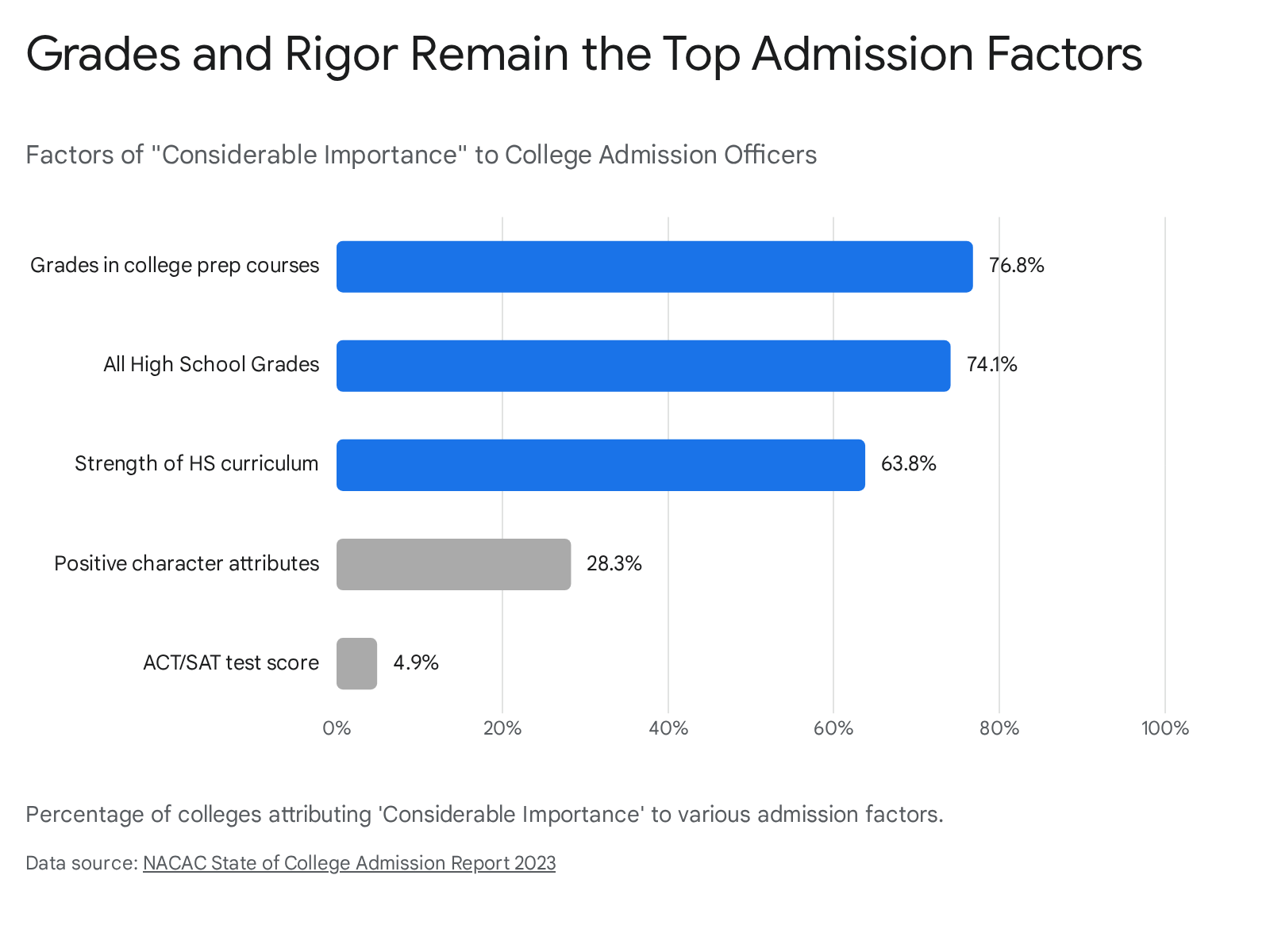
The NACAC survey data indicates that 76.8% of colleges place "considerable importance" on a student's grades in college-preparatory courses, and 63.8% place considerable importance on the strength of the curriculum itself. By contrast, essays, extracurriculars, and demonstrated interest trail far behind in raw importance 3839.
The Academic Rating System
To quantify this balance between grades and rigor, many admissions offices assign applicants an internal "Academic Rating," typically on a scale of 1 to 5 3740.
In this rating system, a "5" (Most Demanding) is reserved for students who have essentially maxed out the advanced courses offered at their school. At top-20 universities, the vast majority of admitted students possess a "5" rating 37. If "Charlie" applies with a perfect 4.0 GPA but only took three AP classes throughout high school, and "Taylor" applies with a 3.92 GPA but took 12 AP classes, Taylor is viewed as the significantly stronger academic candidate 37. In a highly selective admissions pool where nearly everyone has straight A's, the lack of rigor knocks Charlie's academic rating down to a level where he is no longer competitive, despite the flawless GPA.
The Role of the School Profile in Contextualizing Rigor
Crucially, colleges do not penalize students for failing to take AP classes if their high school does not offer them. Rigor is evaluated strictly in context 137. Every high school sends a "School Profile" along with student transcripts - a document detailing exactly how many Honors, AP, or IB classes the school provides 119.
Admissions officers cross-reference the student's transcript against this profile. If a rural high school offers only two AP classes and the student takes both, they receive a "Most Demanding" curriculum rating 37. However, if a wealthy suburban high school offers 25 AP classes and the student only takes four, the admissions committee will note that the applicant actively avoided the most rigorous academic opportunities available to them 3741. According to a sociological study of elite university admissions, a student's chances of acceptance actually drop if they attend a high school filled with highly talented peers taking advanced coursework, but fail to match that rigor themselves 1239.
Admissions officers read course selection as an argument. Choosing challenging courses and succeeding in them signals intellectual curiosity, a strong work ethic, and a genuine readiness for the intense pace of university-level academics 3541.
Grade Inflation and the Post-Pandemic Testing Landscape
The conversation surrounding recalculated GPA cannot be separated from the recent, seismic shifts in standardized testing policies. Historically, the SAT and ACT served as universal benchmarks to validate a student's high school grades. However, the COVID-19 pandemic forced a massive pivot in 2020, leading nearly all universities to adopt test-optional, test-flexible, or test-blind admissions policies 1314.
This sudden absence of standardized testing placed an unprecedented burden of proof on the high school transcript and the recalculated GPA. At the same time, high schools across the country were experiencing a severe crisis of "grade inflation." Over the past decade, average GPAs have steadily climbed, and reports from the Department of Education indicate that an "A" has become the most commonly awarded grade in American high schools 4445.
When 90% of applicants to a selective university present a 4.0 GPA, the metric completely loses its power to differentiate students 3744. Without test scores, admissions officers struggled to determine whether a 4.0 GPA represented true academic mastery or simply a lenient high school grading environment 46.
The 2025 - 2026 Admissions Divide
As the college admissions landscape moves into the 2025 and 2026 cycles, a clear bifurcation has emerged regarding how GPAs and test scores are weighed:
The Test-Optional Majority: More than 80% of U.S. four-year colleges - over 1,800 institutions, including massive state systems, national universities, and selective liberal arts colleges - will not require applicants to submit ACT or SAT scores for fall 2025 admissions 47. Advocacy groups like FairTest argue that test-optional policies consistently result in more diverse and academically strong applicant pools 47. At these institutions, the recalculated GPA, the strength of the curriculum, and qualitative factors like essays and recommendation letters remain the undisputed arbiters of admission 1315.
The Return to Testing at Elite Institutions: Conversely, a highly influential subset of elite institutions - including MIT, Harvard, Yale, Dartmouth, Brown, Georgetown, the University of Texas at Austin, and Caltech - have recently reversed course, reinstating mandatory standardized testing requirements 495051.
These reversals were driven by deep, internal data analysis. Dartmouth College convened a working group that discovered test-optional policies were inadvertently harming lower-income and first-generation applicants 465152. Without test scores, admissions officers were forced to rely on transcripts from under-resourced high schools that lacked a common reference point, leading to "undermatching" - where highly capable students enrolled in less selective colleges than they were qualified for 4652. A 1400 SAT score from a high school where the average is 1000 acts as a powerful beacon of talent; without it, the student's contextually impressive GPA was easily lost in a sea of wealthy, suburban 4.0s 4651.
Furthermore, a landmark 2024 study by Opportunity Insights, a Harvard-based research team, analyzed data from "Ivy-Plus" colleges and found that standardized test scores have substantial predictive power for college success, while high school GPA does not 4549. The researchers found that students with perfect test scores earned first-year college GPAs roughly 0.43 points higher than students with modest scores. In stark contrast, a student with a perfect 4.0 high school GPA performed only about 0.1 college GPA points better than a student with a 3.2 high school GPA 45. At the elite level, grade inflation has rendered the high school GPA too noisy; test scores have proven to be the superior predictor of university readiness 4551.
Even at test-optional schools, submitting a high test score serves a vital purpose: it validates the recalculated GPA 44. It assures the admissions officer that the "A" grades on the transcript are grounded in genuine academic capability, providing a competitive edge in an era where perfect grades are no longer unique.
Strategic Course Selection for College Readiness
Given the intense scrutiny placed on the recalculated GPA and course rigor, students must approach their high school course selection as a strategic argument. Former admissions officers consistently advise students to take the most challenging courses available in their specific areas of interest 4153. If a student intends to major in engineering, avoiding AP Calculus to protect a GPA raises immediate red flags regarding their readiness for a STEM degree 41.
However, this push for rigor must be balanced with realism and mental well-being. Overloading on AP and IB courses simply for the sake of appearances can lead to burnout, sleep deprivation, and ultimately, a collapse in academic performance 5354. A schedule filled with "C" grades in advanced courses demonstrates poor judgment and an inability to manage workload 54. The optimal strategy is to build a "4x5" foundation - four years of study across the five core subjects (Math, Science, English, History, Foreign Language) - and selectively apply high-level rigor to the subjects where the student naturally excels 53.
Bottom line
The GPA printed on a high school transcript is rarely the exact number colleges use to make admissions decisions. Instead, admissions offices recalculate grades using proprietary formulas to strip away non-academic electives, normalize varied grading scales, and account for the rigor of advanced coursework. While maintaining strong grades is essential, selective colleges place massive weight on the strength of a student's curriculum, actively prioritizing applicants who challenge themselves with honors, AP, and IB classes. In an era of rampant grade inflation where a 4.0 is increasingly common, admissions officers evaluate the recalculated GPA not just as a number, but as a contextual narrative of a student's intellectual curiosity and readiness for university-level work.