
How to Co-Parent After Divorce According to Science
Child development research indicates that successful post-divorce parenting hinges on minimizing children's exposure to ongoing interparental conflict while maintaining high-quality, consistent relationships with both caregivers. While shared physical custody generally yields the best emotional and behavioral outcomes in amicable situations, high-conflict dynamics require distinct strategies - like parallel parenting and structured communication boundaries - to protect the child's physiological and psychological well-being. Ultimately, the stability of the parenting approach and the emotional regulation of the adults are far more critical to a child's resilience than achieving a perfect division of time.
The Science of Living Arrangements: Shared vs. Lone Custody
The dissolution of a marriage initiates a profound restructuring of family dynamics. For decades, legal systems, child psychologists, and family courts debated the optimal post-separation living arrangements for children. The traditional model often defaulted to lone physical custody - typically with the mother - while the non-residential parent was granted limited weekend visitation. However, modern empirical research has dramatically shifted this paradigm toward shared physical custody, where children spend a significant portion of their time (usually at least 35%) with each parent.
The 2023 Systematic Review on Custody Outcomes
A landmark 2023 systematic review published in PLOS ONE synthesized data from 39 rigorous studies conducted between 2010 and 2022 to evaluate children's outcomes across different living arrangements 112. The researchers meticulously assessed five specific developmental domains: emotional, behavioral, relational, physical, and educational. The findings fundamentally disrupt outdated notions about the harm of transitioning between two homes. In 75% of the studies analyzed, children living in shared physical custody arrangements demonstrated outcomes equal to those of children raised in intact, nuclear families 13.
Conversely, children in lone physical custody arrangements consistently reported the worst outcomes across all measured domains 1. When direct comparisons were made between the two divorce arrangements, children in lone custody exhibited worse behavioral outcomes 45.5% of the time and worse relational outcomes - specifically parent-child relationship quality - 62.5% of the time compared to their peers in shared arrangements 1. The literature suggests that the ongoing presence of two active caregivers provides a developmental safety net that solitary custody arrangements struggle to replicate.
The "Fewer Resources" vs. The "Instability" Hypothesis
To explain these wide disparities in child welfare, researchers test empirical data against several sociological theories. The "instability hypothesis" posits that the sheer stress of moving between two homes, packing bags, and disrupting daily routines causes psychological harm. If this hypothesis were the primary driver of post-divorce outcomes, children in shared custody would exhibit markedly worse outcomes than those in lone custody due to the frequent transitions.
However, the data overwhelmingly supports the "fewer resources hypothesis" 11. This theory suggests that children in lone physical custody suffer not from the stability of a single home, but from a severe reduction in relational, emotional, and economic resources. Shared physical custody allows children to maintain continuous access to the social capital, extended family networks, financial support, and distinct parenting styles of both caregivers. The research indicates that the benefits of retaining full access to both parents' resources far outweigh the logistical stressors of moving between two residences 14. In essence, the psychological security of knowing both parents remain invested eclipses the inconvenience of split logistics.
The Tipping Point of the 50/50 Presumption
The robust empirical backing for shared parenting has led many jurisdictions to adopt a legal presumption of 50/50 equal parenting time 57. Proponents of this shift point to data showing that children benefit significantly from overnight visits, which foster deeper attachment and allow parents to engage in routine caregiving - such as homework and bedtime - rather than just "fun weekend" activities 86. Time spent engaging in mundane daily tasks builds a foundation of trust that intermittent visitation cannot establish.
| Custody Arrangement | Primary Characteristics | Observed Child Outcomes (Aggregate Data) |
|---|---|---|
| Intact Nuclear Family | Parents co-reside; combined economic and emotional resources. | Highest baseline for emotional, behavioral, and academic stability. |
| Shared Physical Custody (SPC) | Child spends 35% to 50% of time with each parent; frequent transitions. | Equal to nuclear families in 75% of studies; high relational security. |
| Lone Physical Custody (LPC) | Child resides primarily with one parent; limited visitation with the other. | Highest risk for behavioral issues, lower emotional regulation, fewer resources. |
| High-Conflict SPC | Equal time split, but parents engage in chronic, hostile disputes. | Elevated anxiety, depression, and physiological stress markers; worse than LPC in some cohorts. |
Despite the general consensus favoring shared time, family law experts and child psychologists warn against applying a rigid 50/50 formula as a universal panacea. The benefits of shared parenting rely heavily on the assumption that both parents are safe, capable, and reasonably cooperative 711. When researchers look closely at the data, the positive effects of shared custody begin to deteriorate under specific conditions: severe interparental conflict, domestic violence, untreated addiction, or severe mental illness 118. In these high-risk scenarios, forcing a 50/50 schedule exposes the child to chronic trauma, effectively using the child as a conduit for continued abuse or psychological manipulation 11. The presence of ongoing, toxic conflict shifts shared custody from a protective factor to a profound vulnerability.
The Physiological and Psychological Impact on Children
The transition through divorce is not merely an emotional or logistical challenge; it is a profound physiological stressor that alters neurobiology and hormonal regulation in both children and adults. Understanding the biological underpinnings of stress helps clarify why certain co-parenting strategies succeed while others fail.
Cortisol, Stress Reactivity, and the HPA Axis
The hypothalamic-pituitary-adrenal (HPA) axis is the human body's primary stress response system, responsible for the synthesis and release of the glucocorticoid cortisol. Under normal conditions, cortisol release is a healthy response to acute emergencies. However, research demonstrates that children exposed to high levels of interparental conflict and family instability exhibit dysregulated cortisol responses resulting from chronic stress exposure 91011. Prolonged exposure to high cortisol levels due to ongoing family hostility is associated with reduced antibody levels, emotional instability, and an increased risk for internalizing disorders, such as depression and anxiety, or externalizing behaviors, such as aggression and delinquency 1112.
Interestingly, the physical presence of a supportive parent acts as a biological buffer against this stress. Studies indicate that when children face acute stressors, the presence of a calm, supportive caregiver significantly reduces cortisol reactivity 9. This underscores the critical biological importance of keeping both parents actively involved in a child's life post-divorce; the loss of a parent equates to the loss of a primary physiological stress buffer 912. Furthermore, parenting quality directly impacts this physiological baseline. Highly supportive, warm parenting is associated with healthy diurnal cortisol rhythms. In contrast, harsh, unpredictable, or neglectful parenting correlates with either hypercortisolism - a state of chronic high stress - or hypocortisolism, which represents a blunted, exhausted stress response system 13.
Long-Term Mental Health and Academic Trajectories
Beyond immediate physiological responses, the long-term trajectories for children of divorce are heavily influenced by the quality of the post-divorce environment. The American Academy of Pediatrics notes that while children experience acute emotional trauma during a separation, the majority bounce back within two to three years if provided with stable, conflict-free environments 714. However, a sizeable minority of children suffer prolonged symptomatology that extends well into adulthood.
Population data suggests that eliminating the negative effects of hostile parental divorce could theoretically prevent significant proportions of teen pregnancies, school dropouts, and early adulthood mental health problems 15. Children from economically disadvantaged divorced families often experience compounded stress, facing diminished educational opportunities and increased uncertainty regarding their future 16. Yet, resilience research demonstrates that children who are supported by emotionally regulated parents, who maintain positive relationships with both caregivers, and who are shielded from interparental disputes tend to exhibit outcomes indistinguishable from those in intact families 1718.
Navigating the High-Conflict Co-Parenting Dynamic
When parents cannot achieve the collaborative ideal of cooperative co-parenting, they must rely on structural boundaries to protect their children and themselves. While amicable co-parenting involves flexibility, shared events, and fluid communication, high-conflict scenarios require a radically different approach to neutralize hostility.
Understanding Interparental Conflict and its Harms
Interparental conflict following divorce encompasses a wide range of behaviors, including verbal and physical fighting, hostile contempt, uncooperative behaviors, and prolonged legal battles. Previous research and large-scale meta-analyses have exhaustively documented the negative impact of this conflict on youth adjustment 19. Children exposed to chronic disputes often feel caught in the middle, suffering from divided loyalties that manifest as severe anxiety and behavioral regression 20.
Furthermore, some studies have found nuanced gender differences in how children process this conflict within shared arrangements. For instance, adolescent girls living in joint custody situations characterized by high parental conflict reported significantly higher feelings of depression and lower life satisfaction than girls in primary maternal custody, suggesting that the constant exposure to hostile transitions can sometimes outweigh the benefits of shared time 19. Therefore, shielding children from the crossfire is the paramount objective in any high-stress separation.
When Traditional Co-Parenting Fails: The Parallel Parenting Model
When cooperative co-parenting completely fails, family courts and mental health professionals universally recommend shifting to a "parallel parenting" model 252621. Unlike traditional co-parenting, which requires parents to align their rules, collaborate on daily decisions, and present a united front, parallel parenting assumes complete emotional and logistical disengagement.
In a parallel parenting arrangement, each parent operates their household as an independent, sovereign entity 2522. Parents do not attend joint parent-teacher conferences, they do not sit together at sporting events, and they abandon the goal of enforcing identical bedtime or screen-time rules across both homes 23. Communication is strictly limited to major legal, medical, or educational decisions mandated by law, and is almost exclusively conducted through written platforms or monitored co-parenting applications 252431.
The primary goal of parallel parenting is not to foster a healthy relationship between the adults. Rather, the sole objective is to drastically reduce the child's exposure to toxic adult conflict 1921. By removing the need for negotiation, parents remove the opportunity for argumentation.
| Feature | Cooperative Co-Parenting | Parallel Parenting |
|---|---|---|
| Communication Frequency | Regular, open, and fluid dialogue via calls or texts. | Minimal; scheduled and strictly written via dedicated apps. |
| Decision Making | Collaborative, shared daily choices and routine planning. | Independent; major decisions only via formal protocol or mediator. |
| Household Rules | Highly synchronized across both homes for consistency. | Independent; each home sets its own rules without interference. |
| Transitions/Exchanges | Flexible; parents may chat pleasantly at the door. | Rigid; neutral locations (e.g., school drop-offs) to avoid contact. |
| Event Attendance | Parents attend child's events together, often sitting side-by-side. | Parents attend alternate events or sit entirely separately. |
| Ideal Use Case | Amicable divorces with mutual respect and low conflict. | High-conflict divorces, narcissism, or history of post-separation abuse. |
Addressing Narcissism and Toxic Ex-Partners
In cases involving a narcissistic or highly toxic ex-partner, the traditional advice to "compromise" is often counterproductive and potentially dangerous. Narcissistic individuals frequently use the co-parenting relationship to exert control, seeking out conflict to satisfy a psychological need for "narcissistic supply" - the emotional reaction of their target 3233.
Therapists advise targeted parents to emotionally disengage entirely 2132. This involves recognizing that the other parent's home rules cannot be controlled and focusing solely on providing a safe, predictable haven during one's own parenting time. Maintaining firm boundaries, documenting all interactions, and refusing to defend oneself against baseless accusations are critical survival tactics for the targeted parent. When a child has one healthy, emotionally regulated parent, that single stable relationship can effectively outweigh the detrimental impacts of the toxic parent 25.
Communication Strategies and Emotional Boundaries
Managing a difficult co-parent requires specialized communication frameworks designed to convey necessary information without inviting debate. Psychologists and legal professionals have developed specific methodologies to neutralize hostility.
The BIFF Communication Method
Developed by Bill Eddy of the High Conflict Institute, the BIFF method is a widely recommended, evidence-based communication protocol for managing hostile exchanges 353626. High-conflict individuals often use digital communication to provoke emotional reactions, draw their ex-partner into endless debates, or manufacture evidence of instability. The BIFF method starves this dynamic by stripping the communication of all emotional fuel 27.
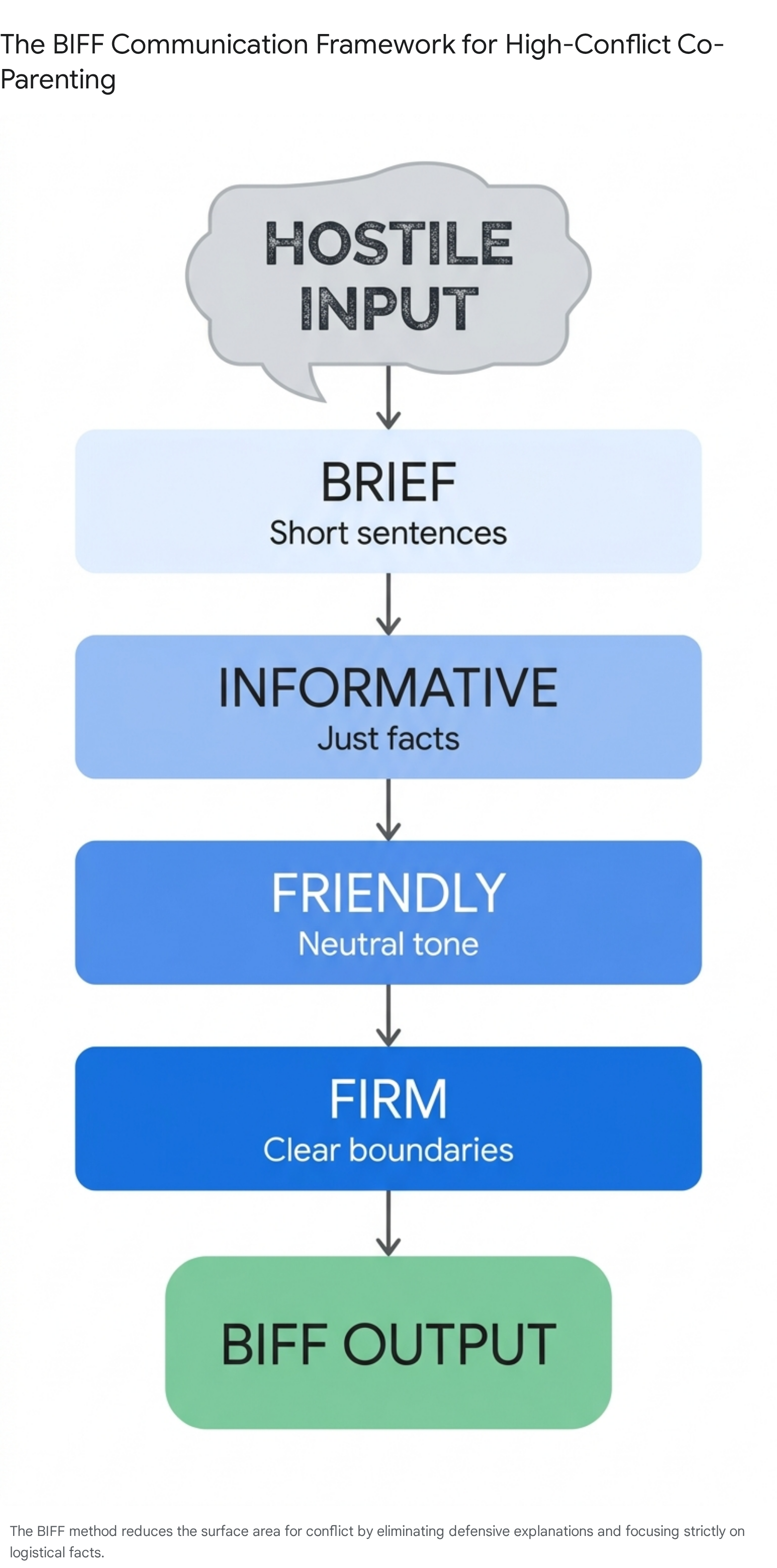
The BIFF framework operates on four foundational pillars: Brief responses are essential; messages should be as short as possible. Lengthy paragraphs provide more material for the high-conflict parent to misinterpret, quote selectively, or argue against. By keeping the word count low, parents minimize the surface area for conflict 2728.
Informative communication must focus exclusively on objective facts and logistics. Parents are advised to avoid sharing opinions, defending themselves against false accusations, or offering unsolicited advice. The goal is to transmit data, not to persuade or be understood 2840.
Friendly tones should mirror a professional exchange with a distant, difficult colleague. This does not require warmth, affection, or vulnerability, but rather the inclusion of basic social pleasantries - such as "Thank you for the update" - to prevent the message from sounding aggressive and triggering further escalation 3528.
Firm responses should close the loop on the conversation. The message must state a clear boundary or decision without leaving room for further negotiation, manipulation, or endless back-and-forth dialogue 3640.
The Grey Rock Technique
When face-to-face interaction is unavoidable, psychologists often recommend a behavioral strategy known as the "Grey Rock" method. This technique involves the targeted parent making themselves as uninteresting, unresponsive, and emotionally flat as a literal grey rock 3132.
Because high-conflict personalities seek emotional reactions, removing that reaction eliminates their incentive to provoke. By offering monotone, one-word answers, avoiding eye contact, and refusing to engage with bait, the targeted parent protects their own peace. This psychological disengagement ensures that the adult remains regulated, which in turn de-escalates the immediate environment for the child 22.
The Trauma of Notification Anxiety and App Settings
The tools designed to facilitate co-parenting can inadvertently become vectors for trauma. Research into modern digital co-parenting highlights a phenomenon known as "notification anxiety" 41. For individuals who have left hostile or abusive marriages, the sound of a text message or a notification from a co-parenting app can trigger a cascade of trauma responses akin to Post-Traumatic Stress Disorder (PTSD) 41. Symptoms include hypervigilance, racing heart rates, emotional dysregulation, and avoidance behaviors.
The constant digital tether to a high-conflict ex-partner prevents the nervous system from returning to a baseline state of rest. As a result, emerging technologies and specialized communication apps like OurFamilyWizard, TalkingParents, and BestInterest are heavily utilized by courts 3142. These platforms not only create an unalterable, court-admissible record of communication but also feature "smart silence" settings or hostility monitors 233641. These features allow parents to batch notifications and engage with communications only when they are emotionally prepared, providing critical psychological distance.
Digital Boundaries and Technoference
The proliferation of smartphones and social media has introduced new complexities to post-divorce parenting. "Technoference" - the interruption of interpersonal interactions by digital devices - has been linked to poorer parent-child relationship quality and increased behavioral issues in children 2930.
In co-parenting scenarios, inconsistent rules regarding screen time, internet access, and social media sharing can become major battlegrounds. When parents fail to establish a united front regarding digital boundaries, children often retreat into electronic devices to escape the resulting tension, leading to problematic media use 30. Current guidance urges co-parents to draft explicit digital agreements within their parenting plans, detailing acceptable screen time, rules for sharing photos of the child online, and guidelines for the child's use of artificial intelligence tools for homework or entertainment 424531.
Age-Appropriate Transitions and Developmental Needs
Children process the dissolution of their family differently depending on their cognitive and emotional development. Parenting plans and transition routines must be tailored to the child's specific age group and continuously updated as they mature to prevent developmental delays 323349.
Infants and Toddlers (Ages 0 - 3): Attachment and Predictability
For children under three, the primary developmental task is forming secure attachments. Toddlers thrive on rigid predictability and struggle to conceptualize time 49. Transitions for this age group should prioritize routine and familiarity. Research suggests that while overnights with the non-residential parent are beneficial for long-term bonding and reduce the likelihood of social withdrawal, transitions must be handled delicately to prevent severe separation anxiety 8649. Parents are encouraged to maintain identical sleep and feeding schedules across both homes and ensure that transitional objects, such as a favorite blanket or stuffed animal, travel consistently with the child 49.
Preschoolers (Ages 3 - 5): Magical Thinking and Consistency
Preschoolers possess a growing imagination but often engage in "magical thinking," leading them to erroneously believe their behavior - such as misbehaving at dinner - caused the divorce 3234. They require frequent, simple verbal reassurances that both parents love them and that the separation is permanent, which helps prevent distressing fantasies of reconciliation.
Because transitions are notoriously difficult for this age group, experts advise a specific protocol: dropping the child off at the other parent's home rather than having the receiving parent pick them up. This psychologically reinforces that the departing parent is willingly entrusting the child to a safe space, rather than having the child forcibly "taken away" 35.
School-Aged Children (Ages 6 - 11): Structure and Social Worlds
As children enter school age, their social worlds expand beyond the nuclear family into classrooms and extracurricular activities 34. These children require rigorous structure to manage homework and social obligations across two households. Parents must ensure that duplicate school supplies and sports equipment are available in both homes to prevent the child from feeling like a transient visitor carrying their life in a backpack 34. Conflict during this stage often arises from inconsistent discipline; parents must enforce unified consequences to prevent children from testing boundaries or playing parents against each other 3637.
Adolescents (Ages 12 - 18): Autonomy and the Grief Cycle
Preteens and teenagers require a higher degree of flexibility in custody schedules to accommodate extracurricular activities, part-time jobs, and peer relationships 33. Research indicates that adolescents who feel forced to choose between a parent and their social life experience intense resentment and loyalty conflicts 33.
Furthermore, adolescents experience a distinct grief cycle following a divorce, sometimes internalizing their pain through depression and isolation, or externalizing it through aggression, delinquency, or substance abuse 38. The literature highlights that boys often display overt physical and verbal aggression post-divorce, while girls are more likely to internalize aggression or exhibit psychosomatic symptoms like headaches and stomachaches 38. Parents must remain vigilant for these behavioral shifts and maintain open, non-judgmental communication. Engaging in dialogue utilizing "I" statements allows parents to model healthy emotional regulation and validates the teenager's complex feelings 3839.
Establishing Transition Rituals
Regardless of age, the physical transition between households represents a moment of high vulnerability. Child development experts highly recommend establishing "transition rituals" to anchor the child during these shifts 404142.
Instead of chaotic packing sessions, transition rituals inject predictability and comfort into the exchange. This might involve a specific goodbye handshake, a shared meal before leaving, engaging in a continuous activity like building a Lego set that remains at one house, or playing a designated playlist in the car on the way to the other parent's home 4142. Furthermore, parents must avoid "parentification" - the damaging practice of burdening the child with adult emotional needs 43. Telling a child, "I'm going to be so lonely without you," unfairly saddles the child with guilt. Instead, parents should frame the transition positively, expressing joy that the child gets to spend quality time with their other parent 3542.
Emerging Trends and Alternative Custody Models
As societal norms evolve, so too do the frameworks surrounding post-divorce family life. Recent research has shed light on novel custody arrangements and the profound influence of cultural contexts on family restructuring.
Bird's Nest Parenting: Reversing the Transition
"Birdnesting" is an alternative custody arrangement that completely reverses the traditional model. Instead of the children packing their bags and moving between two residences, the children remain stationary in the primary family home (the "nest"). The divorced parents are the ones who rotate in and out of the house according to the custody schedule, typically maintaining separate, smaller apartments for their off-duty time 4445.
A 2025 phenomenological study analyzed the outcomes of birdnesting and found that it significantly preserved children's sense of security and independence. Siblings benefited from uninterrupted time together, and the children were spared the logistical stress of living out of a suitcase 44. However, researchers caution that birdnesting is generally only viable as a short-term, transitional strategy - typically up to six months. It requires immense financial resources to maintain up to three separate households and demands a high degree of trust and communication between the ex-spouses, making it entirely unsuitable for high-conflict divorces or situations involving new romantic partners 4546.
Cross-Cultural Perspectives: South Asia, Latin America, and Beyond
While much of the foundational research on divorce originates in Western contexts, emerging demographic studies from Asia, Latin America, and Africa highlight the profound impact of cultural stigma and socioeconomic factors on child resilience 164748.
In South Asian communities, for instance, divorce carries a heavy cultural stigma that can lead to social withdrawal and internalized shame for both the parents and the children. The perception of "family dishonor" places an immense psychological burden on the child, compounding the standard stressors of family separation and often hindering effective post-divorce adjustment 49.
In Latin America, the rise of union dissolution has resulted in a massive increase in unpartnered mothers. However, cultural norms regarding extended families mean that these children frequently co-reside with grandparents or non-primary kin. This multi-generational living provides a vital secondary layer of emotional and economic support that acts as a strong protective buffer against the negative impacts of the parental separation 48.
Across all cultures, research consistently demonstrates that a child's psychological adjustment is heavily dependent on the parents' own well-being. "Emotional divorce" - where parents remain legally married under one roof but are emotionally estranged and highly hostile - has been shown to cause more severe emotional and behavioral problems in children than a finalized legal divorce accompanied by healthy, separated co-parenting 1643.
Future Trajectories in Modern Family Systems
Looking ahead, child development experts note a broader societal shift toward "lighthouse parenting" and enhanced emotional intelligence following family separation 5067. Parents are increasingly prioritizing their own mental health and utilizing technological tools - including AI-assisted scheduling and specialized co-parenting platforms - to reduce logistical friction 6751. This trend reflects a growing recognition that effective co-parenting is not about forcing a fractured family to mimic an intact one, but rather about creating a new, highly functional dual-household system where the child's emotional security takes absolute precedence.
Bottom line
The extensive body of child development research confirms that children are remarkably resilient, and the trauma of divorce can be mitigated by keeping the child insulated from adult hostility. Shared physical custody generally promotes the best developmental outcomes by preserving the child's access to both parents' emotional and financial resources, provided the environment is safe and free from severe conflict. For high-conflict situations, utilizing the BIFF communication method and implementing parallel parenting frameworks are essential boundaries that protect both the parents' physiological health and the child's emotional stability. Ultimately, a child's successful adjustment depends less on the precise mathematics of the custody schedule and more on the consistency, predictability, and emotional regulation demonstrated by their caregivers.