
Effects of Father Absence on Child Development
The structural composition of the family has undergone profound transformations globally over the last half-century. These demographic shifts have prompted extensive sociological, psychological, and economic investigation into how the absence of a resident father influences child development. Historically, the phenomenon of father absence was often analyzed through ideological frameworks that presupposed deterministic, negative outcomes for children raised outside the traditional nuclear family structure 123. However, contemporary empirical research has increasingly deconstructed the monolithic category of "father absence." Advanced statistical modeling reveals that developmental outcomes are heavily mediated by the specific mechanisms causing the absence, the socioeconomic context of the household, the presence of extended kinship networks, and the quality of maternal and co-parenting relationships 456.
By separating ideological assumptions from longitudinal data, researchers have identified that the physical absence of a father is frequently a proxy variable for other deeply embedded structural disadvantages, such as abrupt income loss, severe parental conflict, and neighborhood deprivation 789. This report synthesizes peer-reviewed demographic, sociological, and developmental data to examine the diverse pathways through which father absence impacts cognitive, behavioral, and long-term socioeconomic outcomes in children, effectively isolating the "father effect" from the myriad covariates that typically accompany it.
Sociological Shifts in Family Structures
Sociological inquiry into family structures has shifted from a deficit-based model to an ecological and resource-based model. Early literature often conflated the outcomes of children raised in poverty-stricken single-parent households with the inherent lack of a paternal figure, failing to account for broader macroeconomic and cultural shifts 310.
Demographic Trends in Household Composition
Long-term demographic trends indicate that the traditional family structure - defined as a married couple and their dependent children - is declining as the absolute societal norm in many regions 310. In the United States, households containing married couples decreased from 71% in 1970 to 47% in 2022 1. Among 49 analyzed countries, the United States ties with Colombia for the second-highest rate of children growing up in single-parent homes, trailing only South Africa 11. Concurrently, nonmarital childbearing has risen significantly; in the U.S., births to unmarried mothers rose from 5% in 1960 to approximately 40% in recent years 112.
These changes are representative of more extensive social, economic, cultural, and technological shifts. Sociologists identify multiple drivers for these trends, including increased female labor force participation, delays in marrying age, higher divorce rates, the decline of the male-breadwinner economic model, and the wider acceptance of varied family structures 2310. The structural transformation of the family means that approximately 21% of U.S. children under the age of 18 live without their biological father, necessitating a rigorous examination of how varying family forms impact child socialization and economic stability 5.
Theoretical Frameworks of Individualization
Theoretical models of modern family dynamics, such as the individualization theory proposed by sociologists Beck and Beck-Gernsheim, suggest that modern family roles are increasingly negotiated rather than strictly prescribed by traditional cultural scripts 1314. This shift toward individualization implies that contemporary relationships prioritize emotional satisfaction, mutual support, and equality over economic necessity or social expectation 14.
Consequently, researchers now emphasize that family processes - such as parental warmth, communication, consistency, and conflict resolution - are more highly predictive of child well-being than the strict biological or residential structure of the family 410. The assumption that growing up without a father is inherently detrimental is largely drawn from mid-20th-century studies of divorced households, where children often experienced severe interparental conflict and sudden financial disruption alongside the departure of the father 15. When researchers isolate family structure from these confounding variables, utilizing more sophisticated data sets, the deterministic narrative surrounding father absence becomes significantly more complex.
Methodological Challenges in Family Research
Analyzing family structure without accounting for geographic, socioeconomic, and methodological context leads to significant statistical distortions. Sociological critiques emphasize that individual development is nested within community ecosystems, and failing to account for this can result in deterministic fallacies that incorrectly attribute the effects of poverty to family structure 716.
The Ecological Fallacy in Neighborhood Studies
A primary methodological hazard in fatherhood research is the "ecological fallacy" - a logical error that occurs when researchers incorrectly deduce inferences about individual children based on the aggregate statistics of the neighborhood or demographic group to which they belong 161617. For example, early sociological studies observed that neighborhoods with high proportions of single-mother households also exhibited high rates of juvenile crime and academic failure. From this aggregate data, it was erroneously inferred that father absence directly causes individual criminality or cognitive deficits 1617.
However, group-level relationships do not automatically characterize relationships at the individual level. In the 1950s, sociologist William S. Robinson famously demonstrated the ecological fallacy by showing that states with higher proportions of immigrants had higher average literacy rates, but at the individual level, immigrants were actually more likely to be illiterate than native-born citizens; the state-level correlation merely reflected that immigrants settled in states with better educational infrastructure 161617. Similarly, neighborhoods do not necessarily have high crime rates because they contain more single mothers; rather, both high crime and high rates of family dissolution are downstream effects of systemic economic deprivation, lack of institutional resources, and residential segregation 71618.
Controlling for Selection Bias and Fixed Effects
To prevent ecological fallacies, modern demographic researchers employ fixed-effects models and multilevel modeling to separate individual variance from neighborhood-level disadvantage 719. When researchers utilize these models to eliminate between-individual variance and control for the social organization of the community, the direct, causal relationship between a resident father and child behavioral outcomes often weakens or disappears entirely 7.
For instance, studies of toddler behavior reveal that while disadvantaged neighborhoods confer immense risk for disruptive and aggressive behavior, the specific effect of the neighborhood is negligible once proximal family factors - such as maternal depression, family disadvantage, and exposure to violence - are accounted for 19. Furthermore, longitudinal analyses utilizing hybrid models demonstrate that a child's level of aggression is influenced far more by stable household and neighborhood characteristics than by the presence of a father. In these rigorous fixed-effects models, no significant direct relationship was found between having a resident father and lower child aggression once neighborhood disadvantage was controlled 7. This highlights that children in disadvantaged environments suffer primarily from the erosion of overall caregiving quality and chronic stress, rather than the isolated absence of a male parent.
Categorical Causes of Paternal Absence
The developmental trajectory of a child without a resident father depends critically on the catalyst for that absence. The empirical data draws sharp distinctions between absence due to parental conflict (divorce or separation), paternal incarceration, paternal mortality, and labor migration 2021. Grouping these distinct phenomena under the umbrella of "father absence" obscures the specific mechanisms that drive child outcomes.
Parental Conflict and Union Dissolution
Divorce and relationship dissolution are the most common drivers of father absence in Western contexts. Population-level data consistently shows that children whose parents divorce are at a greater risk of exhibiting internalizing behaviors (such as anxiety, withdrawal, and depression) and externalizing behaviors (such as aggression and non-compliance) 2223.
However, longitudinal research indicates that these difficulties are largely associated with the strain of the divorce process itself, the exposure to parental hostility, and the subsequent financial hardship 422. After a divorce, fathers tend to see their children less often and may become less involved, which can lead adolescents to rate their non-resident fathers as less caring 1. Yet, in cases where divorce resolves a highly toxic, abusive, or conflict-ridden interparental dynamic, children often show marked psychological improvements over time, particularly if the parents establish a cooperative co-parenting arrangement 424. The negative outcomes associated with divorce are thus better understood as symptoms of relationship dissolution and economic disruption rather than the mere lack of a paternal figure 8.
Paternal Incarceration
Among all forms of father absence, paternal incarceration produces the most severe, enduring, and unique negative developmental outcomes 2126. With mass incarceration disproportionately affecting marginalized communities, millions of children experience father loss due to the criminal justice system 252627.
Utilizing data from the Fragile Families and Child Wellbeing Study, researchers have demonstrated that paternal incarceration is linked to a significantly greater incidence of attention deficit hyperactivity disorder (ADHD), severe aggression, learning disabilities, speech problems, and developmental delays compared to absence caused by divorce or death 212628. In comparative regression models, the effect of incarceration on child aggression and attention problems was found to be statistically stronger and significantly different from the effect of a father being absent for other reasons 21.
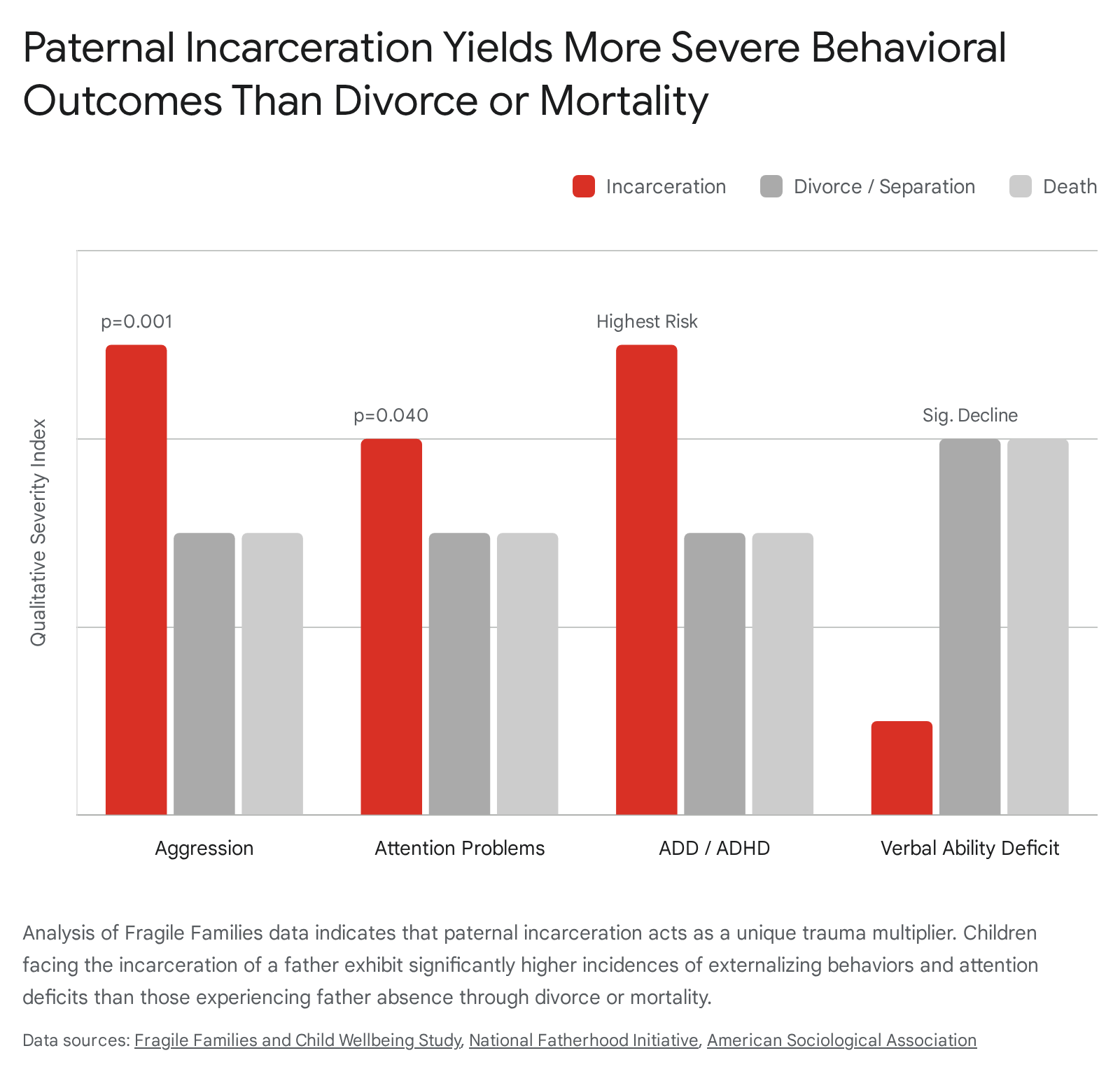
The mechanisms driving these poor outcomes extend far beyond parent-child separation. Incarceration introduces profound social stigma, acute economic instability, and chaotic cycles of imprisonment and release that disrupt attachment formation and create chronic uncertainty 2529. Children of incarcerated fathers are more likely to experience neglectful or harsh parenting from the remaining caregiver, who must suddenly contend with the emotional toll of the penal system and the loss of household resources 2125.
The long-term economic consequences are equally stark. Research utilizing Swedish administrative data - which exploits the random assignment of criminal defendants to judges with different incarceration tendencies to isolate causal effects - reveals that for disadvantaged children, paternal incarceration decreases adult employment at age 25 by 28.7 percentage points and decreases annual earnings by $7,111 (a 34% change) 29. Furthermore, paternal imprisonment reduces formal child support receipt, pushing families onto food stamps and exacerbating long-term poverty 30. The research indicates that the trauma of the penal system serves as a specific trauma multiplier that is fundamentally distinct from general family dissolution 29.
Paternal Mortality
The death of a father presents a distinct psychological and economic profile. While it entails absolute and irreversible separation, the absence is culturally unambiguous and generally elicits high levels of formal and informal social support, devoid of the stigma associated with desertion or incarceration 2031. Children who experience paternal death in childhood do not typically exhibit the same severe externalizing behaviors, high school dropout rates, or delinquency seen in children of divorced or incarcerated parents 82132.
However, paternal mortality does result in long-term economic scarring that manifests in adulthood. Utilizing population-wide Danish administrative data, researchers examined sudden, first parental deaths in adulthood and traced the subsequent labor market outcomes. Five years after losing a parent, adult sons experienced a persistent earnings decline of approximately 2%, while adult daughters experienced an earnings decline of roughly 3% to 4% 333435. This economic impact is largely driven by deteriorating mental health (evidenced by increased psychological support and opioid prescriptions) and the sudden loss of informal intergenerational family support 333536. For women with young children, the earnings drop is particularly severe, as the death of a parent frequently eradicates the grandparent-provided childcare networks required to maintain full-time workforce participation 333436.
Labor Migration and Remittances
In developing nations across Latin America, Asia, and Sub-Saharan Africa, father absence is frequently a byproduct of labor migration 611. This arrangement introduces a paradox: the physical absence of the father disrupts daily authority structures and caregiving consistency, yet the remittances he provides often elevate the household's material welfare above that of intact, locally employed families 6.
Studies in rural Bangladesh demonstrate that daughters of labor migrants tend to have older ages at marriage and first birth - markers of a delayed, more stable life history - mediated by the high socioeconomic status afforded by the father's income 20. Conversely, daughters whose fathers divorced or deserted them experienced consistently younger ages at marriage and first birth, driven by psychosocial stress and low paternal investment 20. Thus, migration highlights how economic provisioning can sometimes offset the developmental risks of physical absence, provided that the remaining family network maintains structural stability.
| Cause of Father Absence | Primary Psychological/Behavioral Indicators | Primary Socioeconomic Indicators | Key Mediating Variables |
|---|---|---|---|
| Incarceration | Severe aggression, ADHD, developmental delays, high rule-breaking 212628. | Extreme long-term earnings drop, perpetuation of poverty 2529. | High social stigma, maternal depression, chaotic reentry cycles. |
| Divorce/Conflict | Internalizing (anxiety) and externalizing (non-compliance) behaviors 2223. | Reduced household resources, maternal labor shifts 822. | Interparental hostility, coparenting quality, sudden income loss. |
| Mortality | Grief-related trauma, lower rates of delinquency compared to divorce 832. | Persistent adult earnings decline (2-4%), loss of childcare support 3334. | High communal support, lack of social stigma, clear psychological closure. |
| Labor Migration | Varied; potential for identity confusion but buffered by extended kin 37. | Elevated household assets via remittances, delayed life history events 620. | Consistency of remittances, quality of substitute caregiving. |
Socioeconomic and Ecological Mechanisms
The developmental challenges observed in father-absent homes are frequently manifestations of underlying socioeconomic deprivation. Single-parent families are structurally disadvantaged because they rely on one income, leading to higher rates of poverty; in 2019, 38.1% of children living with two unmarried parents lived below the poverty line, compared to 7.5% of children with married parents 1.
Neighborhood Disadvantage and Danger
The ecological context in which a single-parent family resides profoundly influences parenting quality. Exhaustive modeling of twin studies indicates that neighborhood socioeconomic deprivation - characterized by a lack of institutional and economic structural resources - demonstrates consistent negative associations with positive parenting behaviors and maternal control 38. The chronic stress of financial instability frequently degrades the psychological resources required for authoritative parenting, leading to authoritarian or uninvolved parenting styles 3940.
Conversely, neighborhood danger (defined by recorded crime, fear of crime, and exposure to violence) sometimes prompts parents to increase behavioral control and monitoring as a protective adaptation to keep children safe 3841. Thus, the Family Stress Model posits that single parents in deprived neighborhoods are not inherently worse caregivers; rather, they are operating under intense ecological constraints that limit their ability to engage in warm, consistent, and patient parenting 4041.
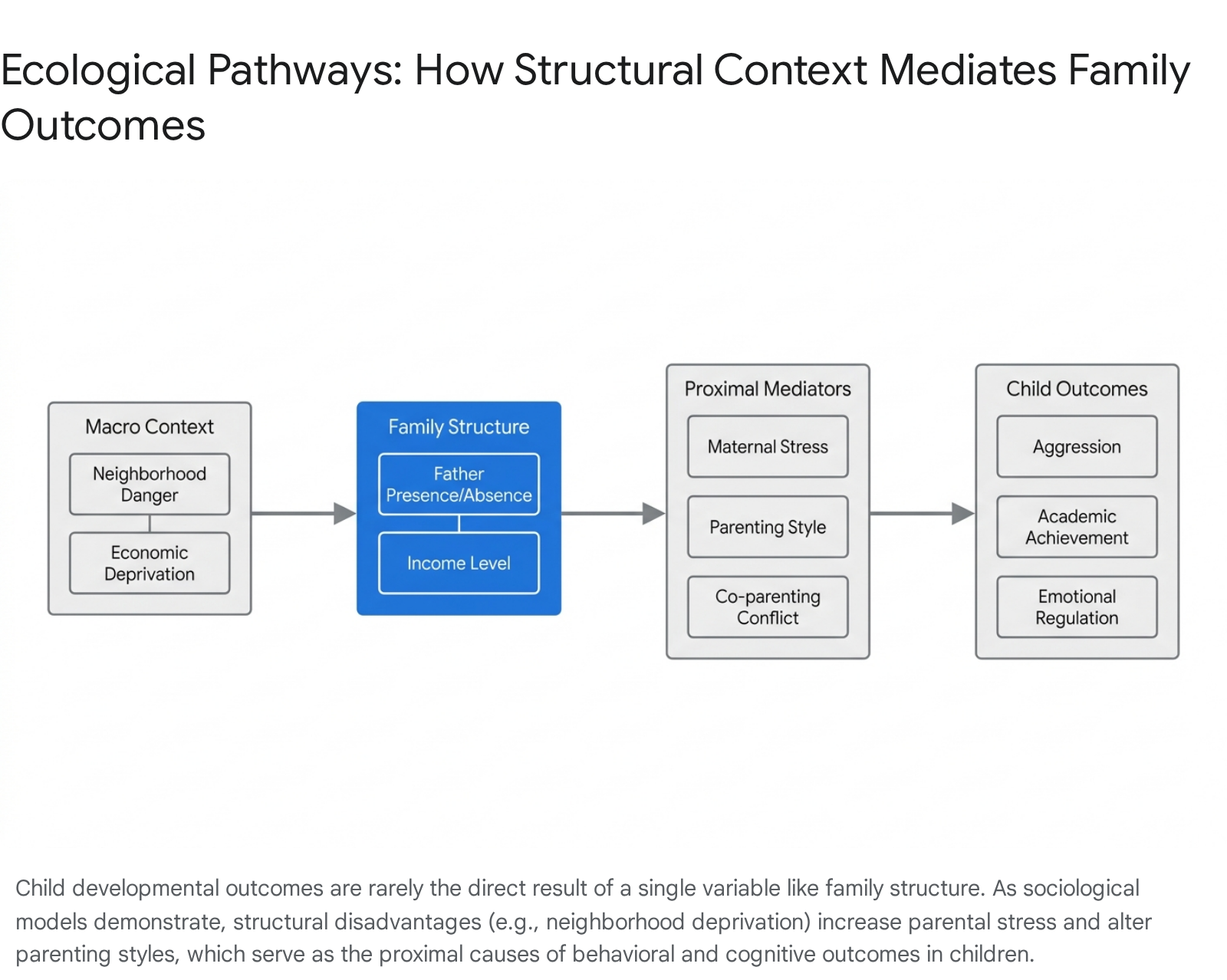
When socioeconomic status and educational attainment are controlled for, the disparities in parenting quality between single and dual-parent households narrow significantly 8.
Income Loss and Resource Deprivation
The Resource Institutional Model suggests that children in two-parent families often perform better academically and socially primarily due to the increased resources available to them 841. Single parents must spend a greater proportion of their income on basic necessities and childcare, leaving fewer resources for cognitive enrichment materials, extracurricular activities, and safer housing 840. Furthermore, non-resident fathers who are unemployed or face financial instability are significantly less likely to maintain active involvement with their children, compounding the resource deficit 5. The empirical evidence establishes that financial involvement, residential status, and availability are interlinked variables; lacking one often degrades the others, severely limiting the child's developmental supports 5.
Single Mothers by Choice and Intentionality
One of the most rigorous ways to separate the psychological effects of father absence from the sociological effects of poverty and parental conflict is to examine the developmental outcomes of children raised by "Single Mothers by Choice" (SMC). SMCs are typically heterosexual, well-educated, financially stable women who make an active, intentional decision to parent alone, often utilizing donor insemination in their late 30s or early 40s 422.
Psychological Adjustment in Planned Father Absence
Comparative longitudinal studies matching SMC families with traditional two-parent heterosexual families have consistently found no significant differences in child adjustment, emotional well-being, internalizing/externalizing problem behaviors, or academic performance 153142. Furthermore, assessments utilizing the Parent Development Interview have found that single mothers by choice exhibit lower mother-child conflict, express greater joy, and demonstrate less anger toward their children than mothers in intact, two-parent homes 422.
The parity in outcomes between SMC households and two-parent households fundamentally challenges the ideological premise that a resident male is a biological or psychological prerequisite for healthy child development 4. It indicates that the negative outcomes traditionally associated with single motherhood - such as heightened risk of abuse, behavioral instability, and delinquency - are actually the sequelae of unplanned pregnancies, marital breakdown, maternal psychological distress, and economic deprivation, rather than the absence of a father per se 4822. The stable, consistent upbringing provided by SMCs proves that solo motherhood, in itself, does not result in psychological pathology for children 2242.
Maternal Education and Academic Socialization
The success of SMC households relies heavily on maternal education and robust social support networks. SMCs generally possess higher levels of education and professional attainment, which grants them the financial resources to outsource childcare and mitigate the "time poverty" that afflicts lower-income single mothers 431. Furthermore, single mothers by choice actively cultivate extensive formal and informal social support networks - including grandparents, friends, and pediatric professionals - compensating for the lack of a co-parent and reducing parental stress 1531.
This aligns with broader developmental research demonstrating that maternal education is a profound protective factor against child developmental delays 4344. Educated mothers are more likely to engage in "academic socialization" - teaching children the expectations needed to succeed in school, monitoring progress, and setting academic goals 4445. A meta-analysis of the unique and combined contributions of parental education found that while paternal education contributes to child growth, models adjusting for the other parent's education show that maternal education holds unique, overriding associations with the prevention of developmental delays in toddlerhood 43. Mothers with higher education are also more likely to employ authoritative parenting styles, which foster resilience, self-soothing, and emotional regulation in children facing frustration 4446.
Extended Kinship Networks and Cultural Contexts
The Western paradigm of the independent nuclear family fails to capture the adaptive realities of family structures in many global contexts. In regions characterized by high rates of paternal migration, historical trauma, or chronic economic instability - such as the Caribbean, Sub-Saharan Africa, and parts of Latin America - father absence is frequently mitigated by robust extended kinship networks 61137.
Matrifocal Societies and Grandparent Caregiving
In Afro-Caribbean communities, historical disruptions to family unity - including the legacies of slavery and contemporary economic migration - have normalized matrifocal households where the biological father may be non-residential or entirely absent 4748. In these systems, extended family members - particularly grandmothers, aunts, and older siblings - function as essential "emotional scaffolding" 37. These networks absorb the caregiving, disciplinary, and financial responsibilities traditionally assigned to a resident father 37.
Grandmothers frequently emerge as stabilizing authorities within household systems, providing necessary discipline, moral instruction, and daily structure 37. This intergenerational caregiving serves as a mitigating factor against negative psychological outcomes, buffering children against the depression, anxiety, and identity confusion that typically accompany paternal abandonment 37. While extended kin cannot always structurally replicate the specific relational and gendered modeling functions of an actively present father, they provide functional continuity, material buffering, and a deep sense of community belonging 37.
Paternal Extended Family Support
The influence of extended family also plays a crucial role in maintaining the involvement of non-resident fathers. Research utilizing data from the Fragile Families and Child Wellbeing Study investigated African American non-resident fathers and found a complex dynamic regarding extended family support: high levels of support from the child's paternal extended family were associated with significantly higher levels of active involvement from the non-resident father himself 49.
Conversely, increased support solely from the maternal extended family was associated with lower levels of paternal involvement, suggesting that maternal kin networks may sometimes inadvertently displace the father or reflect underlying inter-familial conflict 49. Furthermore, when low-income mothers receive high levels of instrumental support from family and friends, it can sometimes increase parenting stress due to heightened potential for family conflict and differing child-rearing opinions 50. Therefore, paternal kin act as vital conduits and social facilitators, connecting absent fathers to their children and reinforcing their ongoing role.
Co-Parenting Dynamics and Non-Resident Fathers
When a father is non-residential, his ongoing impact on the child is dictated almost entirely by the quality of the co-parenting relationship and his specific parenting behaviors, rather than his mere physical address.
Dimensions of Co-Parenting
Co-parenting is defined as the way parents coordinate, support, or undermine each other in their child-rearing roles, encompassing dimensions such as solidarity, support, shared parenting, and competitive-withdrawing behavior 5152. It is a distinct construct from general marital or romantic quality; parents can have a dissolved romantic relationship but maintain a highly functional co-parenting alliance 2351.
Longitudinal studies demonstrate that high levels of hostile or competitive co-parenting - where parents vie for the child's affection, openly contradict one another, or withdraw from communication - are powerful predictors of childhood aggression, externalizing behaviors, and poor adolescent adjustment, even after controlling for standard marital disagreements 235253. Hostile co-parenting observed as early as infancy is associated with higher levels of child aggression three years later 53.
Conversely, when parents are able to let go of divorce-related anger and focus neutrally on the child, outcomes improve dramatically 24. Cooperative and supportive co-parenting by the mother significantly increases the likelihood that a non-residential father will remain engaged and continue to pay financial child support 24. A meta-analysis of non-resident fathers confirms that those who engage in warm, positive parenting practices, regardless of their residential status, foster social, emotional, and academic resilience in their children, mitigating the risks of early sexual behavior and school dropout 122454.
Evolving Definitions of Active Fatherhood
The conceptualization of fatherhood is shifting globally from a purely traditional "provider and disciplinarian" model toward an active, emotionally engaged partnership 257. Contemporary "intimate fatherhood" emphasizes day-to-day caregiving, emotional attunement, shared domestic responsibilities, and cognitive stimulation 1355. Studies tracking this shift show that millennial fathers are spending significantly more time with their children than previous generations, driven by shifting gender norms, workplace flexibility, and an increased cultural focus on child-centrism 25556.
However, the transition to intensive, active fatherhood is not without psychological friction. Longitudinal data on the transition to parenthood indicates that resident fathers often experience increases in depressive symptoms during the child's first five years - a critical attachment period 57. This is likely due to the intense pressures of balancing modern caregiving expectations with persistent traditional provider anxieties 57. When fathers possess high parental self-efficacy, adequate social support, and low psychological distress, their sensitive engagement directly predicts better physiological, behavioral, and academic outcomes for the child 25256.
Long-Term Physiological and Economic Outcomes
The ramifications of growing up without a father - when that absence is coupled with conflict and deprivation - extend far beyond childhood behavioral metrics, embedding themselves into the child's long-term physiological health and adult economic viability.
Biological Embedding and Stress Responses
The psychosocial stress resulting from a harsh family environment, sudden parental desertion, or persistent interparental conflict can trigger biological adaptations in children. Research on pubertal timing indicates that father absence is a reliable predictor of earlier onset of menarche in daughters 958. Meta-analyses confirm that this phenomenon is largely mediated by the high levels of childhood stress associated with familial perturbation and an unpredictable, under-resourced environment, which biologically signals the body to accelerate reproductive maturity as an evolutionary adaptation to risk 9.
Furthermore, the quality of early father-child interactions has measurable effects on cardiometabolic health. A longitudinal study spanning early childhood to middle childhood found that when fathers exhibit sensitive engagement with infants at 10 months, and refrain from competitive or withdrawn co-parenting at 24 months, their children display significantly lower levels of systemic inflammation (C-reactive protein, IL-6) and better glycemic control (HbA1c) years later 52. This highlights how the quality of paternal involvement, or the stress induced by toxic family dynamics, becomes biologically embedded, altering physical health trajectories long before adulthood 52.
Intergenerational Mobility and Adult Earnings
From a socioeconomic perspective, the single-parent household is statistically the least likely family structure to facilitate upward intergenerational mobility 159. Because single parents must stretch a single income across housing, nutrition, and childcare, the sheer lack of material resources often limits the child's educational attainment, leading to lower high school and college graduation rates 38. Children raised in communities with high proportions of single-parent households face compounded barriers to economic mobility, as local institutions and tax bases are frequently underfunded 159.
The most devastating economic effects are seen in the children of incarcerated fathers, who face steep declines in adult employment and educational graduation rates compared to peers from otherwise similar socioeconomic backgrounds 29. Even in the case of paternal mortality - which avoids the stigma of incarceration - adult children suffer persistent economic scarring. Danish registry data indicates that the sudden death of a parent results in a 2% to 4% persistent decline in the adult child's earnings five years post-bereavement 3334. For women with young children, this earnings drop is particularly severe, as the death of a parent eradicates the informal, intergenerational childcare networks required to maintain full-time workforce participation 333436.
The empirical data demonstrates that the physical presence of a father is not a monolithic cure-all, nor is his absence an insurmountable deficit. Children raised by single mothers by choice, or within robust extended kinship networks, thrive when maternal resources are high and parental conflict is absent 437. However, in the vast majority of unplanned cases - driven by divorce, desertion, or incarceration - the absence of a father triggers a cascade of acute resource deprivation, maternal stress, and interparental conflict 82123. These are the structural mechanisms that depress academic achievement, foster behavioral disorders, and limit adult economic mobility, indicating that policy interventions must target poverty, toxic co-parenting, and penal system trauma rather than merely the demographic shape of the household.