
How to Build a Strong College Extracurricular List
Building a strong college extracurricular list requires demonstrating deep, sustained commitment and quantifiable impact in a few key areas rather than superficial involvement in many. Admissions officers value quality over quantity, looking for "pointy" students whose activities reflect genuine passions, leadership, and a coherent personal narrative. In the modern admissions landscape, effectively framing these experiences - including family responsibilities, independent projects, and part-time jobs - is as critical as the activities themselves.
The Evolving Role of Extracurriculars in College Admissions
To understand how to build a highly competitive extracurricular list, one must first understand how modern college admissions offices evaluate applications. The process is holistic, but it operates through a sequence of increasingly narrow screens.
According to the National Association for College Admission Counseling (NACAC), academic performance has been the most important consideration in freshman admission decisions for decades 1. Over 75% of surveyed colleges consider a student's high school GPA to be a "considerably important" factor, and roughly 64% say the same of the strength of the student's high school curriculum 234.
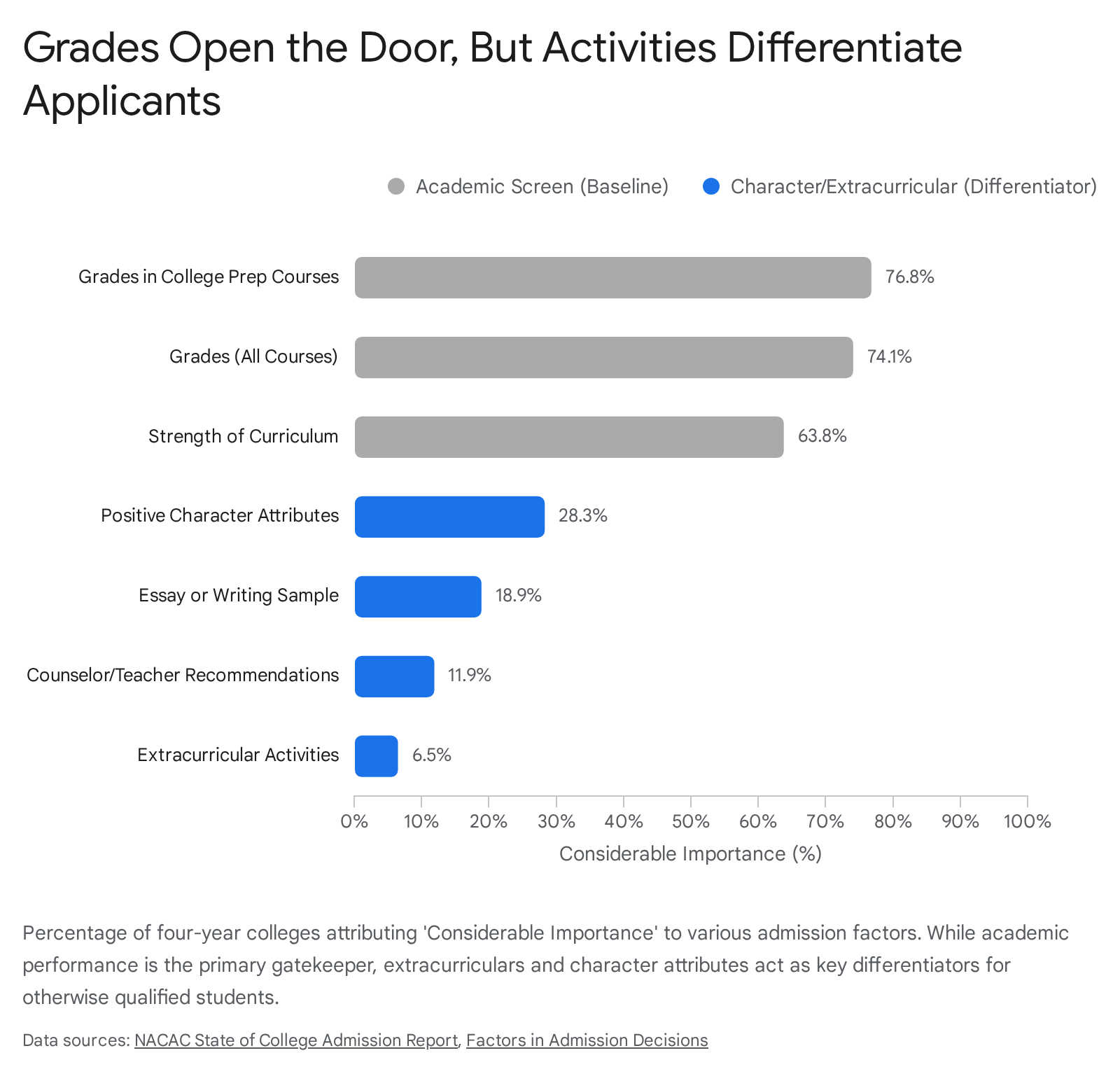
If an applicant's grades and coursework do not align with a college's baseline academic expectations, their extracurricular activities will rarely be enough to push the application into the acceptance pile. Academics serve as the primary gatekeeper.
However, once a student passes that initial academic screen, extracurricular activities become the ultimate differentiator.
This dynamic is particularly pronounced in the 2026 admissions cycle. Following a multi-year period of test-optional policies triggered by the COVID-19 pandemic, leading institutions - including Harvard, Yale, Brown, Dartmouth, MIT, and Caltech - have reinstated mandatory standardized testing requirements 56. Simultaneously, widespread grade inflation has eroded the power of the 4.0 GPA as a distinguishing metric 6. With a growing number of applicants presenting near-perfect academic records, admissions officers are increasingly reliant on qualitative factors to shape their incoming classes. While NACAC data shows that only 6.5% of colleges rate extracurriculars as "considerably important" across all institutions, another 44.3% rate them as "moderately important" 34. At highly selective "Ivy Plus" institutions and top-tier state flagships, the weight of a student's activities list is magnified exponentially 259.
In short, academic metrics prove that a student can handle the rigorous coursework of a given university. Extracurricular activities, on the other hand, prove that the student possesses the character, leadership, and drive to add unique value to the campus community 1011.
The "Pointy" vs. "Well-Rounded" Applicant Paradigm
For decades, conventional guidance dictated that high school students needed to be "well-rounded" to gain acceptance to a prestigious college. Students were encouraged to play a sport, learn an instrument, join the debate team, and volunteer at a local charity, signaling that they could successfully juggle a wide array of disciplines.
In today's highly competitive admissions landscape, this generalist approach is largely counterproductive 6.
Highly selective colleges no longer seek well-rounded students; instead, they seek to build a well-rounded class composed of highly specialized, "pointy" students 613. A pointy student is one who demonstrates profound depth, sustained commitment, and significant leadership in one or two specific areas. Visually, one can imagine the well-rounded profile as a circle segmented into ten tiny, shallow slices of participation. In contrast, the pointy profile resembles a central core of academic strength with three or four deep, elongated spikes reaching outward, representing sustained leadership and national recognition. Spreading oneself too thin results in shallow impact, whereas focusing energy yields a standout profile.
The Sweet Spot for Activity Count
The Common Application currently provides space for applicants to list up to 10 extracurricular activities 7158. This arbitrary limit induces immense anxiety among applicants, leading many to pad their resumes with shallow, low-impact memberships merely to ensure no blanks are left on the form 817.
Data strongly suggests this is a strategic error. A recent survey analyzing students admitted to top-tier, highly exclusive colleges - including the Ivy League, MIT, and Stanford - revealed that the "sweet spot" for extracurricular activities is actually just four 9. Acceptance and enrollment rates ramped upward based on the number of activities listed: 8% admission rate for one activity, 15% for two, 25% for three, and peaking at 30% for students who listed exactly four primary activities 9.
Crucially, after four activities, the admission rates began to drop. Students listing five extracurriculars saw a 25% admission rate, and for those listing six activities, the rate plummeted to just 7% 9. This data indicates that it is entirely possible to over-do out-of-class activities. Admissions officers can easily spot resume-padding, and five deep, meaningful activities will consistently outperform ten shallow ones 619.
Comparing the Strategic Approaches
The table below outlines the distinct differences between the outdated well-rounded approach and the highly sought-after pointy profile 61320.
| Trait | The "Well-Rounded" Profile (Outdated) | The "Pointy" Profile (Highly Competitive) |
|---|---|---|
| Activity Volume | 8 to 10 distinct activities. | 3 to 5 core activities. |
| Commitment Level | 1-2 hours a week across many clubs; frequently drops activities year to year. | 10+ hours a week in targeted areas; multi-year sustained involvement. |
| Leadership | Passive member, or holding minor titles (e.g., Secretary) in standard clubs. | Founder, President, or initiator of measurable change within an organization. |
| Narrative Cohesion | Disjointed. Activities do not relate to the student's intended major or personal essays. | Cohesive. Activities serve as evidence supporting the student's academic interests and values. |
| Impact Metrics | Focuses on attendance and participation ("Attended meetings," "Helped out"). | Focuses on verifiable outcomes ("Raised $5,000," "Published research," "Tutored 20 peers"). |
The Four Tiers of Extracurricular Activities
When admissions officers and independent educational consultants audit an applicant's extracurricular profile, they often mentally categorize activities into a four-tier framework to assess their relative weight and significance 21. Understanding this hierarchy is vital for students looking to optimize their time outside the classroom.
Tier I: Rare and Exceptional
Tier I activities are incredibly rare and are generally reserved for the very best students in the country or the world at what they do 21. These achievements demonstrate an exceptional level of talent, dedication, and competitive success. Examples include: * Being an Olympic-level or highly recruited All-American athlete. * Winning a National Debate Championship or placing top in the nation at the Science Olympiad. * Conducting high-level independent research that is published in a peer-reviewed journal or recognized by the Regeneron Science Talent Search. * Founding a non-profit organization or business that generates substantial, verifiable revenue and garners national media attention 2122.
Tier II: Significant Leadership and Impact
Tier II activities represent major accomplishments within a state, regional, or highly competitive local context 21. While more common than Tier I, these roles still require significant responsibility, initiative, and time management. Examples include: * Being elected Student Body President. * Serving as Editor-in-Chief of the school newspaper. * Making an All-State athletic team or serving as the captain of a highly successful varsity team. * Organizing a regional conference or leading a community initiative that has a measurable, large-scale impact 621.
Tier III: Meaningful Participation
Tier III activities form the backbone of most strong college applications. They show dedication, reliability, and active involvement, though they lack the elite prestige of the top two tiers 21. Examples include: * Holding a standard officer position (Treasurer, Vice President) in a typical high school club. * Playing on a varsity sports team without captain status. * Maintaining a steady, multi-year volunteer commitment at a local hospital or food bank. * Participating consistently in the school band or theater program 21.
Tier IV: Passive Membership
Tier IV activities hold the least weight in the admissions process and are often viewed as resume filler 621. These activities require minimal effort and demonstrate little to no leadership or impact. Examples include: * Attending a club meeting a few times a month without contributing to its operations. * Generic, short-term volunteering (e.g., a single weekend beach cleanup). * Joining an honor society strictly for the title, without participating in any of its service projects 21.
A highly competitive applicant to a top-25 university will typically anchor their list with one or two Tier II activities (and perhaps a Tier I activity, if applicable), supported by a few deeply engaged Tier III commitments that align with their overall narrative 21.
Broadening the Definition: What Actually Counts?
A pervasive misconception among high school students and their parents is that "extracurricular activities" only refer to official, school-sponsored organizations like the Model UN or the marching band. In reality, college admissions offices define an extracurricular activity as virtually anything constructive a student does with their time outside of required coursework and basic life functions like sleeping and eating 152324.
The Value of Part-Time Jobs and Internships
Working a part-time job - whether at a high-tech internship or a local fast-food restaurant - is highly respected by admissions committees. Jobs demonstrate reliability, time management, interpersonal skills, and an understanding of the real world 1525. As one former admissions director noted, a student interested in business who works a retail job learns firsthand about management, scheduling, teamwork, and the difficulties of turning a profit 25. Furthermore, paid employment signals a level of maturity and accountability that standard high school clubs rarely require 26.
Independent Projects and Self-Study
Activities that a student initiates entirely on their own are particularly compelling because they require intrinsic motivation. If a school does not offer a specific club, starting one demonstrates initiative. Beyond school grounds, independent projects - such as self-publishing a novel, developing and launching a mobile app, building an investment portfolio, or engaging in rigorous self-study of advanced mathematics or coding languages - showcase exceptional curiosity and drive 615172728. Admissions officers value self-created projects highly because they cannot be passively consumed; they demand ownership and risk 29.
The 2026 Shift: Family Responsibilities and Lived Circumstances
Historically, the college admissions process has inherently favored affluent applicants who possess the financial resources and free time to participate in expensive travel sports, elite summer programs, or unpaid internships 10.
Recognizing this inequity, the Common Application has made deliberate changes to level the playing field. For the 2025 - 2026 application cycle, the Common App permanently implemented a required "Responsibilities and Circumstances" checklist within the Activities section 17311133. This feature was added following a multi-cycle pilot program to gather structured context about the constraints that shape a student's opportunities 31.
The new checklist covers two primary areas: 1. Household Responsibilities: This allows students to formally disclose significant home commitments, such as providing daily caregiving for a younger sibling or elderly family member, acting as a translator for non-English-speaking parents, contributing labor to a family business, or managing significant domestic work 1731. 2. Personal Circumstances: This section captures challenges that may have limited extracurricular involvement, such as health conditions, financial stress, housing instability, or demanding work schedules 1731.
This is a checkbox-only feature requiring no long-form narrative 1731. Its inclusion signals a massive paradigm shift in admissions philosophy: colleges want to destigmatize family commitments and actively recognize them as valuable, character-building activities 11. By providing this context, admissions officers can properly evaluate a student's academic and extracurricular achievements relative to the actual time and resources they had available 1011.
Post-SCOTUS "Identity Signaling"
The way colleges evaluate a student's lived experience has evolved dramatically since the June 2023 Supreme Court ruling (Students for Fair Admissions v. Harvard) that banned race-conscious affirmative action in admissions 341213.
While universities can no longer use a student's race as a standalone demographic factor in a holistic review, Chief Justice John Roberts' majority opinion explicitly stated that universities can still consider an applicant's discussion of how their background shaped their life, "be it through discrimination, inspiration, or otherwise" 3414.
In response to this legal landscape, admissions deans are increasingly looking at a student's extracurricular choices and personal essays as a form of "identity signaling" 343839. The activities a student chooses to pursue serve as a direct proxy for their values, resilience, and unique perspective 3815. For example, a student leading a cultural affinity group, advocating for social justice policies in their local community, or volunteering to teach English as a Second Language (ESL) to immigrants is signaling their lived experience and core values through action. Admissions officers scour these activities to understand the diverse viewpoints a student will bring to the campus environment 3415.
However, authenticity is paramount. Students are advised against designing an extracurricular profile solely for the sake of impressing a committee or pandering to perceived ideological preferences. Admissions readers are highly trained to spot resume-padding and activities pursued strictly for optics 62441.
Mastering the Common App Activities Section
If there is one area where highly qualified students routinely sabotage their own applications, it is in the formatting and execution of the Common App Activities list.
Research indicates that admissions officers spend an average of only eight to ten minutes reviewing a full application 7. Because of this severe time constraint, officers typically scan the activities list before they even read the personal statement 19. A former admissions officer noted that the activities list acts as the "table of contents for the entire application," providing the fastest snapshot of who the student is and what they care about 19. A strong list frames the entire narrative; a weak one forces the personal essay to do all the heavy lifting 19.
Despite its critical importance, the space provided by the Common Application is brutally short. For each of the 10 available slots, students must fill out dropdown menus for grade levels and time commitments, alongside three primary text fields: * Position/Leadership Title: 50 characters maximum 151742. * Organization Name: 100 characters maximum 151742. * Activity Description: 150 characters maximum 7151742.
To put this constraint in perspective, 150 characters is shorter than a standard post on X (formerly Twitter) 715. Furthermore, the character count includes spaces and punctuation 42.
The Formula for 150-Character Success
Because space is at such a premium, every single word must earn its keep. Students must abandon traditional paragraph writing and avoid full, grammatically complete sentences 15. Instead, descriptions should utilize a punchy, resume-style syntax.
The most effective activity descriptions reliably follow a specific formula: Strong Action Verb + Specific Task + Quantifiable Impact/Result 7154243.
Words and phrases like "helped with," "was responsible for," "participated in," or "member of" are passive, generic, and waste valuable characters 71543. Students should replace them with high-impact, dynamic verbs such as Managed, Designed, Spearheaded, Coordinated, Researched, Founded, or Fundraised 1542.
Furthermore, integrating numbers is essential. Numbers communicate scale, scope, and success instantly 642. Replacing a vague phrase like "helped students improve" with "tutored 12 peers, raising test averages by 15%" completely alters how an admissions officer perceives the weight of the commitment 6743.
Finally, students must avoid redundancy. Because the "Position" and "Organization" fields exist separately and carry their own context, the 150-character description should never waste space repeating the title. If the position field reads "Varsity Captain" and the organization reads "Lincoln High School Soccer," the description should not begin with "As captain of the soccer team, I..." 42.
Weak vs. Strong Activity Descriptions
The following table demonstrates how to transform generic, low-impact activity descriptions into highly competitive summaries that fit comfortably within the strict 150-character limit 67154243.
| Activity Category | Weak Description (Wastes Space & Lacks Impact) | Strong Description (Action + Numbers + Result) | Character Count (Strong) |
|---|---|---|---|
| Academic Tutoring | I helped younger students with their math homework after school and worked to improve their grades. 743 | Tutored 12 freshmen in Algebra II weekly; created practice quizzes that raised average test scores by a full letter grade over one semester. 743 | 143 characters |
| School Newspaper | Member of the newspaper club. I wrote articles sometimes about school events and worked with other members. 15 | Researched & wrote 12+ articles on school events; edited peer articles for clarity; increased digital readership by 20% in junior year. 15 | 137 characters |
| Community Service | I helped organize events for our club and worked with other members on different volunteer projects. 42 | Organized 12 service events for 80+ members; coordinated logistics, guest speakers, and volunteer signups; raised $5,000 for local food bank. 642 | 145 characters |
| Independent Research | I learned about climate change and wrote a paper on how it affects the ocean, which was really interesting. 44 | Conducted 10-week independent study on ocean acidification; analyzed regional pH data sets; presented findings to 50+ peers at regional fair. 4445 | 143 characters |
Strategic Ordering
The order in which activities are presented on the Common Application matters immensely. The platform does not require activities to be listed chronologically 23. Instead, students must rank their activities in descending order of impact, commitment, and personal importance 1523.
The very first activity listed on the application sets the interpretive frame for the rest of the file 7. It should ideally be the student's most defining commitment - the Tier I or Tier II activity that connects most closely to their intended major, their future career goals, or the core theme of their personal statement 728. The next three slots should highlight depth, leadership, or sustained commitment, while the remaining slots can be used to show breadth, such as part-time jobs, community service, or family responsibilities 7.
Leveraging the "Additional Information" Section
If a student has achieved something truly extraordinary - such as conducting a multi-year independent research project resulting in a peer-reviewed publication, founding a revenue-generating business, or navigating a complex family health crisis while maintaining their grades - 150 characters will simply not do the experience justice 1742. In these specific cases, students can use the "Additional Information" section of the Common App to expand 1742.
However, applicants must be exceedingly concise. For the 2025-2026 application cycle, the Common App significantly reduced the word limit for the Additional Information section, cutting it down from 650 words to a strict 300 words 3116. This space is strictly intended for vital context, overflow details for highly complex activities, or explanations of severe academic disruptions 1716. It is not a place for resume dumping, padding the application with minor activities that didn't make the top 10, or pasting in a secondary personal essay 1716.
Aligning Extracurriculars with Institutional Priorities
The strategy required to build a successful extracurricular list has shifted rapidly because the institutional targets themselves have shifted.
The Rise of State Flagships and "New Ivies"
For years, affluent and ambitious families viewed their state's flagship public universities as reliable "safety" or "match" schools - a respectable place to land if the student was rejected by the Ivy League 9. In the 2026 admissions cycle, that assumption is entirely obsolete 947.
Public flagships such as the University of North Carolina at Chapel Hill, the University of Texas at Austin, Georgia Tech, the University of Virginia, the University of Michigan, and UCLA are now operating with demand and selectivity rates that directly rival elite private institutions 9. Furthermore, major corporate employers are increasingly skeptical of whether Ivy League diplomas still guarantee the best recruits 5. Data indicates a rising employer preference for graduates from rigorous state flagships and specialized "Ivy Plus" institutions (such as Stanford, MIT, Duke, and Johns Hopkins), which are perceived as providing superior workforce preparation and technological fluency 5.
As a result, the volume of applications flooding into these top public universities has skyrocketed 9. Because state-funded schools are politically mandated to admit a large percentage of in-state residents, the remaining spots for out-of-state students are fiercely contested 47. To compete for an out-of-state spot at a flagship university, an applicant cannot simply rely on a high SAT score; they must present a "pointy," highly specialized extracurricular profile that proves they will immediately contribute to the university's specific academic or entrepreneurial ecosystems 947.
Liberal Arts Colleges (The "Little Ivies")
Conversely, students applying to elite liberal arts colleges - often referred to as the "Little Ivies" (e.g., Williams, Amherst, Swarthmore, Bowdoin) - may find that admissions officers weigh extracurriculars with a slightly different lens 484950. While they still demand excellence, liberal arts colleges place a massive premium on community building, intellectual curiosity, and interdisciplinary thought 49. At a school with fewer than 2,000 undergraduates, every single student must contribute to the campus culture. Therefore, extracurricular lists that highlight collaborative leadership, sustained community service, and cross-disciplinary projects (e.g., blending science with ethics, or art with engineering) are highly valued 20.
Specialized Applications: The Pre-Med Track (AMCAS)
While the Common Application governs undergraduate admissions, students targeting highly specialized tracks - such as competitive BS/MD programs or eventual medical school admissions - must understand how extracurricular scrutiny intensifies as they progress in their academic careers.
For medical school applicants using the American Medical College Application Service (AMCAS), the expectations for the activities list are vastly expanded, yet the core principles of impact, reflection, and depth remain identical 2651.
Unlike the Common App's 10 slots and 150-character limit, the 2025-2026 AMCAS application allows applicants to list up to 15 post-secondary activities, providing up to 700 characters to describe each one 455152. More importantly, applicants are required to designate up to three of these activities as "Most Meaningful Experiences" (MMEs), which grants an additional 1,325 characters to elaborate on the profound impact the activity had on their journey toward medicine 515253.
AMCAS Activity Strategy
Medical school admissions committees expect a highly specific, well-rounded portfolio of competencies. A competitive AMCAS Work and Activities section typically includes: * Two to three clinical experiences involving direct patient exposure 45. * Extensive shadowing of physicians 4552. * Community service and volunteerism (both medical and non-medical) 2652. * Substantive research or laboratory work, ideally leading to publications or poster presentations 4553. * Demonstrated leadership and advocacy 2645.
Just as with undergraduate admissions, quality and authenticity trump quantity. Filling all 15 slots with superficial experiences is actively detrimental; admissions committees notice when applicants pad their resumes with generic "shadowing" entries or inflate their responsibilities in a research lab 5153. When writing the 700-character descriptions, successful applicants utilize a "2-3-3 model": naming the setting and role to provide context, detailing the specific actions taken to solve a problem, and reflecting on the impact and lessons learned 53. For the "Most Meaningful" essays, applicants must go beyond describing their duties and instead reflect on how the experience shaped their empathy, resilience, and unyielding commitment to patient care 5153.
Actionable Strategies for High Schoolers: A Timeline
Building a compelling extracurricular profile is not something that can be reverse-engineered during the fall of senior year. It requires a strategic, multi-year approach 116.
- Freshman Year (Exploration): The goal of the first year of high school is discovery. Students should try various clubs, sports, and activities to find out what genuinely interests them 625. It is entirely acceptable to dabble and cast a wide net, provided the student maintains strong academic footing 25.
- Sophomore Year (Curation): By the second year, students should begin shedding the activities they do not love and start going deeper into the two or three areas that resonate most 625. This is the time to transition from a passive participant to an active contributor, seeking out minor leadership roles, securing internships, or dedicating significant time to an independent project 625.
- Junior Year (Leadership and Impact): The eleventh grade is the most critical period for extracurricular development 11. Students should step into major leadership roles (Tier II or Tier III), initiate tangible changes within their organizations, and focus heavily on generating quantifiable impact and results 116.
- Senior Year (Maintenance and Reflection): By senior year, the focus shifts to maintaining core commitments, mentoring younger students within clubs to ensure a legacy, and reflecting on the growth achieved over the past three years to effectively translate those experiences into the Common App descriptions and personal essays 6.
Bottom line
Building a strong college extracurricular list is no longer about proving you can do a little bit of everything; it is about proving you can do a few things exceptionally well. Highly selective colleges favor "pointy" students who demonstrate sustained commitment, take on leadership roles, and generate verifiable impact in areas they are genuinely passionate about. When it comes time to apply, ruthless editing is required - students must use strong action verbs and quantifiable metrics to communicate their achievements within tight character limits, ensuring their activities paint a cohesive, authentic picture of their lived experience.