
Do Colleges Prefer a Spike or Well-Rounded Profile
Elite universities increasingly prefer "spiky" students who demonstrate exceptional depth in one or two areas, using these specialized applicants to build a dynamic, well-rounded class. However, strong academic performance remains the primary gatekeeper, and many liberal arts and large public universities still highly value broad, well-rounded curiosity. Ultimately, authenticity and sustained commitment matter more than manufacturing a perfect profile, as admissions offices are increasingly prioritizing genuine character over a padded resume.
The Cultural Anxiety of College Admissions
If you are a high school student, or the parent of one, chances are you have been bombarded with the classic advice regarding college admissions: to get into a good school, you need to be well-rounded. For decades, the accepted wisdom dictated that an ideal applicant should play a varsity sport, master a musical instrument, lead the student government, volunteer regularly at a local charity, and maintain a perfect grade point average 1.
This advice was perfectly accurate for previous generations. Today, however, it is largely considered a "Suburban Legend" by modern admissions experts 2.
The contemporary college admissions landscape is vastly more competitive, complex, and specialized than it was even twenty years ago. In the 2024 - 2025 application cycle, 1.5 million first-year applicants submitted more than 8.2 million applications through the Common Application platform 343. This represents a staggering 65% increase in applications since 2019, driven by demographic shifts, the ease of digital applications, and pervasive anxiety pushing students to apply to more schools 336. Top-tier universities - often referred to as highly selective or highly rejective colleges - now receive tens of thousands of applications for just a couple of thousand freshman seats. In recent cycles, Harvard University's acceptance rate has hovered around 3.59%, Yale University's at 4.2%, and Columbia University's at 3.9% 749.
When an admissions committee is faced with 50,000 applicants who all boast 4.0 GPAs, play a sport, and participate in the debate club, well-roundedness ceases to be a differentiator. It simply becomes the baseline. To stand out in this hyper-competitive environment, students are increasingly advised to develop a "spike" - a highly developed, specific passion or talent that makes them a recognized specialist in the applicant pool 5116.
Understanding exactly what a spike is, why colleges want it, and whether abandoning a well-rounded approach is the right choice requires looking closely at the history of holistic admissions, the hard data driving modern enrollment decisions, and the psychological toll this academic arms race takes on adolescents.
The Paradigm Shift: From Well-Rounded Student to Well-Rounded Class
To understand why the well-rounded student is now frequently considered a myth at elite institutions, it is necessary to examine how the concept originated and evolved. The shift away from the generalist ideal is not merely a recent trend; it is a profound philosophical transformation that has been decades in the making 1.
The Dark History of "Holistic" Admissions
In the early part of the twentieth century, elite universities like Harvard, Yale, and Princeton evaluated applicants almost exclusively based on academic merit and rigorous entrance exams 2. By the 1920s and 1930s, however, these institutions began shifting their focus toward evaluating the "best graduate" or the "whole person."
As detailed by sociologist Jerome Karabel in his extensive history of Ivy League admissions, The Chosen, this shift was not initially driven by a noble pursuit of educational holism. Rather, it was a systemic mechanism engineered to limit the enrollment of Jewish students, who were scoring exceptionally high on purely academic metrics 12. By 1933, Harvard had effectively reduced its Jewish enrollment from 21% back down to 15% without officially implementing quotas 1.
To achieve this, universities incorporated subjective measures - like "character," "manliness," leadership potential, and extracurricular involvement - allowing them to engineer the demographics of their incoming classes 2. The ideal of the "well-rounded boy" became deeply entrenched in the American educational psyche. For decades, admissions committees rated applicants across multiple dimensions: academic, personal, athletic, and extracurricular. A student with perfect test scores but no outside interests would frequently lose out to a slightly weaker student who was also the class president, varsity captain, and a volunteer leader 1.
The Application Explosion and the Need for Specialists
This well-rounded ideal dominated for decades. However, by the late 1980s and 1990s, elite colleges faced an unprecedented logistical problem: an absolute explosion of applicants 1. The sheer volume of students arriving with perfect transcripts, varsity letters, and student government experience meant that the well-rounded profile was no longer unique. Admissions officers quickly realized that admitting thousands of identical generalists - often referred to affectionately but dismissively as "generic geniuses" - did not create a vibrant, dynamic campus 5.
Instead, institutions needed to build a complex mosaic of talents. In 1965, Columbia University's admissions director famously told the Wall Street Journal: "We don't want the well-rounded boy so much as the well-rounded student body" 12. This sentiment represented a fundamental shift in thinking that would eventually become the guiding philosophy of elite admissions by the 2000s 1.
Visualizing this shift helps applicants understand why being "pretty good at everything" blends in. Admissions officers prefer to assemble a cohesive mosaic of talents, where sharply distinct, "spiky" students fit together to form a well-rounded incoming class. Former Stanford admissions officer Grace Kim compared the process to hosting a dinner party: "They are looking for a well-rounded class even if not each individual student is well-rounded. You want to invite people who will add value to the conversation" 1.
Similarly, former Princeton Dean of Admissions Fred Hargadon noted the pragmatic institutional needs driving this philosophy. He explained that if the university needed a quarterback for the football team and had already admitted two early in the admissions cycle, they simply wouldn't take a third, no matter how academically impressive or well-rounded that third quarterback might be 1. Christoph Guttentag, Duke University's Dean of Undergraduate Admissions, summarized the modern approach perfectly: "Everybody in admissions stopped talking about the well-rounded student and started talking about the well-rounded class... we always have our eyes open for students who do one thing exceptionally or unusually well" 5.
Defining the College Application "Spike"
In the context of highly selective college admissions, a "spike" (sometimes referred to as an "angular" or "pointy" profile) refers to an area where a student demonstrates exceptional ability, depth, achievement, or impact 56.
If a traditional well-rounded student's profile looks like a smooth circle - they are competent at math, excel in English, play a seasonal sport, and volunteer occasionally on weekends - a spiky student's profile looks like a graph with a massive vertical peak in one specific domain. This spike could manifest in the arts, academic research, technological entrepreneurship, athletics, or deep community activism 613.
Elite schools favor spiky students because these individuals are highly likely to contribute something specific, masterful, and world-class to the campus ecosystem. A top-tier university wants to ensure its symphony orchestra has a brilliant oboist, its student newspaper has a tenacious investigative journalist, and its science laboratories are populated by students who already understand the rigors of peer-reviewed research 1. The spike answers the fundamental question every admissions officer asks: "What will this specific student bring to our community?" 11.
What Does a Realistic Spike Look Like?
When students and parents first hear the word "spike," panic often ensues. There is a pervasive, toxic misconception that a spike requires winning a medal at an international Olympiad, holding a lucrative software patent, or founding a multi-million-dollar non-governmental organization (NGO) before the age of 18 1415. While those extraordinary achievements certainly count as spikes, they are far from the only way to demonstrate exceptional depth.
At its core, a spike is about sustained dedication and measurable impact over time. It is the transition from being merely "good" at something to being "exceptional" within the student's available context and resources 6. Consider how a generalized interest translates into a compelling, admissions-ready spike:
- The Environmental Advocate: Instead of just joining the high school's environmental club and picking up litter, a student with a true environmental spike might initiate a city-wide composting program, secure local grants to fund the initiative, and formally petition the city council to change local waste management ordinances 16.
- The Computer Scientist: Instead of merely taking AP Computer Science and playing video games, a spiky applicant might start a non-profit that teaches coding to underprivileged middle schoolers, develop a functional app that solves a specific community problem, or participate heavily and place in regional hackathons 17.
- The Creative Writer: A student whose spike is writing doesn't just write a few poems for the school literary magazine; they publish a collection of short stories, consistently win regional writing contests, and earn spots at prestigious summer writing workshops 16.
Even more importantly, a spike can be crafted out of everyday, seemingly mundane experiences by building a cohesive, self-aware narrative. One recently admitted student to a top-five Ivy League university noted that they gained admission with no national awards, no published research, and no successful startups. Instead, they built a spike around their role as a high school Chemistry Teaching Assistant. Rather than describing the role generically (e.g., "helped the teacher"), they focused their application on the specific soft skills of laboratory management: preparing molal solutions for 50+ students, managing volatile experiments, and guiding groups of peers through complex scientific concepts. This created a compelling narrative of scientific leadership and educational dedication that resonated deeply with admissions readers 1518.
Beyond the Spike: The Five C's of Meaningful Engagement
Some modern admissions consultants and educational psychologists argue that the concept of the "spike" has become too transactional. When students view the spike merely as an admissions hack, it leads to teenagers manufacturing passions just to impress a committee 1419. Instead of simply looking for a sharp vertical point on a resume, admissions committees at top schools are looking for students who demonstrate deep, authentic intellectual engagement outside the classroom 19.
A highly compelling extracurricular profile, whether it is a single spike or a tightly woven web of interests, generally exhibits the "Five C's": 1. Curiosity: A genuine, self-directed desire to learn beyond the standard high school curriculum. 2. Competence: Demonstrated mastery, skill, or significant progress in a specific area. 3. Communication: The ability to articulate exactly why this passion matters to the student and to the world. 4. Context-awareness: An understanding of how this specific interest fits into the broader community or addresses a real-world problem. 5. Critical Thinking: The capacity to push the boundaries of a field, question assumptions, and actively create rather than passively participate 19.
When an applicant combines these five elements into one or two dedicated pursuits, the resulting profile is authentic, memorable, and highly attractive to top-tier universities. The spike lies not necessarily in the objective prestige of the achievement, but in the singularity and depth of the student's engagement 19.
Is the Well-Rounded Profile Actually Dead?
Despite the overwhelming preference for specialized students at the Ivy League and highly selective universities, it is a mistake to declare the well-rounded profile completely dead. In fact, for the vast majority of college applicants, being well-rounded is still a perfectly viable - and sometimes highly preferred - strategy 6721.
It is vital to recognize that the obsession with "spikes" is primarily a phenomenon of the nation's most elite colleges - institutions with acceptance rates dipping below 15% or 20% 3. However, highly selective schools represent less than 5% of all U.S. colleges. More than 90% of universities in the United States accept over 50% of their applicants, and the average acceptance rate at four-year colleges remains around 73% 3. At these majority institutions, the admissions process is less about meticulous curation of a "mosaic" and more about finding capable, dependable students who will succeed academically, graduate on time, and contribute positively to campus life.
Furthermore, different types of institutions inherently value different applicant profiles:
- Highly Selective Universities (e.g., Ivy League, Stanford, MIT, Caltech): These institutions almost exclusively favor the "spike." They have a large enough applicant pool to build a diverse class of extreme specialists 1721.
- Liberal Arts Colleges: These institutions often appreciate both approaches, and sometimes actively prefer generalists. Because the liberal arts educational philosophy is rooted in broad exploration across the humanities, sciences, and arts, a genuinely well-rounded student who demonstrates insatiable curiosity across multiple disciplines fits perfectly into their academic model 7.
- Large Public Universities: Preferences here vary wildly by specific college or program. A student applying directly to a highly competitive undergraduate engineering, nursing, or business program will almost certainly need a spike relevant to that field. Conversely, a student applying as an "undecided" major to the general College of Arts and Sciences may be perfectly well-served by a well-rounded profile showing general leadership, adaptability, and academic competence 7.
Spike vs. Well-Rounded: A Strategic Comparison
To help clarify which approach aligns best with a student's natural inclinations, available resources, and ultimate college goals, consider the following strategic comparison:
| Feature | The "Spike" Profile (The Specialist) | The "Well-Rounded" Profile (The Generalist) |
|---|---|---|
| Core Philosophy | Depth over breadth. Exceptional mastery and sustained focus in 1-2 specific areas. | Breadth over depth. Competence, active involvement, and exploration across diverse fields. |
| Typical Extracurriculars | National competitions, independent research, founding organizations, specialized internships. | Varsity sports, student government, school band, generalized community service. |
| Admissions Advantage | Highly memorable; directly helps admissions officers fill specific institutional needs to build a "well-rounded class." | Demonstrates adaptability, strong time management, and a willingness to explore new subjects. |
| Primary Drawback | Can lead to a narrow high school experience, or severe burnout if the specialized passion is forced/manufactured. | Can make the applicant appear generic, scattered, or lacking in deep commitment in highly competitive applicant pools. |
| Best Suited For... | Ivy-Plus, highly selective universities, and highly competitive direct-admit majors (e.g., Engineering, Computer Science). | Less selective state universities, broad Liberal Arts colleges, and students who are genuinely exploring their interests. |
Where Extracurriculars Actually Rank in Admissions
While the debate between a spike and a well-rounded profile dominates the cultural conversation around college applications, it is crucial to ground this discussion in the statistical reality of how admissions offices actually make decisions.
There is a dangerous myth among high-achieving students that an incredible extracurricular spike can entirely make up for poor academic performance. This is rarely true. A national award in robotics will almost never save an application if the student's high school transcript demonstrates they cannot handle rigorous, college-level coursework 289.
The National Association for College Admission Counseling (NACAC) regularly surveys hundreds of four-year colleges to determine the top factors in admissions decisions. The data from their 2023-2024 State of College Admission report highlights a stark and unyielding hierarchy:
- High School Grades: 76.8% of colleges rate grades in college prep courses as "considerably important." This is the undisputed top factor 3.
- Strength of Curriculum (Course Rigor): 63.8% of colleges rate taking challenging courses (such as AP, IB, or dual-enrollment) as "considerably important" 324.
- Positive Character Attributes: Approximately 70% of admissions officers rate the applicant's character as either moderately or considerably important, a factor that is growing in weight 3.
- Extracurricular Activities: Surprisingly to many, only 6.5% of schools view extracurriculars with "considerable importance." However, a substantial 44.3% weigh them as having "moderate importance" 910.
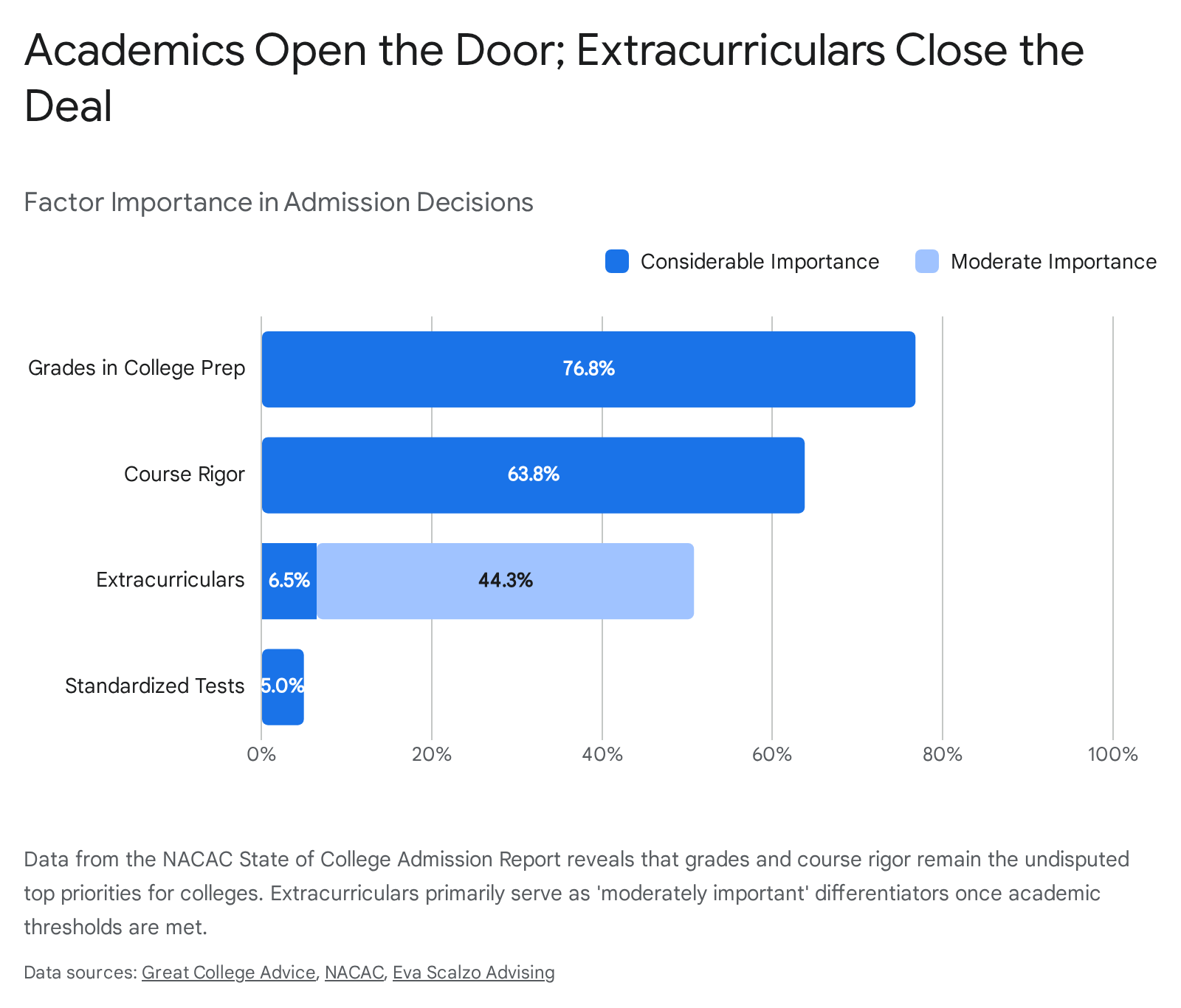
What this data reveals is a functional two-tiered system in college admissions. Grades and course rigor act as the primary gatekeepers. If a student does not meet the academic threshold of a highly selective institution, their application is rarely reviewed any further 9.
However, because tens of thousands of applicants do meet that rigorous academic threshold, extracurricular activities transition from being merely "moderately important" in the overall national survey to being the critical, tie-breaking deciding factor among the top academic tier 8. For the Ivy League and similar elite institutions, the spike in your extracurricular profile is the main differentiator between one stellar academic record and the next. If everyone in the pool has a 4.0 GPA, the student with the 4.0 who also published a collection of poetry will win the seat 8.
The Impact of Test-Optional Policies and Artificial Intelligence
The landscape of what truly matters in an application has also been heavily distorted by recent global events and technological advancements.
Prior to the COVID-19 pandemic, standardized test scores (the SAT and ACT) were rated as "considerably important" by roughly 50% of surveyed colleges. However, going into the 2024 - 2025 admissions cycle, that number had collapsed to just 5%, largely due to the widespread, rapid adoption of test-optional policies during the public health crisis 3924.
While a handful of elite institutions - including Yale, Harvard, Dartmouth, and Caltech - have recently reinstated standardized testing requirements, arguing that these tests remain the strongest predictor of collegiate academic success, the vast majority of U.S. colleges remain fully test-optional 611. When standardized tests are removed from an applicant's file, admissions offices are forced to place significantly more weight on holistic factors. Consequently, the importance of the college essay, teacher recommendations, and the applicant's extracurricular spike has surged 272829.
Simultaneously, the meteoric rise of Generative AI (such as ChatGPT and Claude) is threatening the integrity of the college essay. Recent studies of the 2024 admissions cycle, which analyzed over 81,000 Common App essays, found a significant surge in AI usage. Pre-2023, estimated AI use hovered around 3% to 5%; by 2024, it jumped to nearly 10% overall 29.
Crucially, this AI usage disproportionately affects low-income (low-SES) students who may lack access to private college counselors or robust high school advising 29. Unfortunately, free AI tools tend to produce homogenized, formulaic narratives that strip away a student's unique voice and reduce lexical diversity 29. Because admissions officers are increasingly wary of AI-generated content - with 78% of officers expressing concern over authenticity - an "authenticity penalty" is emerging 29.
This technological disruption makes a student's documented extracurricular track record incredibly vital. An extracurricular spike acts as an un-fakeable anchor for an application. If an essay sounds suspiciously perfect or generic, a deep, verifiable history of involvement in a specific extracurricular pursuit provides the concrete proof of a student's actual capabilities and dedication.
The Post-Affirmative Action Era: Character Takes Center Stage
Another seismic legal shift affecting how colleges evaluate extracurricular profiles occurred in June 2023, when the U.S. Supreme Court effectively banned race-conscious admissions in the Students for Fair Admissions (SFFA) cases 1213.
In the wake of this landmark decision, colleges have had to completely reinvent how they build diverse, dynamic classes without relying on race as a primary metric. Early enrollment data from the fall of 2024 and 2025 shows sharp demographic shifts: Black student enrollment at many selective colleges has decreased sharply - in some cases by over 20% - while white students remain disproportionately enrolled compared to their share of the applicant pool 1415. Meanwhile, legacy preferences, which historically favor affluent and white applicants, largely remain in place at many institutions 14.
To adapt to these legal restrictions and attempt to maintain diversity, universities have placed a massively increased premium on holistic review. Specifically, institutions are elevating the weight of "character attributes" 2915.
Extracurricular activities are no longer evaluated solely for prestige or raw achievement; they are heavily mined for evidence of personal character. According to high-profile initiatives like Harvard's Making Caring Common project and the NACAC Character Focus Initiative, admissions offices are actively seeking students who demonstrate emotional intelligence, resilience, genuine concern for others, and a commitment to the public good 24343536.
This shift directly impacts the "Spike vs. Well-Rounded" debate. A spike that looks purely self-serving - such as a student exclusively competing in high-profile math olympiads solely to win individual medals - may be significantly less appealing today than a spike rooted in community impact. For example, using those exact same advanced math skills to build predictive logistical models for a local food bank demonstrates both high-level competence and high-level character. The depth of the spike is still required, but the character revealed by how a student applies that talent is now under intense, critical scrutiny.
The Burnout Epidemic: The Danger of Manufactured Spikes
While from a purely strategic standpoint, crafting a specialized extracurricular spike makes sense for elite college admissions, educational psychologists and pediatricians are increasingly sounding the alarm about the devastating toll this academic arms race is taking on adolescents.
Dr. Denise Pope, a senior lecturer at the Stanford Graduate School of Education and co-founder of Challenge Success, has spent decades researching student engagement, well-being, and curriculum reform. Her findings are sobering: up to 75% of high school students are not regularly or genuinely engaged in school 3716. Instead, they are caught in a phenomenon Pope calls "doing school" - treating education as a high-stakes game to be won rather than a meaningful process of learning and discovery 37.
When students hear that elite colleges demand a "spike," the immediate reaction is often to overschedule themselves, specializing far too early in an attempt to manufacture a passion 17. Middle schoolers are pushed into intensive, single-sport private club leagues; high school freshmen are pressured by anxious parents to start non-profits they do not actually care about; and unstructured free time is entirely eliminated 1440.
The problem with this hyper-specialized approach is twofold: 1. It Causes Severe Burnout and Mental Health Crises: Research consistently shows that combining intense, premature specialization with relentless academic pressure puts students at an exceptionally high risk for physical exhaustion, clinical anxiety, and severe school burnout 181943. When a student's entire identity is tied to a singular "spike" intended for college admissions, any setback in that area can trigger a mental health crisis. 2. It Backfires Developmentally: According to Pope's research, early specialization does not reliably develop into exceptional skills later in life. In fact, playing multiple sports, engaging in diverse hobbies, and maintaining periods of unstructured play is significantly more developmentally appropriate. It reduces physical injury, delays burnout, and fosters better long-term emotional regulation, conflict resolution, and social skills 1740.
Mental health professionals note that the pressure to be an audacious "game-changer" before the age of 18 creates a toxic culture. Students feel like absolute failures before they even reach adulthood because they haven't cured a disease or founded a tech startup 14. The "spike" paradigm, when misinterpreted by anxious families, forces teenagers to sacrifice essential personal time, adequate sleep, and the simple, necessary joy of discovering disparate interests.
Reclaiming Sanity: The Lafayette College Example
Fortunately, the higher education sector is beginning to recognize the mental health crisis exacerbated by its own admissions processes. Some institutions are taking concrete steps to signal to applicants that sanity and authentic engagement matter more than a padded resume.
A prominent example of this pushback occurred in 2023 when Lafayette College - a highly regarded liberal arts and engineering institution in Pennsylvania - made a radical change to how it evaluates the Common Application. Historically, the standard Common App provides space for students to list and describe up to 10 extracurricular activities 2021. Fearing that this arbitrary limit inadvertently signaled to anxious students that they needed to fill all 10 slots to be competitive, Lafayette announced it would cap its review, only considering a maximum of six activities 20.
Lafayette President Nicole Hurd explained the philosophy behind the decision clearly: "Suggesting that students should pursue 10 activities while in high school and producing a great academic record does not make good sense to us... We want to make it clear to students that what matters to us are the activities and passions in which they are deeply invested" 20.
The Lafayette admissions office further clarified that maintaining a fine academic record and a robust personal life is a significant challenge in itself. They explicitly noted that "part-time work and caring for your family and household are activities, too," acknowledging the socio-economic realities of many applicants 21. This policy beautifully bridges the gap between the modern requirement for a "spike" and the absolute necessity of student well-being. It affirms that colleges vastly prefer deep, meaningful engagement in a few areas over a frantic, superficial sprint to appear perfectly well-rounded, giving students official permission to do less, but to do it better.
Actionable Strategy: Cultivating an Authentic Profile
So, what should a high school student actually do? If being a broad generalist makes you invisible to top schools, but manufacturing a fake spike leads to severe burnout, how do you successfully navigate the modern admissions landscape?
1. Don't build a resume; build a narrative. Your extracurricular profile should tell a coherent, easily understandable story about who you are and what you value. Random, disconnected activities do not create a compelling narrative. If you are naturally interested in many different things, take a step back and find the intersection. If you love both biological science and community volunteering, focus your efforts on local public health initiatives rather than treating them as two entirely unrelated hobbies 15.
2. Follow authentic interests, not perceived institutional needs. Do not try to guess what a college wants this year. Even if you hear a rumor that a specific Ivy League school "needs a hockey goalie" or is short on "robotics experts," institutional priorities shift rapidly, and admissions deans retire 8. If you spend four years grooming yourself for a specific niche you don't actually enjoy, you risk wasting your high school years and suffering severe burnout if you are ultimately rejected. Elite colleges want any appropriate passion, provided it is pursued to its highest authentic level 8.
3. Embrace and leverage your local context. You do not need to cure a disease or win an international prize to have a valid spike. Admissions officers evaluate you based on the opportunities available in your specific environment. If your context is an under-resourced rural high school, a part-time job at a fast-food restaurant, and significant family caregiving responsibilities, your "spike" might simply be rising to a shift manager position at your job while balancing community college classes. The soft skills derived from menial work - such as time management, conflict resolution, and leadership - are incredibly valuable when framed correctly in your application essays 151822.
4. Protect your academic foundation at all costs. Never sacrifice your grades or course rigor for an extracurricular activity. Being "pointy" does not excuse being academically weak. You must clear the fundamental academic hurdle of the institutions you are applying to before your brilliant extracurricular spike will even be considered 189.
5. Start early, but allow for organic evolution. Developing genuine expertise takes time. The students with the most compelling spikes often begin exploring their interests in middle school or early high school 1. However, this exploration must remain developmentally appropriate. It is perfectly fine - and healthy - to pivot if a childhood interest fades. Authenticity resonates far more strongly with an admissions officer than forced, miserable persistence 16.
Bottom line
The era of the "well-rounded student" as a guaranteed golden ticket to the nation's most elite universities is effectively over. Today, highly selective colleges are looking to build a "well-rounded class" composed of students with deep, specialized, and authentic "spikes." However, this shift does not mean every high school student must sacrifice their mental health to become a world-class prodigy by age 17. The most successful college applicants clear the necessary academic thresholds first, and then pursue a few genuine passions with depth, community context, and strong character, deliberately avoiding the toxic burnout of trying to be perfect at absolutely everything.