
Neural correlates of consciousness research over 35 years
Introduction to the Neural Correlates of Consciousness
For over 35 years, the scientific pursuit of the neural correlates of consciousness (NCC) has operated as one of the most complex interdisciplinary challenges in neuroscience. The NCC framework is formally defined as the minimal set of neuronal events and anatomical structures that are jointly sufficient for a specific conscious percept or explicit memory 12. The overarching objective of this research paradigm is to map the exact relationship between subjective mental states and physical brain states, providing a bridge across the explanatory gap of the mind-body problem 13.
Historically, neurobiologists posited that the variables giving rise to consciousness are governed by classical physics at the cellular level, relying heavily on mechanisms such as synchronized action potentials within neocortical pyramidal neurons 1. However, extensive functional mapping has revealed a profound degree of redundancy and parallelism within neural networks. Activity in one specific population of neurons may correlate with a percept in one context, yet a completely different neuronal population may mediate a related percept if the primary network is damaged or inactivated 1. Consequently, contemporary neuroscience has shifted away from seeking isolated "consciousness centers" and instead models consciousness as a state-dependent property of an undefined, adaptive, and highly interconnected biological system 12.
Distinguishing Arousal from Phenomenal Content
A fundamental prerequisite for advancing NCC research has been the conceptual and methodological separation of the "background state" of consciousness from the "specific contents" of consciousness 45. The background state - often termed "creature consciousness," vigilance, or arousal - refers to an organism's overall capacity to receive sensory stimulation and process information . This capacity operates on a continuous spectrum ranging from full wakefulness to varied levels of sleep, anesthesia, vegetative states, and deep coma 4.
Conversely, content-specific NCC refers to the precise neural representational systems whose dynamic states correlate directly with specific subjective experiences, such as the phenomenal awareness of a specific visual stimulus or auditory tone 45. Identifying the precise neural determinants for these specific experiences requires methodologies capable of monitoring representational content in real-time, often necessitating high-resolution electrophysiology and advanced neuroimaging 25. Identifying the boundaries between mere neural processing and actual conscious awareness remains the central empirical hurdle of the discipline.
Methodological Evolution: The Report Versus No-Report Paradigm
The primary strategy for identifying the NCC over the past three decades has been the contrastive paradigm. In these experimental designs, neuroscientists compare brain activity recorded during the conscious perception of a stimulus against the neural activity recorded under closely matched conditions where the stimulus is presented but the subject reports no conscious awareness of it 2. While foundational, this approach has generated profound methodological controversies regarding the conflation of perception with cognition.
The Confounds of Traditional Report Paradigms
Traditional contrastive paradigms instructed human participants to actively report their conscious content, typically via a physical button press or a verbal declaration 67. This requirement introduced a significant confound: it became exceptionally difficult to untangle the neural correlates of pure phenomenal experience from the neural correlates of its cognitive preconditions (such as the allocation of spatial attention) and its post-perceptual consequences (such as metacognitive reflection, working memory encoding, decision-making, and motor execution) 67.
Research utilizing these report-based paradigms consistently identified massive activation in the prefrontal cortex (PFC) and widespread frontoparietal networks during conscious perception 78. Based on these univariate functional magnetic resonance imaging (fMRI) and electroencephalography (EEG) data, cognitive theories of consciousness naturally positioned the frontal lobes as the critical hub for conscious experience 89. Specifically, a late, positive-going event-related potential (ERP) known as the P3b wave - occurring approximately 300 to 500 milliseconds after stimulus onset and peaking in the central frontoparietal region - was widely championed as the definitive neural signature of conscious access 7910.
The Transition to No-Report Frameworks
To isolate the genuine neural basis of conscious perception from the noise of post-perceptual cognitive processing, the field initiated a major shift toward "no-report" paradigms 678. These frameworks seek to ascertain a subject's conscious experience without requiring explicit first-person behavioral reports. Instead, researchers rely on autonomic physiological proxies, such as optokinetic nystagmus (OKN), spontaneous eye-tracking patterns, or pupil dilation, to infer what the subject is actively perceiving 71011. Binocular rivalry has served as a cornerstone of this approach. By presenting a constant but conflicting visual stimulus to each eye, the subject's conscious percept naturally alternates without any change to the physical stimulus, allowing researchers to track the neural shifts corresponding purely to awareness 81112.
The deployment of no-report paradigms yielded highly disruptive findings. Under strictly controlled no-report conditions, univariate statistical analyses demonstrated a dramatic reduction, and frequently a total disappearance, of prefrontal cortex activation associated with the stimulus 6713.
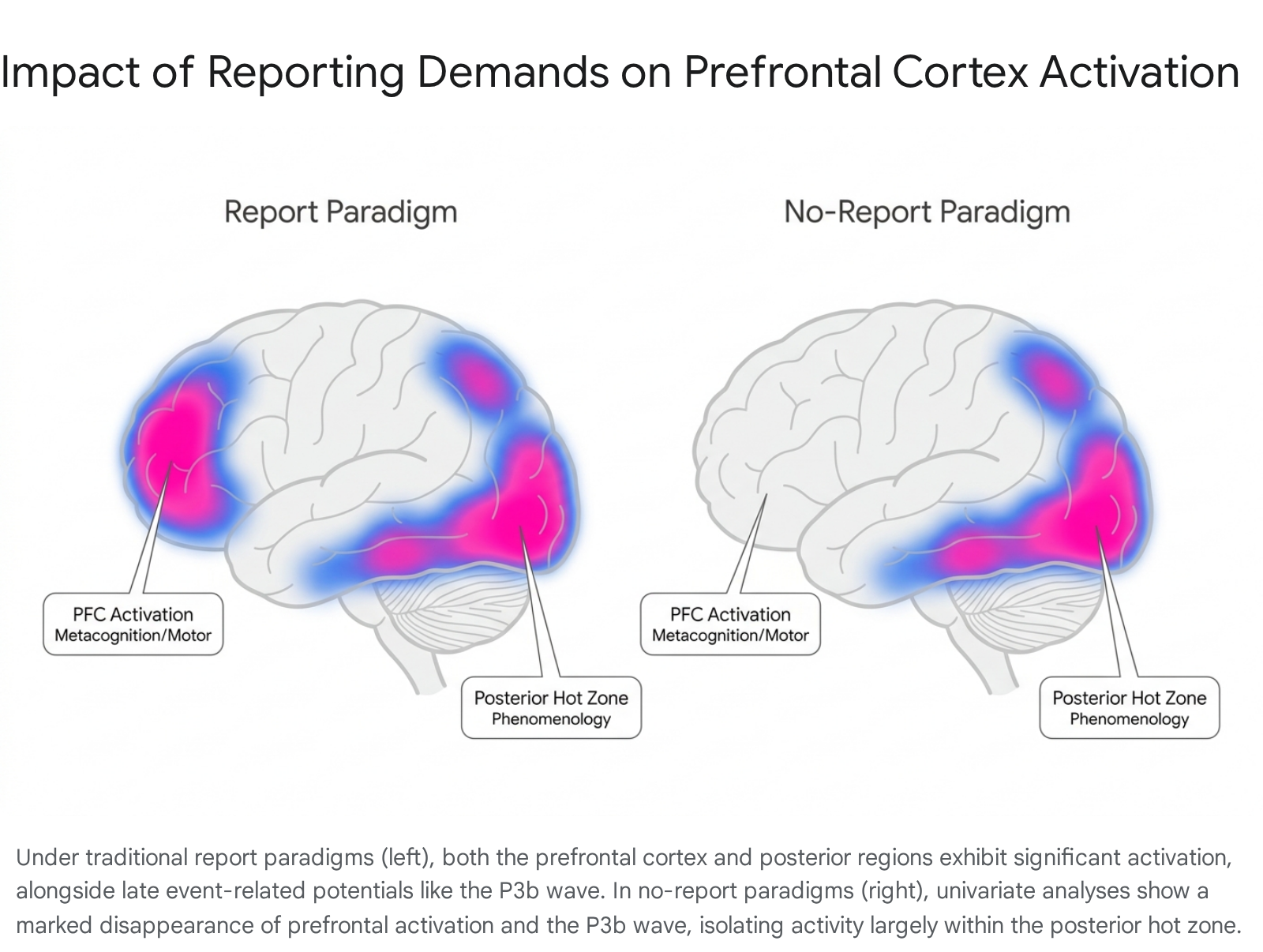
Furthermore, the P3b wave, once the gold standard of conscious access markers, was shown to vanish entirely when subjects were no longer required to actively report their perception 91516. In the absence of the P3b, researchers observed earlier electrocortical signals, such as the Visual Awareness Negativity (VAN), emerging as more robust candidates for the pure NCC 1617.
Limitations of No-Report and the Re-emergence of the Prefrontal Cortex
The initial conclusion drawn from no-report paradigms - that the prefrontal cortex is entirely extraneous to phenomenal consciousness - has faced intense methodological pushback. Critics maintain that simply removing the requirement to press a button does not eliminate post-perceptual cognition; a human subject presented with a novel stimulus may still engage in spontaneous metacognitive reflection, categorization, and internal reasoning 68.
Moreover, the absence of a structured task introduces an alternative confound: mental disengagement. Without a task to perform, the conscious mind naturally turns inward, shifting resources to the default mode network and engaging in mind-wandering or daydreaming 6. Consequently, no-report paradigms may inadvertently measure the neural correlates of perceptual ambiguity or conscious disengagement rather than the pure phenomenal percept 614.
Recent advancements in data analysis have fundamentally altered the interpretation of PFC involvement. While standard univariate fMRI analyses suggested that PFC activity disappears under no-report conditions, the application of Multivariate Pattern Analysis (MVPA) and advanced decoding algorithms tells a different story. Cross-time multivariate decoding reveals that the prefrontal cortex continues to exhibit statistically significant encoding of the conscious percept even without reporting demands 101316. These decoding studies identify a period of late, meta-stable brain activity (typically 200 - 400 milliseconds post-stimulus) that reliably generalizes across different stimulus types (such as shapes, faces, and words), indicating that the PFC maintains a universal, low-amplitude signature of conscious access that univariate averaging previously failed to detect 1316.
| Paradigm Property | Traditional Report Paradigms | Standard No-Report Paradigms | Multivariate No-Report Paradigms |
|---|---|---|---|
| Data Extraction | Behavioral interaction (button/verbal) | Autonomic proxies (pupil, OKN) | Autonomic proxies + Machine Learning |
| PFC Activation Profile | High magnitude, widespread | Univariate absence | Statistically significant decoding |
| Primary ERP Identified | P3b Wave (late frontoparietal) | VAN (early posterior) | Temporal generalization (200-400ms) |
| Primary Confounds | Metacognition, working memory, motor prep | Mind-wandering, default mode activation | High computational overhead, susceptibility to spontaneous reflection |
Anatomical Mappings of Conscious Experience
For decades, the search for the anatomical locus of consciousness predominantly pitted anterior cognitive networks against posterior sensory networks. However, the last several years of high-resolution structural and functional mapping have redefined the anatomical parameters of consciousness, elevating the role of subcortical structures from mere physiological enablers to critical drivers of awareness.
The Posterior Hot Zone
First-order and non-cognitivist theories maintain that the "posterior hot zone" - an organized network spanning the parietal, occipital, and temporal lobes - constitutes the primary anatomical substrate for specific conscious experiences 115. Neuroimaging studies robustly confirm that activity within these posterior associative regions tightly correlates with the phenomenological content of perception 2. In high-level cortical areas, such as the inferior temporal cortex along the ventral stream, specific neural populations demonstrate reciprocal activity that maps directly to conscious object recognition, largely independent of executive control 1. Structural characterizations suggest that conscious processing reliably occurs within specific regions of an organized representational geometry located in the posterior cortex, establishing the necessary substrate for sensory representation 2.
The Thalamic Gateway and Subcortical Hubs
A major paradigm shift occurred between 2024 and 2025 with the publication of studies leveraging 7-Tesla resting-state fMRI and direct intracranial stereoelectroencephalography (sEEG) in human patients 41621. These studies dismantled the traditional view that subcortical structures strictly mediate binary states of wakefulness while the cortex alone handles perceptual awareness.
Clinical trials involving patients with implanted deep brain electrodes - such as those undergoing treatment for drug-resistant headaches or receiving deep brain stimulation - allowed researchers to track single-neuron activity in deep structures during threshold-level visual and tactile tasks 41718. The data revealed that specific higher-order thalamic regions, most notably the intralaminar and medial thalamic nuclei, play a direct and pivotal role in initiating conscious perception 41819.
Crucially, the sEEG recordings demonstrated a specific temporal sequence: during the onset of conscious perception, the intralaminar and medial thalamic nuclei exhibit strong consciousness-related neural activity earlier than the prefrontal cortex 171920.
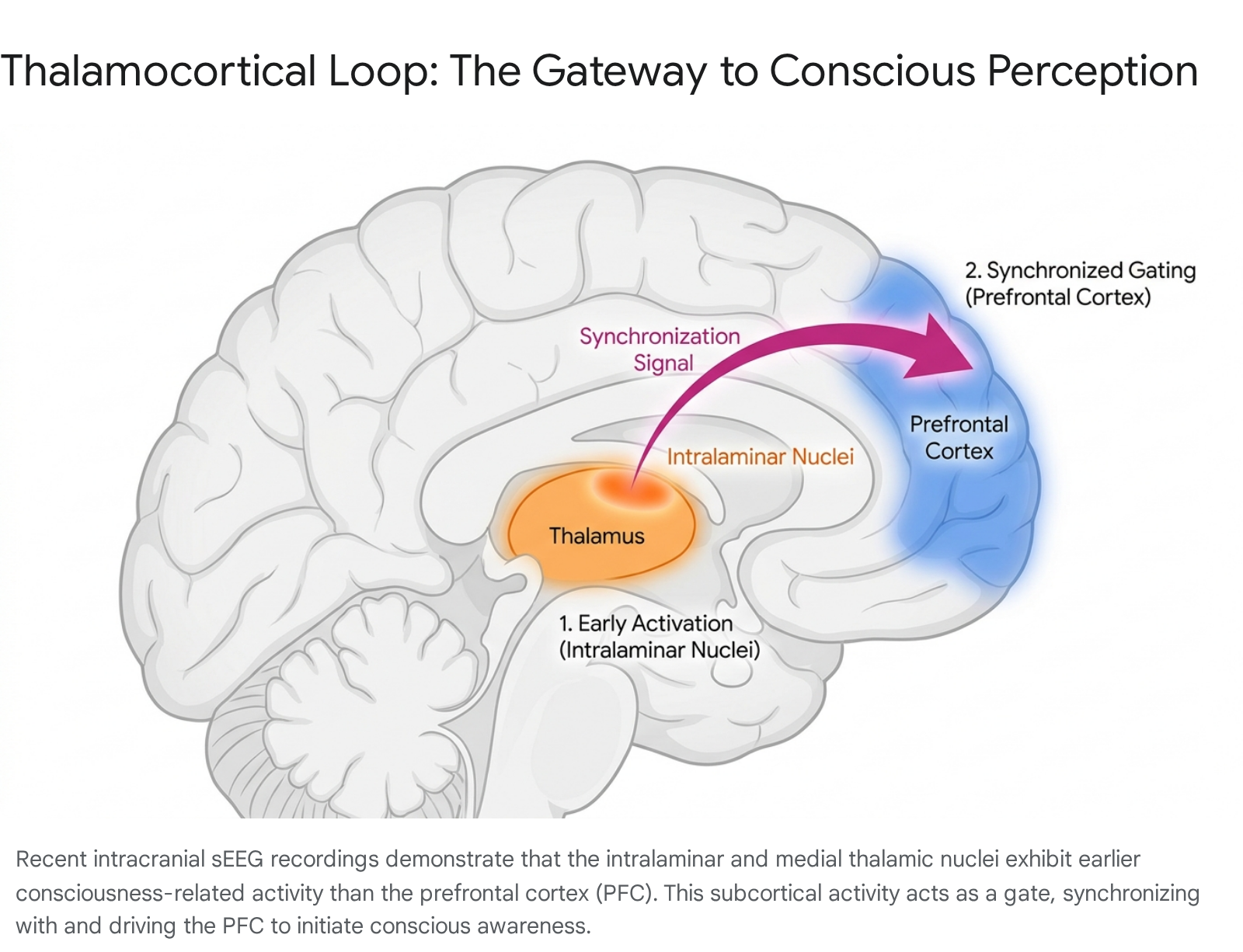
The thalamus does not simply pass along sensory signals; it operates as an active gating mechanism 421. Neural activity originating in these intralaminar nuclei projects forward, synchronizing with the lateral prefrontal cortex to trigger and drive the widespread cortical activity required for conscious awareness 1921.
Beyond the thalamus, high-resolution connectivity mapping has identified multiple subcortical hubs within the brainstem tegmentum, the basal ganglia, and the ventral tegmental area (VTA) that modulate cortical function 1621. These deep hubs are functionally connected to both the default mode network and the salience network, emphasizing their integrative role in subcortico-cortical signaling 1622. By overlapping these hubs with canonical brainstem arousal nuclei, researchers have pinpointed specific targets in the pontomesencephalic tegmentum that currently serve as the primary focus for neuromodulatory therapies aiming to restore consciousness in patients with severe brain injuries 162122.
Prominent Theoretical Frameworks
The empirical data generated over the last 35 years has been categorized and interpreted through several competing theoretical frameworks. These theories attempt to define the exact computational motifs and anatomical substrates required for phenomenal experience.
Global Neuronal Workspace Theory (GNWT)
Developed by Bernard Baars and significantly expanded by Stanislas Dehaene and Jean-Pierre Changeux, GNWT proposes that conscious experience occurs when specific information is selected and globally broadcast across the brain 22324. Under this framework, localized processing in sensory cortices is unconscious. Consciousness requires a widespread network of brain areas - heavily reliant on the prefrontal cortex and frontoparietal loops - to spotlight important pieces of information and hold them in a global workspace 2330. GNWT predicts that this process is marked by an "ignition" event: a non-linear, global synchronization of neural activity that brings sensory data to the forefront of the mind, making it available for diverse cognitive processes such as verbal report and memory encoding 233125.
Integrated Information Theory (IIT)
Proposed by Giulio Tononi, Integrated Information Theory approaches consciousness from an opposing, "phenomenology-first" perspective. IIT starts by defining the essential properties (axioms) of subjective experience - such as existence, composition, information, integration, and exclusion - and subsequently derives the necessary physical requirements (postulates) for any substrate capable of supporting those experiences 33133.
IIT posits that consciousness is strictly identical to a system's integrated cause-effect structure. The theory introduces a mathematical metric, Phi ($\Phi$), which quantifies the maximally irreducible integrated information within a neural substrate 3133. According to IIT, the degree of consciousness a system possesses is directly proportional to its $\Phi$ value 3. Anatomically, IIT predicts that the core NCC resides in the "posterior hot zone" of the cortex, asserting that local recursive structures in this region possess the optimal high-$\Phi$ architecture, largely independent of prefrontal executive networks 312534.
Predictive Processing (PP)
While GNWT and IIT attempt to monolithically identify consciousness with specific mechanisms, Predictive Processing (PP) operates as a broader framework for brain function that maps physical mechanisms to functional properties 262728. Under PP, the brain functions as a hierarchical Bayesian inference engine 312829. The brain does not passively receive sensory input; it actively constructs internal generative models to anticipate the environment 29.
Top-down neural pathways transmit these predictions, while bottom-up pathways carry "prediction errors" - the discrepancies between the internal model and the actual sensory input 2829. Consciousness is deeply associated with the continuous, precision-weighted minimization of these prediction errors across recursive cortical loops 3126. Phenomenal experience occurs as the brain resolves ambiguities and alters hypotheses to realign its internal memory with current sensory realities 2939.
Higher-Order and Recurrent Theories
Two other major frameworks continue to guide NCC research. Higher-Order Theories (HOT) posit that a first-order sensory representation (such as seeing a red apple) only becomes conscious when it is targeted by a higher-order meta-representation (the awareness that one is seeing the apple) 302530. HOTs generally locate the neural basis of these meta-representations in anterior regions, specifically the prefrontal cortex 3030.
Conversely, Recurrent Processing Theory (RPT), proposed by Victor Lamme, argues that feedforward sweeps of neural activity are inherently unconscious. Conscious experience arises solely from localized, re-entrant (recurrent) processing loops, typically instantiated within early sensory and posterior cortices, independent of the global broadcasting mechanisms demanded by GNWT 303130.
| Theory | Primary Mechanism | Core Anatomical Substrate | Empirical Marker / Prediction |
|---|---|---|---|
| GNWT | Global broadcasting and non-linear ignition | Prefrontal and frontoparietal networks | Widespread late-stage synchronization, P3b-like ERPs |
| IIT | Irreducible integrated cause-effect structure ($\Phi$) | Posterior cortical "hot zone" | High system complexity (PCI), sustained posterior synchrony |
| Predictive Processing | Hierarchical Bayesian inference, error minimization | Recursive cortical loops, diverse integration | Mismatch Negativity (MMN), theta-gamma phase coupling |
| RPT | Localized recurrent (re-entrant) processing | Early sensory and posterior cortices | Local recurrence/gamma persistence post-feedforward sweep |
| HOT | Meta-representation of first-order states | Anterior regions, Prefrontal Cortex | Higher-order tracking of first-order sensory activation |
Empirical Adjudication: Adversarial Collaborations
Because theories of consciousness often rely on highly disparate theoretical assumptions, isolated experiments have historically failed to falsify them; researchers simply interpreted data to fit their preferred framework. To break this impasse, the field initiated a series of formal adversarial collaborations. Orchestrated by groups like the Templeton World Charity Foundation, these protocols require proponents of opposing theories to jointly agree on a pre-registered experimental design, specify their divergent predictions in advance, and define mutually accepted criteria for falsification 304131.
The Cogitate Consortium: GNWT vs. IIT
The most prominent of these initiatives, the Cogitate Consortium, directly pitted Global Neuronal Workspace Theory against Integrated Information Theory 3031. The experimental protocol involved 256 human participants who viewed suprathreshold visual stimuli of varying durations. Using a massive multimodal neuroimaging suite consisting of fMRI, MEG, and intracranial EEG (iEEG), unbiased experimentalists tracked neural activity during tasks specifically designed to control for behavioral reporting confounds 314332.
The results, published in Nature in 2025, provided a highly nuanced outcome that failed to declare a definitive victor, instead highlighting severe empirical anomalies in both theories 253432.
Challenges and Support for IIT: IIT predicted that the primary neural signatures of consciousness would manifest in the posterior cortex and sustain themselves for the duration of the conscious percept. The data supported this anatomical prediction; information regarding conscious content was reliably decoded in the occipital and lateral temporal cortices, reflecting stimulus duration without relying on frontal engagement 253432. However, IIT failed a critical functional prediction. The data revealed a pronounced lack of sustained, short-range functional synchronization within these posterior regions during the experience 3132. Because IIT's mathematical foundation dictates that network integration specifies conscious content, this lack of posterior synchrony directly challenges the theory's core premise 32.
Challenges and Support for GNWT: GNWT predicted late, ignition-like responses in prefrontal networks and widespread long-range synchrony. The data partially supported GNWT by identifying content-specific synchronization and dynamic functional connectivity between the prefrontal cortex and early visual areas 253132. However, GNWT suffered major falsifications regarding its temporal predictions. Researchers observed a general lack of the predicted "ignition" signal at the offset of the stimulus 3132. Furthermore, the prefrontal cortex demonstrated a highly limited capacity to decode certain dimensions of the conscious content, undermining the assertion that the PFC serves as the primary, high-fidelity global workspace 32.
Expanding Adversarial Methodologies
The Cogitate results demonstrated that while large-scale, pre-registered consciousness experiments are viable, no single framework currently possesses complete explanatory power 25. Consequently, the adversarial approach has rapidly expanded across the discipline. A second major iteration of the Cogitate protocol is currently testing GNWT against IIT in non-human primate and murine models using high-density Neuropixels probes and optogenetic silencing 3031. Additionally, the INTREPID project is pitting IIT against Predictive Processing, while the ETHoS initiative is testing the empirical predictions of four distinct variants of Higher-Order Theories to refine the exact role of anterior meta-representations 30.
The Epistemological Crisis and the Pseudoscience Controversy
While adversarial collaborations challenge theories on empirical grounds, Integrated Information Theory has recently faced profound epistemological attacks regarding its fundamental scientific validity. Because IIT argues that consciousness is mathematically identical to integrated information ($\Phi$), the theory is inherently panpsychist. If consciousness is a fundamental property of specific causal architectures, then any system exhibiting a non-zero $\Phi$ possesses some degree of subjective experience 33333. Under strict IIT calculations, an inactive grid of connected logic gates, organoids cultured in petri dishes, and highly simplified biological arrays could technically be classified as conscious - potentially even more so than certain mammalian architectures 2446.
The 2023 Open Letter
In late 2023, a coalition of 124 prominent scholars, neuroscientists, and philosophers published an open letter aggressively condemning IIT as "pseudoscience" 243347. The signatories argued that while peripheral claims of IIT (such as the involvement of the posterior hot zone) are testable, the theory's core mathematical formalisms are computationally prohibitive to calculate for complex systems, rendering the specific claims about $\Phi$ unfalsifiable 346. The critics maintained that accepting panpsychist implications without the ability to empirically verify the existence of consciousness in inanimate or simple systems marks a dangerous departure from empirical science 3346.
The Nature Neuroscience Debate
The controversy escalated throughout 2025 and 2026, culminating in a series of highly publicized exchanges in Nature Neuroscience. Critics reiterated that a theory whose core claims cannot be tested, even in principle, fails the demarcation problem of science 3334. If constructing a complete $\Phi$-structure for real biological systems is practically impossible, IIT's explanatory power relies purely on metaphysical deduction rather than observation 33.
Proponents of IIT, including Giulio Tononi and Christof Koch, vigorously defended the theory, diagnosing the attack as a symptom of a broader epistemological crisis within neuroscience 35. They argued that the dominant computational-functionalist paradigm is inherently ill-equipped to explain the "hard problem" of consciousness - why physical processing is accompanied by subjective feeling at all 3550. According to IIT defenders, paradigms clash and die when they encounter a stubborn fact they cannot accommodate; in this instance, the stubborn fact is the irreducible reality of experience itself 4735. Proponents suggest that treating consciousness as a fundamental property of physics, derived axiomatically from phenomenology, is a legitimate scientific endeavor comparable to early theoretical physics, requiring the field to move beyond simplistic emergentist views 4735.
Diagnostic Translation: Predictive Processing in Clinical Practice
While theoretical debates dominate academic discourse, clinical neurology requires actionable biomarkers to assess residual consciousness in patients suffering from severe Disorders of Consciousness (DoC), such as those in a vegetative state (VS/UWS) or minimally conscious state (MCS) 28. Gold-standard behavioral assessments frequently misdiagnose patients whose profound physical impairments mask underlying awareness 28. In this clinical context, Predictive Processing (PP) has proven to be the most translationally effective framework.
By modeling the brain as a hierarchical inference engine, PP provides objective neurophysiological markers of conscious processing. The Mismatch Negativity (MMN) signal - an automatic neural error response generated when a sensory input violates the brain's internal generative model - serves as a highly reliable proxy for residual awareness 28. High-dimensional decoding of these hierarchical prediction errors allows clinicians to bypass behavioral reports entirely. Systematic reviews spanning the last 15 years confirm that the temporal progression and integrity of prediction error signatures in the early stages of coma demonstrate exceptional specificity for distinguishing conscious states and predicting a patient's likelihood of awakening 28. Current research prioritizes 24-hour continuous monitoring and multimodal data fusion to refine these PP-based computational models into standard bedside diagnostic tools 28.
Contributions of Large-Scale Brain Initiatives
The dramatic shift in NCC research from localized mapping to the analysis of dynamic, multi-scale network geometry has been made possible by state-sponsored, large-scale brain initiatives. Over the past decade, these global consortia have developed the computational infrastructure necessary to process the massive datasets required to understand consciousness.
The European Human Brain Project and EBRAINS
Concluding its ten-year mandate in late 2023, the European Union's Human Brain Project (HBP) pioneered the field of digital neuroscience 363738. A primary objective of the HBP was the multiscale understanding of physiological brain states - such as wakefulness, sleep, and anesthesia - that serve as the necessary background conditions for cognition 39.
HBP researchers mapped the intricate dynamics of neuronal circuits during transitions in and out of consciousness. They observed that during deep sleep or anesthesia, the cerebral cortex alternates between 'Up states' (brief periods of awake-like, asynchronous firing) and 'Down states' (silent, highly synchronized periods where information processing is blocked) 3940. Crucially, the HBP discovered that these global 'Down states' are not monolithic. They consist of distinct phases, including a transitional recovery phase where neuronal firing gradually resumes, becoming increasingly noisy and priming the brain for the next cycle 40. During this specific recovery window, the otherwise unconscious brain becomes highly susceptible to external stimuli 40. Understanding the exact topography of these silent periods offers profound therapeutic potential for preventing global Down states and artificially guiding brain-injured patients back into conscious states 40.
The HBP's legacy continues through EBRAINS, an open research infrastructure that hosts leading digital atlases - such as the microscopic Julich-Brain 3D atlas - and provides advanced platforms for simulating brain network complexity across humans, macaques, and mice 374142.
Asian Brain Projects: Single-Cell Modularity to Human BCIs
Parallel initiatives in Asia have generated complementary breakthroughs. In Japan, the RIKEN Center for Brain Science (CBS) has utilized proprietary wide-field two-photon microscopy to observe cellular network behavior 434460. By simultaneously recording the activity of over 10,000 individual neurons across 10 distinct cortical regions in mice, RIKEN researchers demonstrated how functional networks physically restructure depending on the state of consciousness 43. During unconsciousness, the cortex shifts into a highly segregated, modular state; intra-subnetwork connections strengthen, but the vital inter-subnetwork connections that allow for global information transfer are severely weakened 43. The researchers identified that specific "intermediate degree" neurons are uniquely responsible for generating these modularity shifts, operating as the mechanistic switches for consciousness 43.
Simultaneously, the China Brain Project (CBP) - led by the Center for Excellence in Brain Science and Intelligence Technology (CEBSIT) - has advanced mesoscale mapping to unprecedented levels in non-human primates 4546. Integrating high-resolution brain imaging, spatial transcriptomics, and artificial intelligence, CEBSIT published seminal macaque brain atlases in 2024 and 2025, detailing single-cell neuronal connections across complex evolutionary models 4647.
This deep structural understanding directly facilitated remarkable clinical applications. In March 2025, CEBSIT successfully executed China's first-in-human clinical trial of a high-throughput, wireless invasive brain-computer interface (BCI) 48. Implanted in a tetraplegic patient, the device leverages exact topological mapping to establish a direct communication link between the patient's conscious intent and external electronic devices, allowing the patient to control computer programs solely through mental activity 48. By effectively bypassing damaged physical pathways to read conscious intent directly from cortical activity, this BCI technology represents the ultimate translational triumph of decades of highly theoretical NCC mapping 4548.
Conclusion
Over 35 years of intensive investigation, the search for the neural correlates of consciousness has evolved from the identification of isolated cortical regions to the analysis of highly dynamic, multi-scale network states. The historical reliance on explicit behavioral reporting skewed early models heavily toward the prefrontal cortex. The subsequent integration of no-report paradigms, coupled with sophisticated multivariate decoding, has refined this view: the posterior hot zone is recognized as the primary engine for content-specific sensory representation, while the prefrontal cortex maintains a meta-stable, low-amplitude role in conscious access independent of task execution.
Perhaps the most significant revelation of recent years is the dismantling of the strictly cortico-centric paradigm. High-resolution deep brain recordings have confirmed that subcortical structures - specifically the intralaminar thalamic nuclei and the ventral tegmental area - do not merely enable arousal but actively gate, trigger, and synchronize the cortical activity requisite for phenomenal awareness.
While theoretical consensus remains elusive, large-scale adversarial collaborations have successfully forced abstract models like the Global Neuronal Workspace Theory and Integrated Information Theory into the realm of rigorous falsifiability. Neither theory currently provides a flawless account of empirical data, and intense epistemological debates over the boundaries of scientific inquiry persist. Nevertheless, through the fusion of global brain initiatives, hierarchical predictive processing models, and high-resolution structural mapping, the field has transitioned from philosophical speculation to a mature clinical science capable of diagnosing, simulating, and technologically interfacing with human consciousness.