Global Definitions of Success in 2026
The global conceptualization of human progress and individual success has reached a definitive inflection point in 2026. For the latter half of the 20th century and the first two decades of the 21st, the dominant paradigm was prescribed by Western socioeconomic frameworks. This model defined success primarily through the accumulation of capital, continuous aggregate economic growth measured by Gross Domestic Product (GDP), and the celebration of hyper-individualistic career milestones 123. However, a confluence of environmental limits, widespread psychological burnout, and the restructuring of labor via artificial intelligence has fractured the consensus surrounding this model 445.
In response, diverse cultural paradigms are being institutionalized at both the state and corporate levels. Frameworks such as Buen Vivir in Latin America, Ubuntu in Sub-Saharan Africa, Barakah in the Middle East, and Antyodaya in South Asia reject the extractivism and social atomization inherent in Western models. Instead, these paradigms propose that success must be measured by collective well-being, spiritual alignment, and ecological equilibrium 6789. This report provides an exhaustive sociological and economic analysis of the decentralization of success metrics in 2026, examining the decline of Western hustle culture and the formalization of alternative, polycentric definitions of human flourishing.
The Sociological Decline of Western Hyper-Individualism
The traditional Western model of success is predicated on hyper-individualism, an ideology that emphasizes personal achievement, autonomy, and self-actualization, frequently at the expense of social connection and collective obligation 1210. Evolutionary biologists and sociologists characterize this framework as a product of WEIRD (Western, Educated, Industrialized, Rich, Democratic) psychology, which dismantled traditional clan loyalties in favor of universal rules and individual property rights 11. While this structural shift historically catalyzed rapid economic expansion and technological innovation, contemporary analyses associate it with profound systemic fragility 111.
The Phenomenon of Liberated Anomie
The relentless pursuit of individualistic success has generated a distinct sociological condition described as "liberated anomie" 1. Unlike classical anomie, which involves feelings of worthlessness and despair, liberated anomie is characterized by a state in which individuals feel entirely free to act in their own self-interest to satisfy personal needs, yet remain profoundly disconnected from the broader society and the ecosystem 1. This condition is defined by an active disregard for the social norms that once encouraged cooperation and mutual care, replacing them with a hyper-focus on the self and an apathy toward structural societal issues 1.
This hyper-individualism manifested most acutely in the "hustle culture" of the previous decade, which glorified exhaustion, normalized 80-hour workweeks, and framed continuous output as the ultimate marker of professional success 412. Success was explicitly tied to labor volume and corresponding financial compensation. However, empirical medical and economic data from 2025 and 2026 demonstrate the fundamental unsustainability of this model. Working over 55 hours weekly increases the risk of stroke by 35% and precipitates a decline in marginal productivity to near zero 4. The physical and psychological toll has led to widespread rejection of this paradigm; approximately 64% of Generation Z workers now value mental health over financial growth, and 58% report a willingness to accept lower compensation in exchange for a sustainable work-life balance 4.
Global Wellbeing Deficits and the Rejection of the Grind
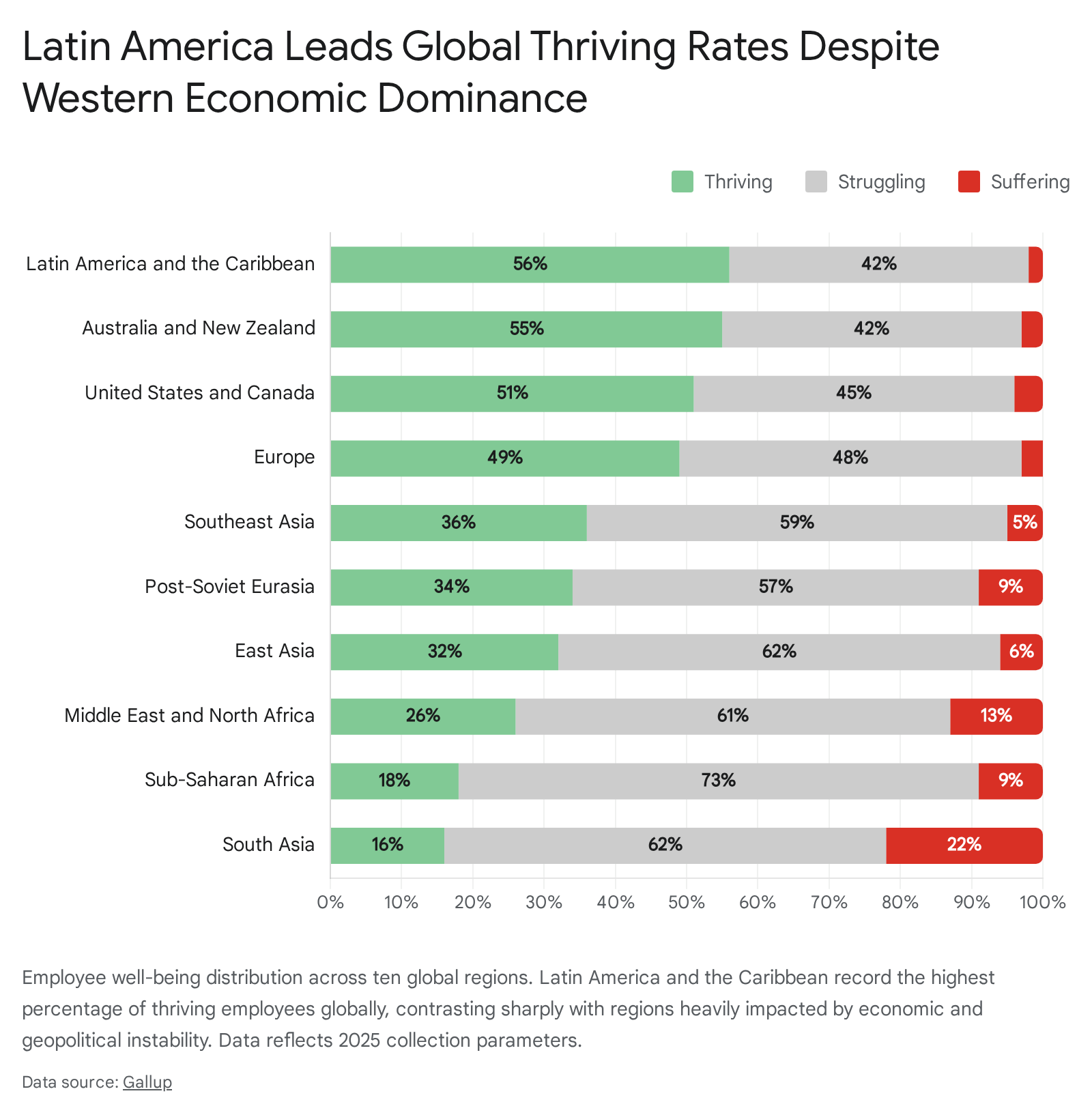
The psychological consequences of the Western success model are evident in global macroeconomic and well-being data. According to the Gallup State of the Global Workplace: 2026 Report, global employee engagement dropped to 20%, costing the global economy an estimated $10 trillion in lost productivity 1314. The prevalence of daily negative emotions remains at historic highs in the regions most associated with hustle culture. In the United States and Canada, 50% of employees reported experiencing significant daily stress, the highest rate worldwide, while 19% reported persistent daily loneliness 15.
| World Region | Employees Thriving (%) | Employees Struggling (%) | Employees Suffering (%) | Daily Stress (%) |
|---|---|---|---|---|
| Latin America & Caribbean | 56% | 42% | 2% | Data Unavailable |
| Australia & New Zealand | 55% | 42% | 3% | Data Unavailable |
| United States & Canada | 51% | 45% | 4% | 50% |
| Europe | 49% | 48% | 4% | Data Unavailable |
| Southeast Asia | 36% | 59% | 5% | Data Unavailable |
| Post-Soviet Eurasia | 34% | 57% | 9% | Data Unavailable |
| East Asia | 32% | 62% | 6% | Data Unavailable |
| Middle East & North Africa | 26% | 61% | 13% | Data Unavailable |
| Sub-Saharan Africa | 18% | 73% | 9% | Data Unavailable |
| South Asia | 16% | 62% | 22% | Data Unavailable |
| Table 1: Regional Well-being and Employee Engagement Metrics, 2025-2026. Source: Gallup State of the Global Workplace 2026 Report 15. Note: Percentages may not sum to 100% due to rounding. |
The World Happiness Report (WHR) 2026 corroborates this structural decline, particularly among younger demographics. Over the past two decades (comparing the 2006 - 2010 baseline to 2023 - 2025), the subjective life evaluation of individuals under 25 years of age fell by an average of 0.86 points (on a 0 to 10 scale) in the United States, Canada, Australia, and New Zealand (collectively designated as the NANZ region) 1617.
| Demographic Group & Region | Change in Life Evaluation (2006-2010 vs 2023-2025) | Global Ranking for Youth Happiness Change (out of 136) |
|---|---|---|
| Youth (Under 25) in NANZ Region | -0.86 points | Ranks 122nd to 133rd |
| Youth (Under 25) in Western Europe | Moderate Decline | Data Unavailable |
| Youth (Under 25) in Central & Eastern Europe | Significant Increase (+1.0 points or more) | Top Rankings |
| Youth (Under 25) in MENA Region | Stable (Despite High Social Media Use) | Data Unavailable |
| Table 2: Shifts in Demographic Happiness and Life Evaluation. Source: World Happiness Report 2026 161718. |
The decline in Western youth well-being is heavily correlated with hyper-individualistic digital consumption. Heavy social media use (defined as over seven hours daily) is associated with substantially lower well-being in Western regions; for instance, girls in Western Europe who are heavy users are 63% more likely to report low life satisfaction compared to light users 1618. Conversely, in regions with stronger collective community norms, such as the Middle East and North Africa (MENA), youth well-being has not seen a marked decline despite similarly high rates of social media use, suggesting that collective social frameworks act as a psychological protective factor against the atomization of the digital era 1718.
Artificial Intelligence and the Transition to Gentle Careers
The collapse of hustle culture is fundamentally intertwined with the maturation of Artificial Intelligence (AI) in the modern workplace. The traditional Western model of success assumed a linear correlation between hours worked and economic output 19. In 2026, autonomous agentic AI has severed this correlation. Generative optimization tools execute repetitive manual tasks in seconds, rendering volume-based labor metrics obsolete 1921.
Success in the 2026 knowledge economy requires a transition from functioning as a "laborer" to operating as a "systems architect" 19. Professionals who achieve high financial success increasingly manage automated systems rather than executing manual work, decoupling their income generation from their physical time 19. Organizations have pivoted to valuing "cognitive capital" - distinctly human skills such as ethical reasoning, strategic synthesis, and stakeholder empathy - over raw output 20. This technological paradigm shift facilitates the rise of "gentle careers," where success is measured by emotional sustainability, flexible work arrangements, and alignment with personal ethics, rather than competitive exhaustion 12.
Latin American Paradigms: Buen Vivir and Post-Extractivism
In opposition to the Western pursuit of limitless economic expansion, Latin American cultures have formalized success through the paradigm of Buen Vivir (derived from the Quechua concept of Sumak Kawsay, translating to "good living" or "harmonious living") 721. Buen Vivir is not a localized variant of Western sustainable development; it is an epistemological break from it. Where Western sustainability typically seeks to mitigate the environmental externalities of continued economic growth (often termed "green growth"), Buen Vivir posits a relational ontology that fundamentally rejects capital accumulation as the primary marker of progress 3722.
Biocentrism and the Rights of Nature
Buen Vivir operates on three interrelated levels of harmony: Sacha Runa Yachay (harmony with oneself), Runakuna Kawsay (harmony with communities), and Sumak Allpa (harmony with nature) 21. A central tenet of this philosophy is the total rejection of anthropocentrism. Nature (Pachamama) is not viewed as an inanimate pool of resources awaiting human extraction, but as a living entity and a moral subject possessing intrinsic rights 722.
This philosophy has transcended academic and indigenous discourse to become institutionalized state policy. Both Ecuador (in 2008) and Bolivia (in 2009) revised their national constitutions to enshrine the principles of Buen Vivir, formally recognizing the legal rights of nature 723. By redefining success as ecological balance and community sufficiency, these nations possess a legal framework to challenge the extractivist economic models that have historically dominated the Global South 723.
The Economic Mechanisms of Post-Extractivism
The practical implementation of Buen Vivir is closely aligned with the economic theories of post-extractivism and degrowth 32124. Extractivism - the mass removal of natural resources primarily for export to industrialized nations - is viewed as a neo-colonial dependency trap that perpetuates domestic inequality, damages local ecosystems, and prevents the realization of a "good life" for indigenous populations 727.
Proponents of Buen Vivir argue that for countries in the Global South to achieve structural success, economies in the Global North must embrace degrowth, thereby systematically reducing the insatiable demand for raw materials that drives environmental exploitation 2324. In 2026, the principles of Buen Vivir influence major developmental strategies across the region. The Open Society Foundations launched an eight-year Latin American investment strategy explicitly inspired by Buen Vivir, redirecting capital toward inclusive policies, green economic agendas, and the structural empowerment of historically marginalized Afro-descendant and Indigenous populations 25.
African Frameworks: Collective Personhood and the Ubuntu Economy
In Sub-Saharan Africa, the definition of success is heavily mediated by the philosophy of Ubuntu, a Nguni Bantu term broadly translated as "I am because we are" 262728. Ubuntu represents a definitive shift from individualistic achievement to collective personhood, emphasizing mutual respect, reciprocity, and shared prosperity 92729. Success is not measured by the capital an individual accumulates, but by how their actions enhance the social cohesion and material well-being of the broader community 2930.
Ubuntu in Environmental Activism and Social Development
In 2026, Ubuntu serves as the foundational framework for political and social activism on the continent. In East Africa, youth-led environmental movements in Kenya and Uganda utilize Ubuntu to challenge both historical colonial land-use paradigms and modern extractivist projects that threaten local ecosystems 31. These activists critique traditional Western social movement theories, arguing that African activism is intrinsically linked to communal responsibility for the environment, rather than operating solely through the lens of individual political rights 31.
The global social work and developmental community has increasingly adopted these principles. The 2026 Joint World Conference on Social Work and Social Development (SWSD 2026) in Nairobi operates under the theme "Harambee for Sustainable Shared Futures." Harambee, a Kenyan concept deeply intertwined with Ubuntu, denotes the value of working collaboratively, sharing responsibility, and co-building solutions 26. This approach to social development prioritizes inclusive livelihoods, equitable access to resources, and community-led environmental initiatives over top-down Western intervention models 2629.
The Ubuntu Economy and the Evolution of Tech Hubs
Economically, the Ubuntu philosophy is manifesting as a "middle path" between the systemic inequalities of laissez-faire capitalism and the administrative inefficiencies of centralized socialism 9. The concept of the "Ubuntu Economy" promotes shared prosperity through mechanisms like the Equal Trade Certification, which mandates equitable revenue-sharing structures to ensure that wealth generated from raw materials benefits local producers rather than solely enriching foreign corporations or local elites 9. Under this model, the state's role is to facilitate the equitable redistribution of resources to align with communal well-being, vesting the ultimate ownership of natural resources in the populace 9.
This collective philosophy is currently engaged in a complex structural dialectic with imported Western business models. African urban centers such as Lagos (Nigeria), Nairobi (Kenya), and Kigali (Rwanda) have rapidly developed into massive technology hubs, drawing billions in venture capital and giving rise to native corporate "unicorns" 32333435. Africa's digital economy is projected to reach $180 billion by 2025 and $712 billion by 2050 3435.
Initially, these hubs heavily imported Silicon Valley's hyper-competitive "hustle culture." However, in 2026, analysts note that a direct replication of the Silicon Valley model is unsustainable due to differing structural realities, including infrastructure deficits, currency volatility, and unique consumer market dynamics 36. Consequently, African founders are adapting the tech ecosystem to local realities. Innovation in hubs like the "Silicon Savannah" (Nairobi) or the Ekiti Knowledge Zone (Nigeria) is characterized by a focus on products that solve fundamental collective challenges - such as mobile payments (e.g., M-Pesa) and logistics - rather than chasing arbitrary hyper-valuations 323435. The integration of the diaspora and the utilization of revenue-based financing signify a maturation away from the purely extractive venture capital models of the West 3336.
Middle Eastern and Islamic Frameworks: Barakah vs. Hustle
In the Middle East and broader Islamic cultural spheres, the Western definition of success is being actively deconstructed and replaced by faith-driven and community-oriented paradigms. Arab and Muslim sociologists argue that importing Western sociological theories without aligning them with the specificities of the Islamic community distorts social reality, as Western theories are dominated by secular, post-colonial historical references . Thinkers critique Western political modernity and postmodernity as epistemological frameworks that fail to address the unique spiritual and communal demands of the Arab world, asserting that true developmental success requires indigenous frameworks 3742.
The Contrast Between Barakah and Hustle Culture
At the individual and organizational levels, the most prominent articulation of this shift is the dichotomy between "Hustle Culture" and "Barakah Culture" 64338. Barakah, an Islamic concept denoting divine blessing, increase, and spiritual benefit, offers a radically different metric for productivity and success 643.
Where Western hustle culture is diagnosed as ego-centric, result-driven, and focused on short-term worldly accumulation, Barakah culture is God-centric, purpose-driven, and focused on long-term, multi-generational impact 64339. Success in a Barakah framework involves ridaa (contentment with one's current reality) coupled with sincere effort, regardless of immediate material outcomes 643. A key differentiator is the detachment from immediate results; success is defined by the sincerity of the intention and the effort expended to please God, even if the tangible results of the labor are not realized until generations later 643.
This paradigm emphasizes an abundance mindset over a scarcity mindset, prioritizing tranquility, presence, and communal responsibility over rushed, distracted busyness 639. Corporate consulting firms and organizations operating under a Barakah framework actively aim to align their corporate values and daily rituals with these principles, moving away from employee burnout and toward sustainable, spiritually intelligent leadership 39.
Institutionalizing Quality of Life: Saudi Vision 2030
At the state level, Middle Eastern nations are redefining macroeconomic success beyond mere GDP output and oil dependency. Saudi Arabia's Vision 2030, initiated in 2016 and maturing deeply by 2026, exemplifies this structural pivot 404142. While economic diversification remains a core pillar, the Vision explicitly elevates societal well-being to equal prominence through its "Vibrant Society" theme 4043.
The Kingdom's Quality of Life Program targets highly specific, non-economic success metrics that prioritize physical health, cultural engagement, and environmental sustainability 404344. By integrating culture, entertainment, and sports into its core developmental blueprint, Saudi Arabia is actively pivoting its national success metrics toward holistic citizen well-being 404244.
| Saudi Vision 2030 Quality of Life Metric | Baseline Status (Pre-Vision) | 2030 Target |
|---|---|---|
| Average Life Expectancy | 74 years | 80 years |
| Citizens Exercising Weekly | 13% | 40% |
| Household Spending on Culture/Entertainment | Data Unavailable | 6% |
| Annual Umrah Visitors | 8 million | 30 million |
| Social Capital Index Ranking | Data Unavailable | Top 10 Globally |
| Global City Rankings | Data Unavailable | 3 Saudi cities in Top 100 |
| Table 3: Selected Non-Economic Targets within Saudi Vision 2030's Vibrant Society Pillar. Source: Vision 2030 Official Documentation 404344. |
South Asian and Southeast Asian Paradigms
South and Southeast Asia present unique case studies in the tension between necessary macroeconomic growth and the implementation of inclusive, sustainable definitions of success.
Antyodaya and the Recalibration of Growth in India
India's economic trajectory in 2026 is formidable; with a sustained 6% to 7% annual growth rate, it is projected to overtake Japan and Germany to become the world's third-largest economy by the end of the decade 454647. The digital economy and manufacturing sectors have generated over 2.1 million direct startup jobs and immense wealth 4748. However, the stark reality is that this prosperity remains highly concentrated; only an estimated 5% to 10% of India's 1.4 billion population enjoys living standards comparable to leading Western economies, while GDP per capita hovers around $3,000 4546.
Consequently, Indian policymakers and intellectuals increasingly emphasize the philosophy of Antyodaya - the rise or upliftment of the person at the very bottom of the socioeconomic pyramid 8. Rooted in the "Integral Humanism" framework conceptualized by Pandit Deendayal Upadhyaya, Antyodaya shifts the metric of national success from aggregate GDP growth to the immediate eradication of absolute poverty and hunger 849. Under this paradigm, vast logistical welfare programs - such as the Antyodaya Anna Yojana (AAY) for subsidized food grains and the Deendayal Antyodaya Yojana-National Rural Livelihoods Mission (DAY-NRLM), which has mobilized over 100 million rural women into Self Help Groups - are deployed as primary mechanisms for national success 849. Success for the state is thus defined not merely by its global economic ranking, but by its administrative capacity to deliver provisions to AAY and Below Poverty Line (BPL) cardholders, absorb millions of young people into the workforce, and facilitate inclusive urban development 845.
The Recalibration of ASEAN Startups
In Southeast Asia, the definition of corporate success has undergone a brutal structural recalibration. During the previous decade, the region aggressively imported the Silicon Valley venture capital model, wherein success was defined by astronomical valuations, hyper-scaling, and capturing market share regardless of underlying capital burn rates 505152.
By 2026, this model has largely collapsed under the weight of market realities. The Brunei Startup Summit 2026 highlighted a definitive structural pivot: the era of the "mega-valuation trap" is over 50. Venture capital markets now penalize the pursuit of artificially high early-stage valuations, as startups inevitably struggle to meet the exponential growth metrics required to justify them 5052.
| Primary Causes of High-Growth Startup Failure in ASEAN/India | Prevalence | Core Structural Issue |
|---|---|---|
| Premature Scaling | 74% | Expanding operations and cash burn before achieving true product-market fit or unit economics. |
| Founder Burnout | 55% | Exhaustion resulting from 80-hour workweeks and toxic "hustle culture" expectations. |
| Weak Team Alignment | 23% | Prioritizing rapid hiring over cultural fit, leading to internal clashes. |
| Regulatory Blind Spots | 18% | Ignoring local compliance (data privacy, taxation) in the rush to expand borders. |
| Table 4: Structural Failures of the Imported Western Startup Model in Asia. Source: 2025 Market Research and CB Insights data 5152. |
The human cost of this imported hustle culture has been severe, with 83% of Asia's employees reporting burnout in recent years 53. In response, a "quiet rebellion" is reshaping the ASEAN tech ecosystem 53. Success is increasingly defined by sustainable unit economics, early profitability, operational maturity, and cash flow discipline 5052. Furthermore, a new cultural narrative around failure is emerging; traditional Asian stigmas regarding risk and the necessity of "saving face" are giving way to models that value resilience, authentic growth, and community-driven creator economies over endless output and systemic exhaustion 5253.
Institutionalizing Alternative Success Metrics: Beyond GDP
The cultural rejection of Western, capital-centric success definitions is heavily reflected in the evolution of global institutional metrics in 2026. The limitations of Gross Domestic Product (GDP) as a proxy for human progress are now universally acknowledged across international bodies 4545556. GDP fails to account for wealth inequality, unpaid domestic labor, and, crucially, the systematic depletion of natural capital 456.
The Planetary Pressures-Adjusted HDI
The United Nations Development Programme (UNDP) has systematically updated its frameworks to reflect these new realities. Building on foundational work introduced earlier in the decade, the 2026 UN Human Development Report (HDR) places central focus on integrating environmental stewardship into developmental metrics through the Planetary Pressures-Adjusted Human Development Index (PHDI) 55758.
The traditional Human Development Index (HDI) measures health, education, and standard of living. However, the PHDI penalizes countries that achieve high HDI scores through excessive carbon dioxide emissions and outsized material footprints 557. This effectively redefines success at the highest geopolitical level: a highly developed nation that achieves economic growth by destroying the global environmental commons is no longer classified as successful 556. Alongside the Inequality-Adjusted HDI (IHDI), these metrics demonstrate that eliminating inequality and maintaining ecological balance are now prerequisites for recognized global progress 5758. The UN's High-Level Expert Group (HLEG) on Beyond GDP is further codifying these standards, preparing to present final recommendations that build on pillars of well-being, equity, and sustainability 56.
Shifting Values in Global Surveys
The shift in global priorities is further quantified by the World Values Survey (WVS) Wave 8, which spans data collection from 2024 to 2026 across 80 countries 5960. Recognizing that success and societal stability are deeply influenced by cultural context, the WVS-8 questionnaire explicitly incorporates new modules to measure contemporary phenomena 59.
Alongside traditional metrics of post-materialism, the survey now heavily monitors perceptions of climate change, generalized trust, subjective well-being, family planning, and attitudes toward migration and technological advancements 5961. Advanced empirical analyses of WVS data demonstrate that long-term life satisfaction is driven not solely by financial status, but by a complex matrix of factors including freedom of choice, democratic values, and health 6263. By elevating these metrics, global research institutions are empirically validating the localized philosophies - from Buen Vivir to Ubuntu to Barakah - that prioritize relational harmony and holistic well-being over strict material accumulation 35463.
Conclusion
In 2026, the global consensus regarding what constitutes "success" has fundamentally fragmented, shifting decisively away from a homogenized Western ideal. The relentless pursuit of individualistic wealth and exponential economic growth, characteristic of Western hustle culture and neo-liberal economics, is increasingly recognized as both ecologically disastrous and psychologically ruinous.
Instead, regional cultures are asserting indigenous, faith-based, and community-centric paradigms that redefine human progress. Latin America's Buen Vivir demands legal harmony with the natural world and an end to neo-colonial extractivism. Africa's Ubuntu necessitates shared prosperity, collective responsibility, and the recalibration of digital economies to serve local needs. The Middle East's Barakah culture calls for purpose-driven, God-centric labor that values long-term, multi-generational impact over immediate ego gratification. Concurrently, South and Southeast Asia are balancing rapid macroeconomic modernization with a return to sustainable unit economics and the Antyodaya principle of uplifting the most vulnerable citizens.
Supported by advanced institutional metrics like the Planetary Pressures-Adjusted HDI and updated World Values Survey methodologies, these diverse frameworks represent a cohesive global realization. True success in the 21st century cannot be measured by the isolated accumulation of capital or raw economic output, but rather by the resilience, equity, psychological health, and ecological balance of the entire human community.