
History and myths of the Illuminati
The Historical Bavarian Illuminati
Foundation and Enlightenment Ideals
The organization historically known as the Illuminati was established on May 1, 1776, in the Electorate of Bavaria by Adam Weishaupt, a twenty-eight-year-old professor of canon law at the University of Ingolstadt 112. Raised by his godfather, Baron von Ickstatt, a proponent of the Enlightenment and a member of the Bavarian Privy Council, Weishaupt became the university's first non-Jesuit chair of canon law in nearly a century 2. Frustrated by the pervasive clericalism, superstition, and conservative orthodoxies of his academic environment, Weishaupt sought to create a clandestine network dedicated to the advancement of secularism, rational thought, and egalitarianism 13.
Initially referring to his organization as the "Perfectibilists" (driven by the aim of human perfectibility), Weishaupt eventually settled on the Illuminatenorden, or the Order of the Illuminati 12. The society's overarching mission was the systematic dismantling of religious influence over public life and the curtailment of monarchical abuse. In their general statutes, the founders explicitly stated their goal to "put an end to the machinations of the purveyors of injustice" and to foster a global environment where mankind could live in equality, guided by an enlightened elite 11.
Organizational Structure and Expansion
To bypass state censorship and maintain operational security, the Illuminati adopted a highly structured, hierarchical model heavily influenced by Jesuit discipline and Masonic degrees 14. Members communicated using ciphers and adopted classical aliases to conceal their identities. Weishaupt took the codename "Spartacus," while his founding law students - Franz Anton von Massenhausen, Max Edler von Merz, and Bauhoff - adopted the names "Ajax," "Tiberius," and "Agathon," respectively 12. The organization's primary symbol was the Owl of Minerva, representing wisdom in Greek mythology 1.
The society's rapid expansion was catalyzed by the involvement of Adolph Freiherr von Knigge, a prominent German author who facilitated the Illuminati's integration with existing European Masonic lodges 15. Through this strategic infiltration, the Order grew from its initial five members to an estimated 650 to 2,500 active participants across Germany, France, Italy, and Poland 15. The ranks included civil servants, academics, medical professionals, and progressive members of the nobility. Historical records indicate that prominent intellectual figures of the Aufklärung (the German Enlightenment), including Johann Wolfgang von Goethe and Johann Gottfried Herder, were either members of or closely associated with the society 14.
State Suppression and Dissolution
The Illuminati's radical anti-clerical agenda ultimately triggered its demise. Plagued by internal dissension between Weishaupt and other high-ranking members, such as the diplomat Xavier von Zwack, the group was exposed to state authorities 12. In 1784, Charles Theodore, the Elector of Bavaria, issued an edict banning all unauthorized secret societies, followed by more targeted and severe edicts in 1785, 1787, and 1790 16.
Law enforcement agencies subsequently raided the homes of prominent members, including von Zwack, confiscating internal documents, membership lists, and ideological texts 26. Some confiscated documents were allegedly falsified by disgruntled former members to frame the group as militant atheists advocating for suicide and anarchy 6. While conventional historiography posits that the Illuminati dissolved entirely by 1785, modern archival analysis conducted by the Illuminati Research Unit at the Gotha Research Centre reveals that the organization maintained a provincial stronghold in Thuringia. Operating under the leadership of translator and Freemason Johann Joachim Christoph Bode, the network persisted until approximately 1787 before succumbing entirely to state suppression 7.
The Genesis of the Illuminati Conspiracy Theory
Despite its brief operational lifespan and strict geographical confinement to Europe, the Illuminati achieved profound historical endurance by transforming into the central antagonist of a global conspiracy narrative.
The French Revolution and European Dissemination
The foundational texts of the modern Illuminati mythos emerged in the immediate aftermath of the French Revolution. In 1797 and 1798, two authors - the exiled French Jesuit priest Augustin Barruel and the Scottish physicist John Robison - independently published extensive treatises blaming the societal upheaval of the era on the Illuminati 1. Barruel's Memoirs Illustrating the History of Jacobinism and Robison's Proofs of a Conspiracy argued that the Bavarian Illuminati had not been destroyed by Charles Theodore's edicts, but had instead gone underground, infiltrated international Freemasonry, and orchestrated the French Revolution 18.
These publications effectively severed the Illuminati from its historical reality. The narrative repositioned the group as a borderless, permanent coalition dedicated to the total annihilation of Christianity, the dismantling of national sovereignties, and the establishment of a centralized global authority 1.
Transmission to the United States and Clerical Anxiety
By the spring of 1798, the Barruel-Robison conspiracy framework had crossed the Atlantic, finding a highly receptive audience among conservative orthodox clergymen in New England. On May 9, 1798, the Reverend Jedidiah Morse, a prominent Congregationalist pastor in Charlestown, Massachusetts, delivered a highly publicized fast-day sermon warning that the Illuminati had infiltrated the United States 910.
Historical and sociological analyses indicate that this early American conspiracy panic was driven by acute "status anxiety." The orthodox Calvinist clergy felt increasingly marginalized by the rise of egalitarian democratic politics, Jeffersonian republicanism, and the rapid expansion of evangelical denominations 1011. By projecting these complex societal shifts onto an imagined European cabal, Morse and his contemporaries attempted to consolidate their waning moral authority and re-establish themselves as the "watchmen of the New Jerusalem" 1011. Although Morse's claims were thoroughly investigated and debunked by his contemporaries - who demonstrated that the "Illuminati lodges" in Virginia were merely standard Masonic bodies - the psychological template for American conspiracism was firmly established .
The Morgan Affair and the Anti-Masonic Party
While the immediate panic regarding the Illuminati subsided in the early nineteenth century, the underlying suspicion of secret elite societies culminated in the Anti-Masonic movement of the 1820s. In 1826, William Morgan, a stonemason from Batavia, New York, was abducted and presumed murdered after threatening to publish an exposé of local Masonic rituals 912.
The resulting public outrage catalyzed a massive populist backlash. An elaborate conspiracy theory posited that prominent Masons had orchestrated Morgan's murder and utilized their political influence to evade justice and silence the press 9. This sentiment spawned the Anti-Masonic Party, a significant political force in the northern United States that mobilized rural and agricultural demographics against an urban middle class widely perceived as a corrupt shadow government 912.
Iconography and the Great Seal of the United States
Central to the contemporary mythology of the Illuminati is the appropriation of specific visual symbols, most notably the Eye of Providence hovering above an unfinished pyramid. This imagery, prominently featured on the reverse of the Great Seal of the United States and the American one-dollar bill, is frequently cited as definitive proof of Illuminati influence over the American founding 11316. However, the historical record regarding the creation of the Great Seal comprehensively refutes this assertion.
The Committees of the Great Seal
The design of the Great Seal was a complex, iterative process spanning six years (1776 - 1782) and involving three separate congressional committees 1317. Of the fourteen men who contributed to the design process, Benjamin Franklin was the only confirmed Freemason 131617. Franklin's proposed design, which depicted Moses dividing the Red Sea to overwhelm the Pharaoh, was entirely rejected by Congress and had no bearing on the final imagery 1718.
| Committee Year | Key Consultants & Artists | Structural Contributions to the Final Seal |
|---|---|---|
| 1776 | Pierre Eugene Du Simitière (Non-Mason) | The Eye of Providence within a radiant triangle; the motto E Pluribus Unum; the foundational shield. 131714 |
| 1780 | Francis Hopkinson (Non-Mason) | The unfinished pyramid (adapted from his 1778 design for a $50 Continental currency note); olive branch; red and white stripes. 131720 |
| 1782 | William Barton & Charles Thomson (Non-Masons) | Synthesis of prior elements; the bald eagle; the mottos Annuit Coeptis and Novus Ordo Seclorum. 131720 |
The Eye of Providence and the Unfinished Pyramid
The specific elements of the reverse seal were deliberately chosen to reflect American geopolitical realities, not esoteric occultism. Charles Thomson, the Secretary of Congress, explicitly documented the rationale behind the design: the pyramid signified "Strength and Duration," explicitly drawing inspiration from the Great Pyramid of Egypt, while its unfinished nature represented the ongoing construction of the new nation 161820.
The Eye of Providence and the accompanying Latin motto Annuit Coeptis (He has favored our undertakings) alluded to divine intervention in the American revolutionary cause 1718. The Eye of Providence itself was a pervasive cultural motif long before the founding of the United States. Originating in Renaissance Christian art, the all-knowing eye was a standard representation of the Christian God and the Holy Trinity, appearing frequently in religious paintings such as Pontormo's Supper at Emmaus 11317.
The Divergence from Freemasonry
The retrospective conflation of the Great Seal with the Illuminati relies on a fundamental misattribution of Masonic iconography. While modern Freemasonry does utilize the all-seeing eye as a representation of the "Great Architect of the Universe," this adoption occurred at the end of the eighteenth century, well after the United States Congress had formalized the design of the Great Seal 1316. Furthermore, the unfinished pyramid has never functioned as an official Masonic symbol 1316.
The belief that the seal represents a global Masonic or Illuminati conspiracy is an anachronistic fabrication, largely popularized by modern conspiracy literature and heavily amplified by fictional thrillers such as Dan Brown's The Da Vinci Code and Angels & Demons 816.
Psychological and Sociological Drivers of Conspiracy Belief
The endurance of the Illuminati myth over two and a half centuries cannot be explained by historical evidence, as the original Bavarian society ceased to exist in 1787. Instead, the myth's survival is rooted in the fundamental psychological and sociological mechanisms that govern human sense-making and threat perception 1516.
Evolutionary Adaptations and Agency Detection
Evolutionary psychology provides two competing frameworks for understanding conspiracy ideation. The "adaptation hypothesis" posits that human beings possess an evolved, functionally integrated mental system designed specifically to detect hostile coalitions 1516. In ancestral environments, the ability to recognize covert plots by rival tribes was critical for survival, reproductive success, and the avoidance of fatal ambushes 1516.
Conversely, the "by-product hypothesis" argues that conspiracy theories are the non-functional consequences of other evolutionary cognitive tools, specifically "hyperactive agency detection" and "pattern recognition" 1523. Agency detection refers to the human capacity to identify intentional actors in the environment and to attribute mental states, motives, and intentions to those actors 1517. While vital for empathy, social regulation, and cooperation, this mechanism frequently misfires. Studies demonstrate a strong positive correlation between conspiratorial ideation and anthropomorphism - the tendency to over-ascribe human intent to inanimate objects, random events, or complex socio-economic phenomena 152318. When faced with chaotic global events, the human brain inherently recoils from randomness, actively seeking causal connections. The Illuminati functions as the ultimate cognitive placeholder, resolving the anxiety of systemic chaos by providing a deliberate, albeit malevolent, design 151819.
Epistemic, Existential, and Social Motives
Sociological research utilizing System Justification Theory categorizes the motivations behind conspiracy belief into three distinct domains: epistemic, existential, and social 20.
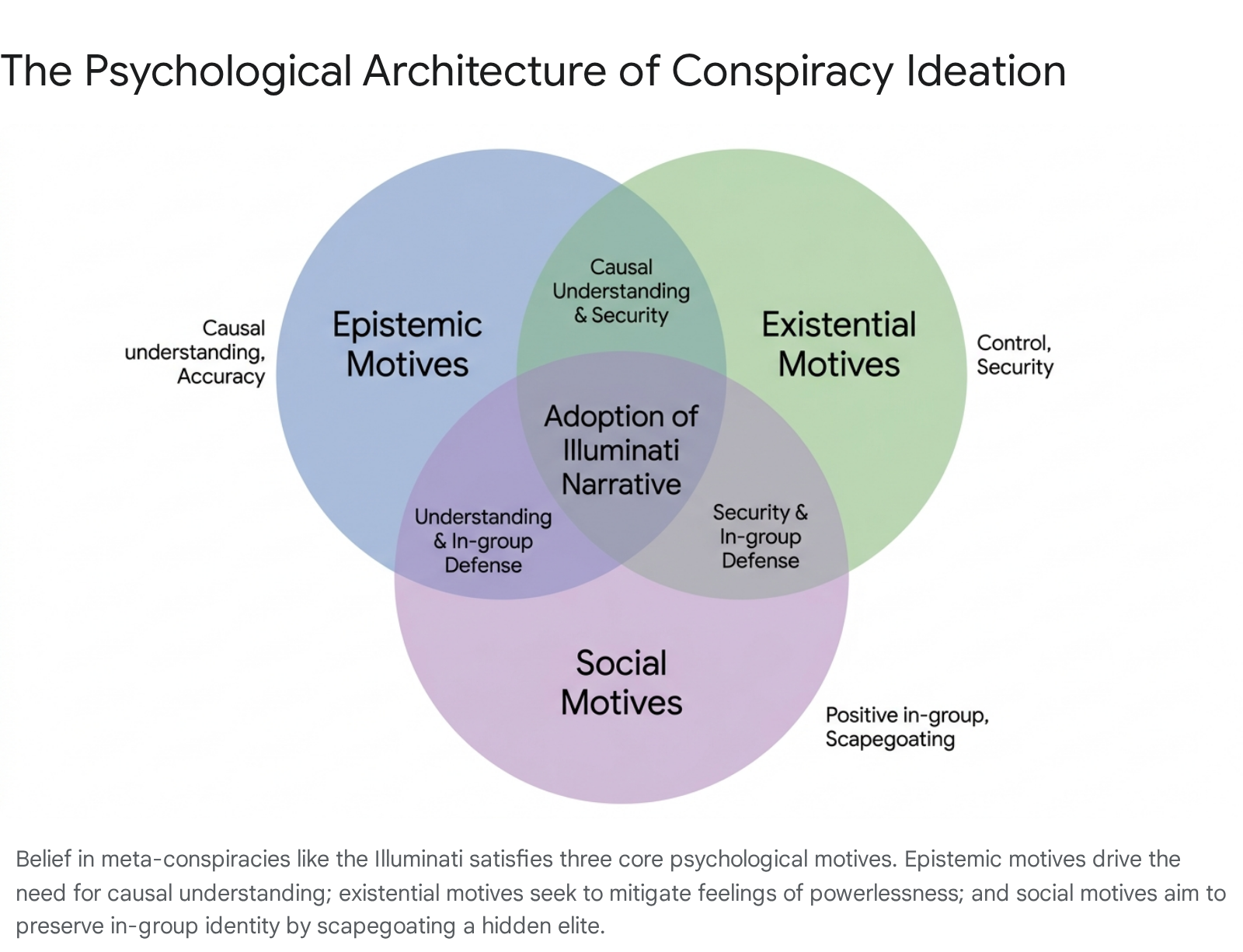
Epistemically, individuals are driven by a need to understand their environment and achieve subjective certainty. Conspiracy theories provide a simplified, overarching explanation for complex geopolitical issues, shielding believers from the distress of uncertainty 20. Existentially, belief in a monolithic elite orchestrating global events affords the believer a compensatory sense of control. Individuals experiencing political disenfranchisement or economic distress are highly susceptible to these narratives, as rejecting official explanations grants them an alternative account and an epistemic high ground 20. Socially, conspiracy theories preserve the positive image of the in-group by scapegoating a hidden out-group. The Illuminati myth valorizes the believer as competent and moral, while externalizing blame for societal failures onto an unscrupulous elite 20.
The Illuminati in Modern Popular Culture
In the late twentieth and early twenty-first centuries, the Illuminati transitioned from a niche political anxiety into a pervasive fixture of global popular culture. This transition was facilitated largely by literature, digital media, and the music industry.
Literature and the Satirical Revival
The contemporary resurgence of the Illuminati as a pop-cultural phenomenon is heavily indebted to The Illuminatus! Trilogy, a three-part science-fiction series published in 1975 by Robert Shea and Robert Anton Wilson 12129. Operating as a highly layered satire, the novels intentionally synthesized disparate and often contradictory conspiracy theories - ranging from the assassination of John F. Kennedy to the Knights Templar and the numerical significance of 666 - into an elaborate, absurd tapestry 29.
Paradoxically, the satirical intent of the work was misunderstood by large segments of the public. The synthetic mythology constructed by Shea and Wilson was gradually absorbed into genuine conspiracist frameworks, reinvigorating public interest in the Illuminati 129. This cultural momentum was further solidified by the publication of Dan Brown's thriller Angels & Demons in 2000, which portrayed the Illuminati as a surviving sect of scientific enlightenment locked in a mortal struggle with the Vatican 2130.
Hip-Hop Culture and Counter-Hegemonic Critique
The intersection of the Illuminati myth with hip-hop and African American popular culture provides a profound sociological case study. In the late 1990s and 2000s, explicit references to the Illuminati surged in the lyrical content of prominent hip-hop artists, including Tupac Shakur, Nas, Jay-Z, and Prodigy of Mobb Deep 2223. Concurrent rumors proliferated within the music industry that high-profile entertainers achieve astronomical wealth and influence by pledging allegiance to the Illuminati, frequently allegedly signaled through the use of the Eye of Providence hand gestures or occult iconography in music videos 32124.
Academic analyses of this phenomenon suggest that Illuminati conspiracism in hip-hop functions as a rationalized, metaphorical response to historical and ongoing racial repression. The hip-hop genre emerged as a platform to articulate the trauma of structural violence, extreme poverty, and the paradoxes of a hyper-capitalist society 252627. For African American communities, the historical realities of systemic racism, aggressive institutional surveillance (e.g., the FBI's COINTELPRO operations), and egregious medical exploitation (e.g., the Tuskegee Syphilis Study) establish a legitimate, empirical foundation for profound institutional distrust 2325.
Within this context, the Illuminati serves as an allegorical framework - a form of "coded social critique" or "counter-knowledge" - used to explore themes of exploitation, powerlessness, and the commodification of Black artistry by corporate entities 2225. Condemning these artists simply as literal conspiracy theorists fundamentally misinterprets the genre's rhetorical tradition, denying lyricists the artistic agency to utilize the occult and the conspiratorial to confront the impasses of societal racialization 222528.
The Illuminati as a Template for Meta-Conspiracies
In the digital era, the Illuminati myth functions less as a specific historical claim and more as a cognitive template. The core structural logic of the Illuminati - a hidden cabal of elites engaging in malevolent, secretive acts while exerting totalitarian control over the media and economy - has been subsumed by newer, hyper-networked meta-conspiracies 38.
QAnon and the Weaponization of Information Literacy
The QAnon movement, which gained significant momentum in 2017, directly mirrors the historical Illuminati framework. QAnon alleges a secret war against a globalist, pedophilic cabal of liberal elites, Hollywood celebrities, and deep-state operatives 29. To ensure its survival and expansion, QAnon operates by colonizing alternative cultural spaces - including yoga studios, neo-shamanistic circles, and wellness groups - disguising its abrasive political objectives beneath the rhetoric of "conspirituality" and alternative wellness 29.
Crucially, both the modern Illuminati narrative and the QAnon movement subvert traditional academic and scientific rhetoric. By adopting the mandate to "do your own research," these movements weaponize the foundational principles of information literacy 383031. Believers engage in highly sophisticated, crowd-sourced data visualization to connect unrelated political, economic, and cultural events. Scholars characterize this practice as a "slippage between data and information" that artificially accelerates apophenia (the tendency to perceive meaningful connections between unrelated things) 32. Consequently, combating these theories with standard media literacy frameworks is exceptionally difficult, as adherents operate under the conviction that they are already practicing rigorous, independent investigative research 30.
The Deep State and Algorithmic Radicalization
The concept of the "Deep State" - a shadow government operating independently of democratic oversight - functions as a secularized adaptation of the Illuminati myth . Sociological mapping of global conspiracy networks, particularly socio-symbolic network analyses comparing U.S. and German QAnon communities across millions of Telegram posts, reveals deep structural alignments. Both communities construct "social ontologies" that divide the world into comparable actor groups (corrupt local elites vs. alternative saviors) and organize political conflicts along epistemic lines 33.
This ideological resonance highlights that the global spread of these meta-conspiracies relies on "selective compatibility." The core Illuminati template is flexible enough to accommodate specific local grievances, allowing for the rapid cross-contextual diffusion of the conspiracy 33.
Global Adaptations of the Illuminati Narrative
The Illuminati myth is not exclusively a Western phenomenon. Driven by global internet accessibility and social media algorithms, the framework has been aggressively exported, localized, and hybridized to address specific regional anxieties across the Global South.
| Region | Core Localized Narrative | Primary Vectors of Transmission |
|---|---|---|
| Middle East | Conflation with Zionism; anti-Western interventionism. | State-sponsored media, historical antisemitic texts. 3435 |
| Latin America | Suppression of socialism; "URSAL" communist cabals. | YouTube recommendation algorithms, political debates. 4736 |
| Sub-Saharan Africa | Occult syncretism; explanations for wealth disparities. | Digital media, traditional witchcraft frameworks. 3738 |
| Southeast Asia | Economic manipulation; political and military hoaxes. | TikTok, WhatsApp, platform trend-jacking. 5152 |
Latin America and the URSAL Phenomenon
In Latin America, the Illuminati myth seamlessly integrates with deep-seated anxieties regarding political corruption and socialist governance. During the 2018 Brazilian presidential election, a conspiracy theory regarding the "United Socialist Republics of Latin America" (URSAL) gained mainstream traction, even being cited by candidates during nationally televised debates 4736.
Originally coined as a throwaway, satirical joke in a 2001 article, URSAL was amplified by far-right digital influencers and presented as a genuine plot orchestrated by the Illuminati to establish a communist New World Order 4736. Researchers tracking this phenomenon noted that YouTube's recommendation algorithms played a critical role in radicalizing audiences. Users who initially engaged with content discussing the URSAL joke were systematically recommended escalating, extremist videos linking political figures like Emmanuel Macron to the anti-Christ and outlining global Illuminati unification plans 47.
The Middle East and Conspiratorial Racialization
In the Arab world, conspiracy theories heavily influence political landscapes, often serving as the "ultimate refuge of the powerless" to interpret the destabilizing impacts of Western colonialism, superpower interventions, and rapid modernization 35. Within this context, the Illuminati narrative has been inextricably linked with virulent anti-Zionism and antisemitism.
The mythology frequently merges with The Protocols of the Elders of Zion - a fabricated, early-twentieth-century antisemitic hoax document - to advance the concept of "conspiratorial racialisation." This process falsely depicts Jewish populations as a monolithic entity plotting global economic and political subjugation under the guise of an Illuminati-driven New World Order 343539. In this regional adaptation, disparate global events, ranging from the rise of ISIS (with rumors circulating that its leadership comprised Mossad agents) to the outbreak of the COVID-19 pandemic, are seamlessly incorporated into the Illuminati/Zionist conspiracy template, promoted heavily by both top-down state media and unregulated digital platforms 3540.
Sub-Saharan Africa and Occult Syncretism
In Sub-Saharan Africa, the Illuminati myth has been hybridized with traditional belief systems regarding witchcraft and the occult. The rapid influx of global capitalism and neoliberal economic policies has generated massive wealth disparities, class formation, and social strain across the continent 3755. In nations such as Nigeria and South Africa, the Illuminati is frequently invoked to rationalize sudden personal enrichment, political dominance, or the success of cybercrime syndicates 37.
This narrative replaces traditional localized "evil strangers" or witches with Western-originated secret societies. A poignant example of this ideological fusion occurred in South Africa in February 2025. A photograph depicting South African President Cyril Ramaphosa placing his hand on the hip of billionaire businessman Johann Rupert was widely circulated online and interpreted through an Illuminati lens 38. Domestic conspiracy theorists framed the gesture as proof of occult symbolism, asserting it demonstrated the political leader's subservience to a shadowy, global economic elite 38.
Southeast Asia and Digital Disinformation
In Southeast Asia, particularly within the massive digital economy of Indonesia, social media algorithms heavily dictate the spread and adaptation of conspiracy theories. With high internet penetration and intense political polarization, platforms such as Facebook, TikTok, X, and WhatsApp serve as primary vectors for hoaxes spanning political, military, and economic spheres 5141.
The Illuminati template is frequently utilized by organized social media "buzzers" (influence workers) and independent influencers to "trend-jack" algorithms, translating global conspiracy symbols into local vernaculars to maximize visibility, provoke emotional engagement, and reshape party politics 524243. Furthermore, economic conspiracies specifically targeting gold investment and financial manipulation spread rapidly across Indonesian social networks during periods of economic uncertainty in 2025, actively exploiting cultural traditions and deteriorating institutional trust 5144. Efforts to combat this algorithmic proliferation are ongoing, requiring sophisticated interventions. One such initiative is the development of Gali Fakta, a WhatsApp-inspired media literacy game explicitly tailored for Indonesian audiences. The intervention is designed to inoculate users against false information by teaching them to recognize the manipulative rhetorical styles, emotional appeals, and unverified data structures common to these pervasive meta-conspiracies 41.