
History and Influence of Secret Societies
Fraternal organizations and secret societies have long occupied a dual position in modern history, functioning simultaneously as verifiable sociological institutions and as the imagined architects of global conspiracies. The Bavarian Illuminati, Freemasonry, and Yale University's Skull and Bones represent three distinct typologies of secretive organizations 112. Despite being routinely conflated in popular lore and modern conspiracy theories - most notably those concerning a "New World Order" 34 - these groups possess disparate origins, organizational structures, and historical trajectories.
To assess the actual power wielded by these entities, it is necessary to separate documented historical reality from accumulated myth. Their influence has rarely manifested as the centralized, omnipotent control suggested by conspiracists. Instead, their historical power is best understood through the sociological frameworks of "soft power" - the ability to shape preferences through attraction, shared values, and networking 67 - and "social capital," which facilitates the reproduction of elite status across generations 85.
To contextualize their disparate natures, the following table summarizes the fundamental characteristics of the three organizations examined in this report.
| Organization | Founding | Core Typology | Primary Objective | Verified Power Mechanism |
|---|---|---|---|---|
| Bavarian Illuminati | 1776 (Bavaria) | Radical Enlightenment political order | Promote secularism, rationalism, and dismantle monarchies. | Brief intellectual dissemination; suppressed entirely by 1785. |
| Freemasonry | 14th C. origins; formalized 18th C. | Global civic and moral fraternity | Moral instruction, mutual aid, and civic cohesion. | Soft power via social networking; intermittent political influence. |
| Skull and Bones | 1832 (Yale University) | Collegiate senior society | Elite socialization and intergenerational networking. | Social capital accumulation and elite reproduction within institutions. |
The Bavarian Illuminati
The Order of the Illuminati stands as one of history's most misunderstood organizations. While it existed for less than a decade, its ideological legacy and subsequent mythologization have exerted a profound impact on the public perception of secret societies 1011.
Origins and Enlightenment Framework
The Illuminati was established on May 1, 1776, in Ingolstadt, Bavaria, by Adam Weishaupt 613. Weishaupt, born in 1748 and orphaned at a young age, was raised by his godfather, Baron von Ickstatt, a member of the Privy Council and tutor to the Elector of Bavaria 1113. Educated extensively by Jesuits, Weishaupt subsequently became the first non-Jesuit chair of natural and canon law at the University of Ingolstadt 1113.
Deeply dissatisfied with the religious and political conservatism of the Bavarian state - which was heavily dominated by the Catholic Church and the cultural remnants of the recently dissolved Jesuit order - Weishaupt sought to create a vanguard organization to promote the radical ideals of the Enlightenment 1113. Initially calling his group the "Perfectibilists," Weishaupt aimed to cultivate an elite body of men who would eventually infiltrate and assume key positions within the state apparatus, thereby subverting the hegemony of the territorial princes and the church 1378. The Illuminati's core philosophical tenets included the promotion of rational thought, secularism, gender equality, and the eradication of absolute monarchical power 1069.
Despite his overt disdain for the Jesuits, Weishaupt modeled the internal discipline and mutual surveillance of his secret society directly on the Jesuit hierarchical structure 137. The original five founding members consisted of Weishaupt, who took the secret order name "Spartacus," and four of his law students, who adopted the aliases "Ajax," "Tiberius," "Erasmus Rotterdamus," and "Agathon" 13.
Expansion and Masonic Integration
Recognizing the limitations of his initial recruitment pool, Weishaupt drew heavily from the established infrastructure of Freemasonry. After being initiated into a Strict Observance Masonic lodge in Munich in 1777, Weishaupt utilized Masonic networks to rapidly expand the Illuminati's ranks 13.
This expansion was significantly accelerated by the recruitment of Baron Adolph von Knigge, a prominent former Freemason, who assisted Weishaupt in organizing the society and establishing a complex hierarchy consisting of thirteen degrees of initiation 11. Members were assigned classical code names, and geographic locations were given historical pseudonyms 1113. The organization quickly grew, attracting intellectuals, politicians, doctors, lawyers, and literary figures, most notably the writer Johann Wolfgang von Goethe 11. By 1782, the society boasted approximately 600 members, and by 1784, it had grown to between 2,000 and 3,000 members 1113. By 1779, the Order of the Illuminati had successfully assumed leadership of the primary Masonic lodge in Munich 13.
State Suppression and Eradication
The rapid expansion of the Illuminati ultimately catalyzed its destruction. The clandestine nature of the group, combined with its explicitly anti-monarchical and anti-clerical objectives, drew the ire of Bavarian authorities 116. Furthermore, internal dissent weakened the order; Xavier von Zwack, Weishaupt's second-in-command, resigned in 1784 in protest of Weishaupt's despotic leadership style 13.
In 1784, Duke-Elector Charles Theodore issued an edict banning all unauthorized secret societies, followed by a specific ban explicitly targeting the Illuminati in 1785 1167. The crackdown was absolute. In 1786, police raided the private residence of Zwack in Landshut, discovering highly compromising documents among his possessions 1113. These confiscated materials included the Illuminati's internal cipher, their calendar, geographic code names, and a comprehensive list of members initiated between 1776 and 1779 13.
The publication of these texts by the state sparked immense public paranoia regarding the group's intentions 10. By 1787, membership in the Illuminati was decreed a crime punishable by death, effectively dismantling the society 11. Weishaupt was stripped of his academic professorship and forced into permanent exile in Gotha, Saxony, where he spent the remainder of his life teaching and writing philosophy 1189. The historical consensus remains definitive: there is no documentary evidence that the Bavarian Illuminati survived its suppression in 1785 16.
The Evolution of the Illuminati Conspiracy Theory
While the physical organization was swiftly dismantled, the Illuminati achieved a potent afterlife in the realm of political paranoia. Following the outbreak of the French Revolution in 1789, conservative European elites sought an explanatory framework for the sudden, violent overturning of the state. In 1797, two authors independently published works that would cement the Illuminati's status as a perpetual global menace 61011.
The French Jesuit priest Abbé Augustin Barruel published the multi-volume Memoirs Illustrating the History of Jacobinism, arguing that the French Revolution was not the result of organic social unrest, but the culmination of a decades-long, deliberate conspiracy 1012. Barruel alleged that a coalition of philosophes, Freemasons, and the surviving remnants of the Illuminati had orchestrated the dismantling of the throne and altar 1012. Simultaneously, the Scottish physicist and mathematician John Robison published Proofs of a Conspiracy against all the Religions and Governments of Europe 11. Robison, a respected academic at the University of Edinburgh, relied heavily on the confiscated Bavarian documents to argue that the Illuminati had infiltrated Continental Freemasonry and orchestrated the Reign of Terror 112021.
The historical evolution of this conspiracy theory demonstrates how a localized intellectual society was transformed into a global myth, as summarized in the table below.
| Era | Ideological Evolution | Key Figures and Texts | Impact on the Conspiracy Narrative |
|---|---|---|---|
| 1776-1785 | Historical Reality | Adam Weishaupt; Bavarian Illuminati | Real, finite political order suppressed by the Bavarian state. |
| 1797-1798 | Post-Revolution Paranoia | Abbé Barruel (Memoirs); John Robison (Proofs of a Conspiracy) | Blamed the Illuminati for the French Revolution; introduced the concept of a surviving, hidden cabal. |
| 1798-1800 | The American Illuminati Scare | Jedidiah Morse; Timothy Dwight | Federalists utilized the European texts to accuse political opponents (e.g., Jeffersonians) of Illuminati affiliation. |
| Mid-20th Century | Anti-Communist Conflation | The John Birch Society (JBS); William Guy Carr | Fused the Illuminati myth with anti-communist, anti-globalist fears of an international collectivist government. |
| Late 20th Century | The "New World Order" | Pat Robertson (The New World Order, 1991) | Cemented the Illuminati as the primary architect of a dystopian global government, incorporating anti-Semitic tropes. |
Robison and Barruel's texts achieved massive popularity and sparked the first "Illuminati scare" in the United States in 1798 2022. The theory was heavily promoted by conservative clergymen, such as Jedidiah Morse and Timothy Dwight, who feared the infiltration of radical, atheistic European ideologies into the young republic 2022. Thomas Jefferson was publicly, albeit baselessly, accused of being a member of Weishaupt's Order 2021.
Over a century later, this framework was adapted by right-wing populist groups in the United States. In the mid-20th century, organizations such as the John Birch Society fused the 18th-century anti-Illuminati narrative with anti-communist and anti-globalist rhetoric 3. This amalgamation created the modern "New World Order" conspiracy theory, which posits that a shadowy cabal of elites operates across centuries to establish a totalitarian global government 46. The publication of Pat Robertson's book The New World Order in 1991 further cemented this theory in American conspiratorial culture 3. The actual Illuminati, therefore, possessed almost no real-world power outside of brief local influence in 1780s Bavaria, but its perceived power has shaped conspiratorial frameworks for nearly 250 years.
Freemasonry
Freemasonry constitutes the oldest existing secular fraternal organization, evolving from medieval guilds of operative stonemasons into a speculative fraternity dedicated to moral instruction and mutual aid 2. While conspiracy theorists frequently conflate Freemasonry with the Illuminati 14, Freemasonry's actual historical influence is vastly different. It is characterized by deep internal schisms, a dedication to civic soft power, and isolated, highly controversial instances of direct political intervention.
The Ideological Schism: Anglo-American versus Continental Traditions
To understand the power dynamics of Freemasonry, one must recognize its fundamental bifurcation in the 19th century into two irreconcilable branches: Anglo-American (or Regular) Freemasonry and Continental (or Liberal) Freemasonry 131425.
Anglo-American Freemasonry, tracing its descent from the United Grand Lodge of England (UGLE), is the dominant form in the Anglosphere, including the United States 213. It adheres to strict core values known as "Landmarks." These include a non-negotiable requirement that members profess a belief in a Supreme Being (the "Great Architect of the Universe"), the mandatory presence of a "volume of sacred law" in the lodge, the exclusion of women, and a strict prohibition on the discussion of religion or politics within the lodge 21325. Consequently, the power exercised by Anglo-American Freemasonry has historically been limited to civic networking, character building, and large-scale philanthropic endeavors, rather than coordinated political action 2627.
Conversely, Continental Freemasonry, dominated by the Grand Orient de France (GOdF), emerged from the French Enlightenment as a progressive, philosophically liberal force 1415. The divergence between the two traditions escalated during the 1860s over issues of racial equality. In 1868, the Grand Orient de France recognized a Scottish Rite body in Louisiana that admitted Black men 1429. This prompted the Grand Lodge of Louisiana and several other American Grand Lodges to withdraw recognition of the GOdF 2930. The definitive schism occurred in 1877, when the GOdF famously eliminated the requirement for belief in a deity, asserting "absolute liberty of conscience" and human solidarity as its guiding principles 131429.
This action triggered a permanent break with the UGLE, which declared the GOdF "irregular" 2529. Unlike its Anglo-American counterpart, the GOdF became deeply and institutionally involved in progressive politics, secularism, and the establishment of the French Third Republic 1415.
The structural and ideological differences that dictate how these branches exercise power are outlined in the following comparative table.
| Characteristic | Anglo-American (Regular) Freemasonry | Continental (Liberal) Freemasonry |
|---|---|---|
| Primary Authority | United Grand Lodge of England (UGLE) | Grand Orient de France (GOdF) |
| Religious Requirement | Mandatory belief in a Supreme Being. | Absolute freedom of conscience; atheists admitted. |
| Political Discussion | Strictly prohibited within the lodge. | Encouraged; heavy focus on progressive social engagement. |
| Geographic Dominance | USA, UK, former British Empire. | France, Continental Europe, Latin America. |
| Mechanism of Power | Civic soft power, charity, business networking. | Direct political advocacy, state secularization, lobbying. |
The Affaire des Fiches: The Implementation of Hard Power
While claims of global Masonic control are fictitious, Continental Freemasonry did exert immense, covert political hard power during the French Third Republic. The most striking historical manifestation of this was the Affaire des Fiches (The Affair of the Cards), a major political scandal that erupted in France in 1904 1516.
In the wake of the Dreyfus Affair, the French republican government grew deeply suspicious of the military officer corps, which was heavily populated by aristocratic, conservative Catholics suspected of anti-republican, royalist sympathies 1617. In a bid to ensure the military's loyalty to the secular state, the Minister of War, General Louis André, established a clandestine intelligence network utilizing the local lodges of the Grand Orient de France 1633.
Beginning in the spring of 1894, the Secretary General of the GOdF, Dr. Antoine Blatin, hired Narcisse Amédée Vadécard and his assistant Jean-Baptiste Bidegain to manage this intelligence operation 33. From 1900 to 1904, Masonic members across France compiled secret dossiers (fiches) on the religious and political leanings of military officers 1617. If an officer was noted as attending Mass, sending his children to Catholic schools, or possessing nationalist convictions, this information was funneled directly to the Ministry of War 16.
General André utilized these dossiers - which historians estimate totaled at least 18,818 individual files - to systematically block the promotions and decorations of Catholic officers, while fast-tracking the careers of republican and Masonic officers 1633. The system operated efficiently until 1904, when Jean-Baptiste Bidegain sold a trove of the secret dossiers to the nationalist deputy Jean Guyot de Villeneuve 1633. On October 28, 1904, Guyot de Villeneuve exposed the operation in the Chamber of Deputies, producing the physical files as evidence 16. The revelation that a secret society was dictating military promotions shattered the government, forcing General André's resignation and severely damaging the reputation of the Grand Orient 16. The Affaire des Fiches remains the most thoroughly documented historical instance of a secret society successfully exercising direct, covert hard power over a state apparatus.
The Léo Taxil Hoax and the Mechanism of Anti-Masonic Lore
While the GOdF engaged in verifiable political machinations, Anglo-American Freemasonry found itself the target of a vastly different kind of attack: the fabrication of satanic lore. In the 1890s, the French writer Marie Joseph Gabriel Antoine Jogand-Pagès, operating under the pen name Léo Taxil, orchestrated one of the most successful literary hoaxes in history 3318.
Taxil, previously known for writing anti-Catholic and anti-clerical tracts, feigned a public conversion to Catholicism in 1885 to exploit the Church's intense opposition to Freemasonry 1819. He subsequently published volumes of supposed "exposés" claiming to reveal an inner, ultra-secret Masonic order called the "Palladists," who allegedly took direct orders from demons 1819.
Taxil invented the character of Dr. Bataille, a ship's surgeon who supposedly infiltrated the Masons, and Diana Vaughan, a fictitious Palladist high priestess claiming descent from the Rosicrucian alchemist Thomas Vaughan 1836. Taxil's accounts of Vaughan encountering demons and piano-playing crocodiles thrilled anti-Masonic readers, and his works were celebrated by the Vatican, including Pope Leo XIII 1936. Taxil also fabricated the infamous "Luciferian Doctrine" quote, falsely attributing it to Albert Pike, a prominent American Scottish Rite Masonic leader, claiming Pike instructed Masons to maintain the "purity of the Luciferian Doctrine" 3637.
The hoax culminated on April 19, 1897, when Taxil called a highly publicized press conference at the Geographic Society in Paris, promising to finally introduce Diana Vaughan to the public 1819. Instead, wearing a fez, Taxil gleefully confessed to the assembled clergy and press that the entire Palladist cult, Vaughan, and the satanic rituals were complete fabrications designed to mock the credulity of the Catholic Church, thanking them for being willing dupes 1936. Despite Taxil's thorough and public confession, the fabricated quotes attributed to Albert Pike continue to circulate in contemporary anti-Masonic conspiracy theories as alleged "proof" of the fraternity's demonic nature 3637.
Sociological Soft Power and Fraternal Mutual Aid
Stripped of conspiracy and scandal, the actual power of the vast majority of Freemasons resided in civic soft power. The concept of soft power, popularized by political scientist Joseph Nye, emphasizes the ability to shape preferences through attraction, shared values, and diplomacy, rather than coercion 67. Throughout the 19th and early 20th centuries, Masonic lodges functioned as critical nodes of this soft power within local communities 2639.
Prior to the advent of the modern welfare state, Freemasonry provided vital mutual aid, life insurance, and social safety nets for its members 27. The fraternity exerted significant financial and social influence through the establishment of extensive charitable networks, including Masonic Homes for the aged and infirm, orphanages, and disaster relief funds 27. To this day, Masonic bodies fund significant charitable enterprises, such as the Shriners Hospitals for Children, dyslexia learning centers, and medical research foundations 27. Furthermore, membership in a lodge provided immense business networking advantages, granting tradesmen, merchants, and professionals a trusted network of peers 26. This soft power - the ability to leverage localized social trust into economic and civic stability - was the true mechanism of Anglo-American Masonic influence throughout the industrial era.
Skull and Bones
Unlike the massive, decentralized, and internationally widespread structure of Freemasonry, Skull and Bones operates as a highly exclusive, hyper-localized collegiate senior society at Yale University 120. Founded in 1832, the society is characterized by its small, fixed membership and its explicit function as an engine of elite social reproduction 121.
Institutional Origins and Ideological Framework
Skull and Bones emerged following a dispute among Yale's traditional debating societies - Linonia, Brothers in Unity, and the Calliopean Society - over the distribution of Phi Beta Kappa awards 1. In response, William Huntington Russell, the class valedictorian, and Alphonso Taft co-founded the society, originally naming it the Eulogian Club after a fictitious Greek goddess of eloquence 12143.
Russell had recently returned from studying abroad in Germany, and it is widely believed that he modeled the new society on the secretive German student corps he observed there 214322. This German connection is often cited by historians to explain the society's ubiquitous use of the number "322" in its insignia. One persistent legend claims that "322" denotes the society as the "2nd Corps" founded in 1832, descended from a first corps at a German university 143. However, internal archives suggest a classical origin: the number venerates the year 322 BCE, which marks the death of the Greek orator Demosthenes and the end of the Lamian War, an event that forced Athenians to dissolve their democratic government in favor of a plutocracy 143. Members reportedly measure time from this year, referring to regular time as "barbarian time" 145.
The society selects exactly fifteen rising juniors each spring during a public ceremony known as "Tap Day" 12143. By tightly restricting membership to a minuscule fraction of the Yale student body, Skull and Bones manufactures artificial scarcity, ensuring its status at the apex of the university's social hierarchy 2021. Institutional operations are funded and managed by the Russell Trust Association, a highly capitalized alumni corporation established in 1856 by Russell and Daniel Coit Gilman 143. This trust manages the society's assets, which include its windowless campus headquarters known as the "Tomb" (built in 1856) and a private retreat on Deer Island in the St. Lawrence River 121.
Social Capital and the Mechanism of Elite Reproduction
The historical power of Skull and Bones cannot be explained by secret rituals or hidden global agendas; rather, it is best analyzed through the sociological lens of Pierre Bourdieu's theory of capital 846.
Bourdieu posited that inequality is maintained not just through economic wealth, but through cultural capital (education, elite competencies) and social capital 85. He defined social capital as the aggregate of actual or potential resources linked to the possession of a durable network of institutionalized relationships of mutual acquaintance and recognition 4647. In this framework, social capital is an exclusive property accumulated by elites, allowing them to exert power by mobilizing the resources of their group 4647.
Skull and Bones operates as a highly efficient mechanism for converting the cultural capital of an Ivy League education into weaponized social capital. Undergraduate members (referred to internally as "knights") spend their senior year undergoing intense bonding rituals within the Tomb, creating absolute trust and breaking down external allegiances 2048. Members are assigned internal nicknames; for instance, the tallest member is traditionally dubbed "Long Devil," while prominent historical figures bore names like "Boaz," "Magog" (George H.W. Bush), and "Sancho Panza" (Lewis Lapham) 4950.
Upon graduation, the knights transition into "patriarchs," joining an incredibly powerful alumni network that historically dominated the American Eastern Establishment 2048. This network functions as a localized nepotism engine. The society's soft power is evident in its ability to place its members in the highest echelons of American law, finance, and government 2148. The roster of "Bonesmen" includes a staggering concentration of influence: media titans like Henry Luce, conservative intellectuals like William F. Buckley Jr., progressive activists like William Sloane Coffin, multiple CIA directors, Supreme Court Justices, and three U.S. Presidents - William Howard Taft, George H.W. Bush, and George W. Bush 20212248. The society did not control the government; rather, the government and major institutions were heavily staffed by individuals who shared the homogenous, institutionalized social trust fostered by the society 48.
Modern Demographic Shifts and Institutional Conflict
Historically, Skull and Bones was an absolute bastion of White Anglo-Saxon Protestant (WASP) hegemony and elite male privilege 120. However, the institutional power of the society has been forced to evolve as the broader culture of elite formation in America has shifted 148.
The society gradually adapted to modern sociological realities, though often against the fierce resistance of its older members. It tapped its first Black member in 1965 and the president of the campus gay student organization in 1975 1. The most severe internal conflict occurred over the admission of women. Although Yale University became coeducational in 1969, Skull and Bones remained exclusively male for decades 1. When the class of 1991 attempted to tap seven women, conservative alumni patriarchs, led by William F. Buckley Jr., intervened by obtaining a temporary restraining order and physically changing the locks on the Tomb to block the integration 120. The issue was debated extensively until a mail-in vote formally permitted women to join the society in 1992 121.
In the 21st century, the society has drastically altered its selection criteria, reflecting the changing values of elite institutions. Recent cohorts have prioritized campus leaders in progressive activism, and in 2020, the society tapped its first entirely non-white class 145. Despite these demographic shifts, the core sociological function remains identical: the consolidation of social capital among those destined for leadership roles within the American establishment.
The Trajectory of Fraternal Influence
While secret societies captured the public imagination in the 19th and 20th centuries, their actual sociological power has been in a steep, verifiable decline over the past several decades.
The Peak and Collapse of Membership
Fraternal organizations in the United States, particularly Freemasonry, experienced a massive surge in membership following the conclusion of World War I and World War II 23. During this "Golden Age of Fraternalism," membership in a fraternity was considered practically mandatory for local civic and business leaders 52. Freemasons reached their highest representation relative to the population in 1928, comprising 3.11% of the U.S. population with 3.2 million members 53. The absolute numerical peak occurred in 1959, with over 4.1 million men participating, representing roughly 4.5% of all American men 3952.
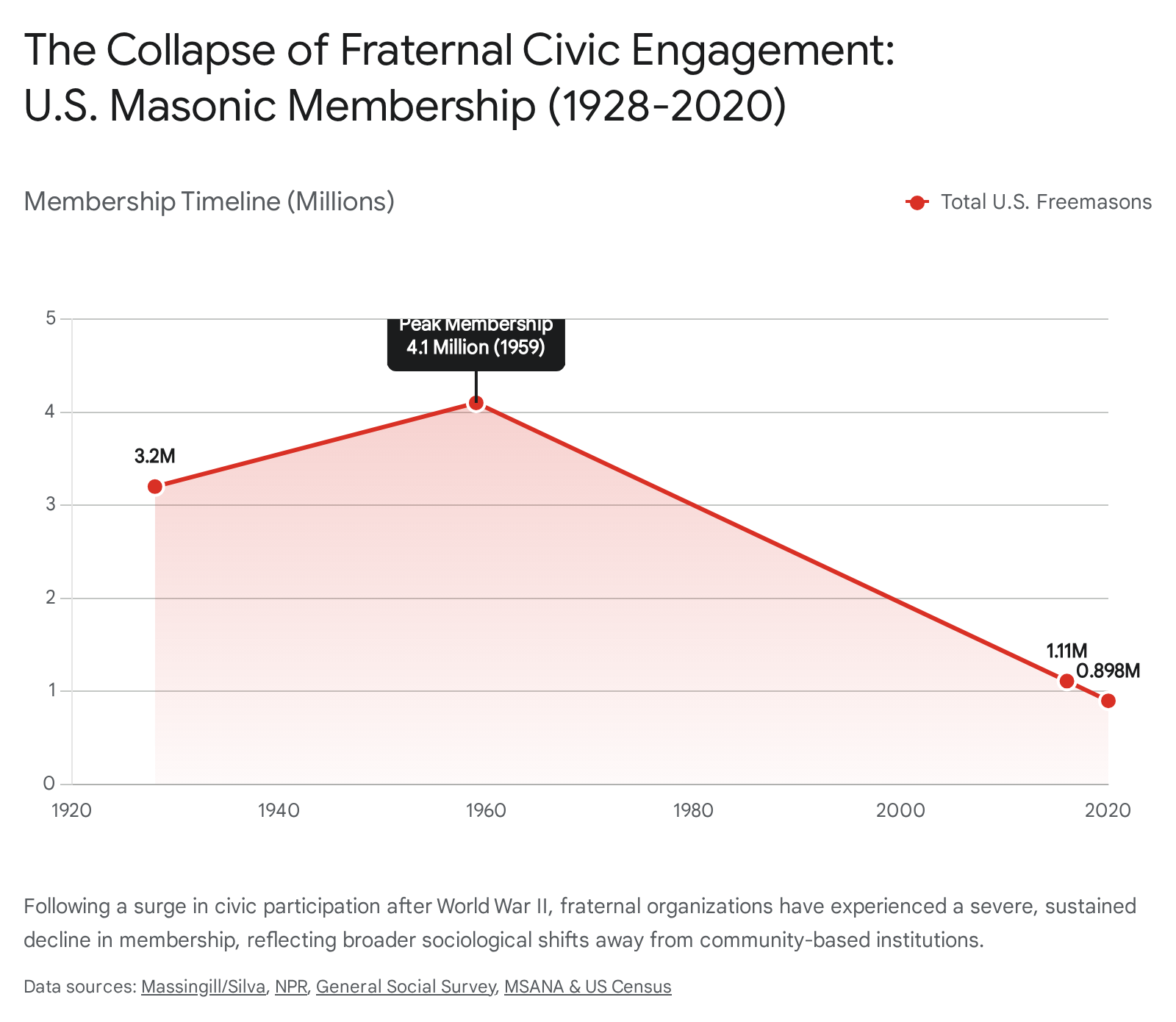
However, the late 20th and early 21st centuries have witnessed a catastrophic collapse in participation. This phenomenon, heavily analyzed by sociologist Robert Putnam in his "Bowling Alone" thesis, highlights a broader systemic failure of civic engagement in American society 3954. Sociologists attribute this decline to several intersecting factors: demographic transformations, economic pressures, the privatization of leisure time driven by the advent of television and digital technology, and a generational shift away from structured, ritualistic sociability 3954.
By 2020, U.S. Masonic membership had plummeted by approximately 75% from its peak, falling to roughly 898,000 members 5253. This decline is not unique to Freemasonry; similar drops have been recorded across the fraternal spectrum, with the Jaycees declining by 64% and the Elks by 18% during similar periods 3954.
Active versus Passive Participation
Furthermore, sociological data indicates that the quality of engagement has deteriorated alongside absolute numbers. Studies show that active participation - defined as regularly attending meetings and engaging in organizational governance - has declined even faster than "checkbook memberships," where individuals merely pay dues without engaging 55. As the professional class and local elites migrated to digital networking and modern professional associations, fraternal orders lost the immense civic soft power they once wielded over local communities 52. Consequently, the power of these organizations has largely transitioned from active societal influence to historical stewardship.
Conclusions
The disparity between the perceived and actual power of secret societies is immense, driven by centuries of sensationalized literature and political paranoia. The Bavarian Illuminati wielded marginal intellectual influence in 18th-century Germany before being entirely eradicated by state hard power, leaving a legacy that exists solely as an imaginary construct weaponized by successive generations of conspiracy theorists 11610.
Freemasonry, while globally expansive, primarily exerted localized soft power through philanthropy, mutual aid, and civic integration 2627. When it did attempt to exercise clandestine political hard power, as seen in the French Affaire des Fiches, the exposure of the plot resulted in public scandal and a severe backlash against the fraternity, demonstrating the limits of secretive governance in modern states 16.
Skull and Bones represents the most successful contemporary model of secretive power, yet its influence is strictly sociological rather than conspiratorial. By curating a hyper-elite subset of students and integrating them into a fiercely loyal, well-capitalized alumni network, the society acts as an accelerator for social reproduction 4648. The power of a Bonesman does not stem from esoteric rituals, but from the tangible capacity to leverage social capital within the highest echelons of American institutions 20. Ultimately, secret societies have never ruled the world. Their actual historical function has been to serve as highly organized mechanisms for community cohesion, ideological dissemination, and the consolidation of elite social networks.