
History of conspiracy theories
Conspiracy theories - explanatory narratives that attribute the ultimate cause of an event or chain of events to a secret, malevolent plot by a covert group - have operated as a persistent force in human history. Far from being a uniquely modern pathology born of the internet age, conspiratorial thinking is deeply embedded in the social, political, and psychological fabric of human societies. From the scribbled graffiti of ancient Rome to the algorithmic amplification of QAnon, conspiracy theories serve a dual function. Epistemologically, they offer a framework for making sense of complex, threatening realities; politically, they operate as theories of power designed to marginalize enemies, consolidate in-group identity, and challenge or defend institutional authority 12.
The historical evolution of conspiracy theories maps directly onto the evolution of information technology and periods of intense societal upheaval. The transition from word-of-mouth rumors in the Middle Ages to the printed pamphlets of the Enlightenment, and subsequently to the mass media of the Cold War and the decentralized digital networks of the twenty-first century, has not fundamentally altered the core psychological tropes of conspiracism. Instead, these technological shifts have dramatically accelerated the velocity, reach, and convergence of these narratives, allowing isolated anxieties to metastasize into global political movements 3456.
Psychological and Sociological Foundations
To trace the history of conspiracy theories, it is necessary to first delineate the cognitive and sociological mechanisms that render them a ubiquitous feature of human civilization. Historically, conspiratorial belief was frequently dismissed as a symptom of psychopathology, mass paranoia, or intellectual deficit. However, contemporary psychological and sociological research demonstrates that these narratives appeal to individuals attempting to satisfy fundamental psychological needs, particularly during times of acute crisis 78.
Epistemic, Existential, and Social Motives
Psychological research categorizes the drivers of conspiratorial belief into three primary motives: epistemic, existential, and social 789.
Epistemic motives revolve around the human desire for understanding, accuracy, and subjective certainty. When individuals are confronted with major, disruptive events - such as wars, pandemics, or assassinations - they naturally seek explanations. If official information is ambiguous, contradictory, or absent, conspiracy theories fill the knowledge gap by providing a structured, albeit flawed, narrative 6710. Furthermore, cognitive biases, such as the tendency to detect patterns and agency where none exist (hypersensitive agency detection) and a reliance on intuition, strongly correlate with the adoption of conspiratorial frameworks 81112.
Existential motives relate to the need for physical safety and a sense of control over one's environment. Individuals who feel powerless, anxious, or disenfranchised are more likely to endorse conspiracy theories as a coping mechanism to explain their lack of agency 7813. By personifying the agents of a conspiracy, individuals can ameliorate feelings of powerlessness by reducing abstract, systemic threats into concrete villains 13.
Social motives involve the desire to maintain a positive image of the self or the in-group. Conspiracy theories often feature strong in-group and out-group dynamics, allowing believers to view themselves as part of an enlightened minority holding secret knowledge, while simultaneously demonizing an out-group as a malevolent cabal 6712. This creates a sense of superiority and community cohesion among believers.
Despite their appeal, longitudinal research demonstrates that conspiracy theories rarely satisfy these underlying motives. Instead of reducing anxiety, exposure to conspiratorial narratives often exacerbates feelings of uncertainty, powerlessness, and disillusionment, creating a self-perpetuating cycle of paranoia 79.
The Existential Threat Model
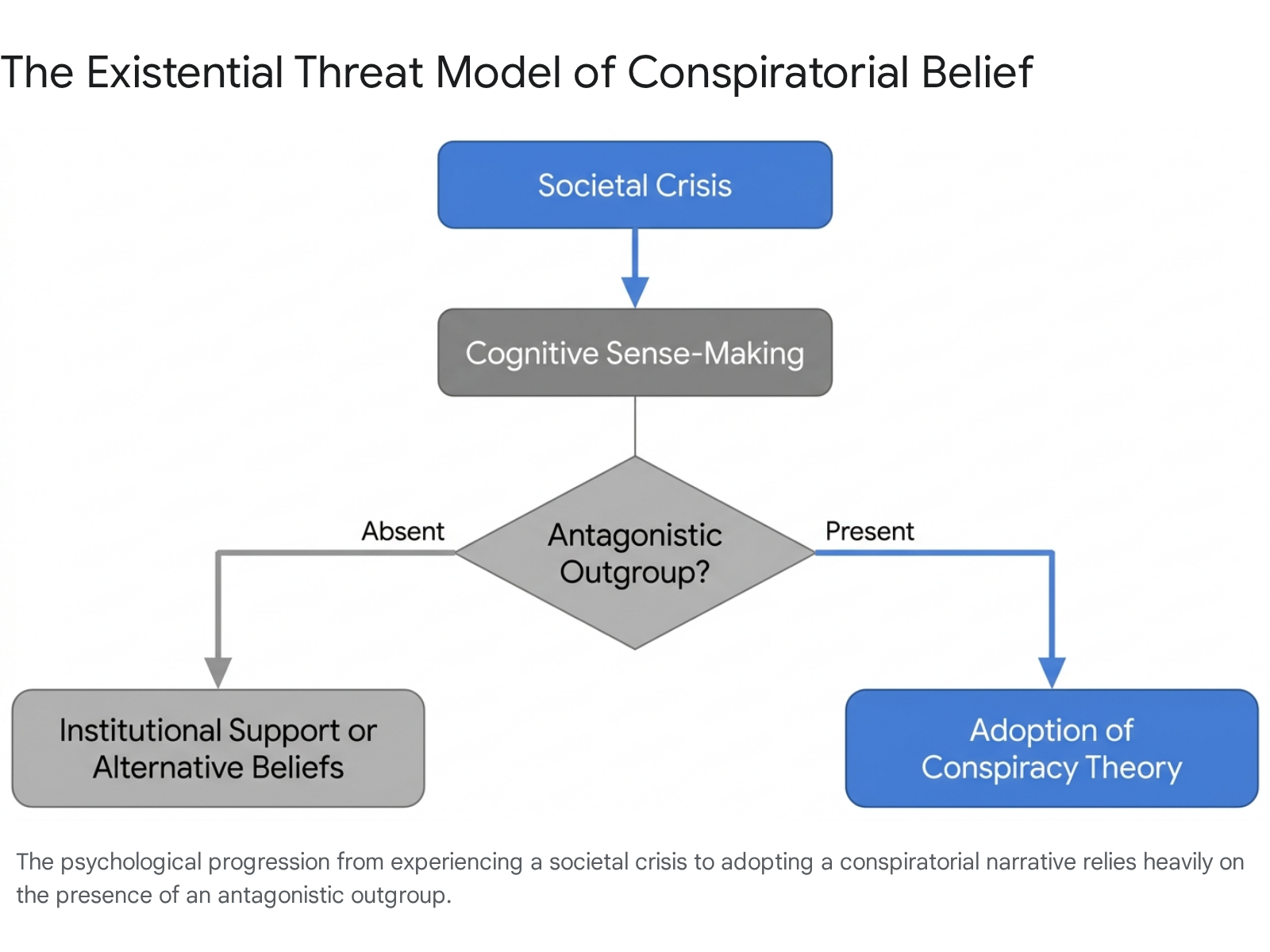
The proliferation of conspiracy theories is inextricably tied to acute societal crises. The Existential Threat Model posits that experiences of profound anxiety or threat - such as economic collapse, natural disasters, or rapid cultural shifts - trigger intense epistemic sense-making processes 111415.
However, existential threat alone does not inevitably lead to conspiracism; it often leads to increased support for established institutions as populations rally around leaders during crises. The critical catalyst that transforms threat-induced sense-making into a conspiracy theory is the presence of a salient, antagonistic outgroup 1114. When a crisis occurs, if a marginalized minority, a competing political faction, or a foreign adversary can be plausibly scapegoated, the sense-making process crystallizes into a conspiratorial narrative blaming that outgroup for the threat 1415.
Demographic and Global Correlates
The demographic profile of the typical conspiracy believer challenges popular misconceptions. While mainstream media often characterizes conspiracists as mentally unwell or strictly confined to the political fringe, empirical evidence reveals a more pervasive reality 412. Conspiracism spans all socioeconomic statuses, genders, and age groups, though it tends to correlate positively with lower levels of formal education, lower self-esteem, high social media consumption, and a deep distrust of governmental institutions 410131617.
Politically, conspiracy mentality often exhibits a curvilinear (U-shaped) relationship with political ideology, finding strongest support at both the extreme far-left and extreme far-right, particularly among voters of opposition parties who feel deprived of political control 1819.
Globally, the prevalence of conspiracy theories varies significantly based on socio-political structures, corruption, economic inequality, and political instability. Research utilizing the Comparative Conspiracy Research Survey (CCRS) and YouGov global polling demonstrates that conspiracism is not merely a psychological quirk but a reflection of macro-level institutional realities 161920.
| Country | Belief in Secret Global Cabal ("World run from shadows") | Belief that Humans Have Secret Contact with Aliens | Belief US Government Was Involved in 9/11 Attacks |
|---|---|---|---|
| Nigeria | 78% | 43% | Data unavailable |
| South Africa | 68% | 34% | Data unavailable |
| Mexico | 59% | 44% | 49% |
| Turkey | 57% | Data unavailable | 55% |
| United States | 37% | 29% | 20% |
| United Kingdom | 28% | 20% | 12% |
| Japan | 19% | Data unavailable | Data unavailable |
| Denmark | 20% | 11% | 5% |
Data sourced from the 2020 YouGov-Cambridge Globalism Project 20. Percentages indicate respondents who believe the theory is "definitely" or "probably" true.
Premodern and Medieval Conspiratorial Narratives
While the term "conspiracy theory" is a relatively recent linguistic invention, the underlying sociopolitical phenomenon has existed for millennia 621. In premodern environments lacking mass media, editing processes, and formal information filters, narratives spread primarily by word of mouth or localized writing 35. Because textual production was highly restricted, the mere fact that something was written down in a monastic text often invested it with unearned authority 35.
Early Examples and the Mechanics of Medieval Rumor
The Great Fire of Rome in 64 AD provides an early archetype of conspiratorial scapegoating. Following the destruction of two-thirds of the city, citizens facing extreme existential threat generated rumors that Emperor Nero had deliberately started the fire to clear land for the Domus Aurea, his palatial project 6. In response, Nero scapegoated the emerging Christian minority, claiming they were the true conspirators, which led to mass executions based on conspiratorial accusations 6. This event perfectly illustrates the intersection of crisis, knowledge gaps, and outgroup demonization.
The thirteenth and fourteenth centuries represented a golden age for medieval conspiracies, fueled by political upheaval, religious anxiety, crusading failures, and famine 523. In 1307, King Philip IV of France orchestrated one of the most successful elite-driven conspiracies of the Middle Ages to destroy the Knights Templar. Oweing massive debts to the wealthy military order, Philip utilized conspiratorial rumors - accusing the Templars of Satan worship, pedophilia, sodomy, and blasphemy - to justify a coordinated, nationwide arrest of the knights 3524. The charges were fabricated, yet they resonated deeply with a public primed to believe in hidden, demonic forces working to undermine Christendom.
Similarly, in 1321, amidst famine and political instability, rumors swept through France that Jews and lepers were conspiring to poison the wells 2322. These premodern iterations of conspiracism laid the groundwork for centuries of antisemitic blood libels, characterizing marginalized groups as a league of sorcerers employed by Satan to orchestrate the ruination of the community 21.
Rumor as Political Resistance
Conspiracy theories also served as tools of popular political resistance and subversion. Following the deposition and secret murder of King Richard II of England in 1399 by Henry IV, a widespread rumor emerged that Richard was still alive and raising an army to reclaim the throne 23. Historical analysis suggests this narrative acted less as a genuine belief in the king's survival and more as a unifying myth to destabilize the new regime 23. Despite Henry IV knowing his cousin was dead, the state threw the full weight of the judicial system behind prosecuting those spreading the tale, demonstrating that premodern authorities implicitly understood that a widely adopted conspiracy theory held more political power than the truth 23.
The Printing Press and Early Modern Conspiracism
The advent of the printing press fundamentally altered the transmission velocity of conspiracy theories. The ability to mass-produce pamphlets, broadsides, and books democratized information but simultaneously removed localized limitations on the spread of disinformation. This technological shift allowed regional rumors to rapidly escalate into national hysterias.
The Popish Plot of 1678
In 1678, England was engulfed by the "Popish Plot," a fabricated conspiracy that nearly triggered a civil war and demonstrated the lethality of printed disinformation. Titus Oates, an Anglican clergyman with a history of perjury, and Israel Tonge, a fanatic cleric, authored a manuscript alleging that the Catholic Church, specifically the Jesuits, were plotting to assassinate King Charles II and forcibly return England to Catholicism 2425.
Despite a total lack of evidence and numerous contradictions in Oates's testimonies, the claims triggered a violent moral panic 2425. This panic was heavily fueled by mass print media; broadsides, pamphlets, and ballads flooded London, stoking pre-existing anti-Catholic prejudice 2426. The hysteria culminated in the executions of at least 22 innocent men, the death of many others in prison, and the passage of the Papists' Disabling Act of 1678, which barred Catholics from Parliament 252728. The Popish Plot exemplifies how printing technology could take a fringe fabrication, wrap it in sectarian anxiety, and amplify it into systemic political violence.
The Enlightenment and the Bavarian Illuminati
The late eighteenth century marked a pivotal shift in the target of conspiracy theories: moving away from strictly religious and monarchical anxieties toward fears of secular, ideological subversion. In 1776, Adam Weishaupt, a defrocked Jesuit and academic, founded the Order of the Illuminati in Bavaria. It was a secret society modeled on the structure of Freemasonry but dedicated to Enlightenment ideals, anti-clericalism, and opposing state abuses by monarchs 293031. Weishaupt, aided by Adolph, Freiherr Knigge, infiltrated existing Masonic lodges to recruit members to their radical political vision 3031.
The Bavarian government, encouraged by the Catholic Church, outlawed the group between 1784 and 1790, and the actual Illuminati effectively ceased to exist 2930. However, the Illuminati achieved immortality in the realm of conspiracy theory following the shock of the French Revolution in 1789 2930. Monarchists and conservatives across Europe struggled to comprehend how the powerful Bourbon dynasty could collapse so rapidly from within. To explain this existential threat, propagandists turned to the myth of a grand, hidden orchestrator 32.
Between 1797 and 1798, French Jesuit Augustin Barruel and Scottish scientist John Robison published highly influential books alleging that the Illuminati had survived its banishment, maintained control over Freemasonry, and orchestrated the French Revolution to destroy Christianity and monarchy worldwide 293233. These texts birthed the modern "Grand Conspiracy Theory" - the idea of a small, secular, international cabal secretly directing global historical events 3234.
The Revolutions of 1848 and Counter-Revolutionary Conspiracism
The blueprint established by Barruel and Robison was recycled during the Revolutions of 1848, a wave of liberal and democratic uprisings that swept across Europe demanding constitutionalism, popular sovereignty, and the abolition of serfdom 3536. When conservative authorities crushed these movements, resulting in a mass exodus of European revolutionaries to the United States and elsewhere, reactionary forces utilized conspiracy theories to frame the uprisings not as organic demands for civil rights, but as the coordinated machinations of international secret societies 343540. These early modern narratives solidified the ideological framework that would later be weaponized against socialist and labor movements in the twentieth century.
Industrialization, Mass Media, and Antisemitic Forgeries
While early modern conspiracy theories focused heavily on Freemasons and political radicals, the late nineteenth and twentieth centuries saw a violent resurgence of antisemitic conspiracism. This new wave was modernized to reflect anxieties about industrial capitalism, global finance, imperialism, and the reach of mass media.
The Origins of the Protocols of the Elders of Zion
The most destructive and internationally influential conspiracy theory of the modern era is The Protocols of the Elders of Zion. First published in the Russian Empire in 1903 by Pavel Krushevan in the Black Hundreds newspaper Znamya, and later serialized by mystic priest Sergei Nilus, the document purported to be the leaked minutes of a late-nineteenth-century meeting of Jewish leaders in Basel, Switzerland 373839.
The text outlines a meticulous, diabolical plan for Jewish world domination through the control of global finance, the manipulation of the press, and the promotion of liberalism and socialism to subvert Christian civilization 373940. The document was a complete forgery. Subsequent historical analysis demonstrated that officials of the Russian secret police (the Okhrana) plagiarized the text heavily from two primary sources: Maurice Joly's 1864 political satire Dialogue in Hell Between Machiavelli and Montesquieu (a critique of Napoleon III that did not mention Jews), and Hermann Goedsche's 1868 antisemitic novel Biarritz 223839.
Global Dissemination and Lethal Consequences
Despite being definitively exposed as a hoax by The Times of London in 1921 and the German Frankfurter Zeitung in 1924, the Protocols spread globally and became deeply entrenched in international political discourse 3839.
The forged document became a foundational text for twentieth-century antisemitism. It was utilized by Adolf Hitler and the Nazi Party to justify the systemic persecution and eventual genocide of European Jews, with the text assigned as factual reading in German schools in the 1930s 3738. In the United States, industrialist Henry Ford heavily promoted the document, financing its mass printing and disseminating its claims through his private newspaper, the Dearborn Independent 39.
The underlying architecture of the Protocols - the concept of a shadowy, international elite controlling the banks and the media to subjugate the masses - remains the genetic blueprint for countless modern conspiracy theories. Today, these tropes are frequently recycled, often with the overt antisemitism scrubbed and replaced by coded language targeting "globalists," "international bankers," or specific philanthropists 2137.
| Historical Era | Primary Existential Threat / Anxiety | Dominant Communication Vector | Common Scapegoats & Targets | Core Narrative Trope |
|---|---|---|---|---|
| Antiquity & Medieval | Famine, Plague, Regime Change, Religious Schism | Word of mouth, Graffiti, Monastic Texts | Heretics, Witches, Jews, Lepers, Rival Claimants | Demonic pacts, poisoning wells, blood libels, hidden survival of deposed leaders. |
| Early Modern & Enlightenment | Religious Wars, Political Revolutions, Secularization | Printing Press, Pamphlets, Broadsides, Books | Catholics (in Protestant lands), Jesuits, Freemasons, Illuminati | Royal assassinations, orchestrating revolutions, destroying religious institutions. |
| 19th & 20th Century | Industrialization, Communism, Geopolitical conflict | Mass Market Newspapers, Radio, Television | Jews, Capitalists, Communists, State Intelligence (CIA/KGB) | Global financial control, secret bioweapons, manufactured wars, false flag operations. |
| Digital Age (21st Century) | Globalization, Pandemics, Demographic shifts | Social Media, Algorithmic Feeds, Imageboards | Global elites, "Deep State," Public Health Officials | Institutional pedophilia rings, mass population control, deliberate release of pathogens. |
The Cold War and State-Sponsored Disinformation
During the Cold War, the organic generation of conspiracy theories was systematically weaponized by state intelligence apparatuses. Both the United States and the Soviet Union engaged in psychological operations designed to undermine the adversary's credibility.
Etymology and the CIA Meta-Conspiracy
A pervasive meta-conspiracy theory claims that the Central Intelligence Agency (CIA) invented the term "conspiracy theory" in 1967 (via Dispatch 1035-960) to discredit critics of the Warren Commission following the assassination of President John F. Kennedy . Historical and linguistic analysis refutes this; the term appeared in American newspapers as early as the 1860s in relation to the assassination of President Abraham Lincoln, and was later used following the shooting of President James A. Garfield in 1881 . The term entered academic discourse primarily through philosopher Karl Popper in the 1950s, who critiqued the "conspiracy theory of society" as a flawed mechanism that replaces complex sociological forces with the intentional design of hidden groups 21.
However, the intense public skepticism of the 1960s and 1970s was validated by the exposure of actual covert government operations, such as the CIA's MKUltra mind-control experiments and the FBI's COINTELPRO operations 45. The revelation that real conspiracies existed provided a rational baseline for the proliferation of unfounded theories, creating an epistemic void where institutional trust collapsed 45.
Soviet Active Measures: Operation INFEKTION
One of the most successful state-sponsored disinformation campaigns in history was the KGB's Operation INFEKTION (also referred to as Operation Denver). Launched in the 1980s, the campaign aimed to convince the developing world and Western populations that the HIV/AIDS virus was a biological weapon engineered by the United States military at Fort Detrick, Maryland 464142.
The operation provides a masterclass in "narrative laundering" - the process of concealing the origin of false information to artificially generate credibility through seemingly independent sources 42. The KGB initiated the placement stage in July 1983 by planting an anonymous letter from a purported "well-known American scientist" in the Patriot, a pro-Soviet Indian newspaper established by the KGB years earlier for disinformation purposes 414243.
The narrative was subsequently layered through Soviet publications; in October 1985, Valentin Zapevalov published an article in Literaturnaya Gazeta summarizing the Patriot claims 43. To achieve integration and provide a scientific veneer, the East German Stasi enlisted retired biophysicist Jakob Segal and his wife Lilli. They authored the 47-page "Segal Report," which provided pseudo-scientific backing for the biological weapon claim, arguing that HIV was created by splicing two existing viruses 464143.
The campaign successfully spread to over 80 countries, heavily impacting the African press, and eventually penetrated mainstream American media, even being reported by Dan Rather on the CBS Evening News 464144. Even decades after the fall of the Soviet Union and official admissions by Russian intelligence in 1992 regarding the hoax, the theory persisted; a 2005 RAND Corporation study found that 27% of Black Americans surveyed believed HIV was produced in a government laboratory 414243. Modern Russian disinformation tactics targeting the US electoral system are a direct technological evolution of these Cold War active measures 4244.
Postcolonial and Geopolitical Conspiracism
Academic research on conspiracy theories has historically been heavily Euro-centric and US-centric. However, conspiracism is a vital political force in the Global South, where narratives are shaped by the legacies of imperialism, immense economic inequality, and postcolonial anxieties 454647. In these contexts, conspiracy theories often function as vernacular sociology - attempts by marginalized populations to map complex trajectories of power and economic asymmetry 4546.
Anxieties in Postcolonial Africa and the Middle East
In postcolonial Africa, particularly in Francophone nations like Cameroon and Gabon, prominent conspiracy narratives intertwine Western esoteric organizations, such as Freemasonry, with homosexuality and the illicit enrichment of the political elite. Anthropological research suggests that these narratives crystalize local anxieties regarding the spectacular wealth of the elite amid widening societal inequality 4849. By framing Freemasonry and same-sex relationships as "un-African" imports imposed by foreign colonial powers, these theories serve to make sense of corrupt political structures through a familiar indigenous idiom of witchcraft and occult politics, acting as an "epistemological knot" to explain rapid social change 4849.
In the Middle East, the historical reality of European colonial espionage - such as British intelligence operations aimed at quashing anti-colonial rebellions during the 1919 revolutions - has heavily influenced modern political culture. Suspicions regarding CIA psychological operations or Israeli military actions frequently map onto the archetype of the "collaborator" or "scholar-spy," making conspiracy theories a pervasive mode of political analysis 45.
Latin America: Social Exorcism and Foreign Interference
Latin America presents a highly fertile ground for conspiracism due to a long history of institutional vulnerability, geopolitical intervention (primarily by the United States), and deep social inequality 150. Conspiratorial narratives in the region are frequently utilized by both right-wing military dictatorships and left-wing populists to enact "social exorcism," dividing society into hostile, antagonistic camps to consolidate power 5051.
For instance, in Argentina during the 1970s, far-right academics promoted theories of a Jewish plot to annex Patagonia to create a second Israel. Decades later in Venezuela, Chavista leaders routinely accused the domestic opposition of conspiring with the US and Colombia to orchestrate the assassination of Hugo Chávez 51. More recently, following the onset of COVID-19, a Peruvian criminal court issued an official order accusing Bill Gates, George Soros, and the Rockefeller family of creating the virus to establish a "new world order" - demonstrating the profound degree to which globalized conspiracy theories have penetrated formal state institutions in the region 51.
Asia: Proxy Scapegoating and the Century of Humiliation
In Southeast Asia, conspiracy theories frequently reflect localized racial and religious tensions. In Malaysia, research into belief in Jewish conspiracy theories reveals that such narratives are often utilized as a socially acceptable proxy to mask domestic anti-Chinese sentiment 13. Across the region, conspiracism is applied to major events, from blaming foreign agents for the 2002 Bali bombings to generating myriad theories regarding the disappearance of Malaysia Airlines flight MH370 45.
In China, conspiratorial thinking regarding foreign powers is deeply intertwined with the state-sanctioned national narrative of the "Century of Humiliation" (1839 - 1949). This period, characterized by military defeats, the Opium Wars, and the loss of sovereignty to Western powers and Japan, functions as a founding trauma for the Chinese Communist Party 52535455. This historical memory serves as a cognitive lens through which modern geopolitical events are interpreted. Conflicts such as trade disputes, the 1999 NATO bombing of the Chinese embassy in Belgrade, or narrative battles over the origins of COVID-19 are frequently framed within China as new iterations of Western attempts to contain, bully, and humiliate the nation 475253. Consequently, state-amplified anti-Western conspiracy theories in China act to focus citizen unrest toward a common external enemy, stimulate nationalism, and signal political resolve 55.
In South Asia, specifically India, transnational conspiracy theories have been aggressively weaponized by authoritarian populist political movements to consolidate state power 5657. The ruling apparatus utilizes conspiratorial framing to target foreign-funded NGOs, frame Sikh activists as "Khalistani" terrorists operating a global plot, and accuse Western philanthropists like George Soros of orchestrating regime change. This rhetoric justifies the legal, virtual, and physical repression of dissidents 56. During the COVID-19 pandemic, misinformation in India was frequently driven by right-wing figures framing the virus through anti-minority conspiracies, revealing how theories are deployed to entrench religious divides in a constitutionally secular nation 58.
The Digital Age: Algorithmic Amplification and Meta-Narratives
The transition to the digital age has fundamentally altered the velocity, structure, and morphology of conspiracy theories. The internet, specifically social media platforms operating on engagement-driven algorithms, removed traditional editorial gatekeepers. This allowed niche conspiracy communities to interact, cross-pollinate, and scale globally with unprecedented speed 46.
Social Media Ecology and Amplification Dynamics
Digital network analysis, such as the Discursive Nodal Analysis (DNA) methodology, reveals that conspiracy theories in the digital space operate through highly connected nodes - specific accounts, websites, or influencers that launder fringe claims into broader discourse 5966.
Crucially, empirical research indicates that while the total percentage of the population holding deep conspiratorial beliefs may not have drastically increased over time, the visibility and engagement of these claims have skyrocketed due to platform dynamics 6061. A report by the Media Ecosystem Observatory analyzing online ecosystems found that the top 100 most active accounts are responsible for 68% of conspiratorial posts, capturing nearly 90% of total views 60. Influencers and algorithmic promotion, particularly on platforms like X (formerly Twitter) and Telegram, drive the vast majority of this amplification, with engagement spiking dramatically during major events like elections or natural disasters 46062.
However, some data suggests mitigation efforts have an impact. Research from the Stanford Internet Observatory analyzing the U.S. media environment found that while 44.3% of Americans visited websites containing false or misleading information during the 2016 election, that number dropped to 26.2% during the 2020 election, suggesting that media literacy and platform interventions can reduce exposure 6364.
The Conspiracy Smoothie: QAnon and the Great Reset
The digital ecosystem has facilitated the convergence of previously distinct conspiracy theories into massive, adaptable meta-narratives - a phenomenon researchers refer to as a "conspiracy smoothie" 6566.
The QAnon movement perfectly encapsulates this. Originating on anonymous imageboards (4chan/8chan), QAnon posits that a secret cabal of Satan-worshipping, cannibalistic pedophiles operates a global deep state 32467. The movement represents a dangerous digital synthesis of medieval blood libels (harming children), early modern anti-elite sentiment, and contemporary political polarization 32324.
The evolution of "The Great Reset" theory further demonstrates this convergence. In June 2020, the World Economic Forum (WEF) launched an economic recovery initiative titled "The Great Reset," advocating for sustainable development following the pandemic 656869. Within months, this mundane policy proposal was hijacked by a digital ecosystem already primed by QAnon and anti-vaccination narratives 667071.
The conspiratorial version of the Great Reset claims that global elites (personified by WEF founder Klaus Schwab) engineered the COVID-19 pandemic to collapse the global economy, abolish private property ("You'll own nothing and you'll be happy"), and enforce a totalitarian one-world government through vaccine mandates and digital IDs 65666869. Amplified by right-wing populist politicians - such as Thierry Baudet in the Netherlands - the Great Reset transitioned from a fringe internet claim to a mainstream political talking point, demonstrating how rapidly digital media can launder disinformation into standard political discourse 6668.
The Threat to Democratic Institutions and Political Violence
The most pressing concern regarding the digital proliferation of conspiracy theories is their capacity to motivate real-world political violence and undermine democratic stability 472.
Conspiracy theories frame political opponents not merely as incorrect, but as cosmically evil or an existential threat to survival. This logic justifies extreme, non-normative countermeasures. This dynamic directly contributed to the January 6, 2021, insurrection at the U.S. Capitol, where believers in election fraud and QAnon attempted to violently disrupt the democratic transfer of power 237273.
Furthermore, empirical studies across Europe and the Americas show that belief in fringe conspiracy theories is significantly correlated with support for political violence 472. By eroding shared epistemic realities, driving polarization, and fracturing civic trust, the unchecked spread of these narratives poses an ongoing existential challenge to the vitality of democratic institutions globally 474.
Conclusion
The history of conspiracy theories is the history of human attempts to impose cognitive order on a chaotic, unequal, and threatening world. From the persecution of the Knights Templar to the digital contagion of QAnon, these narratives utilize the same fundamental architecture: the identification of a hidden, omnipotent enemy orchestrating complex events to the detriment of the public.
While the psychological motives driving belief - the search for epistemic certainty, existential security, and social superiority - remain constant, the mechanisms of transmission have grown exponentially more powerful. The shift from localized rumors to globally synchronized digital disinformation networks means that modern conspiracy theories can destabilize institutions at a speed and scale unprecedented in human history. The weaponization of these narratives by state actors, authoritarian populists, and digital influencers reveals that conspiracy theories are not just flawed ways of understanding the world; they are potent tools for controlling it. Addressing this challenge requires moving beyond simply debunking individual claims; it necessitates addressing the underlying geopolitical inequalities, institutional distrust, and algorithmic structures that allow conspiracism to thrive.