
What Confirmed Government Cover-Ups Teach Us
Real government cover-ups are ultimately exposed because massive, perfectly executed conspiracies mathematically collapse under the weight of human error, whistleblowers, and bureaucratic incompetence. By examining confirmed historical scandals - from the UK's Infected Blood tragedy to Mexico's Ayotzinapa massacre - we can understand the true anatomy of institutional deception and learn to separate genuine state secrets from baseless conspiracy theories.
Humans are naturally pattern-seeking creatures, which makes the idea of a secret, hyper-competent cabal pulling the strings of world events deeply compelling. During times of crisis, uncertainty, or political polarization, it is comforting to imagine that a hidden entity is in control, even if their motives are malevolent 12. The psychological draw of conspiratorial thinking is often fueled by a legitimate mistrust of government transparency during emergencies, where officials may withhold information under the guise of national security 23. However, the historical record of confirmed, declassified government cover-ups paints a very different picture.
Actual state secrets rarely resemble the flawless operations depicted in espionage thrillers. They are frequently mundane, clumsy, and driven by a desperate desire to avoid embarrassment, save public funds, or protect political careers 456. More importantly, maintaining a lie requires a level of strict, enduring secrecy that is almost impossible to sustain when more than a handful of people are involved 789. This report explores the mathematical limitations of secrecy, the psychological toll on those forced to maintain institutional lies, the anatomy of real-world cover-ups, and the frameworks we can use to distinguish verified government scandals from baseless paranoia.
The Mathematical Limits of Maintaining a Secret
One of the most effective ways to evaluate whether a suspected cover-up is real is to examine the sheer mathematics of human collaboration. In 2016, Oxford University physicist and cancer researcher Dr. David Robert Grimes published a mathematical model in the peer-reviewed journal PLOS ONE that calculated the viability of conspiratorial beliefs 910.
Dr. Grimes' equation sought to quantify a fundamental vulnerability in any cover-up: the more people who know a secret, the higher the probability that the secret will be leaked, either intentionally by a whistleblower or accidentally through incompetence. His model factored in the number of active conspirators, the length of time the secret must be kept, the natural baseline probability of a leak, and the effects of conspirators aging and dying off over time 79. To establish realistic parameters for human secret-keeping ability, Grimes tested his formula against real, confirmed cover-ups that had eventually been exposed, such as the infamous Tuskegee syphilis experiment and the global NSA surveillance program exposed by Edward Snowden 78.
The results of the modeling were definitive: large conspiracies quickly become mathematically untenable 10.
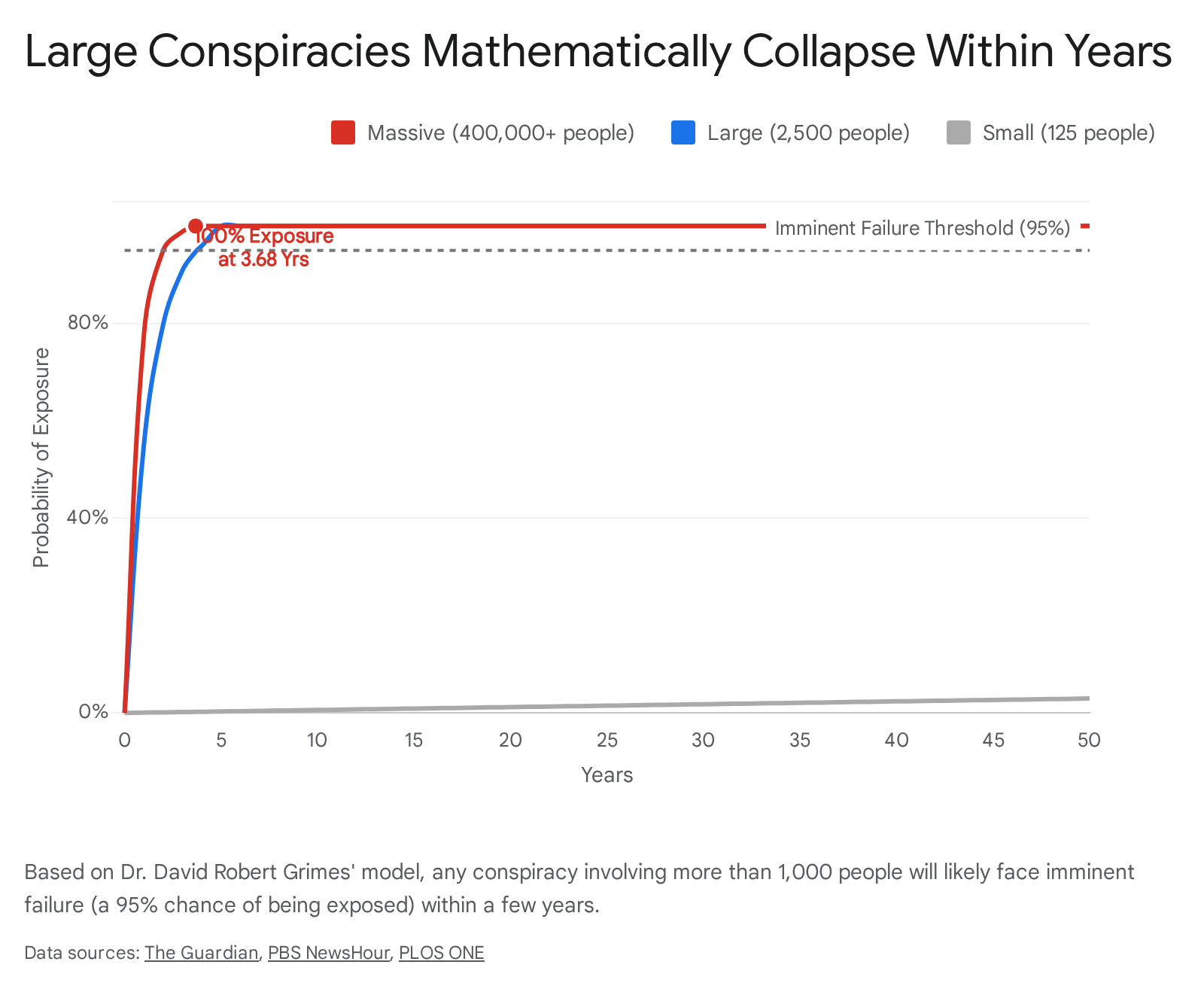
When applying this mathematical framework to popular conspiracy theories, the logic of a massive cover-up entirely collapses. For instance, the theory that the 1969 Apollo 11 moon landing was staged would require the absolute silence of approximately 411,000 NASA employees 8. Grimes' model predicts that a secret held by a group of this magnitude would suffer imminent failure - meaning it would reach a 95 percent probability of exposure - in just three years and eight months 78. Decades of silence from hundreds of thousands of individuals is statistically impossible.
Similarly, the theory that climate change is a hoax orchestrated by the scientific community would require the complicity of an estimated 405,000 international scientists, and would mathematically unravel in three years and nine months 78. A pharmaceutical plot to suppress a cure for cancer, involving roughly 714,000 researchers and corporate actors, would be exposed in exactly 3.17 years 811. Even a smaller-scale conspiracy regarding unsafe vaccinations, assuming a conspirator pool of around 22,000 individuals, would be blown in slightly over three years 7.
The mathematical reality is stark: for a cover-up to survive for a mere five years, no more than 2,521 people can be active participants aware of the truth. To keep a secret for 25 years, that circle must drop to roughly 502 people. To successfully maintain a conspiracy for a century, a maximum of 125 people can know 8. The overarching conclusion of the Grimes model is that any conspiracy involving more than 1,000 active agents rapidly becomes untenable and highly prone to failure 910.
The Architecture of Legitimate Secrecy: Compartmentalization
If large groups cannot keep secrets, how do legitimate government intelligence operations and massive defense projects function? The answer lies in the structural architecture of "compartmentalization."
Compartmentalization is the information security practice of limiting access to data strictly on a "need-to-know" basis 12. During the Manhattan Project - the United States' effort to develop the first atomic weapons - tens of thousands of personnel at facilities like Oak Ridge constructed and operated centrifuges to isolate uranium. However, almost none of them knew they were building an atomic bomb 12. The workers knew only their specific, isolated tasks, while the overarching purpose was restricted to a minuscule fraction of senior directors. By restricting the "big picture," governments drastically shrink the number of active conspirators, effectively bypassing the failure thresholds of Grimes' mathematical model 1213.
Furthermore, political scientists note that state secrecy operates on a spectrum ranging from collusion to complete concealment 13. Governments frequently engage in secret behavior to manage public optics, deescalate potential conflicts, or reach delicate peace negotiations without the pressure of public scrutiny 14. However, when an operation moves from standard classified intelligence into the realm of an illegal cover-up, the necessity of widening the circle of complicity often leads to its eventual downfall.
The Anatomy of Bureaucratic Denial: The UK Infected Blood Scandal
When we examine actual government cover-ups that were eventually dragged into the light, we rarely find hyper-competent villains orchestrating master plans. Instead, we find institutional groupthink, a defensive posture designed to avoid financial payouts, and desperate attempts to hide tragic incompetence.
A prime example is the UK Infected Blood Scandal, widely regarded as the worst treatment disaster in the history of the National Health Service (NHS) 415. During the 1970s and 1980s, an estimated 30,000 UK patients were infected with HIV and Hepatitis C after receiving contaminated blood products and transfusions. This tragedy decimated the haemophilia community, resulting in approximately 3,000 deaths, including roughly 380 children 415.
For decades, victims and their families suspected that the government and the NHS knew far more about the risks than they admitted. In May 2024, the final report of the Infected Blood Inquiry confirmed these fears, revealing a systemic cover-up that inquiry chair Sir Brian Langstaff described as "subtle, pervasive and chilling" 16.
Crucially, the report concluded that the cover-up was not an orchestrated, shadowy conspiracy in the traditional sense. Rather, it was a "defensive closing of ranks" driven by a desire to "save face and to save expense" 416. The mechanisms of this cover-up were bureaucratic and institutional: * False Public Assurances: Successive governments falsely claimed that blood screening was introduced at the earliest possible opportunity. They publicly reassured patients that there was "no conclusive proof" that blood products carried AIDS, and dismissed the risk of Hepatitis C as "mild and inconsequential" despite internal research linking it to severe liver disease 4. * Destruction of Evidence: The inquiry found evidence of the deliberate destruction of relevant government documents, as well as the loss or destruction of individual medical records 417. * Withholding Patient Information: Patients were treated without informed consent and were not told about the risks of their treatments or alternative options. Horrifyingly, many individuals were not informed they had been infected with HIV or Hepatitis C until years later, while others received the news in insensitive ways 416. * Denial of Compensation: To avoid liability, ministers cruelly repeated a coordinated line starting in 1989 that patients "had received the best treatment available," using this as a justification to deny the need for financial compensation 4.
The UK government formally accepted the findings of the 2024 report, and Prime Minister Rishi Sunak apologized for what he termed a "day of shame for the British state" 16. The inquiry's primary recommendation was the immediate establishment of a robust compensation scheme, acknowledging the profound financial hardship and social stigma endured by the victims 417. This case illustrates how a cover-up can persist for decades not through a secret cabal, but through institutional inertia, groupthink, and a lack of transparency among civil servants 4.
The State Crime and False Flags: Case Studies in Extreme Cover-Ups
While some cover-ups stem from bureaucratic self-preservation, others are deliberate state crimes involving violence, geopolitics, and extreme lengths to silence the truth.
Mexico's Ayotzinapa Massacre (2014)
On the night of September 26, 2014, forty-three male students from a rural teachers' college in Ayotzinapa, Mexico, were abducted and subsequently disappeared in the city of Iguala 18. The incident sparked nationwide outrage. In response, the government of then-President Enrique Peña Nieto launched an investigation led by Attorney General Jesús Murillo Karam, which culminated in a narrative dubbed the "historical truth" 1819. The official account claimed that corrupt local municipal police had handed the students over to a local drug cartel, Guerreros Unidos, who mistook them for a rival gang, murdered them, and burned their remains in a local trash dump 18. The federal government and the military adamantly denied any involvement 18.
However, this narrative was a deliberate fabrication concocted at the highest levels of the federal government 19.
The truth began to surface through relentless pressure from the families of the victims, investigations by the Inter-American Commission on Human Rights, and eventually a truth commission (CoVAJ) established by subsequent President Andrés Manuel López Obrador 18. Leaked documents, thousands of intercepted text messages, and declassified reports from 2022 and 2023 exposed a massive state cover-up.
The military and federal police were actively monitoring the kidnapping as it happened through real-time surveillance, yet did nothing to intervene . Even more damning, the investigation revealed that the students were not burned in a dump. Instead, the majority were murdered, dismembered with machetes, and buried the night of the massacre, with their remains later moved by organized crime elements to a military base in Iguala 19. Six of the students were kept alive for days before being murdered on the direct orders of a military officer, General José Rodríguez Pérez 19.
To protect the military and their lucrative collusion with the cartels, the state engaged in extreme cover-up tactics. Officials tortured 95 suspects into giving false confessions to support the "historical truth" narrative 20. The military actively withheld evidence and altered testimony, prompting international investigators to accuse them of profound obstruction of justice . It was even revealed that former President Peña Nieto allegedly requested that the mayor of Iguala go into hiding, and the head of the Criminal Investigation Agency offered to help the mayor flee the country if he took the fall for the murders 19.
The Lavon Affair: Israel's False Flag (1954)
Another profound example of a state cover-up driven by geopolitical motives is the Lavon Affair. In the summer of 1954, Israeli military intelligence initiated a covert false flag operation in Egypt codenamed Operation Susannah 6. The objective was to recruit a cell of Egyptian Jews to plant bombs in civilian targets owned by the United States and the United Kingdom, including libraries, post offices, and cinemas in Cairo and Alexandria 621. The bombs were designed using acid and nitroglycerine to detonate hours after closing time to avoid mass casualties 6.
The strategic goal was to blame the attacks on the Muslim Brotherhood, Egyptian communists, or local nationalists 621. Israel hoped that creating a climate of violence and instability would induce the British government to retain its occupying troops in the Suez Canal zone, thereby maintaining a buffer against Egypt 6.
The plot unraveled instantly when a bomb ignited prematurely in the pocket of an operative, Philip Natanson, as he walked to a theater in Alexandria 622. Egyptian authorities quickly arrested 11 suspects, exposing the Israeli spy ring 6. The fallout was disastrous: two operatives died by suicide in prison, and two others were executed by hanging 621. The incident triggered a chain reaction in the Middle East, leading to retaliatory incursions, an Egyptian-Soviet arms deal, and the eventual Suez Crisis 23.
Domestically, the scandal caused political upheaval in Israel. Prime Minister Moshe Sharett claimed to have been kept out of the loop, and Defense Minister Pinhas Lavon was forced to resign, becoming the scapegoat for the operation - hence the name "The Lavon Affair" 621. Despite the spectacular failure, the Israeli government engaged in a rigid, state-sponsored cover-up, outright denying official involvement in the bombings for 55 years 22. It was not until 2005 that Israel finally acknowledged the operatives' actions and honored them with a state ceremony, officially confirming the state's role in the false flag operation 22.
Financial Plunder and State-Sponsored Whitewashes
Beyond bureaucratic survival and geopolitical strategy, many cover-ups are simply mechanisms to hide massive financial theft by political elites. These scandals often rely on corrupting the justice system itself to silence whistleblowers and whitewash the evidence.
The 1999 South African Arms Deal
Following its transition from apartheid to democracy, the South African government undertook a massive defense procurement program in 1999 to modernize its armed forces. Known as the Strategic Defence Package, or the Arms Deal, the government spent approximately $5 billion (R30 billion) on European warships, submarines, fighter jets, and helicopters from companies based in the UK, Sweden, France, Germany, and Italy 242526.
Almost immediately, allegations surfaced that the procurement process was manipulated in exchange for roughly $300 million in bribes paid to senior African National Congress (ANC) politicians and middlemen 2427. For example, investigations eventually determined that the British defense company BAE Systems paid roughly £115 million in bribes to secure contracts 2425.
To protect the involved elites - which included former President Jacob Zuma, his financial advisor Schabir Shaik, and ANC Chief Whip Tony Yengeni - the state engaged in a protracted cover-up 2426. In 2011, President Zuma appointed the Seriti Commission of Inquiry to investigate the allegations. However, the commission acted as a blatant whitewash, extraordinarily concluding in 2016 that there was "no evidence of corruption" 2527. Key whistleblowers and civil society researchers withdrew their participation when it became clear the commission was suppressing evidence 27.
The cover-up ultimately failed due to the relentless efforts of civil society organizations like Shadow World Investigations and Corruption Watch, alongside international probes. In 2019, a South African High Court completely set aside the Seriti Commission's findings, vindicating the activists and paving the way for renewed prosecutions against Zuma and the involved defense contractors 2627.
Malaysia's 1MDB and the High Price of Whistleblowing
In Malaysia, the 1Malaysia Development Berhad (1MDB) scandal represents one of the largest financial cover-ups in history. The 1MDB fund was established by former Prime Minister Najib Razak, ostensibly for economic development. Instead, associates of the Prime Minister, including fugitive financier Jho Low, embezzled an estimated $3.5 billion from the fund, spending it on luxury real estate, artwork, and Hollywood film productions 2829.
The massive theft required a coordinated cover-up to shield the Prime Minister. The conspiracy began to collapse when Xavier Justo, a Swiss banker who had previously worked for PetroSaudi (a company involved in a joint venture with 1MDB), leaked 90 gigabytes of data, including 227,000 internal emails, to an investigative journalist in 2015 2830.
The conspirators responded with extreme retaliation. In an effort to discredit the leaked data and paint it as a forgery designed to attack Najib, PetroSaudi executives and Thai authorities orchestrated Justo's arrest in Bangkok on false blackmail charges 3132. Justo was coerced into a forced confession and spent 547 days in a Thai prison, completely isolated and denied access to FBI investigators due to the diplomatic pressure exerted by the Malaysian government 3132.
Ultimately, the cover-up could not withstand the weight of international scrutiny. Based largely on Justo's leaked data, the U.S. Department of Justice launched a massive kleptocracy investigation, confirming the theft and the diversion of funds into Najib's personal accounts 2831. In 2020, Najib Razak was sentenced to 12 years in prison, proving that even the highest levels of state power cannot permanently suppress hard documentary evidence 29.
Summary of Confirmed Government Scandals
To understand the varied nature of government cover-ups, it is helpful to categorize them by their primary motives, mechanisms, and the catalysts that eventually brought them to light.
| Cover-Up | Year Initiated | Primary Motive | Mechanism of Cover-Up | Catalyst for Exposure |
|---|---|---|---|---|
| UK Infected Blood 417 | 1970s | Save expense; avoid legal liability; preserve NHS reputation. | Destruction of records; defensive groupthink; lying to patients about risks. | Decades of persistent victim advocacy and an eventual public inquiry. |
| Lavon Affair (Israel) 621 | 1954 | Geopolitical manipulation (keep British troops in Egypt via false flag). | Total state denial for 55 years; scapegoating the Defense Minister. | Premature bomb detonation; immediate arrests by Egyptian police. |
| South African Arms Deal 2427 | 1999 | Financial enrichment via $300M in defense contract bribes. | State-sponsored whitewash (Seriti Commission) dismissing evidence. | Foreign anti-corruption probes; relentless civil society litigation. |
| Ayotzinapa Massacre 1920 | 2014 | Protect military and police collusion with local drug cartels. | Fabrication of the "Historical Truth"; torture of suspects; spyware. | Inter-American Commission investigators; leaked text messages. |
| 1MDB Scandal 2831 | 2009 | Massive embezzlement ($3.5B) by political elites and financiers. | Jailing the whistleblower on false charges; international legal threats. | Whistleblower data leak (227,000 emails); US DOJ investigations. |
The Psychological Toll on Operatives and Insiders
Why do heavily guarded, compartmentalized secrets eventually leak? The answer lies deeply embedded in human psychology and sociology.
Sociologists theorize that organizations based on lies or concealment are subject to a natural entropic tendency; information naturally diffuses and escapes unless significant barriers - barriers to asking, perceiving, believing, and acting - are actively maintained 33. Keeping a secret requires deliberate, continuous effort. When individuals are forced to operate within a "post-truth regime," it creates an immense psychological toll 3334.
Intelligence operatives and bureaucrats tasked with maintaining a cover-up often suffer from severe cognitive dissonance, particularly when government actions directly conflict with their personal moral values 34. The absolute necessity of secrecy forces individuals to wear masks, blurring the lines between their authentic identities and their occupational roles. Furthermore, the inability to share their experiences with family members or uncleared colleagues breeds deep isolation, paranoia, and chronic stress, sometimes resulting in psychological injuries akin to post-traumatic stress disorder (PTSD) 34.
Eventually, the moral burden of the lie outweighs the fear of institutional punishment. This psychological breaking point results in the "good leak" - the disclosure of classified or proprietary information that expands public understanding of a critical issue without causing unwarranted harm 35. When lives or public monies are at stake, the ethical obligation to the public supersedes the legal obligation to the state.
Modern Declassifications and Government Vulnerabilities
Governments are slowly recognizing that infinite secrecy is impossible in the digital age. Institutions like the National Security Archive work tirelessly to dislodge U.S. government secrets through Freedom of Information Act (FOIA) requests, offering a glimpse into what the state historically tried to hide 36.
In 2024, the Archive released a wealth of declassified documents that reshaped historical understanding. Among these was a declassified December 1960 Joint Atomic Energy Intelligence Committee (JAEIC) report, representing the first and only known U.S. intelligence assessment to explicitly state that a heavily guarded Israeli site was intended for nuclear weapons 3637. The Archive also published the "Long Telegram" of 1994, a previously secret 70-paragraph memo by a U.S. diplomat outlining early post-Cold War Russia policy, as well as highest-level records detailing President Bill Clinton's personal support for Boris Yeltsin during the 1994 Moscow Summit 3637.
Other recent declassifications highlight institutional anxieties rather than malicious plots. A declassified "after-action" report from a 2002 war game revealed internal Pentagon warnings that the highly advanced U.S. military was deeply vulnerable to low-tech warfare - a vulnerability the military preferred to keep secret 36. Additionally, documents revealed that President Jimmy Carter was the first U.S. president to participate in a highly classified nuclear drill in 1977, known as a Missile Attack Conference, underscoring the grim realities of Cold War continuity-of-government planning 36.
Despite historical declassifications, modern transparency battles continue. In May 2026, veteran CIA official James Erdman provided explosive testimony before the U.S. Senate Homeland Security Committee regarding the origins of the COVID-19 pandemic 3938. Erdman alleged that between 2021 and 2023, CIA scientific analysts repeatedly concluded that a laboratory leak in Wuhan, China, was the most likely origin of the virus 3941. However, he testified that senior intelligence leaders and management actively suppressed and manipulated this assessment to avoid geopolitical fallout with China, and retaliated against analysts who refused to back a rewritten narrative 3941. This ongoing conflict highlights the persistent tension between bureaucratic control and the public's right to know.
The Rise of Global Whistleblower Protections (2024 - 2026)
Because whistleblowers are the single greatest threat to institutional cover-ups, and the most reliable mechanism for exposing the truth, international legal frameworks have rapidly evolved to protect them from retaliation. Throughout 2024, 2025, and into 2026, nations worldwide have overhauled their compliance obligations.
In the United Kingdom, the Employment Rights Act 2025 introduces significant whistleblowing reforms, to be implemented through 2026 and 2027. A major provision coming into force in April 2026 explicitly classifies disclosures regarding sexual harassment as protected under whistleblowing legislation, ensuring workers have protection from unfair dismissal from day one 39. Furthermore, the UK has expanded its "prescribed persons" regime; as of June 2025, whistleblowers can directly report breaches of UK financial and trade sanctions to HM Treasury and the Secretary of State for Business and Trade with full legal immunity 43.
In the United States, whistleblowers drove billions in settlements across healthcare, pharmaceuticals, and cross-border tax evasion throughout 2025 and 2026 40. To further encourage this, the Department of Justice (DOJ) launched a Whistleblower Rewards Pilot Program, financially incentivizing individuals to report corporate misconduct by offering them a percentage of recovered funds 41. Similarly, the Financial Crimes Enforcement Network (FinCEN) proposed new rules under the Anti-Money Laundering Whistleblower Improvement Act to accept confidential reports from international whistleblowers regarding illicit cross-border financing 42.
Globally, other nations are closing the gap. In June 2025, Japan approved an amendment to its Whistleblower Protection Act that explicitly prohibits identifying a whistleblower without a valid reason and presumes that any dismissal occurring within one year of a report is retaliatory, shifting the burden of proof to the employer 47. Meanwhile, the Brazilian Congress advanced Bill 2581/2023 to establish a monetary awards program inspired by the U.S. Dodd-Frank Act, granting anonymity and protection to those who expose accounting fraud 43.
Distinguishing Fact from Fiction: The CONSPIR Framework
If verified cover-ups and state secrets do exist, how can an intelligent layperson distinguish a real institutional failure from the wild, logic-defying conspiracy theories that flood the internet?
Real investigative journalism and historical analysis require evidence, corroboration from multiple credible sources, and an understanding of geopolitical context 4944. Conspiratorial thinking, by contrast, operates as a closed loop of motivated reasoning that is entirely immune to contrary evidence 1.
To help the public identify the cognitive traps of fake conspiracies, psychologists Stephan Lewandowsky and John Cook developed The Conspiracy Theory Handbook.

They identified seven distinct psychological traits of conspiratorial thinking, summarized by the mnemonic acronym CONSPIR 454653:
The framework breaks down as follows: 1. Contradictory: Conspiracy theorists can simultaneously hold mutually exclusive ideas to be true, so long as both ideas challenge the official narrative (e.g., believing a target was assassinated by a covert agency, while simultaneously believing the target faked their own death to escape). 2. Overriding Suspicion: Believers exhibit an extreme, almost nihilistic skepticism towards official accounts, which is paradoxically paired with extreme gullibility toward any anti-establishment claim, no matter how dubious 145. 3. Nefarious Intent: There is an assumption that the conspirators have purely evil, omnipotent motives. In reality, as seen in the UK Infected Blood Scandal, cover-ups are often driven by mundane bureaucratic motives like saving money or avoiding embarrassment. 4. Something Must Be Wrong: Even if a specific claim within the theory is definitively debunked, the believer abandons the specific point but insists the overarching official account is still a lie. 5. Persecuted Victim: Theorists view themselves as heroic victims fighting a massive, oppressive system, elevating their sense of self-importance. 6. Immune to Evidence: Perhaps the most defining trait. Any evidence that disproves the theory is not accepted as truth, but is instead viewed as part of the cover-up itself, created by the conspirators to trick the public 145. 7. Re-interpreting Randomness: Believers connect entirely unrelated events, forcing a sinister pattern onto random occurrences to confirm their pre-existing biases 145.
When evaluating claims of a cover-up, applying the CONSPIR framework alongside Grimes' mathematical viability thresholds provides a robust defense against misinformation.
Bottom line
History confirms that governments and institutions do engage in cover-ups, but these operations are generally small-scale, deeply compartmentalized, and driven by a bureaucratic desperation to hide incompetence, avoid financial liability, or conceal targeted crimes. Massive, world-altering conspiracies mathematically collapse within a few years because human beings are fundamentally incapable of keeping secrets at scale without whistleblowers emerging. While expanding global legal protections are making it harder for corrupt officials to hide the truth, the public must employ critical thinking and mathematical skepticism to distinguish verified institutional failures from baseless paranoia.