
The history and evolution of moral panics
Introduction to the Sociology of Collective Fear
The study of collective anxiety and societal overreaction has long occupied a central position within the sociologies of deviance, mass communication, and criminology. At its core, the phenomenon of the "moral panic" describes a sudden, intense eruption of societal fear directed toward a specific group, subculture, or condition perceived as an existential threat to the established moral order and the well-being of a community 12. Since its initial conceptualization in the early 1970s, the theoretical framework of the moral panic has been utilized to deconstruct episodes of collective hysteria ranging from youth subculture clashes to drug epidemics and immigration controversies 34. However, as the architecture of human communication has transitioned from localized gossip networks and centralized mass broadcast media to decentralized, algorithmic social networks, the velocity, scale, and very nature of these panics have fundamentally transformed 56.
Contemporary society exists in an era of hyper-mediation, where traditional institutional gatekeepers of information have been largely bypassed by digital platforms optimized for emotional engagement, cognitive resonance, and moral outrage 679. Consequently, the mechanisms that once contained, structured, or eventually debunked moral panics have been dismantled or entirely reconfigured. Understanding this profound evolution requires a rigorous historical and sociological continuum, tracing the anatomy of panic from the religiously fueled Salem witch trials of the 17th century, through the non-Western cultural anxieties of the Global South, to the broadcast-driven Satanic Panic of the 1980s, and finally into the post-2020 landscape of QAnon and anti-LGBTQIA+ "grooming" narratives 811910. By contrasting the mechanisms of amplification across these distinct epochs, one can identify not only how the medium intrinsically shapes the message, but how the underlying human psychological vulnerabilities to fear, existential dread, and scapegoating remain remarkably constant across centuries.
Theoretical Foundations: The Cohen Framework and its Evolution
The formal study of moral panics originated with sociologist Stanley Cohen's seminal 1972 work, Folk Devils and Moral Panics, which analyzed the British media and public reaction to relatively minor seaside clashes between two youth subcultures known as the "Mods" and the "Rockers" 31415. Cohen observed that deviance is not merely discovered but actively constructed through social reaction, particularly via mass media exaggeration and institutional labeling 316. He delineated a process wherein an event, condition, or group emerges as a threat to societal values; the mass media then presents this threat in stylized and stereotypical rhetoric; the public responds with heightened anxiety; and authorities, operating as moral entrepreneurs, implement disproportionate measures of social control 116. The targeted groups, designated as "folk devils," serve as visible repositories for broader societal unease, allowing the dominant culture to temporarily resolve its anxieties by reasserting its boundaries and punitive values 51411.
The Attributional Model
In 1994, aiming to operationalize Cohen's qualitative observations, sociologists Erich Goode and Nachman Ben-Yehuda systematized the conceptual framework into an attributional model, defining five strict criteria necessary for a phenomenon to be classified as a moral panic. First, there must be a heightened level of concern regarding the behavior of a certain group and its potential negative consequences on society 11412. Second, this concern must generate hostility, creating a stark dichotomy of "us versus them" and stigmatizing the designated folk devils 141213. Third, there must be a consensus - a broad, though not necessarily universal, societal agreement that the threat is real, serious, and requires immediate intervention 141612. Fourth, the reaction must exhibit disproportionality, meaning the public concern and subsequent punitive actions vastly exceed the objective reality or empirical extent of the actual threat 141214. Finally, moral panics are characterized by volatility; they tend to erupt suddenly and dissipate quickly as public attention shifts, though their legislative, carceral, or cultural impacts may endure long after the immediate panic subsides 1412.
Contemporary Critiques and Theoretical Expansion
While Cohen's paradigm remains a foundational cornerstone of sociological inquiry, contemporary sociology, history, and criminology have increasingly critiqued the classical model as insufficient for navigating the complexities of the 21st century. Early feminist and structuralist critiques noted that Cohen overemphasized media influence while neglecting underlying structural factors such as poverty, systemic inequality, and gendered dynamics, arguing that his focus on male youth subcultures ignored how societal anxieties are frequently projected onto women's behavior and sexual morality 15. Furthermore, scholars such as Angela McRobbie and Sarah Thornton argued that in a multi-mediated social world, the classic top-down model of panic generation is obsolete 51521.
More recently, the concept of a monolithic "consensus" has been vigorously challenged. In a fragmented, polarized digital ecosystem, the idea of a single mainstream society uniting against a fringe folk devil is increasingly viewed as an anachronism 1215. To address this, scholars Adams and Behl (2023) proposed the "Dual Panic Theory," arguing that modern socio-political events frequently trigger simultaneous, antithetical moral panics 12. Analyzing the 2020 encounters between the McCloskey family and Black Lives Matter protesters in St. Louis, Adams and Behl demonstrated how a single incident generates competing panics among opposing ideological factions 12. In a dual panic, both sides observe the exact same phenomenon but construct entirely different threat narratives and folk devils. One faction constructs a panic around the breakdown of law and order, while the opposing faction constructs a simultaneous panic around systemic racism and authoritarian violence 12. Both sides exhibit concern, hostility, disproportionality, and volatility, but their consensuses exist entirely within sealed interpretative bubbles 1215.
Similarly, the concept of "pluralized moral panics" highlights how contemporary conflicts feature a proliferation of ideologies, continual reframing and counter-framing, and highly ambiguous responsibilities among disputant groups 15. Furthermore, modern critiques caution against the overuse of the term "moral panic" as a pejorative tool utilized by politicians to dismiss legitimate grievances. Some scholars argue that the concept has been weaponized in political discourse to delegitimize the claims of marginalized groups by labeling their genuine concerns as mere "panic" 1624. Consequently, recent sociological analysis emphasizes that identifying a phenomenon as a moral panic does not mean the underlying issue is entirely fictional; rather, it highlights that the media-constructed image and the resulting societal reaction are wildly disproportionate to the actual empirical threat 1116.
Guarding Against Historical Flattening: Salem and Secular Anxieties
To fully understand modern moral panics, sociologists and historians must analyze historical precedents without falling into the trap of "historical flattening" - the erroneous assumption that early modern witchcraft trials and contemporary online panics are perfectly analogous. While the Salem witch trials of 1692 are frequently cited as the quintessential historical panic, the sociopolitical, cosmological, and jurisprudential drivers of that era were fundamentally distinct from modern secular anxieties 81117.
The Cosmology and Geography of Salem
The crisis in Salem Village, Massachusetts, which ultimately resulted in the executions of twenty people and the imprisonment of scores more, was deeply rooted in a Puritan cosmology where the devil was not a metaphor, but an active, literal presence in daily life 1718. Recent digital geographic mapping by historian Benjamin Ray has challenged traditional socio-economic explanations that relied heavily on class resentments, pinpointing the epicenter of the initial accusations directly beside the home of the Reverend Samuel Parris 18. The panic was not merely a reaction to general misfortune, impending Native American attacks, or rural-versus-urban tensions between Salem Village and Salem Town; it was interpreted as a coordinated, literal Satanic assault on the central institution of Puritan society - the church itself 1718. The alleged witches were believed to be establishing a counter-church of Satan, holding spectral masses to supplant the Christian faith 18.
Crucially, the legal mechanisms that amplified the Salem panic relied heavily on "spectral evidence" - the legal acceptance of claims that the devil could assume the shape of an innocent person to torment victims without the accused's consent 1719. When the Court of Oyer and Terminer convened in June 1692, culminating in the execution of Bridget Bishop, this theological-legal construct created an insurmountable epistemological crisis 19. It rendered physical alibis useless and empirically verifiable facts irrelevant, as the crime occurred in the spectral realm 19. The panic eventually subsided abruptly in October 1692 not merely due to shifting public sentiment, but because the colonial elite and leading ministers, such as Cotton Mather, expressed deep procedural concerns regarding spectral evidence. They recognized that the devil might employ the specters of innocent people, leading to a breakdown in the legal machinery and an end to the executions 1719.
Distinguishing Witch Hunts from Crime Panics
Legal scholars heavily emphasize the necessity of distinguishing true "witch hunts" from "crime panics." True witch hunts - such as the persecution of Quakers in 17th-century Massachusetts or the political Red Scares of the 20th century - target individuals or groups purely based on their beliefs, ideologies, or identities, often requiring the passage of new laws to target a disfavored ideological group 8. In contrast, crime panics target activities that are already universally classified as illegal, but do so in an overzealous, paranoid manner that reveals deep procedural deficiencies and a breakdown in due process 8.
Modern internet-driven panics, such as the anxiety over human trafficking, day care ritual abuse, or algorithmic grooming, almost universally operate as crime panics. They exploit genuine, universally condemned secular crimes (e.g., child sexual abuse) and exaggerate their prevalence to astronomical proportions, utilizing the abhorrence of the crime to justify the suspension of rational procedural safeguards 1828. Understanding this distinction is critical: early witchcraft panics were driven by theological survival and state-sanctioned spectral jurisprudence, whereas modern equivalents are driven by secular anxieties regarding the loss of social control, the vulnerability of children in changing economic systems, and institutional distrust 81511. Conflating the two obscures the distinct sociological mechanisms that propel them.
Expanding the Geographic Paradigm: Non-Western Moral Panics
Western sociological literature on moral panics has historically over-indexed on Anglo-American examples, from the Mods and Rockers to the Satanic Panic. Broadening the theoretical grounding requires investigating collective panics in non-Western contexts. These episodes illuminate how universal human psychological vulnerabilities to fear are shaped and triggered by highly specific cultural, economic, and historical circumstances.
Epidemic Koro in Southeast Asia
A striking historical and cultural divergence from Western panics is the phenomenon of Koro, a culture-bound psychiatric syndrome historically documented in Southeast Asia, Southern China, and India 292021. Derived from a Malay word referencing a retracting turtle head, Koro is characterized by an overpowering, sudden panic that one's genitals (the penis in men, and the vulva or nipples in women) are actively retracting into the body, accompanied by an intense fear of sexual dysfunction and imminent death 202122. While day-to-day practitioners observe Koro as a sporadic psychiatric or somatoform disorder linked to masturbatory guilt or personal stress, the phenomenon is most sociologically significant when it manifests as a mass epidemic moral panic 202123.
During these epidemics - such as the massive outbreaks in a remote region of Guangdong, China, in 1984-1985, or earlier outbreaks in Singapore - the panic spreads rapidly through populations as a form of mass psychogenic illness 292223. The "folk devil" in these non-Western instances is rarely a specific marginalized demographic group. Instead, the threat is attributed to supernatural entities, evil spirits, or sorcery, deeply intertwined with cultural anxieties regarding shifting traditional roles, exposure to cold, or the consumption of contaminated food 292023. Sociological analysis indicates that Koro epidemics thrive in environments experiencing rapid sociocultural transition, where deeply held traditional beliefs in magic intersect with collective stress and a lack of modern educational infrastructure 2923. The panic is highly volatile, often subsiding as quickly as it erupts once community leaders and medical professionals mount public information campaigns and reassure the afflicted using culturally appropriate methods, sometimes including traditional remedies or drug therapy 292021.
Organ Theft and "Child-Snatcher" Narratives in the Global South
In Latin America, Africa, and parts of Asia, recurring moral panics have centered on "child thieves" and organized organ-harvesting rings. Emerging prominently in the late 1980s alongside actual advancements in global organ transplantation and tissue rejection therapies, the "Baby Parts" and "Sacaojos" (eye thieves) legends allege that wealthy foreigners, tourists, or corrupt domestic doctors kidnap impoverished children to harvest their organs for the international black market 934.
These panics perfectly fulfill Cohen's criteria for concern, hostility, consensus, and disproportionality, but they are deeply rooted in the structural inequalities of globalization. The narratives reflect a profound, visceral anxiety among marginalized populations regarding their literal disposability in a capitalist global order. It is an expression of the fear that the impoverished are quite literally being consumed to extend the lives of the wealthy in the Global North 934. Public belief in these panics is reinforced by the genuine existence of an illegal organ trade and instances of tissue trafficking from unclaimed mortuary bodies, blurring the line between urban legend and reality 342425. Unlike Western panics that traditionally target minority youth or vulnerable subcultures as folk devils, these Global South panics frequently target powerful outsiders, foreign tourists, and complicit state authorities 934. The resulting hostility has historically led to lethal outcomes, including the lynching of tourists in Guatemala and Peru who were falsely identified as child snatchers simply for taking photographs of local children 9.
The WhatsApp Lynchings: The Bridge to Digital Virality
The lethal intersection of these pre-existing cultural anxieties and modern decentralized communication became starkly evident in 2018. In India and Mexico, viral rumors regarding child kidnappers and organ harvesters spread rapidly via WhatsApp, a closed, encrypted, peer-to-peer messaging platform 2638. In India, rumors warning of child kidnapping gangs spread through thousands of users, resulting in the mob lynching of dozens of innocent people across the country, often simply because they were strangers passing through a village 2638. Similarly, in Acatlán, Mexico, in August 2018, a WhatsApp rumor incited a hysterical mob to invade a local police station, pull two innocent men into the street, and burn them alive 26.
These events represent a critical evolutionary node in the history of moral panics. Traditional mass media was entirely absent from the amplification process; in fact, the state and legacy media actively attempted to quell the rumors, with the Indian government even suspending internet access in certain regions to halt the spread of misinformation 26. The "WhatsApp lynchings" definitively demonstrated that decentralized, peer-to-peer algorithmic networks possess an unprecedented capacity for volatility and disproportionality, bypassing traditional editorial gatekeepers entirely and allowing grassroots panic to escalate to lethal violence in a matter of hours 1426.
Mechanisms of Mass Media Amplification: The 1980s Satanic Panic
To fully appreciate the danger of algorithmic virality, it is necessary to contrast it with the most destructive mass media panic of the late 20th century: the Satanic Ritual Abuse (SRA) Panic of the 1980s and early 1990s. Spurred by the rise of the New Right, evolving conservative gender roles, a sudden influx of women into the workforce, and the subsequent reliance on institutional daycare, the American public was primed for a crisis regarding child safety 272841.
The McMartin Preschool Trial and "Pack Journalism"
The panic crystallized around the McMartin preschool in Manhattan Beach, California, in 1983. Initiated by allegations from a single mother, Judy Johnson, the case quickly spiraled. Daycare operators Virginia McMartin, Peggy McMartin Buckey, Ray Buckey, and others were accused of systematically abusing hundreds of children in elaborate Satanic rituals involving blood-drinking, animal sacrifice, and secret underground tunnels 293031. Despite the complete absence of physical evidence - and subsequent archaeological reports debunking the existence of secret tunnels, identifying them merely as the filled-in remains of a rural family's trash pit - the resulting trials became the longest and most expensive in U.S. history, spanning seven years and costing $15 million, ultimately resulting in zero convictions 27293032.
The amplification of the McMartin panic was an artifact of centralized broadcast media operating prior to the internet. Driven by what sociologists term "pack journalism," legacy television stations, daytime talk shows, and print media operated as a self-reinforcing echo chamber, continuously inflating the claims to retain viewership and public attention 533. "Experts" in child psychology at the Children's Institute International (CII) employed highly coercive and suggestive interviewing techniques on toddlers, effectively implanting false memories of Satanic abuse 293247. The media reported these induced testimonies breathlessly, assuming the guilt of the defendants and stoking national terror without critical investigation 2933. The media mechanism was strictly top-down: moral entrepreneurs and self-appointed experts fed information to centralized broadcasters, who dispensed it to a terrified, passive audience 4133.
The Role of Geraldo Rivera and Broadcast Ratings
The zenith of this top-down broadcast amplification was the 1988 NBC primetime television special Devil Worship: Exposing Satan's Underground, hosted by journalist Geraldo Rivera 48. Reaching nearly 20 million homes, Rivera confidently asserted the existence of a highly organized, secretive cabal of over one million Satanists infiltrating small towns to conduct ritual murders and produce child pornography 48. By stitching together disparate, unverified interviews with marginalized individuals, heavy metal musicians, and fearful parents, Rivera engineered a master narrative of ubiquitous evil 4134.
This era of panic also heavily targeted youth subcultures, echoing Cohen's early observations. Dungeons & Dragons was vilified as a gateway to demon worship, while heavy metal music was accused of embedding subliminal Satanic messages 4134. The panic had severe real-world consequences, most notably the wrongful conviction of the West Memphis Three - teenagers targeted largely due to their affinity for metal music and, in one case, a low IQ, highlighting the ableist roots of the panic 41.
This broadcast model of panic generation relied on high-profile "events" to manufacture consensus 4148. The disproportionality was driven by the commercial imperatives of television networks seeking ratings in a highly competitive landscape 41. However, because the information flow was centralized, it was eventually susceptible to institutional correction. By the mid-1990s, investigative journalists, clinical psychologists, and legal scholars began dismantling the SRA narratives, exposing the flawed therapeutic techniques and media sensationalism, leading to the gradual deflation of the panic 82930.
Algorithmic Amplification in the Digital Age
The structural differences between the broadcast media of the 1980s and the social media algorithms of the post-2020 era have fundamentally altered the mechanics of the moral panic.
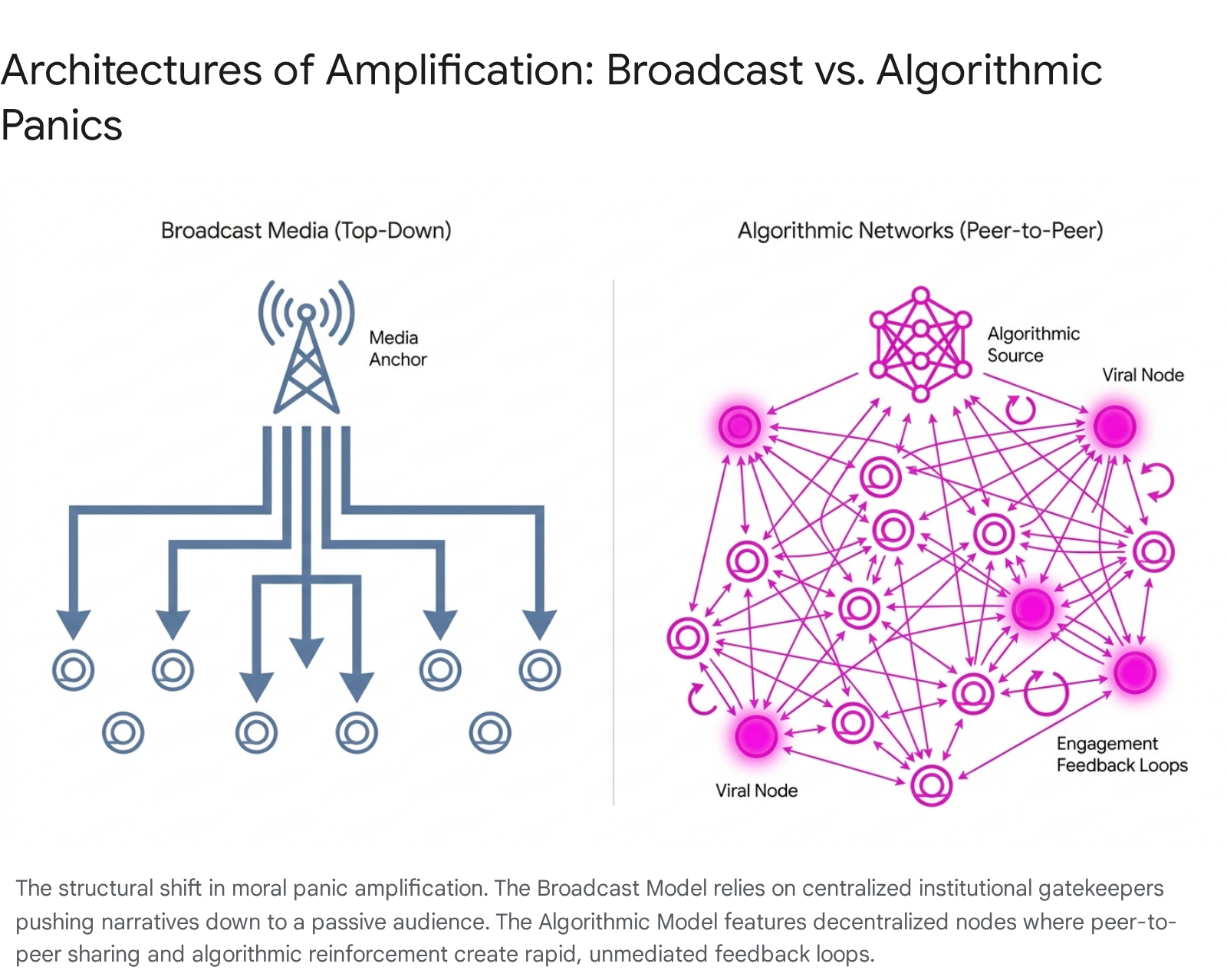
Where traditional panics required the complicity of editors, broadcasters, and institutional moral entrepreneurs to identify "folk devils," digital platforms allow rumors, fears, and dramatic stories to spread instantly, generated and amplified from the bottom up by ordinary users 56.
Virality as a Psychological Signal of Threat
Recent post-2023 sociological and psychological research has isolated the exact mechanisms by which social media intensifies panic. Puryear, Vandello, and Gray (2024), in a landmark study published in the Journal of Personality and Social Psychology, introduced the "social amplification model of moral panics" 6750. Through extensive naturalistic analysis of hundreds of thousands of Twitter posts and controlled experiments, they demonstrated that virality itself - measured by retweets, shares, and likes - serves as a powerful psychological signal to the human brain 67.
Evolutionary human vigilance toward threats is hijacked by social media metrics. When content regarding a societal threat goes viral, the visible metrics signal to users that the issue is genuinely dangerous, widely recognized, and requires immediate moral outrage 650. This creates an algorithmic feedback loop: a perceived threat triggers outrage; outrage drives engagement (likes, replies, shares); the algorithm, optimized to maximize user engagement, pushes the content to wider networks; the high virality metrics signal even greater danger to new viewers, prompting further outrage 65035. Unlike the 1980s, where Geraldo Rivera had to curate a mass audience, modern algorithms autonomously identify and micro-target the users most psychologically susceptible to the specific anxiety being propagated 6936.
Context Collapse, Cognitive Resonance, and AI as Moral Cover
Another distinct driver of modern digital panics is "context collapse," a phenomenon identified by researchers danah boyd and Alice Marwick 6. Social media flattens diverse audiences into a single timeline. A private joke, a satirical image, or an isolated teenage dispute can be screenshot, stripped of its original context, and injected into an adult or politically opposed community where it is interpreted literally as evidence of a dangerous societal trend 6. This environment actively encourages public shaming and digital "pile-ons," serving as a new form of community policing executed without due process 6.
Furthermore, "Cognitive Resonance Theory" (Gombar & Križanec Cvitković, 2025) outlines how algorithms prioritize emotionally resonant content over factual accuracy, fostering cognitive rigidity and ideological echo chambers 9. A landmark 2018 study by Vosoughi, Roy, and Aral proved that false news spreads significantly faster, deeper, and to more people than truth online, largely because falsehoods are systematically designed to evoke high-arousal emotions like fear, anger, and disgust 6.
In this ecosystem, artificial intelligence and algorithmic curation function as "moral cover" (Borinca, 2025) 54. Users demonstrate "selective adherence," eagerly accepting algorithmic outputs or viral narratives that confirm their pre-existing prejudices while dismissing counter-stereotypical data 54. System justification motives lead individuals to defend discriminatory or panicked responses as objective, "data-driven" reality, utilizing moral disengagement mechanisms to preserve their own self-regard while participating in the vilification of folk devils 54. Consequently, digital panics are highly volatile, deeply disproportionate, and remarkably resistant to the institutional debunking that ended historical panics, as the algorithm continuously serves confirming evidence to the believer 6954.
A Modern Technological Panic: The AI Education Crisis
A brief but illustrative example of a modern, rapidly cycling moral panic is the global reaction to the release of ChatGPT in late 2022. Widespread fear that artificial intelligence would facilitate ubiquitous cheating led to a global educational panic 3137. The media framed AI using crisis language and metaphors like "arms race," declaring the "death of the college essay" and prompting major school systems from New York City to India to enact immediate, preemptive bans 3137. This anxiety was fundamentally connected to projections of an existentially threatening, uncontrollable "other" displacing human effort 385758. However, demonstrating the volatility of modern panics, by mid-2023 the discourse shifted rapidly. AI-positive advocates successfully reframed the narrative, likening AI to calculators and shifting the focus from futile bans to adaptation, AI literacy, and pedagogical reform 3137.
Contemporary Online Panics: QAnon and Grooming
While the AI panic was relatively benign, the decentralized algorithmic mechanisms described above have fueled a new generation of socio-political moral panics that rival historical witch hunts in their intensity, real-world hostility, and political impact, most notably the QAnon movement and the anti-LGBTQIA+ grooming panic.
QAnon: An Epistemological and Existential Panic
Originating on the fringe message board 4chan in 2017 before migrating to mainstream social networks, QAnon posits that a global "deep state" cabal of Satan-worshipping, pedophilic elites controls the world and operates a massive child sex-trafficking ring 10394041. While QAnon explicitly echoes the blood-libel and SRA narratives of the 1980s Satanic Panic, its operation is distinctly modern 4734. It is a decentralized, "big tent" conspiracy movement fueled by algorithmic echo chambers, where "drops" of cryptic information are collaboratively interpreted by followers, creating a gamified, crowd-sourced mythmaking process 394042.
Sociological and psychological analysis reveals that QAnon functions as a moral panic driven by profound existential motives. Adherents, often feeling a loss of social control or experiencing societal strain - particularly in homogenous, conservative communities undergoing rapid demographic change - find psychological security and rigid group cohesion in the narrative 414263. The movement is heavily correlated with Strict Father Morality, conspiratorial worldviews, and dark triad personality traits, rather than strictly traditional ideological conservatism 4365. The "folk devils" are the liberal elites, the mainstream media, and the "deep state" 4041.
QAnon perfectly illustrates the "consensus" and "disproportionality" criteria of moral panics 10. While the threat of an elite, child-eating cabal is entirely fictitious, the consensus within the algorithmic bubble is absolute, reinforcing anti-Semitic and authoritarian fascist fantasies 104044. The resulting hostility is not theoretical; it led directly to offline volatility, including the January 6th Capitol insurrection and numerous targeted threats against institutions and individuals, prompting the FBI to designate it a domestic terror threat 10394042.
The Anti-LGBTQIA+ "Grooming" Panic
In the post-2023 landscape, perhaps the most pervasive and destructive moral panic is the systematic framing of LGBTQIA+ individuals - particularly transgender people - as "groomers" 116768. This narrative aggressively weaponizes the language of child protection, merging anxieties over evolving gender ideology with visceral, universally held fears of pedophilia 112167.
Criminologist Maxwell Osborn (2025) provides a comprehensive sociological analysis of this phenomenon, explicitly classifying the anti-LGBTQIA+ legislative and cultural backlash as a modern moral panic engineered through political polarization, symbolic threat construction, and institutional capture 116768. According to Osborn, this panic fulfills all traditional Cohen criteria: the LGBTQIA+ community is designated as the folk devil, social media influencers and conservative political actors serve as moral entrepreneurs, and the hostility has manifested in real-world harassment, severe threats to trans-affirming educators, and physical violence 116769.
The most glaring evidence of disproportionality is the institutional and legislative response. In 2024 alone, U.S. state legislatures introduced a record 533 bills targeting LGBTQIA+ communities, attempting to criminalize gender-affirming care, restrict participation in public life, and erase trans existence 112168. Just as the 1980s Satanic Panic fueled the censorship of fantasy books and heavy metal music 47, the modern grooming panic has fueled an unprecedented surge in book bans targeting LGBTQIA+ and racial equity literature in schools and libraries since 2021 47. This policy wave is not a grassroots reaction to an empirical threat, but rather a strategically constructed moral panic, orchestrated by elite actors to reassert control amid perceived social disruption, magnified by the velocity and echo chambers of digital networks 68.
Comparative Analysis: Mapping the Evolution of Panic
To guard against historical flattening while demonstrating the structural consistency of societal fear, the following table maps Erich Goode and Nachman Ben-Yehuda's five criteria across three distinct eras of moral panic: the Salem Witch Trials (1692), the Satanic Panic (1980s), and Modern Online Panics (2020s) 18141217.
| Cohen's Criteria | Salem Witch Trials (1692) | Satanic Panic (1980s) | Modern Online Panics (QAnon / Grooming) |
|---|---|---|---|
| 1. Concern | Absolute fear that Satan was actively infiltrating the Puritan church and community. | Anxiety that daycare centers and popular culture were hiding Satanic cults abusing children. | Existential dread that deep-state elites or LGBTQIA+ individuals are grooming/trafficking children. |
| 2. Hostility | Accused witches (often marginalized women or outcasts) viewed as literal agents of the Devil. | Daycare operators, heavy metal musicians, and teenagers viewed as sociopathic cult members. | "Liberal elites," educators, and transgender individuals labeled as "groomers" and pedophiles. |
| 3. Consensus | Localized but absolute within Salem; enforced by theology and the colonial judiciary. | National consensus manufactured top-down via broadcast media, talk shows, and "expert" therapists. | Hyper-fragmented "Dual Panic" consensus; absolute belief within algorithmically sealed echo chambers. |
| 4. Disproportionality | 20 executed based entirely on "spectral evidence" and invisible torment. | Years of multi-million dollar trials (e.g., McMartin) yielding zero convictions and debunked claims. | Hundreds of legislative bills (533 in 2024) and capital insurrections based on easily falsifiable internet memes. |
| 5. Volatility | Erupted in early 1692 and ended abruptly by October when elite support collapsed. | Peaked in the late 1980s and slowly dissipated over a decade as investigative journalism debunked claims. | Highly volatile but sustainable; algorithms continuously mutate the narrative to evade debunking, keeping the panic chronic. |
Conclusion
The history of moral panics is a chronicle of humanity's deepest vulnerabilities to fear, amplified by the dominant communication technologies of the era. Whether analyzing the spectral evidence of Salem, the cultural epidemics of Koro in Southeast Asia, the organ-theft myths of the Global South, or the broadcast-driven Satanic Panic of the 1980s, the sociological architecture remains remarkably intact. A perceived threat to societal values is exaggerated, folk devils are identified to bear the burden of collective anxiety, and disproportionate retaliation ensues.
However, the post-2020 era represents a critical paradigm shift. The transition from centralized mass media to decentralized, algorithmic social networks has democratized the creation of panic while removing institutional brakes. Virality now functions as a psychological proxy for danger, bypassing editorial scrutiny and institutional gatekeeping to trigger deep-seated evolutionary responses. In this environment, panics like QAnon and the anti-LGBTQIA+ "grooming" narrative are not anomalous overreactions, but inevitable outputs of a digital ecosystem engineered to optimize for cognitive resonance, system justification, and emotional outrage. Addressing these contemporary panics requires moving beyond simple fact-checking; it demands a critical sociological intervention into the algorithms that structure our reality and a deeper understanding of the existential anxieties that make these digital witch hunts so intoxicating to the public mind.