
The Science of How Memes and Ideas Evolve
Memes are the fundamental units of cultural information - ideas, behaviors, and styles - that spread from person to person through imitation and social learning. While the concept originated as a way to understand the slow, intergenerational evolution of human traditions and technologies, modern digital platforms have industrialized this process, utilizing algorithms to hyper-accelerate the mutation and selection of ideas based on emotional contagion. Understanding the science of cultural evolution explains how everything from ancient folklore to viral social media trends survives, adapts, or goes extinct.
What Is a Meme? The Origins of Cultural Evolution
The fundamental idea that human culture evolves is not new. In his 1871 book The Descent of Man, Charles Darwin noted a "curious parallel" between the evolution of biological species and the gradual evolution of human languages, drawing on the work of historical linguists 1.
However, it was not until 1976 that British evolutionary biologist Richard Dawkins formalized the concept in his seminal book, The Selfish Gene 23. Dawkins proposed that biological genes are not the only entities subject to Darwinian evolution. Any system containing a "replicator" - a unit of information capable of being copied, undergoing variation, and facing selection pressures - will naturally evolve 34. To describe the cultural equivalent of the gene, Dawkins coined the term "meme," derived from the ancient Greek mimema, meaning "imitated thing" 235.
In scientific literature, a meme is any piece of cultural information passed from brain to brain via imitation or social learning 35. This encompasses vastly more than internet jokes. Catchphrases, melodies, religious beliefs, the technology of building arches, and fashion trends are all memes 34. Like biological genes, memes act as "selfish" replicators; they compete for survival in a limited environment 24. However, instead of competing for physical resources, memes compete for space in human memory and attention 67.
The Mathematical Models of Cultural Transmission
Following Dawkins, researchers in the 1980s began building rigorous mathematical models to quantify how culture evolves. Scholars such as L.L. Cavalli-Sforza, Marcus Feldman, Robert Boyd, and Peter Richerson adapted population genetics equations to trace how cultural traits spread through human societies 189.
These models revealed that human culture relies on highly sophisticated social learning mechanisms. Unlike basic animal imitation, humans utilize "context biases" (e.g., copying prestigious individuals or conforming to the majority) and "content biases" (e.g., favoring ideas that are emotionally salient, easy to remember, or highly useful) 1012. These biases dictate which memes survive and which fade into obscurity.
Biological vs. Cultural Evolution
To understand how cultural ideas replicate, researchers map the parallels between biological evolution and cultural evolution 131112. Both systems rely on three core Darwinian mechanisms: variation (new traits emerge), selection (some traits are favored over others), and inheritance or retention (traits are passed on to the next generation) 111314.
Despite these foundational similarities, the mechanical realities of how genes and memes operate are vastly different.
| Feature | Biological Evolution (Genes) | Cultural Evolution (Memes) |
|---|---|---|
| The Replicator | DNA and RNA sequences 36. | Neural pathways, language, external media, texts, and artifacts 467. |
| Transmission Pathway | Strictly vertical (parent to offspring) 713. | Vertical, horizontal (peer-to-peer), and oblique (e.g., teacher to student, media to mass audience) 1315. |
| Speed of Change | Slow, spanning distinct generational life cycles and thousands of years 615. | Extremely rapid, often occurring within a single generation, a year, or even hours 61519. |
| Mutation Rate | Low fidelity loss; replication is highly accurate 16. | High fidelity loss; transformation, misinterpretation, and active reconstruction are the norm 616. |
| Inheritance Model | Darwinian; traits acquired during a lifetime are generally not passed on genetically 13. | Lamarckian elements; human agents actively and intentionally modify information before passing it on 713. |
| Selection Pressures | Natural selection (survival) and sexual selection (reproduction) 213. | Psychological biases, emotional resonance, social utility, and algorithmic curation 21017. |
The most profound difference lies in transmission pathways. Genetic evolution is locked into a unidirectional, vertical path. Cultural evolution operates as a sprawling, multi-directional network 1315. Furthermore, because human minds act as an active bottleneck for cultural storage, ideas merge, blend, and mutate rapidly, allowing societies to adapt to new environments much faster than biological evolution permits 619.
The Memetics Debate: Replication vs. Transformation
In the late 1990s, a dedicated academic discipline called "memetics" emerged, seeking to establish a rigorous science around Dawkins's original concept 34. However, the movement largely fractured, and the Journal of Memetics ceased publication in 2005 318.
The primary scientific criticism of memetics was its over-reliance on the genetic metaphor 161823. Genes are discrete, highly stable packages of information that replicate with near-perfect fidelity; mutation is a rare anomaly 16. In human culture, the opposite is true: transformation is the rule, and exact replication is the rare exception 616.
When humans encounter an idea, they do not act as passive tape recorders or "vehicles" for mind viruses 723. Cognitive anthropologists, such as Dan Sperber, argue that humans actively filter, reinterpret, and reconstruct information based on pre-existing beliefs and psychological attractors 11619. For example, a rumor or urban legend passed through a community transforms significantly with each retelling.
Today, researchers prefer the broader frameworks of "cultural evolution" and "gene-culture coevolution" 4823. This modern consensus recognizes two primary dynamics driving cultural change: 1. Cultural Selection: Population-level biases dictate which variants become popular, similar to genetic selection (e.g., everyone adopting a superior farming tool) 1017. 2. Biased Transformation: Individual-level cognitive biases cause people to consistently alter ideas in non-random directions (e.g., stories evolving to become more emotionally shocking to ensure they are remembered) 1017.
Cultural Evolution Beyond Humans
Cultural evolution is not uniquely human. A robust body of observational research confirms that non-human animals also possess cultural traditions characterized by social learning 11225.
For instance, certain populations of bonobos exhibit unique tool-use traditions not found in neighboring groups 25. Chimpanzees have been observed adopting arbitrary fashion trends, such as placing a blade of grass in their ears, which spreads rapidly through the troop without any practical utility 26. Marine biologists have documented how humpback whales culturally transmit complex hunting strategies and vocalized songs, with specific acoustic trends originating near Australia and migrating across global whale populations over several years 25.
However, human culture is distinguished by its "cumulative" nature. Cumulative Cultural Evolution (CCE) dictates that our knowledge builds upon itself generation after generation, becoming far more complex than any single individual could invent in their lifetime 121927. While a chimpanzee can learn to crack a nut with a stone, chimpanzee groups do not systematically improve the stone over millennia to eventually build a mechanical nutcracker. Humans, driven by uniquely high-fidelity social learning, language, and teaching adaptations, achieve exactly this 827.
Indigenous Knowledge Systems and High-Fidelity Transmission
If human ideas naturally mutate and transform, how have ancient societies successfully passed down complex survival mechanisms and ethical frameworks for millennia without them degrading into noise? The answer lies in the engineering of Indigenous Knowledge Systems (IKS), which utilize highly structured transmission mechanisms to artificially suppress cultural mutation.
Unlike the passive scrolling of modern digital environments, traditional cultural transmission relies on active, structured participation 28.
| Cultural Tradition | Geographic Region | Transmission Mechanism and Function |
|---|---|---|
| Storytelling and Oral History | Ghana (and wider West Africa) | Not mere entertainment, but structured civic education. Narratives encode vocabulary, ecological observations, genealogies, and moral frameworks. Repetition and communal participation ensure high-fidelity retention of language and heritage 2030. |
| Drum Language | Ghana | An indigenous literacy system grounded in sound and rhythm. Tonal patterns mirror spoken language, allowing complex, culturally coded messages to be transmitted rapidly across vast distances without semantic decay 20. |
| Ethnomathematics in Art | AmaNdebele (South Africa) | Complex geometric knowledge encoded in beadwork and mural art (iqathana). Transmission is strictly controlled through gender protocols (passed mother to daughter via apprenticeship) to protect the integrity of the knowledge from outside corruption 21. |
| Ecological Apprenticeship | Ogiek Community (Kenya) | Hunter-gatherer knowledge regarding sustainable forestry and natural disaster preparation is transferred through immersive, intergenerational apprenticeship, ensuring vital survival heuristics are copied flawlessly 28. |
These case studies illustrate that high-fidelity cultural replication does not happen by accident. It requires immense communal effort, ritual, and context to ensure the memes crucial to a society's survival are protected against the natural entropy of human memory.
The Attention Economy and Emotional Contagion
The digital age fundamentally altered the selective pressures acting upon cultural ideas. In a world defined by the internet, information is no longer a scarce resource. As psychologist and Nobel Laureate Herbert A. Simon posited, "a wealth of information creates a poverty of attention" 32.
Because human attention is the primary limiting factor in the modern digital ecosystem, the environment aggressively selects for "memeability" 3233. A digital meme's fitness is rarely tied to its empirical truth or long-term utility; rather, its fitness is defined by its ability to capture a fraction of a second of human focus as a user scrolls through a feed 1833. Digital memes adapt to this environment by condensing information into highly visual, instantly digestible formats that frequently rely on juxtaposition, intertextuality, or paraprosdokian (a surprising or unexpected conclusion to a sentence) 33.
The MAD Model of Moral Contagion
To win the war for scarce attention, digital memes rely heavily on emotional contagion - the deeply ingrained psychological tendency for humans to unconsciously mimic and align with the emotional states of those they observe 3422. Research has long supported emotional contagion in offline settings, from empathy building in medical students to the shared affect of sports teams 22.
Online, memes hijack this psychological wiring. Ideas that elicit high-arousal emotions - specifically anger, outrage, fear, or profound awe - spread significantly faster and further than emotionally neutral content 3436. This phenomenon is articulated by the MAD (Motivation, Attention, Design) model of moral contagion 23, which breaks down the spread of highly charged cultural ideas into three pillars: 1. Motivation: Humans have powerful, group-identity-based motivations to signal their virtues and share moral-emotional content with their peers 23. 2. Attention: Emotionally charged ideas naturally hijack human cognitive biases, overriding slow, critical thinking and commanding immediate focus 23. 3. Design: Social media platforms are deliberately engineered to amplify our natural motivational and cognitive vulnerabilities to maximize time-on-site 23.
Consequently, the digital meme pool becomes systematically skewed. Nuanced, complex arguments are often selected against because they require high cognitive effort. Conversely, outrage-inducing political memes or absurd humor replicate prolifically because they demand merely a rapid, impulsive reaction 1836.
The Algorithmic Engine: TikTok and Cultural Selection
Historically, early social media platforms operated on a "social network" model: users saw ideas shared by the friends and family they explicitly chose to follow, forming what sociologists call "networked publics" 2439.
The introduction of the "For You" algorithmic feed, most notably pioneered by TikTok, fundamentally shifted the internet to a "social interest cluster" model 39. Under this paradigm, the algorithm - rather than the user's explicit social graph - acts as the primary curator and distributor of culture 3940.
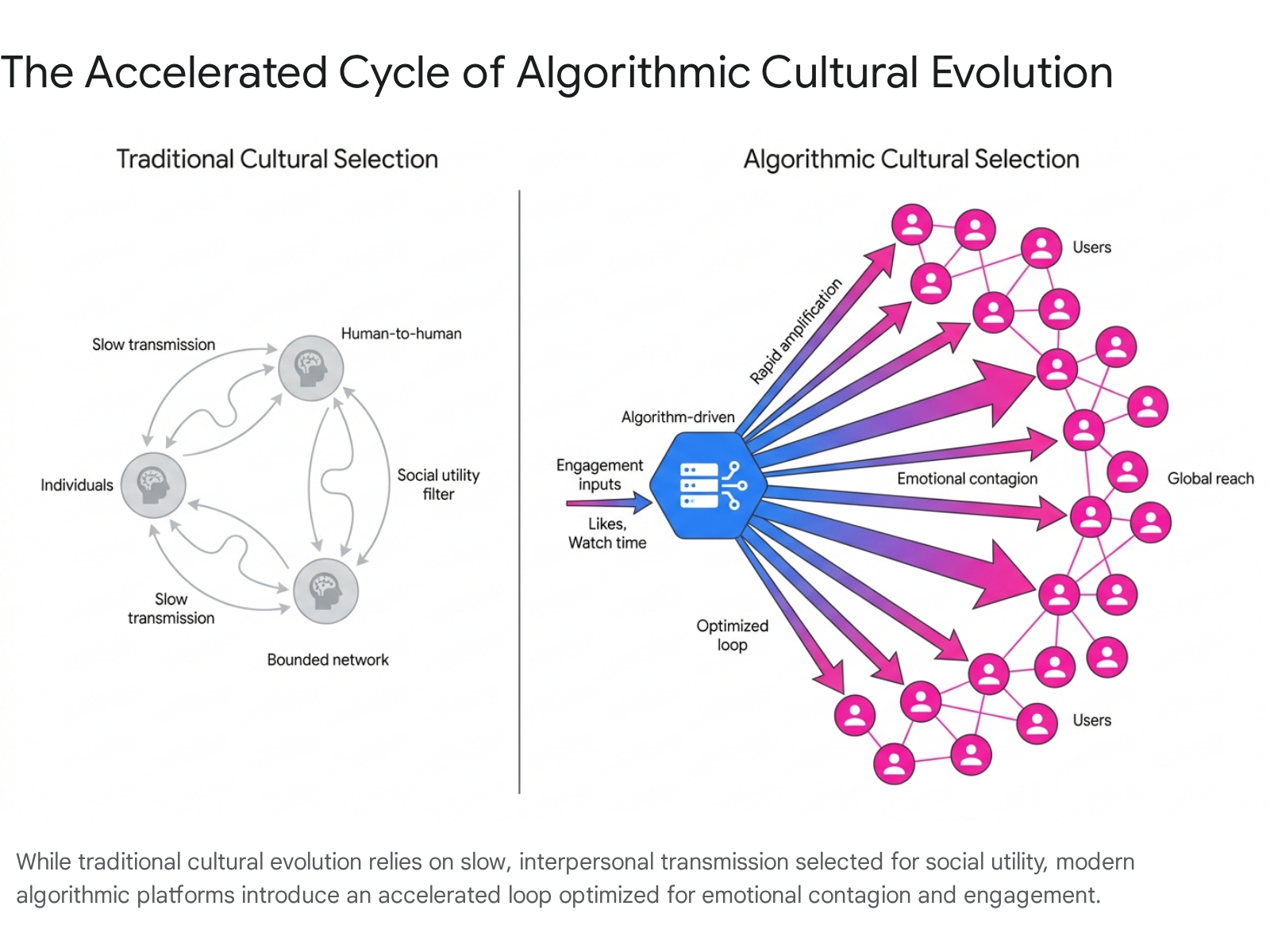
These algorithms operate as highly sophisticated recommendation engines utilizing machine learning frameworks, including Graph Neural Networks (GNN), Reinforcement Learning (RL), Temporal Convolutional Networks (TCN), and Natural Language Processing (NLP) 25. When a new meme is uploaded, the algorithm acts as a hyper-accelerated natural selection environment. It tests the meme on a small cluster of users, monitoring implicit and explicit interaction signals (e.g., watch time, replays, likes, comments). If the meme proves "fit," it is immediately pushed to exponentially larger pools 4026.
Audits of algorithmic amplification reveal that platforms can categorize a user's niche interests and begin force-feeding them highly targeted, resonant content within as few as 200 videos, equating to roughly 90 minutes of browsing 40. By entirely decoupling cultural transmission from physical space and personal relationships, algorithms allow ideas to mutate and achieve global dominance in a matter of days. As human creators adapt their content to try and "please the algorithm," an interactive synergy forms where human culture and machine agency continuously co-evolve 26.
Platform Decay and "Enshittification"
As algorithmic platforms mature, the cultural environment they foster tends to degrade. Author Cory Doctorow coined the term "enshittification" to describe the lifecycle of digital platforms 24. Initially, platforms offer immense value to users by surfacing highly relevant, entertaining cultural memes. Once a massive audience is locked in, the platform shifts its algorithms to serve advertisers, aggressively inserting sponsored content into feeds. Finally, the platform optimizes entirely for shareholder profit, resulting in a degraded user experience flooded with algorithmic clutter, fees, and low-quality engagement bait 24.
This cycle forces cultural creators into unwinnable arms races. For instance, when Meta (Facebook) fraudulently inflated video metrics to force a "pivot to video," digital publishers spent billions altering their cultural output, only for the ecosystem to collapse when the true engagement numbers were revealed 24.
Algorithmic Echo Chambers and Cultural Polarization
One of the most consequential threats posed by algorithmic cultural selection is the rapid formation of echo chambers. An echo chamber is an enclosed media environment where a system systematically filters out irrelevant or opposing viewpoints, resulting in a continuous feedback loop that reinforces an individual's pre-existing beliefs 362728.
Algorithms naturally breed echo chambers because their primary directive is to maximize user retention 3627. Humans exhibit "homophily" - the tendency to associate with similar others - and confirmation bias, preferring information that validates what they already believe. Algorithms quickly learn that the most efficient way to keep a user scrolling is to feed them ideological clones of their own worldview, exploiting these psychological vulnerabilities 2829.
When a cultural subgroup is isolated in an echo chamber, the memes within that group mutate rapidly toward extremes. Without the friction of opposing viewpoints to filter out radical or nonsensical ideas, misinformation and ideological polarization thrive 3629. Fear and anger become the primary mechanisms of meme transmission, which can ultimately culminate in confrontational interactions, offline radicalization, and the erosion of shared societal reality 3646.
Strategies to Break the Feedback Loop
Breaking out of an algorithmic echo chamber requires active intervention against the platform's standard operating procedures. Recent research suggests several mechanisms for both users and platform designers to foster a healthier cultural ecosystem:
- Introduce Algorithmic Randomness: From a design perspective, researchers at the University of Rochester have demonstrated that when algorithms are tweaked to introduce a small degree of random, unselected content into a user's feed, the echo chamber effect weakens significantly. Exposure to unexpected viewpoints reduces belief rigidity and opens users to differing perspectives, without fundamentally destroying the personalization of the feed 30.
- Confuse the Algorithm: From a user perspective, intentionally interacting with diverse, contradictory content (e.g., following accounts from opposite ends of the political spectrum) introduces noise into the machine learning model. This prevents the algorithm from placing the user into a highly rigid interest cluster, disrupting the echo chamber 29.
- Cultivate Algorithmic Literacy: Users who actively understand how recommendation systems manipulate their feeds demonstrate higher "algorithmic awareness." Studies on Generation Z users indicate that this awareness acts as a powerful cognitive filter, prompting users to engage more deliberately, critically, and reflectively with the media they consume, mitigating the passive effects of emotional contagion 2631.
Bottom line
Memes are the fundamental replicators of human culture, subject to the same evolutionary forces of variation, selection, and retention as biological genes. However, unlike genetic DNA, cultural ideas are continuously and actively transformed by human cognitive biases, social interactions, and environmental needs. In the modern era, artificial intelligence and algorithmic platforms like TikTok have industrialized this evolutionary process, testing and mutating ideas at a hyper-accelerated rate based primarily on emotional contagion and engagement metrics. While this environment allows for unprecedented global connectivity, it leaves human culture highly vulnerable to polarized echo chambers, requiring both individuals and technologists to cultivate algorithmic literacy and introduce diversity into our digital diets.