
What Declassified Records Show About Project MKUltra
Project MKUltra was a highly classified, illegal human experimentation program directed by the U.S. Central Intelligence Agency from 1953 to 1973, designed to discover and weaponize mind-control techniques, truth serums, and psychological torture. Operating across more than 80 institutions - including universities, hospitals, and prisons - the CIA and its proxy organizations subjected unconsenting citizens to covert doses of LSD, sensory deprivation, and extreme electroshock therapy. While the program utterly failed to produce reliable mind-control methods, its exposure reshaped modern bioethics, overhauled domestic intelligence oversight, and established lasting legal precedents regarding government transparency.
The Cold War Paranoia That Birthed a Monster
To understand how the United States government authorized the systematic psychological abuse of its own citizens, one must look at the profound paranoia of the early Cold War era. Following World War II and the onset of the Korean War, American intelligence agencies were gripped by the fear that the Soviet Union, Communist China, and North Korea had mastered the dark art of "brainwashing" 123. American soldiers and prisoners of war were returning home making seemingly robotic, anti-American statements, leading the CIA to believe their adversaries had developed advanced behavioral modification techniques 24.
The American intelligence apparatus was determined not to fall behind in what it perceived as an invisible arms race of the human mind. The CIA's response began under the Truman administration with Project BLUEBIRD, which was established in 1950, and Project ARTICHOKE, which followed in 1951 135. These early initiatives utilized secret black-site prisons in West Germany and Japan, as well as locations in the United States, to experiment on captured foreign nationals and suspected double agents using hypnosis, forced drug withdrawals, and extreme isolation 135.
The agency's scientific foundation for these programs was grim. It was bolstered by Operation Paperclip, a post-WWII program that secretly recruited former Nazi scientists. Some of these individuals, including General Walter Schreiber, had overseen chemical and torture experiments in concentration camps like Dachau and Auschwitz 136. The Central Intelligence Agency heavily relied on this dark expertise to formulate its own interrogation strategies.
On April 13, 1953, CIA Director Allen Dulles approved a massive expansion of these efforts, officially creating Project MKUltra 37. Placed under the direction of Dr. Sidney Gottlieb - a chemist who served as the head of the Chemical Division of the CIA's Office of Technical Service - the program's goal was twofold. First, it sought to develop defensive techniques to protect American spies from enemy brainwashing. Second, it aimed to engineer offensive weapons, such as chemical "truth serums" for interrogations, amnesia-inducing compounds, and methods to psychologically program unwitting assassins 789.
| Program Name | Active Years | Primary Objective and Methods | Precedent or Connection to MKUltra |
|---|---|---|---|
| Operation Paperclip | 1945 - 1959 | Recruitment of former Nazi scientists for U.S. military and intelligence advantage. | Provided foundational research on extreme human experimentation from concentration camps 13. |
| Project BLUEBIRD | 1950 - 1951 | Defensive focus to prevent unauthorized extraction of information from U.S. personnel. | The CIA's first official foray into mind control and behavioral modification 13. |
| Project ARTICHOKE | 1951 - 1953 | Offensive interrogation techniques using hypnosis and drug combinations. | Directly preceded MKUltra; established the use of secret interrogation facilities abroad 19. |
| Project MKUltra | 1953 - 1973 | Widespread covert research on domestic populations using LSD and psychological torture. | Absorbed prior programs and massively expanded funding and domestic scope 7. |
The Bureaucracy of Mind Control
Project MKUltra was not a single, centralized laboratory experiment. It was a sprawling "umbrella project" consisting of at least 149 known subprojects 111011. Because the CIA understood the severe legal, political, and ethical violations involved, it took immense lengths to hide its operational footprint.
The agency funneled millions of dollars into the project. Historical estimates place the total explicit funding at around $10 million during its operational years, which equates to roughly $87.5 million when adjusted for modern inflation 7. However, the true cost may be higher, as financial records were heavily fragmented. To distance the CIA from the horrific realities of the research, administrators utilized "cut-out" organizations 2512. Fake philanthropic entities, such as the Society for the Investigation of Human Ecology (also known as the Human Ecology Fund) and the Geschickter Fund for Medical Research, were established to issue research grants 251213. Through this financial subterfuge, the CIA covertly compromised the American scientific and medical establishment.
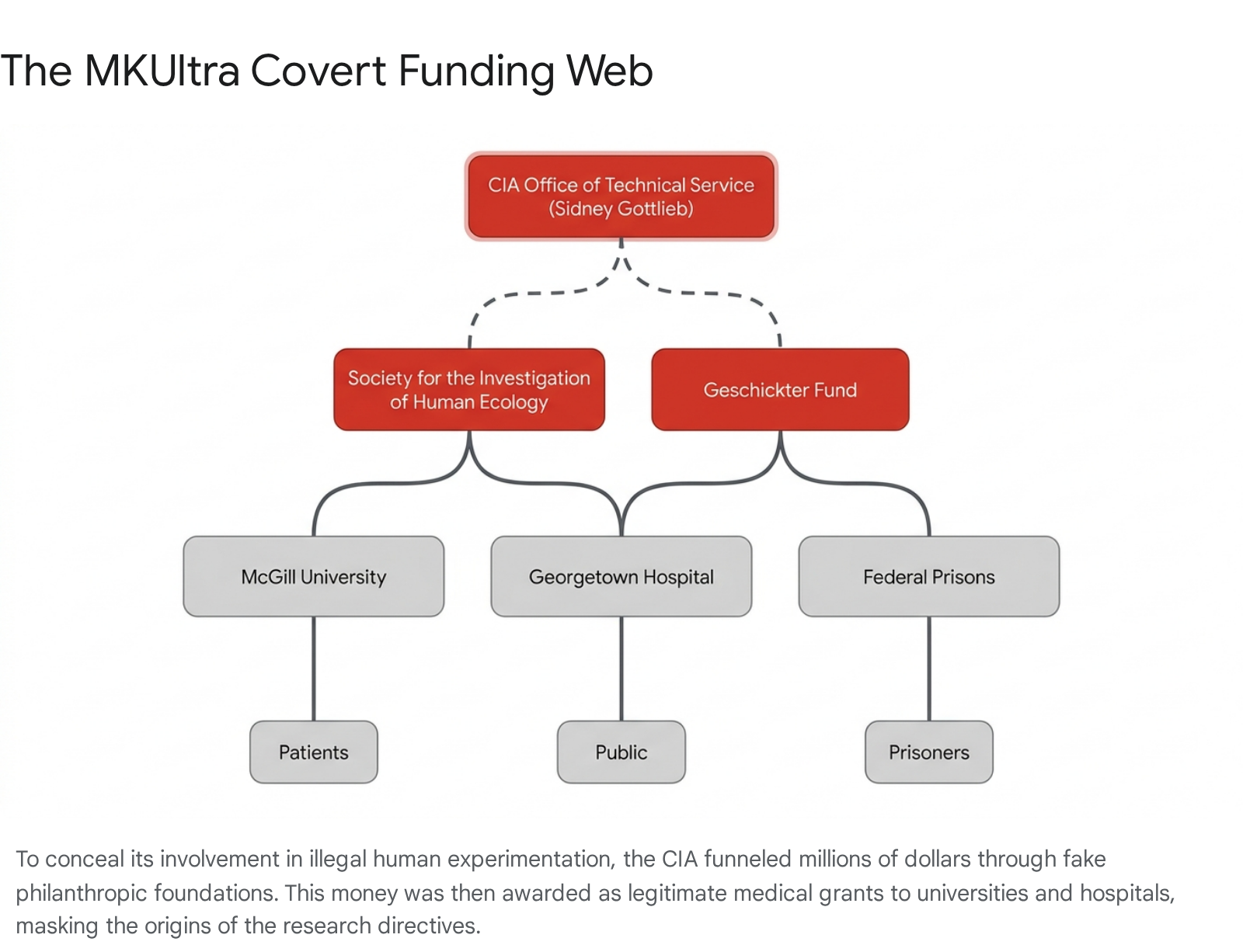
According to the declassified 1977 Senate hearing transcripts, MKUltra encompassed over 80 institutions. This included 44 colleges and universities, 15 research foundations or pharmaceutical companies, 12 hospitals or clinics, and 3 penal institutions 71116. Over 185 non-government researchers were involved in the network. While some doctors and scientists enthusiastically collaborated with the intelligence community, fully aware of the ethical breaches, others were entirely unwitting, believing their grants came from legitimate private foundations 71114.
What Do the 149 Subprojects Actually Show?
The surviving financial records - alongside subsequent Freedom of Information Act (FOIA) releases and civil depositions - provide a fragmented but chilling look into MKUltra's 149 subprojects. The research directives ranged from the bizarre to the deeply inhumane.
| Subproject Number | Lead Figure(s) | Primary Location / Institution | Research Focus / Operational Goal |
|---|---|---|---|
| Subproject 3 | George Hunter White | Safehouses in San Francisco & New York | "Operation Midnight Climax." Surreptitious administration of LSD to unwitting citizens lured by sex workers to observe vulnerability to extortion 91111. |
| Subproject 15 & 19 | John Mulholland | Independent (CIA Contractor) | Hiring a professional magician to write training manuals for field agents on sleight-of-hand techniques for covertly dropping pills into targets' drinks 1118. |
| Subproject 35 | Unknown/Redacted | Georgetown University Hospital | Covert funding for the "Gorman Annex," a hospital safehouse built partially with a $375,000 CIA grant funneled through the Geschickter Fund 51113. |
| Subproject 47 | Dr. Carl Pfeiffer | Emory Univ. / Atlanta Federal Penitentiary | Pharmacological screening and testing of chemical compounds on human volunteers, specifically federal prisoners, to induce temporary psychotic states 5. |
| Subproject 68 | Dr. Donald Ewen Cameron | Allan Memorial Institute (McGill University) | "Depatterning" and "Psychic Driving." Wiping human memories via drug-induced comas and massive electroshock, then playing looped audio to rebuild personalities 2712. |
The records show a relentless pursuit to map the limits of human endurance. Subprojects involved paralyzing drugs, sleep deprivation, radiation, biological toxins, and even investigations into the weaponization of indigenous plants 71015.
The Search for a Truth Serum and the LSD Obsession
At the center of Dr. Sidney Gottlieb's research was a powerful, relatively unknown hallucinogen: lysergic acid diethylamide, or LSD-25. In the early 1950s, LSD was an obscure pharmaceutical compound manufactured by Sandoz Laboratories in Switzerland. The CIA, terrified that the Soviets would buy up the world's supply and weaponize it, purchased massive quantities from Sandoz and later established a domestic supply line through the American pharmaceutical manufacturer Eli Lilly & Company 5713. Declassified documents reveal that the CIA cached LSD in field stations around the world, from Manila to Japan 16.
Initially, Gottlieb and his team tested LSD on themselves and other willing CIA and military personnel to understand its effects. However, they soon concluded that observing subjects who knew they were participating in a drug trial could not accurately simulate the shock and disorientation of a field interrogation 79. The agency decided they needed unwitting subjects in naturalistic social settings to truly gauge the drug's potential as a truth serum or an offensive weapon.
Operation Midnight Climax: The CIA's Illicit Safehouses
The requirement for unwitting test subjects birthed "Operation Midnight Climax," officially designated as Subproject 3. To run this operation, Gottlieb hired George Hunter White, a hard-drinking federal narcotics agent with a history of legally dubious operations and an alias of "Morgan Hall" 917. White established a network of CIA-funded safehouses in New York City and the Telegraph Hill neighborhood of San Francisco 918.
The San Francisco apartment was notorious. It was decorated like a French bordello, complete with posters of cancan dancers, red curtains, and heavy surveillance equipment, including microphones disguised as wall outlets and a large two-way mirror 918. The CIA placed sex workers on its payroll, paying them $100 per target to lure men back to the safehouses. There, the men's drinks were spiked with heavy doses of LSD, barbiturates, amphetamines, or scopolamine 918.
While the men hallucinated, CIA agents - including White and sometimes Gottlieb himself - sat behind the two-way mirrors, often drinking martinis on portable toilets, observing the subjects 18. They directed the sex workers to ask specific probing questions to see if the combination of sex and psychedelic drugs made the men more likely to reveal secrets 918. The men could not report the crime to the police without admitting they had solicited a prostitute, ensuring their silence.
Operation Midnight Climax ran for nearly a decade, continuing until 1963. It produced virtually no actionable scientific data regarding mind control, but it revealed a staggering culture of impunity, voyeurism, and systemic ethical failure within the intelligence community 9918.
The Chamber of Horrors at McGill University
If Operation Midnight Climax represented the CIA's chaotic lack of oversight, Subproject 68 represented its capacity for clinical cruelty. In 1957, the CIA began funneling grants through the Society for the Investigation of Human Ecology to Dr. Donald Ewen Cameron, a world-renowned Scottish psychiatrist who served as the head of the Allan Memorial Institute at McGill University in Montreal, Canada 2712.
Cameron was experimenting with a radical theory to cure schizophrenia by entirely breaking down a patient's existing personality and rebuilding it from scratch 219. The CIA realized that if Cameron could successfully erase a human mind, that same technique could be weaponized against enemy agents.
Cameron's patients - many of whom came to the Allan Memorial Institute for relatively mild complaints like postpartum depression, mild anxiety, or marital issues - were subjected to a torturous regimen without their informed consent 1220. The treatment involved two distinct phases:
Depatterning
First, patients were placed into chemically induced comas using heavy doses of barbiturates and Thorazine, kept asleep for days or even months 1221. During this sleep, they were administered electroconvulsive therapy (ECT) at 30 to 40 times the normal power, often twice a day instead of the standard psychiatric practice of three times a week 719. The goal of "depatterning" was absolute behavioral regression. Patients were reduced to an infantile, incontinent state, suffering from profound amnesia, often unable to speak or feed themselves 1219.
Psychic Driving
Once the mind was essentially wiped blank, Cameron initiated "psychic driving." This involved forcing the patient to listen to tape-recorded negative and positive messages on an endless loop. Patients were confined to sensory deprivation chambers, wearing blacked-out goggles and heavy headphones, while a single phrase criticizing their past behavior or offering a new personality directive was repeated up to half a million times 1219.
The Montreal experiments permanently destroyed the lives of the victims. Many awoke unable to recognize their own children, devoid of their life skills, and suffering from permanent retrograde amnesia 1220. Cameron was paid $69,000 for his work between 1957 and 1964, leaving behind a legacy of shattered families and severe psychological trauma 7.
Exploiting the Vulnerable: Prisoners and Patients
Throughout the duration of MKUltra, the CIA deliberately targeted "people who could not fight back" 714. Because the experiments carried immense risk of psychological breakdown, researchers sought out marginalized populations whose complaints would be ignored by society or the justice system.
Inmate Testing and "Whitey" Bulger
The CIA viewed penitentiaries as ideal, closed-loop laboratories. At the federal penitentiary in Atlanta, Dr. Carl Pfeiffer dosed inmates with heavy amounts of LSD 515. James "Whitey" Bulger, who would later become a notorious Boston organized crime boss, was an inmate at Atlanta in 1957. Lured by the promise of reduced prison time, Bulger was told he was participating in a trial to cure schizophrenia and was given LSD almost daily for more than a year 1522. He later described the experience as a "living nightmare," recalling intense paranoia, violent urges, and hallucinations of the walls bleeding and guards turning into skeletons 1528. Bulger later wrote that the government had committed a far greater crime on him than the one that put him in prison 28.
At the NIMH Addiction Research Center in Lexington, Kentucky, Dr. Harris Isbell exploited a captive population of heroin addicts. He offered them hits of high-grade heroin in exchange for participating in harrowing LSD trials. In one particularly egregious case, Isbell kept a patient under the continuous influence of LSD for 174 consecutive days 57.
Medical Patients and the Terminally Ill
In parallel to the psychiatric abuses in Montreal, researchers at other institutions utilized the terminally ill. The rationale, horrifyingly detailed in later congressional records, was that any long-lasting detrimental or lethal effects of the experimental drugs would be masked by the patients' impending deaths from cancer or other terminal illnesses 1423.
The Death of Frank Olson
The program also claimed the lives of government personnel. In November 1953, Dr. Frank Olson, a civilian biowarfare researcher for the U.S. Army Biological Warfare Laboratories, attended a CIA retreat at Deep Creek Lake. As part of a casual experiment, Sidney Gottlieb secretly spiked Olson's Cointreau with LSD 924. Olson, unaware he had been dosed, suffered a severe psychological crisis and deep depression. Several days later, while staying in New York City with a CIA escort, Olson fell or jumped to his death from the 10th floor of the Hotel Statler 39. The CIA covered up the true nature of his death for over two decades, initially ruling it a standard suicide 2526.
The 1973 Purge: Destroying the Evidence
By the early 1960s, the CIA recognized that MKUltra was fundamentally flawed as a scientific endeavor. Brainwashing, it turned out, was not a magic trick or a chemical switch, but rather a combination of traditional physical torture, exhaustion, and isolation 28. LSD proved too unpredictable to be used reliably in field operations; a dosed target was just as likely to become completely incoherent as they were to tell the truth 1827. Operation Midnight Climax was shuttered in the mid-1960s, and the broader MKUltra program was formally halted in 1973 79.
That same year, the United States government was engulfed in the rising panic of the Watergate scandal. Fearing that congressional investigations would inevitably expose the CIA's illegal domestic operations, CIA Director Richard Helms ordered the destruction of all MKUltra records 734. Sidney Gottlieb, the program's architect, personally drove to the archives to oversee the shredding of the files 3. For a brief moment, it appeared the CIA had successfully erased two decades of human rights abuses from history.
The FOIA Discovery and the Congressional Reckoning
Despite Helms's strict orders, bureaucracies are vast and prone to clerical errors. The truth of MKUltra eventually surfaced through a combination of journalistic persistence and accidental document preservation.
In the mid-1970s, journalist Seymour Hersh broke the story of illegal CIA domestic spying in The New York Times, bringing immense pressure on the intelligence community 313. But the definitive breakthrough occurred in 1977. Following a Freedom of Information Act (FOIA) request by John Marks, a former State Department official, a CIA employee discovered seven boxes containing roughly 20,000 pages of MKUltra documents 71135.
These documents had escaped the 1973 purge because they had been misfiled in a financial records building rather than under the MKUltra project title 711. While they lacked detailed operational medical data - meaning the exact clinical outcomes and the names of most victims were lost forever - they contained the financial paper trails, receipts, contracts, and internal memos required to expose the sheer scale of the program 11.
This discovery triggered a political earthquake in Washington. It became a focal point for the Church Committee (the Senate select committee investigating intelligence abuses chaired by Senator Frank Church) and the presidential Rockefeller Commission 3728.
On August 3, 1977, Senator Edward Kennedy chaired a joint Senate hearing that laid bare the agency's actions 2938. Admiral Stansfield Turner, the new Director of Central Intelligence, sat before Congress and formally admitted that the CIA had experimented on unwitting Americans 111629. Senator Kennedy noted on the Senate floor that the program included covert drug tests on unwitting citizens "at all social levels, high and low, native Americans and foreign" 1729.
The Enduring Legal and Bioethical Legacy
The fallout from MKUltra permanently altered the American legal and medical landscapes. The shock of the revelations forced the government to address the rights of human subjects and the extreme boundaries of national security secrecy.
The Overhaul of Medical Ethics and IRBs
The revelations of MKUltra, combined with the exposure of other domestic abuses like the Tuskegee Syphilis Study, shattered public trust in the medical establishment 830. The realization that esteemed doctors at elite universities would willingly drug, torture, and exploit vulnerable populations for government funding prompted a massive bioethical reckoning 840.
This outrage led directly to the creation of the 1978 Belmont Report and the establishment of the modern system of Institutional Review Boards (IRBs) 162440. Today, IRBs mandate strict, legally binding protocols for informed consent, independent ethical review, and the protection of vulnerable subjects such as prisoners, children, and the mentally ill. These regulatory frameworks were designed specifically to prevent the loopholes and systemic complicity that allowed MKUltra to flourish 162440.
The FOIA Shield and the "Mosaic Theory"
While victims and their families sought answers, the CIA fiercely fought to keep the identities of its collaborating researchers and institutions secret. This legal battle culminated in the 1985 Supreme Court case CIA v. Sims 731. Plaintiffs sued under FOIA to obtain the names of the MKUltra researchers and affiliated universities so that the unwitting victims could be traced, notified, and offered medical help .
The Supreme Court ruled unanimously in favor of the CIA. The Court held that Section 102(d)(3) of the National Security Act of 1947 gave the Director of Central Intelligence broad authority to protect "intelligence sources and methods" from unauthorized disclosure, overriding FOIA requests 313233. Crucially, the Court endorsed the "mosaic theory" - the idea that the CIA could withhold even seemingly innocuous information (like the name of a university) because foreign adversaries could theoretically piece it together with other scattered data points to uncover vital intelligence sources 734.
This ruling established a powerful legal shield that intelligence agencies continue to use to deny public records requests today 734. Because of this ruling, combined with Helms's 1973 document destruction, the vast majority of MKUltra's victims remain unidentified and uncompensated 20.
MKUltra in Pop Culture: Myth vs. Reality
Due to the scarcity of complete medical files and the inherently bizarre nature of the surviving documents, MKUltra has become incredibly fertile ground for pop culture, conspiracy theories, and urban legends. Over the decades, the lines between documented historical horrors and science fiction have heavily blurred.
The most prominent recent example of this cultural footprint is the hit Netflix series Stranger Things. The show is heavily rooted in MKUltra lore. In the narrative, a young girl named Eleven is born with telekinetic and telepathic powers after her mother, Terry Ives, is dosed with LSD and subjected to sensory deprivation in an MKUltra subproject at the fictional Hawkins National Laboratory 354736. The show's primary antagonist, Dr. Martin Brenner, is explicitly modeled after real-life figures like Sidney Gottlieb 4736. Furthermore, the show draws inspiration from the "Montauk Project," a popular conspiracy theory regarding alleged government time-travel and mind-control experiments at Camp Hero in New York 2549.
Other cultural intersections involve famous figures of the 1960s counterculture. Authors like Ken Kesey (One Flew Over the Cuckoo's Nest), poet Allen Ginsberg, and Grateful Dead lyricist Robert Hunter were all exposed to LSD through early MKUltra-funded trials at universities 222850. Ironically, the CIA's attempt to hoard and study LSD inadvertently helped seed the psychedelic movement of the 1960s 1850.
However, there is a stark difference between pop culture depictions and historical reality. While shows like Stranger Things accurately portray the aesthetic and the methods of MKUltra - such as sensory deprivation tanks, heavy LSD dosing, and the kidnapping of vulnerable subjects - the reality was utterly devoid of any supernatural results 353649. The real MKUltra did not unlock psychic phenomena, remote viewing, or telekinesis. Instead, it produced immense human suffering, psychosis, and broken minds 48. The fictionalization of MKUltra, while entertaining, often sanitizes the mundane, bureaucratic evil of government researchers destroying the minds of mental patients and prisoners in the futile pursuit of an impossible Cold War weapon.
Bottom line
Project MKUltra was a sprawling, illegal CIA initiative that prioritized Cold War paranoia over fundamental human rights, turning over 80 American and Canadian institutions into covert testing grounds. While the program failed to yield any functional mind-control technologies, it succeeded in traumatizing hundreds - perhaps thousands - of unwitting subjects through the use of LSD, massive electroshock, and psychological torture. Because the vast majority of the program's files were destroyed in 1973 and subsequent Supreme Court rulings protected the agency from disclosure, the full scope of the victims' suffering remains permanently obscured, though the scandal fundamentally reformed modern medical ethics and informed consent.