
How MKULTRA Changed Psychology and Research Ethics
The CIA's covert MKULTRA program subjected unwitting citizens to psychological torture and experimental drugs, violating basic human rights in the name of Cold War security. When these abuses were exposed in the 1970s, the public outrage catalyzed a total overhaul of bioethics. Today's strict rules requiring informed consent, institutional review boards (IRBs), and severe limits on psychological deception exist largely as a direct safeguard against these historical atrocities.
The Cold War Paranoia That Birthed Mind Control
The roots of MKULTRA lie deep in the geopolitical paranoia of the early Cold War. In the late 1940s and early 1950s, intelligence agencies in the United States grew increasingly terrified that the Soviet Union, China, and North Korea had developed advanced "brainwashing" techniques 11. Fearing that they were falling behind in a psychological arms race, the CIA sought to uncover methods to extract truth from captured spies, reprogram enemy minds, and ensure their own agents could resist aggressive interrogation 13.
The agency began its foray into behavioral engineering under President Harry Truman with Project Bluebird, which later evolved into Project ARTICHOKE 25. These early programs explored the use of hypnosis and sleep-inducing materials to lower a subject's defenses during interrogations 37. However, the CIA soon desired a more covert and aggressive approach. On April 13, 1953, CIA Director Allen Dulles officially approved Project MKULTRA, a top-secret program designed to explore the "covert use of biological and chemical materials" 149.
Directed by CIA chemist Sidney Gottlieb, the program operated with an extraordinary lack of oversight, essentially giving Gottlieb unchecked power to explore the farthest extremes of human behavior modification 210. The program's scope was massive, ultimately encompassing 149 known subprojects carried out at more than 80 institutions, including prominent colleges, universities, hospitals, research foundations, and prisons across the United States and Canada 15.
To conceal the government's involvement, the CIA funneled money through front organizations like the Human Ecology Society 15. Because of these covert funding mechanisms, some academic researchers conducting the experiments were entirely unaware that their work was being bankrolled by an intelligence agency aiming to weaponize human psychology 15.
Psychological Torture in the Name of National Security
The experiments conducted under the MKULTRA umbrella read like a catalog of systemic abuse. The CIA was particularly obsessed with the potential of lysergic acid diethylamide (LSD). Gottlieb and his team sought to determine if the powerful hallucinogen could be used to wipe a subject's mind clean, induce psychosis, or act as the ultimate truth serum 13.
Because the risks and basic safety profiles of LSD were not properly assessed at the time, the CIA determined that the only way to test its true operational effectiveness was to observe the reactions of people who did not know they had been drugged 12. Seeking "people who could not fight back," the agency deliberately targeted vulnerable populations: mental patients, prisoners, drug addicts, and sex workers 14.
In a subproject known as Operation Midnight Climax, the CIA set up safehouses in San Francisco and New York, hiring sex workers to lure unsuspecting men into rooms outfitted with two-way mirrors. The men were secretly dosed with LSD while CIA operatives observed their reactions from behind the glass 36. In another egregious instance, Dr. Harris Isbell tested hundreds of psychoactive drugs on prisoners in Kentucky who had a history of addiction, coercing them into participation by offering their drug of choice as a reward. In one case, a mental patient was administered LSD for 174 consecutive days 1614.
Perhaps the most notorious individual case was that of Dr. Frank Olson, an Army biological warfare scientist. In 1953, Olson attended a CIA-sponsored retreat where he was unwittingly served a cocktail spiked with LSD 114. The drug triggered severe paranoia and psychological distress. Nine days later, Olson plunged to his death from the window of a New York City hotel - a tragedy the CIA initially covered up as a routine suicide 3414.
Beyond psychedelics, MKULTRA explored other frontiers of psychological destruction. Dr. Ewen Cameron, a prominent psychiatrist operating at the Allan Memorial Institute at McGill University in Montreal, received MKULTRA funding to conduct "depatterning" experiments. Cameron's goal was to break down a patient's personality to a childlike state and rebuild it 359. He achieved this by placing patients in barbiturate-induced comas for weeks at a time, subjecting them to severe electroconvulsive therapy, and playing repetitive audio messages on loop for countless hours - a process he called "psychic driving" 3716. The result was catastrophic, leaving many patients with permanent amnesia, cognitive impairment, and lifelong psychological trauma 39.
The Irony of Operating Outside the Nuremberg Code
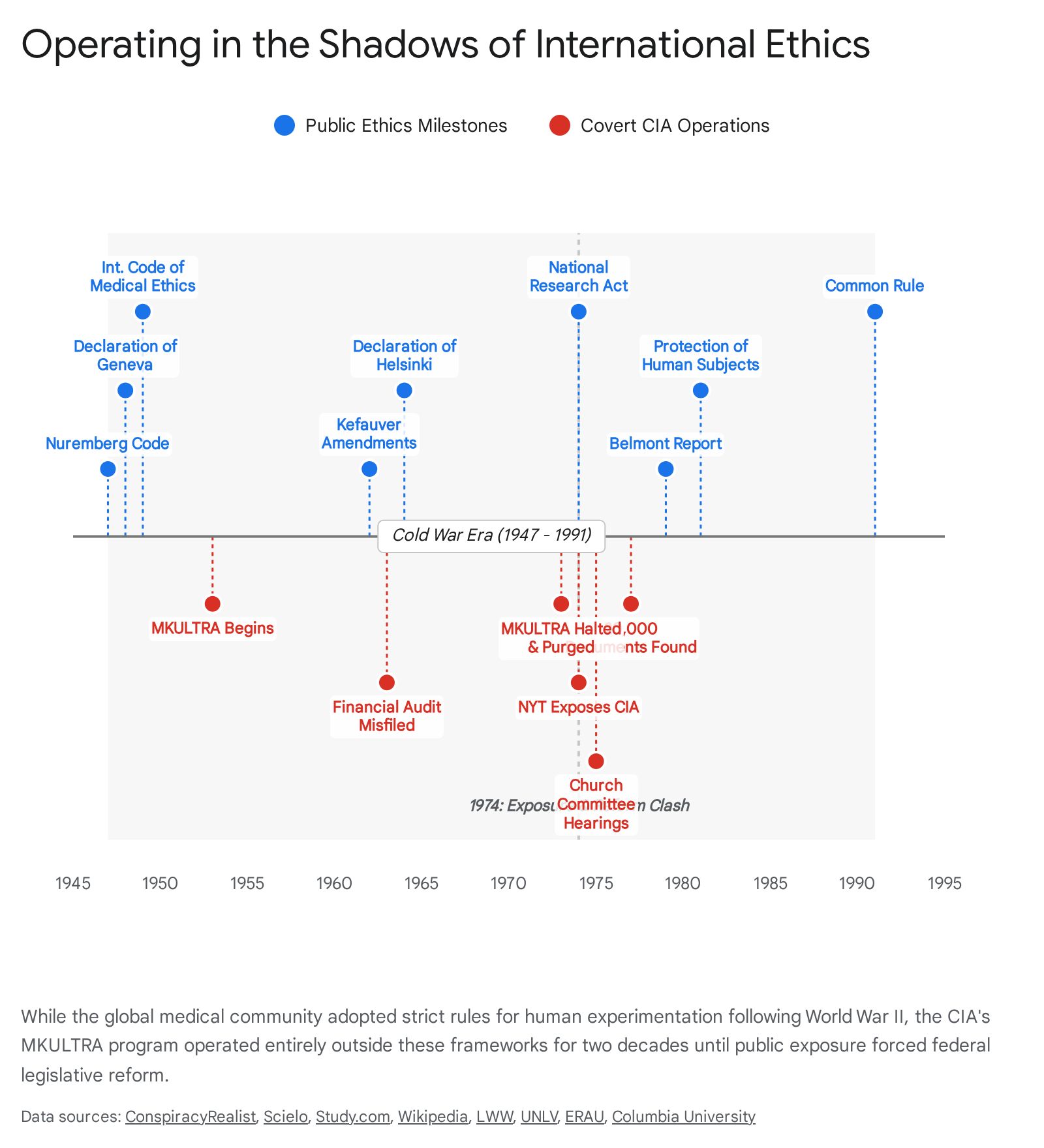
One of the most striking aspects of MKULTRA's legacy is that it did not occur in an ethical vacuum. Following the atrocities committed by Nazi doctors during World War II, the international community established the Nuremberg Code in 1947 171819. This landmark document was created to ensure that human experimentation would never again occur without strict ethical boundaries.
The very first principle of the Nuremberg Code states unequivocally: "The voluntary consent of the human subject is absolutely essential" 17198. The Code further emphasized that research must avoid unnecessary physical and mental suffering, yield fruitful results for the good of society, and ensure that subjects have the liberty to withdraw from an experiment at any time 17198. These principles were further codified for physicians globally by the World Medical Association's Declaration of Helsinki, first adopted in 1964 18910.
Despite these internationally recognized standards, MKULTRA defied every tenet of the Nuremberg Code point by point 17. Subjects were routinely lied to, drugged covertly, coerced in prisons, and denied any opportunity to consent or withdraw 1417.
The CIA justified its actions internally under the guise of national security, fearing that acknowledging ethical rules would put them at a severe disadvantage against their Soviet adversaries 914. To protect their operations, the CIA actively worked to conceal their activities from the American public. A 1957 report from the CIA's Inspector General explicitly warned that "precautions must be taken" to conceal these activities, noting that public knowledge of the agency engaging in "unethical and illicit activities would have serious repercussions in political and diplomatic circles" 4. The disconnect between the public advancement of medical ethics and the secret realities of intelligence research created a volatile contradiction that eventually exploded into public view.
The 1970s Reckoning and Public Exposure
The secrecy surrounding MKULTRA began to violently unravel in the 1970s, triggered by the broader fallout of the Watergate scandal and a growing national distrust of government institutions. In 1973, amid an agency-wide panic over accountability, CIA Director Richard Helms ordered the destruction of all MKULTRA files to hide the program's existence from congressional investigators 1717.
Helms's purge was largely successful, destroying the vast majority of operational planning documents and rendering a complete historical accounting of the program impossible 1. However, the destruction was not absolute. In December 1974, The New York Times published an explosive report alleging that the CIA had conducted illegal domestic experiments on U.S. citizens 1. This prompted immediate investigations by the presidential Rockefeller Commission and the United States Senate Select Committee to Study Governmental Operations with Respect to Intelligence Activities, widely known as the Church Committee 11023.
The true turning point occurred in 1977. Thanks to a Freedom of Information Act (FOIA) request, researchers discovered a cache of roughly 20,000 documents that had miraculously survived Helms's purge 117. They survived because they were financial records - ledgers, grants, and receipts - that had been incorrectly stored in a separate financial records building rather than the primary operational archives 117. These financial trails provided irrefutable evidence of the institutions, researchers, and drugs involved in the subprojects 75.
The discovery led to a series of heavily publicized Senate hearings in 1977 chaired by Senator Edward Kennedy 414. The hearings featured testimony from former CIA officials, including Sidney Gottlieb himself, and brought the horrific details of unwitting LSD dosing, psychological torture, and the death of Frank Olson to the American public 545. Senator Kennedy famously declared that the program of human experimentation had "violated the sacred trust" of the American people, signaling an urgent need for systemic federal reform 14.
The Transformation of American Bioethics
The exposure of MKULTRA occurred concurrently with another massive ethical scandal: the growing public awareness of the Tuskegee Syphilis Study, where researchers had deliberately withheld a known cure (penicillin) from African American men for decades to simply study the disease's natural progression 1011. Together, these twin scandals proved that the scientific and intelligence communities could not be trusted to self-regulate. Existing frameworks like the Nuremberg Code were highly respected internationally, but they carried no domestic legal enforcement mechanisms to stop abuses within the United States 19.
The federal government was forced to act. In 1974, Congress passed the National Research Act, a direct legislative response to the outcry over these abuses 101125. This act fundamentally altered the infrastructure of scientific research by legally mandating the creation of the modern Institutional Review Board (IRB) system 1125. Henceforth, any institution conducting research on human subjects with federal funding was required to establish an independent ethical committee to review, scrutinize, and approve study protocols before they could legally begin 1025.
Furthermore, the National Research Act established the National Commission for the Protection of Human Subjects of Biomedical and Behavioral Research 19810. The Commission was tasked with identifying the foundational ethical principles that should govern all human research moving forward. In 1979, they published their findings in a document that remains the cornerstone of modern bioethics: The Belmont Report 81125.
The Belmont Report established three non-negotiable ethical pillars that directly addressed the historical violations of MKULTRA and Tuskegee:
- Respect for Persons: This principle demands that individuals be treated as autonomous agents. It is the absolute bedrock of informed consent, dictating that participants must be fully aware of the risks, benefits, and exact nature of the research before agreeing to participate 811. It explicitly outlaws the unwitting experimentation, deception, and coercion that defined MKULTRA 114.
- Beneficence: Researchers have an absolute obligation to do no harm, and to maximize possible benefits while minimizing potential risks 811. The physical and psychological destruction caused by programs like Ewen Cameron's "depatterning" were permanently condemned under this standard.
- Justice: This principle requires that the burdens and benefits of research be distributed fairly. It specifically prevents researchers from exploiting vulnerable populations - such as the prisoners, terminally ill patients, cognitively impaired individuals, and sex workers disproportionately targeted by CIA chemists - simply because they are easily accessible or unlikely to fight back 148.
These principles were subsequently codified into federal law in 1991 through the Federal Policy for the Protection of Human Subjects, widely known today as the "Common Rule" 1125.
| Ethical Standard | Pre-1970s Research Norms (The MKULTRA Era) | Modern Standards (Post-Belmont Report) |
|---|---|---|
| Informed Consent | Often entirely absent. Subjects were routinely lied to, coerced, or kept entirely unaware they were participating in research 117. | Informed consent is a strict legal requirement. Subjects must understand risks, benefits, and procedures prior to any intervention 1112. |
| Vulnerable Populations | Actively targeted for exploitation. Prisoners, mental patients, and institutionalized populations were used due to a lack of agency 14. | Highly protected under the Common Rule. Strict limits exist on experimenting with prisoners, children, and those lacking cognitive capacity 1125. |
| Regulatory Oversight | Internal and secretive. CIA directors and lead chemists approved their own high-risk protocols with no outside review 2. | Independent Institutional Review Boards (IRBs) must pre-approve and continuously monitor all human subjects research 1011. |
| Right to Withdraw | Non-existent. Subjects were kept in studies against their will, sometimes facing 77 consecutive days of abuse 14. | Absolute right. Subjects can withdraw at any time, for any reason, without penalty or loss of medical benefits 1213. |
Reshaping the American Psychological Association
While MKULTRA was undeniably a CIA intelligence operation, its daily execution relied heavily on the expertise, theories, and active participation of psychiatrists, psychologists, and behavioral scientists. The revelation that prominent academics and medical professionals had actively designed and facilitated psychological torture forced a profound reckoning within the American Psychological Association (APA).
The Evolution of the APA Ethics Code
The APA actually published its very first official code of ethics in 1953 - the exact same year Sidney Gottlieb launched MKULTRA 1429. This early code was developed using the "Critical Incident Technique," wherein a committee reviewed over 1,000 real-world ethical dilemmas submitted by practicing psychologists to formulate guidelines 2930. However, this 1953 code was largely a collection of aspirational principles rather than strict legal boundaries 2915. Because it was not a rigid, legally enforceable document, it did little to deter researchers who believed their clandestine work was justified by Cold War national security imperatives.
The fallout from the 1970s investigations initiated a massive cultural shift within the discipline of psychology. The profession realized that relying on the personal morality of scientists was insufficient 29. Over subsequent decades, culminating in a major structural overhaul in 1992, the APA Ethics Code shifted from a purely aspirational document to one containing strict, enforceable standards 2932. The new code drew clear distinctions between broad principles and strict rules. Psychologists could now be formally sanctioned, disciplined by state boards, or stripped of their ability to practice for violating specific rules regarding the welfare of human subjects 1617.
The Strict Modern Rules on Deception and Debriefing
Because MKULTRA's methodology relied so heavily on trickery - dosing people's drinks, disguising experimental drugs as routine vitamins, and setting up fake brothels to monitor behavior covertly - the APA was forced to reckon with the concept of "deception" in psychological research 317.
In the behavioral sciences, a minor degree of deception is occasionally necessary; if participants know exactly what a psychological test is measuring, they may alter their behavior and ruin the validity of the data 18. However, the legacy of MKULTRA ensured that deception could never again be used to mask harm.
Today, the APA Ethics Code (specifically Standard 8.07) places an exceptionally high burden of proof on researchers who wish to use deceptive techniques. Deception is strictly forbidden if the research is reasonably expected to cause physical pain or severe emotional distress 17193720. Furthermore, an IRB will only approve deception if the researcher can prove that the study possesses "significant prospective scientific, educational, or applied value" and that absolutely no effective, non-deceptive alternative procedure exists 171937.
To counterbalance any permitted deception, the APA instituted rigorous rules surrounding "Debriefing" (Standard 8.08). As soon as the data collection is complete - or as early as is feasible - psychologists are legally mandated to provide a prompt opportunity for participants to obtain appropriate information about the true nature, results, and conclusions of the research 1737.
Crucially, once a participant is debriefed and the deception is revealed, they are granted the retroactive right to withdraw their consent 121819. The participant can demand that their data and biological materials be completely removed from the study and destroyed 1218. These stringent requirements for transparency and the absolute power of the participant to withdraw are the direct conceptual inverses of MKULTRA's operating procedures, ensuring that no subject is ever trapped in an experiment without their informed consent 131821.
The Psychedelic Renaissance and Lasting Stigma
A fascinating third-order consequence of MKULTRA's legacy is its lasting impact on psychopharmacology - specifically the academic study of psychedelics like LSD. In the early 1950s, LSD showed genuine promise in early, legitimate clinical settings as a powerful adjunct to psychotherapy 12.
However, the CIA's horrific misuse of the drug, combined with its eventual leakage into the counterculture, resulted in a severe government backlash 1214. The ethical taint of MKULTRA helped propel the eventual criminalization of LSD and effectively halted legitimate psychedelic research in the United States for decades 1214.
Today, as modern science experiences a "psychedelic renaissance" exploring these compounds for treating severe depression, addiction, and PTSD, researchers must navigate an intensely strict regulatory environment 12. Because of the historical trauma inflicted by figures like Sidney Gottlieb and Ewen Cameron, modern psychedelic clinical trials require extraordinary layers of IRB oversight, rigorous blinding protocols, and immense attention to patient vulnerability to ensure the abuses of the 1950s are never repeated 12.
Bottom line
The MKULTRA program represents one of the darkest chapters in the history of American science and intelligence, characterized by the gross exploitation of vulnerable populations and the systematic application of psychological torture. Its ultimate legacy, however, is the robust ethical infrastructure it inadvertently helped create in its wake. The shock of the program's exposure directly catalyzed the National Research Act, the Belmont Report, and the strict, enforceable codes of conduct maintained by the APA today, ensuring that informed consent and institutional oversight are now unbreakable pillars of human research. Because the CIA successfully destroyed the majority of the project's files in 1973, the total number of victims and the full extent of the psychological damage inflicted will permanently remain uncertain.