
Effectiveness and Buyer Perceptions of AI in Business Sales
Market Adoption and Deployment Metrics
The integration of artificial intelligence into business-to-business (B2B) sales and marketing represents a structural transformation in revenue operations. Following periods of intense capital allocation and experimental deployments, the market has reached a phase characterized by both massive scale and critical deployment hurdles. The global market for artificial intelligence in sales and marketing achieved a valuation of approximately $58 billion in 2025, with industry projections anticipating expansion to $240.59 billion by 2030, representing a compound annual growth rate (CAGR) of 32.9% 1. Independent surveys indicate that 88% of enterprise organizations regularly utilize artificial intelligence in at least one business function, with 78% of B2B companies actively deploying the technology across their commercial operations 12. Furthermore, 71% of organizations report utilizing generative artificial intelligence specifically, marking a rapid escalation from 33% just two years prior 12.
The economic drivers behind this adoption are rooted in the pursuit of operational efficiency and revenue acceleration. Empirical data demonstrates that sales teams leveraging artificial intelligence realize up to a 40% increase in baseline productivity and a 25% reduction in overall sales cycle duration 1. Moreover, organizations effectively utilizing these tools report an 83% likelihood of achieving year-over-year revenue growth, compared to only 66% for non-adopting cohorts 3456.
The Deployment Gap and Project Abandonment
Beneath the overarching narrative of ubiquitous adoption lies a systemic challenge characterized as the "deployment gap" or "pilot paradox." While enterprise experimentation is nearly universal, the conversion of artificial intelligence pilot programs into scaled, revenue-generating production systems frequently fails. A comprehensive 2025 study by the MIT Media Lab, which systematically reviewed over 300 public deployments and surveyed 153 executives, revealed that 95% of enterprise generative artificial intelligence pilots delivered no measurable profit and loss (P&L) impact 278.
The failure rates are corroboratively documented across major research institutions. S&P Global's 2025 survey of over 1,000 enterprises found that organizations abandoned 46% of their proof-of-concept models, with 42% of companies scrapping the majority of their artificial intelligence initiatives before reaching production environments 8. Gartner research predicts that through 2026, up to 60% of all artificial intelligence projects will be abandoned entirely 89. Furthermore, the RAND Corporation estimates that the overall failure rate for artificial intelligence projects exceeds 80%, which is double the failure rate of traditional information technology implementations 8.
A critical differentiator in deployment success lies in the sourcing of the implementation. The MIT data indicates that externally partnered deployments - utilizing established vendor architectures and deployment expertise - achieve production status approximately 67% of the time, whereas internally built, bespoke corporate initiatives succeed in only 33% of cases 7. This divergence underscores the complexity of operationalizing algorithms within legacy corporate environments.
The Artificial Intelligence Leaper Phenomenon
The primary catalyst for these high failure rates is rarely a deficiency in the underlying large language models (LLMs) or algorithmic capability. Instead, failures are overwhelmingly attributed to organizational "data debt" and a lack of foundational workflow integration. Organizations classified as "AI Leapers" aggressively purchase and deploy front-end conversational interfaces and generative drafting tools without first addressing their back-end data architecture 10.
Artificial intelligence systems function by scaling the quality of their foundational data. Models trained on unmanaged CRM environments containing duplicate records, outdated contact information, and conflicting firmographic profiles systematically produce flawed outputs at an accelerated rate 910. Gartner assessments indicate that 57% of enterprise data is not structurally ready for artificial intelligence integration, and 63% of data management leaders lack confidence in their internal data governance practices 89. Consequently, organizations deploying artificial intelligence without master data management (MDM) infrastructure find their systems trapped in administrative limbo, incapable of executing complex, multi-step go-to-market workflows 910.
Technological Categorization and Efficacy
To understand the varied success rates of sales automation, it is necessary to categorize the technology into specific operational modalities. The commercial impact of artificial intelligence diverges sharply depending on whether the system is utilized for statistical forecasting, content creation, or autonomous execution.
| Technology Category | Primary Operational Function | Dominant Sales Use Cases | Market Efficacy and Implementation Profile |
|---|---|---|---|
| Predictive AI | Forecasts outcomes by analyzing historical data patterns utilizing regression analysis and decision trees. | Lead scoring, churn prediction, pipeline forecasting, demand modeling. | High success rate. Delivers immediate, measurable operational efficiency when supported by clean underlying CRM data. 51112 |
| Generative AI | Creates novel, synthetic outputs (text, audio, image) based on statistical probability distributions. | Email drafting, conversational scripting, collateral customization. | High adoption rate but high risk. Often fails to show P&L impact without human oversight; prone to inducing buyer fatigue. 25712 |
| Conversational AI | Processes and generates natural language for interactive dialogs across text or voice mediums. | Initial inbound screening, website chatbots, automated voice qualification. | Moderate success. Highly effective for basic triage but suffers high abandonment rates in complex B2B negotiations. 121315 |
| Agentic AI | Executes autonomous, multi-step workflows, anticipating outcomes with minimal human supervision. | Automated meeting scheduling, autonomous cybersecurity mitigation, dynamic pricing. | Emerging phase. Demonstrates exponential capability growth but faces severe corporate governance and trust barriers. 25 |
Predictive Analytics and Intelligent Lead Prioritization
The most statistically reliable returns on artificial intelligence investments in sales currently derive from predictive analytics. Historically, lead scoring relied on static, point-based models developed through subjective human assumptions (e.g., assigning fixed point values for email opens or specific job titles) 111417. These manual methodologies are brittle, rapidly becoming obsolete as market conditions shift, and often fail to capture complex behavioral correlations 14.
Predictive artificial intelligence replaces human heuristics with machine learning algorithms capable of continuously analyzing hundreds of dynamic variables. By evaluating disparate data sets - including website intent signals, historical deal velocity, macroeconomic trends, and ideal customer profile (ICP) matching - predictive models generate highly accurate, dynamic probability scores for every prospect 111417. The empirical outcomes of this technological shift are substantial. Companies implementing predictive lead scoring report an average conversion rate increase of 25%, with highly optimized deployments achieving up to a 51% increase in lead-to-deal conversions 11415. Furthermore, organizations utilizing predictive models for forecasting are 7% more likely to achieve their sales quotas and experience significant improvements in overall pipeline accuracy 5.
Human-in-the-Loop Content Generation
Generative artificial intelligence has achieved deep market penetration in the creation of outbound sales collateral. By automating the synthesis of account research and the drafting of initial communication, generative tools save sales representatives an estimated 11 to 12 hours per week 1. However, the most effective deployment of these tools adheres strictly to a "Human-in-the-Loop" (HITL) methodology 16.
When organizations permit artificial intelligence to autonomously generate and dispatch outbound communications without human editorial oversight, the resulting output frequently lacks contextual nuance, damaging brand reputation and triggering automated spam filters 716. Successful deployments utilize generative models to handle the initial 80% of administrative drafting, relying on human sellers to apply the final 20% of strategic personalization, empathy, and relationship context 16. For example, AI-assisted personalization on professional networking platforms like LinkedIn - when carefully moderated by human operators - has yielded connection acceptance rates averaging 40% and reply rates of 45%, vastly outperforming generic, fully automated sequences 202122.
Conversational and Voice Modalities
Conversational artificial intelligence, particularly voice-enabled agents, has advanced significantly beyond traditional Interactive Voice Response (IVR) systems. Modern platforms leverage large language models to conduct fluid, non-linear dialogues capable of qualifying leads, addressing baseline product inquiries, and routing calls 1213.
For organizations managing high volumes of inbound inquiries or conducting broad outbound qualification, the economics are compelling. Enterprise platforms indicate that advanced voice agents can be operated at approximately 20% of the cost of human personnel 23. In optimized deployments within high-consideration sectors, AI voice agents have achieved a 97% containment rate - meaning only 3% of interactions required human escalation prior to qualification - driving inbound operational cost reductions of up to 80% 23. Additionally, in structured outbound scenarios, voice AI implementations have increased prospect response rates by up to 40% through persistent, natural-language follow-ups 12.
Despite these operational efficiencies, the technology possesses strict functional limitations. Consumer preference data reveals that 93% of U.S. consumers still prefer human agents for complex interactions 13. Furthermore, 46% of text-based chatbot conversations are abandoned prior to completion, and 73% of users express acute frustration when automated systems fail to comprehend nuanced inquiries 15. Complex negotiations, empathetic relationship building, and the handling of sophisticated B2B objections remain firmly outside the reliable capabilities of current conversational models 4.
The Evolving B2B Buyer Journey
The widespread availability of artificial intelligence has fundamentally restructured buyer behavior. B2B purchasers are operating with greater independence, increasing their research velocity, and altering how they allocate trust within the marketplace.
Buyer Integration of Large Language Models
The traditional, linear B2B purchasing funnel is becoming obsolete as buying cycles compress. Survey data indicates that nearly 75% of U.S. business buyers now complete their purchasing journeys in 12 weeks or less, with 58% reporting vendor switches within a six-month window 17. This velocity is directly enabled by the buyer's own weaponization of artificial intelligence.
An overwhelming 94% of B2B buyers now utilize generative artificial intelligence tools (such as ChatGPT, Claude, or Perplexity) to assist in their procurement processes 1819. Buyers heavily leverage these tools during the middle evaluation phases to synthesize vast quantities of vendor documentation, request comparative feature matrices, and summarize dense technical specifications 1920. Consequently, buyers are completing between 70% and 90% of their independent research before ever initiating contact with a sales representative 2122.
This dynamic has created a strong preference for autonomous research. Surveys by Gartner reveal that 61% of B2B buyers now explicitly prefer an overall "rep-free" buying experience during the discovery and evaluation phases 323. Traditional outbound sales tactics - such as the generic "discovery call" designed to uncover baseline pain points - are increasingly rejected by buyers who have already utilized artificial intelligence to map vendor trade-offs and establish shortlists 1921.
The Omnichannel Rule of Thirds
Despite the heavy reliance on digital self-service, the necessity for human interaction has not been eliminated; it has simply been reallocated. McKinsey's global B2B Pulse Survey identifies a consistent "rule of thirds" governing buyer preferences across the purchasing journey: approximately one-third of buyers desire in-person interactions, one-third prefer remote human communications, and one-third demand entirely digital self-serve options .
This distribution remains stable across diverse geographies, industries, and transaction sizes. Critically, while 94% of buyers employ artificial intelligence for research, the total number of interactions required to close a deal remains unchanged. Data from 2025 shows an average of 16 discrete touchpoints per buying committee member with the winning vendor, a metric that has held steady despite the proliferation of automation 19. Buyers use artificial intelligence to complement their research, not to replace the human validation required for final financial authorization 19.
Peer Validation and the Trust Hierarchy
While buyers utilize artificial intelligence for data aggregation, they maintain a strict psychological separation between computational utility and commercial trust. Research by Forrester emphasizes that buyers view artificial intelligence as a starting point, actively seeking validation from trusted human sources to compensate for algorithmic limitations 18.
The "Hidden B2B Journey" report, which surveyed 1,200 U.S. decision-makers, quantifies this trust disparity. When asked which information sources carry the most authority during a purchase evaluation, 73% of B2B buyers cited peer recommendations. Conversely, only 39% expressed trust in AI chatbots 18.
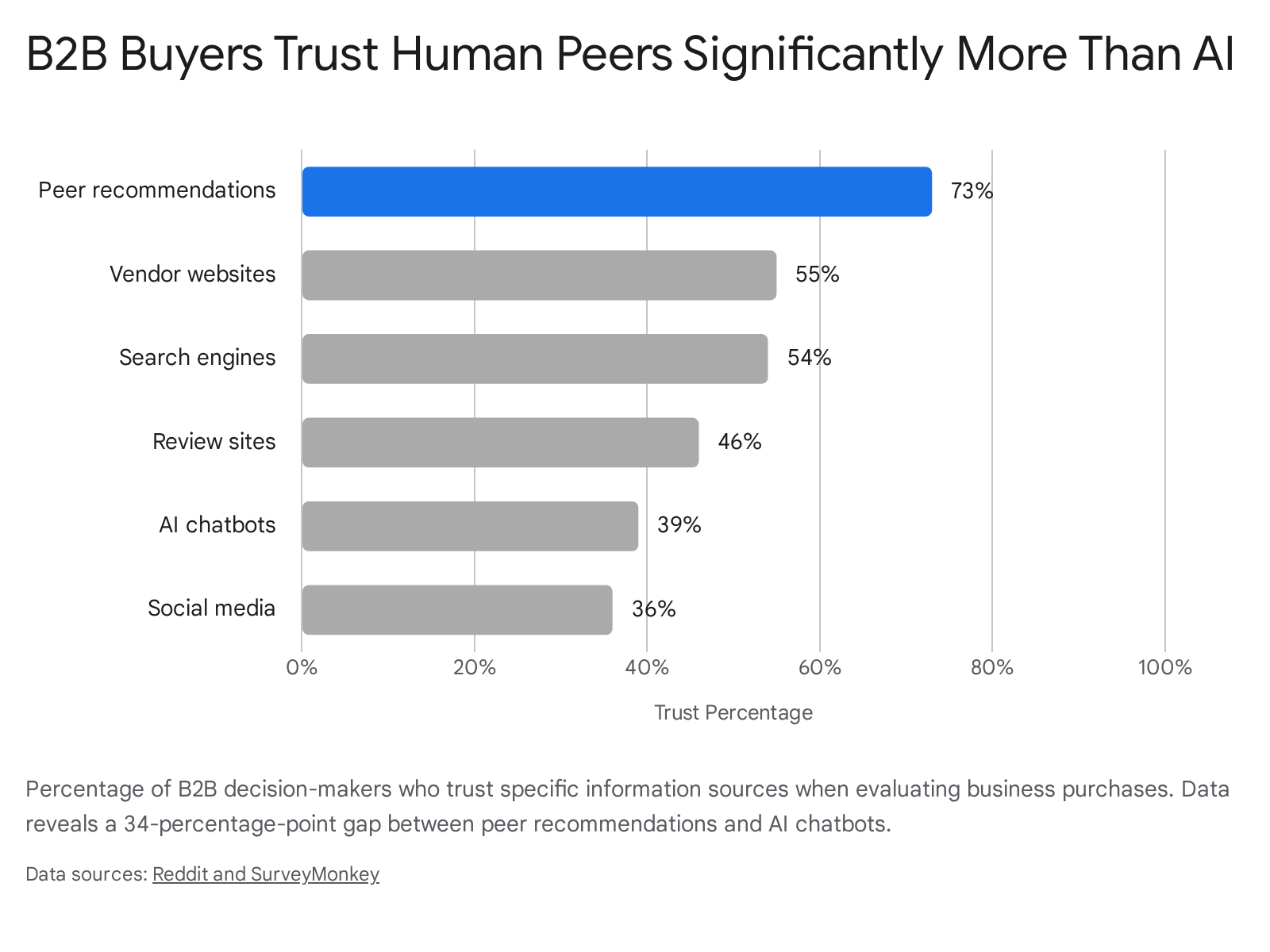
This 34-percentage-point divide indicates that organizations cannot rely exclusively on automated SEO and artificial intelligence generation to capture market share. Buyers rely on the lived, verifiable experiences of their professional networks to mitigate the risks associated with vendor claims and algorithmic inaccuracies 18.
Psychological Responses to Sales Automation
The rapid deployment of automated systems has triggered profound psychological responses from both buyers and sales practitioners. These responses range from cognitive fatigue to active behavioral resistance against algorithmic interfaces.
Inbox Saturation and Cognitive Overload
The commoditization of generative artificial intelligence has effectively reduced the marginal cost of creating personalized email copy to zero. Consequently, B2B buyers are experiencing unprecedented levels of digital solicitation, creating severe cognitive overload. In 2026, the average B2B buyer receives over 120 sales-related emails per week 21. The constant barrage of algorithmic outreach generates psychological fatigue, technostress, and a pervasive sense of digital exhaustion among decision-makers 24.
This inbox saturation has collapsed traditional outbound metrics. The average cold email open rate declined from 36% in 2023 to 27.7% in 2024, while platform-wide reply rates plummeted to between 1% and 4.5% 2125. Buyers easily detect "thinly customized" generative content, which degrades the purchase experience for an estimated 70% of B2B buyers 26. With 61% of decision-makers citing irrelevant outreach as a primary reason for immediate disengagement, leveraging artificial intelligence simply to increase the volume of unsolicited outreach is a mathematically failing strategy 2123.
Algorithm Aversion and the Uncanny Valley
A significant barrier to the effective deployment of sales automation is the psychological phenomenon known as "algorithm aversion." Extensive academic research within the Journal of Business Research and the Journal of the Academy of Marketing Science documents that human beings exhibit a persistent bias against algorithmic decision-making 272829. Even in scenarios where a predictive algorithm objectively outperforms a human counterpart (e.g., in lead scoring or pricing optimization), users rapidly lose trust in the system if they observe a single error, whereas they remain highly forgiving of human fallibility 2729. Within sales organizations, this manifests as representatives selectively ignoring data-driven recommendations in favor of their own intuition 2930.
Externally, when artificial intelligence systems attempt to simulate human empathy or conversation without genuine cognition, they frequently trigger the "uncanny valley" effect 2531. While consumers may accept basic anthropomorphism in low-stakes customer service tasks, introducing highly human-like artificial agents into high-stakes B2B negotiations causes severe emotional discomfort, feelings of eeriness, and a rapid erosion of trust 253132.
The Artificial Intelligence Terminology Backlash
The organizational enthusiasm for artificial intelligence is increasingly diverging from consumer sentiment. A robust 2024 experimental study conducted by researchers at Washington State University, published in the Journal of Hospitality Marketing & Management, evaluated the responses of over 1,000 U.S. adults to product marketing. The empirical findings demonstrated that explicitly including the term "artificial intelligence" in product or service descriptions consistently reduced product popularity and purchase intent 333435.
The researchers concluded that emphasizing artificial intelligence terminology significantly lowers "emotional trust" in the brand. This backlash was most pronounced in "high-risk" product categories - such as enterprise software, medical devices, and financial services - where operational failure carries substantial monetary or physical risk 3335. As buyer skepticism evolves from abstract ethical concerns regarding job displacement toward acute anxieties regarding output accuracy and data privacy, marketers are advised to prioritize functional benefits and eliminate superficial artificial intelligence branding 3435.
Operational Risks and Systemic Failures
Beyond psychological resistance, the technical limitations of current artificial intelligence models introduce severe operational and reputational liabilities for sales organizations.
The Business Cost of Artificial Intelligence Hallucinations
Because generative large language models operate probabilistically rather than utilizing deterministic database retrieval, every major frontier model inherently fabricates information 36. These fabrications, termed hallucinations, represent a critical liability in commercial sales environments. In 2024, global business losses directly attributable to artificial intelligence hallucinations were estimated at $67.4 billion 36.
In B2B sales, hallucinations manifest when an automated agent invents non-existent product features, fabricates pricing structures, or cites illusory case studies to a prospective client 3637. The damage is particularly insidious because hallucinations are generated with high linguistic confidence, easily bypassing casual human review. Studies indicate that 47% of executives report making major decisions based on unverified, hallucinated content, and 82% of artificial intelligence bugs in production environments stem from hallucinations rather than traditional software crashes 36.
Because epistemic uncertainty and computational intractability make hallucinations mathematically impossible to eliminate entirely at the foundational model level, organizations face immense reputational risk 3638. When a prospective buyer detects a fabricated fact during discovery, brand trust evaporates instantaneously 1637. Consequently, organizations must implement robust secondary verification layers and mandate rigorous human-in-the-loop oversight for all client-facing deployments.
Strategic Go-To-Market Alignment
The convergence of high pilot failure rates, automated inbox saturation, psychological aversion, and shifting buyer autonomy requires sales leaders to fundamentally re-architect their go-to-market strategies. The current misalignment is acute: while 67% of buyers state that problem discovery is the most vital part of the sales process, 60% report that human sellers consistently fail to uncover actual business challenges, relying instead on generic pitches generated by automated workflows 39.
Funnel Stage Calibration
To mitigate the uncanny valley effect and align with autonomous buyer preferences, organizations must calibrate the application of artificial intelligence based on the specific stage of the sales funnel.
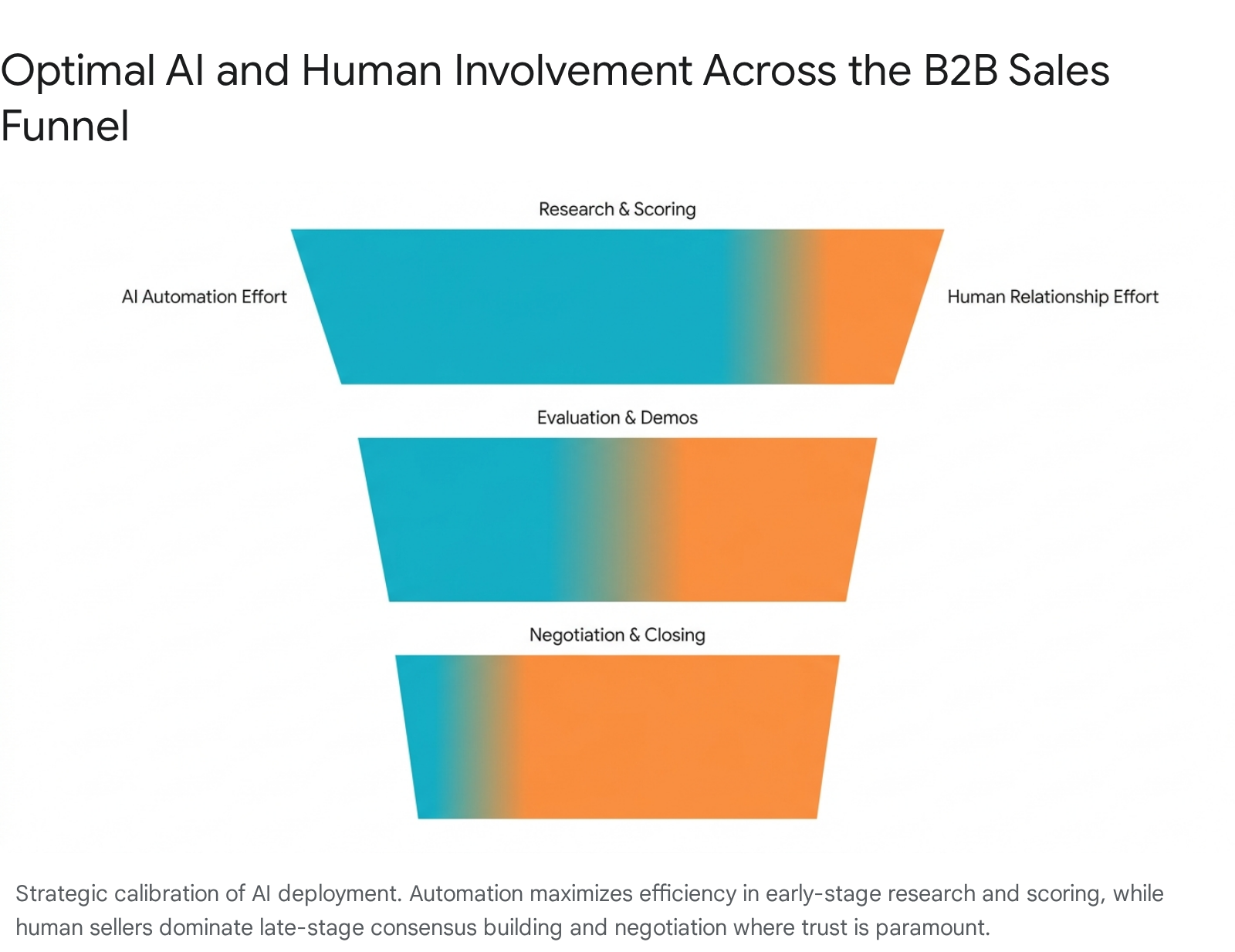
- Top of Funnel (Automation-Dominated): Artificial intelligence should aggressively automate backend research, predictive lead scoring, account-based intent monitoring, and the initial segmentation of audiences. Because buyers prefer independent digital research during this phase, providing robust, AI-optimized self-service content is highly effective 31723.
- Middle of Funnel (Human-in-the-Loop): As buyers transition from evaluation to engagement, artificial intelligence shifts to an assistive role. It analyzes conversational intelligence to score leads and prepares customized demo environments, but human representatives actively review, edit, and orchestrate all direct communications 161938.
- Bottom of Funnel (Human-Dominated): During complex discovery, consensus building across the buying committee, and final financial negotiation, automation must be relegated strictly to the background (e.g., CRM logging and legal review). Gartner predicts that by 2030, 75% of B2B buyers will actively prefer human interaction over artificial intelligence for complex deal closure 425. Trust, credibility, and peer validation cannot be algorithmically simulated at this stage.
Resolving the Efficiency Versus Volume Conflict
The overarching conclusion drawn from contemporary market data is that utilizing artificial intelligence merely to increase the volume of traditional, brute-force sales tactics is a structurally failing strategy. While 52% of go-to-market leaders cite departmental alignment as a top priority, and 56% desperately seek to improve operational efficiency, deploying automation to bombard prospects actively subverts these goals by increasing buyer friction and brand degradation 2340.
High-performing sales organizations are actively shifting from volume-based selling to value-based selling. They leverage predictive analytics to identify fewer, but statistically higher-quality targets 61114. They utilize generative artificial intelligence to synthesize deep account research, allowing human representatives to bypass generic inquiries and lead conversations with immediate business relevance 39. In a marketplace where 82% of buyers prioritize a seller's credibility and business insight over likability, the ultimate utility of artificial intelligence is not in replacing the human seller, but in outfitting them with the contextual intelligence required to penetrate a saturated digital environment 39. The future of B2B sales relies on organizations that treat artificial intelligence as a robust backend infrastructure for data synthesis, while fiercely protecting the authenticity, empathy, and consultative nuance of the human representative at the point of customer contact.