
Freelance vs Full-Time: Pay, Benefits, and Wellbeing
While independent workers consistently report higher levels of day-to-day happiness and autonomy than their full-time counterparts, they must generate approximately 30% to 40% more in gross revenue to match the financial equivalent of a traditional salary with benefits. The modern freelance economy is sharply bifurcated, offering lucrative flexibility to highly skilled knowledge workers while subjecting lower-skilled platform workers to severe income volatility and algorithmic precarity.
The Structural Transformation of the Modern Workforce
The global labor market is undergoing a profound and permanent structural transformation, shifting away from traditional, institutionally bound employment toward decentralized, project-based independent work. Historically viewed as a temporary stopgap during economic downturns or a supplementary method to generate secondary income, independent work has matured into a deliberate, primary career trajectory for tens of millions of professionals globally. As of 2025, the independent workforce in the United States alone reached 72.9 million individuals, representing a significant portion of the total labor force 12. Within this demographic, 27.7 million individuals operate as full-time independents, defined as those working independently for more than 15 hours per week 34.
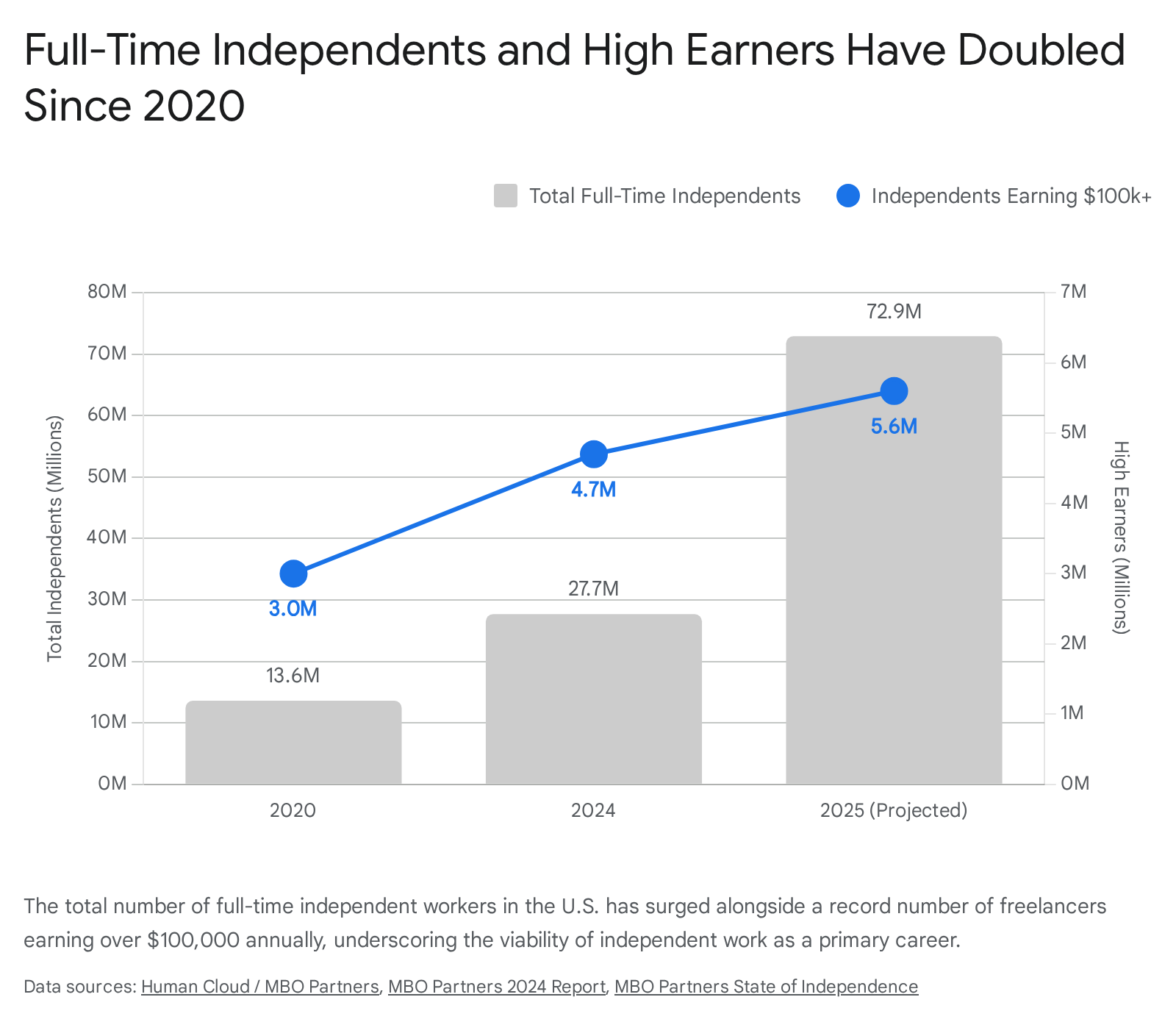
This specific cohort is growing at a compound annual growth rate 5.5% faster than overall traditional employment, proving that the shift toward autonomy is a durable trajectory rather than a fleeting pandemic-era anomaly 23.
This realignment is largely driven by a reaction against traditional corporate structures and an escalating desire for lifestyle flexibility. Survey data from 2024 and 2025 indicates that 63% of independent workers report their status is entirely by choice, and 54% state they would not return to a traditional payroll job under any circumstances 12. When examining the motivations behind this shift, the desire for higher compensation frequently ranks lower than the desire for autonomy. While only 52% to 59% of independent workers state they make more money working on their own, an overwhelming 84% report that they are happier operating independently, and 79% believe it is better for their physical and mental health 1234.
The globalization of the freelance economy has also decentralized talent sourcing. The World Bank and the International Labour Organization (ILO) estimate that approximately 1.57 billion people globally participate in some form of self-employed or independent work, though this broad definition includes subsistence agriculture and informal retail alongside digital platform work 56. When narrowed strictly to online gig and freelance platforms, estimates range between 154 million and 435 million workers worldwide 67. Emerging markets are driving a significant portion of this growth. India currently dominates the global freelance talent pool with over 15 million active freelancers, generating substantial export value in IT and digital services 68. In the Philippines, the freelance market experienced exponential growth following the 2020 pandemic, with 55% of the country's freelancers falling between the ages of 21 and 35 9. Businesses in North America and Western Europe are increasingly relying on this international talent pool to achieve agile, project-based staffing without the fixed overhead of full-time hires. In fact, nearly 48% of Fortune 500 companies actively utilized freelance platforms as of 2022, and enterprise adoption continues to deepen 66.
The Financial Reality: Deconstructing the Freelance Premium
When attempting to compare the financial compensation of an employee to a self-employed individual, the most pervasive error is equating a salaried wage directly to an hourly freelance rate. This flawed mental math - frequently referred to by pricing consultants as "The Salary Trap" - leads millions of new independent workers to chronically underprice their services, resulting in financial hardship despite working ostensibly full-time hours 1112.
If a traditional employee earns a base salary of $100,000 per year, dividing that figure by 2,080 standard annual working hours yields an hourly rate of roughly $48. Assuming that charging $50 per hour as a freelancer will allow one to maintain their previous standard of living is a profound miscalculation 11. A traditional W-2 employee's base salary represents only a portion of their total compensation. Employers subsidize a vast array of hidden overhead costs, including payroll taxes, health insurance premiums, retirement matching, paid time off, and professional equipment 13.
In the United States, for example, employers pay half of an employee's Social Security and Medicare taxes, which equates to 7.65% of their gross wages. A self-employed individual is legally responsible for the entirety of the 15.3% Self-Employment (SE) tax on their net earnings, fundamentally altering their baseline tax burden before federal and state income taxes are even applied 111214. Furthermore, freelancers do not bill for every hour they work. While a salaried employee is compensated for a 40-hour week regardless of their daily task efficiency, independent workers typically bill only 50% to 70% of their actual working hours 14. The remaining unbillable time is consumed by essential, non-revenue-generating business operations: prospecting and sales (10% to 20%), administrative tasks and invoicing (10%), marketing (5% to 10%), and continuous professional development (5%) 14.
To illustrate the stark gap between gross revenue and actual take-home pay, we must systematically compare the full financial ecosystem of both working models.
| Compensation Component | Traditional Employee ($100,000 Base Salary) | Full-Time Freelancer (Targeting $100k Equivalent Net) |
|---|---|---|
| Gross Annual Revenue Target | $100,000 | $140,000 |
| Federal Income Tax (Est. Single) | -$15,104 | -$15,104 (Varies widely with business deductions) |
| Payroll / Self-Employment Tax | -$7,650 (Employer covers the other half) | -$14,130 (Full 15.3% SE burden on net income) |
| Health Insurance Premiums | $0 (Assuming comprehensive employer subsidy) | -$7,500 (Out of pocket via marketplace or private) |
| Paid Time Off (Vacation/Sick) | Included seamlessly in base salary | -$4,000 (Calculated as lost billable opportunity cost) |
| Retirement Contributions | 3.5% Employer Match ($3,500 direct value) | Fully self-funded from net income |
| Business Overhead (Tech, Software) | Provided and maintained by employer | -$5,000 (Hardware, software licenses, liability insurance) |
| Actual Functional Take-Home Pay | ~$77,246 | ~$77,246 |
| Required Effective Hourly Rate | $48.00 / hour (Based on 2,080 standard hours) | $93.00 / hour (Based on realistically billing 1,500 hours) |
As the comparative data demonstrates, a freelancer must generate approximately $140,000 in gross revenue - often needing to charge upwards of $90 per billable hour - to match the true lifestyle purchasing power and financial security of a $100,000 salaried employee 1314. This economic reality necessitates a strategic shift away from time-based pricing toward value-based pricing, where experienced freelancers charge based on the tangible return on investment they deliver to the client, rather than simply tracking the raw hours spent executing a task 14.
The Hidden Tax of Income Volatility
Even when independent workers successfully set accurate, sustainable rates, they face a structural macroeconomic challenge rarely experienced by traditional employees: chronic income volatility. Securing steady project work does not guarantee a steady, predictable paycheck.
Extensive research utilizing high-frequency, anonymized banking data from the JPMorgan Chase Institute reveals the profound financial instability inherent in independent, platform, and hourly work. The study, which analyzed proprietary data from millions of accounts, determined that while salaried workers enjoy highly predictable cash flows, the typical hourly or gig worker experiences a month-to-month earnings fluctuation of roughly 9% 78. More alarmingly, in one out of every four months, these workers experience an earnings swing of at least 21% - a financial shock that is frequently larger than their entire checking account balance at the time of the fluctuation 8.
For median-income individuals engaged in non-salaried work, this translates to nearly $500 in labor income fluctuations across months, with spikes in earnings generally being larger in magnitude but less frequent than income dips 7. This constant feast-or-famine cycle carries a heavy psychological and economic toll. The banking data shows that income and consumption changes do not move in perfect tandem, but a significant portion of earnings instability - roughly 25% - is directly passed through to spending instability 89. This forces households to abruptly cut back on essential consumption during lean months, revealing that the typical independent individual does not possess a sufficient financial buffer to weather the degree of volatility inherent in their chosen labor model 9. The volatility is so difficult to manage that the typical hourly or gig worker would willingly accept a pay cut of between 4% and 11% of their total annual income just to achieve the same month-to-month paycheck stability as a traditional salaried worker 8.
However, it is crucial to recognize that income volatility acts differently across the diverse spectrum of freelancing. For highly skilled independent consultants, having a diversified portfolio of multiple clients can actually serve as a strategic hedge against catastrophic income loss. While a salaried employee's month-to-month income volatility is generally near zero, the sudden loss of their single job results in an immediate 100% income drop. By contrast, a freelancer who loses one of five active clients experiences only a 20% drop in revenue. This diversification of risk is the primary reason why 65% of full-time independent contractors actively report feeling more financially secure than traditional employees 1410.
The Bifurcation of Independent Labor
When evaluating the financial health, sustainability, and psychological wellbeing of the independent workforce, it is statistically misleading to view the "gig economy" as a monolith. The global freelance market is heavily segmented into two entirely different socioeconomic realities.
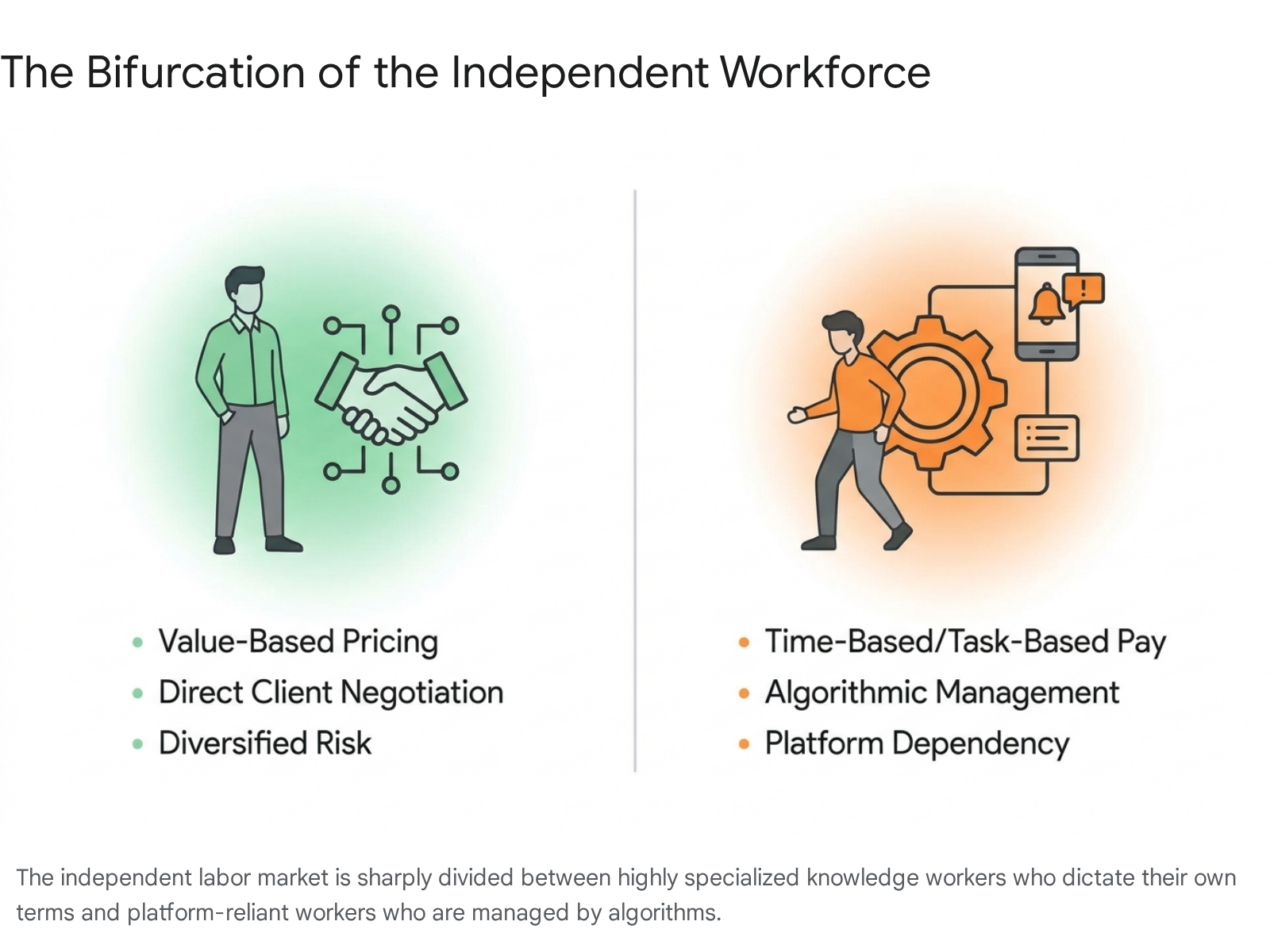
On one end of the spectrum is the high-skill micro-enterprise. These are knowledge workers - software engineers, strategic management consultants, digital marketers, and specialized designers - who leverage digital platforms primarily for lead generation but ultimately build direct, high-value relationships with enterprise clients. These workers enjoy massive autonomy, set their own rates, and are currently thriving in the modern economy 19. The Upwork Research Institute reported that in 2024, full-time skilled freelancers out-earned their full-time employee counterparts, boasting a median income of $85,000 compared to $80,000 for salaried employees 11. Furthermore, the MBO Partners 2025 State of Independence report found that a record 5.6 million independent workers in the U.S. reported earning more than $100,000 annually, a nearly 19% increase from the prior year and almost double the 3 million high-earners recorded in 2020 2. Within highly technical fields, freelance programmers and mobile developers consistently average between $55 and $70 per hour, generating annual revenues that rival senior corporate compensation packages 5.
On the opposite end of the spectrum is the platform-mediated gig worker. These individuals - including ride-hail drivers, food delivery personnel, and remote micro-taskers - face algorithmic management, severe wage stagnation, and intense occupational precarity 19. While platforms claim to offer autonomy, they retain unilateral control over pricing, task visibility, and access to the customer, mimicking classical employer-employee dynamics without providing the associated legal benefits or minimum wage guarantees 19.
A comprehensive 2024 report by the ILO surveying digital platform workers across Latin America and the Caribbean highlighted this extreme disparity. The data revealed that workers operating on digital platforms consistently earn less than they do in their traditional off-platform jobs. For individuals combining traditional employment with gig work, their traditional jobs paid an average of $10.50 per hour, while their platform work paid only $5.72 per hour 12. The segmentation is visible even within the platform ecosystem itself, heavily dependent on the complexity of the task being performed.
| Digital Platform Labor Category (Latin America, 2024) | Average Hourly Pay (USD) | Median Hourly Pay (USD) |
|---|---|---|
| Competitive Programming | $10.69 | $4.55 |
| Free Competition / Bidding Platforms | $7.58 | $2.85 |
| Online Freelancing (General) | $6.58 | $3.17 |
| Crowdwork / Micro-tasking | $4.78 | $2.50 |
Data sourced from the 2024 ILO Regional Office survey on digital platform workers, trimming outliers to provide accurate medians. 12
This bifurcation means that aggregate statistics regarding the "gig economy" often obscure the fundamental truth. The high-skill freelancer operates effectively as an empowered enterprise, wielding immense pricing power and enjoying career mobility. In stark contrast, the low-skill platform worker operates in a state of continuous vulnerability, subject to opaque rating systems, the constant threat of algorithmic deactivation, and relentless downward pressure on wages as they compete against a globalized labor pool willing to accept lower rates 1913.
Navigating the Void: Healthcare and Social Safety Nets
Perhaps the most daunting logistical and emotional transition from traditional employment to freelancing is the sudden loss of the corporate safety net. In institutional employment models, companies act as the primary distributors of social welfare - organizing health insurance, negotiating favorable group rates, providing paid sick leave, and managing tax withholdings. The freelancer must reconstruct this entire infrastructure independently. The ease of doing so depends heavily on the geopolitical region in which they operate.
The Cost of Health Insurance
Healthcare represents one of the largest fixed overhead costs for independent workers, and the financial burden varies drastically based on national policy.
In the United States, a system historically reliant on employer-sponsored health coverage, freelancers must turn to the Affordable Care Act (ACA) Marketplace, private individual plans, or a spouse's employer plan. On average, a US freelancer pays approximately $500 per month for an individual health insurance plan, with family plans costing substantially more 23. ACA premiums in 2025 rose by about 7% over the previous year due to rising medical and prescription costs, with Bronze-tier plans averaging $380 per month and Gold-tier plans exceeding $510 24.
However, the U.S. tax code and the ACA subsidy structure offer hidden financial leverage for self-employed individuals. ACA subsidies are calculated based on Modified Adjusted Gross Income (MAGI), meaning that a freelancer's net Schedule C income - gross business revenue minus all allowable business deductions - is the figure that determines subsidy eligibility, not their top-line revenue 25. A freelancer generating $120,000 in gross revenue but reporting a net income of $45,000 after legitimate business deductions may qualify for significant premium tax credits, effectively lowering their monthly premium to between $0 and $200 2514. Furthermore, health insurance premiums for the self-employed are 100% tax-deductible on federal returns, reducing taxable income dollar for dollar 2514.
Despite these subsidies, the functional quality of coverage in the individual market often lags behind corporate group plans. In 2025, the average annual deductible for an ACA individual market plan was $2,789, compared to an average deductible of just $1,886 for workers utilizing employer-sponsored group coverage 15.
In Europe, the burden of health insurance for freelancers varies by the structure of the national welfare state. While basic universal care is widely available in many EU nations, independent workers often face mandatory contributions to access full social insurance. In Germany, for instance, public health insurance for self-employed individuals can cost up to €925 per month depending on their income level, while private insurance alternatives average around €350 per month 23. In Spain, monthly contributions generally range from €100 to €200, though specific qualifications and government initiatives can occasionally lower this cost to €50 for new freelancers 23.
The Extinction of Paid Leave and the "Shadow of the Future"
The concept of a "paid day off" fundamentally does not exist in the pure freelance economy. Every day an independent worker takes off for vacation, illness, or caregiving is a day of permanently lost revenue.
This reality contrasts sharply with the statutory protections afforded to employees, particularly in European nations where paid leave is viewed as an inviolable labor right. The United States is an extreme outlier, possessing no federal statutory requirement for paid vacation or sick leave, though competitive private employers typically offer 10 to 15 days of paid time off 16. In contrast, European labor movements have secured extensive mandates. Nations like France and Austria guarantee 25 working days of statutory annual leave, alongside numerous paid public holidays 1617.
When examining compensation during illness, the disparity between employees and freelancers becomes a structural crisis. European social safety nets provide extensive wage replacement for sick employees, funded either by employer mandates or social insurance systems. In Luxembourg and Norway, workers receive 100% of their regular salary during their initial sick leave periods, with Luxembourg mandating that employers cover the cost for the first 77 days 171819. In Germany, employers are mandated to pay 100% of an employee's salary for up to six weeks of illness 32. Poland leads the world in total absentee allowances, with the average worker taking 34 days off annually, supported by an 80% wage replacement mandate 18.
| Country | Statutory Sick Pay Mechanism (Initial Period) | Wage Replacement Rate |
|---|---|---|
| Luxembourg | Employer mandate (first 77 days) | 100% |
| Germany | Employer mandate (first 6 weeks) | 100% |
| Norway | Employer mandate (first 16 days), then National Insurance | 100% |
| Poland | Employer mandate (first 33 days) | 80% |
| France | Social insurance (after 3 waiting days) | 50% |
| United States | No federal statutory mandate | 0% |
Data aggregated from Moorepay global leave data and EuroDev assessments 171832.
Because independent workers are entirely excluded from these statutory protections, they suffer from what labor researchers term the "shadow of the future." A freelancer operates under the constant psychological pressure that declining work today due to severe illness might not only cost them immediate income but could also permanently damage the client relationship and jeopardize their long-term pipeline of future revenue 20. This relentless dynamic leads directly to presenteeism - the act of working while visibly or severely sick - and severely encroaches on the individual's work-life balance, as recovery time is viewed strictly as a financial penalty.
Wealth Accumulation and the Solo 401(k) Advantage
While freelancers lose the traditional 401(k) employer match, the U.S. tax code offers highly compensated self-employed individuals a retirement vehicle that vastly outperforms traditional corporate plans in sheer accumulation capacity: the Solo 401(k), officially termed by the IRS as a One-Participant 401(k) 2135.
Available exclusively to business owners with no full-time W-2 employees (other than a spouse), the Solo 401(k) allows the freelancer to act as both the "employee" and the "employer" for contribution purposes 213536. This dual role unlocks exceptionally high contribution limits:
- The Employee Contribution (Elective Deferral): Just like a corporate employee, the self-employed individual can defer up to $24,500 of their income into the account in 2026. For those aged 50 or older, an $8,000 catch-up contribution is permitted 2135.
- The Employer Contribution (Profit Sharing): Acting as the employer, the freelancer's business can contribute an additional 20% of net earnings (for sole proprietorships or partnerships) or 25% of W-2 wages (for S-Corps and C-Corps) 3536.
Combined, these dual contributions allow a high-earning freelancer to shelter a maximum of $72,000 in tax-advantaged retirement accounts in 2026, or $80,000 if the individual is aged 50 to 59 2135. A special provision for 2026 allows those between ages 60 and 63 to reach a total limit of $83,250 21. For example, an independent consultant netting $150,000 a year could theoretically contribute their $24,500 employee maximum, plus a $30,000 employer contribution (calculated as 20% of their net), tucking away $54,500 in a single year while simultaneously slashing their current taxable income and shielding themselves from high marginal tax brackets 36.
While a corporate employee receives "free money" via an employer match (typically 3% to 6% of their salary), their tax-advantaged savings are strictly bottlenecked by the $24,500 individual deferral limit. The self-employed worker must meticulously fund every single dollar themselves from their own cash flow, but they possess a substantially higher legal ceiling for aggressive wealth accumulation and tax mitigation. Additionally, because there are no non-owner employees, Solo 401(k) plans are entirely exempt from complex ERISA nondiscrimination testing requirements, lowering administrative costs compared to traditional group plans 35.
Wellbeing, Stress, and the Autonomy Paradox
The psychological impact of independent work is deeply paradoxical. Empirical data consistently shows that freelancers report significantly higher levels of overall life and job satisfaction than salaried employees, yet they simultaneously experience profound occupational stress and alarming rates of clinical burnout.
Job Satisfaction and the Need Theory
According to the MBO Partners 2024 State of Independence report, the shift to freelancing yields massive emotional returns: 84% of full-time independents explicitly say they are happier working on their own, and 79% believe independent work is vastly better for their physical and mental health than institutional employment 134.
Peer-reviewed studies grounded in "need theory" and "socioemotional selectivity theory" heavily support these industry findings. A cross-sectional survey of the IT sector found that while traditional employees required high income satisfaction to predict overall work satisfaction, freelancers drew their primary life satisfaction from high levels of leisure satisfaction and workplace flexibility 3722. The largest measured psychological "gain" for freelancers compared to wage workers is satisfaction with their leisure time, largely explained by the high flexibility they enjoy regarding their physical workplace (often home-based) and their daily work rhythm 22.
This satisfaction is rooted in the fundamental psychological need for autonomy, competence, and self-determination. The ability to dictate one's own schedule, selectively choose favorable clients, and bypass rigid corporate hierarchy provides a powerful psychological buffer against the inherent economic stresses of the job. For many, utilizing their own skills in an entrepreneurial context is associated with a profound sense of professional self-efficacy, which acts as a protective factor against stress 2324.
Client Colonization and the Architecture of Burnout
However, this freedom operates alongside immense, unrelenting pressure. The Global Freelance Burnout Index reveals that between 50% and 75% of independent workers report experiencing moderate to high burnout symptoms 25. The primary driver of this burnout is rarely the actual specialized labor being performed; rather, it is the staggering cognitive load of single-handedly running a business infrastructure. Freelancers bear the absolute, non-delegable burden of client acquisition, marketing, project management, debt collection, and complex tax planning 25.
In traditional employment, institutional boundaries - such as physical office buildings, enforced HR policies, and set operating hours - help delineate professional labor from personal life. Freelancers lack these external architectures. Researchers utilizing the "spillover theory" have documented how the high cognitive demands and financial uncertainty of self-employment frequently bleed over and contaminate personal time 3723. Independent workers are highly susceptible to "client colonization," a psychological phenomenon where the constant fear of losing a lucrative contract causes the freelancer to continuously sacrifice their work-life balance to accommodate client demands at unreasonable hours 20.
Furthermore, peer support in the freelance community can occasionally be detrimental. While collegial support among traditional employees is generally proven to reduce stress, studies suggest a dangerous "social contagion" effect among high-skill freelancers. As they network with their peers, they often internalize intense, hyper-competitive industry norms regarding constant availability and the absolute necessity of overwork to succeed, which ultimately degrades their work-life balance and normalizes exhaustion 20.
The physical toll of this chronic stress is measurable in clinical studies. A massive analysis of the Korean Working Condition Survey, which reviewed over 34,000 workers, revealed that self-employed workers exhibit a significantly higher prevalence of sleep disturbances than paid workers 26. The odds ratio in self-employed workers compared to paid workers was 1.25 for anxiety, 1.11 for overall fatigue, and 1.24 for extreme fatigue upon waking 26. The study attributed this directly to the excessive activation of the arousal system caused by continuous financial stress and the reality that over 51% of self-employed individuals in the sample worked more than 52 hours a week, compared to just 13.6% of paid workers 26. Similarly, a study of Japanese freelancers identified a heavily elevated risk of work-related physical injuries among those working more than 60 hours per week, a threshold many cross during "feast" periods to compensate for anticipated future periods of low income 27.
Coping mechanisms play a critical, defining role in surviving the gig economy. Studies utilizing the Brief COPE scale have found that avoidant coping strategies - such as self-blame, denial, or ignoring financial realities - are highly correlated with extreme stress and burnout among gig workers 28. Conversely, proactive and approach-based coping - defined by the direct confrontation of problems, rigorous financial planning, and seeking structured social support - serves as a vital protective factor, lowering perceived stress and preventing mental exhaustion 2428.
AI Integration and Enterprise Adoption in 2026
As the labor market navigates through 2026, the independent workforce is being rapidly reshaped by demographic turnover and the aggressive integration of artificial intelligence.
Generation Z is fundamentally altering the composition of the freelance economy. Having entered the workforce during a period defined by rolling economic crises, massive tech layoffs, and the total normalization of remote work, younger professionals view institutional employment with deep skepticism. Over 53% of Gen Z skilled knowledge workers are already engaging in freelance work, and they are significantly more optimistic about their future earning potential than older generations, with 70% expecting to make more money from independent work in the coming year 1129.
Simultaneously, the widespread adoption of Generative AI is rapidly widening the gap between high-skill and low-skill independent workers. Data demonstrates that freelancers are adopting AI technologies at vastly faster rates than their corporate counterparts. An astonishing 74% of independent workers now actively use AI tools to automate administrative tasks, draft communications, analyze data, and accelerate content generation 229. Those who leverage these platforms report saving an average of 8.1 hours per week, effectively expanding their billable capacity and driving their effective hourly rates significantly higher 729. Upwork research indicates that AI-skilled freelancers can command between 25% and 60% higher rates than general practitioners in the exact same fields 68. Conversely, freelancers offering highly commoditized, low-complexity digital services are facing severe pricing pressure, as clients realize they can automate those specific tasks internally.
Globally, the integration of enterprise companies and freelance platforms is cementing independent work as a permanent, load-bearing fixture of corporate strategy. Nearly 99% of major employers surveyed indicated they plan to continue or increase their usage of freelancers in 2026, preferring the scalability of project-based contractors over the rigid, fixed overhead of full-time hires 6.
Bottom line
The decision to transition from full-time employment to freelancing represents a profound trade-off between institutional security and absolute personal autonomy. While independent workers consistently report significantly higher levels of happiness, schedule flexibility, and long-term career satisfaction, they must actively engineer their own financial, retirement, and healthcare safety nets from scratch. To survive the inherent 9% to 21% monthly income volatility and the heavy overhead costs of the modern gig economy, successful freelancers must view themselves not merely as workers, but as highly disciplined micro-enterprises capable of commanding value-based premiums for specialized expertise.